Associations of premorbid adjustment with type and timing of childhood trauma in first-episode schizophrenia spectrum disorders
Abstract
BACKGROUND: Childhood trauma may contribute to poorer premorbid social and academic adjustment which may be a risk factor for schizophreniaAIM: We explored the relationship between premorbid adjustment and childhood trauma, timing of childhood trauma's moderating role as well as the association of clinical and treatment-related confounders with premorbid adjustmentSETTING: We conducted a secondary analysis in 111 patients with first-episode schizophrenia (FES) disorders that formed part of two parent studies, EONKCS study (n =73) and the Shared Roots study (n =38METHODS: Type of childhood trauma was assessed with the Childhood Trauma Questionnaire, short-form and premorbid adjustment using the Premorbid Adjustment Scale. Timing of childhood trauma was assessed using the Life Events Checklist and life events timeline. Linear regression analyses were used to assess the moderating effect of timing of childhood trauma. Clinical and treatment-related confounders were entered into sequential hierarchical regression models to identify independent predictors of premorbid adjustment across key life stagesRESULTS: Childhood physical neglect was associated with poorer premorbid academic functioning during childhood and early adolescence, and poorer premorbid social functioning during early and late adolescence. By hierarchical regression modelling (r2 = 0.13), higher physical neglect subscale scores (p = 0.011) independently predicted poorer premorbid social adjustment during early adolescence. Timing of childhood trauma did not moderate the relationship between childhood trauma and premorbid functioningCONCLUSION: In patients with FES, childhood physical neglect may contribute to poorer premorbid social functioning during early adolescence. This may provide us with an opportunity to identify and treat at-risk individuals earlier
childhood trauma; premorbid adjustment; first episode schizophrenia spectrum disorders; academic and social functioning; early adolescence
Introduction
Childhood trauma exposure is associated with increased risk for the development of severe mental illnesses, including schizophrenia.1,2 Indeed, approximately 45% of individuals diagnosed with a psychiatric disorder report a history of childhood trauma as opposed to 33% of the population without a psychiatric disorder.3,4 Poor premorbid adjustment is frequently a precursor to schizophrenia and may reflect compromised neurodevelopment.5,6 Early life adversity, which may be associated with childhood trauma, has been linked to poorer premorbid adjustment in patients with schizophrenia.7
An association between childhood trauma and poorer premorbid adjustment across key developmental stages has also been replicated in some5,8 but not all9,10 studies. Stain et al.8910
A potentially important determinant of the effects of trauma exposure is the timing thereof. As far as we know, only one study to date has investigated the relationship between the timing of trauma exposure and premorbid adjustment and found that the timing of trauma exposure moderated its relationship with premorbid global functioning in schizophrenia. Those exposed to sexual and physical abuse (SPA) before the age of 11 suffered global premorbid functional impairment at all time points of the study, compared with an improvement of global functioning overtime for those exposed to SPA at a later age.1112813
In a recent study conducted on 77 patients with first-episode schizophrenia (FES), an association was found between physical neglect and poorer premorbid social functioning in early adolescence.514,15 The physical neglect subscale was also found to load on different factors and may vary across cultures.16,17,18 One reason could be that physical and emotional neglect subscales are conceptually intertwined, making it difficult to differentiate between the two subscales.16,19
A number of clinical and treatment-related factors may impact the relationship between childhood trauma and premorbid functioning across multiple developmental periods A higher number of completed years of education in people with schizophrenia may be associated with less cognitive impairment202122232425
The present study was conducted in a larger sample of patients (n = 111) with FES, as opposed to a previous study that included a smaller sample set (n = 77). The operational definition of FES was treatment naïve, first-episode psychotic patients, diagnosed with schizophrenia, schizophreniform disorder or schizo-affective disorder. We aimed to further elucidate the relationship between childhood trauma exposure and premorbid adjustment by interrogating the effects of trauma type and timing on both premorbid academic and social functioning across different developmental stages. It could be that childhood trauma impairs premorbid academic and social functioning, which in turn renders individuals with a genetic predisposition towards schizophrenia more vulnerable and a greater likelihood to develop schizophrenia. A better understanding of the specificity of early trauma can inform preventative measures. We hypothesised that (1) childhood trauma would be associated with poorer premorbid adjustment, (2) different trauma types would have differential relationships with premorbid adjustment, (3) timing of childhood trauma would significantly moderate the relationship between premorbid functioning and childhood trauma, with earlier exposure associated with worse premorbid adjustment across multiple developmental periods, (4) clinical and treatment-related factors (symptoms severity, DUP, education, substance use and age at study entry) would be significant confounders in the relationship between childhood trauma and premorbid adjustment.
Materials and methods
Study setting and selection of participants
This study forms part of two parent studies, the EONKCS study (n = 126) and Shared Roots study (n = 38). For this secondary data analysis we used 111 participants: 73 participants from the EONKCS study and 38 participants from the Shared Roots study. The parent studies were both prospective longitudinal non-comparative studies where we followed up people with FES who were treated with the lowest effective dose of flupenthixol decanoate medication over 12-24 months.26,27,28,29,30,31
Participants in the parent studies were recruited from community health clinics and from first admissions to Tygerberg and Stikland Hospitals in the broader Cape Town area. The inclusion criteria for both parent studies were as follows: men and women; aged 16-45 years; inpatients or outpatients; presenting with a first psychotic episode, confirmed by the Diagnostic and Statistical Manual of Mental Diseases, fourth edition, text revisions (DSM-IV TR) criteria for schizophrenia, schizophreniform or schizoaffective disorder. The exclusion criteria were serious general medical conditions that would have affected participation in the study: lifetime exposure to antipsychotic treatment for more than 4 weeks, educational level less than Grade 7 and current substance abuse/dependence. The inclusion criteria for the present secondary data analysis were all the participants from the parent studies who had data available on both premorbid adjustment and childhood trauma.
Patient assessment measures
All patients in the parent studies were assessed using the Structured Clinical Interview for DSM-IV (SCID).32
Childhood trauma
Childhood trauma exposure was assessed using the CTQ-SF.3334353614
The minimisation/denial score of the CTQ-SF was not taken into account because patients with mental illnesses tend to report more frequently on past traumatic events.3738
Premorbid adjustment
The Premorbid Adjustment Scale (PAS) was administered by a research assistant or investigator on the patients and supplemented with collateral information from primary caregivers. The PAS has inter-rater reliability with an estimated range of 0.74-0.85.394041
Ethical considerations
Ethical approval for the two parent studies and the present secondary data analysis were obtained from the Health Research Ethics Committee of the Faculty of Medicine and Health Sciences, Stellenbosch University (Reference numbers: N06/08/148; N13/08/115; S19/05/098). All procedures related to this research complied with the relevant national and institutional committees on human experimentation and with the Helsinki Declaration of 1975, as revised in 2008. Prior to study entry into the parent studies, all participants provided written informed consent and in the case of minors, assent was provided by the minor and consent by the legal guardian or parent. Participants also agreed to future data analysis of their study data.
Statistical analysis
For this secondary data analysis, statistical analyses were performed on a larger sample (n = 111) using the Statistical Package for Social Sciences (SPSS), IBM software (statistics 25). Categorical characteristics were described using cross-tabulation and frequency tables. Normally distributed numerical data were described as the mean along with standard deviation (s.d.) and the median along with the inter-quartile range. Given the skewed distribution of the clinical variable, DUP and the childhood trauma subtype sexual abuse, Spearman's rank correlation was performed. The linear relationships between childhood trauma exposure and premorbid adjustment scores were assessed using Pearson's correlation coefficients. Univariate and bivariate analyses were used to identify relevant predictors of distinct social and academic domains of premorbid adjustment, which were entered as independent variables into sequential hierarchical regression models. The domains of premorbid adjustment were the outcome (dependant) variables. We used separate linear regression analyses to assess whether the timing of childhood trauma had a moderating effect on each of the developmental stages of premorbid functioning and childhood trauma (overall and subscale). Statistical significance was set at p < 0.05.
Results
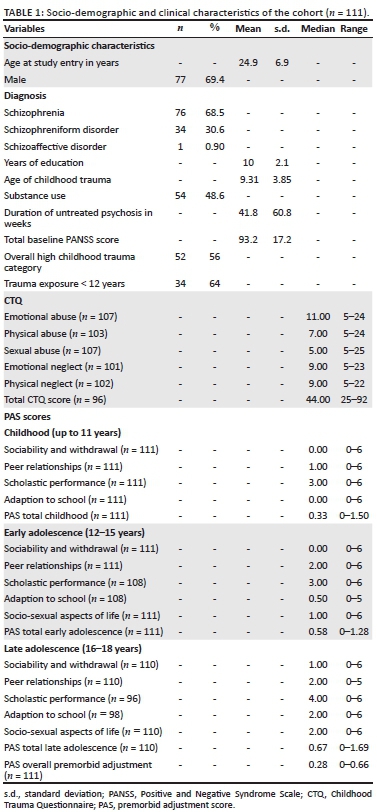
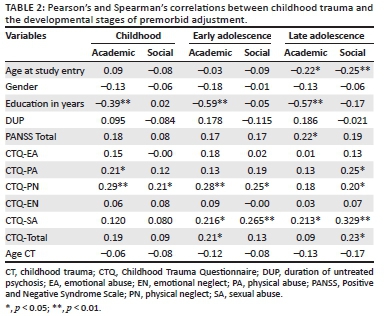
Table 1 provides details of the 111 patients. They were predominantly male, with a diagnosis of schizophrenia or schizophreniform disorder. High levels of all of the abuse subtypes were reported, with 52 (47%) falling into the overall high childhood trauma category and 34 (31%) reporting trauma exposure < 12 years. Table 2 summarises the correlations between childhood trauma exposure and the premorbid adjustment domains.
Analysis of variance (ANOVA) tests were used to assess the relationships between substance use and premorbid adjustment domains.
Academic functioning during both early adolescence (F = 4.15, p = 0.044) and late adolescence (F =7.60, p = 0.007) was poorer amongst substance users compared with their non-using counterparts. In the linear regression analyses, we found that the timing of childhood trauma did not significantly moderate the relationship between any stage of premorbid functioning and specific or overall childhood trauma.
Hierarchical regression to identify predictors of poorer premorbid adjustment
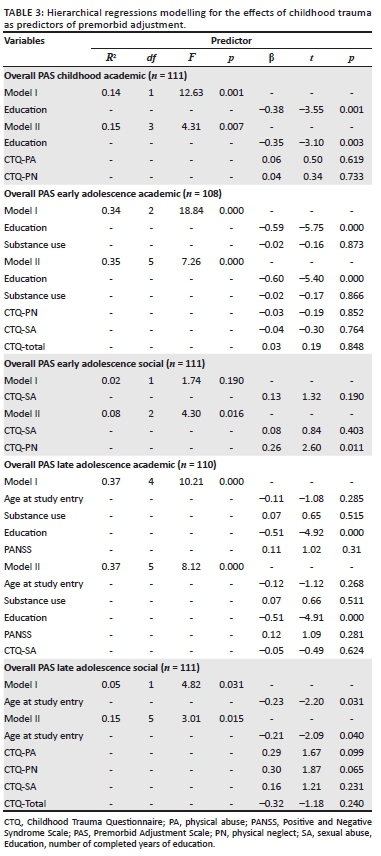
Informed by the statistically significant associations from Pearson's bivariate correlation analysis, Spearman's rank correlation analysis and ANOVA test, individual hierarchical linear regression analysis was performed for five of the six outcome measures (PAS childhood academic, PAS early adolescent academic and social, including PAS late adolescent academic and social) (Table 3).
To further investigate the significant associations pertaining to academic functioning in childhood, education was entered into model I. Thereafter, it was adjusted for the childhood trauma variables, physical abuse and neglect in model II. Education demonstrated a significant relationship with childhood academic functioning (r2p = 0.003). To study the next outcome variable, premorbid academic functioning in early adolescence, education and substance use were entered in model I. Thereafter, it was adjusted for the childhood trauma variables physical neglect and overall childhood trauma in model II. Years of education displayed a significant relationship with academic functioning in early adolescence (r2p = 0.000). To further study significant associations with social functioning in early adolescence, sexual abuse was entered into model I and adjusted for physical neglect in model II. Physical neglect (r2p = 0.011) had a significant relationship with premorbid social functioning in early adolescence. To study the variables of interest concerning academic functioning in late adolescence, age at study entry, substance use, years of education and PANNS baseline score were entered into model I, adjusting for the childhood trauma variable, sexual abuse in model II.
Education was the only variable with a significant relevance to academic functioning in late adolescence (r2p = 0.000). Lastly, to study the outcome variable social functioning in late adolescence, age at study entry was entered into model I, thereafter adjusting for the childhood trauma variables sexual abuse, physical abuse, physical neglect and overall childhood trauma were entered into model II. Age at study entry displayed a significant relationship with social functioning in late adolescence (r2p = 0.040).
Discussion
This study examined a cohort of 111 people with FES; physical neglect significantly and independently predicted poorer social premorbid adjustment during early adolescence. Several significant correlations between physical neglect and premorbid functioning across key development periods were also evident. The moderator variable 'less years of education' independently predicted poorer premorbid academic functioning during childhood, early adolescence and late adolescence. An earlier age at study entry independently predicted poorer premorbid social functioning in late adolescence. Overall, childhood trauma was not significantly associated with overall premorbid adjustment. In addition, we failed to demonstrate an association between the timing of early life exposure to trauma and premorbid adjustment.
The main finding was that physical neglect significantly and independently predicted poorer social premorbid adjustment during early adolescence. One possible explanation for this is that in a neurodevelopmental disorder such as schizophrenia, neglect in the physical care of the child during periods of cerebral maturation may result in subtle but significant effects on adult social functioning.4243
Furthermore, the beginning of neuro-endocrinological changes characteristic of early adolescence go hand in hand with increased sensitivity to stress. Additional stress related to physical neglect during this period may be implicated in abnormal behavioural development,4445454645
No association between the timing of early life exposure to trauma and premorbid adjustment was found in our study. Only one prior study to date has investigated the relationship between the timing of trauma exposure and premorbid adjustment in schizophrenia and found that global functional impairment was greater in those exposed to SPA before the age of 11 than those exposed to SPA at a later age.11
One possible reason for the negative finding in our study for an association between the timing of childhood trauma and premorbid functioning is that only a subset of the patients (n = 53) provided information on the timing of childhood trauma. A total of 34 patients (64%) reported trauma exposure < 12 years of age and 19 (36%) reported trauma ≥ 12 years of age. This sample may therefore be underpowered to examine the timing of childhood trauma, which could have led to a false-negative finding. Another possible reason for the negative finding is that poverty and neglect are inter-related47
We also identified significant correlations between clinical and demographic variables and premorbid functioning across key development periods. Consistent with the findings of Larsen et al.,232048
There are some limitations of this study. Inferences on causality cannot be made because of the cross-sectional design of the study. A larger representative sample would provide more power to study the effects of timing of trauma exposure on the relationship between premorbid functioning and childhood trauma and to detect smaller effects. The study did not control for resilience and family support, nor was a healthy control group included. The CTQ-SF is a retrospective instrument that potentially imposes a risk for recall bias and unreliability.
However, Fergusson et al.493714
The strengths of the study include the incorporation of specific effects of trauma subtypes on the various domains of premorbid adjustment during different developmental periods. This study contributes to the small body of research on the subject matter in FES, and also contributes to the timing of childhood trauma. The use of a hierarchical regression analysis allowed the researcher to control for multiple confounding factors. Lastly, the study emphasised the deleterious consequences of childhood trauma on mental health in a developing country.
Conclusion
In summary, our study suggests a significant link between physical neglect and premorbid social functioning in early adolescence, which is an important sensitive period of neurodevelopment. Future recommendations would be to conduct larger, representative, longitudinal studies to elucidate the mechanisms involved in the effect of childhood trauma on premorbid adjustment, including long-term outcomes. Inclusion of matched healthy controls when studying childhood trauma histories in relationship with premorbid social and academic functioning could inform on illness-specific effects on premorbid functioning.
Competing interests
The authors declare that they have no financial or personal relationships that may have inappropriately influenced them in writing this article.
Authors' contributions
A.M.S., S.M., R.A.E., H.K.L., L.S., S.S. and L.A. all contributed equally to this article.
Funding information
This study was funded by the New Partnership for Africa's Development (NEPAD) grant, through the Department of Science and Technology of South Africa, the Medical Research Council of South Africa 'SHARED ROOTS' Flagship Project Grant no. MRC-RFA-ISFP-01-2013/SHARED ROOTS' and an unrestricted grant from Lundbeck International.
Data availability
The data that support the findings of this study are available from the corresponding author, A.M.S., upon reasonable request.
Disclaimer
The views and opinions expressed in this article are those of the authors and do not necessarily reflect the official policy or position of any affiliated agency of the authors.
Acknowledgements
Prof. R.A. Emsley has received honoraria from AstraZeneca, Bristol-Myers Squibb, Janssen, Lilly, Lundbeck, Organon, Pfizer, Servier, Otsuka and Wyeth for participating in advisory boards and speaking at educational meetings. Prof. S. Seedat has received speaker's honoraria and travel sponsorship from Lundbeck, Servier, Cipla, Sanofi and Dr. Reddy's.
References
-
1. Paolucci EO, Genuis ML, Violato C. A meta-analysis of the published research on the effects of child sexual abuse. J Psychol. 2010;135(1):17-36. https://doi.org/10.1080/00223980109603677
» https://doi.org/10.1080/00223980109603677 -
2. Varese F, Smeets F, Drukker M, et al. Childhood adversities increase the risk of psychosis: A meta-analysis of patient-control, prospective-and cross-sectional cohort studies. Schizophr Bull. 2012;38(4):661-671. https://doi.org/10.1093/schbul/sbs050
» https://doi.org/10.1093/schbul/sbs050 -
3. Green JG, McLaughlin KA, Berglund PA, et al. Childhood adversities and adult psychiatric disorders in the national comorbidity survey replication I: Associations with first onset of DSM-IV disorders. Archiv Gen Psychiatry. 2010;67(2):113-123. https://doi.org/10.1001/archgenpsychiatry.2009.186
» https://doi.org/10.1001/archgenpsychiatry.2009.186 -
4. Kessler RC, McLaughlin KA, Green JG, et al. Childhood adversities and adult psychopathology in the WHO World Mental Health Surveys. Br J Psychiatry. 2010;197(5):378-385. https://doi.org/10.1192/bjp.bp.110.080499
» https://doi.org/10.1192/bjp.bp.110.080499 -
5. Kilian S, Burns JK, Seedat S, et al. Factors moderating the relationship between childhood trauma and premorbid adjustment in first-episode schizophrenia. PLoS One. 2017;12(1):1-14. https://doi.org/10.1371/journal.pone.0170178
» https://doi.org/10.1371/journal.pone.0170178 -
6. Conus P, Ward J, Lucas N, et al. Characterisation of the prodrome to a first episode of psychotic mania: Results of a retrospective study. J Affect Disord. 2010;124(3):341-345. https://doi.org/10.1016/j.jad.2009.12.021
» https://doi.org/10.1016/j.jad.2009.12.021 -
7. Tikka M, Luutonen S, Ilonen T, et al. Childhood trauma and premorbid adjustment among individuals at clinical high risk for psychosis and normal control subjects. Early Interv Psychiatry. 2012;7(1):51-57. https://doi.org/10.1111/j.1751-7893.2012.00391
» https://doi.org/10.1111/j.1751-7893.2012.00391 -
8. Stain HJ, Bronnick K, Hegelstad WTV, et al. Impact of interpersonal trauma on the social functioning of adults with first-episode psychosis. Schizophr Bull. 2014;40(6):1491-1498. https://doi.org/10.1093/schbul/sbt166
» https://doi.org/10.1093/schbul/sbt166 -
9. Trauelsen AM, Bendal S, Jansen JE, et al. Childhood adversities: Social support, premorbid functioning and social outcome in first episode psychosis and a matched case-control group. Aust N Z J Psychiatry. 2016;50(8):770-782. https://doi.org/10.1177/0004867415625814
» https://doi.org/10.1177/0004867415625814 -
10. Chan CC, Shanahan M, Ospina LH, Larsen EM, Burdick KE. Premorbid adjustment trajectories in schizophrenia and bipolar disorder: A trans-diagnostic cluster analysis. Psychiatry Res. 2018;272:655-662. https://doi.org/10.1016/j.psychres.2018.12.169
» https://doi.org/10.1016/j.psychres.2018.12.169 -
11. Alameda I, Ferrari C, Baumann PS, Gholam-Rezaee M, Do KQ, Conus P. Childhood sexual and physical abuse: Age at exposure modulates impact on functional outcome in early psychosis patients. Psychol Med. 2015;45(13):2727-2736. https://doi.org/10.1017/50033291715000690
» https://doi.org/10.1017/50033291715000690 -
12. Startup M, Jackson MC, Bendix S. The concurrent validity of the Global Assessment of Functioning (GAF). Br J Clin Psychol. 2002;41:417-422. https://doi.org/10.1348/014466502760387533
» https://doi.org/10.1348/014466502760387533 -
13. Berry L, Biersteker L, Dawes A, Lake L, Smith C. Getting the basics right: An essential package of services and support for ECD. S Afr Child Gauge [serial online]. 2013 [cited 2019 Nov];2:26-33. Available from: http://www.ci.uct.ac.za/ci/child-gauge/2013
» http://www.ci.uct.ac.za/ci/child-gauge/2013 -
14. Spies G, Kidd M, Seedat S. A factor analytic study of the Childhood Trauma Questionnaire Short Form in an all-female South African sample with and without HIV infection. Child Abuse Neglect. 2019;92:157-166. https://doi.org/10.1016/j.chiabu.2019.04.002
» https://doi.org/10.1016/j.chiabu.2019.04.002 -
15. Lochner C, Seedat S, Allgulander C, Kidd M, Stein D. Gerdner A. Childhood trauma in adults with social anxiety disorder and panic disorder: A cross-national study. Afr J Psychiatry. 2010;13(5):376-381. https://doi.org/10.4314/ajpsy.v13i5.63103
» https://doi.org/10.4314/ajpsy.v13i5.63103 -
16. Gerdner A, Allgulander C. Psychometric properties of the Swedish version of the Childhood Trauma Questionnaire - Short Form (CTQ-SF). Nord J Psychiatry. 2009;63(2):160-170. https://doi.org/10.1080/08039480802514366
» https://doi.org/10.1080/08039480802514366 -
17. Klinitzke G, Romppel M, Häuser W, Brähler E, Glaesmer H. The German version of the Childhood Trauma Questionnaire (CTQ) - Psychometric characteristics in a representative sample of the general population. Psychother Psychol Med. 2012;62(02):47-51. https://doi.org/10.1055/s-0031-1295495
» https://doi.org/10.1055/s-0031-1295495 -
18. Villano CL, Cleland C, Rosenblum A, et al. Psychometric utility of the Childhood Trauma Questionnaire with female street-based sex workers. J Trauma Dissociation. 2003;5(3):33-41. https://doi.org/10.1300/J229v05n03_03
» https://doi.org/10.1300/J229v05n03_03 -
19. Kim D, Park SC, Yang H, Oh DH. Reliability and validity of the Korean version of the Childhood Trauma Questionnaire-short form for psychiatric outpatients. Psychiatry Investig. 2011;8(4):305-311. https://doi.org/10.4306/pi.2011.8.4.305
» https://doi.org/10.4306/pi.2011.8.4.305 -
20. Robertson H. A right hemisphere role in cognitive reserve. Neurobiol Aging. 2014;35(6):1375-1385. https://doi.org/10.1016/j.neurobiolaging.2013.11.028
» https://doi.org/10.1016/j.neurobiolaging.2013.11.028 -
21. Swanson CL, Gur RC, Bilker W, Petty RG, Gur RE. Premorbid educational attainment in schizophrenia: Association with symptoms, functioning, and neurobehavioral measures. Biol Psychiatry. 1998;44(8):739-747. https://doi.org/10.1016/S0006-3223(98)00046-8
» https://doi.org/10.1016/S0006-3223(98)00046-8 -
22. Barnes TRE, Leeson VC, Mutsatsa SH, Watt HC, Hutton SB, Joyce EM. Duration of untreated psychosis and social function: 1 year follow-up study of first-episode schizophrenia. Br J Psychiatry. 2008;193(3):203-209. https://doi.org/10.1192/bjp.bp.108.049718
» https://doi.org/10.1192/bjp.bp.108.049718 -
23. Larsen TK, Friis S, Haahr U, et al. Premorbid adjustment in first-episode non-affective psychosis: Distinct patterns of pre-onset course. Br J Psychiatry. 2004;185(2):108-115. https://doi.org/10.1192/bjp.185.2.108
» https://doi.org/10.1192/bjp.185.2.108 -
24. Saracco-Alvarez R, Rodríguez-Verdugo S, García-Anaya M, Fresán A. Premorbid adjustment in schizophrenia and schizoaffective disorder. Psychiatry Res. 2009;165(3):234-240. https://doi.org/10.1016/j.psychres.2007.11.004
» https://doi.org/10.1016/j.psychres.2007.11.004 -
25. Salyers MP, Mueser KT. Social functioning, psychopathology, and medication side effects in relation to substance use and abuse in schizophrenia. Schizophr Res. 2001;48(1):109-123. https://doi.org/10.1016/S0920-9964(00)00063-3
» https://doi.org/10.1016/S0920-9964(00)00063-3 -
26. Chiliza B, Asmal L, Oosthuizen P, et al. Changes in body mass and metabolic profiles in patients with first-episode schizophrenia treated for 12 months with a first-generation antipsychotic. Eur Psychiatry. 2015;30(2):277-283. https://doi.org/10.1016/j.eurpsy.2014.11.013
» https://doi.org/10.1016/j.eurpsy.2014.11.013 -
27. Drogemoller B, Emsley R, Chiliza B, et al. The identification of novel genetic variants associated with antipsychotic treatment response outcomes in first-episode schizophrenia patients. Pharmacogenet Genomics. 2016;26(5):235-242. https://doi.org/10.1097/FPC.0000000000000213
» https://doi.org/10.1097/FPC.0000000000000213 -
28. Emsley R, Chiliza B, Asmal L, et al. Neurological soft signs in first-episode schizophrenia: State- and trait-related relationships to psychopathology, cognition and antipsychotic medication effects. Schizophr Res. 2017;188:144-150. https://doi.org/10.1016/j.schres.2017.01.034
» https://doi.org/10.1016/j.schres.2017.01.034 -
29. Malan-Mueller S, Kilian S, Van den Heuvel LL, et al. A systematic review of genetic variants associated with metabolic syndrome in patients with schizophrenia. Schizophr Res. 2016;170(1):1-17. https://doi.org/10.1016/j.schres.2015.11.011
» https://doi.org/10.1016/j.schres.2015.11.011 -
30. Scheffler F, Kilian S, Chiliza B, et al. Effects of cannabis use on body mass, fasting glucose and lipids during the first 12 months of treatment in schizophrenia spectrum disorders. Schizophr Res. 2018;199:90-95. https://doi.org/10.1016/j.schres.2018.02.050
» https://doi.org/10.1016/j.schres.2018.02.050 -
31. Luckhoff H, Phahladira L, Scheffler F, et al. Weight gain and metabolic change as predictors of symptom improvement in first-episode schizophrenia spectrum disorder patients treated over 12 months. Schizophr Res. 2019;206:171-176. https://doi.org/10.1016/j.schres.2018.11.031
» https://doi.org/10.1016/j.schres.2018.11.031 - 32. First MB, Spitzer RL, Gibbon M, Williams JBW. Structured Clinical Interview for DSM-IV-TR Axis I Disorders, Research Version, Non-patient Edition (SCID-I/NP). New York, NY: New York State Psychiatric Institute, Biometrics Research; 2002.
- 33. Bernstein D, Fink LA. CTQ: Childhood Trauma Questionnaire: A retrospective self-report. San Antonio, TX: Psychological Corporation; 1998.
-
34. Alemany S, Arias B, Aguilera M, et al. Childhood abuse, the BNDF-Val66Met polymorphism and adult psychotic-like experiences. Br J Psychiatry. 2011;199(1):38-42. https://doi.org/10.1192/bjp.bp.110.083808
» https://doi.org/10.1192/bjp.bp.110.083808 -
35. Bernstein DP, Stein JA, Newcomb MD, et al. Development and validation of a brief screening version of the Childhood Trauma Questionnaire. Child Abuse Neglect. 2003;27(2):169-190. https://doi.org/10.1016/S0145-2134(02)00541-0
» https://doi.org/10.1016/S0145-2134(02)00541-0 -
36. Bernstein DP, Fink L, Handelsman L, et al. Initial reliability and validity of a new retrospective measure of child abuse and neglect. Am J Psychiatry. 1994;151(8):1132-1136. https://doi.org/10.1176/ajp.151.8.1132
» https://doi.org/10.1176/ajp.151.8.1132 -
37. Church C, Andreassen OA, Lorentzen S, Melle I, Aas M. Childhood trauma and minimization/denial in people with and without a severe mental disorder. Front Psychol. 2017;8:1276. https://doi.org/10.3389/fpsyg.2017.01276
» https://doi.org/10.3389/fpsyg.2017.01276 -
38. Gray MJ, Litz BT, Hsu JL, Lombardo TW. Psychometric properties of the life events checklist. Assessment. 2004;11:330-341. https://doi:10.1177/1073191104269954
» https://doi:10.1177/1073191104269954 -
39. Cannon-Spoor HE, Potkin SG, Wyatt RJ. Measurement of premorbid adjustment in chronic schizophrenia. Schizophr Bull. 1982;8(3):470-484. https://doi.org/10.1093/schbul/8.3.470
» https://doi.org/10.1093/schbul/8.3.470 -
40. Norman RMG, Malla AK, Manchanda R, Townsend L. Premorbid adjustment in first-episode schizophrenia and schizoaffective disorders: A comparison of social and academic domains. Acta Psychiatr Scand. 2005;112(1):30-39. https://doi.org/10.1111/j.1600-0447.2005.00555.x
» https://doi.org/10.1111/j.1600-0447.2005.00555.x -
41. Allen DN, Strauss GP, Barchard KA, Vertinski M, Carpenter WT, Buchanan R. Differences in the development changes in academic and social premorbid adjustment between males and females with schizophrenia. Schizophr Res. 2013;146(1-3):132-137. https://doi.org/10.1016/j.schres.2013.01.032
» https://doi.org/10.1016/j.schres.2013.01.032 -
42. Gil A, Dama CS, Jesus DR, Lobato MI, Zimmer M, Belmonte-de-Abreu P. The association of child abuse and neglect with adult disability in schizophrenia and the prominent role of physical neglect. Child Abuse Neglect. 2009;33(9):618-624. https://doi.org/10.1016/j.chiabu.2009.02.006
» https://doi.org/10.1016/j.chiabu.2009.02.006 -
43. Bornstein MH, Hahn CS, Haynes OM. Social competence, externalizing, and internalizing behavioral adjustment from early childhood through early adolescence: Developmental cascades. Dev Psychopathol. 2010;22(4):717-735. https://doi.org/10.1017/S0954579410000416
» https://doi.org/10.1017/S0954579410000416 -
44. Romeo RD. The teenage brain: The stress response and the adolescent brain. Curr Dir Psychol Sci. 2013;22(2):140-145. https://doi.org/10.1177/0963721413475445
» https://doi.org/10.1177/0963721413475445 -
45. Hildyard KL, Wolfe DA. Child neglect: Developmental issues and outcomes. Child Abuse Neglect. 2002;26(6-7):679-695. https://doi.org/10.1016/S0145-2134(02)00341-1
» https://doi.org/10.1016/S0145-2134(02)00341-1 -
46. Manly JT, Kim JE, Rogosch FA, Cicchetti D. Dimensions of child maltreatment and children's adjustment: Contributions of developmental timing and subtype. Dev Psychopathol. 2001;13(4):759-782. https://doi.org/10.1017/S0954579401004023
» https://doi.org/10.1017/S0954579401004023 -
47. Carter V, Myers MR. Exploring the risks of substantiated physical neglect related to poverty and parental characteristics: A national sample. Child Youth Serv Rev. 2007;29(1):110-121. https://doi.org/10.1016/j.childyouth.2006.08.002
» https://doi.org/10.1016/j.childyouth.2006.08.002 -
48. McCellan J, Breiger D, McCurry C, Hlastala SA. Premorbid functioning in early-onset psychotic disorders. J Am Acad Child Adolesc Psychiatry. 2003;42(6):666-672. https://doi.org/10.1097/01.CHI.0000046844.56865.6B
» https://doi.org/10.1097/01.CHI.0000046844.56865.6B -
49. Ferguson DM, Horwood LJ, Borden JM. Structural equation modelling of repeated retrospective reports of child maltreatment. Int J Methods Psychiatr Res. 2011;20(2):93-104. https://doi.org/10.1002/mpr.337
» https://doi.org/10.1002/mpr.337

Accepted: 16 Apr. 2021
Published: 22 June 2021
Research Project Registration:
Project Number: Parent study EONKCS: 4258, Parent study Shared Roots: 2334, Secondary study: 9783.