Coping Styles and Sources of Stress of Undergraduate Health Science Students: An Integrative Review
Abstract
METHOD: Background and aim: Tertiary education provides many personal and social benefits. However, students, particularly those from professional and health science disciplines are known to face significantly greater stress throughout their undergraduate degrees. In this integrative review sources of stress for students and the strategies they use to cope with the stress are explored. : Various databases were searched using common key phrases such as "stressors among undergraduate health science students" and "coping mechanisms utilised by undergraduate health science students". Thirty-three articles were selected based on predetermined inclusion and exclusion criteria. The content in the articles were analysed to identify themesRESULTS: Academic stress was the primary source of stress for health science students. Other sources of stress included interpersonal interactions and clinical training. Students primarily used problem-focused strategies to cope with stress. Other strategies included avoidance and the use of social support networksCONCLUSION: Health science students experience stress from academic tasks, interpersonal stress and stresses emanating from clinical training. They utilize problem-focused coping strategies, as well as avoidance and seeking social support when faced with stressful situations. Students would benefit from regular screening for stress-related conditions, and interventions to teach them more adaptive ways to deal with stress
stressors; coping strategies; health science students; workload; student support
INTRODUCTION
Higher education is essential for both personal success and economic growth. Tertiary education provides social benefits such as the acquisition of advanced knowledge, increased employability and financial stability1
Fears concerning the future, leaving behind friends and family, and having a poor work-life balance all take a toll on the mental health of university students23245
This article is based on a review that was conducted by UKZN undergraduate students for the fulfilment of a bachelor's degree in Occupational Therapy. This review was underpinned by the following questions:
1. What are the sources of stress among undergraduate health science students?
2. What strategies do students use to cope with stress?
METHOD
An integrative review of the literature was conducted to understand the sources of stress, as well as the coping mechanisms utilised by undergraduate health science students. This method allowed for the inclusion of different types of studies for a holistic understanding of the research phenomenon6
Inclusion criteria:
• Articles published between 2000-2020
• Articles on undergraduate health science students.
• All articles were published in English and had to be full text.
Exclusion criteria:
• Articles involving medical students were excluded from the review as they are exposed to different stressors, and the demands and duration of their degree was different to that of other health science disciplines.
• Articles on postgraduate health science students were excluded as they may be exposed to different stressors, and cope differently.
Review process
The review process was done in phases. The following health databases were searched: Microsoft academic, Refseek, Catalogue search, SagePub, SciELO, Semantic Scholar, Science Direct, Google Scholar, Pubmed, Ebscohost and Medline were used. Pubmed and Medline were searched separately. The following descriptors and Boolean phrases were used as key phrases:
• undergraduate health science students,
• undergraduate occupational therapy students,
• coping mechanisms utilised by undergraduate health science students, OR undergraduate occupational therapy students,
• stressors among undergraduate health science students, OR undergraduate occupational therapy students
• AND sources of stress in undergraduate health science students OR undergraduate occupational therapy students.
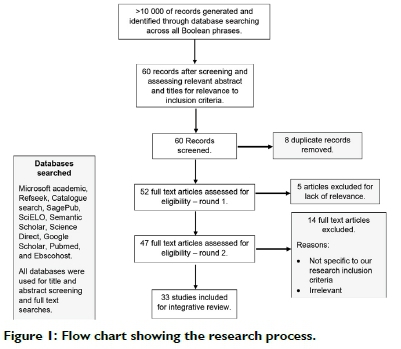
The initial searches yielded 60 studies, and the title and abstracts were read in July 2020. The final sample consisted of 33 articles that met the inclusion criteria. The information to be extracted from the studies were defined and categorized, and the full-text articles were read. Data analysis entailed creating a table and extracting the information from all articles into sources of stress and coping strategies. Information was further broken down into themes such as academic, personal, environmental factors and other stressors, as well as adaptive and maladaptive coping strategies. Once all the information was extracted, the themes were constituted, reviewed, and refined, and a flow chart created. The review process is illustrated in Figure 1 (below).
RESULTS
Twenty five of the 33 studies were quantitative, six were qualitative, and two were systemic reviews. The studies were conducted in various countries including South Africa, Nigeria, Saudi Arabia, the United Kingdom, the United States of America, and Australia. The studies were focused on the perspectives of occupational therapy, physiotherapy, dental therapy, speech pathology, pharmacy, and nursing students. The articles included in this review are presented in Table I (p31), which are organized according to the numerical order of references.
The findings are presented according to the sources of stress and coping strategies utilized by students.
Sources of stress
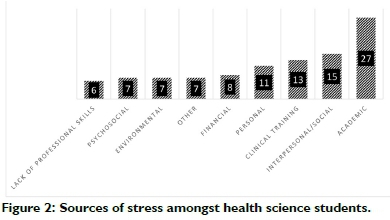
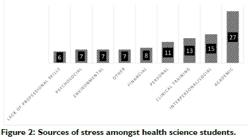
Three major sources of stress were identified, which included academic activities, interpersonal/social interactions, and clinical training. Several studies identified academic demands as the most significant source of stress for health science students7-9. Students described examinations and a high workload as the major factors contributing to academic stress10-12. Interpersonal or social stressors with family and peers were cited in 15 studies7,11,13-25. In another study conducted in Saudi Arabia, nursing students identified relationships with hospital staff to be a source of stress26
Stress from clinical training was emphasised by 13 out of the 33 studies7,13,17,18,20,25-32. Poorly staffed clinical departments, fast-paced wards and initial clinical placements were all factors contributing towards the stress of students2813,17,20. Other stressors that were reported less frequently included personal issues, financial concerns, environmental factors, psychosocial issues, and lack of students' professional skills. Personal stressors consisted primarily of students being stressed about their personal health-related conditions and illnesses7
Financial issues were cited in a study by Gibbons, Dempster and Moutray28133910
Lack of professional knowledge was reported as a source of stress in six out of the 33 studies13,17,20,23,25,27. Students felt that they lacked the necessary skills, and that clinical training was not always sufficient407Figure 2.
Strategies used by students to cope with stress
Students used a variety of strategies to help them cope with stress. Problem-focused coping was identified as one of the most used coping strategies14,20,25. Avoidance was another commonly used strategy, which involved students waiting for others to solve their problems, or avoiding teachers, but this approach led to difficulties in clinical training33
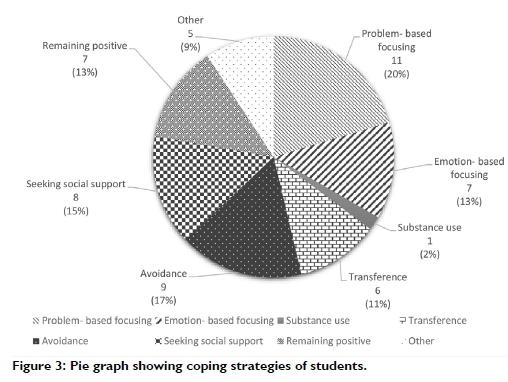
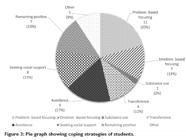
Students used social support networks as a strategy for coping, as indicated in eight of the 33 studies14,16,18,21,24,29,33,39. The frequency with which various coping strategies were used by students in the reviewed studies can be seen in Figure 3.
DISCUSSION
Health science students experience significantly higher levels of stress as compared to students in other disciplines417-9 and appeared to increase over the four-year occupational therapy course, with final year students perceiving it to be the greatest source of stress1210-12, which was attributed to students' poor time management344242
Clinical training was also identified as a source of stress2877et al.3421
Gomathi et al.3439437,13. Students with chronic illnesses, or those who had surgeries found it difficult to manage these additional stressors7444545
Environmental factors such as noisy environments and the climate within the university and clinical settings were also stress inducing. Servilha and Delatti46284723
Coping strategies of health science students
Students used a variety of coping strategies, including problem focused coping and emotion focused coping. It was found that students with high levels of resilience and optimism tended to respond to stress with adaptive coping strategies, such as task-oriented and active coping, whilst those with high levels of pessimism were likely to use maladaptive strategies, such as disengagement, denial, and venting of emotions. Some of the adaptive strategies included remaining positive and using social support. Other negative coping strategies included avoidance, transference, and substance use to cope with stress.
As can be seen in Figure 3, health science students were more likely to utilize problem-focused coping (20%)14,17,20,24-27,34,35,36,41, in contrast to emotional-focused coping (13%)14,16,24,34,35,37,39. Problem focused coping involves taking control of the stressor by either seeking information or assistance in handling the situation, whereas emotional focused coping included avoidance(l7%)17,24,25,27,29,33,34,35,36 and seeking social support14,16,18,21,24,29,33,35 (15%). Govender et al14 134814
Adaptive coping strategies
Remaining positive was cited in 11 out of the 33 studies included in this integrative review14,17,20,24-27,34,35,36,39. Students were found to adopt a positive attitude and mind-set in response to stressful events, confirming the use of hopefulness and optimism as a coping style3626384817
Emotion-focused coping was cited in seven out of the 33 articles14,16,24,34,35,37,39, where the individual tried to minimise the stressor, and they felt better, but the problem remained unsolved. Other strategies used by students included remaining positive, transference, and other non-specific methods, such as remaining positive or optimistic,17,27 and substance use.
Maladaptive coping strategies
Students who engaged in avoidance behaviours often participated in activities such as procrastination, substance use and playing video games. These students were unlikely to identify the positive aspects of a situation2421
LIMITATIONSThe limitation in this study was that the researchers were undergraduate students and novice researchers. This could have affected the analysis and information extracted during the integrative review. However, having the project supervised by a more experienced researcher mitigated this limitation.
RECOMMENDATIONSBased on the researchers' analysis, the following recommendations are made:
• Health science and other professional degrees are associated with an increased academic workload, due to the clinical training component. Therefore, there is a need for health science disciplines to review their course structures, and the number and timing of assessments, to reduce the stress on students.
• Interventions to support students should be emphasised for first year orientation programmes. Thereafter student support services could send out electronic stress questionnaires to students, which could be conducted biannually, at the beginning and end of the academic year, allowing support services to screen for any students who may be struggling, and ensure timely support, nuanced to the students' needs3949
Some believe that academic support should be compulsory for health science students, who are often reluctant to attend sessions voluntarily50
• Workshops aimed at addressing budgeting skills would be useful in assisting students to better manage their finances and reduce financial stress.
• The clinical supervisor-student bond may be strengthened during annual workshops for supervisors to ensure students are well supported during their fieldwork blocks. King, Edlington and Williams51
CONCLUSION
The purpose of this integrative review was to determine the sources of stress for health science students in undergraduate programmes, and strategies that they used to cope with stress as reported in international published peer reviewed articles. The sources of stress included academic demands, social and personal factors, financial worries, and stress as a result of clinical training. Other stress-inducing factors included environmental influences, psychosocial factors, and feelings of inadequacy in relation to professional knowledge. Most students reported the use of problem-focused coping in response to increased stress, while others used maladaptive coping styles, such as substance use and other avoidant behaviours. The multitude of stressors and maladaptive coping necessitates the need for support to be timeously accessed by students. The implementation of online semester check-ins would be beneficial in allowing support services to identify students requiring additional support. Students' mental health are predictors for how well they will cope in tertiary education, and specifically with the demands of the health science programmes. It is imperative they access timely support, nuanced to their academic and personal needs.
AUTHOR CONTRIBUTIONSOdell Chetty and Robyn Henderson conducted the initial article search, information extraction, data analysis, writing, editing and submission of the article. Thavanesi Gurayah conceptualised and supervised the project and edited the final manuscript.
Acknowledgements
The authors wish to acknowledge the other members of their research team Lerato Xulu, Nelly Zulu, Zama Mzobe and Nqobile Mhlope who assisted in conducting the review.
REFERENCES
-
1. Chan R. Understanding the purpose of higher education: An analysis of the economic and social benefits for completing a college degree. Journal of Education Policy, Planning and Administration, 2016; 6(5): 1-40. https://www.researchgate.net/publication/305228497_Understanding_the_purpose_of_higher_education_An_analy-sis_of_the_economic_and_social_benefits_for_completing_a_college_degree
» https://www.researchgate.net/publication/305228497_Understanding_the_purpose_of_higher_education_An_analy-sis_of_the_economic_and_social_benefits_for_completing_a_college_degree - 2. Grabowski C, Rush M, Ragen K, Fayard V Watkins-Lewis K. Today's Non-Traditional Student: Challenges to Academic Success and Degree Completion. Inquiries Journal/Student Pulse, 2016; 8(03).
-
3. Makoni M. Mental health a worry for student affairs worldwide. Journal of Student Affairs in Africa, 2016; 4(2): 65-66. https://doi:10.14426/jsaa.v4i2.1524; http://www.inquiriesjournal.com/a?id=1377
» https://doi:10.14426/jsaa.v4i2.1524; http://www.inquiriesjournal.com/a?id=1377 -
4. Dhunpath R Vithal R. Alternative access to higher education. Cape Town: Pearson. 2014. https://doi:10.1163/22125868-12340091
» https://doi:10.1163/22125868-12340091 -
5. Tewari DD, Ilesanmi KD, Serpa S. Teaching and learning interaction in South Africa's higher education: Some weak links. Cogent Social Sciences, 2020; 6:1. https://doi:10.1080/23311886.2020.1740519
» https://doi:10.1080/23311886.2020.1740519 -
6. Samaan, Z., Mbuagbaw, L., Kosa, D., Borg Debono, V, Dillenburg, R., Zhang, S., Fruci, V, Dennis, B., Bawor, M., & Thabane, L. (2013). A systematic scoping review of adherence to reporting guidelines in health care literature. Journal of multidisciplinary healthcare, 6, 169-188. https://doi.org/10.2147/JMDH.S43952
» https://doi.org/10.2147/JMDH.S43952 -
7. Garber M, Huston S, Breese C. Sources of stress in a pharmacy student population. Currents in Pharmacy Teaching and Learning, 2019; 11(4): 329-337. https://doi:10.1016/j.cptl.2019.01.014
» https://doi:10.1016/j.cptl.2019.01.014 -
8. Jacobs T, Gummesson C, Nordmark E, Ansary D, Remedios L, Webb G. Perceived stress and sources of stress among physiotherapy students from 3 countries. Journal of Physical Therapy Education, 2012; 26(3): 57-65. https://doi:10.1097/00001416-201207000-00008
» https://doi:10.1097/00001416-201207000-00008 -
9. Walsh J, Feeney C, Hussey J, Donnellan C. Sources of stress and psychological morbidity among undergraduate physiotherapy students. Physiotherapy, 2010; 96(3): 206-212. https://doi:10.1016/j.physio.2010.01.005
» https://doi:10.1016/j.physio.2010.01.005 -
10. Amanya SB, Nakitende J, Ngabirano TD. A cross-sectional study of stress and its sources among health professional students at Makerere University, Uganda. Nursing open, 2017; 5(1): 70-76. https://doi.org/10.1002/nop2.113
» https://doi.org/10.1002/nop2.113 -
11. Othman C, Farooqui M, Yusoff M, Adawiyah R. Nature of Stress among Health Science Students in a Malaysian University. Procedia - Social and Behavioral Sciences, 2013; 105: 249-257. https://doi:10.1016/j.sbspro.2013.11.026
» https://doi:10.1016/j.sbspro.2013.11.026 -
12. Radeef AS, Faisal GG, Ali SM, Ismail MK. Source of stressors and emotional disturbances among undergraduate science students in Malaysia. International Journal of Medical Research & Health Sciences, 2014; 3(2). https://doi:10.5958/j.2319-5886.3.2.082
» https://doi:10.5958/j.2319-5886.3.2.082 -
13. Muhammad D, Ahmad A, Usman J. Assessment of Level and Sources of Stress among Allied Health Sciences Students of Bayero University Kano: A Comparison between Clinical and Pre-Clinical Students. Education in Medicine Journal, 2019; 11-19. https://doi:10.21315/eimj2019.11.1.2
» https://doi:10.21315/eimj2019.11.1.2 -
14. Govender P Mkhabela S, Hlongwane M, Jalim K, Jetha CG. OT student's experience of stress and coping. South African Journal of Occupational Therapy, 2015; 45: 34-39. http://dx.doi.org/10.17159/2310-3833/2015/v45n3/a7
» http://dx.doi.org/10.17159/2310-3833/2015/v45n3/a7 -
15. De Witt PA, Monareng L, Abraham AAH, Koor S, Saber R. Resilience in occupational therapy students. South African Journal of Occupational Therapy, 2019; 49(2): 33-41. https://dx.doi.org/10.17159/23103833/2019/vol49n2a6
» https://dx.doi.org/10.17159/23103833/2019/vol49n2a6 -
16. Delany C, Miller KJ, El-Ansary D, Remedios L, Hosseini A, McLeod S. Replacing stressful challenges with positive coping strategies: a resilience program for clinical placement learning. Advances in health sciences education: theory and practice, 2015; 20(5): 1303-1324. https://doi.org/10.1007/s10459-015-9603-3
» https://doi.org/10.1007/s10459-015-9603-3 -
17. Gurková E, Zeleníková R. Nursing students' perceived stress, coping strategies, health and supervisory approaches in clinical practice: A Slovak and Czech perspective. Nursing Education Today, 2018; 65: 4-10. https://doi.org/l0.l0l6/j.nedt.2018.02.023
» https://doi.org/l0.l0l6/j.nedt.2018.02.023 - 18. Yamashita K, Saito M, Takao T. Stress and coping styles in Japanese nursing students. International Journal of Nursing Practice. 2012;18(5):489-496.
-
19. Kumar S, Jejurka K. Study of stress level in occupational therapy students during their academic curriculum. The Indian Journal of Occupational Therapy, 2005; 37(1): 5-14. http://dx.doi.org/10.17159/2310-3833/2015/v45n3/a7
» http://dx.doi.org/10.17159/2310-3833/2015/v45n3/a7 -
20. Leodoro J. A literature review on stress and coping strategies in nursing students. Journal of Mental Health, 2017; 25(4). https://doi:10.1080/09638237.2016.1244721
» https://doi:10.1080/09638237.2016.1244721 -
21. McCombie RP, Evans A, Miller MJ. Alcohol Use by Occupational Therapy Students: An Exploratory Study. Occupational Therapy in Mental Health, 2016; 32(1): 1-15, https://doi:10.1080/0164212X.2015.1079514
» https://doi:10.1080/0164212X.2015.1079514 -
22. Nerdrum P Rustoen T. Psychological distress among nursing, physiotherapy and occupational therapy students: A longitudinal and predictive study. Scandinavian Journal of Educational Research, 2009; 53(4): 363-378. https://doi.org/10.1080/00313830903043133
» https://doi.org/10.1080/00313830903043133 -
23. Seham M. Psychosocial stress factors among mental health nursing students in KSA. Journal of Taibah University Medical Sciences, 2019; 14(1): 60-66. https://doi:10.1016/j.jtumed.2018.11.006
» https://doi:10.1016/j.jtumed.2018.11.006 -
24. Seyedfatemi N, Tafreshi M, Hagani H. Experienced stressors and coping strategies among Iranian nursing students. BMC Nursing, 2007; 6(1). https://doi:10.1186/1472-6955-6-11
» https://doi:10.1186/1472-6955-6-11 -
25. Labrague LJ, McEnroe-Petitte DM, Papathanasiou IV Edet OB, Tsaras K, Leocadio MC, Colet P, Kleisiaris CF, Fradelos EC, Rosales RA, Vera Santos-Lucas K, Velacaria P. Stress and coping strategies among nursing students: an international study. Journal of Mental Health, 2018; 27(5): 402-408. https://doi.org/10.1080/09638237.2017.1417552
» https://doi.org/10.1080/09638237.2017.1417552 -
26. Labrague LJ, McEnroe-Petitte DM, De Los Santos J, Edet OB. Examining stress perceptions and coping strategies among Saudi nursing students: A systematic review. Nurse Education Today, 2018; 65: 192-200. https://doi.org/10.1016/j.nedt.2018.03.012
» https://doi.org/10.1016/j.nedt.2018.03.012 -
27. Chan C, So W, Fong D. Hong Kong baccalaureate nursing students' stress and their coping strategies in clinical practice. Journal of Professional Nursing, 2009; 25(5): 307-313. https://doi:10.1016/j.profnurs.2009.01.018
» https://doi:10.1016/j.profnurs.2009.01.018 -
28. Gibbons C, Dempster M, Moutray M. Stress and eustress in nursing students. Journal of Advanced Nursing, 2008; 61(3): 282-290. https://doi:10.1111/j.1365-2648.2007.04497.x
» https://doi:10.1111/j.1365-2648.2007.04497.x -
29. Gibbons C, Dempster M, Moutray M. Stress, coping and satisfaction in nursing students. Journal of Advanced Nursing, 2011; 67(3): 621-632. https://doi.org/10.1111/j.1365-2648.2010.05495.x
» https://doi.org/10.1111/j.1365-2648.2010.05495.x -
30. Gordon N, Rayner C, Wilson V Crombie K, Shaikh A, Yasin-Harnekar S. Perceived stressors of oral hygiene students in the dental environment. African Journal of Health Professions Education, 2016; 8(1): 20-24. https://doi:10.7196/AJHPE.2016.v8i1.422
» https://doi:10.7196/AJHPE.2016.v8i1.422 -
31. Harris M, Wilson J, Holmes S, Radford D. Perceived stress and well-being among dental hygiene and dental therapy students. British Dental Journal, 2017; 222(2): 101-106. https://doi:10.1038/sj.bdj.2017.76
» https://doi:10.1038/sj.bdj.2017.76 -
32. Zupiria Gorostidi X, Huitzi Egilegor X, Jose Alberdi Erice M, Jose Uranga Iturriotz M, Eizmendi Garate I, Barandiaran Lasa M, Sanz Cascante X. Stress sources in nursing practice. Evolution during nursing training. Nurse Education Today, 2007; 27(7): 777-787. https://doi:10.1016/j.nedt.2006.10.017
» https://doi:10.1016/j.nedt.2006.10.017 -
33. Lincoln M, Adamson B. Perceptions of stress, time management and coping strategies of speech pathology students on clinical placement. Advances in speech language pathology. 2004; 6(2): 91-99. https://doi.org/10.1080/14417040410001708512
» https://doi.org/10.1080/14417040410001708512 -
34. Gomathi K, Ahmed S, Sreedharan J. Causes of Stress and Coping Strategies Adopted by Undergraduate Health Professions Students in a University in the United Arab Emirates. Sultan Qaboos University Medical Journal, 2013; 13(3): 430-434. https://doi:10.12816/0003267
» https://doi:10.12816/0003267 -
35. Mirsaleh Y Rezai H, Kivi S, Ghorbani R. The role of religiosity, coping strategies, self-efficacy, and personality dimensions in the prediction of Iranian undergraduate rehabilitation interns' satisfaction with their clinical experience. Clinical Rehabilitation, 2010; 24(12): 1136-1143. https://doi:10.1177/0269215510375907
» https://doi:10.1177/0269215510375907 -
36. Waled AM, Badria MA. Nursing students' stress and coping strategies during clinical training in KSA. Journal of Taibah University Medical Sciences, 2019; 14(2): 116-122. https://doi.org/10.1016/j.jtumed.2019.02.002
» https://doi.org/10.1016/j.jtumed.2019.02.002 -
37. Vera Dahlqvist AS, Astrid N. Dealing with stress: Patterns of self-comfort among healthcare students. Nurse Education Today, 2018; 28(4): 476-84. https://doi:10.1016/j.nedt.2007.07.010.
» https://doi:10.1016/j.nedt.2007.07.010 -
38. Bedaso A, Duko B, Yeneabat T. Predictors of mental distress among undergraduate health science students of Hawassa University, College of Medicine and Health Sciences, Hawassa, SNNPR, Ethiopia: a cross-sectional study. Annals of general psychiatry, 2020; 19: 6. https://doi.org/10.1186/s12991-020-0258-y
» https://doi.org/10.1186/s12991-020-0258-y -
39. Van Vuuren E, Bodenstein K, Nel M. Stressors and coping strategies among physiotherapy students: Towards an integrated support structure. Health SA = SA Gesondheid, 2018; 23: 8-1091. https://doi.org/10.4102/hsag.v23i0.1091
» https://doi.org/10.4102/hsag.v23i0.1091 -
40. Arzu Y, Emel B. The effect of mentoring program on adjustment to university and ways of coping with stress in nursing students: Aquasi-experimental study. Nurse Education Today, 20l9; 80: 52-58. https://doi.org/10.1016/j.nedt.2019.06.006
» https://doi.org/10.1016/j.nedt.2019.06.006 -
41. Alkatheri A, Bustami R, Albekairy A, Alanizi A, Alnafesah R, Almodaimegh H. Quality of Life and Stress Level among Health Professions Students. Health Professions Education, 2020; 6(2): 201-210. https://doi.org/10.1016/j.hpe.2019.11.004
» https://doi.org/10.1016/j.hpe.2019.11.004 - 42. Mohamadkhani Ghiasvand A, Naderi M, Zagheri Tafreshi M, Ahmadi F Hosseini M. Relationship between time management skills and anxiety and academic motivation of nursing students in Tehran. Electronic physician, 2017; 9(1): 3678-3684.
-
43. Peters L, Cant R, Payne S, O'Connor M, McDermott F, Hood K. How Death Anxiety Impacts Nurses' Caring for Patients at the End of Life: A Review of Literature. The Open Nursing Journal, 2013; 7: 14-21. https://doi:10.2174/1874434601307010014
» https://doi:10.2174/1874434601307010014 - 44. Lipson S, Sonneville K. Eating disorder symptoms among undergraduate and graduate students at 12 U.S. colleges and universities. Eating Behaviors, 2017; 24: 81-88.
-
45. Dominguez-Whitehead Y Food and housing challenges: (Re) framing exclusion in higher education. 2017. http://www.scielo.org.za/scielo.php?script=sci_arttext&pid=S2520-98682017000100009
» http://www.scielo.org.za/scielo.php?script=sci_arttext&pid=S2520-98682017000100009 -
46. Servilha E, Delatti M. College students' perception of classroom noise and its consequences on learning quality. Audiology - Communication Research, 2014; 19(2): 138-144. https://doi:10.1590/s2317-64312014000200007
» https://doi:10.1590/s2317-64312014000200007 -
47. Joo S, Durband D, Grable J. The Academic Impact of Financial Stress on College Students. Journal of College Student Retention: Research, Theory & Practice, 2008; 10(3): 287-305. https://doi:10.2190/cs.10.3.c
» https://doi:10.2190/cs.10.3.c - 48. Lazarus RS, Folkman S. Stress, appraisal, and coping. New York: Springer; 1984.
- 49. Jan LK, Popescu L. Israel's nursing students' stress sources and coping strategies during their first clinical experience in hospital wards: A qualitative research. Revista de Asistenã Socialã, 2014; 13(4): 163-188.
-
50. Hoyne, G. & McNaught, K., 2013, 'Understanding the psychology of seeking support to increase Health Science student engagement in academic support services: A practice report', The International Journal of the First Year in Higher Education 4(1): 109-116. https://doi.org/10.5204/intjfyhe.v4i1.149
» https://doi.org/10.5204/intjfyhe.v4i1.149 -
51. King C, Edlington T, Williams B. The "Ideal" Clinical Supervision Environment in Nursing and Allied Health. Journal of Multidisciplinary Healthcare, 2020; 13: 187-196. https://doi:10.2147/jmdh.s239559
» https://doi:10.2147/jmdh.s239559
** Undergraduate students at the time of the study