Challenges impacting functional recovery experienced by Mental Health Care Users with Major Depressive Disorder after a short-term admission to hospital
Abstract
INTRODUCTION: Major Depressive Disorder often has a chronic course. Mental Health Care Users (MHCUs) with this diagnosis report experiencing challenges with the transition to their home and in resuming their previous activities of daily living or their functional recovery after a short-term admission to hospital. This research aimed to explore these challenges which these MHCUs perceived had contributed to their re-admission within a six-month periodMETHODS: A qualitative descriptive design was used to explore these challenges. Data were gathered through semi-structured interviews with eleven participants and analysed thematicallyRESULTS: Data analysis generated two themes: 'Inability to fully benefit from the therapeutic programme' and Life was not what I expected it to be after discharge'. Participants reported struggling to participate fully in the occupational therapy programme during admission and with the abrupt transition from hospital to home. They reported challenges in implementing changes that they had committed to in hospital and a lack of support from significant others. The greatest challenge reported by participants was in the social participation category of occupation and their experiencing extreme loneliness and isolation after dischargeCONCLUSION: The unresolved challenges experienced by participants during hospitalisation and after discharge were perceived to be detrimental to their functional recovery
major depressive disorder; mental health; re-admission; functional recovery
INTRODUCTION
Major Depressive Disorder (MDD) is a serious and recurrent disorder, which is predicted to be the leading cause of disability worldwide by 2030'. More than 90% of people diagnosed with depression in South Africa reported "global role impairment" on the Sheehan Disability Scale, which indicated that they were unable to perform the daily activities related to their role responsibilities2
Occupational impairments - with varying deficit levels in social participation - are commonly reported in mental health care users (MHCU's) with MDD. This results in poor engagement in daily occupations with resultant serious effects for the MHCU, their families and communities34
Despite advances in the treatment of MDD the improvement of symptoms, impaired functioning and reduced quality of life can persist for a considerable period after discharge from hospital567
Specialised care is required for the treatment of persons diagnosed with MDD to be effective. In the South African private health care sector, admissions of MHCUs with MDD who rely on medical insurance are limited to three weeks' hospitalisation, regardless of their progress. Subsequently, many of these MHCUs are often discharged prematurely which can increase the risk of recurrence4e.The exact nature of the challenges faced by the MHCU's were not known, making it difficult for occupational therapists to address the occupational performance difficulties that MHCUs faced when trying to re-establish their life post discharge.
Major depressive disorder is estimated to affect 264 million people worldwide910212
Amongst the symptoms of MDD, a depressed mood and loss of interest in pleasurable activities are the most indicative of the disorder. Other symptoms include loss of energy, changes in sleep pattern, decreased appetite, psychomotor retardation, feelings of worthlessness, recurrent suicidal thoughts and diminished concentration13141516
Occupational therapy plays an integral part in the treatment of MHCU's diagnosed with MDD. The focus of intervention includes facilitating insight into the symptoms and behaviour related to the condition as well as the impact that MDD has on occupational performance and occupational roles1718
Discharge from hospital, usually determined by the psychiatrist, is often based on the resolution of depressive symptoms with less importance placed on participation and the ability to carry out occupations, daily life activities or functional recovery after an MDD episode419204
Functional recovery from mental illness, including MDD, relies on the active involvement of the MHCU in the everyday life in their own context while engaged in routine occupations and roles21222123
Several theories and models implicate the causal role of the inability to deal with life stresses in recurrences of MDD after the index episode24252627282930
The Integrated Model for Depression Relapse proposed by Backs-Dermott et al.3130323334
In addition, various other challenges including re-adapting to everyday activities in the home, finding the right medication and financial management have been reported. Structuring their time and day has been found to be particularly challenging. Nolan et al.34
Despite the above, there is still limited information on the challenges experienced by South African MHCUs with MDD impacting their functional recovery during and post discharge. This study therefore aimed to explore the challenges that MHCUs considered as contributing to their re-admission to a private acute care hospital within a six-month period.
METHODS
A social constructionist worldview was used within a descriptive qualitative design3536
*The Faculty of Health Science of the University of the Witwatersrand approved the research and ethical clearance was obtained from the Human Research Ethics Committee (M061007). Permission to conduct the research was obtained from the hospital management. Ethical principles of signed informed consent, voluntary participation and confidentiality were adhered to. The inclusion criteria were adult MHCUs who were fluent in English or Afrikaans, diagnosed with MDD and a first readmission to the research site within a six-month period.
Semi-structured one-on-one interviews were conducted to provide participants with the opportunity to share their experience and perceptions. The interviews were conducted by the researcher in a private room and lasted between 45 minutes to one hour. The researcher had a set of predetermined open-ended questions that served as a guide for the interviews. Prompting was used when necessary, to ensure a clear understanding of what was reported. The following trustworthiness strategies were employed in this study3738 39
The audiotapes of all interviews were professionally transcribed verbatim. All transcriptions were checked for accuracy by the researcher. The data were analysed using thematic analysis method described by Creswell3740
Coding was checked by the researcher by re-reading data and relevant quotes were added to clusters. Codes were also confirmed by the two research supervisors.
FINDINGS
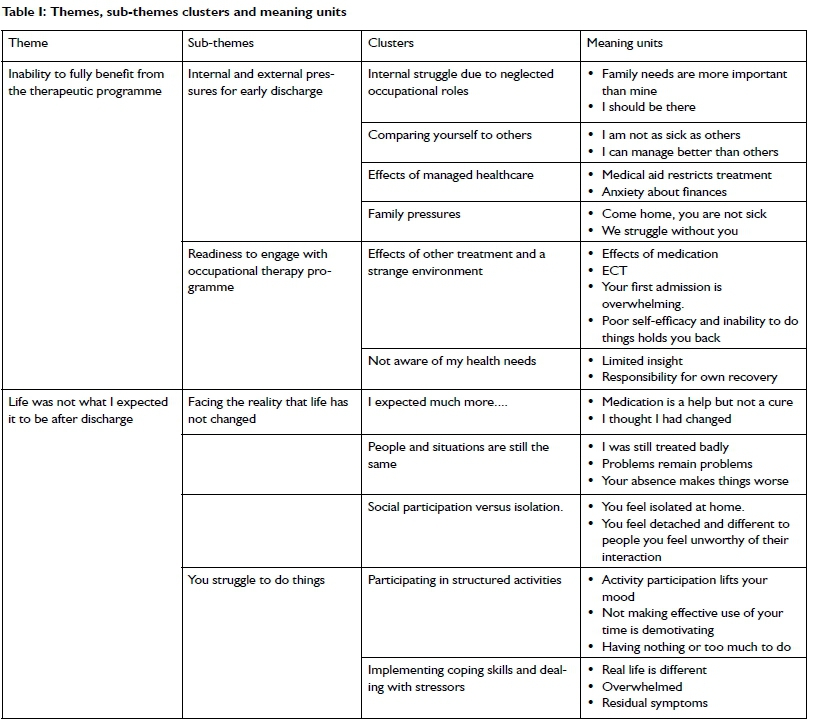
Eleven participants were included in the study. Eight of the participants were female while three were male. Participants were allocated pseudo-names to ensure confidentiality. Two themes emerged from the data analysis (Table I p58): Theme I: "Inability to fully benefit from the therapeutic programme" focused on the fact that participants felt distracted during their first hospital admission and therefore were unable to fully appreciate the changes they needed to make for their recovery. Theme 2: "Life was not what I expected it to be after discharge" highlighted the realisation by participants that life after discharge was still difficult and engagement in structured daily life continued to present a problem.
Theme 1: Inability to fully benefit from the therapeutic programme:
In this theme, participants described not being able to make the most of their time in hospital for two reasons described in the sub-themes. The first sub-theme that emerged was participants preoccupation with early discharge compelled by internal and external pressures which distracted them from their engagement in their recovery process. Participant accounts reflected a sense of urgency for early discharge. They reported experiencing internal pressure as others had to take over their responsibilities and their questioning of the severity of their illness and their need for hospitalisation.
"The guilt feeling because you are here... your work colleagues have to stand in for your work, yes and your husband has to take over all your domestic duties" (Rene).
All but one of the participants fulfilled the role of spouse and/or parent and stepping out of these caring roles was experienced as abandoning their loved ones.
"Ufe goes on and I have to be there, people need me. So sorry, I had to go...." (Marie).
Participants also compared their occupational performance with that of some more acutely ill MHCUs and concluded that they ought to be discharged as they seemed well compared to them.
"You look at the others and they seem a lot more ill than you and you realise 'but I am fine', but actually you are not" (Liezel).
Pressures for early discharge were not only experienced as being internal, but participants reported some external pressures as well. Managed health care, imposed restrictions affecting their length of hospitalisation, was reported as one such external pressure. The time the MHCU spent in hospital was not determined by improvement, but by the number of days that their medical scheme allowed for psychiatric hospitalisation per year.
"My medical aid, they said, yes that it [his benefit] was going to be depleted, so therefore I had to go home" (Oscar).
Uncertainty about the amount of funding that was available was also experienced as a stressor which distracted from the recovery.
"They spoke about PMB [prescribed minimum benefits], it made me feel anxious because I didn't know about all these things... So, I was afraid of it, I didn't know what they were talking about and I rather wanted to go home before I received this account" (Rene).
In addition, some participants spoke of the external pressure from their family members to be discharged. Participants perceived family members as having limited knowledge about MDD and did not understand the MHCU's need for hospitalisation:
"I have been told every day [by my family] that there is nothing wrong with me, I can just as well go home" (Liezel).
Some participants reported that their family perceived that their [the MHCU] admission to hospital as being on a "holiday" while the family had to struggle to manage tasks at home.
"You are on holiday, that is how they see it and they have to go on... I think that is also why I wanted to go home too soon the first time" (Alvene).
Feedback from family members about how much they were missed also placed external pressure on participants to be discharged early.
The second sub-theme to emerge was the participants' inability to engage in and fully benefit from the occupational therapy programme due to the side effects of other treatments and their own lack of insight into their problems. Participants reflected that this also contributed to their experience of not being prepared for the transition from hospital to home and the resuming of everyday activities on discharge. Participants reported that their ability to concentrate was impaired by the initiation or changing of anti-depressant medication when they were first admitted. They perceived they needed time to adjust to the newly prescribed medication, which resulted in the experience of side-effects and leaving some participants feeling unwell. In some cases, Electroconvulsive Therapy (ECT) during admission also had a profound influence on the participant's ability to absorb information in the occupational therapy programme.
"Many of us are on medication, many of the guys walk around here like zombies so you can't absorb any information in anyway. I went through shock therapy and though I attended all the sessions, and I didn't know what was going on half of the time. Uhm, I couldn't absorb the session, I couldn't benefit from it" (Elsabe).
Another factor that seemed to prevent participants from making the most of their first admission was that it took time to adapt to a new and unfamiliar hospital environment. Many participants felt emotionally overwhelmed, they were unsure what to expect and how the range of therapy related to their health needs. Although MHCUs were encouraged to attend inpatient occupational therapy group sessions immediately after admission, participants reported that it took a few days before they settled down before they felt ready to participate. They particularly found exposure to other patients unsettling:
"I don't like having people around me, I'm a loner" (Liezel).
Another underlying factor perceived as an initial barrier to participation was a lack of self-efficacy and low self-worth. Participants described how a lack of confidence and fear prevented them from actively engaging in the group sessions, resulting in missed opportunities for meaningful interaction. Therefore, by the time that participants felt confident enough to participate, they had lost valuable treatment time during their admission period, which was two weeks on average. A lack of insight during their first admission and the degree to which responsibility for own recovery was needed were other factors that made it difficult for participants to benefit from occupational therapy. Participants indicated they only appreciated the value of group work after their first discharge when they were confronted with demanding situations in their lives outside the hospital. They were then able to identify gaps in their functional recovery and attended therapy sessions which addressed their needs.
"I only do the ones, I wouldn't say that concern me, but those that I feel I need like anxiety and depression and those and the conflict management and those, I did the previous time." (Neels).
Participants reported not understanding their own health needs and the severity of their depression as well as the degree to which their daily occupations were disrupted by the disorder. They expected to be cured and they did not take responsibility for their own recovery. They reported being voluntarily admitted to hospital on the advice of their employer or family members, due to concerns about their mental wellbeing. They perceived that their recovery process was driven medical staff, so an external locus of control was evident during the first admission. During the second admission the participants reflected on the process of developing insight and the move from purely adhering to expectations of others to acknowledging the need to take responsibility:
"It was an issue of all the expectations during the first time... it was the best place to go to, do you understand, because you don't cope and you are in a bad state... I was alone with the second time, I had myself admitted and I was determined to walk out of here (Elsabe)
Theme 2: Life was not what I expected it to be after discharge:
Participants reported that they expected their life situation to be different on discharge. Returning to the same situation as before admission was a reality check and presented challenges that made implementing newly acquired skills more difficult than expected. These challenges were intensified by the presence of residual symptoms of depression and remerging occupational dysfunction.
Participants reported they left the hospital with a strong conviction that they had completely recovered and assumed that the negative thought patterns had changed, newly learnt skills had been internalised and that their improved mood state would remain. However, they were challenged when faced with the reality of everyday life. They realised that although the medication reduced the symptoms and enabled more effective coping with situational stressors, the need to implement changes in their engagement in occupations, lifestyle and situation was what was critical to recovery.
"It is not as though your problems are gone. Perhaps the tablets [prescribed medications] help that you are more relaxed about everything, but it is not gone" (Rene).
During hospitalisation, the participants held high expectations for improved functioning in all categories of occupational performance as the depressive symptoms subsided. Participants expressed immense disappointment when it emerged that the positive changes that occurred during occupational therapy sessions could not be implemented at home. This served to retard their recovery and sub-sequently contributed to their relapse and readmission to hospital.
"It was such a disappointment to me when I realised that I actually was the same Sarie that was admitted" (Sarie). "... but when I got home, I realised that I was far from okay" (Ena).
Participants were taken aback by the realisation that the growth that they had personally experienced was one-sided and people in the outside world did not automatically change. The lack of change in their relationships was perceived as a challenge. Although the participants felt more competent to deal with daily interpersonal struggles using the skills they had acquired during therapy sessions, they held an unrealistic expectation that friends, family members and co-workers had changed the way they related to them:
"[In therapy] we tried to work on how to deal with conflict and stress and everything else. But what awaits you outside, the people that are usually there, I mean nothing about them has changed" (Marie).
Being treated unkindly by significant others was experienced as a major disappointment.
"I expected things to turn out better. That people would treat me better. That my mom would not refer to me as the black sheep any longer" (Elna).
In addition to relationship difficulties, participants also reported that situational stressors remained the same. They were still faced with the same ones that they had encountered before admission and participants were surprised by the problems needing to be resolved after discharge:
"I went home and thought 'Oh well, I am OK, I don't have any problems anymore' but it wasn't like that" (Sarie).
Some participants instead of encountering an improved situation after discharge, the opposite held true, as problematic situations were intensified and their absence while hospitalised complicated matters even more than before admission:
"Nothing changed... as a matter of fact; it's a little bit more intense, because you haven't been there" (Stefan).
Most participants reported the overriding experience at home was a desperate sense of isolation, spending prolonged periods on their own at home. They found it difficult to re-connect with or establish new social contacts after discharge.
"You have no one to talk to if you feel a bit down the day, because you're all alone at home" (Oscar).
Even for those participants that returned to work they reported difficulty in relating to other people as a challenge and described feeling socially detached despite being surrounded by others.
"... all of a sudden I just had this feeling that I didn't fit in here, I don't belong here" (Marie).
Although participants valued the confidence-building aspect of social participation in therapy, this was not consolidated, and their new-found confidence was diminished when they were faced with groups of people after discharge.
"Making social contact with others... that was hard... To go to church, I felt I wasn't good enough" (Andrea);
"[with others I feel] I am an idiot; I am stupid, and I am ugly. I felt so intimidated by everyone there" (Marie).
Participants were also challenged by the absence of meaningful activities in their lives and not making effective use of their time after discharge. The occupational therapy programme provided structured engagement in activities during the admission which provided structure to the day, served as behavioural activation, taught new skills and improved self-confidence. Participants emphasised the therapeutic value of activities and the sense of purposeful doing that was fostered by activity participation which they now associated with their recovery.
"What really helped me a lot last time, we played a lot of volleyball and the volleyball saved me.....it makes it easier to open up and to say that you have a problem" (Stefan).
The absence of participation and decline in activity levels at home were thought to result in a downward spiral of occupational dysfunction. Limited activity participation reduced the opportunity for positive experiences and a sense of accomplishment, which in turn aggravated depressive symptoms:
"I had all this time on my hands, and I just sat on the bed or lay on the couch and that's wrong. I couldn't motivate myself" (Elsabe).
Other participants felt they had too much to do, and this left them feeling drained and unable to fulfil all their responsibilities.
Finally, participants reported a challenge in applying newly acquired coping and problem-solving skills in the context of their personal life situation which resulted in impaired engagement in occupations. They perceived they did not have sufficient practice opportunity to try out their newly learnt skills before they are discharged. The feasibility of using these skills could therefore only be established after discharge when challenging situations occurred and this was more difficult than they thought.
methods and techniques, it's more difficult to apply it than what you hear, and it doesn't always work like that in reality" (Rene).
"Every time that I experience a crisis, I can't think about [what we learnt on] ...how to solve the problem. The first thing that comes to mind is that I feel extremely tired" (Sarie).
Participant accounts reflected feelings of despondence as they tried to apply the strategies that they had decided upon in therapy, but which failed to deliver the desired outcome and they felt over-whelmed when stressors exceeded whatever coping mechanisms they had to hand.
"It feels as though I can't go on some days. I know that there are 110,120 other people who also have to do it, but I just can t cope with it at this moment. I can't cope with anything at this moment" (Marie).
"I just sat on the couch in a heap and cried for the whole night and half of the following day... " (Daphne).
The presence of residual depressive symptoms was another challenge which made it difficult for participants to deal with stressors.
"I wasn't completely over the depression. I struggled to get going, to get over the depression" (Elna).
"...inside me was no motivation; inside me was no desire to do anything" (Elsabe).
DISCUSSION
Although various clinical variables have been identified relating to the relapse of MDD124
Participants reported experiencing feelings of aguilt-associated inability to fulfil responsibilities that pressurised them to ask for early discharge before sufficient treatment gains had been made. They reported an internal struggle relating to neglecting their occupational roles and accompanying responsibilities on the one hand, whilst acknowledging but under-estimating their own need for treatment on the other. Pressure from relatives to be discharged distracted participants from focusing on their own treatment needs which in some cases, resulted in premature discharge. This finding resonated with a study by Skundberg-Kletthagen et al.4142
Another relevant finding in this study was the implementation of managed healthcare which resulted in a short hospital admission, restricted the time available for therapeutic intervention especially occupational therapy. At the private psychiatric hospital at which this research was conducted, only MHCUs who had a medical aid scheme or were able to personally carry the cost of hospitalization were admitted. When the Medical Schemes Act of 1998 was promulgated, certain medical conditions received better benefits by medical schemes. Schizophrenia and Bipolar Mood Disorder were the only two psychiatric conditions recognised on the list of PMBs, therefore excluding MHCUs with a diagnosis of MDD. Thus, if a client was admitted with a diagnosis of MDD, hospitalisation was limited to a maximum of 21 days per annum or up to 15 out-patient psychotherapy contacts4343444546
Since only MHCUs struggling with severe depressive symptoms that impair their functioning are admitted474849505152532854
A lack of insight as well as reluctance to take responsibility for their recovery resulted in the participants' unrealistic expectations regarding recovery. Firstly, awareness of and insight into one's own needs are necessary to identify the kind of help one needs. For participants in this study, the development of insight was limited due to the challenges restricting the benefit participants indicated they were able derive from occupational therapy groupwork. As suggested by Nunstedt et al.55565758
Taking responsibility and engaging in an active approach in managing MDD have been found to contribute towards one's recovery592255
The second factor that participants perceived to have contributed to their relapse and readmission relate to the unrealistic expectations that they held regarding the recovery process, which resulted in a deep sense of disappointment when they relapsed. This was further aggravated by residual or recurring symptoms which prevented participants from living life in the way that they anticipated after discharge60420
The support of family members or friends is crucial in the recovery of depression, but participants in this study did not feel adequately supported after discharge. On the contrary, they felt blamed for being ill, felt judged and rejected by their support network6162
Some participants reported that loved ones tried to offer support, but that they did not know how to offer appropriate support. The reasons for others not being able to provide adequate support, could be hypothesised as: the lack of involvement in the treatment process, lack of insight in MDD and feeling burdened and in need of some emotional support themselves. Furthermore, the occupational therapy programme at the research setting did not allow significant others to attend group sessions as suggested by Priestley and McPherson63
Although emotional support was available to some participants, they described how they withdrew emotionally and struggled to make use of available support. Participants acknowledged that it is difficult to receive support if you do not 'open up', and they were reluctant to share information or their experiences of depression with others as it made them feel exposed and vulnerable. They also felt they may have been the cause of their suffering of significant others' suffering, or a burden to them, and consequently, tended to cut themselves off646134 56 65
The reason for non-participation in activities appeared to be due to lack of structure and motivation. Although the occupational therapy programme promoted occupational engagement by scheduling of daily activities and monitoring accomplishment experienced during engagement in activities, consistent with a study by Skarsater et al.6667
The prolonged presence of depressive symptoms also hampered activity participation, whether the residual symptoms were present at discharge or re-emerged once at home. In the current study, participants described being taught coping skills but that the application of these skills in "real-life" situations was difficult. Increased sensitive to stressors282930565623
CONCLUSION
It can be concluded that during the acute phase of an episode of MDD, which usually is when someone is admitted to hospital, is not the ideal period for critical learning to take place. Mental Health Care Users are often acutely ill and as such, do not benefit optimally from group intervention. Therefore, hospitalisation should not be seen as a complete treatment process, and the scope of the occupational therapy programme could potentially be broadened to extent to the period beyond discharge. Learning opportunities offered to MHCUs during hospitalisation should be maximised, by synchronising activity requirements with depressive symptom severity. Groups requiring higher cognitive functions should therefore be attended at a later stage in admission, when symptoms have improved to such an extent that effective learning can take place.
Challenges that participants experienced after discharge can partially be explained by the contrast between their expectations of recovery and the principles of the Recovery model. Participants struggled to regain control of their life situations after discharge. They lacked adequate insight, learning ability was compromised, did not employ active self-management strategies and were faced with disappointment due to unrealistic expectations. These negative experiences were perceived to have contributed to their relapse and readmission to hospital. The introduction of outpatient post discharge support groups needs to be investigated.
AUTHOR CONTRIBUTIONSPatricia de Witt was a supervisor of the research study and the main author of the manuscript, and with Fasloen Adams who co-supervised this study, provided guidance during the analysis and interpretation of the data. Nadia Roestroff-Hambrock conceptualised and conducted the research as a post-graduate student. Denise Franzsen assisted with the conceptualisation and write-up of the manuscript.
REFERENCES
Literature review
-
1. World Health Organization. Depression. WHO, Geneva. Available from: https://www.who.int/news-room/fact-sheets/detail/depression
» https://www.who.int/news-room/fact-sheets/detail/depression -
2. Tomlinson M, Grimsrud AT, Stein DJ, Williams DR Myer L. The epidemiology of major depression in South Africa: results from the South African stress and health study. South African Medical Journal = Suid-Afrikaanse Tydskrif vir Geneeskunde. 2009;99(5 Pt 2): 367-373. https://doi.org/10.1016/j.biotechadv.2011.08.021.Secreted
» https://doi.org/10.1016/j.biotechadv.2011.08.021.Secreted -
3. Hays RD, Wells KB, Sherbourne CD, Rogers WH, Spritzer K. Functioning and well-being outcomes of patients with depression compared with chronic general medical illnesses. RAND Corporation; 1996; Available from: https://www.rand.org/pubs/reprints/RP387.html
» https://www.rand.org/pubs/reprints/RP387.html -
4. Romera I, Perez Y Menchón JM, Delgado-Cohen H, Polavieja F? Gi-laberte I. Social and occupational functioning impairment in patients in partial versus complete remission of a major depressive disorder episode. A six-month prospective epidemiological study. European Psychiatry, 2010;25(1): 58-65. https://doi.org/10.1016/j.eurpsy.2009.02.007
» https://doi.org/10.1016/j.eurpsy.2009.02.007 -
5. Rhebergen D, Beekman ATE de Graaf R Nolen WA, Spijker J, Hoogendijk WJ, et al. Trajectories of recovery of social and physical functioning in major depression, dysthymic disorder and double depression: A 3-year follow-up. Journal of Affective Disorders. 2010; 124(1-2): 148-156. https://doi.org/10.1016/j.jad.2009.10.029
» https://doi.org/10.1016/j.jad.2009.10.029 -
6. Solomon DA, Leon AC, EndicottJ, Mueller Tl, Coryell W, Shea MT, et al. Psychosocial impairment and recurrence of major depression. Comprehensive Psychiatry. 2004;45(6): 423-430. https://doi.org/10.1016/j.comppsych.2004.07.002
» https://doi.org/10.1016/j.comppsych.2004.07.002 -
7. Seemüller E Meier S, Obermeier M, Musil R Bauer M, Adli M, et al. Three-Year long-term outcome of 458 naturalistically treated inpatients with major depressive episode: severe relapse rates and risk factors. European Archives of Psychiatry And Clinical Neuroscience. 2014;264(7): 567-575. https://doi.org/10.1007/s00406-014-0495-7
» https://doi.org/10.1007/s00406-014-0495-7 -
8. Saohatse L, de Witt P van Niekerk M. Experiences and perceptions of Return to Work (RTW) by clients with major depressive disorder in an extended sick leave period. South African Journal of Occupational Therapy. 20l9;Saonatse,(1): 36-42. http://dx.doi.org/10.17159/2310-3833/2019/vol49n1a6
» http://dx.doi.org/10.17159/2310-3833/2019/vol49n1a6 -
9. James SL, Abate D, Abate KH, Abay SM, Abbafati C, Abbasi N, et al. Global, regional, and national incidence, prevalence, and years lived with disability for 354 Diseases and Injuries for 195 countries and territories, 1990-2017: A systematic analysis for the Global Burden of Disease Study 2017. The Lancet. 2018;392( 10159): 1789-1858. https://doi.org/10.1016/S0140-6736(18)32279-7
» https://doi.org/10.1016/S0140-6736(18)32279-7 -
10. Kessler RC, Bromet EJ. The epidemiology of depression across cultures. Annual Review of Public Health. 20I3;34: 119-138. https://doi.org/10.1146/annurev-publhealth-031912-114409
» https://doi.org/10.1146/annurev-publhealth-031912-114409 -
11. Freeman C, Joska J. Dealing with major depression in general practice. South African Family Practice. 2013;55(4): 3 19-325. https://doi.org/10.1080/20786204.2012.10874216
» https://doi.org/10.1080/20786204.2012.10874216 -
12. Andersson LM, Schierenbeck I, Strumpher J, Krantz G, Topper K, Backman G, et al. Help-seeking behaviour, barriers to care and experiences of care among persons with depression in Eastern Cape, South Africa. Journal of Affective Disorders. 2013; 151 (2): 439-448. https://doi.org/S0165-0327(13)00502-8 [pii]\n10.1016/j.jad.2013.06.022 [doi]
» https://doi.org/S0165-0327(13)00502-8 [pii]\n10.1016/j.jad.2013.06.022 -
13. Sadock BJ, Sadock VA, Ruiz P Kaplan and Sadock's Synopsis of Psychiatry Behavioral Sciences/Clinical Psychiatry. Kaplan and Sadock's synopsis of psychiatry: Behavioral Sciences/Clinical Psychiatry (11 th ed.). 2015. p. 356-359. https://doi.org/10.1017/CB09781107415324.004
» https://doi.org/10.1017/CB09781107415324.004 -
14. Lépine JP Briley M. The increasing burden of depression. Neuro-psychiatric Disease and Treatment. 2011 ;7(Suppl.): 3-7. https://doi.org/10.2147/NDT.S19617
» https://doi.org/10.2147/NDT.S19617 -
15. Kamenov K, Caballero FF Miret M, Leonardi M, Sainio P, Tobiasz-Adamczyk B, et al. Which Are the Most Burdensome Functioning Areas in Depression? A Cross-National Study. Frontiers in Psychology. 2016;7: 1342. https://d0i.0rg/10.3389/fpsyg.2016.01342
» https://d0i.0rg/10.3389/fpsyg.2016.01342 -
16. Stander MP Bergh M, Miller-Janson HE, de BeerJC, Korb FA. Depression in the South African workplace. South African Journal of Psychiatry. 2016. https://doi.org/10.4102/sajpsychiatry.v22i1.814
» https://doi.org/10.4102/sajpsychiatry.v22i1.814 -
17. American Occupational Therapy Association. Occupational therapy practice framework: Domain and process (4th ed.). American Journal of Occupational Therapy. 2020;74(Suppl. 2): 7412410010. https://doi.org/10.5014/ajot.2020.74S2001
» https://doi.org/10.5014/ajot.2020.74S2001 - 18. Duncan M, Prowse C. Occupational Therapy with Mood Disorders. In: Crouch R, Alers V(eds.) Occupational Therapy in Psychiatry and Mental Health. 5th ed. London: Wiley Blackwell; 2014.
-
19. Viinamaki H, HintikkaJ, Tolmunen T, Honkalampi K, Haatainen K, Koivumaa-Honkanen H. Partial remission indicates poor functioning and a high level of psychiatric symptoms: A 3-phase 6-year follow-up study on major depression. Nordic Journal of Psychiatry. 2008;62(6): 437-443. https://doi.org/10.1080/08039480801959281
» https://doi.org/10.1080/08039480801959281 -
20. FurukawaTA, Takeuchi H, Hiroe T, Mashiko H, Kamei K Kitamura T et al. Symptomatic recovery and social functioning in major depression. Acta Psychiatrica Scandinavica. 2001; 103(4): 257-261. https://doi.org/10.1034/j.1600-0447.2001.00140.x
» https://doi.org/10.1034/j.1600-0447.2001.00140.x -
21. Kelly M, Lamont S, Brunero S. An Occuational Perspective of the Recovery Journey in Mental Health. British Journal of Occupational Therapy. 2010;73(3): 129-135. https://doi.org/10.4276/030802210X12682330090532
» https://doi.org/10.4276/030802210X12682330090532 -
22. Davidson L. Recovery, self management and the expert patient - Changing the culture of mental health from a UK perspective. Journal of Mental Health. 2005. p. 25-35. https://doi.org/10.1080/09638230500047968
» https://doi.org/10.1080/09638230500047968 -
23. Gopinath S, Katon WJ, Russo JE, Ludman EJ. Clinical factors associated with relapse in primary care patients with chronic or recurrent depression. Journal of Affective Disorders. 2007; 101 (1-3): 57-63. https://doi.org/10.1016/j.jad.2006.10.023
» https://doi.org/10.1016/j.jad.2006.10.023 -
24. Stroud CB, Davila J, Moyer A. The Relationship Between Stress and Depression in First Onsets Versus Recurrences: A Meta-Analytic Review. Journal of Abnormal Psychology. 2008; 117(1): 206-213. https://doi.org/10.1037/0021-843X.117.1.206
» https://doi.org/10.1037/0021-843X.117.1.206 -
25. Post RM. Transduction of psychosocial stress into the neurobiology of recurrent affective disorder. American Journal of Psychiatry. 1992. p. 999-1010. https://doi.org/10.1176/ajp.149.8.999
» https://doi.org/10.1176/ajp.149.8.999 -
26. Monroe SM, Harkness KL. Life stress, the 'kindling' hypothesis, and the recurrence of depression: Considerations from a life stress perspective. Psychological Review. 2005; 112(2):417-445. https://doi.org/10.1037/0033-295X.112.2.417
» https://doi.org/10.1037/0033-295X.112.2.417 -
27. Lewinsohn PM, Steinmetz JL, Larson DW, Franklin J. Depression-related cognitions: Antecedent or consequence? Journal of Abnormal Psychology. 1981 ;90(3): 213-219. https://doi.org/10.1037/0021-843X90.3.213
» https://doi.org/10.1037/0021-843X90.3.213 -
28. Mitchell PB, Parker GB, Gladstone GL, Wilhelm K, Austin MP V Severity of stressful life events in first and subsequent episodes of depression: The relevance of depressive subtype. Journal of Affective Disorders. 2003;73(3): 245-252. https://doi.org/10.1016/S0165-0327(01)00479-7
» https://doi.org/10.1016/S0165-0327(01)00479-7 -
29. Hammen C. Generation of Stress in the Course of Unipolar Depression. Journal of Abnormal Psychology. 1991; 100(4): 555-561. https://doi.org/10.1037/0021-843X.100.4.555
» https://doi.org/10.1037/0021-843X.100.4.555 -
30. Daremo A, Kjellberg A, Haglund L. Occupational Performance and Affective Symptoms for Patients with Depression Disorder. Advances in Psychiatry. 2015;2015: 1-6. https://d0i.0rg/l0.1155/2015/438149
» https://d0i.0rg/l0.1155/2015/438149 -
31. Backs-Dermott BJ, Dobson KS, Jones SL. An evaluation of an integrated model of relapse in depression. Journal of Affective Disorders. 2010; 124(1-2): 60-67. https://doi.org/10.1016/j.jad.2009.11.015
» https://doi.org/10.1016/j.jad.2009.11.015 -
32. Brown GW, Harris TO, Kendrick T, Chatwin J, Craig TKJ, Kelly Y et al. Antidepressants, social adversity and outcome of depression in general practice. Journal of Affective Disorders. 2010; 121 (3): 239-246. https://doi.org/10.1016/j.jad.2009.06.004
» https://doi.org/10.1016/j.jad.2009.06.004 -
33. Skärsäter I, Langius A, Ägren H, Haggstrom L, Dencker K. Sense of coherence and social support in relation to recovery in first-episode patients with major depression: A one-year prospective study. International Journal of Mental Health Nursing. 2005; 14(4): 258-264. https://doi.org/10.1111/J.1440-0979.2005.00390.X
» https://doi.org/10.1111/J.1440-0979.2005.00390.X -
34. Nolan P Bradley E, Brimblecombe N. Disengaging from acute inpatient psychiatric care: a description of service users' experiences and views. Journal of Psychiatric and Mental Health Nursing. 2011; 18(4): 359-367. https://doi.0rg/10.1111/j.1365-2850.2010.01675.x
» https://doi.0rg/10.1111/j.1365-2850.2010.01675.x -
35. Sandelowski M. Whatever happened to qualitative description? Research in Nursing & Health. 2000;23(4): 334-340. https://doi.org/10.1002/1098-240x(200008)23:4<334::aid-nur9>3.0.co;2-g
» https://doi.org/10.1002/1098-240x(200008)23:4<334::aid-nur9>3.0.co;2-g - 36. De Vos AS, DelportCSL, FoucheCB, Strydom H. Research at grass roots : for the social sciences and human services professions. Van Schaik; 2011.547 p.
-
37. Creswell JW, Miller DL. Determining Validity in Qualitative Inquiry. Theory Into Practice. 2000;39(3): 124-130. https://doi.org/10.1207/s15430421tip3903_2
» https://doi.org/10.1207/s15430421tip3903_2 -
38. Chambers E, Cook S, Thake A, Foster A, Shaw S, Hutten R et al. International update: I. Psychiatric rehospitalization following hospital discharge. Journal of Affective Disorders. NIH Public Access; 2011; 11 (3): 22-27. https://doi.org/10.1159/000101500
» https://doi.org/10.1159/000101500 -
39. Starks H, Trinidad SB. Choose your method: a comparison of phenomenology, discourse analysis, and grounded theory. Qualitative health research. 2007;17(10): 1372-1380. https://doi.org/10.1177/1049732307307031
» https://doi.org/10.1177/1049732307307031 - 40. Colaizzi P Psychological research as a phenomenologist views it. In: Valle RS, King M (eds.) Existential Phenomenological Alternatives for Psychology. New York: Open University Press; 1978.
-
41. Skundberg-Kletthagen H, Wangensteen S, Hall-Lord ML, Hedelin B. Relatives of patients with depression: experiences of everyday life. Scandinavian Journal of Caring Sciences. 2014;28(3): 564-571. https://doi.org/10.1111/scs.12082
» https://doi.org/10.1111/scs.12082 -
42. Ahlström BH, Skarsater I, Danielson E. Living with major depression: experiences from families' perspectives. Scandinavian Journal of Caring Sciences. 2009;23(2): 309-316. https://doi.org/10.1111/j.1471 -6712.2008.00624.x
» https://doi.org/10.1111/j.1471 -6712.2008.00624.x -
43. Smit R. Unipolar Depression. CMScript Issue 6. p. 1-3. Available from: https://www.medicalschemes.com/files/CMScript/CMScript6Of2016.pdf
» https://www.medicalschemes.com/files/CMScript/CMScript6Of2016.pdf -
44. He H, Chang Q, Ma Y. The Association of Insight and Change in Insight with Clinical Symptoms in Depressed Inpatients. Shanghai Archives of Psychiatry. 2018. p. 110-118. https://doi.org/10.11919/j.issn.1002-0829.217149
» https://doi.org/10.11919/j.issn.1002-0829.217149 -
45. Paykel ES. Partial remission, residual symptoms, and relapse in depression. Dialogues in Clinical Neuroscience. 2008. p. 431 -437. https://doi.org/10.31887/dcns.2008.10.4/espaykel
» https://doi.org/10.31887/dcns.2008.10.4/espaykel -
46. Donisi Y Tedeschi F Wahlbeck K, Haaramo F? Amaddeo F. Pre-discharge factors predicting readmissions of psychiatric patients: A systematic review of the literature. BMC Psychiatry. 2016; 16(1): 449. https://doi.0rg/10.1186/s12888-016-1114-0
» https://doi.0rg/10.1186/s12888-016-1114-0 -
47. BoeremaAM, Kleiboer A, Beekman ATF van Zoonen K, Dijkshoorn H, Cuijpers P Determinants of help-seeking behavior in depression: Across-sectional study. BMC Psychiatry. 2016;16(1): 78. https://doi.org/10.1186/s12888-016-0790-0
» https://doi.org/10.1186/s12888-016-0790-0 -
48. Stenhouse RC. 'Safe enough in here?': patients' expectations and experiences of feeling safe in an acute psychiatric inpatient ward. Journal of Clinical Nursing. 2013;22(21 -22): 3 109-3119. https://doi.org/10.1111/jocn.12111
» https://doi.org/10.1111/jocn.12111 -
49. Herzallah MM, Moustafa AA, Natsheh JY, Danoun OA, Simon JR, Tayem Yl, et al. Depression impairs learning, whereas the selective serotonin reuptake inhibitor, paroxetine, impairs generalization in patients with major depressive disorder. Journal of Affective Disorders. 2013; 151 (2): 484-492. https://doi.org/10.1016/j.jad.2013.06.030
» https://doi.org/10.1016/j.jad.2013.06.030 -
50. Vogel S, Schwabe L. Learning and memory under stress: implications for the classroom. npj/Science of Learning. 2016; 1 (1): 1. https://doi.org/10.1038/npjscilearn.2016.11
» https://doi.org/10.1038/npjscilearn.2016.11 -
51. Cowls J, Hale S. It's the activity that counts: What clients value in psycho-educational groups. Canadian Journal of Occupational Therapy. 2005 ;72(3): 176-182. https://doi.org/10.1177/000841740507200305
» https://doi.org/10.1177/000841740507200305 -
52. Tanaka S, Ishikawa E, Mochida A, Kawano K, Kobayashi M. Effects of Early-Stage Group Psychoeducation Programme for Patients with Depression. Occupational Therapy International. 2015;22(4): 195-205. https://doi.org/10.1002/oti.1397
» https://doi.org/10.1002/oti.1397 -
53. Tursi MFDS, Baes CVW, Camacho FRDB, Tofoli SMDC, Juruena MF Effectiveness of psychoeducation for depression: A systematic review. Australian and New Zealand Journal of Psychiatry. England; 2013. p. 1019-1031. https://doi.org/10.1177/0004867413491154
» https://doi.org/10.1177/0004867413491154 -
54. Gillis I, Wilhelm K, Batchelor J, Burke D. Information processing speed remains low in school teachers a decade after recovery from depression. International Journal of Geriatric Psychiatry. 2014;29( 10): 1098-1 100. https://doi.org/10.1002/gps.4162
» https://doi.org/10.1002/gps.4162 -
55. Nunstedt H, Nilsson K, Skarsater I, Kylén S. Experiences of major depression: Individuals' perspectives on the ability to understand and handle the illness. Issues in Mental Health Nursing. 2012;33(5): 272-279. https://doi.org/10.3109/01612840.201 1.653038
» https://doi.org/10.3109/01612840.201 1.653038 -
56. Nikendei C, Haitz M, Huber J, Ehrenthal JC, Herzog W, Schauenburg H, et al. Day clinic and inpatient psychotherapy of depression (DIP-D): Qualitative results from a randomized controlled study. International Journal of Mental Health Systems. 2016; 10(1): 1-14. https://doi.org/10.1186/s 13033-016-0074-6
» https://doi.org/10.1186/s 13033-016-0074-6 -
57. Cunningham K, Wolbert R, Graziano A, Slocum J. Acceptance and Change: The Dialectic of Recovery. Psychiatric Rehabilitation Journal. 2005;29(2): 146-148. https://doi.org/10.2975/29.2005.146.148
» https://doi.org/10.2975/29.2005.146.148 -
58. Mizock L, Russinova Z, Miliner UC. Acceptance of mental illness: Core components of a multifaceted construct. Psychological Services. 2014; 11(1): 97-104. https://doi.org/10.1037/a0032954
» https://doi.org/10.1037/a0032954 -
59. van Grieken RA, Klrkenier ACE, Koeter MWJ, Nabitz UW Schene AH. Patients' perspective on self-management in the recovery from depression. Health Expectations. 2015; 18(5): 1339-1348. https://doi.0rg/10.1111/hex.12112
» https://doi.0rg/10.1111/hex.12112 -
60. Desplenter FA, Laekeman GJ, Simoens SR. Following up patients with depression after hospital discharge: A mixed methods approach. International Journal of Mental Health Systems. 2011;5(1): 1 -10. https://doi.org/10.1186/1752-4458-5-28
» https://doi.org/10.1186/1752-4458-5-28 -
61. Y-Garcia EF Duberstein P Paterniti DA, Cipri CS, Kravitz RL, Epstein RM. Feeling labeled, judged, lectured, and rejected by family and friends over depression: Cautionary results for primary care clinicians from a multi-centered, qualitative study. BMC Family Practice. 2012; 13(1): 1-9. https://doi.org/10.1186/1471-2296-13-64
» https://doi.org/10.1186/1471-2296-13-64 -
62. Da Silva GDG, Jansen K, Barbosa LP Branco JDC, Pinheiro RT, Magalhães PVDS, et al. Burden and related factors in caregivers of young adults presenting bipolar and unipolar mood disorder. International Journal of Social Psychiatry. 20I4;60(4): 396-402. https://doi.org/10.1177/0020764013491740
» https://doi.org/10.1177/0020764013491740 -
63. Priestley J, McPherson S. Experiences of adults providing care to a partner or relative with depression: A meta-ethnographic synthesis. Journal of Affective Disorders. 2016. p. 41-49. https://doi.org/10.1016/j.jad.2015.12.011
» https://doi.org/10.1016/j.jad.2015.12.011 -
64. Nyström M, Nyström MES. Patients' experiences of recurrent depression. Issues in Mental Health Nursing. 2007;28(7): 673-690. https://doi.org/10.1080/01612840701416064
» https://doi.org/10.1080/01612840701416064 -
65. Mgutshini T. Risk factors for psychiatric re-hospitalization: An exploration. International Journal of Mental Health Nursing. 2010; 19(4): 257-267. https://doi.0rg/10.1111/J.1447-0349.2009.00664.X
» https://doi.0rg/10.1111/J.1447-0349.2009.00664.X -
66. Skärsäter I, Baigi A, Haglund L. Functional status and quality of life in patients with first-episode major depression. Journal of Psychiatric and Mental Health Nursing. 2006; 13(2): 205-213. https://doi.0rg/10.1111/j.1365-2850.2006.00942.X
» https://doi.0rg/10.1111/j.1365-2850.2006.00942.X -
67. Dimidjian S, Hollon SD, Dobson KS, Schmaling KB, Kohlenberg RJ, Addis ME, et al. Randomized trial of behavioral activation, cognitive therapy, and antidepressant medication in the acute treatment of adults with major depression. Journal of Consulting and Clinical Psychology. 2006;74(4): 658-670. https://doi.org/10.1037/0022-006X.74.4.658
» https://doi.org/10.1037/0022-006X.74.4.658
* Ethical clearance for this study was granted prior to the enactment of the amended POPIA on 2021 -07-01.