Exploring the influence of hyper-reactive responses to clothing on families of children with tactile hyper-reactivity
Abstract
INTRODUCTION: Children with tactile hyper-reactivity may respond with aversive responses to certain clothing items, such as school uniforms. Given that families operate as interconnected systems, a child's hyperreactive responses to clothing can impact the entire family. This study aimed to explore the influence of children's hyper-reactive responses to clothing on their families and determine the strategies families use to cope with resulting challenges. METHOD: This exploratory qualitative study focused on the views of parents with children (aged 5-19 years old) with tactile hyper-reactivity. Four online focus group discussions were held with a cumulative total of 14 parents. Data analysis involved thematic analysis using Atlas.ti. Two themes with subthemes emerged. RESULTS: Theme 1 (family influence) includes the influence on the parents' emotions, the siblings, and family resources. Theme 2 (family strategies) includes the coping and adaptation strategies that families employ to prevent hyper-reactive responses and to promote their family wellness to deal with the challenges they experience. CONCLUSION: This study emphasises how children's hyper-reactive responses to clothing can influence families. Families should be guided to implement strategies that contribute to preventing hyper-reactive responses to clothing that may promote overall family wellness. IMPLICATIONS FOR PRACTICE: • The sensory hyper-reactive responses elicited by clothing influenced the families of children with tactile hyper-reactivity in multiple ways. • Occupational therapists who assist children and families of children who experience sensory hyper-reactive responses to clothing should keep the broader perspective of the child and family in mind when designing interventions. • Occupational therapists should guide families to make the adaptations required to prevent hyper-reactive responses as far as possible. • Strategies aimed at promoting family participation in wellness activities, as well as the adaptation of family routines, should be facilitated. • Purposefully adapting clothing that elicits sensory hyper-reactive responses is avaluable strategy.
clothing; family; tactile hyper-reactivity; strategies; wellness
INTRODUCTION
As a basic necessity, clothing is inherently intertwined with our daily lives. Its ubiquity often leads people to dismiss its impact when children with tactile hyper-reactivity complain about how irritating they find certain items. Sensory-friendly clothing items are not necessarily widely accessible or suitable to families, which may lead to children with tactile hyper-reactivity having to wear clothing that elicits hyper-reactive responses. This can spark sensory meltdowns in children and affect the entire family1
Although one would expect the clothing choices that families make to result from their personal preferences, the decision of what a child wears is influencedgreatly by diffère ntenvironmental aspects. For example, societal expectations govern acceptable dress practices, cultural norms determine appropriateness, and the availability and affordability of appropriate clothing items determine which options families can access23
Wearing clothing is necessary to enable participation in most childhood activities, highlighting the potential impact of clothes on children's daily lives. Although most children become easily habituated to the feeling of clothes against their skin, children with tactile hyperreactivity may experience aversive responses to wearing certain clothing4,5.
Tactile hyper-reactivity is one type of sensory hyper-reactivity commonly called tactile defensiveness65,7,8. However, in this paper, the authors will use the term hyper-reactivity, as this aligns with the terminology used in the DSM-5's diagnostic criteria for autism spectrum disorder9,10.
Tactile hyper-reactivity has been defined as an overreaction to ordinary touch sensations11114,11,12. Although typically developing children could have tactile hyper-reactivity, it is often associated with conditions such as autism spectrum disorder and attention deficit and hyperactivity disorder13,14.
As clothing is worn next to the skin, it is a regular source of light touch stimuli and can, therefore, contribute to hyper-reactive responses from children with tactile hyper-reactivity151516,17, with people with tactile hyper-reactivity typically disliking rough textiles. Design elements that may cause difficulties include tight necklines and collars, scratchy embroidery, and irritating sleeves and sleeve-finishes1617
Families and family wellness play a vital role in supporting the development of all children181920,21, parents may experience high levels of stress that could affect family wellness. Parents of children with sensory hyper-reactivity have reported challenges in various daily activities that may contribute to their distress for example, disruptions during mealtimes221623,24.
In addition to the World Health Organisation's definition of wellness as an overall state of well-being25262728
Limited information is available on the perspectives of parents on the influence of a child's hyper-reactive responses to clothing on their family. Understanding parents' perspectives on this topic is valuable as it can guide the provision of empathetic and family-centred intervention. Furthermore, understanding which strategies families find helpful to address these challenges may be useful to service providers who guide families in similar situations.
This study is the continuation of a previous study conducted by the same authors1616
Therefore, this research aimed to i) Explore the influence of hyper-reactive responses to clothing on the family of children with tactile hyper-reactivity as experienced by parents and to ii) Determine what strategies families employ to cope with their children's hyper-reactive responses to clothing.
METHODS
Research design
The research design was qualitative and exploratory and consisted of four online focus group discussions. Two initial focus group discussions were conducted, as reported on by Jordaan et al.16
Sampling
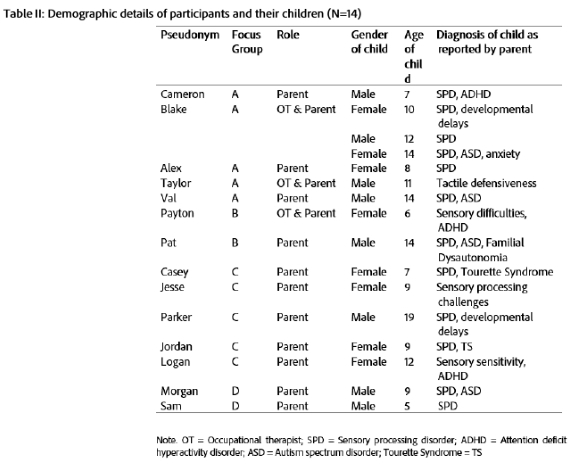
The participants of all four focus groups were recruited through invitations distributed on social media platforms with a focus on issues related to tactile hyper-reactivity. Although the participants of the initial two focus groups consisted of parents, occupational therapists and teachers who interact with children with tactile hyper-reactivity, this paper will report only on the data collected from parents of children with tactile hyper-reactivity (aged 5 - 19** years of age). Participants had to confirm that they were the parents of a child/children with tactile hyper-reactivity in order to participate in one of the last two focus groups. Therefore, the analysis for this paper included input from 14 participants across the four focus groups. Each participant only took part in one of the four focus group discussions. Table I (page 3) indicates which participants formed part of the initial two focus groups (Groups A and B) and the last two focus groups (Groups C and D). All participants provided informed consent. The study's transferability was enhanced through purposive sampling16
Ethical clearance
Data collection commenced after ethical clearance was obtained from the University of Pretoria's ethics committee (reference number NAS081/2021 Line 2).
Data collection
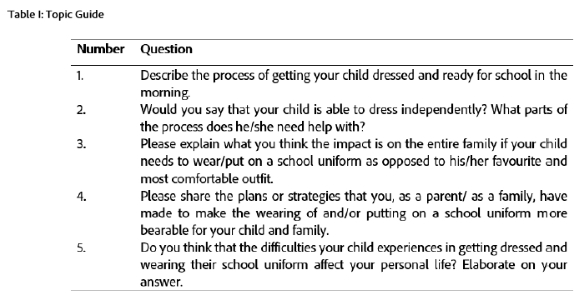
The four synchronous focus group discussions were hosted online on Blackboard Learn (the learning management system used by the University of Pretoria) and recorded. All discussions were in English. Each discussion lasted over an hour, which promoted extended participant engagement. The questions included in the topic guide used in the initial two focus groups were formulated specifically to elicit responses pertaining to the initial study topic. Although these questions were not specific to the aims of the current paper, the participants discussed much relevant data unprompted. These questions may be viewed in Jordaan et al.16Table I (page 3).
Data analysis
The recordings were transcribed using the Otter.ai app, and the second author checked and corrected them where necessary. Pseudonyms were used during data analysis to protect the identity of the participants. Although the data obtained from the first two focus groups had been previously analysed, a new analysis of this data with "clean" transcripts was started. The study employed inductive thematic analysis, with researchers developing codes iteratively throughout the process3031
FINDINGS
Table II (below) also describes the participants and their respective children. Some participants had more than one child with tactile hyper-reactivity, and three of the participants were not only parents of children with tactile hyper-reactivity but also trained occupational therapists. All the parents reported that their children had tactile hyper-reactivity. The authors did not personally assess the children.
Themes and subthemes
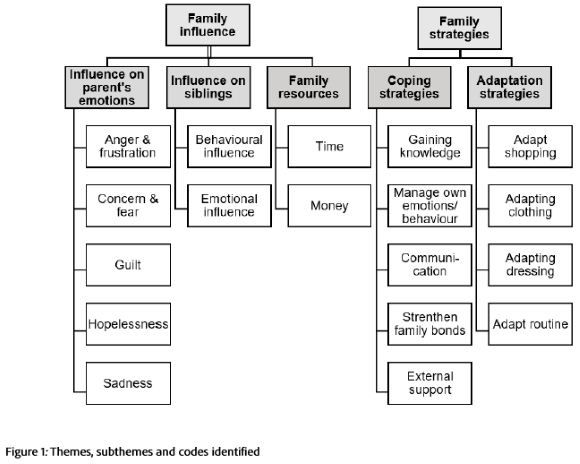
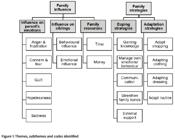
Two overarching themes were identified to address the two research questions. These include i) Family influence and ii) Family strategies. Each theme has subthemes, with several codes identified under each. Themes and subthemes are depicted in Figure 1 (below).
THEME 1: Family Influence
Influence on parent emotions (Subtheme 1)
The participants mentioned that their families experienced various emotions resulting from the difficulties their children experienced with clothing. Five subthemes were identified under family emotions.
Anger and frustration. Participants explained the anger and frustration they experienced due to their children's hyper-reactive responses (such as tantrums) in response to clothing.
"I mean, before I knew how to deal with this, I would start shouting and saying: Get done, you need to get to school, clock is ticking... and there would be a huge meltdown... it's very difficult for you as the mother to understand where your child is coming from and also not get upset' (Jordan; SPD, TS)*
Concern and fear. Participants discussed various concerns and fears.
"Will they always be awkward throughout their life? Or will they improve that they can tolerate clothing?" (Pat; SPD, ASD, Familial Dysautonomia)
"Will they always be tactile defensive, right throughout their life [or] will it improve to a point where he can tolerate things better?" (Peyton; sensory difficulties, ADHD)
Guilt. Several parents expressed feelings of guilt - particularly if they were assisting their child to get dressed. They report doing this to complete the activity in a reasonable time, even though the child could physically dress themselves.
"I thought I was the only one who felt guilty for helping my child to get dressed" (Cameron; SPD, ADHD)
"In the end, you [are] dressing your six-year-old child when you know you shouldn't be. But as I've said, at that moment, it's about getting the kids to school in a reasonably okay state" (Blake; children with SPD, developmental delays, ASD, anxiety)
Hopelessness. A sense of hopelessness was observed in some participants.
"I don't know, I don't know how to get through to her" (Jordan; SPD, TS)
Others referred to the unpredictability of their children's hyper-reactive responses to clothing and described their continued struggle to prevent these from happening.
"But, but if we can just know beforehand... I'll wake up, I'll never even go to sleep if it's necessary [in order to prepare the clothing for the morning routine]. It's most definitely difficult for you as a parent..." (Sam; SPD)
Sadness. Several participants spoke of feelings of sadness about the situation.
"Because many times, if he starts crying, what [kind of] parent is not unhappy when he knows his child is unhappy?" (Morgan; SPD, ASD)
"It's difficult fora parent... if you know your child is unhappy and you sent your child unhappy to school, there is something in your heart and in your head that is not okay" (Sam; SPD)
Influence on siblings (Subtheme 2)
Participants also explained the different ways the siblings were influenced by the hyper-reactive responses of their children to clothing. *Participant identifiers depict participant's initials and diagnosis/diagnoses of the child
Behavioural influence. One of the participants explained that her young daughter copied behaviour from her child with tactile hyper-reactivity and found it hard to understand that this behaviour was then not allowed from her:
"... she's copying her sister, and she's copying behaviours. And to teach her, you know, your sister is allowed to do this, but you're not...a three-year-old doesn't understand that" (Casey; SPD, TS)
Another participant mentioned that her son would try to avoid his sister (with tactile hyper-reactivity) when she was upset. She gave a typical example of driving in a car after an unpleasant clothing-related incident:
"My son just asked me: "Mommy, can I please sit in front?" He couldn't understand what's going on. And his way to deal with it was just [that] he just doesn't want to sit next to her" (Jesse; sensory processing challenges)
Emotional influence. It was evident that the hyper-reactive responses due to irritation caused by clothing can also affect the other siblings emotionally.
"It has a huge impact on our family... if Daniel (pseudonym) is difficult and crying and he's unhappy, it affects his brother and sister too... They get emotional and unhappy that their brother is not happy" (Morgan; SPD, ASD)
One participant found her 19-year-old sibling's behaviour frustrating. Parker explained that her daughter confronts her on how she deals with it:
"And it's always... you spoil him. Why do you have to do everything for him? Why does he have to behave in this manner? He's out of hand. So it's difficult... [to] make them understand, you know, that he has this issue... ?" (Parker; SPD, developmental delays)
Family resources (Subtheme 3)
Family resources, specifically time and money, are also influenced by the hyper-reactive responses of a child to clothing.
Time. The morning routine was viewed as particularly problematic. Since dressing is a big part of the routine, it is often the trigger for meltdowns and can consume a significant amount of time:
"This is so stressful for him as well as for us in the morning. It is a challenge. It makes you late" (Sam; SPD)
"[You] try to calm him down [after a meltdown], get him finished, get everyone happy again. And then you have to go to school quickly and I have to get to work otherwise I'm late" (Morgan; SPD, ASD)
Although the child with tactile hyper-reactivity experienced the challenges directly, the family was influenced because of the interconnectedness of family life.
"And I mean it's difficult because I also have to be on time for work, and I also have appointments at work. And I mean, if it runs too late, everybody's going to be late for their day, but you still need to keep in control and keep everything intact" (Casey; SPD, TS)
Money. Several participants mentioned that preferred clothing may have a higher cost than other options and, therefore, strained their financial resources.
"it comes at double the price than the one you would normally buy'. (Alex; SPD)
Jordan (SPD, TS) indicated that she purchased "very expensive [sensory-friendly] socks" to try to prevent adverse reactions.
THEME 2: Family Strategies
Several strategies were identified under two subthemes that families appeared to use to promote their family's wellness around this issue. The subthemes included i) Coping strategies and ii) Adaptation strategies.
Coping Strategies (Subtheme 1)
Coping strategies refer to the efforts that families employ to manage the demands of stressful or challenging situations32
Gaining knowledge. Participants explained that they had to gain knowledge on tactile hyper-reactivity to cope.
"I had to educate myself (Parker; SPD, developmental delays)
Other participants explained that they had to learn how to deal with the challenges:
"And for us as parents also how to deal with it. Because I mean, you're not born with the tools on how to handle the child with sensory issues, you have to learn how to deal with it" (Casey; SPD, TS)
"And in the beginning, it was so it was difficult to understand because... it would be a specific jacket, for instance... that specific thing he would not wear it because he would say something is pinching me or something is scratching me and we didn't understand it. Now, obviously, we do understand it much easier" (Sam; SPD)
Manage own emotions/behaviour. Several participants explained that they have to manage their own reactions to an emotional outburst from their child. They highlighted that they must stay calm as their reactions impact their child's behaviour:
"... it teaches you patience, it teaches you to calm down... when your child starts to behave like that you immediately become anxious too, because you know where this is going. And you need to try and keep that anxiety down because they also feed on that' (Jordan; SPD, TS)
"But in terms of the meltdowns... I also had to learn and I'm not yet there... how to get my own anxiety down the moment when I can see the stress levels increase, how to be calm, how to breathe, how to try and distinguish between what is really something worth fighting about and what not..." (Jesse; Sensory processing challenges)
Communication. Communication was repeatedly discussed as a useful tool to improve the family's wellness and resolve conflict. Participants explained that they have learned to negotiate with their children and make compromises. They have learned to focus on the most important aspects and no longer start arguments about aspects that are not absolutely necessary. One of the participants explained that she does not challenge her child when he removes his clothing any longer:
"... he will take all his clothing off. He doesn't care where he is, what he's doing, everything will come off. And he won't wear it... So I don't even insist anymore. I just leave him" (Pat; SPD, ASD, Familial Dysautonomy)
Another participant described the importance of communication with the child to resolve conflict in the family:
"... after the meltdown, he will say, Mom, I'm sorry. Are you okay? And then I'll say I'm fine... and then we'll work out a strategy to say, you know what, let's do it this way" (Parker; SPD, developmental delays)
Sam highlighted the importance of interpreting children's behaviour as a way to communicate:
"What I always tell people... remember that, that their behaviour is communication. And we as adults ...are supposed to listen to our children's behaviour" (Sam, SPD)
Strengthen family bonds. Doing activities together was described as a way aamilies address their wellness and improve their coping:
"It's a busy day, it's a busy schedule. And when we get home, we make sure we spend quality time to make sure that we are all okay emotionally. It's not always as easy... "(Sam, SPD)
Families benefited from support within their nuclear family and extended family structures.
"We as a family most certainly try... I'm not talking about just me and my family... Primarily, me, my husband, my two sons. That's our inner circle. But we also have an extremely strong outer circle structure as well ...[that] are also extremely supportive towards our family..." (Sam, SPD)
When these support structures were not in place, potentially due to families living far from each other, families experienced strain. Morgan (mother to 9-year-old boy with SPD and ASD) mentioned:
"It's only me, my husband [and] my three kids ...my parents [are] very faraway... my [husband's] parents are very faraway... so it's only us, yeah, it's not really easy many times" (Morgan; SPD, ASD)
External support. Participants explained that external support, such as talking to other parents who face similar difficulties, helps. Participants described identifying with others when sharing their stories with parents in a similar situation.
"Other people also struggle the same [way]...that helps me... a lotto say, Okay, I'm not alone anymore. But sometimes you forget because it feels.. inyourfamily ...that you are alone many times... it helps a lot to hear other parent's stories and what they do to help manage their day and their kids" (Morgan; SPD, ASD)
Several parents experienced the focus groups positively, as they could identify with others with the same challenges.
"I'm just saying it's nice ...to know that you're not the only one going through something like this" (Jordan, SPD, TS)
"I think it was just good to talk to other parents who are experiencing similar things than you are experiencing and also to share ideas of how we can help our kids to improve" (Casey; SPD, TS)
Adaptation strategies (Subtheme 2)
To cope with their daily challenges, families made various adaptations that included adaptations to their i) shopping behaviour, ii) dressing of their child, iii) routines and iv) child's clothing. These strategies are aimed at solving the specific problems related to clothing and activities involving clothing that families have identified.
Adapt shopping. A strategy many families adopted was to adapt their shopping behaviour. Participants mentioned that they purchase speciality items to avoid difficulties:
"We only use these sensory socks because the other ones... the normal ones that you find in the shops is just not right..." (Jordan; SPD, TS)
Another participant explained that she goes to shops where she can feel the texture of the clothing before purchasing an item:
"So, if the material of the normal school uniform is for them also too hard, or they didn't love it, I go to certain places in the shops that I can feel you can go to [retailers] who has this, and then I go and feel actually the materials..." (Morgan; SPD, ASD)
Several families explained that they take their children with tactile hyper-reactivity along when shopping for clothes, even though this may be challenging.
"So when we do go shopping, he feels the clothes before he purchases. So it's difficult to go and buy... school shoes were horrific" (Parker; SPD, developmental delays)
One mother explained that it was helpful when her child decided for themselves on the suitability of a piece of clothing:
"And even when we have [to] sometimes go to the shops and he [has] to decide, and I ask him- Yep? No? Yep? No? And that's that. And then I know. You don't even try. Even if it's beautiful or soft [to] you. If he said no, it's no" (Morgan; SPD, ASD)
Adapt clothing. How families adapted clothing to enable their children to wear it was discussed in detail:
"So if clothing does have a tag I unpick the tag and then sew it closed or else I buy clothing that is tagless" (Pat; SPD, ASD, Familial Dysautonomia)
Covering irritating surfaces on the inside of clothing was another strategy identified:
"I found with my son he had an embroidery on his shirt, and in the inside they had that backing and it was scratchy That was a huge irritation! I had to put on a softer backing just so he could wear that" (Val; SPD, ASD)
With clothing that caused irritation, some children wore oversized items to reduce the sensory input, while others preferred wearing additional and tight-fitting items under the clothing they were expected to wear. In some cases, school uniforms had to be adapted:
"He couldn't wear the pants' wide bottom. Therefore, he put the skinny jeans under his school pants so he can have that comfort" (Parker; SPD, developmental delays)
Some children preferred to wear nothing apart from underwear
"So he just finds clothing irritating, even at home. He's only in his undies at the moment" (Pat; SPD, ASD, Familial Dysautonomia)
Adapt dressing. Several participants mentioned that they assist with setting up their child's dressing activity, as this may also reduce the likelihood of hyper-reactive responses.
"... I have also trained myself to make sure that everything is in its place so that we can avoid those kinds of meltdowns. It's tiring, it's exhausting" (Parker; SPD, developmental delays)
"... many times in the evening already, I go and put [out] his clothes... I take out his clothes the previous evening" (Morgan; SPD, ASD)
Sam explained her family's system - to pack containers with the applicable day's clothing in advance.
"... we have a cupboard or actually have buckets where we put in Monday, Tuesday, Wednesday, we make sure he chooses the stuff that he wants to wear, we put it in, [and] he knows exactly what am I [the child] wearing on Monday, Tuesday, Wednesday, Thursday, Friday according to his activities at school as well" (Sam; SPD)
Some families found it helpful to give the child options of different pieces of clothing to choose from. Morgan explained that her child chooses what he wants to wear from the available options the night before
"... if he still has the energy by the evening. He doesn't have too much homework and that type ofthing. So he ... allows himself to choose what he wants" (Morgan; SPD, ASD)
Although having options available could be helpful, participants also indicated that they limit the clothing options available to their children. Morgan explained that she removes clothing that elicits an adverse response immediately from her child's wardrobe:
"And [in] that moment [after an aversive response to a certain item of clothing], I take that one piece of clothing out of his cupboard and never put it back in his cupboard, he will not wear it again...I'm not going to try, not going through the trouble again [and] messing around. I just take it out there immediately. Get something else... it's just easier for us". (Morgan, SPD, ASD)
Another mother explained that she helps her child to ensure that the clothes are just the way the child likes them:
"So I have to help her put that on because the socks have to stay in the right position and then put the tekkie [sneaker] on. So yes, I do assist with that" (Jordan; SPD, TS)
Adapt routine. Multiple participants mentioned that they adapted their family routine to prevent hyper-reactive responses, particularly in the morning.
"So you try and make little adjustments, little routine changes, anything just to keep everybody on schedule, without turning every morning into a fight". (Casey; SPD, TS)
Some children also appeared to welcome good routines.
"...we have a tiny system because he tends to like routine and systems, so for him, it works even though it [may not] work tomorrow morning" (Sam, SPD)
DISCUSSION
The findings described above indicate that the sensory hyper-reactive responses elicited by clothing influenced the families of children with tactile hyper-reactivity in multiple ways. Although the focus group topic guide questions were specifically around difficulties with school uniforms, the participant responses transcended this focus.
Firstly, intense emotions were described by parents, including anger and frustration, sadness and feelings of guilt about their response to their child's behaviour. This aligns with results from other studies indicating that sensory sensitivities in a child may increase parental stress8,21,22. Furthermore, the findings confirmed that the siblings of children with tactile hyper-reactivity were also influenced. This has been described previously, for example, by Spies & Van Rensburg33
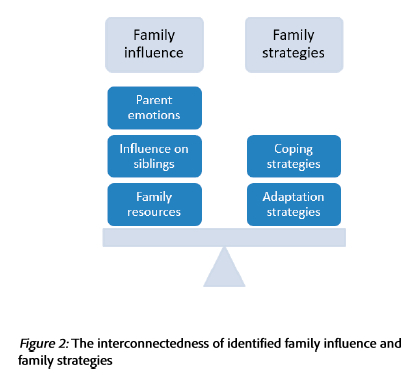
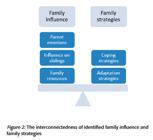
In Figure 2 (page 8), the factors influencing the family are depicted on the left of a scale. In order to balance the various influences on their family, the families seemed to employ various strategies to cope and promote wellness. These are depicted on the right side of the scale. These coping and adaptation strategies, as detailed in the findings, seemed to be aimed at either preventing hyper-reactive responses in the first place or on promoting the wellness of the entire family in response to the challenges they face. As a result of implementing these strategies, the influence of the hyper-reactive responses on the families seemed to become more manageable, and families described better wellness and coping. This balancing act is depicted in Figure 2 (page 8).
In order for service providers to assist children and families of children who experience sensory hyper-reactive responses to clothing, it is vitally important to keep the broader perspective of the child and family in mind when designing interventions. In alignment with a family-oriented approach, service providers should include in their interventions the guidance of families to make the adaptations required to prevent hyper-reactive responses34,35. Additionally, as suggested by King et al.28
The findings highlighted several important aspects that can be addressed to assist families. Firstly, participants were acutely aware of the influence of their emotional responses on their children's behaviour and the importance of regulating their own emotions to prevent the behaviour from escalating. The ability of parents to regulate their own emotions has been described as essential, particularly in cases where parents are required to model appropriate regulation skills to children with regulation difficulties3637
Additionally, gaining knowledge of their child's condition seemed to assist parents in dealing with their daily challenges. It has been described that knowledge about sensory conditions assists parents in understanding and coping better with their child and can even prevent challenging behaviours332128
Adaptation of the routine activity of dressing was also described and can be incorporated into interventions. Parents managed choices and adapted the environment as well as the activity to prevent hyper-reactive responses. The implemented strategies were individualised to fit specific children, and service providers could assist families by providing insight into the sensory preferences of specific children. Several participants described their strategy of helping their child to get dressed, even though they could dress themselves. This was perceived as a workable solution for the family, albeit an outsider may view independent dressing as preferable for the individual child. This insight aligns with the participation-based perspective, where activity participation in routines is prioritised over facilitating individual child development34,38. Service providers may discuss these priorities with families and assist them in reducing feelings of guilt.
Families discussed how they adapted their routines to cope better with the difficulties faced related to clothing. Importantly, service providers should assess the routines of families, such as through a routine-based interview3940
Purposefully adapting clothing that elicits sensory hyper-reactive responses was identified as a well-used strategy. This has not been described in this manuscript, as it is comprehensively discussed elsewhere16
Limitations
It is a limitation of this study that professionals, including teachers and occupational therapists, were included in the initial two focus groups, as this may have influenced the responses of the parent participants. However, the researchers did not experience this as a threat during the focus groups, as all the participants actively participated in the discussion. It was a limitation that only parents (and specifically mothers) from nuclear families were included.
Additionally, the online nature of the focus groups may have created communication difficulties for some participants, as fluctuations in connectivity caused disruptions in one of the focus groups. However, the authors are of the opinion that the benefits in terms of access to participants who would not be able to attend a face-to-face group outweigh the potential risk that the online nature of the focus group may have introduced.
As in most qualitative research, this study used a small, purposive sample and focused on in-depth and contextual understanding rather than breadth. The authors have attempted to increase the transferability of the findings by making the descriptions rich and detailed enough for readers to apply them to other contexts as applicable.
CONCLUSION
This study aimed to explore the influence of hyper-reactive responses to clothing on the families of children with tactile hyper-reactivity and to identify the strategies that families employ to cope. The findings highlighted the potentially profound influence that children's hyper-reactive responses to clothing can have on family emotions, siblings and family resources. Families employ various coping strategies to manage their challenges, including general coping skills and adapting specific clothing and clothing-related activities. Service providers should guide families in adopting strategies to promote the entire family's wellness and to implement adaptations that aim to prevent hyper-reactive responses as far as possible.
Competing interests
The authors have no competing interests to disclose.
AI Declaration
Otter.ai, Otterai Inc. was used solely to transcribe the focus group recordings from audio files into text. No specific prompt was required and the tool was not used to perform any data analysis.
Author contributions
Karin van Niekerk: Conceptualisation, Formal Analysis, Methodology, Visualisation, Writing - original draft preparation and editing. Lizette Diedericks: Investigation, Formal Analysis, Funding Acquisition, Methodology, Writing - review & editing. Both authors agreed to the final version of the manuscript.
Acknowledgements
Thank you to Wenette Jordaan for assistance in the recruitment of participants and data collection, as well as to the participants for their valuable contributions.
REFERENCES
-
1. Andeweg SM et al. Does sensory-processing sensitivity moderate the effect of household chaos on caregiver sensitivity? An experimental design. Journal of Family Psychology. 2021,-35(3):356-365. https://doi.org/10.1037/fam0000766
» https://doi.org/10.1037/fam0000766 - 2. Johnson KKP, Lennon SJ. The social psychology of dress. Fairchild Bloomsbury; 2017.
-
3. Reidy J. Reviewing School Uniform through a Public Health Lens: Evidence about the Impacts of School Uniform on Education and Health. Public Health Reviews. 2021;42(June):1-17. https://doi.org/10.3389/phrs.2021.1604212
» https://doi.org/10.3389/phrs.2021.1604212 - 4. Christopher S. Touch hypersensitivity in children with autism-An analysis. International Journal of Research and Analytical Reviews. 2019;6(2):616-622.
- 5. Dunn W. The impact of sensory processing abilities on the daily lives of young children and their families: A conceptual model. Infants & Young Children. 1997;9(4):23-35.
- 6. Ayres AJ. Sensory integration and learning disorders. Western Psychological Services; 1972.
-
7. Bar-Shalita T et al. Psychophysical correlates in adults with sensory modulation disorder. Disability and Rehabilitation. 2012;34(11):943-950. https://doi.org/10.3109/09638288.2011.629711
» https://doi.org/10.3109/09638288.2011.629711 -
8. Ohanneson B, Schoen SA, Mitchell V. Emerging Ideas. Parent perspectives on children with sensory over-responsivity. Family Relations. 2023;72:2820-2832. https://doi.org/10.1111/fare.12843
» https://doi.org/10.1111/fare.12843 - 9. American Psychiatric Association. Diagnostic and statistical manual of mental disorders. 5th ed. American Psychiatric Publishing; 2013.
-
10. Lord C, Bishop SL Recent advances in autism research as reflected in DSM-5 criteria for autism spectrum disorder. Annual Review of Clinical Psychology. 2015;11:53-70. https://doi.org/10.1146/annurev-clinpsy-032814-112745
» https://doi.org/10.1146/annurev-clinpsy-032814-112745 - 11. Parham LD, Mailloux Z. Sensory integration. In: O'Brien JC, Kuhaneck H, editors. Case-Smith's Occupational Therapy for Children and Adolescents. 8th ed. Elsevier Health Sciences; 2019.
- 12. Karthikeyan C. Evaluative study on consequences of cognitive and sensory overload: a socio-psychological perspective. International Journal of Management, IT and Engineering. 2017,7(4):300-326.
- 13. Ayres AI, Robbins J. Sensory integration and the child: Understanding hidden sensory challenges. Western Psychological Services; 2005.
- 14. van Jaarsveld A. Patterns of sensory integration dysfunction in children from South Africa. South African Journal of Occupational Therapy. 2014;44(2):1-6.
- 15. Zhou Q. Clothing accessory design based on sensory experience. NeuroQuantology. 2018;16(6):460-465.
-
16. Jordaan W, Diedericks L, van Niekerk K, Kruger S. Investigating the Influence of the Properties of School Uniforms on Children With Sensory Overreactivity. Clothing and Textiles Research Journal. 2024,-42(3):205-221. https://doi.org/10.1177/0887302X231187777
» https://doi.org/10.1177/0887302X231187777 -
17. Kyriacou C, Forrester-Jones R, Triantafyllopoulou P. Clothes, Sensory Experiences and Autism: Is Wearing the Right Fabric Important? Journal of Autism and Developmental Disorders. 2023;53(4):1495-1508. https://doi.org/10.1007/s10803-021-05140-3
» https://doi.org/10.1007/s10803-021-05140-3 -
18. King G, Williams L, Hahn Goldberg S. Family-oriented services in pediatric rehabilitation: a scoping review and framework to promote parent and family wellness. Child: Care, Health and Development. 2017;43(3):334-347. https://doi.org/10.1111/cch.12435
» https://doi.org/10.1111/cch.12435 -
19. Newland LA. Supportive family contexts: promoting child well-being and resilience. Early Child Development and Care. 2014;184(9-10):1336-1346. https://doi.org/10.1080/03004430.2013.875543
» https://doi.org/10.1080/03004430.2013.875543 -
20. Chiu EC Preliminary study: Taiwanese mothers' experiences of children with sensory processing disorder. Journal of Nursing Research. 2013;21(3):219-224. https://doi.org/10.1097/jnr.0b013e3182a0afd4
» https://doi.org/10.1097/jnr.0b013e3182a0afd4 -
21. Gourley L, Wind C, Henninger EM, Chinitz S. Sensory Processing Difficulties, Behavioral Problems, and Parental Stress in a Clinical Population of Young Children. Journal of Child and Family Studies. 2013;22(7):912-921. https://doi.org/10.1007/s10826-012-9650-9
» https://doi.org/10.1007/s10826-012-9650-9 -
22. Cunliffe L, Coulthard H, Williamson IR. The lived experience of parenting a child with sensory sensitivity and picky eating. Maternal and Child Nutrition. 2022;18(3):1-11. https://doi.org/10.1111/mcn.13330
» https://doi.org/10.1111/mcn.13330 -
23. Hartman AG, McKendry S, Soehner A, Bodison S, Akcakaya M, DeAlmeida D, Bendixen R. Characterizing Sleep Differences in Children With and Without Sensory Sensitivities. Frontiers in Psychology. 2022;13. https://doi.org/10.3389/fpsvg.2022.875766
» https://doi.org/10.3389/fpsvg.2022.875766 -
24. Spira G. A sensory intervention to improve sleep behaviours and sensory processing behaviours of children with sensory processing disorders. Irish Journal of Occupational Therapy. 2021,-49(1):11-20. https://doi.org/10.1108/IJOT-09-2020-0014
» https://doi.org/10.1108/IJOT-09-2020-0014 -
25. World Health Organisation. Closing the gap in a generation: The WHO report on social determinants of health. 2008 [accessed 2022 Jan 27]. https://www.who.int/publications/i/item/WHO-IER-CSDH-08.1. https://doi.org/http://dx.doi.org/10.1016/j.respe.2009.04
» https://www.who.int/publications/i/item/WHO-IER-CSDH-08.1 -
26. Weiss JA, Tajik-Parvinchi D, Maughan AL, Lake J. Family Wellness in Intellectual and Developmental Disabilities: a Balanced Approach. Current Developmental Disorders Reports. 2018:5(3):157-164 https://doi.org/10.1007/s40474-018-0145-2
» https://doi.org/10.1007/s40474-018-0145-2 -
27. Harari MJ, Waehler CA, Rogers JR. An empirical investigation of a theoretically based measure of perceived wellness. Journal of Counseling Psychology. 2005;52(1):93-103. https://doi.org/10.1037/0022-0167.52.1.93
» https://doi.org/10.1037/0022-0167.52.1.93 -
28. King G, Williams L, Hahn Goldberg S. Family-oriented services in pediatric rehabilitation: a scoping review and framework to promote parent and family wellness. Child: Care, Health and Development. 2017;43(3):334-347. https://doi.org/10.1111/cch.12435
» https://doi.org/10.1111/cch.12435 - 29. Denzin NK, Lincoln YS. The Sage handbook of qualitative research. 5th ed. Sage; 2018.
- 30. Saldana J. The Coding Manual for Qualitative Researchers. SAGE Publications; 2012.
-
31. Cofie N, Braund H, Dalgarno N. Eight ways to get a grip on intercoder reliability using qualitative-based measures. Canadian Medical Education Journal. 2022;13(2):73-76. https://doi.org/10.36834/cmej.72504
» https://doi.org/10.36834/cmej.72504 -
32. Biggs A, Brough P, Drummond S. Lazarus and Folkman's psychological stress and coping theory. In: The handbook of stress and health: A guide to research and practice. Wiley Blackwell; 2017. p 351-364 https://doi.org/10.1002/9781118993811.ch21
» https://doi.org/10.1002/9781118993811.ch21 - 33. Spies R, Van Rensburg E. The experiences of parents with tactile defensive children. South African Journal of Occupational Therapy. 2012;42(3):7-11.
-
34. Campbell PH, Sawyer LB. Supporting learning opportunities in natural settings through participation-based services. Journal of Early Intervention. 2007;29(4):287-305. https://doi.org/10.1177/105381510702900402
» https://doi.org/10.1177/105381510702900402 -
35. Campbell PH, Milbourne S, Wilcox MJ. Adaptation interventions to promote participation in natural settings. Infants & Young Children. 2008;21(2):94-106. https://doi.org/10.1097/01.IYC.0000314481.16464.75
» https://doi.org/10.1097/01.IYC.0000314481.16464.75 -
36. Hajal NJ, Paley B. Parental emotion and emotion regulation: A critical target of study for research and intervention to promote child emotion socialization. Developmental psychology. 2020;56(3):403-417. https://doi.org/10.1037/dev0000864
» https://doi.org/10.1037/dev0000864 -
37. Zhang X, Gatzke-Kopp LM, Cole PM, Ram N. A dynamic systems account of parental self-regulation processes in the context of challenging child behavior. Child Development. 2022:93(5):e501-e514 https://doi.org/10.1111/cdev.13808
» https://doi.org/10.1111/cdev.13808 -
38. Palisano RI et al. Participation-based therapy for children with physical disabilities. Disability and Rehabilitation. 2012;34(12):1041-1052. https://doi.org/10.3109/09638288.2011.628740
» https://doi.org/10.3109/09638288.2011.628740 - 39. Mcwilliam RA, Casey AM, Sims J. The Routines-Based Interview. Infants & Young Children. 2009;22(3):224-233.
-
40. Pereira APS, Jurdi A, Reis HIS, Sousa A. Routine-based interview in early intervention: professionals' perspectives. Support for Learning. 2022;37(3):435-449. https://doi.org/10.1111/1467-9604.12419
» https://doi.org/10.1111/1467-9604.12419

Reviewed: 27 March 2025
Revised: 16 April 2025
Accepted: 11 June 2025
EDITOR
Annelize Kruger
https://orcid.org/0000-0002-7947-2929
DATA AVAILABILITY
The qualitative data collected to support the findings of this study are stored on a password-protected platform at the University of Pretoria, Department of Consumer and Food Science, for a minimum of 10 years. A written request to the authors will be required to access the data.
FUNDING
None to declare.
* Fabric hand refers to the "feel" of a fabric against the skin when touched
** The 19-year-old was still attending school and lived in his familial home.
* Participant identifiers include participant initials and diagnosis/diagnoses of their children