The lived experience of employed patients with spinal cord injury following vocational rehabilitation
Abstract
BACKGROUND: Vocational rehabilitation creates many employment benefits for patients with spinal cord injury. Benefits that include restored self-esteem, lower impact of medical conditions and related complications, promotes well-being and facilitates the safe and timely return of patients with spinal cord injury to work following injury, to name a few. Despite its benefits vocational rehabilitation remains underutilized due to barriers such as inadequate follow up, limited employer engagement and vocational rehabilitation services are often unavailable, inaccessible to or unfamiliar to patients with spinal cord injury. The aim of the study was to describe the lived experiences of employed patients with spinal cord injuries who had received vocational rehabilitation in Gauteng, South Africa, focusing in its effectiveness, challenges and impact on workplace reintegration. METHOD: A descriptive phenomenological qualitative method was utilized. Through purposive sampling ten individuals with spinal cord injury who received vocational rehabilitation, were selected. Individual interviews were conducted using a semi-structured interview guide. Interpretative phenomenological analysis was used to analyse the data. RESULTS: The Person-Environment-Occupation-Participation (PEOP) model was used to extract themes. The ten employed patients with spinal cord injury, reported how they benefitted from vocational rehabilitation as well as the challenges they experienced upon return to work. The benefits included (1) overcoming challenges in the workplace, (2) positive effects on employment and (3) financial independence. Participants stated that (4) absenteeism, (5) promotion opportunities and (6) recognition remained challenging. CONCLUSION: Vocational rehabilitation, specifically the return-to-work aspect, plays a significant role in terms of the employment of patients with spinal cord injuries. Findings highlight the need for structured follow-ups, employer collaboration, and enhanced accessibility measures to optimise vocational rehabilitation outcomes. IMPLICATIONS FOR PRACTICE • Occupational therapists should contribute through providing education on reasonable accommodation (job adaptations, accessibility and workplace modifications) to employers or potential employers, for reintegration into the workplace. • Occupational therapists can identify physical and psychosocial barriers that they can address by means of therapeutic interventions • For a successful return to work the occupational therapists need to collaborate with other interprofessional team members. • With the continuous involvement of the occupational therapists after job placement, challenges can be addressed for job retention and job satisfaction. A comprehensive return to work programme, provided by Occupational Therapists, that improves employment opportunities for individuals living with spinal cord injuries, is highly relevant.
return-to-work; descriptive phenomenological study; PEOP model; occupational therapy; workplace reintegration; good health and well-being; decent work and economic growth; work rehabilitation
BACKGROUND
Spinal cord injury (SCI) is a severe type of traumatic injury with long-lasting negative impacts on health status, functioning, and participation (for example on employment and community participation), personal goals and expectations1234
The first author has experience of working with patients with SCI, as a case manager, in a rehabilitation setting, and observed a high unemployment rate amongst her patients. Many patients with SCI could not return to work due to their age, severity of injury, work experience, and other reasons not identified. The majority of her patients with SCI had received vocational rehabilitation, however, they remained unemployed. Statistics South Africa561
Vocational rehabilitation comprises different intervention types for instance; job readiness training, employer mediation, and workplace modifications), preventing complication and additional disability, return to-, maintain employment or find work7888899
The Person-Environment-Occupation and Performance (PEOP) Model101010person is the patient with SCI characterized by the individuals age, race, level of education, gender, severity of injury, health status and occupation. The environment is the surroundings in which everyday occupations occur. The environmental factors can either facilitate or be a barrier to the patient with SCI. The characteristics that form barriers of the environment includes negative attitudes, inaccessible transport and public buildings, and limited social support, availability of vocational rehabilitation services and resources10Occupations is everything people do to occupy themselves for instance Activities of Daily Living, leisure, social participation and work10
Vocational rehabilitation is a process resorted to in order to overcome the barriers an individual faces when accessing employment, maintaining employment or returning to work, following injury, illness or impairment91112
The four main benefits of vocational rehabilitation following disability namely: firstly, an understanding of existing barriers, secondly to facilitate the patient's effective use of personal and environmental resources, thirdly to assist individuals in adapting to the environment; and fourthly providing recommendations to change the environment in accommodating the needs of the individual for career, personal, social and community adjustment131415
The Constitution of the Republic of South Africa Act 108 (1996)16 17
The important stakeholder, when returning to the work environment or gaining employment is concerned, is the employer. According to Soeker, Wegner and Pretorius181920
Benefits of employment after SCI are multiple and well documented in literature, with productivity and employment being consistently associated with life satisfaction and adjustment20212121222324
METHOD
Research design
A qualitative study approach, specifically descriptive phenomenological qualitative method, was selected to understand the experiences of employed patients with SCI, who received vocational rehabilitation as an intervention to return to work25Participant selection
The first author approached the spinal cord rehabilitation facilities in Gauteng (both public and private) and was given access to the database by clinical managers, to recruit patients with SCI who were legible for the study. The study included participants who met the following criteria: any gender, of working age (age of 25 to 48 years) and who received intervention services for instance work preparation and readiness, work guidance, workplace accommodation and other return to work efforts. The study excluded participants with cognitive problems, for instance, head injuries, or those with an inability to communicate. Purposive sampling was used to recruit ten patients who met the inclusion criteria, to participate in this study.
The author, with the assistance of the administrative staff at the spinal cord rehabilitation facilities, were able to contact the outpatients and briefly outline the aim of the study and invited to take part in in-depth interviews. Appointments were scheduled with the interested outpatients, either at the rehabilitation facilities, place of employment or at their homes. Upon contact consent forms were signed.
Data collection
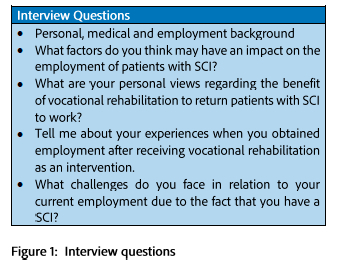
An interview guide was developed to address the aim and objectives of the study, with questions based on existing literature25Fig. 1, below):
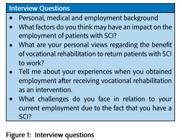
A pilot study was conducted to test the logistics of the interview guide, by interviewing three participants. The first author conducted individual interviews with 10 participants until data saturation was reached26
Data analysis
The interpretative phenomenological analysis was used. The focus of the analysis was to understand the lived experiences of vocational rehabilitation of employed patients who sustained spinal cord injury. Interviews were transcribed verbatim. Transcripts were translated to English prior to analysis. Bracketing was used to set aside authors' own biases and assumptions to better understand the participant's unique perspectives272810
Trustworthiness
To check the trustworthiness of the coding, the author submitted the draft to the co-author for agreement. The co-author coded the information independently, and concurrently codes were compared to ensure that all the provided data were included, in order to come up with well-grounded themes, categories and subcategories. To ensure credibility the first author conducted a preliminary study with three individuals. Three occupational therapists, who are experts in the vocational rehabilitation field were asked to look at the data collected during the pre-test interviews. The data were critiqued by the three occupational therapists and the feed back that was provided enabled the author to refine the interview guide. Dependability was ensured as the author reported the research methodology and the implementation in detail, describing what was planned and executed. To ensure confirmability findings in the research was based purely on the responses of the participants. Transferability was ensured by providing detailed descriptions of the participants and methodology to outline practical application in other contexts.
Ethical considerations
The protocol was submitted to the School of Health Care Sciences Research Committee (SRC), ethical clearance and approval was obtained from Sefako Makgatho Health Sciences University Research and Ethics Committee (SMUREC/H/234/2015:PG). The ethical principles of the Republic of South Africa Department of Health's: Ethics in Health Research 29
FINDINGS
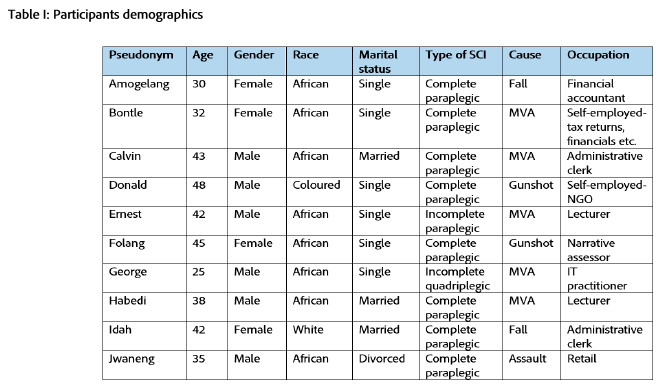
The details of the participants who were interviewed can be found on Table I (page 4). The study included six males and four females, between ages of 25 and 48 years and had received vocational rehabilitation as an intervention to return to work. The majority of the participants' SCI resulted in paraplegia (nine complete lesion and one who had an incomplete lesion). The participants had post high school qualifications, were employed fulltime at the time of the interview and performed administrative duties. All ten participants were previously employed. Two participants required reasonable accommodation and were provided with alternative jobs as they could no longer perform their pre-SCI occupations.
THEMES, CATEGORIES AND SUB-CATEGORIES
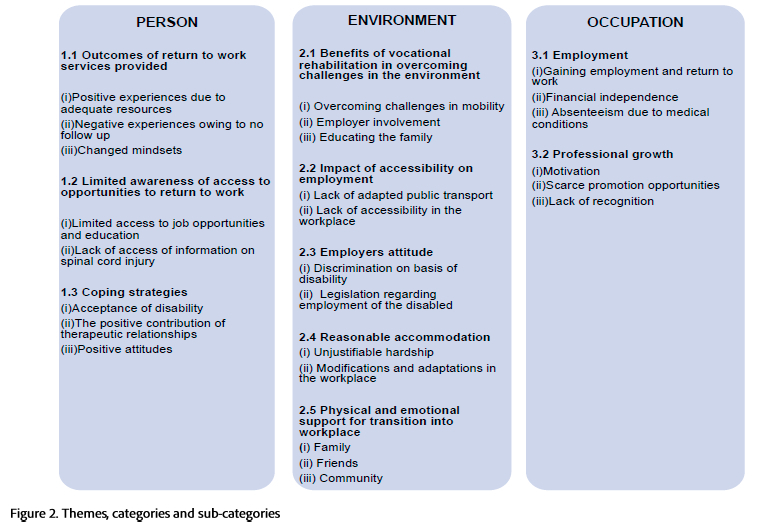
The themes were based on the Person- Environment- Occupation and Performance (PEOP) Model. As can be seen in Figure 2 (below), each theme has accompanying categories and sub-categories derived from the data.
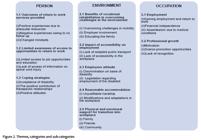
THEME 1: Person
Person is defined by the PEOP model as a unique being who assumes a variety of roles simultaneously3030
Category 1.1:Outcomes of return-to-work services provided
(i)
Positive experiences due to available resourcesThe majority of participants had a positive experience of their vocational rehabilitation journey prior to their return to work. They felt vocational rehabilitation provided them with resources that can equip them to return to work.
"Vocational rehabilitation helps you with your emotion[al] capabilities, [and] your physical capabilities. The help that you receive from the vocational rehabilitation will help you and enable you to meet the world.... This also helps in terms of going into an employment area, to meet other people as well. So they [occupational therapists] provide you with the necessary resources that can equip you to go into the work industry." (Amogelang)
(ii)
Negative experiences owing to limited time spent and no follow upHowever, there were participants who had negative experiences. They expressed dissatisfaction with the short time spent in vocational rehabilitation and inadequate follow up.
"I wish work rehabilitation was fora longer period.... you can't go through training in a short space of time. After voc rehab [vocational rehabilitation] there is no follow up. "(Bontle)
(iii)
Changed mindsetVocational rehabilitation also changed their mindset or perception towards the need for independence in the work environment versus the home environment.
"I will say it assisted me to be independent ....so it assists you to also to have a changed mindset. You should know that now you are at a different environment from your home, where maybe at home you are used to having a person or people who are helping you like family members." (Folang)
Category 1.2: Limited awareness of access to opportunities to return to work
Participants were of the view that it would be difficult for a patient who was unemployed prior to SCI to secure employment due to this limited awareness of access to employment opportunities. The subcategories that were identified were lack of knowledge, education, access to information and resources.
(i) Limited access to job opportunities and education
Participants indicated that after sustaining a SCI a person lacks the knowledge of finding out about employment opportunities and how to improve their educational status. Patients with SCI's who are less educated have difficulties in securing employment or returning to their pre-SCI employment. Technology is currently used in seeking information and employment, and there are those who lacks access to these facilities, due to their socio-economic status.
" It could also be issue of awareness of job opportunities out there .... like where to go, such a place whereby you can contact them and then they can look for work for you, like [for example] in terms of school [education] that how far did they go in their schooling and there are still chances that they can still go to school. "(Calvin)
"Nowadays, you get many jobs that are advertised they will tell people to apply via online and other people cannot access that,
they don't have computers and then some even if they can go to internet cafes, they don't have money to go there." (Folang)
(ii) Lack of access of information on spinal cord injury
Participants identified lack of information about SCI on social platforms like television, social media and radio. The available information is only available to those who know. The participants were of the view that there is no information with regards to where patients with SCI can liaise with other patients for support and where to seek assistance.
"Like you never hear information about spinal cord injury on TV. You never hear of them on radio. Even on social media it doesn't get spoken ofthat much except like on social media there are groups, the groups are existent but they are limited to those who know. Those who don't know they don't have that information and that's where I think the problem is." (Calvin).
Category 1.3: Coping strategies
Coping can be defined as constantly changing behavioural and cognitive efforts made by the individual to cope with stressful events and plays an important role in the adaptation process following SCI1
(i)
Acceptance of disabilityThe participants shared how receiving vocational rehabilitation assisted in coping with their disability, and how most needed time to adjust well.
"It was very difficult for me just to come to terms with how my life has changed. So, in a way vocational rehabilitation has counselled me in accepting the situation that I am in. Just knowing that there is still life even when you are sitting on a wheelchair ." (Bontle).
(ii)
The positive contribution of therapeutic relationshipsParticipants indicated that their relationship with the occupational therapist rendering vocational rehabilitation contributed to their ability to adjust and adapt.
"Looking back,10 years ago, it was a struggle but luckily with vocational rehabilitation, especially, the therapist they did help me a lot, to adjust, and to accept the current situation." '(Calvin)
(iii)
Positive attitudesOne of the participants stated how being disabled, and having received vocational rehabilitation, has indirectly made him more confident and ambitious about life.
"My confidence as a result of counselling through vocational rehabilitation helped me as I was motivated and even more ambitious. I want to work harder than I used to. I'm avoiding to pity myself. This is a condition I'm going to die with. I've accepted it, counselling helped me. And employment [My employer] and my colleagues have to accept me for what I am because I'm proud about myself ." (Habedi)
Every person has a unique experience depending on their knowledge, access to job opportunities, information, attitudes, support system and coping with SCI. Professional therapeutic relationships were highlighted as the tool that ensured that patients with SCI were able to acclimatise to the changes brought about by SCI.
THEME 2: Environment
Physical environment consists of natural and built non-human surroundings and the objects in them. Natural environment includes the geographic terrain. Social environment includes availability and expectations of significant individuals, such as friends, spouse and caregivers and relationship with systems, for instance, political, economic and institutional that influence norms, role expectations and social routines31
Category 2.1: Benefits of vocational rehabilitation in overcoming challenges in the environment
It is essential to design effective vocational rehabilitation programs for persons with SCI for improving return to work outcome following injury. Participants indicated that there are benefits that come with receiving vocational rehabilitation as an intervention to return to work, and these are either physical, emotional and/or social. The three subcategories that were identified were overcoming challenges in mobility, employer involvement and educating the family.
The majority of participants indicated the benefits of vocational rehabilitation in integrating them into the workforce, employer involvement, and including their family members into a programme. Through vocational rehabilitation the participants were able to address and deal with environmental problems that would hinder their participation.
(i)
Overcoming challenges in mobilityThe participants indicated how vocational rehabilitation assisted them into being able to mobilize within their environment.
"Vocational rehabilitation is very beneficial. Not only at work you know, but day to day things [activities]. When you are around, you go to public places, you go to malls...once you get these things [vocational rehabilitation] then you find it [way] much easier [you know] to manoeuvre yourself around and to be able to work every day and to live your life you know, as compared to when you did not attend receive] it at all." (Jwaneng)
(ii)
Employer involvementThe employer is an essential stakeholder when returning to the work environment or gaining employment is concerned. The participants narrated the importance of the occupational therapist negotiating with and preparing the employer, during the vocational rehabilitation process.
"Vocational rehabilitation also helped to negotiate with the employer and also.... informing or educating the employer about his or her [spinal cord as a] disability so that they could negotiate... hours of working, [and] the environment of working. And also assisted the employer, [in] knowing...[the] kind of assistance the person will require." (Folang)
(iii) Educating the family
The participants affirmed that, as part of the vocational rehabilitation process the therapist should also educate and empower family members in terms of both physical and emotional changes required in their approach to the patient with a SCI.
"It was not only me...[my] family was also involved onto how to go about...treating me and possible changes to be made at home. Yeah, and also that thing of [eliminating] feeling sorry for yourself and also for them feeling sorry for me. That thing, [Education] ....shifted...the mindset of... myself and the family. "(Calvin)
Category 2.2: Impact of accessibility on employment
In this category, the participants highlighted the negative and positive impact of accessibility on employment. The main challenges that were highlighted were public and private transport and accessibility into the workplace and buildings. The subcategories that were identified were transport and the workplace.
(i)
Lack of adapted public transportThe participants shared their sentiments regarding transport as the biggest challenge in accessing the workplace due to lack of adapted public transportation, residing in rural areas where there is lack of public transport, not having their own vehicle and if they have a vehicle learning how to operate it, and companies being unable to organise transportation for patients with SCI to reach the workplace.
"And the biggest thing [problem] is the transportation in this country. I learnt how to drive a hand-operated vehicle after the accident through vocational rehabilitation. If my car is giving me a problem, if you are using public transport, you find that you are challenged, you arrive late as a result of the poor public adaptability of transportation." (Habedi)
(ii)
Lack of accessibility in the workplaceParticipants indicated that accessibility in the workplace was a challenge on their day-to-day functioning in terms of manoeuvring their wheelchairs and having to access restricted areas, for instance kitchens, other offices, parking area with their wheelchairs and accommodating adverse weather conditions.
"I have to entersome of the offices maybe that are not wheelchair user friendly [accessible] or don't have space enough to accommodate a person who is in a wheelchair. Or maybe the doorways - the doors, the sizes of the doors were made in such a way that the only size that can pass through is of a person who is walking, not a person who is using some other objects[wheelchair] or some other device." (Folang)
"There's a ramp and then on the ramp there's no shelter in terms of when it's raining. There's a car port where I park, fine, but getting out to get to the office when it's raining then I must wait for the rain to cool off, that's when I can [enter the premises]." (Calvin)
Category 2.3: Employers' attitudes
The participants raised concerns that employers do not see them as individuals who are skilled and can perform their work, despite being disabled. Therefore, employers were deemed as barriers in employment of patients with SCI's. The subcategories that were identified were discrimination on the basis of disability and injustice
(i)
Discrimination on basis of disabilityDiscrimination was deemed as unequal work opportunities by qualified patient with SCI, by an employer, owing to the fact that they are disabled.
"They [Employers] believe we are less of people with ability and that on its own, if you compete against abled [body] people, you are already having a minus on your side [a disadvantage]. And I believe that is discrimination, because if you know there was this scientist who was on a wheelchair and that one was not from an accident [disabled] but he performed and became the best mathematician in the world." (Habedi)
(ii)
Legislation regarding employment of the disabledSome participants were well versed in legislation and, are of the view that they face injustice as a result of their disability in terms of private companies not adhering to legislation of including persons with disability.
"Companies especially private companies, I don't think they do justice to people with disabilities.... there are policies in place that regulates that such a company must at least have 2% of people with disabilities but those things [policies] are not followed. You'll find that in companies, there will be not even one [disabled person]." (Calvin)
Category 2.4: Reasonable accommodation
Reasonable accommodation refers to workplace modification and adaptations. The two subcategories that were identified were unjustifiable hardships and modifications and adaptations to job functions
(i)
Unjustifiable hardshipThe employer can be said to have an obligation to accommodate a disabled or ailing employee, or a feature of a particular culture, but not to the point of unjustifiable hardship. The participants indicated facing a challenge when returning to work, as the employer was not prepared to make alterations to the office environment, for easy movement and manoeuvring of wheelchair. The employer stated that they did not have financial resources.
"But well, it was difficult because of work and they [employer] could not change the resources...to benefit me because with me being [I am] in a wheelchair... the structures were not really much friendly for me." (Amogelang)
(ii)
Modifications and adaptations in the workplaceHabedi had a positive opinion, and narrates how his environment was modified to suit his needs:
"One [of the] toilet is being altered, it suit my needs. And the doors in some of the lecture rooms have been altered to suit my needs. I can say I'm very fortunate. My employ [er] has really accommodated my condition."
Ernest indicated how his employers adapted his job functions: "There are no major challenges, but standing up for long hours, as I have to use crutches. So my superiors... have accommodated me. They actually allow me to teach while I'm seated."
Category 2.5: Physical and emotional support for transition into workplace
Support from family members and friends after SCI, ensured easy transition back into the workforce, is as smooth as possible for patients with SCI's. The subcategories that were identified were family, friends and community.
(i) Family
"My family was there for me through the trying times, I was so depressed. I didn't want to live anymore, but because of their support, I managed to accept my condition and learnt to live with it." (Idah)
(ii) Friends
"You see, after the injury, I was isolated and didn't want....to see anyone. Every time my friends would [come and visit]... I was so shy. But I was happy that my friends didn't judge me and always assured me." (Jwaneng)
(iii) Community
"And you know right now people in my community... are now used to me being in a wheelchair and give me support where necessary." (Bontle)
The environment is where daily activities take place. Without appropriate structures put in place to ascertain access to transport and workplaces, involvement of the employer, modifications and adaptations to job functions, and education of family members and support from family, friends and community, the patients with SCI remains disadvantaged in seeking and gaining employment.
THEME 3: Occupation
Occupations can have an influence on work. Engagement in occupations, in the case of the current study, occupation being work, provides the sense of competence, autonomy, temporal organization, and meaning of existence to individuals30
Category 3.1: Employment
In this category the participants emphasized how employment has made a significant difference in their lives and barriers associated with employment of patients with SCI as well as the challenges of medical conditions that come with SCI, in the workplace. The three subcategories that were identified were gaining employment and return to work, financial independence and absenteeism due to medical conditions.
(i)
Gaining employment and return to workVocational rehabilitation can help a client to identify their remaining skills and where necessary contribute to enhancing their abilities. Patients may even be guided into becoming self-employed, securing new employment or returning to their pre-SCI occupations.
"The people [occupational therapists] who are talking to me in the vocational rehabilitation would ask me ....what kind of work I am doing and such things (so forth]. And as part of the rehabilitation process they would teach me like [how] to write on the board, and beingable to cope in the work environment...I found it very beneficial."(Ernest)
(ii)
Financial independenceThe participants indicated that they value their financial independence and ability to contribute to not only their own livelihood but also to the country's economy.
"Being employed has given me a sense of purpose and able to sustain myself financially ."(Idah)
(iii)
Absenteeism due to medical conditionsThe participants specify that due to the medical conditions related to SCI are often absent from work.
"Yeah. ...like now since it's winter, eish, with my back pain and spasms as well you know that's when I suffer the most. Yeah because I cannot be in a wheelchair fora long period of time.... I have to like now and again lie back, rest my back but as it is, now at work, I was given problems in terms of sick leave... initially it was like four to five months then it changed, some new management came in." (Calvin)
Category 3.2: Professional growth
In this category, the participants narrated how they would like to grow within their profession, promotion opportunities and be recognized as a team player. The subcategories that were identified were motivation, promotion and recognition.
(i) Motivation
Motivation is an experience of aspiration to academic and professional achievement, where employment is concerned.
"I want before the age of 50 to be a doctor in my field of study." (Habedi).
(ii) Scarce promotion opportunities
Promotions in the workplace are usually based on the employee excelling in their current position, exceeding expectations, on merit and work experience. However, participants indicated patients with SCI, being disabled has minimized their chances of being promoted.
"At work now, the current challenge that I am facing is the issue of promotion. Yeah nothing was done I was just left there for now almost I can say 10 years of which I feel it's unfair on my side." (Calvin)
(iii) Lack of recognition
Habedi narrates that since he sustained the SCI his co-workers do not recognize him:
"I see that even if I give an opinion at work, some colleagues are just saying 'ah it's just his opinion'. In the past, before I got an accident, when I gave an opinion, they could [say] 'yeah this is lecturer so and so speaking' and they would think about it. So I'm battling to be recognized and I don't like it."
Employment is of utmost importance to patients with SCI as it provided them with financial independence and being able to contribute to the country's economy. Motivation was noted to be key for professional growth. Barriers associated with being an employed patient with SCI such as absenteeism due to medical conditions, lack of recognition and promotions were emphasized by the participants.
DISCUSSION
Person
Participants expressed their concern about the high rate of unemployment of patients with SCP.The majority of participants indicated that in terms of perso η-factors the advantages of vocational rehabilitation assisted them to improve their capacity to cope with the disability and knowing their current physical capabilities and what job would suit these capabilities313233
Participants reiterated that unemployment was as a result of lack of knowledge about job opportunities and, access to information regarding SCI. Patients with SCI experienced problems of vocational decision-making that included lack of information about employment opportunities, uncertainty about vocational and educational abilities and lack of knowledge of occupations332134
Environment
Understanding the legal framework regarding environmental barriers in the workplace is helpful to guide the employer on return to work of disabled employees. The South African White Paper on the Rights of People with Disabilities3535
One of the main challenges highlighted was accessibility into the workplace and buildings. Joseph et al.3633736
In South Africa, a legal framework exists that promotes the employment as well as assistance of people with disabilities in the workplace. It is captured in what is known as the Employment Equity Act (EEA) No.55 of 1998, which promotes employment equity1717
Job modifications are often indispensable to reintegrate successfully in former and new job17
Occupation
In terms of occupation-factors, to be re-integrated into the work force, vocational rehabilitation provided the necessary vocational and life skills for adapting to the work industry, and address factors that would hinder participation31
In the South African context, no publications were found where the rate of employment post SCI, after receiving vocational rehabilitation as an intervention service, was explained. In the United States of America, Ottomanelli, Cotner, Swanson, Dirk, Arriola, Carlomagno and Toscano38393939
The focus should however also be on the time spent receiving vocational rehabilitation, as some participants were dissatisfied. There was no follow up upon discharge and or after successful work placement, which is therefore indicative of the lack of comprehensive vocational rehabilitation services that are offered in Gauteng Province4040 3940
Participants stated that upon discharge there was no follow up. Follow-up is highly recommended for all patients with SCI who used vocational rehabilitation services4141
When cognisance is taken of patients with SCI who received vocational rehabilitation as an intervention, it was evident that, for the employed participants, vocational rehabilitation played a significant role in terms of their return to employment. Access to these services equipped participants with information and skills in order to cope, as people, within their work environments and occupations.
Limitations
The study focused only on the lived experiences of vocational rehabilitation on the employment of patients with SCI around Gauteng Province. The study could have focused more on those that were unemployed and had received intervention services, in order to determine the influence of vocational rehabilitation in securing employment. This was initially a two phased study, however only the qualitative phase was included in this article which means that any other evidence such as the quantitative phase that may have enhanced this article were excluded. The sample size was limited, with most participants being male and African.
CONCLUSION
The most critical finding is that employed patients with SCI benefitted from vocational rehabilitation when return to work is concerned. However, the unemployment rate of patients with SCI remains a stumbling block, in leading a productive life. To address the challenges of receiving adequate vocational rehabilitation and returning to gainful employment, post SCI, recommendations can be made to ensure adequate vocational rehabilitation services are provided to patients with SCI. It is evident that the vocational rehabilitation process is not carried out fully. It is noted that majority of patients with SCI were not followed up, after placement. This phase is fundamental to a sustainable and successful outcome of return to work, and may bring about an increase in the low employment rate of this patients with SCI.
The study also identified that improved access to information and knowledge in the community regarding available resources, for return to work and SCI, could enhance level of participation of patients with SCI, thereby improving the patient's quality of life.
It is essential that occupational therapists should support patients with SCI in the transition from being out of work to establishing worker roles by thoroughly assessing an individual's physical abilities, cognitive skills, and work environment, a personalized plan can be developed. This plan would outline specific tasks, modifications, and assistive devices or technologies needed to support safe and efficient participation in their desired job role. Collaboration with employers and other healthcare professionals is often involved to ensure a smooth reintegration into the workplace. The environmental factors such as access to reliable transport, workplace, and public places for wheelchair users are important and there should be laws in place that could potentially support patients with SCI returning to work or securing employment.
There is also a need to encourage full participation by collaboration with policymakers, other health professionals, previous employer or potential employer of the patient with SCI in the vocational rehabilitation process, for easy integration into the work force. Occupational Therapists could contribute through providing education on reasonable accommodation (job adaptations, accessibility and workplace modifications) to employers or potential employers, awareness about disability, skills development for patients with SCIs, development of barrier free structures and to get government departments involvement. Therefore, conducting further research to develop a comprehensive return-to-work program that improves employment opportunities for individuals living with spinal cord injuries is highly relevant.
Conflicts of interest
The authors have no conflicts of interests to declare.
Author contributions
Boikhutso Molwana and Hanlie Pitout conceptualised the research project, collected and analysed the data. Both authors wrote and revised the journal article to completion and approved the final version.
Acknowledgments
All the patients with spinal cord injuries who participated in this study
REFERENCES
-
1. Bezuidenhout L, Rhoda A, Conradsson D, M Theron, & Joseph, C. Factors influencing employment among people with spinal cord injury in South Africa. Disability and Rehabilitation. 2022. Nov 28 (1-7) doi: https://doi.org/10.1080/09638288.2022.2151651
» https://doi.org/10.1080/09638288.2022.2151651 -
2. Jaffe RH, Coyte PC, Chan BC, Hancock-Howard RL, Malhotra AK, Ladha K, Wilson JR, Witiw CD. Traumatic Cervical Spinal Cord Injury and Income and Employment Status. JAMA Network Open. 2024. June 3;7(6):e2418468. doi: 10.1001/jamanetworkopen.2024.18468. PMID: 38916890; PMCID: PMC11200142.
» https://doi.org/10.1001/jamanetworkopen.2024.18468 -
3. Joseph C, Scriba E, Wilson V, Mothabeng J, & Theron F. People with Spinal Cord Injury in Republic of South Africa. American Journal of Physical Medicine & Rehabilitation.2017; 6(2): 109-111. doi: https://doi.org/10.1097/PHM.0000000000000594
» https://doi.org/10.1097/PHM.0000000000000594 -
4. Nizeyimana E, Phillips J, Joseph C. Psychosocial reintegration following traumatic spinal cord injury in South Africa: The influence of employment, injury characteristics and living situation. Journal of Spinal Cord Medicine. 2024. March;47(2):255-262 https://doi.org/10.1080/10790268.2021.2016306.
» https://doi.org/10.1080/10790268.2021.2016306 -
5. Statistics South Africa. Work and labour force. 2018 Pretoria: South Africa. [Internet] Available on: http://www.statssa.gov.za/. [Accessed 20 December 2018].
» http://www.statssa.gov.za/ -
6. Joseph C, Delcarme A, Vlok I, Wahman K., Phillips J, Wikmar LN. Incidence and aetiology of traumatic spinal cord injury in Cape Town, South Africa: a prospective, population-based study. Spinal Cord. 2015; 53:692-6. https://doi.org/10.1038/sc.2015.51
» https://doi.org/10.1038/sc.2015.51 -
7. Canhete Pereira RM, Monteiro I. Vocational rehabilitation and return to work: integrative review. Rev Bras Med Trab. 2020 Apr 15,17(3):441-455. doi: https://doi.org/10.5327/Z1679443520190350.
» https://doi.org/10.5327/Z1679443520190350 -
8. van Biljon, H., Casteleijn D., du Toit, S.HJ. & Rabothata, S. An Action Research Approach to Profile an Occupational Therapy Vocational Rehabilitation Service in Public Healthcare. South African Journal of Occupational Therapy. 2015; 45 (3): 40-47. doi: http://dx.doi.org/10.17159/2310-3833/2015/v45n3/a8
» http://dx.doi.org/10.17159/2310-3833/2015/v45n3/a8 - 9. van Biljon, H.M. Transforming the vocational rehabilitation services of occupational therapists in Gauteng public healthcare through action learning action research. Unpublished doctoral dissertation. 2016; University of Witwatersrand: Johannesburg.
- 10. Baum CM, Christiansen CH, & Bass JD. The Person- Environment-Occupation- Performance (PEOP) model. In C. H. Christiansen, C. M. Baum, & J. D. Bass (Eds.), Occupational therapy: performance, participation, and well-being. (4th ed) 2015. SLACK Incorporated: Thorofare, New Jersey.
-
11. Hilton G, Unsworth CA, Murphy GC, Browne M, & Olver J. Longitudinal employment outcomes of an early intervention vocational rehabilitation service for people admitted to rehabilitation with a traumatic spinal cord injury. Spinal Cord. 2017; 55, 743-752; https://doi.org/10.1038/sc.2017.24
» https://doi.org/10.1038/sc.2017.24 -
12. Chimedza I, Uys, & Soeker S. 'The Impact of Impairment, Socio-démographie and Environmental Factors on Spinal Cord Injury Survivors' Ability to Return to Work. Work. 2023 Vol. 75, no. 2, pp. 461-469. https://doi.org/10.3233/WOR-205036
» https://doi.org/10.3233/WOR-205036 -
13. Mlenzana NB, Frantz JM, Rhoda AJ, Eide AH. Barriers to and facilitators of rehabilitation services for people with physical disabilities: A systematic review. Afr J Disabil. 2013 Sep 19,-2(1):22. doi: 10.4102/ajod.v2i1.22. PMID: 28729982; PMCID: PMC5442576.
» https://doi.org/10.4102/ajod.v2i1.22 - 14. Escorpizo, R., Miller, W.C., Trenaman, L.M. & Smith E.M.2018. Work and Employment Following Spinal Cord Injury. In: Eng, J.J., Teasell, R.W., Miller W.C., Wolfe, D.L, Townson, A.F., Hsieh, J.T.C, Connolly, S.J., Noonan V.K., Loh, E. & Mclntyre, A. (eds). Spinal Cord Injury Rehabilitation Evidence. Version 5.0. Vancouver: p 1-22.
- 15. Gobelet C, & Franchignoni F. Vocational Rehabilitation. 2006; Springer: Paris.
-
16. The Constitution of South Africa. 1996. [Internet] Available from: https://www.gov.za/documents/constitution/Constitution-Republic-South-Africa-1996-1 [Accessed: 20 November 2022].
» https://www.gov.za/documents/constitution/Constitution-Republic-South-Africa-1996-1 -
17. South African Department of Labour. 2015. The Employment Equity Act No.55 of 1998 [Internet] Available from: http://www.labour.gov.za/DOL/downloads/legislation/acts/employment-equity/eegazette2015.pdf [Accessed: 28 November 2018].
» http://www.labour.gov.za/DOL/downloads/legislation/acts/employment-equity/eegazette2015.pdf - 18. Soeker MS, Wegner L, & Pretorius B. I'm going back to work: back injured clients' perceptions and experiences of their worker roles. Work. 2008; 30 (2): 161-170. PMID: 18413932.
-
19. The Department of Public Service and Administration. Policy on reasonable accommodation and assistive devices for employees with disabilities in the public service. 2015 [Internet] Available on: https://www.dpsa.gov.za/dpsa2g/documents/ee/2015/289_1_2_3_20082015_Policy.pdf. [Accessed 07 February 2023]
» https://www.dpsa.gov.za/dpsa2g/documents/ee/2015/289_1_2_3_20082015_Policy.pdf - 20. Maja, P.A., Mann, W.M., Sing, D., Steyn, AJ. & Naidoo, P. 2011. Employing people with disabilities in South Africa . South African Journal of Occupational Therapy. 41 (1): 24-31.
- 21. Meade MA, Armstrong AJ, Barrett K, Ellenbogen PS, & Jackson MN. Vocational rehabilitation services for individuals with Spinal Cord Injury. Journal of Vocational Rehabilitation. 2006; 25 (1): 3-11.
-
22. Ottomanelli L, & Lind L. Review of critical factors related to employment after spinal cord injury: implications for research and vocational services. Journal of Spinal Cord Medicine. 2009; 32: 503-531. doi: https://doi.org/10.1080/10790268.2009.11754553
» https://doi.org/10.1080/10790268.2009.11754553 -
23. Holmlund L, Guidetti S, Eriksson G. & Asaba, E. Return to work in the context of everyday life 7-11 years after spinal cord injury - a follow-up study. Disability and Rehabilitation. 2018; 40(24):2875-2883. doi: https://doi.org/10.1080/09638288.2017.1362597
» https://doi.org/10.1080/09638288.2017.1362597 -
24. Yasuda S, Wehman P, Targett P, Cifu DX & West M. Return to work after a spinal cord injury: A review of recent research. Neuro Rehabilitation. 2002;17(3):177-186.doi: https://doi.org/10.3233/NRE-2002-17302
» https://doi.org/10.3233/NRE-2002-17302 - 25. Hammell KW. Spinal cord injury rehabilitation.2014 Springer: Edinburgh.
- 26. Brink HI. Fundamentals of Research Methodology for Health Care Professionals. (3rd ed). 2012 Juta & Co Ltd : Cape Town.
-
27. Guest G, Namey, E. & Chen M. A simple method to assess and report thematic saturation in qualitative research. PLoS One. 2020. May 5;15(5):e0232076. doi: https://doi.org/10.1371/journal.pone.0232076
» https://doi.org/10.1371/journal.pone.0232076 -
28. Thomas, S. P., & Sohn, B.K. 2023. From Uncomfortable Squirm to Self-Discovery: A Phenomenological Analysis of the Bracketing Experience. International Journal of Qualitative Methods, 22. https://doi.org/10.1177/16094069231191635 (Original work published 2023)
» https://doi.org/10.1177/16094069231191635 - 29. Braun V, & Clarke V. Thematic analysis: A practical guide. 2021. SAGE Publications. London
-
30. National Department of Health. Ethics in Health Research Principles, Processes and Structures.2015. [Internet]. Available on : https://knowledgehub.health.gov.za/system/files/elibdownloads/2023-04/NHREC-DoH-2015-Ethics-in-Health-Research-Guidelines-1_0.pdf. [Accessed on 30 July 2024]
» https://knowledgehub.health.gov.za/system/files/elibdownloads/2023-04/NHREC-DoH-2015-Ethics-in-Health-Research-Guidelines-1_0.pdf - 31. Law M, Strong S, Rigby P, Steward D, Cooper B, & Letts L. Application of the Person Environment and Occupation Model: A practical tool. Canadian Journal of Occupational Therapy. 1999; 6 (3): 122-133
- 32. Occupational Therapy Practice Framework: Domain and process. 4th Edition. The American Journal of Occupational Therapy. 2020; 68 (1): S1-S48.
-
33. Dorsett P, Geraghty T, Sinnott A, & Acland R. Hope, coping and psychosocial adjustment after spinal cord injury. Spinal Cord Series and Cases. 2017; 3:17046. doi: https://doi.org/10.1038/scsandc.2017.46
» https://doi.org/10.1038/scsandc.2017.46 - 34. Heymann J, Steyn AS, & Moreno G. Disability and equity at work. 2014. Oxford University Press: United States of America
-
35. Charles WP, Gie L & Musakuro RN. Barriers to the employability of people with disabilities in the South African public service. African Journal of Disability. 2023. July 17;12:1178. DOI: https://doi.org/10.4102/ajod.v12i0.1178
» https://doi.org/10.4102/ajod.v12i0.1178 -
36. Joseph C, Scriba E, Wilson V, Mothabeng J, & Theron F. People with Spinal Cord Injury in Republic of South Africa. American Journal of Physical Medicine & Rehabilitation.2017; 6(2): 109-111. doi: https://doi.org/10.1097/PHM.0000000000000594
» https://doi.org/10.1097/PHM.0000000000000594 -
37. The Republic of South Africa. White Paper on the Rights of People with Disabilities[lnternet] Available from: https://www.westerncape.gov.za/assets/departments/social-development/081_white_paper_on_the_rights_of_persons_with_disabilities_cabinet_approved.pdf [Accessed: 08 June 2024].
» https://www.westerncape.gov.za/assets/departments/social-development/081_white_paper_on_the_rights_of_persons_with_disabilities_cabinet_approved.pdf -
38. Ottomanelli L, Cotner BA, Swanson SJ, Dirk L, Arriola NB, Carlomagno J, & Toscano R. Individual Placement and Support Helps People With Spinal Cord Injury Find and Keep Jobs They Want. Archives of Physical Medicine and Rehabilitation (2023). doi: https://doi.org/10.1016/j.apmr.2022.11.019
» https://doi.org/10.1016/j.apmr.2022.11.019 -
39. van Biljon, Hester M, Casteljien, Daleen, du Toit, Sanetta H J, & Soulsby, Lynn. (2016). Opinions of occupational therapists on the positioning of vocational rehabilitation services in Gauteng Public Healthcare. South African Journal of Occupational Therapy, 46(1), 45-52. https://doi.org/10.17159/2310-3833/2016/v46n1a10
» https://doi.org/10.17159/2310-3833/2016/v46n1a10 -
40. Coetzee, R, Goliath, C, van der Westhuizen, R. & van Niekerk, L. Re-conceptualising vocational rehabilitation services towards an inter-sectoral model. South African Journal of Occupational Therapy. 2011; 41(2): 32-37. https://journals.assaf.org.za/index.php/sajot/article/view/19738
» https://journals.assaf.org.za/index.php/sajot/article/view/19738 -
41. Buys T. Professional competencies in vocational rehabilitation: Results of a Delphi study. South African Journal of Occupational Therapy. 2015; 45: 48-54. https://doi.org/10.17159/2310-3833/2015/v45n3/a9
» https://doi.org/10.17159/2310-3833/2015/v45n3/a9

1st Review: 19 March 2024
Revised: 21 October 2024
2nd Review: 2 February 2025
Revised: 28 March 2025
Accepted: 8 April 2025
EDITOR
Hester van Biljon
https://orcid.org/0000-0003-4433-6457
DATA AVAILABILITY
The data that support the findings of this study are available from the corresponding author upon reasonable request
FUNDING
Self-funded - The authors received no funding for this research