Biomechanics for first year occupational therapy students: enriching learning using an E-learning resource
Abstract
INTRODUCTION: The educational requirements of students are constantly changing due to technological development. Technology can stimulate and enrich learning but ensuring that teaching methods remain relevant is a challenge. Hybrid learning, including e-learning, in occupational therapy is developing but remains a largely unexplored field in South Africa. METHOD: Changes in achievement associated with the use of an e-learning resource developed for biomechanics was determined. Outcomes were measured using a quasi-experimental design with a pre-test-intervention-post-test repeated measure timeline method. Students' experiences associated with using this e-learning resource were determined by a survey questionnaire. A convenience sample group of N=8I first year occupational therapy students in 2010 and 2011 was obtained. FINDINGS: A positive change in achievement were identified especially at the lower levels of Bloom s taxonomy. The use of the e-learning resource was found to be a positive learning experience. CONCLUSION: The e-learning tool had a significant effect on learning and the majority of participants experienced it as positive.
electronic media-based learning, e-learning; performance; occupational therapy students; hybrid learning
INTRODUCTION
Rapid technological development and the expectations of students born during the era identified as the y-generation (1979-1995) has impacted on learning requirements. This generation relies on instant, easy access to information. They piece together information from multiple sources which strengthens their intuitive visual communication, this poses a unique challenge to educators today12,3.
Educators are ultimately responsible for including e-learning resources in a manner that will improve rather than limit learning. Hybrid learning developed from the need to use electronic media to enhance education.
Internationally, occupational therapy educators have questioned the use of e-learning and whether it will be effective and acceptable to students. Initial resistance to e-learning in occupational therapy was identified possibly due to limited computer literacy4,5,6. Limited computer literacy was found in older studies where populations did not have daily access to computers. Most South African occupational therapy students now have access to electronic media and mobile devices, but many experience financial constraints which impact on their ability to own their own computer and pay for internet data. By 2011 when this study was conducted only 39% of urban and 27% of rural young people had mobile data access to the internet in South Africa7568
Occupational therapy students need to apply anatomical and mechanical knowledge when they assess and treat clients. Personal experience has shown that many occupational therapy students struggle to understand the mechanical principles applied to human function. Therefor an e-learning resource, in the form of an interactive CD, was developed as part of a hybrid learning39
E-learning resources are becoming more widely used in structured educational institutions worldwide. Rapid technological advances and the present generation of students place demands on educational developments110,11. Theoretically, the self-directed nature of e-learning may improve critical thinking11
Education in developing countries, such as South Africa, may be affected by the socio-economic level of communities. Children growing up in low-income households are often undernourished and more prone to illness which can result in absence from school12121388,12. Unskilled students may be reluctant to use e-learning resources which may limit rather than assist learning. However, the use of e-learning may assist these students that may be perceived as slow learners to master the concepts in their own time by setting their own goals and learning at their own pace5,6,8.
Attitudes of occupational therapy students to the use of electronic media have gradually changed over time. In 1998, Cameron14 87,14. In 2007, medical students who were able to set their own goals, through e-learning, were more motivated to learn5413,14
The cultural diversity of South African students necessitates evaluations of e-learning resources. The evaluation discussed in this paper considered the academic performance and experiences of first year occupational therapy students at a South African university.
METHODOLOGY
The biomechanics module taught to first year occupational therapy students at the University of Pretoria uses sequential learning. The module comprises two sections namely basic mechanics and the human body. These sections formed two study units each, the first being factual knowledge and the second application. The knowledge covered in each of these four learning units was built on knowledge gained from the preceeding unit, resulting in increased complexity. The material covered in the modules was placed on a CD entitled the 'Basic Biomechanics for therapists'912,13. The students were able to choose the information that they wished to access. The content of the CD included videos, animations, links to terms, related photographs and sketches and drag and drop elements. The content was divided into different learning units namely: basic mechanical principles; application of basic mechanical principles in the physical world; basic human anatomy and function and application of mechanical principles to the human body. Case studies and formative self-assessments that require applying the correct principles through drag and drop choices were incorporated throughout the CD9
A quasi-experimental observational study159l6. The students' experiences of using the CD was obtained at the end of each data capturing session.
Sampling
The study targeted first year occupational therapy students in South Africa, studying at the University of Pretoria in 2010 and 2011. Capturing data in 2010 and 2011 allowed for sample size accumulation. A larger sample would allow for generalisation to the occupational therapy student population studying at this particular university. Students were provided with written and verbal information on the study at the beginning of the learning module, and requested to volunteer to participate in the study. No exclusion criteria were set for participation, which was voluntary and did not limit the teaching and learning opportunities available to all students. All the students in each of the years under consideration selected a number from a box to ensure anonymity throughout the study. Anonymous evaluations according to these numbers ensured that participants did not have undue stress and that non-participants were not discriminated against. The sample consisted of N = 81 students out of a possible of 84. Non-participants had equal access to the CD and face-to-face sessions. They completed the same pre- and post-tests together with the sample group using the selected numbers. Numbers that did not correspond with the numbers on the consent forms, were excluded from the data at the end of the module.
Ethical considerations
Consent forms were signed using selected numbers as an identifier. Participation was voluntary and data capturing sessions took place during normal scheduled class time. Ethical approval, number SI63/2009, was obtained from the Ethical Committee of the University of Pretoria.
Measurement tools
A multiple-choice questionnaire (MCQ) measured performance for each learning unit17,18. Each set of MCQ questions were based on the 'Basic Biomechanics for therapists'919
A survey questionnaire evaluated participants' experiences when using the 'Basic Biomechanics for therapists'920,21.
Research process and data capturing Research Process
Basic demographic information was collected at the informed consent stage. The MCQs, the 'Basic Biomechanics for therapists'9
Steps in the research/learning process
Step one
The subject was presented over a period of 12 weeks. These 12 weeks were divided into four, three week units. Each unit consisted of two face-to-face sessions of two hours each covering the content of one of the learning units as presented in the CD, starting with the basic mechanical concepts. The third week (step two to four) for each of the four units was conducted in a computer lab using the CD as learning tool.
Step two
Four sessions were held, in a computer laboratory, during which the CD was used for learning purposes. Each of these sessions was preceded by a pre-test based on the content learned during the preceding two face-to-face sessions. The student was required to answer 20 randomly selected questions from a possible 30 as part of the computer based programme. Upon completion, participants could access their total score but could not see which questions were correct or incorrect.
Step three
The pre-test was followed by an intervention session of approximately 45 minutes during which the content based on the learning units presented during the two preceding face-to face sessions could be accessed by on the computer according to the students' individual needs. Each computer laboratory session therefore covered different information according to the progression of the curriculum as divided into the four learning units of the CD. Students were observed to see when they had all completed their perusal of the content to determine the end of the session.
Step Four
At the end of the computer laboratory session during which the learning material was accessed, the student was required to complete a second set of 20 MCQs out of a possible 30 questions, covering the material just accessed on the CD. Each session concluded with a 10-minute experience survey.
Data management and statistical analysis
Data were recorded according to the identity numbers selected by the students. All the data was captured electronically and transferred into an Excel® spread sheet for statistical analysis. The data received was recorded and analysed according to consenting participant numbers. Results of non-participants were removed before submission for analysis.
Pre-test and post-test scores were compared to measure the effect of the intervention tool on performance in the MCQs. The mean difference between the pre- and post-test scores was calculated from the test score change of each participant in each of the four learning units and recorded as continuous interval data. Pre and post-test scores were compared using paired t-tests, with a 0.05 level of significance. A two-tailed analysis accommodated positive and negative changes22,23. Year groups were analysed separately and together. The correlation between the pre- and post-test performance scores using a co-variance analysis with a 95% confidence interval was assessed. Mean pre-test and post-test scores were compared using a repeated measures ANOVA which account for related sample means21
The results of the experience survey were measured as discrete ordinal data2425
STATA 1 1R software was used for statistical analysis.
RESULTS
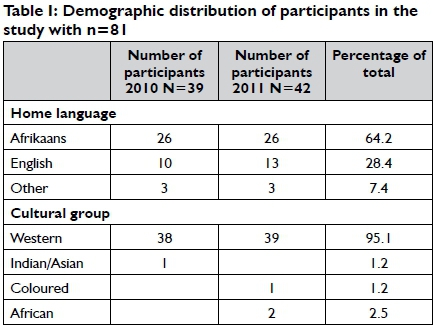
Participants were 98.8% female, 64.2% Afrikaans-speaking and 95% white, resulting in limited cultural differences within the group. (See Table I)
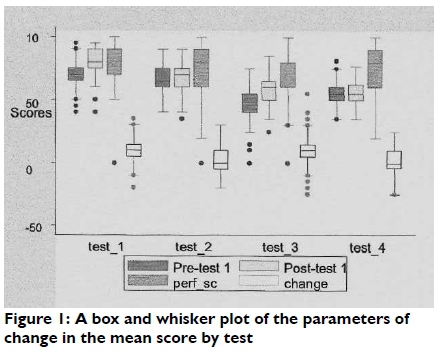
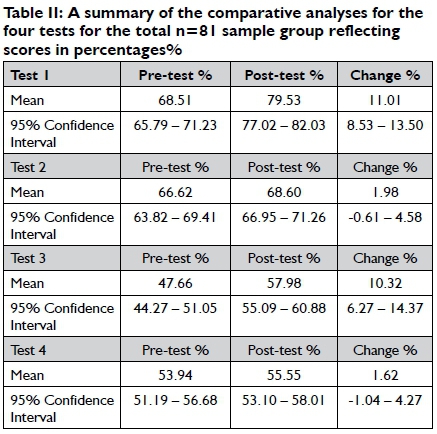
There was a positive change in performance. The magnitude of the change varied between the four sets. The pre-test scores and post-test scores were significantly different for all sets of tests (test one t=0.0009, p<0.05; test two t= 0.0004, p<0.05; test three t= 0.0008, p<0.05; test four t= 0.0012, p<0.05) (Figure 1, Table II).
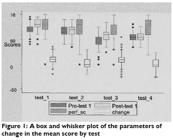
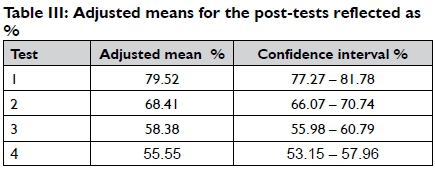
Change in test scores over the course of the intervention varied between the first and third tests and between the second and fourth tests (Table III). The adjusted means by test for the total sample group are reflected in Table III. Minimal adjustment of the pre-test sores was needed.
The combined adjusted pre-test scores were significantly lower than the combined post-test scores (t=0.0008, p=0.00). Despite this overall improvement, variation was observed in the changes for the different tests (Figure 1 on page 39). There was a negative change or deterioration in test scores for the lower quartile of students for tests two and four.
Data were equally distributed in pre- tests one and four. Posttest scores improved after the CD format learning one to four. Test scores were positively skewed in pre-test two, but skewed towards the lower continuum in post-test two. Pre- test and post-test three scores were negatively skewed indicating that less participants experienced an improvement in their results compared to the average26
The experience of the participants was expressed as frequencies for each performance test (Table IV on page 39). Responses did not differ between tests for most questions. Responses varied between tests for questions three and ten (Table IV). Question three asked whether students had a perceived improvement of knowledge.
During the first session, 81% of participants responded positively, 66% of participants in the second and third session and 57% in the final session. Question ten measured the satisfaction of using this e-learning tool. There was a decline in positive responses from 85% in session one to 64% in the subsequent three sessions. Most of the responses were positive for all questions except for question five that asked whether an auditory element should be added to the CD. Most participants (60.22%) responded negatively.
The Cronbach-alpha test analysed the internal consistency and reliability coefficient for the experience survey. The reliability coefficient increased for each session, with the first session having a moderate reliability of 0.44 and the fourth session having a reliability of 0.75. The combined reliability coefficient for all ten questions over all sessions was 0.64 indicating moderate reliability22
DISCUSSION
Participants that used the 'Basic Biomechanics for therapists'919
The experiences of participants using the CD were mostly positive. There were more negative responses for question three which measured perceived improvement in personal understanding. Positive responses declined from 81% after session 1 to 57% after session 4. Once again, the increasing complexity of the content may be associated with decreases in perceived personal improvement. Participants rejected the suggestion of the addition of a verbal element in Question five. Question 10 reported that 85% of participants positively experienced the e-learning resource in session one. The number of positive responses declined by 64% for the subsequent three sessions. The decline could be due to boredom associated with completing the same survey every time or could indicate resistance to the use of the e-learning resource for more complex content. Students may have been more satisfied if they had had additional opportunities to use the resource but the study investigated the impact of a single e-learning session on knowledge improvement. Further investigation may be needed to confirm or deny resistance to e-learning as reported by Cameron1484
Limitations of the study
The use of a control group might have provided more definitive answers to the research questions but we could not ethically justify limiting the exposure of some students to a teaching and learning resource. Alternate testing of face-to-face and e-learning sessions was not a viable option due to the sequential nature of the content. A reliable result could not be obtained with the use of both different content and teaching methods for alternate tests. However, participants did appear to benefit from the exposure to module outcomes in an e-learning format and were enabled to set their own pace, even though it was limited due to the data capturing conditions, and had access to an additional study resource.
The limited diversity of our sample made it difficult to test the conclusions of Cameron141384
Conclusion and Recommendations
The use of the 'Basic Biomechanics for therapists'9
REFERENCES
LITERATURE REVIEW
-
1 Thielfoldt D and Scheef D. Generation X and The Millennials: What You Need to Know About Mentoring the New Generations. American Bar Association. 2004 http://apps.americanbar.org/lpm/lpt/articles/mgt08044.html#author © (15 Aug 2012).
» http://apps.americanbar.org/lpm/lpt/articles/mgt08044.html#author -
2 Yingliang Z. Contempory teaching approaches and their application in the teaching of fundamentals of multimedia technology. The china papers. July 2005 http://science.uniserve.edu.au/pubs/china/vol5/CPS_itcs_04.pdf (7 Aug 2016).
» http://science.uniserve.edu.au/pubs/china/vol5/CPS_itcs_04.pdf -
3 Morrison D. Is Blended Learning the Best of Both Worlds? 2013 https://onlinelearninginsights.wordpress.com (7gust 2016)d by st of each was based on knowledge and the second application ectronic media. i. (28 July 2016).
» https://onlinelearninginsights.wordpress.com - 4 Barnard P Kock AL and Rothberg A. The influence of blended learning on student performance in an undergraduate occupational therapy curriculum. South African Journal of Occupational Therapy. 2014; 44(1): 75-80.
- 5 Ernst H and Colthorpe K. The efficacy of interactive lecturing for students with diverse science backgrounds. Advanced Physiology Education. 2007; 31: 41-44.
- 6 Ruiz JG, Mintzer MJ and Leipzig RM. The Impact of E-Learning in Medical Education. Academic Medicine. 2006; 81(3): 207-212.
-
7 Beger G and Sinha A. Study on South African young people on mobiles. Division of communication. Social and Civic Media Section. 2012 May 29. http://www.unicef.org/southafrica/SAF_resources_mobilegeneration.pdf (7 August 2016).
» http://www.unicef.org/southafrica/SAF_resources_mobilegeneration.pdf - 8 Davies A, Ramsay J, Lindfield H and Couperthwaite J. A blended approach to learning: added value and lessons learnt from students' use of computer-based materials for neurological analysis. British Journal of Education Technology. 2005; 36: 839-49.
- 9 Rudman E. Basic Biomechanics for therapists [CD Rom]. Pretoria: University of Pretoria; 2009.
- 10 Gillani BB. Learning theories and the design of e-learning environments. Calafornia: University Press of America; 2008.
- 11 Anderson T. The theory and practice of online learning. Athabasca: University Press; 2008.
- 12 Porter M. Childhood and child health. In: Alder BAC, van Teijlingen E, Porter M and Millar K, editors. Psychology and sociology applied to medicine: an illustrated colour text. Edinburgh: Churchill Livingstone/Elsevier; 2009.
- 13 Chikolo V The challenge of teaching in under-resourced schools: A Reflection on preservice teachers' Journals. In: Islam F MC, de Lange N, Balfour R Combrink M, editors. School-university partnerships for educational change in rural South Africa: particular challenges and practical cases. New York: Edwin Mellen; 2010.
- 14 Cameron DF. The influence of Occupational therapy students' characteristics when learning with interactive multimedia. Curtin: Curtin University of Technology; 1998.
-
15 Wikipedia 2016 https://en.wikipedia.org (20 July 2016).
» https://en.wikipedia.org - 16 Grinnell Jr RM and Williams M. Research in social work: a primer. Itasca: Peacock; 1995.
- 17 Erwin TD. Assessing student learning and development: A guide to the principles, goals, and methods of determining college outcomes. San Francisco: Jersey-Bass; 1991.
- 18 Pickworth G, Mosterd E and de Bruin E. Writing MCQs. Pretoria: Department of Education Innovation University of Pretoria; 2008.
- 19 Hagstrom F Formative learning and assessment. Comm Disorders Quart. 2006; 28(1): 24- 36.
- 20 Searle J and Barnard S. Therapy Research Processes and Practicalities. Oxford: Butterworth-Heinemann; 1998.
- 21 Polit DF and Hungler BP Essentials of nursing research: methods, appraisals, and utilization. 4th ed. Philadelphia: JB Lippincott;1997.
- 22 Walker J and Almon P Interpreting statistical findings. A guide for health professionals and students. Glasgow: Bell and Bain; 2010.
- 23 Goddard W and Melville S. Research methodology an introduction. 2nd ed. Lansdowne: Juta; 2001.
- 24 Bernstein N, Foxcroft C, McCallum W, Schultheiss D, Seymour B and Stead G, et al. X-kit undergraduate. Statistics for the social sciences. Cape Town: Pearson; 2005.
- 25 Paulin A and Langhan D. Statistics for the social sciences. In: Bernstein N, Foxcroft C, McCallum W, Schultheiss D, Seymour B, Stead G, et al. editors. X-kit undergraduate. Cape Town: Pearson Education SA; 2005.
- 26 Huck SW. Reading statistics and research. 6th ed. Boston: Pearson Education; 2008.
Rudman, Elsje Magdalena Petronella
70 Silk Oak Drive, Irene Farm Villages, Centurion
P Bag X 1 IFV Stand 2411, Pierre van Ryneveld 0045