Caregivers' Perception of their Role in Early Childhood Development and Stimulation Programmes in the Early Childhood Development Phase within a Sub-Saharan African Context: An Integrative Review
Abstract
INTRODUCTION: Caregivers play an integral role in their child's development. Many caregivers from low resource communities within sub-Saharan countries face challenges in providing early childhood development (ECD) and stimulation. In South Africa, there are policies in place that aim to provide caregivers with child-care support and services; however, systemic factors often negatively impact the service delivery of early childhood development at a community level. This integrative review aimed to analyse, appraise, and synthesise the literature concerning the published evidence of caregivers' perception on their role in early childhood development and stimulation programmes for children within the ECD phaseMETHOD: The integrative review followed the five steps highlighted by Whittemore & Knafl. The literature search was conducted by electronic searching through ScienceDirect, Taylor & Francis, PubMed, JSTOR, Lancet, Google Scholar and Research Gate. Literature was included from 01 January 2010 to 31 December 2020, which was published in sub-Saharan Africa, on early childhood development and stimulation. A total of 22 records were included in the review. The data were qualitatively analysed through thematic analysis. The findings are presented according to the Bronfenbrenner's Ecological Systems TheoryFINDINGS: Findings highlight that caregivers' facilitation of early childhood development in their children is influenced by daily practices of child-care and rearing. Caregivers perceived their role as nurturing and disciplining their children. The educational aspect of child development was the role of the school/ECD facility. Among these influences are contextual factors, culture, and poverty, which impact the practices that caregivers implement during early childhood development. There are policies and stimulation programmes in place to support and assist caregivers/parents in facilitating early childhood developmentCONCLUSION: Caregivers' form an integral component in a child's early childhood development and stimulation. The caregiver role is impacted by several factors which include context, culture, awareness of services, knowledge on child development, stimulation and resources. There is poor implementation and knowledge of support structures, policies, and stimulation programmes at a community level. This, therefore, suggests that government departments need to advocate and promote for easier access to facilities to assist caregivers/parents further
Early childhood development; family support; policies; stimulation programmes; low resource contexts; stimulation
INTRODUCTION
According to Bronfenbrenner's Ecological Systems Theory123456
The mesosystem comprises the stimulation programmes provided to caregivers to develop their skills to promote adequate stimulation and parenting practices789
South Africa has commendable policies related to early childhood development; however, there is limited implementation and measuring the outcomes of these policies, especially in low income contexts9101112
A global study conducted in 2020 on early childhood development inequalities in low/middle-income countries discovered that sub-Saharan Africa had the highest disadvantage across all child development indicators13l3,l4. Within South Africa, as of 2018, 49.2% of birth to four-year-old children remained at home with their caregivers/parents with minimal stimulation conducted141415
Children within the ECD phase require stimulation for school readiness, which can be accomplished within the home environment, an early childhood facility, community programmes or through the medial6. Caregivers, particularly those from low income contexts, are faced with numerous challenges when raising a child and are often unaware of what can be done to overcome these challenges1718
The programmes may significantly impact parenting practices, caregiver-child interaction and the child's development19,20.
Despite the steps taken to improve the ECD situation in South Africa, nearly 1.1 million children between the ages of three to five years old have limited access to early learning and stimulation, which impacts their preparation for formal schooling721
RESEARCH DESIGNThe research design for this integrative review was guided by the five steps highlighted by Whittemore & Knafl22
Step 1: Problem Identification
The research question was guided by the PCC (Population, Context, Concept) framework, as per the Joanna Briggs Institute23
Step 2: Literature Search
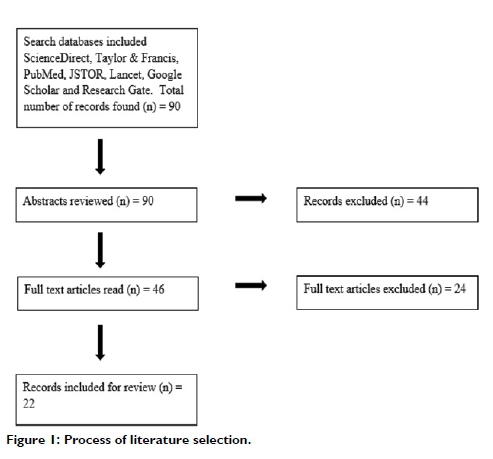
The literature search was conducted through electronic searching, of the following databases: ScienceDirect, Taylor & Francis, PubMed, JSTOR, Lancet, Google Scholar and Research Gate. All research designs were considered. This was accessed online through the UKZN library. The database delimiters included literature from 0l January 2010 to 31 December 2020, literature was inclusive of the caregiver role identification within a Sub-Saharan context and in the English language. The search string for the literature search included a combination of terms such as "caregiver and/or parent", "under-resourced areas or low socio-economic areas", or "Africa and/or Sub-Saharan Africa" together with "understanding, roles and/or perceptions of early childhood development" or "parenting practices" or "stimulation" or "stimulation programmes". The literature search produced a total of 90 records, of which 44 records were excluded after reading the abstract. The literature that did not have abstracts was reviewed to determine if the inclusion criteria was met. A further 24 records were excluded after a full review due to redundancy and not meeting the inclusion criteria.
Step 3: Data Evaluation
The literature located through the various databases were evaluated against the inclusion criteria22
Step 4: Data Analysis
The data obtained from the articles were categorised according to the emerging patterns and themes, following a qualitative analysis. Using thematic analysis, the data analysis were directed by the steps highlighted by Creswell24
Step 5: Interpretation and Representation of Results
The results of the data were comprehensively reported through the integration and discussion of the themes that emerged. The findings of the review were presented in a discussion according to Bronfenbrenner's Ecological Systems Theory1
RESULTS
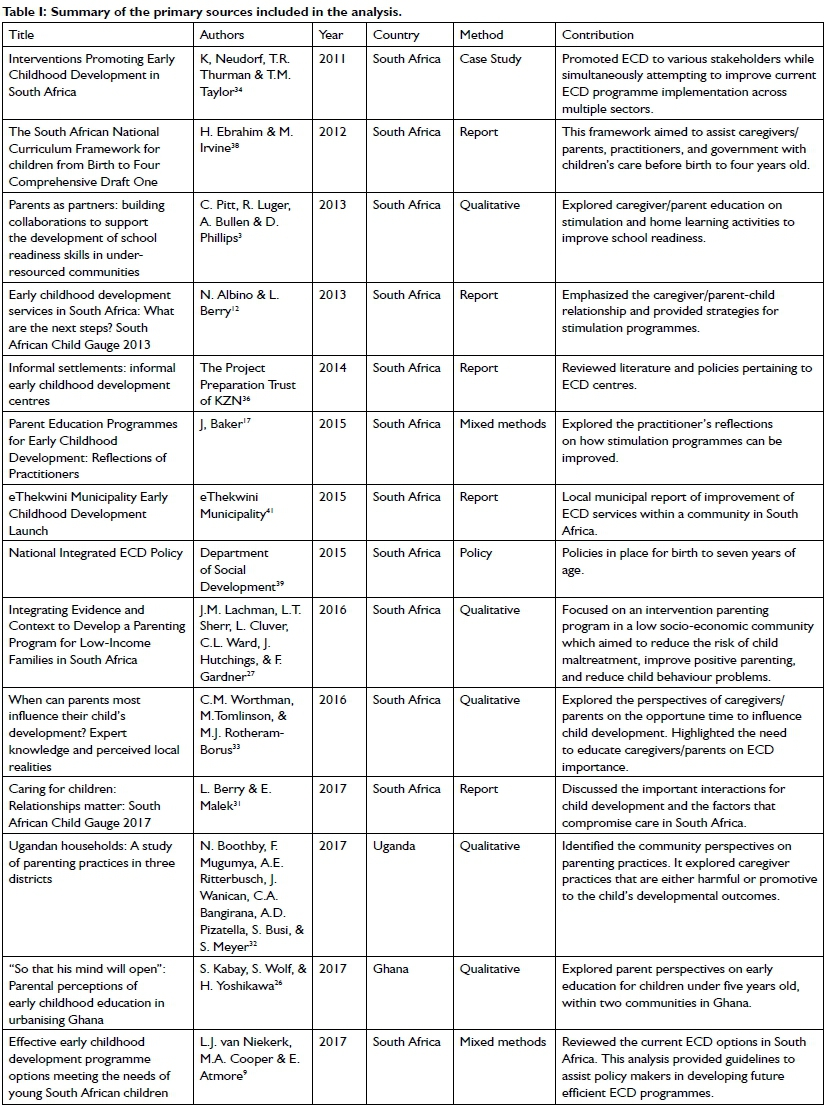
Twenty-two records that met the inclusion criteria included a study each from Uganda, Tanzania, Botswana and two from Ghana. The remainder of the studies (n=17) were from South Africa. Table I (p86-87) below provides the summary of the articles selected for the review.
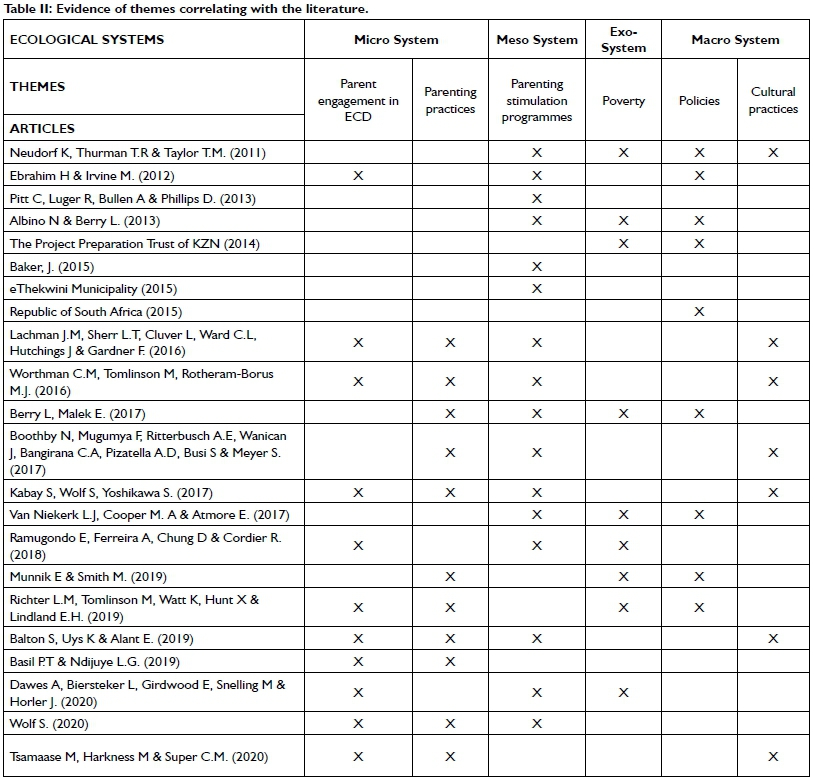
The six themes that emerged within the study and the evidence of themes relating to the selected literature are tabulated in Table II (p88).
Theme One: Caregiver/parent engagement in early childhood development and stimulation
The reviewed literature discussed caregiver participation, understanding, knowledge and expectations of early childhood development and stimulation. Engagement in home activities and play were not always guided by developmental agendas, rather by cultural practices from a macro level or the perceived routine within their context. Two of the studies discussed play; however, there were differing views on play, based on caregiver knowledge, culture, and contexts25-28. Caregivers perceive the child's learning and stimulation as the role of the early childhood facility attended, as opposed to the collaborative role between the caregiver and facility28-30. This perception of early childhood development and stimulation might compromise the school readiness of the child.
Theme Two: Parenting practices
Parenting practices included nurturing care, discipline, positive/negative parenting, caregiver-child interaction, and parenting roles that influenced early childhood development. Negative practices were accompanied by harsh treatment, child neglect and poverty. Four of the studies indicated caregivers' duty to provide nurturing care, warmth, and love as part of their role and associated this with positive parenting practices17,29,31-33. Alternative discipline measures presented itself in some studies where corporal punishment was endorsed to promote good behaviour27,29,30. Caregiving was viewed as the mother's responsibility; however, the fathers' inclusion to assist in sharing the responsibility of caregiving and interacting in the stimulation programmes was also raised2717
Theme Three: Parenting stimulation programmes
Stimulation programmes are available to provide support to care-givers, promote favourable developmental outcomes and encourage appropriate parenting practices9,17. The studies that referred to stimulation programmes highlighted the significance of these programmes, provided an outline for the content and discussed the barriers and facilitators to engagement. Programme barriers included poor intersectoral collaboration, insufficient time to engage in the programmes, low socio-economic status and limited resources9,34. Programme facilitators included generalisability of programmes, family-based approach and compatibility to environmental and cultural contexts9,12,35. The content of the parenting programmes included areas in which caregivers indicated a lack of knowledge, or where researchers observed a gap of knowledge among caregivers. Prevalent topics discussed with parents included discipline strategies, nutrition, promoting maternal and child health and general stimulation activities such as traditional games12,17,34.
Theme Four: Poverty
The literature reviewed discussed increased stress levels, unemployment, perilous society and poor access to services and inequality as the outcomes of poverty, which jeopardised the child's early development and stimulation. Poverty within the low resourced context influenced access to and the services at the ECD facility in which caregivers enrolled their child. Lack of funds, further contributed to their disadvantaged position, infrastructure and the informal nature of these facilities. Despite these adverse conditions, these facilities form the central pillar of early childhood development access within low resourced communities as they provide basic needs and amenities for the children36
Theme Five: Policies
Some policy documents covered strategies which were in place to facilitate appropriate early childhood development service provision at educational and health facilities and future early childhood development plans and guidelines to encourage access of services. In contrast, other studies indicated how policies could be shifted to facilitate a multifaceted approach that would enhance the developmental outcomes of young children37,38- Policy documents also recorded the general standards required for all ECD facilities to provide an expected service delivery level to all children9,36.
Theme Six: Cultural Practices
Cultural practices which are filtered through the microsystem and mesosystem were reported by seven studies. Cultural beliefs are nuanced through lessons of morality, respect and promoted behavioural patterns highlighted in several studies, where care-givers discussed the importance of passing on their culture and traditions26,28,32. Cultural practices are passed on in the home environment and promoted within their educational/school environment. The cultural practices further influenced how children play, what tasks were engaged in, and the expectations within their age group25,26,28. It is therefore imperative that stimulation programmes consider culture practices, as this could indicate the success of programme compliance.
DISCUSSION
The integrative review has provided an insight into the caregivers' role in ECD, stimulation and the support available for them at different levels. This is explained through the Bronfenbrenner's Ecological Systems Theory1
Microsystem
Thirteen of the reviewed publications discussed components within the microsystem. Respondents in selective studies indicated positive and negative parenting practices, which provided an understanding of how caregivers practices to promote or limit early child development3332332528
The childhood occupation of play was closely nuanced with cultural practices. Within the two Ghanaian studies, caregivers perceived play as a shift away from the child's learning at school and did not understand that play is educational as well26,30. Similar perceptions were detected in the study by Balton et al. study2527
Conflicting evidence of the caregiver role in the child's school and education was observed. Caregivers often believed this is where children learn school related skills based on their previous experience of ECD facilities. They viewed their role in collaborating with the educational facility to fulfil needs such as paying fees and provision of nutrition, and not engaging in tasks that provide stimulation for learning and developmental outcomes28,30. Teachers were also perceived as surrogate parents and caregivers relied on them to primarily educate their child37
An additional focus within parenting practice was the discipline strategies that were implemented. Some caregivers used corporal punishment to ensure good behaviour, whereas other caregivers refrained from this to reduce the damage of corporal punishment2717
Mesosystem
Through the mesosystem, there are ECD stimulation programmes that caregivers can implement within the home environment. Implementation of stimulation programmes can assist in improving developmental outcomes by providing the child with the necessary learning and stimulation to further promote their development. Across the various studies, home-based programmes for the care-givers were recommended as it was proved to be more effective than other means of programme implementation912,34,35. However, a recent study contradicts this by stating a direct approach with the children is a better option, as their study revealed that caregivers did not engage in stimulatory activities due to time constraints1512,35. Within varying socio-economic contexts, it is common for various members (adults and children) within the house to engage in childcare. Therefore, the stimulation programme should consider this approach during implementation. Should occupational therapists within under resourced communities place value on the relevant considerations to the caregivers' contexts and beliefs, it may promote eagerness and compliance with stimulation programmes provided. This in turn will assist caregivers in improving their interaction with the child and promoting better developmental outcomes.
Although there is an observable effort to implement stimulation programmes to support caregivers, several barriers hamper this effort. The barriers include lack of advocacy on early child development, inconsistent attendance of programmes due to financial constraints, limited trust in unfamiliar individuals running these programmes and poor contextual planning3,34,35. Numerous studies recommend the inclusion of contextual and cultural relevant focus, to promote stimulation within the parenting stimulation programmes9,12,17,34. Neglecting these factors may contribute to the lack of interaction and learning during the stimulation programmes3
Exosystem
Poverty was acknowledged as a factor influencing the effectiveness of stimulation programmes. A plethora of studies indicated that low socio-economic status and unemployment impact the child's school readiness, stimulation, and caregiver-child activity engagement within the home environment15,29,35,37- Many policies and initiatives have guidelines to combat poverty; however, it is a larger systemic issue that requires the collaboration of multiple sectors over a long period of time. Poverty further results in low attendance of supportive programmes available to caregivers due to lack of transport and finances3527
Macrosystem
This follows the overarching factors that present itself in the caregivers' practices, such as cultural practices commonly followed. In the Ghana study, ECD facilities were for the dual purpose of educating the child academically and encourage appropriate cultural practices such as respect and social etiquette26322825,28. This highlights how some cultural practices are more deeply embedded in specific contexts than others and should always be a contributing factor in the approach used.
In South Africa, there are several policies in place to provide support for caregivers and to facilitate appropriate services available for the child39109
The National Integrated Early Childhood Development Plan (2015) further encourages the collaboration with early childhood development facilities, and in conjunction with the South African National Curriculum Framework (2012), future plans for parenting programmes are in place. Yet there is limited communication across government sectors to target caregivers to facilitate their understanding of stimulation, learning, engagement in play and how to support their children392929
LIMITATIONS OF THE STUDYMost of the literature reported in this study were qualitative in nature and the perspectives were of the female caregivers. Responses of the male caregivers404139
CONCLUSION
Caregivers form a crucial part of the child's ecosystem, yet many caregivers from under resourced contexts may not have the adequate knowledge, skills, understanding, resources or time to facilitate early childhood development. This may result from several factors, such as unawareness of services, poor access and limited intersectoral collaboration. The review shows that stimulation programmes can bridge the gap in early childhood development outcomes; however, several factors such as context and culture must be considered. The findings of this review further indicate the need for a multisectoral approach, which should not be limited to just the ECD facility. Therapists working at a primary healthcare level need to collaborate further with caregivers on matters that are relevant to early childhood development and stimulation and ensure that it is contextually relevant. Additionally, the review indicates that services need to be facilitated locally and not just planned nationally or provincially, to ensure that caregivers of children within the ECD phase benefit from the services available.
AUTHOR CONTRIBUTIONSZainab Ayob conducted the integrative review and was the primary researcher and author. Deshini Naidoo and Chantal Christopher supervised the study and provided guidance through the conceptualisation, and analysis of the review.
CONFLICTS OF INTEREST DECLARATIONS AND FUNDINGThe authors declare no conflict of interest.
ACKNOWLEDGEMENTS
There are no acknowledgments.
REFERENCES
- 1. Bronfenbrenner U. Ecological systems theory. Annals of Child Del. Bronfenbrenner U. Ecological systems theory. Annals of Child Development. 1989;6(1):187-249.
- 2. Shelton LG. The Bronfenbrenner Primer: A Guide to Develecology. New York: Routledge; 2019.
-
3. Pitt C, Luger R, Bullen A, Phillips D, Geiger M. Parents as partners: Building collaborations to support the development of school readiness skills in under-resourced communities. South African Journal of Education. 2013;33(4):1-14. doi:https://doi.org/10.15700/2014l2171334
» https://doi.org/10.15700/2014l2171334 -
4. Onwuegbuzie AJ, Collins KMT, Frels RK. Foreword: Using Bronfenbrenner's ecological systems theory to frame quantitative, qualitative, and mixed research. International Journal of Multiple Research Approaches. 20l3;7(1):2-8. doi:https://doi.org/10.5172/mra.2013.7.1.2
» https://doi.org/10.5172/mra.2013.7.1.2 -
5. Atmore E, Van Niekerk L, Ashley-Cooper M. Challenges Facing Early Childhood Development Sector in South Africa. National Development Agency. 20l2;(April):49. https://www.nda.org.za/assets/resources/CF824421-4FA0-41EE-AB69-4DBl0CD0384A/Challenges-facing-ECD-Sector-in-SA-Prof-Atmore.pdf
» https://www.nda.org.za/assets/resources/CF824421-4FA0-41EE-AB69-4DBl0CD0384A/Challenges-facing-ECD-Sector-in-SA-Prof-Atmore.pdf -
6. UNICEF UNICEF's Programme Guidance for Early Childhood Development. New York; 2017. https://sites.unicef.org/earlychildhood/files/FINAL_ECD_Programme_Guidance._September._2017.pdf
» https://sites.unicef.org/earlychildhood/files/FINAL_ECD_Programme_Guidance._September._2017.pdf -
7. Hall K, Sambu W, Almeleh C, Mabaso K, Giese S, Proudlock P South African Early Childhood Review. Cape Town: Children's Institute; 2019. http://childrencount.uct.ac.za/uploads/publications/SAECR_2019.pdf
» http://childrencount.uct.ac.za/uploads/publications/SAECR_2019.pdf - 8. Krishnan V Early Child Development: A Conceptual Model. 2010
- 9. van Niekerk L, Ashley-Cooper M, Atmore E. Effective early childhood development programme options meeting the needs of young South African children. Centre for Early Childhood Development, Cape Town. 2017:295.
-
10. Budlender D, Motala D, Motala S. Development of a subsidy model for home- and community-based early childhood development services for children 0-5 : Community Agency for Social Enquiry. Human Sciences Research Council. 2010;(February). http://www.hsrc.ac.za/en/research-data/view/4976
» http://www.hsrc.ac.za/en/research-data/view/4976 -
11. Rich EG, Roman N V. Legislative Policies And Culture On Parenting Practices: improving the parent-child relationship in South Africa. Revista de Políticas Públicas. 2019;23(1):389. doi:https://doi.org/10.18764/2178-2865.v23n1p389-401
» https://doi.org/10.18764/2178-2865.v23n1p389-401 -
12. Albino N, Berry L. Early childhood development services in South Africa: What are the next steps? In: Berry L, Biersteker L, Dawes H, Lake L, Smith C, editors. South African Child Gauge. UCT Children's Institute; 2013. p. 78-81. https://open.uct.ac.za/bitstream/handle/11427/3896/CI_chapters_sachildgaugel3_EcdNextSteps_2013.pdf?sequence=1
» https://open.uct.ac.za/bitstream/handle/11427/3896/CI_chapters_sachildgaugel3_EcdNextSteps_2013.pdf?sequence=1 -
13. Lu C, Cuartas J, Fink G, McCoy D, Liu K, Li Z, Daelmans B, Richter L. Inequalities in early childhood care and development in low/middle-income countries: 2010-2018. BMJ Global Health. 2020;5(2):p. e002314. doi:https://doi.org/10.1136/bmjgh-2020-002314
» https://doi.org/10.1136/bmjgh-2020-002314 -
14. Statistics South Africa. General Household Survey. 2019. http://www.statssa.gov.za/publications/P0318/P03182019.pdf
» http://www.statssa.gov.za/publications/P0318/P03182019.pdf -
15. Dawes A, Biersteker L, Girdwood L, Snelling M, Horler J. The Early Learning Programme Outcomes Study Technical Report. Claremont Cape Town; 2020. doi:http://dx.doi.org/10.13140/RG.2.2.10297.39528
» http://dx.doi.org/10.13140/RG.2.2.10297.39528 -
16. Ebrahim H, Seleti J, Dawes A. Learning begins at birth: Improving access to early learning. Cape Town; 2013. www.childrencount.ci.org.za
» www.childrencount.ci.org.za - 17. Baker J. Parent Education Programmes for Early Childhood Development: Reflections of Practitioners. Stellenbosch University; 2015. file:///C:/Users/Den/Downloads/baker_parent_2014.pdf
-
18. Philpott, S.C., 2018. Early Childhood Development: The Disability Policy and its implications for occupational therapists. South African Journal of occupational therapy, 48(3), pp.58-61. http://dx.doi.org/10.17159/2310-3833/2017/vol48n3a9
» http://dx.doi.org/10.17159/2310-3833/2017/vol48n3a9 -
19. Baker-Henningham H, López Bóo FF Early Childhood Stimulation Interventions in Developing Countries: A Comprehensive Literature Review. IZA Discussion Paper. 2010:1-73. doi:https://doi.org/10.1007/s10273-011-1262-2
» https://doi.org/10.1007/s10273-011-1262-2 -
20. Rao N, Sun J, Wong JMS, Weekes B, Ip P Shaeffer S, Young M, Bray M, Chen E, Lee D. Early childhood development and cognitive development in developing countries: A rigorous literature review. Department for International Development. 2014;(September):1-100. http://cerc.edu.hku.hk/wp-content/uploads/ECD-review.pdf
» http://cerc.edu.hku.hk/wp-content/uploads/ECD-review.pdf - 21. Homan, A., 2018. Towards occupational enablement: experiences of the ECD practitioners regarding the crosstrainer programme (Masters dissertation, University of the Free State).
-
22. Whittemore R, Knafl K. The integrative review: Updated methodology. Journal of Advanced Nursing. 2005;52(5):546-553. doi: https://doi.org/10.1111/j.1365-2648.2005.03621.x
» https://doi.org/10.1111/j.1365-2648.2005.03621.x - 23. Peters MD, Godfrey C, McInerney P, Baldini Soares C, Khalil H, Parker D. Chapter ll: Scoping reviews - JBI Wiki. In: Aromataris E, Munn Z, editors. Joanna Briggs Institute Reviewer's Manual. The Joanna Briggs Institute; 2017.
- 24. Creswell JW. Research Design: Qualitative, Quantitative, and Mixed Mehtods Approaches. 4th ed. SAGE Publications; 2014.
-
25. Balton S, Uys K, Alant E. Family-based activity settings of children in a low-income African context. African Journal of Disability. 2019;8:1-14. doi:https://doi.org/10.4102/ajod.v8i0.364
» https://doi.org/10.4102/ajod.v8i0.364 -
26. Kabay S, Wolf S, Yoshikawa H. "So that his mind will open": Parental perceptions of early childhood education in urbanizing Ghana. International Journal of Educational Development. 2017;57(January):44-53. doi:https://doi.org/10.1016/j.ijedudev.2017.08.013
» https://doi.org/10.1016/j.ijedudev.2017.08.013 -
27. Lachman JM, Sherr LT, Cluver L, Ward CL, Hutchings J, Gardner FF Integrating Evidence and Context to Develop a Parenting Program for Low-Income Families in South Africa. Journal of Child and Family Studies. 2016;25(7):2337-2352. doi:https://doi.org/10.1007/s10826-016-0389-6
» https://doi.org/10.1007/s10826-016-0389-6 -
28. Tsamaase M, Harkness S, Super CM. Grandmothers' Developmental Expectations for Early Childhood in Botswana. New Directions for Child and Adolescent Development. 2020;2020(170):93-112. doi:https://doi.org/10.1002/cad.20335
» https://doi.org/10.1002/cad.20335 -
29. Richter LM, Tomlinson M, Watt K, Hunt X, Lindland EH. Early means early: understanding popular understandings of early childhood development in South Africa. Early Years. 2019;39(3):295-309. doi:https://doi.org/10.1080/09575146.2019.1613346
» https://doi.org/10.1080/09575146.2019.1613346 -
30. Wolf S. "Me I don't really discuss anything with them": Parent and teacher perceptions of early childhood education and parent-teacher relationships in Ghana. International Journal of Educational Research. 2020;99(September 2019):101525. doi:https://doi.org/10.1016/j.ijer.2019.101525
» https://doi.org/10.1016/j.ijer.2019.101525 -
31. Berry, Lizette; Malek E. Caring for children: Relationships matter. Cape Town; 2017. https://bettercarenetwork.org/sites/default/files/Caring_for_Children.pdf
» https://bettercarenetwork.org/sites/default/files/Caring_for_Children.pdf -
32. Boothby N, Mugumya F, Ritterbusch AE, Wanican J, Ahabwe C, Pizatella AD, Busi S, Meyer S. Ugandan households : A Study of parenting practices in three districts. Child Abuse & Neglect. 2017;67:157-173. doi: https://doi.org/10.1016/j.chiabu.2017.02.010
» https://doi.org/10.1016/j.chiabu.2017.02.010 -
33. Worthman CM, Tomlinson M, Rotheram-Borus MJ. When can parents most influence their child's development? Expert knowledge and perceived local realities. Social Science and Medicine. 2016;154:62-69. doi:https://doi.org/10.1016/j.socscimed.2016.02.040
» https://doi.org/10.1016/j.socscimed.2016.02.040 -
34. Neudorf K, Thurman T, Taylor TM. Interventions promoting early childhood development in South Africa. Tulane University School of Public Health and Tropical Medicine,; 2011. https://hvc-tulane.org/interventions-promoting-early-childhood-development-in-south-africa/
» https://hvc-tulane.org/interventions-promoting-early-childhood-development-in-south-africa/ -
35. Ramugondo E, Ferreira A, Chung D, Cordier R. Research Article A Feasibility RCT Evaluating a Play-Informed , Caregiver-Implemented , Home-Based Intervention to Improve the Play of Children Who Are HIV Positive. Occupational Therapy International. 2018;(Article ID 3652529):15 pages. doi:https://doi.org/10.1155/2018/3652529
» https://doi.org/10.1155/2018/3652529 -
36. The Project Preparation Trust of KwaZulu-Natal. Informal settlements: Informal early childhood development centres. 2014. http://thehda.co.za/pdf/uploads/multimedia/ISU_Guidelines_Informal_Early_Childhood_Development_Centres_in_Informal_Settle-ments-ilovepdf-compressed-compressed.pdf
» http://thehda.co.za/pdf/uploads/multimedia/ISU_Guidelines_Informal_Early_Childhood_Development_Centres_in_Informal_Settle-ments-ilovepdf-compressed-compressed.pdf -
37. Munnik E, Smith M. Contextualising school readiness in south africa: Stakeholders' perspectives. South African Journal of Childhood Education. 2019;9(1):1-13. doi:https://doi.org/10.4102/sajce.v9i1.680
» https://doi.org/10.4102/sajce.v9i1.680 -
38. Ebrahim H, Irvine M. The South African National Curriculum Framework for children from Birth to Four. 2012. http://www.education.gov.za/Portals/0/Documents/Publications/National_Curriculum_Framework_for_children_from_birth_to_four.pdf?ver=2014-12-04-144326-000
» http://www.education.gov.za/Portals/0/Documents/Publications/National_Curriculum_Framework_for_children_from_birth_to_four.pdf?ver=2014-12-04-144326-000 -
39. Department of Social Development. National Integrated Early Childhood Development Policy 2015.2015:1-140. doi:https://doi.org/10.1007/s00112-008-1824-6
» https://doi.org/10.1007/s00112-008-1824-6 - 40. Basil PT, Ndijuye LG. Is Fathers' Involvement in Young Children's Development and Learning in the Early Years Important? Experiences from the Caregivers in Tanzania. Global Education Review. 2019;6(1):63-74.
-
41. eThekwini Municipality. eThekwini Municipality Early Childhood Development Launch. 2015. http://www.durban.gov.za/City_Services/DCM-Support Services/Documents/ECDLAUNCHARTICLE-edited.pdf
» http://www.durban.gov.za/City_Services/DCM-Support Services/Documents/ECD LAUNCH ARTICLE-edited.pdf