Current practice used by therapists to screen and assess cerebral visual impairment in children with cerebral palsy in the South African setting
Abstract
BACKGROUND AND PURPOSE: Cerebral visual impairment (CVI) is a common comorbidity in children with cerebral palsy and has a significant impact on their functional capabilities. The lack of obvious deficits related to the eyes means awareness of CVI is poor. However, early diagnosis of CVI in children with cerebral palsy supports intervention which may improve the child's functioning in everyday activities. Occupational therapists and physiotherapists are able to identify children at risk for CVI, but there is a lack of research on the screening procedures they use to identify this deficit. This study therefore aimed at determining the current awareness of and clinical screening procedures used by occupational therapists and physiotherapists to detect CVI in children with cerebral palsy in South AfricaMETHOD: A quantitative descriptive survey was distributed nationally to occupational therapists and physiotherapists treating children with cerebral palsyRESULTS: The majority (81%) of the participants could define and explain CVI but a formal diagnosis of CVI is not commonly seen in practice (15.3%). The difficulty in getting a formal diagnosis of CVI was reported as being due to a lack of testing for functional vision by medical professionals. Less than half of the participants (45.7%) reported that they would always screen for a CVI in children with cerebral palsy and 42.9% of participants reported that they used informal screening procedures. Most of the participants reported that they would alter their intervention if they were aware that a child with cerebral palsy presented with CVICONCLUSION: This study shows that although therapists are aware of CVI, there is limited screening for this deficit and little or no formal screening of CVI in children with cerebral palsy in the South African context
cerebral palsy; cerebral visual impairment; screening; assessment; CVI-MQ
INTRODUCTION
Cerebral palsy (CP) is defined as a motor disorder, but is also associated with non-motor dysfunctions such as disorders of communication, behaviour, cognition and sensation123,4. Fairhurst567 89
The lack of obvious deficits related to the eyes and healthcare providers' poor awareness of CVI means the condition often goes undiagnosed10,11. An early diagnosis of CVI in children with CP is important because there is evidence that intervention from a young age may improve the outcome for a child in terms of quality of life and occupational performance129,13.
Occupational therapists and physiotherapists, however, are positioned to screen and identify children with CP at risk for CVI because these professionals are often the first to complete a screening and in-depth assessment of the child's physical, cognitive and communicative deficits and comorbidities affecting everyday function. The screening for CVI should consider the effect of markedly fluctuating visual performances on motor and functional ability99
Cerebral visual impairment
Literature states that CVI is the most common cause of visual impairment in children with CP1415
Cerebral visual impairment includes a variety of visual sensory and perceptive disorders that are of a neurological origin that do not include optical visual impairments91016176
Given that the visual manifestations of CVI are broad and depend on the location and severity of the underlying pathology3918
Assessing cerebral visual impairment
The suggested formal assessments of CVI include three avenues192021188,10.
None of these assessments focus on the constructs of activity and participation in line with the International Classification of Functioning, Disability and Health (ICF)2223234 1324252
It is suggested that occupational therapists and physiotherapists therefore use "visual ability" screening assessments to identify possible CVI in children with CP. These therapists are well placed to observe the effect of CVI on the children's functioning in their everyday environments9625129
This study aimed to determine the current awareness of CVI and current practice of occupational therapists and physiotherapists in screening for CVI in children with CP, in various settings in South Africa.
METHODS
Research design
A quantitative descriptive survey design was used for this study26
Population and sampling
The survey was distributed to occupational therapists and physiotherapists who were members of the South African Neurodevelopmental Therapy Association (SANDTA). This association focuses on neurodevelopmental disorders in children and adults, and their members may be trained in Neurodevelopmental Therapy (NDT), and therefore some therapists treating children with CP would be members of this association. These therapists work in various settings with children with CP, including the private sector (private practices), non-profit organisations, schools for learners with special educational needs (LSEN) and government hospitals and clinics27
The survey questionnaire was also distributed through Rural Rehab South Africa (RuReSA), an association for rehabilitation therapists and physiotherapists working in rural areas of South Africa, and Occupational Therapy Association of South Africa (OTASA), a professional association for occupational therapists, to increase the sample size. Total population sampling was used and all the therapists on the databases for SANDTA, RuReSA and OTASA, with contact details for more than 3000 therapists, were used. Emails were sent to all members on the databases, some of whom may have been duplicated as therapists belong to more than one association, some who do not treat children with CP and some of whom may have been speech therapists. There appear to be a limited number of therapists working with children with CP who are members of these associations and only occupational therapists and physiotherapists working with children with CP were requested to complete the questionnaire. Based on a previous study, which surveyed occupational therapists and physiotherapists working with children with CP in South Africa using a similar sampling method, a sample of 48 therapists was achieved2728
Research tools
Questionnaire on CVI and current practice
The first part of the questionnaire focused on demographic information including work-related information, qualifications, and experience of the participants. The profession of the participant, whether an occupational therapist or physiotherapist, the number of years they had been working and working with children with CP, what province and sector they were working in, and whether they had a qualification in neurodevelopmental therapy were also considered.
Questions on current practice determined the understanding of CVI, diagnosis of CVI and current screening procedures used to identify CVI in children with CP were included in this part of the questionnaire. Closed-ended questions with space for open-ended comments were used. Questions were formulated with guidance from the literature based on CP, CVI and CVI screening procedures. The questionnaire consisted of information regarding the number of years' experience the participants had in treating children with CP, how many children were treated within the space of a month, the main age group of children treated and what the most common GMFCS levels of the children with CP treated were, The questionnaire was piloted for content validity by three subject matter experts.
Data collection
Data collection was done by means of the REDCap electronic platform29
Data analysis
The questionnaire was formulated such that the data to be analysed were ordinal or nominal. All responses were downloaded from the REDCap programme into an Excel spreadsheet. The researcher checked all the data and completed descriptive analyses using frequencies and percentages for the closed-ended questions using Statistica v13.2. Comments and open-ended questions were analysed using summative content analysis and the number of participants making each comment was noted and the frequency of each comment was represented in the results.
Ethical considerations
Ethical clearance was obtained from the HREC of the University of the Witwatersrand (M180953). An information sheet was emailed with the questionnaires to all members of the three organisations. Completion of the questionnaire was considered informed consent. Anonymity was ensured by use of the REDCap platform.
RESULTS
There were 47 participants who responded to the questionnaires. Nine of the participants (19%) were not currently working with children with cerebral palsy (CP) so only the data for the remaining 38 participants was analysed. Although all questions of the questionnaire were not completed by all the participants, all questionnaires were included in the analysis. Not all participants answered all questions and this is indicated in the results.
Demographics
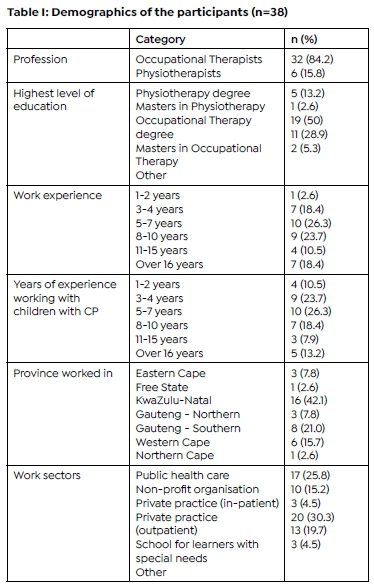
Most of the participants were occupational therapists (84.2%). More than half of the 38 participants had an undergraduate degree as their highest level of education. Slightly more than one quarter of the participants had master's degrees in occupational therapy. Two participants each had a master's degree either in early childhood education or public health (Table I, adjacent).
Of the 38 participants working with children with CP, more than a quarter had 5-7 years' experience while 39.3% of the participants had over 8 years' experience. The majority of the participants worked in KwaZulu-Natal followed by Gauteng, and the Southern and Western Cape. In terms of the work sectors, some of the participants were working in two or more sectors (42%), such as in a school for LSEN and a private practice. Just over a quarter of participants in the public health sector worked in rural, urban, district, regional and tertiary public hospitals and community clinics. The other participants worked in non-profit organisations, private practices and schools for learners with special needs as well as university clinics.
Postgraduate training for treating children with cerebral palsy
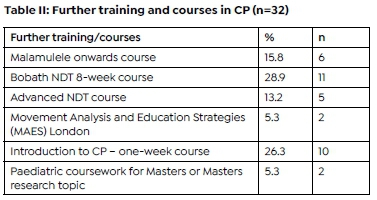
Thirty-two of the 38 participants had further training in assessing and treating children with CP (Table II, adjacent) and 12 of the 38 participants had further training in assessing and treating children presenting with CP and CVI. This training included workshops held by Malamulele Onward and SANDTA including the Bobath 8-week basic paediatric course, advanced NDT courses such as the advanced baby course and hemiplegia course, Movement Analysis and Education Strategies (MAES) course. Some had also attended workshops specifically on vision such as a low vision tutorial from EyeTek, CVI-range training (three-day workshop) by an occupational therapist, Christa Scholtz, or a cortical visual impairment course called From Theory to Practice presented by Lindsay Hillier.
Awareness of what constitutes cerebral visual impairment
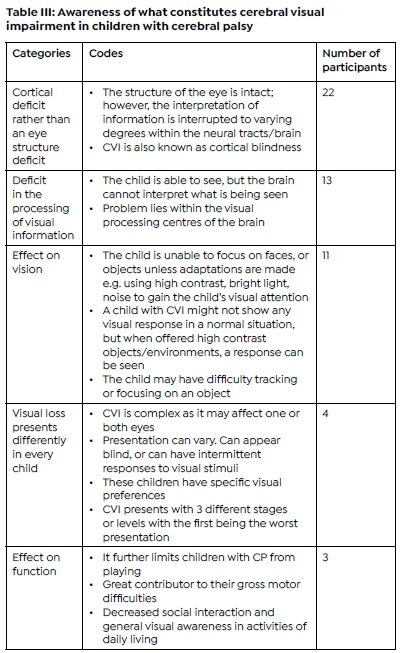
The participants responses were analysed based on the definition of CVI according to Salavati17Table III, above).
Diagnosing cerebral visual impairment
Of the 35 participants who responded, approximately half were not always aware of whether a child with CP presented with CVI. Only 11.4% of participants reported that they knew when a child with CP was diagnosed with CVI and 37.1% said that it depended on whether a caregiver indicated a possible CVI when describing the child's visual ability.
The majority of the participants (85.7%) did not know whether a formal diagnosis of CVI was confirmed, and a quarter of the participants (25.7%) reported they depended on the caregivers to inform them of the diagnosis of CVI. Just less than 30% reported that a CVI diagnosis was reported in the child's file despite the child not having been formally diagnosed. Only one participant, who works in a school for LSEN, indicated that the information about CVI diagnosis was given by the child's teacher.
Participants reported that they often observed the signs of CVI before the child had been given a diagnosis and referred the child for further assessment.
It was indicated that a formal diagnosis of CVI was often not made due to the carer's lack of knowledge, the age of the child (although it was not stipulated if this was because the child was too young or too old), or because there are often more pressing issues for the caregiver to deal with such as feeding and seizures. Obtaining a formal diagnosis for CVI is difficult as agreed to by 70.8% of the participants. This was noted especially in children being treated in the public health sector. The main reason expressed for the difficulty in getting a formal diagnosis of CVI was that medical professionals do not know how to test for functional vision. The child is assessed using tests that test the eye structures but not necessarily for CVI and the participants reported that, in their experience, doctors, optometrists and ophthalmologists are reluctant to assess CVI in children with CP. These professions either are unaware of assessments for CVI; or do not have the knowledge of the functional implications of CVI in CP. Some health professionals do not know when to refer a child for a CVI assessment and doctors are not always prepared to commit to a diagnosis without other formal assessments.
The fact that a child with CP can have communication difficulties makes it more difficult for a formal assessment to be conducted. Two participants mentioned that decreased cognitive level of functioning as well as physical motor deficits in children with CP, exacerbated this difficulty. One participant who worked in a non-profit organisation school for special needs reported that it was difficult to arrange for children with CP to go for a formal assessment as there was only one CVI clinic in Johannesburg, with a limited number of eye clinics in other catchment areas. This caused long waiting times for appointments and ultimately, delayed diagnosis. Logistically, if a child has not been formally diagnosed while in the health system, it is difficult then to confirm the diagnosis when in the education system. If the parents or caregivers have funds to do a formal assessment, the therapists report that they will do a screening at school and suggest a formal assessment.
Three participants were neutral in their response to the difficulty of obtaining a CVI diagnosis. One participant reported that s/he had only seen one child with CP who was high functioning, another participant reported that CVI was not one of the diagnoses considered in children with CP. Of the participants who reported CVI was assessed, three participants used an international CVI screening assessment. Four other participants did not find it difficult to obtain a CVI diagnosis since most of the children get referred to the eye clinic to be assessed, but one of these participants reported it was difficult to evaluate the effectiveness of this service.
Screening for cerebral visual impairment
Less than half of the participants (45.7%) reported that they always screened for a CVI in children with CP that they were treating. Nine participants said they would sometimes screen for CVI, while three participants said that they would never screen for CVI (8.6%). The remaining participants (20%) reported that it depended on whether a visual impairment was suspected.
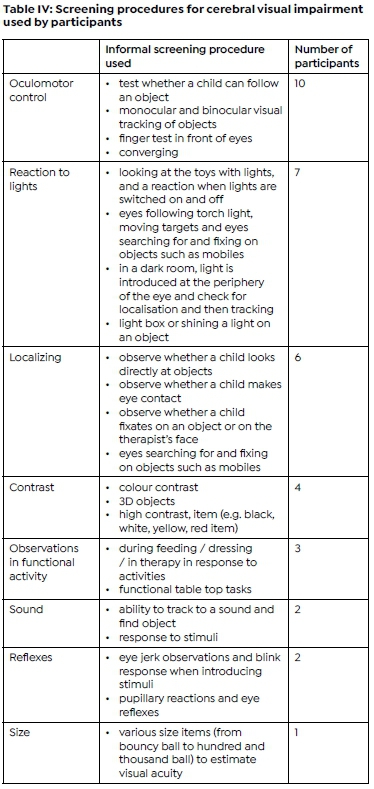
When identifying the need for screening for CVI, participants reported that concerns were usually verbalised by the caregivers, or they would observe inconsistencies in the child's visual function when interacting with their environment. Most participants (88.6%) indicated that they used observations in assessment and therapy sessions during functional tasks to identify the need to screen for CVI. Fifteen of the participants (42.9%) reported that they used informal screening procedures including tracking of an object as an informal screening procedure. Other screening procedures are listed in Table IV (alongside). Most participants indicated they used more than one method of informal screening procedure.
Only five participants (20%) were aware of validated screening and assessment tools/procedures and named the CVI-Range by Christine Roman-Lantsky. Two other participants mentioned using the GMFCS and the HAR assessment, neither of which assesses for CVI. One participant, who worked in a school for special needs and private practice, reported creating their own CVI kit to evaluate the children. However, this CVI kit is not standardised and is rather practice-based. It cannot be assumed that this kit effectively screens or assesses for CVI as it is not a formal screening or assessment tool.
Procedure followed when a cerebral visual impairment is suspected
Participants reported that they would use their own informal screening procedures and observations (57.1%). The majority of the participants reported that they would refer to a specialist if they suspected CVI in a child with CP because they had access to specialists in their settings (65.7%). These specialists included ophthalmologists, optometrists, paediatric neurologists, behavioural optometrists, neurologists, medical officers, developmental doctors and experienced occupational therapists. Thirteen of the participants (37.1%) reported that they would assume a child had CVI and alter their intervention accordingly, but continue with treatment since they did not have access to assessments and specialists to diagnose CVI. Only 11.4% of participants reported that they would carry on with treatment without considering CVI because they did not have access to assessments and specialists to diagnose CVI.
DISCUSSION
Most of the participants in the study were occupational therapists and this could be because the survey was not only administered through SANDTA, but also through OTASA, which targeted only occupational therapists. It was not possible, due to the anonymity of the survey, to identify from which organisations therapists responded. Most sectors and provinces were represented in the sample.
The participants in the study had work experience ranging from 1-32 years, although they had fewer years' experience in working with children with CP. Results therefore indicate that therapists with different levels of experience are currently working in the field of CP. However, nearly two thirds of therapists working with children with CP can be considered as experienced (more than four years of work experience) or experts (more than 10 years of work experience)302828
Participants worked in the most populated provinces, which is congruent with another recent study which surveyed therapists working with children with CP in South Africa and, as with this study, the majority of the participants were working in the private sector and schools for LSEN2731
According to Salavati et al.928
Nearly a third of participants were also aware of varying presentations of CVI, including tracking and localization difficulties; unique visual and behavioural characteristics, such as being attracted to high contrast objects; visual latency; and visual perception difficulties. This heterogeneity of what different participants reported is congruent with other CVI studies932-34. It seems that the participants in the current study focused on impairments and symptoms related to CVI rather than participation in occupations3232,34.
Half of the participants were not always aware if a child with CP had CVI since identifying CVI can be a challenge as there is often no obvious ocular deficit due to its cortical nature1035,36. The main reason expressed for the difficulty in establishing a formal diagnosis of CVI was a lack of services from other health professionals who are reluctant, or do not know how, to test for functional vision. In the current study, none of the participants mentioned the use of formalised assessments reportedly used globally for CVI, such as CT, MRI and functional MRIs2061818
The participants reported (as indicated by the limited literature and a lack of research internationally323,4. This has been ascribed to the fact that in children with CP, CVI is often outweighed by the importance of other comorbid deficits3,4. There is often an assumption that a child with CP has a poor prognosis and there are more pressing medical concerns, so a comorbidity such as CVI and the resultant functional implications are not always considered21037
Occupational therapists and physiotherapists appear more aware of CVI and the functional implications of the condition because they assess and treat function in terms of client factors and participation in children with CP99
Of concern, however, are the more than 50% of participants who were aware of CVI only 'sometimes' or 'never' screen for CVI. Literature indicates the importance of screening for CVI in view of the impact of CVI on functional mobility and quality of life, as well as the high occurrence of CVI in children with CP in developing countries, such as Kenya3839
The use of observational and behavioural assessments are described by Chorna, Guzzetta and Maitre as a "battery of behavioural assessments" which consist of the non-standardised assessments of optokinetic nystagmus, visual fields, oculomotor function, visual acuity and visual-perceptual difficulties1919934
More than two thirds of the participants did acknowledge that the presence of CVI would alter their intervention and it seems that they were aware of the importance of acknowledging CVI but not the functional implications thereof in their treatment of children with CP228
Limitations
The biggest limitation of this study was the low response rate. Cerebral visual impairment is considered a specialised field and has only been introduced as a topic in the SANDTA eight-week paediatric NDT course curriculum in recent years134041
The low response rate means that the results must be interpreted with caution and are not generalisable for other therapists working with children with CP in South Africa. However, data analysis did provide information that can be used in considering the use of the CVI-MQ in screening for CVI in children with CP.
CONCLUSION
There is a lack of research on the screening and assessment procedures that therapists can use to determine the presence of CVI in children with CP, both locally and internationally. Screening for CVI is not always a common practice. Less than half of the participants reported that they would screen for CVI; the remaining participants would only sometimes screen if a visual impairment was suspected and the others would not screen for CVI. Participants reported screening for CVI in children with CP through observation and screening procedures used in therapy sessions. This is congruent with research which found that occupational therapists and physiotherapists use observations to make a diagnosis due to the lack of available screening and assessment tools for CVI9
There are many challenges that face occupational therapists and physiotherapists in screening and assessing for CVI in children with CP. These challenges include a lack of knowledge of CVI by health professionals, a lack of access to specialists and formal CVI screening tools and assessments, and diagnostic difficulties due to multiple comorbidities in children with CP. Research suggests that therapists will often assume the presence or absence of a CVI9 and the majority of the participants reported that they would alter intervention if they were aware of CVI, but not having access to formal screening and assessment tools means that CVI often go undiagnosed.
RECOMMENDATIONSIt is clear from the study that there is a great need for validated screening and assessment tools for CVI in the South African setting. This warrants further research of other internationally-validated screening tools and whether they would be valid and usable in the South African setting.
Investigating and improving knowledge of CVI for all health care professionals in South Africa through adding this knowledge in undergraduate training.
CONFLICTS OF INTERESTNo funding for the project was received.
DATA AVAILABILITY STATEMENT
Upon reasonable request the data is available from Nikita Sweet.
AUTHOR CONTRIBUTIONSNikita Sweet, a postgraduate student who conceptualized, contributed to and completed the article. Denise Frnzsen, supervisor of the projec - data analysis and conceptualisation of results and discussion - conceptualisation and contribution to the article.
REFERENCES
LITERATURE REVIEW
-
1. Rosenbaum P, Paneth N, Leviton A, Goldstein M, Bax M. A report: The definition and classification of cerebral palsy April 2006. Developmental Medicine and Child Neurology. 2007;49(SUPPL. 2):8-14. doi:https://doi.org/10.1111/j.1469-8749.2007.tb12610.x
» https://doi.org/10.1111/j.1469-8749.2007.tb12610.x - 2. Alimovic S. Visual impairments in children with cerebral palsy. Hrvatska revija za rehabilitacijska istrazivanja. 2012;48(1):96-103.
-
3. Dutton GN, Jacobson LK. Cerebral visual impairment in children. Seminars in Neonatology. 2001;6(6):477-485. doi:https://doi.org/10.1053/siny.2001.0078
» https://doi.org/10.1053/siny.2001.0078 -
4. Newcomb S. The reliability of the CVI range: A functional vision assessment for children with cortical visual impairment. Journal of Visual Impairment and Blindness. 2010;104(10):637-647. doi:https://doi.org/10.1177/0145482x1010401009
» https://doi.org/10.1177/0145482x1010401009 -
5. Fairhurst C. Cerebral palsy: The whys and hows. Archives of Disease in Childhood: Education and Practice Edition. 2012;97(4):122-131. doi:https://doi.org/10.1136/edpract-2011-300593
» https://doi.org/10.1136/edpract-2011-300593 -
6. Edmond JC, Foroozan R. Cortical visual impairment in children. Current Opinion in Ophthalmology. 2006;17(6):509-512. doi:https://doi.org/10.1097/ICU.0b013e3280107bc5
» https://doi.org/10.1097/ICU.0b013e3280107bc5 -
7. Salavati M, Rameckers EAA, Steenbergen B, Van Der Schans C. Gross motor function, functional skills and caregiver assistance in children with spastic cerebral palsy (CP) with and without cerebral visual impairment (CVI). European Journal of Physiotherapy. 2014;16(3):159-167. doi:https://doi.org/10.3109/21679169.2014.899392
» https://doi.org/10.3109/21679169.2014.899392 -
8. Fazzi E, Signorini SG, La Piana R, Bertone C, Misefari W, Galli J, Balottin U, Bianchi PE. Neuro-ophthalmological disorders in cerebral palsy: Ophthalmological, oculomotor, and visual aspects. Developmental Medicine and Child Neurology. 2012;54(8):730-736. doi:https://doi.org/10.1111/j.1469-8749.2012.04324.x
» https://doi.org/10.1111/j.1469-8749.2012.04324.x -
9. Salavati M, Waninge A, Rameckers EAA, van der Steen J, Krijnen WP, van der Schans CP, Steenbergen B. Development and face validity of a cerebral visual impairment motor questionnaire for children with cerebral palsy. Child: Care, Health and Development. 2016. doi: https://doi.org/10.1111/cch.12377
» https://doi.org/10.1111/cch.12377 -
10. Ospina LH. Cortical visual impairment. Pediatrics in Review. 2009;30(11):81-90. doi:https://doi.org/10.1542/pir.30-11-e81
» https://doi.org/10.1542/pir.30-11-e81 -
11. Gorrie F, Goodall K, Rush R, Ravenscroft J. Towards population screening for Cerebral Visual Impairment: Validity of the five questions and the CVI questionnaire Kueh YC, editor. PLoS ONE. 2019;14(3):e0214290. doi:https://doi.org/10.1371/journal.pone.0214290
» https://doi.org/10.1371/journal.pone.0214290 -
12. Ortibus E, Laenen A, Verhoeven J, De Cock P, Casteels I, Schoolmeesters B, Buyck A, Lagae L. Screening for cerebral visual impairment: Value of a CVI questionnaire. Neuropediatrics. 2011;42(4):138-147. doi:https://doi.org/10.1055/s-0031-1285908
» https://doi.org/10.1055/s-0031-1285908 -
13. Ferziger NB, Nemet P, Brezner A, Feldman R, Galili G, Zivotofsky AZ. Visual assessment in children with cerebral palsy: Implementation of a functional questionnaire. Developmental Medicine and Child Neurology. 2011;53(5):422-428. doi:https://doi.org/10.1111/j.1469-8749.2010.03905.x
» https://doi.org/10.1111/j.1469-8749.2010.03905.x - 14. Dutton GN, Calvert J, Cockburn D, Ibrahim H, Macintyre-Beon C. Visual disorders in children with cerebral palsy: The implications for rehabilitation programs and school work. Eastern Journal of Medicine. 2012;17(4):178-187.
- 15. Lagunju IA, Oluleye TS. Ocular abnormalities in children with cerebral palsy. African journal of medicine and medical sciences. 2007;36(1):71-75.
-
16. Martín MBC, Santos-Lozano A, Martín-Hernández J, López-Miguel A, Maldonado M, Baladrón C, Bauer CM, Merabet LB. Cerebral versus ocular visual impairment: The impact on developmental neuroplasticity. Frontiers in Psychology. 2016;7(DEC):1-9. doi:https://doi.org/10.3389/fpsyg.2016.01958
» https://doi.org/10.3389/fpsyg.2016.01958 - 17. Salavati A. Assessing gross motor function, functional skills, and caregiver assistance in children with cerebral palsy (CP) and cerebral visual impairment (CVI) (Doctoral dissertation, Rijksuniversiteit Groningen). Rijksuniversiteit Groningen; 2016.
-
18. Donald KA, Samia P, Kakooza-Mwesige A, Bearden D. Pediatric cerebral palsy in Africa: A systematic review. Seminars in Pediatric Neurology. 2014;21(1):30-35. doi:https://doi.org/10.1016/j.spen.2014.01.001
» https://doi.org/10.1016/j.spen.2014.01.001 -
19. Chorna OD, Guzzetta A, Maitre NL. Vision Assessments and Interventions for Infants 0-2 Years at High Risk for Cerebral Palsy: A Systematic Review. Pediatric Neurology. 2017;76:3-13. doi:https://doi.org/10.1016/j.pediatrneurol.2017.07.011
» https://doi.org/10.1016/j.pediatrneurol.2017.07.011 -
20. Fazzi E, Signorini SG, Bova SM, La Piana R, Ondei P, Bertone C, Misefari W, Bianchi PE. Spectrum of visual disorders in children with cerebral visual impairment. Journal of Child Neurology. 2007;22(3):294-301. doi:https://doi.org/10.1177/08830738070220030801
» https://doi.org/10.1177/08830738070220030801 -
21. Watson T, Orel-Bixler D, Haegerstrom-Portnoy G. Early visual-evoked potential acuity and future behavioral acuity in cortical visual impairment. Optometry and Vision Science. 2010;87(2):80-86. doi:https://doi.org/10.1097/OPX.0b013e3181c75184
» https://doi.org/10.1097/OPX.0b013e3181c75184 -
22. World Health Organisation. Overview of ICF Components. Geneva: World Health Organisation; 2001. doi:https://doi.org/10.1055/s-0033-1338283
» https://doi.org/10.1055/s-0033-1338283 -
23. Deramore Denver B, Froude E, Rosenbaum P, Wilkes-Gillan S, Imms C. Measurement of visual ability in children with cerebral palsy: a systematic review. Developmental Medicine and Child Neurology. 2016;58(10):1016-1029. doi:https://doi.org/10.1111/dmcn.13139
» https://doi.org/10.1111/dmcn.13139 -
24. McCulloch DL, Mackie RT, Dutton GN, Bradnam MS, Day RE, McDaid GJ, Phillips S, Napier A, Herbert AM, Saunders KJ, et al. A visual skills inventory for children with neurological impairments. Developmental Medicine and Child Neurology. 2007;49(10):757-763. doi:https://doi.org/10.1111/j.1469-8749.2007.00757.x
» https://doi.org/10.1111/j.1469-8749.2007.00757.x -
25. García-Ormaechea I, González I, Duplá M, Andres E, Pueyo V. Validation of the Preverbal Visual Assessment (PreViAs) questionnaire. Early Human Development. 2014;90(10):635-638. doi:https://doi.org/10.1016/j.earlhumdev.2014.08.002
» https://doi.org/10.1016/j.earlhumdev.2014.08.002 - 26. Creswell JW. Research design: qualitative, quantitative and mixed method approaches. Second. Sage Publications; 2003.
-
27. Davies L. Current occupational therapy and physiotherapy practice in implementing home programmes for young children with cerebral palys in South Africa. University of the Witwatersrand; 2016. http://wiredspace.wits.ac.za/handle/10539/21369
» http://wiredspace.wits.ac.za/handle/10539/21369 -
28. Janse van Rensburg Z. Occupational Therapy practice used for children diagnosed with a dual diagnosis of cerebral palsy and visual impairment in South Africa. 2016:1-123. https://core.ac.uk/download/pdf/188775518.pdf
» https://core.ac.uk/download/pdf/188775518.pdf -
29. Vanderbilt University. REDCap. 2006. https://projectredcap.org/about/
» https://projectredcap.org/about/ - 30. Owen A. Clinical and Professional Reasoning in Occupational Therapy. New York: Lippincott Williams & Wilkins; 2011.
- 31. Coombe H. The clinical presentation of Cerebral Palsy in children in rural Kwazulu Natal, South Africa. University of the Western Cape; 2017.
-
32. Anaby D, Korner-Bitensky N, Steven E, Tremblay S, Snider L, Avery L, Law M. Current Rehabilitation Practices for Children with Cerebral Palsy: Focus and Gaps. Physical and Occupational Therapy in Pediatrics. 2017;37(1):1-15. doi:https://doi.org/10.3109/01942638.2015.1126880
» https://doi.org/10.3109/01942638.2015.1126880 -
33. Ghasia F, Brunstrom J, Gordon M, Tychsen L. Frequency and severity of visual sensory and motor Deficits in children with cerebral palsy: Gross motor function classification scale. Investigative Ophthalmology and Visual Science. 2008. doi: https://doi.org/10.1167/iovs.07-0525
» https://doi.org/10.1167/iovs.07-0525 -
34. Deramore Denver B, Adolfsson M, Froude E, Rosenbaum P, Imms C. Methods for conceptualising 'visual ability' as a measurable construct in children with cerebral palsy. BMC Medical Research Methodology. 2017;17(1):1-13. doi:https://doi.org/10.1186/s12874-017-0316-6
» https://doi.org/10.1186/s12874-017-0316-6 -
35. Maphumulo WT, Bhengu BR. Challenges of quality improvement in the healthcare of South Africa post-apartheid: A critical review. Curationis. 2019;42(1):1-9. doi:https://doi.org/10.4102/curationis.v42i1.1901
» https://doi.org/10.4102/curationis.v42i1.1901 - 36. Reid S. 20 Years of community service in South Africa: what have we learnt? 2018.
-
37. Barratt J, Penn C. Listening to the voices of disability: Experiences of caring for children with cerebral palsy in a rural south African setting. In: Disability and International Development: Towards Inclusive Global Health. 2009. p. 191-212. doi:https://doi.org/10.1007/978-0-387-93840-0_13
» https://doi.org/10.1007/978-0-387-93840-0_13 - 38. Njambi L, Kariuki M, Masinde S. Ocular findings in children attending occupational therapy clinic at Kenyatta National Hospital, Nairobi, Kenya. Joecsa. 2009;15(1).
-
39. Philip SS, Dutton GN. Identifying and characterising cerebral visual impairment in children: A review. Clinical and Experimental Optometry. 2014;97(3):196-208. doi:https://doi.org/10.1111/cxo.12155
» https://doi.org/10.1111/cxo.12155 -
40. Trespalacios JH, Perkins RA. Effects of Personalization and Invitation Email Length on Web-Based Survey Response Rates. TechTrends. 2016;60(4):330-335. doi:https://doi.org/10.1007/s11528-016-0058-z
» https://doi.org/10.1007/s11528-016-0058-z - 41. Saleh A, Bista K. Examining Factors Impacting Online Survey Response Rates in Educational Research: Perceptions of Graduate Students. Online Submission. 2017;13(2):63-74.