The impact of early referral on milestone development of infants with Down Syndrome at the Bloemfontein Child Information Centre, South Africa
Abstract
BACKGROUND: The Bloemfontein Child Information Centre (BCIC) was established in 1985 with a focus on community service in the Free State, South Africa. At the BCIC infants with Down Syndrome (DS) are enrolled in an integrated developmental programme called the Developmental Resource Stimulation Programme (DRSP) as part of their intervention protocol. AIM: This retrospective, descriptive design study aimed to obtain information on the impact of early referral on the milestone development of infants with DS at BCIC. METHODS AND PROCEDURES: The data were collected at the BCIC from January 2010 until July 2023 and included 87 infants with DS. The Bayley Scales of Infant and Toddler Development (3rd Edition) (Bayley-lll) was used to determine the scaled scores for five developmental domains at the following milestone development ages (in months): 3-, 6-, 9-, 12-, 16-, 18- and over 24-months. The data is presented using descriptive statistics and visualisations. To establish the effect of various factors on the scores, linear mixed-effects models were utilised. OUTCOMES AND RESULTS: This study demonstrated that early referral does have an impact on future development. Specifically, significant differences (p-values < 0.05) in scaled scores were observed for four of the five developmental domains for the following three factors: milestone development ages, frequency of follow-up visits and time of referral. Furthermore, the combination of early referral and frequent follow-up intervention sessions resulted in significantly improved scaled scores (p-values < 0.05) for the receptive language domain. CONCLUSIONS AND IMPLICATIONS: Infants with DS should be referred before eight (8) weeks for optimal changes to positively impact milestone development. IMPLICATIONS FOR PRACTICE • Early intervention assists in the analyses of challenges and needs of infants with DS. • The positive impact on early development is evident when infants with DS are referred early for early intervention. • Sustainable development outcomes are proven. • The importance of early referrals highlights occupational therapy intervention for infants with DS.
Developmental Resource Stimulation Programme; DRSP; Bayley Scales of Infant and Toddler Development; Bayley-lll; follow-up intervention; receptive language domain; good health and well-being
INTRODUCTION
Down Syndrome (DS) is the most common multisystem neuro-genetic (chromosomal) disorder that leads to intellectual disability1415
Health practitioners in South Africa have challenges in clinically diagnosing DS, which is detrimental to their development as this leads to late referral for intervention1467488
Early detection of developmental delay isthemosteffective wayto minimise the effects of developmental challenges of young children at risk. With thc certent mtervontion ali oiccl oconaationaltherapy functional outcomes crepossieie9,1112113, a prevention science approach emphasises early referral to promote health and quality of life with Intellectual and Developmental Disabilities (IDD).
In a study conducted at the BCIC in 2013 children with DS showed that they have talents and strengths to rise above the difficulties and challenges of their condition4314,35,. It was designed to stimulate the child's development and involves the parent's active participation while carrying out relevant DRSP activities at home with their child. Parents were equipped with knowledge and instructions on the DRSP activities as they are crucial to the child's early stimulation and assisted in the sustainability of the intervention1516,28,17. The DRSP may be classified as a 'micro-intervention'10 44
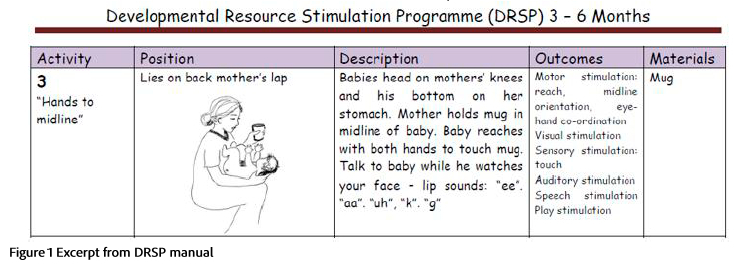
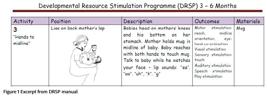
The participation level of the child with DS was calculated by using descriptors from 0-4 based on the qualifiers for seven age bands, namely 0-3, 3-6, 6-9, 9-12,12-18,18-24 and 24-42 months. Each activity is assessed by evaluating the performance of goal-specific abilities, cognitive, gross-motor, fine-motor, language, socio-emotional, play and activities of daily living (ADL). These DRSP activities address the same developmental domains as the Bayley-lll namely cognitive, language, fine-motor and gross-motor development18"Hands in Midline" activity for the 3-to-6-month age band as an example in Figure 1 (below). The baby's head is on the mother's knees and his bottom is against the mother's stomach, according to the description19, p16


The BCIC study established that early intervention using the DRSP should focus on the strengths of a child with DS to reduce their weaknesses1544
functional status of infants with disabilities, occupational therapy creates a wide range of therapeutic interventions3
The study presented aimed to obtain information on the impact of early referral on the milestone development of infants with DS at the BCIC and motivate the importance and value of early referrals immediately after diagnosing infants with DS. Furthermore, to eliminate the delays in early refer by healthcare professionals and promote a practice of early refer for early intervention.20
METHODOLOGY
Study design and participants
A retrospective cross-sectional study design21,22 was conducted. The clinical records (files) of all infants with DS aged birth to 30 months who visited the BCIC from January 2010 to July 2023 were retrieved. The study used convenient sampling method23
The Bayley-III evaluations of 87 infants, from their first visit at the BCIC until the age of 24 months are reached by each infant, were captured and presented in all analyses as scaled scores with a range from 1-19, mean of ten and standard deviation of three1818
According to the clinical records, the evaluations used in this study included the first visit of intervention and data of the following available seven milestone development ages in months: 3-, 6-, 9-, 12-, 16-, 18- and more than 24-months. Even though there were more frequent visits to the BCIC, only the statistics of the seven specific milestone development ages were used. The DRSP was used at all visits, and the activities varied due to the differences in ages of the participants.
Materials and Procedures
The Ethics Committee of the Faculty of Health Sciences of the University of the Free State (UFS-HSD2023/0215/2609) approved the study. Caregivers provided written consent for their children to participate in the study.
The Research Electronic Data Capture (REDCap) a web-based software platform is secure and designed to support data capture for research studies25
Variable Description
Scaled scores of the five developmental domains were recorded at the first session and each of the seven milestone development ages (3-, 6-, 9-, 12-, 16-, 18- and more than 24-months). In all subsequent sections, scores will refer to scaled scores. The following additional information was captured: biological Sex (male or female), Referral (early or late), Follow-up (frequent or infrequent). Referral was classified as early when a child was referred before or at eight weeks (< 8 weeks), alternatively, the referral was classified as late (>8 weeks). The frequency of follow-up evaluation and intervention sessions was categorised into infrequent follow-up if less than five evaluations and frequent for five or more sessions. The classification of the Referral and Follow-up variables were guided by the domain knowledge of the researcher.
Data Analysis
Descriptive statistics (sample size, mean, median and standard deviation) and visualisations were included to present the exploratory analysis of the data. To evaluate the developmental changes of the infants in this longitudinal study, linear mixed-effects models were applied in R statistical software, specifically, the R package26,27. In each model the following variables were included as fixed effects to model the scaled scores (i.e. response variable): Age in months (first visit and 7 levels), Sex (2 levels), Follow-up (2 levels), Referral (2 levels), and the interaction between Follow-up and Referral. The repeated measurements of the scaled scores of the infants over time at the milestone development ages were included as a random factor in the model. Further explanation of the variables is provided in the subsequent section. In the models where significant interaction between Referral and Follow-up occurs, the differences between the combined levels (Frequent & Early, Frequent & Late, Infrequent & Early, Infrequent & Late) were evaluated and not the main effects of each of these variables. A significance level of 5% was used to determine whether effects were significant or not, with a p-value smaller than 0.05 reflecting a significant effect. The associated p-values reported in brackets in the results of each domain.
RESULTS
Descriptive overall summary
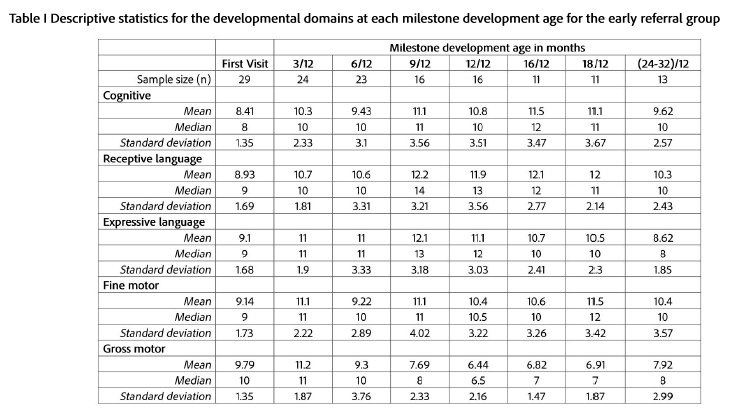
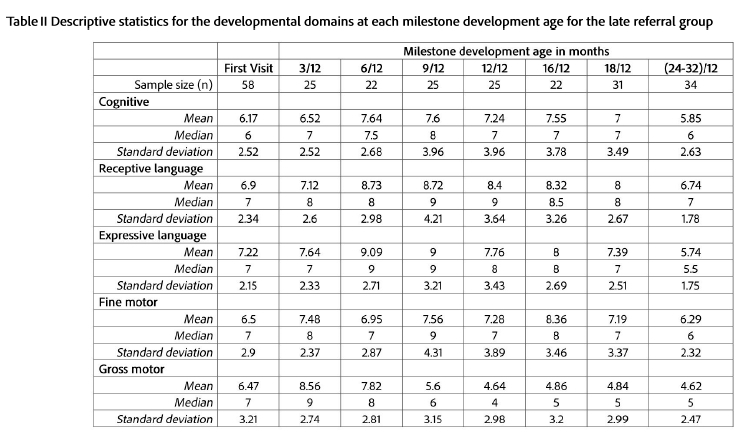
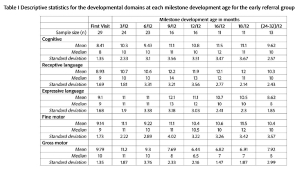
The ages of the infants on their first visit ranged from 2 to 61 weeks, with 29 infants (33%) in the early referral group (cf. Section 0) and 58 infants (67%) in the late referral group with two to four follow-up intervention and evaluation sessions. The descriptive statistics for the scaled scores and milestone development age in months variables for the referral groups are presented separately: early referral group (Table I, below) and late referral group (Table II, page 4). The number of infants per milestone development age for the respective referral groups is recorded in the sample size row.
Cognitive domain
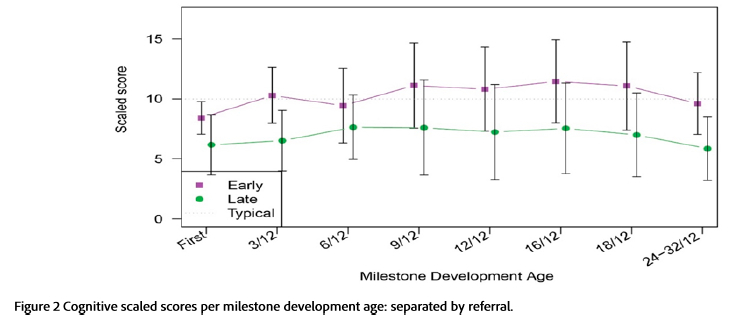
In the cognitive domain there were significant statistical differences between the levels of Milestone development (0.0003), Follow-up (0.0005) and Referral (0.0002). For the interaction between Follow-up and Referral (0.1946) and Sex (0.7417) there were insignificant differences (p > 0.05).
Figure 2 (below) presents the means and error bars with one standard deviation around the mean for the separate referral times (early and late).
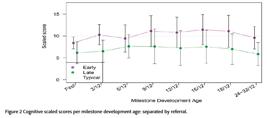
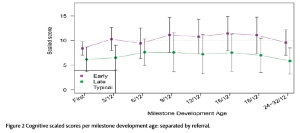
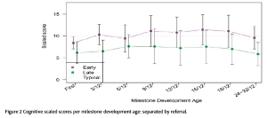
The grey dotted line in Figure 2 indicates the typical development scaled score at 1018
Language domains
Receptive language domain
In the receptive language domain, there were significant differences (p < 0.05) for Milestone development ages (< 0.001) and significant interaction between Referral and Follow-up (0.0492). There were insignificant statistical differences (p > 0.05) between biological Sex (0.4515).
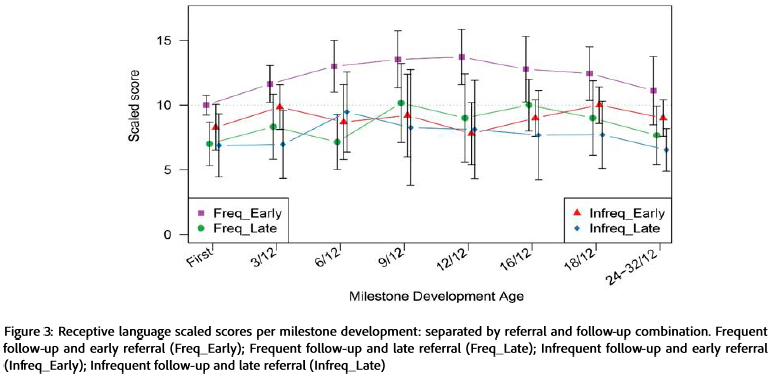
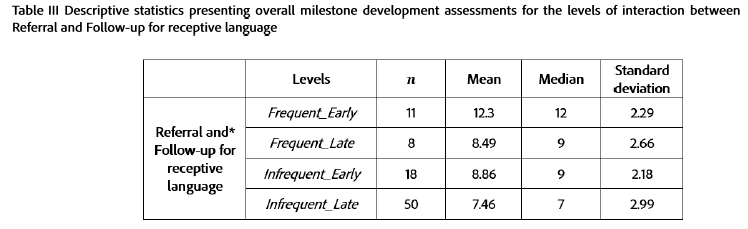
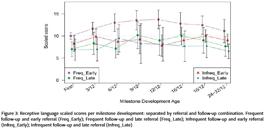
The descriptive statistics for the combined levels of Referral and Follow-up for the receptive language domain presented in Table III (page 5), confirmed that the combination of frequent follow-up sessions and early referral resulted in the highest overall mean score of 12.3.
Expressive language domain
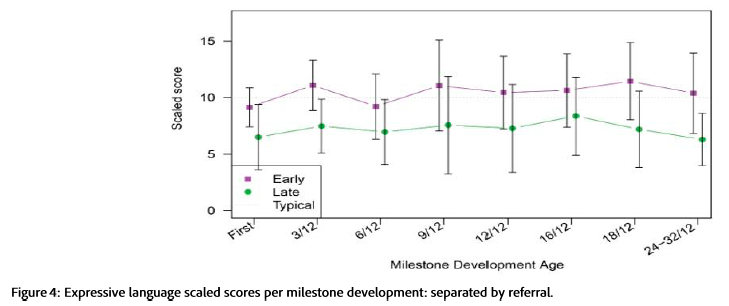
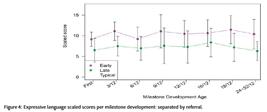
The expressive language domain resulted in significant differences (p < 0.05) for Milestone development ages (< 0.001), Follow-up (0.0001) and Referral (0.0002). There was no significant difference observed for Sex (0.5047) and the interaction between Follow-up and Referral (0.0574).
Fine motor domain
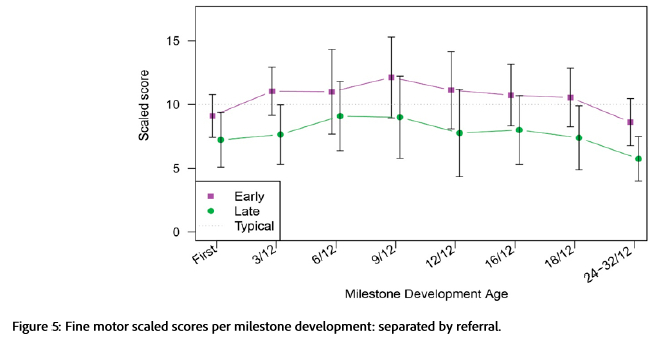
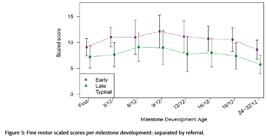
In the fine motor domain, there were significant differences (p < 0.05) for Milestone development ages (0.0019), Follow-up (0.0019) and Referral (0.0001). There were insignificant effects (p > 0.05) for Sex (0.8065) and the interaction between Follow-up and Referral (0.1707).
Gross motor domain
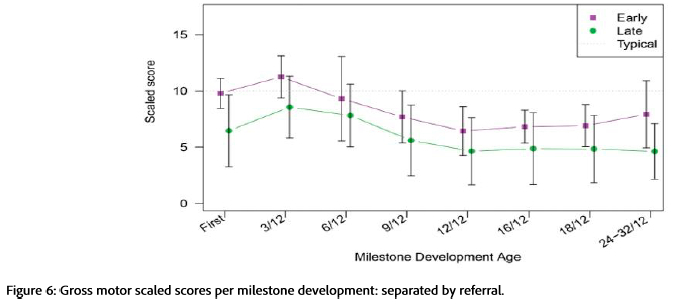
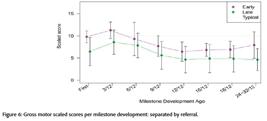
In the gross motor domain, there were significant differences (p<0.05) for Milestone development ages (<0.001), Follow-up (0.0462) and Referral (0.0002). There were insignificant effects (p>0.05) for Sex (0.3302) and interaction between Referral and Follow-up (0.1915).
DISCUSSION
The aim of the study was achieved in that the developmental progression across all five developmental domains and the effect of various factors on the development of this sample of infants with DS was generated. Similar interpretations of the mixed linear model were obtained for the cognitive, expressive language and fine motor with statistically significant differences for Follow-up, Referral and Milestone development ages. In each of these domains, it was established that there were significant negative differences between the two early and late Referral, which indicates that infants with late referral dates have significantly lower scaled scores than infants who started intervention earlier. Similarly, significant negative differences between frequent and infrequent follow-up consultations, confirm that infants benefit from regular follow-up sessions as the scaled scores of these infants are significantly higher than those who have infrequent consultations.
The differences between the scores captured at the seven milestone development ages compared to the score at the first visit were unique for each of the developmental domains and will be discussed separately. This will be followed by discussion of the gross motor domain and receptive language domains, respectively, positive and novel impact of the DRSP.
Cognitive domain
In all cases the scaled scores captured at the milestone development ages were higher than the score at the first visit with significant differences occurring for the 3-, 9-, 12-, 16- and 18- month milestone developments, as presented in Figure 2 (page 9). There was no significant difference between the scores at the first visit compared to 6-months and beyond 24-months. Therefore, cognitive development showed an increase in scores during the first milestone development, followed by a stabilisation anda slight decrease over time. During the 6-month milestone development, there was a decrease in the scores for early referrals. A study by Zuccarini et al. provides new evidence on the intradomain relationships2828et al. found correlations between cognitive and fine motor development scores at 6 months and 12 months284294,30. However, the higher scaled scores of the early referral group show the positive and novel impact of the DRSP.
Receptive languagedomain
The linear model indicated that the scores recorded at subsequent follow-up sessions were higher than the first visit, with significant differences observed for the 3-, 6-, 9-, 12-, 16- and 18- month milestone development ages.
Due to the significant interaction between Referral and Follow-up, the combined means are compared in Table III (page 5). There are slight differences between the other levels with a marginally higher mean for the infrequent follow-up and early referral group, which could indicate that early referral had an advantage and enabled children to catch up, albeit not significantly different from the other levels (Freq_Late, lnfreq_Early, lnfreq_Late).
Figure 3 (page 5) emphasises the importance of the combination of early referral and frequent follow-up sessions, as all solid squares (Freq_Early) are clearly separated from the other three groups and children perform above the typical development score of 10, as indicated by the grey dotted line. At the 9-month milestone development, the early referral group with infrequent follow-up sessions declined when compared to the late referral group with frequent follow-up sessions. This, however, changes from the 18-month milestone development assessment onwards resulting in a higher overall scaled score for the infants in the early referral group. This shows that even with infrequent follow-up sessions, early referral enables the children to 'catch-up' over time. In a study by Schworer et al.31
Expressive languagedomain
The scaled scores were significantly more at milestone development ages 3-, 6-, 9- and 12-months when compared to the first visit scores (cf. Figure 4, page 5). For this domain, the 18-month and older milestone developments are not significantly different from the first visit scores, with positive significant effects observed for the other milestone development assessments compared to the first visit. Even though the DRSP affords the parent I caregiver with home stimulation activities and this assists the baby with DS to improve in this domain, a decline was still observed32Responsive Teaching which involves active social communication between parent and baby, for example, reading story books to children432
Fine motordomain
There was a significant positive impact on the scores for milestone development assessments at 3-, 9- and 18-months compared to the first visit (cf. Figure 5, page 6). Furthermore, a clear significant separation is observed between the means of the early and late referral groups. At 6-month milestone development, there is a decrease in the scores. This tendency was also observed in the cognitive domain (Figure 2, page 9). This might reflect that more skills such as postural control are required to perform tasks at this milestone development assessment. An incline for the early referral group was observed at the 18-month milestone development which is not typical for children with DS4
Gross motor domain
The gross motor scaled scores (cf. Figure 6, page 6) did not follow similar trends as observed for the other developmental domains. A significant decline in the scaled scores was observed at the subsequent milestone development assessments compared to the first visit from 9-months onwards. There was, however, a significant positive difference between the first visit and 3-month milestone development. There was also no significant difference between the interaction of Referral and Follow-up. However, the scaled scores of the early referral group were significantly higher than those of the late referral group. Even with the expected decline in the gross motor scores for children with DS the early referral group performed significantly better than the late referral group. This may be a reflection of the DRSP activities and active parent participation33Figure 5, Figure 6, page 6). This tendency of a positive correlation between motor development and physical activity of infants with DS and fine motor skills was also described in a study by Hauck et al.3434
The motor delay is due to structural differences in the brain, like a reduction in the volume of grey and white matter of the cerebellum, frontal lobes, parietal lobes, corpus callosum, and hippocampus, along with a delay in central and peripheral neural myelination. These structural changes, various neuromuscular and musculoskeletal may show differences in children and adolescents with DS. Among children with DS defects in the cerebrum, corpus callosum, cerebellum, and brainstem could be a reason for the significant developmental delay32, 33. At the 12-month milestone development, typically developing children should stand and start walking according to Bayley Scales-Ill18
The long-term effect of early referral on milestone development in the main domains of development is apparent. This is contradictory to the literature that claims that the motor milestone developments of infants with DS are two times longer than typically developing children. An example is independent sitting for an infant with DS only at 18-months, whereas infants with DS following the DRSP sits at 8-10 months4,33.
LIMITATIONSThe reason for a lack of follow-up sessions was not investigated, but it may be attributed to sociodemographic circumstances such as long distances to visit the BCIC. Furthermore, the underlying medical conditions and co-morbidities apart from DS were not taken into consiaeration in this study.
CONCLUSION
Significant differences between scaled scores at the milestone development ages when compared to the scores at first visits, confirmed the positive impact of early referral on the development of children with DS. Additionally, frequent follow-up sessions play an important role in promoting development of infants with DS. At the first visit the scaled scores of the infants were comparable, but with infrequent follow-up sessions, the separation between the follow-up groups increased with frequent follow-up sessions resulting in higher scores., The results from this study suggest that infants with DS should be referred for early intervention to an occupational therapist before eight weeks.
Overall, this study shows that early referral and frequency of follow-up sessions have a positive effect on milestone development. The authors believe that this effect was evident because the infants were evaluated over time in this longitudinal study. Continued developmental monitoring and early referral of infants with DS to achieve desired results in development milestones35
Emphasis is placed on the results of the cognitive and fine motor domains, in which most milestone development scores of early referred infants with DS were above typical development scores. This confirmed inter-domain relationships, because domains do not exist in isolation and may influence each other positively.
This study echoes the views of Chan et al.36
Conflicts of interest
The authors declare that they have no conflict of interest.
Author Contributions
Dorothy Russell conceptualised the study, collected the data, wrote the original draft and revised the journal article to completion and approved the final version. Olive Khaliq assisted with resources and the planning of the protocol. Johané Nienkemper-Swanepoel analysed and visualised the data, revised the journal article to completion and approved the final version.
Acknowledgements
This study would like to thank the parents for their participation and dedication to their infants with DS. The BCIC for using the clinical records of the infants with DS.
REFERENCES
-
1. Willoughby M, Aldous C, Patrick M, Kavonic S, Christiansen A., 2016. Delay and poor diagnosis of Down syndrome in KwaZulu-Natal, South Africa: A retrospective review of postnatal cytogenetic testing. South African Medical Journal, 106(6):626-9. https://doi.org/10.7196/SAMJ.2016.v106i6.10105.
» https://doi.org/10.7196/SAMJ.2016.v106i6.10105 -
2. Esbensen AJ, Epstein JN, Vincent LB, Kamimura-Nishimura K, Wiley S, Angkustsiri K, et al., 2022. Comparison of attention-deficit hyperactivity disorder in typically developing children and children with down syndrome. Journal of Developmental & Behavioral Pediatrics, 43(1):1-8. https://doi.org/10.1097/DBP.0000000000000972.
» https://doi.org/10.1097/DBP.0000000000000972 -
3. Scott CJ, Futter M, Wonkam A., 2013. Prenatal diagnosis and termination of pregnancy: perspectives of South African parents of children with Down syndrome. Journal of community genetics, 4:87-97. https://doi.org/10.1007/s12687-012-0122-0
» https://doi.org/10.1007/s12687-012-0122-0 - 4. Russell DC. The impact of the" Developmental Resource Stimulation Programme" on children with Down syndrome: University of the Free State; 2013.
-
5. Chen L, Wang L, Wang Y, Hu H, Zhan Y, Zeng Z, Liu L, 2022. Global, regional, and national burden and trends of Down syndrome from 1990 to 2019. Frontiers in Genetics, 13:908482. https://doi.org/10.3389/fgene.2022.908482
» https://doi.org/10.3389/fgene.2022.908482 -
6. Fredes D, Astudillo P, Lizama Calvo M., 2021. Late start of early intervention in children with Down syndrome. Andes Pediatr Rev Chil Pediatr, 92:411-9. https://doi.org/10.32641/andespediatr.v92i3.3449
» https://doi.org/10.32641/andespediatr.v92i3.3449 -
7. McManus BM, Richardson Z, Schenkman M, Murphy NJ, Everhart RM, Hambidge S, Morrato E., 2020. Child characteristics and early intervention referral and receipt of services: A retrospective cohort study. BMC pediatrics, 20(1):84. https://doi.org/10.1186/s12887-020-1965-x
» https://doi.org/10.1186/s12887-020-1965-x -
8. Scharf RJ, Scharf GJ, Stroustrup A., 2016. Developmental milestones. Pediatrics in review, 37(1):25-38. https://doi.org/10.1542/pir.2014-0103
» https://doi.org/10.1542/pir.2014-0103 - 9. Gist L, Stein MT. Developmental screening in your community: an integrated approach for connecting children with services. LWW; 2014.
-
10. Fidler D, Schworer E, Needham A, Prince M, Patel L, Will E, Daunhauer L, 2021. Feasibility of a syndrome-informed micro-intervention for infants with Down syndrome. Journal of Intellectual Disability Research, 65(4):320-39. https://doi.org/10.1111/jir.12814
» https://doi.org/10.1111/jir.12814 -
11. Khetani MA, McManus BM, Albrecht EC, Kaelin VC, Dooling-Litfin JK, Scully EA, Group HVEIR., 2020. Early intervention service intensity and young children's home participation. BMC pediatrics, 20(1):330. https://doi.org/10.1186/s12887-020-02182-x
» https://doi.org/10.1186/s12887-020-02182-x -
12. Novak I, Morgan C, Adde L, Blackman J, Boyd RN, Brunstrom-Hernandez J, et al., 2017. Early, accurate diagnosis and early intervention in cerebral palsy: advances in diagnosis and treatment. JAMA pediatrics, 171(9):897-907. https://doi.org/10.1001/jamapediatrics.2017.1689
» https://doi.org/10.1001/jamapediatrics.2017.1689 -
13. Riggs NR, Hepburn SL, Pinks ME, Fidler DJ., 2022. A prevention science approach to promoting health and quality of life for individuals with intellectual and developmental disabilities. Infant and Child Development, 31(1):e2278. https://doi.org/10.1002/icd.2278
» https://doi.org/10.1002/icd.2278 -
14. Russell DC, van Heerden R, van Vuuren S, Venter A, Joubert G., 2016. The impact of the" Developmental Resource Stimulation Programme" (DRSP) on children with Down syndrome. South African Journal of Occupational Therapy, 46(1):33-40. https://doi.org/10.17159/2310-3833/2016/v46n1a8
» https://doi.org/10.17159/2310-3833/2016/v46n1a8 -
15. JeongJ, Pitchik HO, FinkG., 2021. Short-term, medium-term and long-term effects of early parenting interventions in low-and middle-income countries: a systematic review. BMJ Global Health, 6(3):e004067. https://doi.org/10.1136/bmjgh-2020-004067
» https://doi.org/10.1136/bmjgh-2020-004067 -
16. Russell DC, Scholtz C, Greyling P, Taljaard M, Viljoen E, Very C, 2018. A pilot study on high dosage intervention of children with CP using combined therapy approaches. South African Journal of Occupational Therapy, 48(2):26-33. https://doi.org/10.17159/2310-3833/2017/vol48n2a5
» https://doi.org/10.17159/2310-3833/2017/vol48n2a5 -
17. Kleim JA, Jones TA, 2008. Principles of experience-dependent neural plasticity: implications for rehabilitation after brain damage. 2008. Journal of Speech, Language, and Hearing Research, 51(1). https://doi.Org/10.1044/1092-4388(2008/0
» https://doi.Org/10.1044/1092-4388(2008/0 -
18. Bayley N. 2006. Bayley scales of infant and toddler development. https://doi.org/10.1037/t14978-000
» https://doi.org/10.1037/t14978-000 - 19. Russell DC. Developmental Resource Stimulation Programme (DRSP). Bloemfontein 2010. [Stimulation Programme]
-
20.Santoro JD, Pagarkar D, Chu DT, Rosso M, Paulsen KC, Levitt P, Rafii MS., 2021. Neurologic complications of Down syndrome: a systematic review. Journal of Neurology, 268:4495-509. https://doi.org/10.1007/s00415-020-10179-w
» https://doi.org/10.1007/s00415-020-10179-w -
21. Hunziker S, Blankenagel M., 2024. Cross-sectional research design. Research design in business and management: A practical guide for students and researchers: Springer, p. 187-99. https://doi.org/10.1007/978-3-658-42739-9_10
» https://doi.org/10.1007/978-3-658-42739-9_10 -
22. Wang X, Cheng Z., 2020. Cross-sectional studies: strengths, weaknesses, and recommendations. Chest, 158(1):S65-S71. https://doi.Org/10.1016/j.chest.2020.03.012
» https://doi.Org/10.1016/j.chest.2020.03.012 -
23.Taherdoost H., 2016. Sampling methods in research methodology; how to choose a sampling technique for research. International journal of academic research in management (IJARM),5. https://doi.org/10.2139/ssrn.3205035
» https://doi.org/10.2139/ssrn.3205035 -
24. Del Rosario C, Slevin M, Molloy EJ, Quigley J, Nixon E., 2021. How to use the Bayley scales of infant and toddler development. Archives of Disease in Childhood-Education and Practice, 106(2):108-12. https://doi.org/10.1136/archdischild-2020-319063
» https://doi.org/10.1136/archdischild-2020-319063 -
25. Harris PA, Taylor R, Minor BL, Elliott V, Fernandez M, O'Neal L, et al., 2019. The REDCap consortium: building an international community of software platform partners. Journal of biomedical informatics, 95:103208. https://doi.Org/10.1016/j.jbi.2019.103208
» https://doi.Org/10.1016/j.jbi.2019.103208 -
26. Pinheiro J, Bates D, R Core Team nlme: Linear and Nonlinear Mixed Effects Models. 2023. https://cran.r-project.org/
» https://cran.r-project.org/ -
27. R Core Team. The R Foundation for Statitical Computing. Vienna, Austria 2023. https://www.r-project.org/
» https://www.r-project.org/ -
28.Zuccarini M, Guarini A, Savini S, Faldella G, Sansavini A., 2020. Do 6-month motor skills have cascading effects on 12-month motor and cognitive development in extremely preterm and full-term infants? Frontiers in psychology, 11:1297. https://doi.org/10.3389/fpsyg.2020.01297
» https://doi.org/10.3389/fpsyg.2020.01297 -
29.0nn¡vello S, Pulina F, Locatelli C, Marcolin C, Ramacieri G, Antonaros F, et al., 2022. Cognitive profiles in children and adolescents with Down syndrome. Scientific Reports, 12(1):1936. https://doi.org/10.1038/s41598-022-05825-4
» https://doi.org/10.1038/s41598-022-05825-4 -
30.Ahulló-Fuster M-A, Sánchez-Sánchez ML, Monterrubio-Gordón A, Ruescas-Nicolau M-A, editors., 2025. A Comparison of Developmental Profiles of Preschool Children with Down Syndrome, Global Developmental Delay, and Developmental Language Disorder. Healthcare, MDPI. https://doi.org/10.3390/healthcare13141684
» https://doi.org/10.3390/healthcare13141684 -
31. Schworer EK, Fidler DJ, Daunhauer LA., 2021. Early regulatory skills and social communication development in infants with Down syndrome. Brain Sciences, 11(2):208. https://doi.org/10.3390/brainsci11020208
» https://doi.org/10.3390/brainsci11020208 -
32. Patkee PA, Baburamani AA, Kyriakopoulou V, Davidson A, Avini E, Dimitrova R, et al., 2020. Early alterations in cortical and cerebellar regional brain growth in Down Syndrome: An in vivo fetal and neonatal MRI assessment. Neurolmage: Clinical, 25:102139. https://doi.Org/10.1016/j.nicl.2019.102139
» https://doi.Org/10.1016/j.nicl.2019.102139 -
33. Jain PD, Nayak A, Karnad SD, Doctor KN., 2022. Gross motor dysfunction and balance impairments in children and adolescents with Down syndrome: a systematic review. Clinical and experimental pediatrics, 65(3):142. https://doi.org/10.3345/cep.2021.00479
» https://doi.org/10.3345/cep.2021.00479 -
34. Hauck JL, Felzer-Kim IT, Gwizdala KL, 2020. Early movement matters: Interplay of physical activity and motor skill development in infants with Down syndrome. Adapted Physical Activity Quarterly, 37(2):160-76. https://doi.org/10.1123/apaq.2019-0012
» https://doi.org/10.1123/apaq.2019-0012 -
35. Hendrix JA, Amon A, Abbeduto L, Agiovlasitis S, Alsaied T, Anderson HA, et al., 2021. Opportunities, barriers, and recommendations in Down syndrome research. Translational science of rare diseases, 5(3-4):99-129. https://doi.org/10.3233/TRD-200090
» https://doi.org/10.3233/TRD-200090 -
36.Chan M, Lake A, Hansen K., 2017. The early years: silent emergency or unique opportunity?. The Lancet, Jan 7;389(10064):11-3. https://doi.org/10.1016/S0140-6736(16)31701-9
» https://doi.org/10.1016/S0140-6736(16)31701-9
Reviewed: 01 May 2025
Revised: 31 July 2025
Accepted: 22 September 2025
EDITOR
Pam Gretschel
https://orcid.org/0000-0002-7890-3635
DATA AVAILABILITY
There is an agreement in place not to publicly share the personal information of participants and therefore, the data for this study is not available. This is enforced by the Ethical Committee at the Faculty of Health Sciences, University of the Free State.
FUNDING
None to declare