The need for frailty assessments and intervention as part of holistic occupational therapy practice
Abstract
Are occupational therapists competent to perform frailty assessments? This opinion piece asserts the argument for including frailty assessments as a routine component for baseline assessments, particularly in older individuals, or those who may be considered to be frail. Some regulatory bodies for occupational therapy, such as the Canadian Occupational Therapy Association have included frailty assessment and intervention as a core competency. Frailty is multidimensional and the risk increases with age. There are numerous risk factors that have been identified in the development of the frailty syndrome, including clinical, biological, lifestyle and sociodemographic factors. This paper offers some suggestions for the assessment of frailty, including questionnaires and informal methods. It is recommended that frailty education be included in the undergraduate curricula of occupational therapists in South Africa, and other undergraduate programmes in Africa. An overview of the advantages and disadvantages of standardized and unstandardized assessment tools should also be included as part of the programme. Frailty can be prevented, with timely screening and interventions. It is concluded that frailty assessments should form part of the baseline assessment package of all aging individuals, and especially those who may have one or more of the risk factors. Implications for practice Frailty is a clinical syndrome, particularly in older adults, that is associated with adverse health outcomes. It should be incorporated into occupational therapy practice as it impacts function directly. The authors argue that: • Frailty adversely impacts on the ability of individuals to care for themselves and perform their daily occupations. • Frailty measures should form part of a baseline assessment, especially in older adults. • Frailty assessments need to be conducted in those who display one of more of the risk factors, which includes immobility, incontinence, delirium, and an individual who has had one or more falls. • Frailty can be prevented by timely screening and focused interventions.
core competency; aging individuals; frailty syndrome; rehabilitation intervention; Clinical Frailty Scale (CFS); Frailty Index (Fl); Edmonton Frail Scale; Fried Frailty Phenotype; FRAIL Scale; Occupational Therapy Practice Framework
INTRODUCTION
When an individual is more susceptible to a poor recovery of overall body homoeostasis following illness or surgery, such a person may be termed fragile, or medically described as frail. Frailty is a multifaceted syndrome typified by a reduction in physiological and cognitive reserve, which reduces an individuals' capacity to recover from acute stress11
Some of the sociodemographic risk factors have been cited as female gender, advanced age, living alone and loneliness, as well as certain ethnic backgrounds22
Due to the multiple risk factors frailty evaluations are an essential tool for evaluating the health of the elderly. Screening should be undertaken with elderly clients who may have one of more of the risk factors. This is not an occupational therapist's specific role, but a shared role for all members of the multidisciplinary team. The physician or gerontologist may initially come into contact with the client, and flag him or her as being high risk for frailty. He or she may conduct a few physical investigations, such as blood tests or ECG before referral to the occupational therapist.
The clinical instruments used by clinicians to evaluate frailty comprise two categories, namely questionnaire-based methods, such as the Frail Scale33
Rehabilitation interventions lack uniform definitions of frailty, and those that do exist typically centre on physical functionality. This has not encouraged uniformity in the focus on frailty assessment and management among rehabilitation professionals, like occupational therapists. Kokorelias et al.45
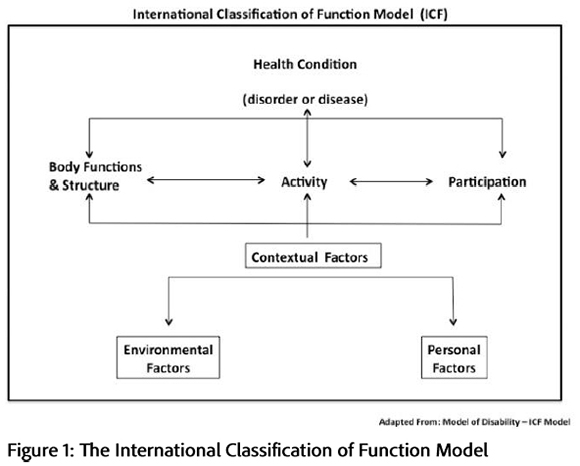
Individuals who are perceived to be frail, may present with impairments and disability related to one or more of the aforementioned occupations in terms of their specific client factors. The personal client factors include the body functions and body structures, in addition to the individuals' values, beliefs and spirituality56Figure 1 (below).
Occupations are always performed within a specific context or environment. These environmental factors can either mitigate, constrain or exacerbate the impairments. The clients' habits, routines, roles and rituals will inform the specific assessments and intervention strategies, to ensure the treatment is appropriate and nuanced to the clients' needs and context. Interventions may include developing process and social interaction skills, specifically in those areas that the client has impairments in. Additionally, if the client is actively involved in the process, they will prioritize and give voice to their goals, which ensures commitment to the therapeutic process and outcomes.
However, in South Africa providing holistic care will be challenging. The elderly are cared for in diverse ways, including retirement homes, independent community living and living in their own homes, with a caregiver. Moreover, the country faces a high disease burden, inequitable resource allocation between provinces and other commitments, in terms of developing and maintaining the infrastructure in the country. High levels of crime and violence are pervasive in the country, and Global South. This diverts resources away from healthcare and other basic needs. Moreover, the elderly remain vulnerable and are often the victims of serious crime.
Key points
A mini-review of the literature established evidence of the prevalence of frailty among clients receiving occupational therapy interventions7,8. A recent study suggests that frailty is preventable89107
Occupational therapists in South Africa are not currently provided with the training to be competent in frailty assessments. Occupational therapy assessments, including frailty assessment, is one of the core competencies an occupational therapist is expected to demonstrate111213
Assessment tools for frailty
When a clients' assessment fails to capture the frailty risk, this will not only lead to sub-optimal outcomes, but may result in treatment failure or non-adherence. It is therefore imperative for occupational therapists to undertake frailty assessments routinely, especially with regards to older adults. A robust frailty assessment tool that is simple, quick to administer, and able to meet the clients' needs will go a long way to assist OTs' compliance in routine baseline assessments14
• Clinical Frailty Scale (CFS)15
• The Frailty Index (Fl)16
• Edmonton Frail Scale17
• The Fried Frailty Phenotype18
• The FRAIL Scale19
Clinical Frailty Scale
This is not a questionnaire, but a way to summarize information and make clinical decisions from assessing an older person. It is used to quantify an individual's overall health status. It was developed as a tool to classify frailty in people with dementia on 9 levels of health from very fit (1) to terminally ill (9).
The Frailty Index
To quantify the level of frailty of an individual, the frailty index approach focuses first on the number of their health deficits, and then on the nature of those deficits. The frailty index is used in routine care all over the world, including in an electronic form in the National Health Service in England.
Edmonton Frail Scale
This is a questionnaire-based assessment that assesses frailty on nine domains such as cognition, general health status, functional independence, social support, medication use, nutrition, mood, continence, and functional performance. Most domains are scored on a 3-point Likert scale. Scoring can range from 0-5 (not frail) to 12-17 (severe frailty), and the total score is achieved by summing all the scores. It is simple and easy to use.
The Fried Frailty Phenotype
The Fried frailty phenotype (FP) assesses physical frailty through five criteria: unintentional weight loss; weakness or poor handgrip strength; self-reported exhaustion; slow walking speed; and low physical activity.
Frail Scale
Of the aforementioned tools, the Frail Scale was found to be the most prognostically useful for elderly clients 65 years and older, who were hospitalized with Acute Coronary Syndrome in a cardiac care unit20
Previous studies have indicated that of the three domains of frailty, including physical, psychological and social aspects, the physical domain is the most reliable predictor of disability2122
Recommendations for practice
Screening for frailty should be included as a part of the holistic assessment of the older adult. Moreover, this also needs to be done for younger individuals who may be at risk, or who have a few of the risk factors. The more lifestyle, sociodemographic, clinical or biological risk factors an individual has, the greater the need for the aforementioned screening assessment. In summary, the exposure to the concept of frailty and its assessment in occupational therapy will allow a better understanding of a client's global health risk stratification, and a more individualized management strategy leading to improved health outcomes.
Assessments that would work in the South African context includes a simple frailty questionnaire that is easy to administer and score, such as the Frail Scale. This could be supported by a balance assessment using the Berg Balance Scale2324
The authors' position is that the theory and practice of frailty evaluation and intervention should form part of the undergraduate occupational therapy curricula in South Africa. This should include exposure to various frailty assessments, including the advantages and disadvantages of these tools. The time taken to perform the assessment, as well as the ease of scoring and interpretation will add to the user friendliness of the tool. In a resource constrained context, such as South Africa, the low cost of screening tools will be advantageous.
Conflict of interest
There are no conflicts of interest regarding this work.
Author Contributions
Thavanesi Gurayah and Michael Opeolowa Ogunlana contributed to the conceptualization, writing and editing of the article. Olufemi Oyeleye Oyewole contributed to the writing of the article and formatted all the references.
REFERENCES
- 1. Clegg A, Young J, lliffe S, Rikkert MO, Rockwood Κ. Frailty in elderly people. Lancet 2013;381:752-62.
- 2. Feng Z, Lugtenberg M, Franse C, Fang X, Hu S, Jin C, et al. Risk factors and protective factors associated with incident or increase of frailty among community-dwelling older adults: A systematic review oflongitudinal studies. PLoS One 2017;12:e0178383.
- 3. Panhwar YN, Naghdy F, Naghdy G, Stirling D, Potter J. Assessment of frailty: a survey of quantitative and clinical methods. BMC Biomedical Engineering 2019;1:7.
- 4. Kokorelias KM, Cronin SM, Munce SEP, Eftekhar P, McGilton KS, Vellani S, et al. Conceptualization of frailty in rehabilitation interventions with adults: a scoping review. Disability Rehabilitation 2023;45:117-53.
-
5. American Occupational Therapy Association. Occupational Therapy Practice Framework: Domain and Process-Fourth Edition. The American Journal of Occupational Therapy 2020,74:7412410010:1-87. https://doi.org/10.5014/ajot.2020.74S2001
» https://doi.org/10.5014/ajot.2020.74S2001 - 6. World Health Organization. International Classification of Functioning, Disability, and Health: ICF. Geneva. 2001.
- 7. Rand D, Sternberg SA, Gasner Winograd R, Buckman Z, Bentur N. The Contribution of Frailty to Participation of Older Adults. International Journal of Environmental Research and Public Health 2022,19:1616.
- 8. Trenholm JR, Warner DG, Eagles DD. Occupational Therapy in the Emergency Department: Patient Frailty and Unscheduled Return Visits. Canadian Journal of Occupational Therapy 2021;88:395-406.
- 9. Fritz H, Hu YL. Habit Formation Intervention to Reduce Frailty Risk Factors: A Feasibility Study. The American Journal of Occupational Therapy. 2022 May 1;76(3).
- 10. Kim MJ, Lee S, Cheong Η-K, Jang SY, Kim H-S, Oh l-H. Healthcare Utilization and Costs According to Frailty Transitions After Two Years: A Korean Frailty and Aging Cohort Study. Journal of Korean Medical Science 2023;38:e191.
- 11. Association of Canadian Occupational Therapy Regulatory Organizations. Essential Competencies of Practice for Occupational Therapists in Canada (3rd Ed.). Toronto, ON: Association of Canadian Occupational Therapy Regulatory Organizations; 2011.
-
12. Griffin N, O'Sullivan L, Usher R. Frailty: perceptions of occupational therapists in Ireland. Irish Journal of Occupational Therapy 2024;52:36-43. https://doi.org/10.1108/IJOT-08-2023-0018
» https://doi.org/10.1108/IJOT-08-2023-0018 -
13. Fritz H, Seidarabi S, Barbour R, Vonbehren A. Occupational Therapy Intervention to Improve Outcomes Among Frail Older Adults: A Scoping Review. American Journal of Occupational Therapy 2019;73:7303205130:1-12. doi: https://doi.org/10.5014/ajot.2019.030585
» https://doi.org/10.5014/ajot.2019.030585 - 14. Kwak D, Thompson LV. Frailty: Past, present, and future? Sports Medicine and Health Science 2021; 3:1-10.
- 15. Rockwood K, Song X, MacKnight C, Bergman H, Hogan DB, McDowell I et al. A global clinical measure of fitness and frailty in elderly people. Canadian Medical Association Journal 2005; 173(5):489-95.
- 16. Mitnitski AB, Mogilner AJ, Rockwood K. Accumulation of deficits as a proxy measure of aging. Scientific World Journal 2001; 1:323-36.
-
17. Rolfson DB, Majumdar SR, Tsuyki RT, Tahir A, Rockwood Κ. Edmonton Frail Scale (EFS). 2006. APA PsycTests. https://doi.org/10.1037/t69109-000
» https://doi.org/10.1037/t69109-000 - 18. Fried LP, Tangen CM, Walston J, Newman AB, Hirsch C, Gottdiener J, et al. Frailty in older adults evidence for a phenotype. Journal of Gerontology Series A. 2001; 56(3): M146-57.
- 19. Van Kan GA, Rolland Y, Bergman H, et al. The International Association of Nutrition and Aging Task Force on frailty assessment of older people in clinical practice. Journal of Nutrition, Health and Aging 2008; 12:29e37.
- 20. Nowak W, Kowalik I, Kuzin M, Krauze A, Mierzynska A, Sadowy E, Marcinkiewicz K, Stçpinska J. Comparison of the prognostic value of frailty assessment tools in patients aged > 65 years hospitalized in a cardiac care unit with acute coronary syndrome. Journal of Geriatric Cardiology 2022 May 28,-19(5):343-53.
- 21. Gobbens RJJ, van Assen MALM, Luijkx KG, Schols JMGA. The predictive validity of theTilburg Frailty Indicator: disability, health care utilization, and quality of life in a population at risk. Gerontologist 2012;52:619-31.
- 22. Vermeulen J, Neyens JC, van Rossum E, Spreeuwenberg MD, de Witte LP. Predicting ADL disability in community-dwelling elderly people using physical frailty indicators: a systematic review. BMC Geriatrics. 2011 Dec; 11:1-11.
- 23. Berg KO, Wood-Dauphinee SL, Williams JI, Maki B. Measuring balance in the elderly: validation of an instrument. Canadian Journal of Public Health 1992;83 (suppl 2):S7-S11. PMID: 1468055
-
24. Powell Lawton M, Brody, EM. Assessment of Older People: Self- Maintaining and Instrumental Activities of Daily Living, The Gerontologist, Volume 9, Issue 3_Part_1, Autumn 1969, Pages 179- 86. https://doi.org/10.1093/geront/9.3Part 1.179
» https://doi.org/10.1093/geront/9.3Part 1.179

Reviewed (Round 1): 30 July 2024
Revised: 6 September 2024
Reviewed (Round 2): 2 October 2024
Revised: 14 October 2024
Accepted: 16 October 2024
EDITOR
Adele Ebrahim
https://orcid.org/0000-0002-5019-980X
FUNDING
No funding was received.
* Research fellow at the College of Health Sciences, University of KwaZulu-Natal, South Africa at the time of writing the article.