The content validity of the Rural ADL Manual Handling Sort - a new instrument for contextual medico-legal practice in South Africa
Abstract
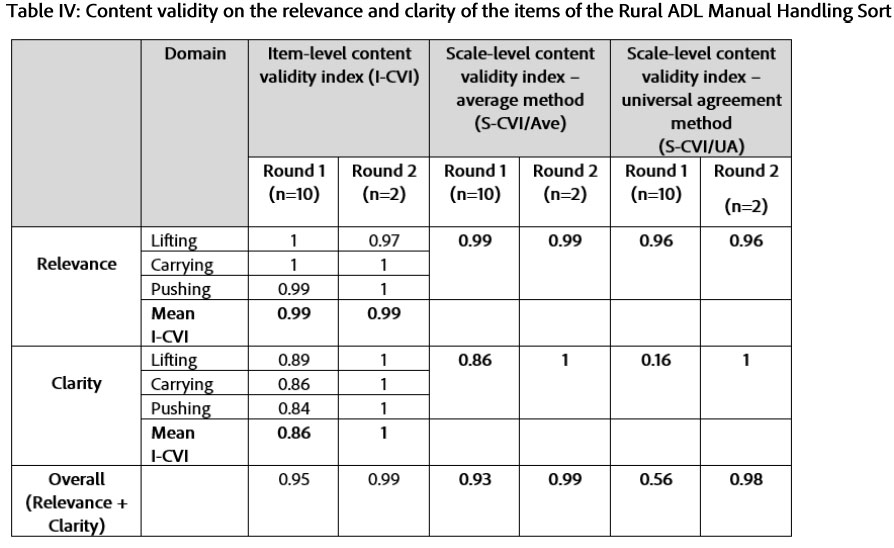
BACKGROUND: South African medico-legal occupational therapists assess claimants' performance in activities of daily living and instrumental activities of daily living (ADL and iADL) which is a prerequisite of work ability. Evaluation of rural claimants can be problematic, since existing assessment instruments do not consider the manual handling demands of iADLs such as firewood and water collection, unique to these settings. This paper reports the content validity determined by subject matter experts (SMEs) for the Rural Activities of Daily Living Manual Handling Sort (RAMS), an outcome measure developed to assess ADLs in rural areas. METHOD: A quantitative descriptive research design with purposive stratified sampling was employed to identify 12 SMEs to determine item-level content validity index (I-CVI), scale-level content validity index-average (S-CVI/Ave) and index-universal agreement (S-CVI/UA) for the RAMS. RESULTS: The results supported good content validity of the RAMS instrument. Items with a score below 0.87 were edited and after recommended changes were made, they were retained in the final RAMS version. The I-CVI scores for the lifting, carrying and pushing domains were 0.97, 1 and 0.99 respectively, while the mean I-CVI was 0.99. The Scale-level content validity index - average (S-CVI/Ave) score for relevance was 0.99. CONCLUSION: The RAMS was found to be a valid instrument for assessment of the manual handling domains of ADLs unique to rural contexts and with further field testing will enable medico-legal occupational therapists to provide realistic evidence to compensation funds. IMPLICATIONS FOR PRACTICE: There is currently no other contextual ADL or iADL instrument available for use in the medico-legal or other practice fields in South Africa. It is anticipated that the use of the RAMS in medico-legal practice will enable South African occupational therapists and those further afield to advocate for appropriate ADL and iADL accommodations for claimants who live in rural resource-scarce contexts. The RAMS is anticipated to contribute substantially to the medico-legal field of occupational therapy in South Africa and to have an impact on improving quality of life of rural claimants. Further studies involving field-testing to investigate the remainder of the psychometric properties of the RAMS, additional contextual occupations and the application of the RAMS in other settings and fields of practice are recommended.
item-level content validity index (I-CVI); scale-level content validity index-average (S-CVI/Ave); index-universal agreement (S-CVI/UA); good health and well-being; rural; activities of daily living; instrumental activities of daily living; outcome measure
 Thumbnail
 Thumbnail
 Thumbnail