Digital apartheid and the effect of mobile technology during rural fieldwork
Abstract
Fourth year occupational therapy students at the University of the Witwatersrand attend a three-week rural fieldwork placement. During this time, they are in a resource-limited environment with limited access to their usual Virtual Learning Environment (VLE) in a blended learning curriculum, thereby contributing to 'digital apartheid' between students from different socioeconomic backgrounds. This study investigates the effect of mobile technology during rural fieldwork to address 'digital apartheid'. A self-reporting pre-test post-test survey design was used. Students self-evaluated their understanding of fieldwork learning objectives at the start of the year and again midyear. Rural fieldwork marks were collected midyear. The experimental group (n=l3) accessed the VLE via the mobile technology, whereas the control group (n0=7) did not. Data were analysed for significance and effect size. While there was no significant difference in the student marks (p=0.27), there was a significant effect on self-evaluated knowledge gain for the experimental group's rural fieldwork learning objectives (d=2.02) which was a notably larger effect size than their other fieldwork learning objectives (d=l.36) and that of the control group's learning objectives. The use of mobile technology during rural fieldwork was a successful strategy towards 'digital democracy' by allowing students equal access to access the VLE.
Digital apartheid; mobile learning; mobile technology; occupational therapy; blended learning; rural clinical fieldwork
INTRODUCTION
The 21st century has seen the rapid penetration of Information and Communication Technology (ICT) into everyday life, driving changes to the way teaching and learning is conducted in higher education1,2. Anywhere-any time access to information has led to democratisa-tion of knowledge21,2. These developments have raised the notion of the 'digital divide', initially viewed as a generational chasm between those who have grown up with technology and those who have had to develop digital skills to evolve with it3,4. The more recent access related divide was identified as socio-economically between the 'have's' and the 'have-not's'5
'Digital apartheid', first coined by General Colin Powell67
Powell66:2.
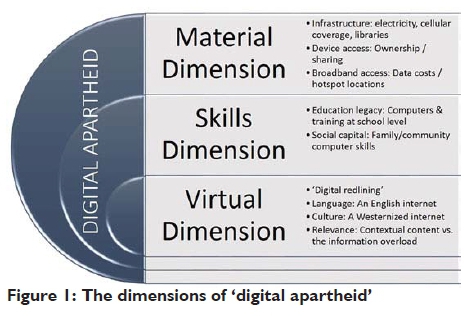
The term 'digital apartheid' is multi-dimensional and thus a more comprehensive representation of the realities facing postapartheid South African higher education. Graham34,8 to further compound student academic and digital literacy. Figure 1 (page 20) illustrated the three dimensions of 'digital apartheid' and the factors to consider within each dimension.
The virtual dimension emerges from the intentional act of 'digital redlining' which takes on a number of forms. It may be under the guise of protecting an organisation from spam and illicit, harmful cyber-attacks, but has the secondary outcome of blocking or filtering out communities who only have access through cheaper portals, as these are attractive avenues for hackers and spammers91010111271333,14.
The skills dimension is most relevant in post-apartheid South Africa where there is still inequity of exposure to technology154,8,1416171816
The material dimension is the most commonly cited concern when introducing technology into a curriculum. Despite near ubiquitous mobile phone ownership by students1982020th in 2016 to almost six times that of Tanzania (current cheapest country)2120414
Brown and Czerniewicz420,22,23. By 2011, 84.2% of South Africans over the age of l5 years owned a mobile phone, 51% of which were devices capable of accessing the internet1922
In health professions education, mLearning provides a wealth of learning opportunities23242422 22
The rapid developments in Tablet Computing Device (TCD) technology since 2010 (with larger screen and keyboard, while retaining mobility), create an advantage for TCDs over a typical smart mobile device for mLearning25et al.2323
Blended learning has been integrated into the undergraduate occupational therapy curriculum at the University of the Witwa-tersrand since 2010. In striving towards post-apartheid transformation, the admissions policy for the degree selects 40% of students on the basis of exceptional academic performance, and 60% based on transformation criteria: ethnicity (20%), rural origins (20%), or education in poorly-resourced schools (20%)2627
METHOD
The aim of the study was to investigate the effect of students having access to TCDs with University funded pre-paid data during the rural fieldwork placement to achieve digital democracy. Two constructs were investigated: the students' perceived knowledge gain and academic performance.
A quantitative self-reporting pre-test post-test survey design was implemented over the first six months of the academic year to evaluate students' perceived knowledge gain across all fieldwork-related learning objectives. A quantitative analysis of academic performance considered the possible impact of digital democracy on student marks.
Setting
The final year occupational therapy students typically attend the three-week rural fieldwork rotation in pairs or groups of three per placement, and are accommodated at a rural hospital >300km from the university. The purpose of the rotation is for students to explore the role of occupational therapy in the field of public health in a typical rural, low socio-economic and impoverished setting; to develop knowledge of the district health system; and to acquire the clinical skills and attitudes necessary to practice appropriate occupational therapy related community rehabilitation. The students participate in community projects such as: an ongoing community project for people with disabilities; nursery school clinical and developmental screening with students from other disciplines; home visits to people with disabilities; community health education drives; and occupational therapy services at community clinics. The students are required to hand over documents (in the form of a paper-based carry-over file) between groups to facilitate continuity of the activities from group to group. Students rotate sequentially in three- to four-week blocks through the rural fieldwork and four other non-rural experiential placements, and are thus not all on the rural placements simultaneously.
The students' performance is assessed in four activities: an individual presentation; group presentation; written work in the carry-over file; and a clinical mark. The clinical mark is awarded by the rural placement clinical educator, counting 15% of the total mark while the remaining activities are marked by the university supervisor who lives in close proximity to many of the rural sites and seldom comes to the University.
Intervention
All students had prior experience in the use of the course VLE for learning activities and communication. Documents, guidelines and links to websites pertinent to rural public health were available on the VLE. A wiki page was created for each hospital for the students to add information about the hospital, thus informing the follow-on groups of the facilities, and generally what to expect. All groups had access to the same VLE content.
The experimental group was issued one TCD per pair, or two between three students at a placement. A pre-paid 500MB mobile data bundle was loaded onto the TCD mobile network Subscriber Identification Module (SIM) cards to ensure that the students were not carrying the data expense. This facilitated the students' ability to access the VLE and other resources anytime and anywhere during the fieldwork in an attempt to create digital democracy. The control group had on-campus access to the VLE before leaving and after returning from the rotation as they were not issued TCDs, but were not restricted in using personal devices during the fieldwork. So as not to disadvantage the control group, they were issued with TCDs during their urban community fieldwork under the same conditions as the experimental group had for their rural fieldwork. The urban and rural fieldwork marks accumulate to the public health curriculum with equal weighting.
Data collection
The survey instrument for this study made use of a 5-point scale based on the method used by McCannon et al.28
The scale ranged from 'l=no knowledge and understanding' to '5=complete knowledge and understanding'. It consisted of a list of 47 learning objectives that pertained to the students' fieldwork requirements during the first six months of the academic year as listed in their curriculum guideline. These learning objectives were randomly ordered via a number draw. Fifteen of the survey items pertained to the Rural Fieldwork Learning Objectives (RFLO), while the remaining 32 were from Other Fieldwork Learning Objectives (OFLO) related to adult psychiatry, paediatrics and adult physical rehabilitation fieldwork. Students were instructed to rate their confidence in their knowledge if they were to write an exam or be examined on that skill at that time.
The baseline survey was paper-based and distributed at the start of the academic year during the fieldwork orientation session. The post-test survey was done mid-year during a one-week campus-based teaching rotation, by which time the students had at various times participated in the same spread of fieldwork rotations. The students were blinded to the study outcome of the RFLO as the target of the experiment, and that the use of the TCDs on the rural fieldwork rotation was being investigated. The pre-test, post-test data were compared, and the difference indicated the students self-evaluated knowledge gain. Data were analysed for significance and effect for the RFLO's for students with or without the TCDs as well as pre-test, post-test data of the OFLO's where students were not limited in their access to the VLE.
Academic performance, in the form of the final student marks for the rural fieldwork rotation was captured at the time of the survey post-test. The clinical educators were not aware of the study thus controlling for marking biases when allocating the clinical marks. While the off-campus university supervisor was aware of the study she was not specifically involved with the study details and was not aware that academic marks were being investigated as a measure. While she was therefore not specifically blinded to which students were in each group, she was also not sensitised to the research outcome related to academic performance. The study was designed by the University- based clinical co-ordinator and the first author.
Participant selection
All final year occupational therapy students were invited to participate in the surveys, convenience sampling was thus employed. Students were under no obligation to participate and they were made aware that they were free to withdraw at any stage without consequence. They were further advised that there would be a mid-year repeat of the survey. Participant allocation to the control or experimental group was directed through two situational variables: a) departmental allocation of students into fieldwork groups; b) timing of the rural fieldwork rotation of each group in relation to availability of the TCDs.
Control group (n0): Students on the first two rural fieldwork rotations were not provided with TCDs for their rural fieldwork as these were not yet available in South Africa. They did however have the TCDs for their urban community fieldwork which is also a module of the public health course.
Experimental group (n;): Students on the third and fourth rural fieldwork rotation were issued TCDs (irrespective of whether they had personal devices) in order to facilitate access to the VLE and other online resources.
The Human Research Ethics Committee (Medical) of the University provided ethical clearance for this study (M090920 and MI60877). All students had access to a TCD for one of the fieldwork placements (either rural or urban) that form part of the fourth year Science of Occupation course. They were issued during the second quarter of the year to all students on rural or urban fieldwork and as such, were all introduced to the TCDs to support the public health curriculum during the same phase of the year.
Data analysis
The self-evaluated knowledge gain survey data and academic performance data for all consenting participants were paired. Baseline and post-test (at six months) data for the control and experimental groups were captured by a research assistant on a Microsoft Excel 10 spreadsheet using the participant numbers.
The data were analysed for significance (α=0.05) using the Mann-Whitney test for non-parametric data on Vassarstats.com29
The self-evaluated knowledge gain data were analysed for effect using Cohen d, and the academic performance data were analysed using Hedges g on the Coe30d analysis is appropriate when using repeated measures and Hedges g reduces the bias in unequal small samples. According to Hill et al.21
RESULTS
The final year occupational therapy class consisted of 26 students of which six (23%) either declined participation or withdrew during the study (failed to complete the post-test survey). Of the participating students (N=20), 13 were in the experimental group (65%) and seven were in the control group (35%).
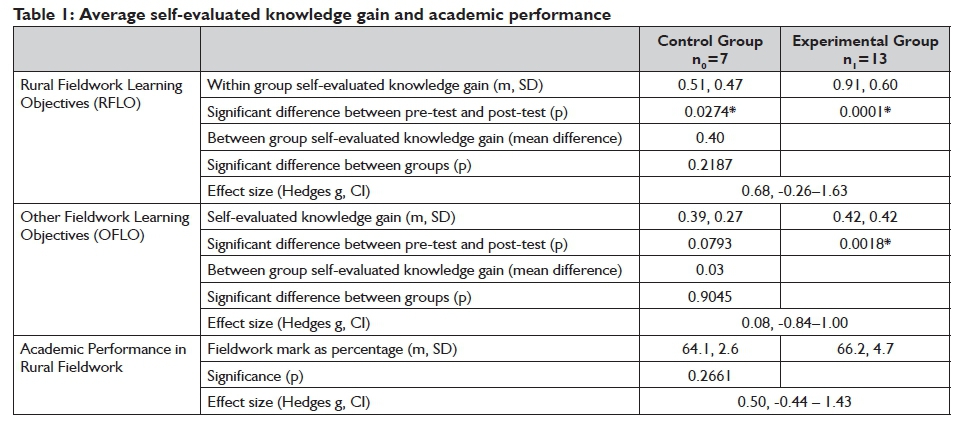
Self-evaluated knowledge gain was indicated by the difference in the pre-test to post-test 5-point scale scores for each learning objective. Table 1 (below) indicates the self-evaluated knowledge gain for both groups and the average academic performance of the students during the rural fieldwork. The experimental group indicated a 0.91 mean difference on the 5-point scale for the RFLO's, compared to a 0.42 gain in their OFLO's. While academic performance was not significantly different between the groups, a medium effect size (Hedges g=0.50) was noted in the experimental group performing higher than the control group.


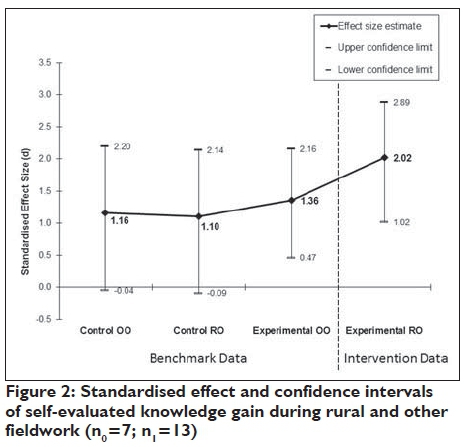
The within-group self-evaluated knowledge gain as anaysed for effect (Cohen d) with associated confidence intervals (95% CI) is represented in Figure 2 (page ??). The intervention data effect
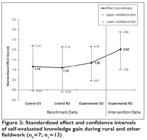
size for the experimental group RFLO (d=2.02, CI=l.02-2.89) is significant and exceeds the expected effect indicated by the other three benchmark data groups (range: d=1.l0 to d=1.36).
As the groups attended the rural fieldwork at different times between the baseline and the post-test, the time variable was investigated. The mean self-evaluated knowledge gain within the fieldwork groups were consistent with their overall control or experimental group data.
Figure 2 (above) illustrates that while the control group's self-evaluated knowledge gain effect size is not significant (CI=95% goes through 0), their OFLO had a large31
When comparing the self-evaluated knowledge gain between groups, there was a medium-large effect size (Hedges g=0.68, CI=-0.26-l.63) for the RFLO with almost no effect (Hedges g=0.08, CI = -0.84-l.00) for the OFLO.
DISCUSSION
The students' self-evaluated knowledge gain was determined through self-reported rating of their knowledge of the learning objectives at the start of the academic year and again at the midyear contact session. It is anticipated that students would perceive themselves to have gained knowledge through their fieldwork experiences. While a significant difference was not noted for the control group OFLO (p=0.0793) there was a mean self-evaluated knowledge gain of 0.39 on the 5-point scale. A significant difference in self-evaluated knowledge gain was noted in the control group's RFLO and both sets of the experimental group's learning objectives (Table 1 pge ??).
In this study the OFLO data of both groups represented the assumed 'digital democracy' conditions of their local academic activities (Table 1 page ??), which formed the benchmark of expected change (effect size)313
It is thus reasonable to determine the non-intervention expected change/effect size benchmark to be within the range d=1:10 to d=1.36, as the trend of change was similar across the self-evaluated knowledge gain when comparing the control and experimental groups for the other fieldwork settings, and the control group's RFLO. The intervention data of the experimental group RFLO represented the strategy towards 'digital democracy' by providing TCDs with pre-paid data to facilitate VLE and online resource access equitably to all students (material support). The results illustrated in Table 1 (pge ??) indicated a significantly large effect (d=2.02, CI=l.02-2.89), which exceeded the benchmark expected change by 0.66, indicating that the use of TCDs during the rural fieldwork had a positive effect on the students self-evaluated knowledge gain and towards 'digital democracy'. The TCDs facilitated the opportunity for students in the experimental group to use various online tools during the rural fieldwork; such as access the navigation application, online resources such as the Department of Health policies and clinical information sites; and full access to their past and current VLE content (not only the Rural Fieldwork content). This opportunity possibly allowed the students in the experimental group to feel more connected to resources any-time and any-where throughout the day. Students' abilities to access and use information relevant to the fieldwork learning objectives possibly allowed them to feel more confident in their knowledge than the control group, and more confident than when they themselves were on other fieldwork without the TCDs. This was further supported by the medium estimated effect size (Hedges g=0.68, CI = -0.26-l.6l) when comparing the RFLO between the control and experimental groups. Creswell32
The academic performance during the rural fieldwork was not significantly different between the control and experimental groups but a medium estimated effect size (Hedges g=0.50, CI = -0.44-1.43) meets the standard indicated by Creswell32
This study is limited in having a small sample size due to the number of final year occupational therapy students, resulting in a low statistical power to detect a significant effect of the intervention hence the confidence intervals for the control group extended below zero. The possibility of bias in the academic marks provided by the off-campus university supervisor are acknowledged. The study is also limited in not being able to track personal device usage to access the VLE and other online resources by students.
CONCLUSION
'Digital apartheid' presents a threat to the successful implementation of blended learning, where during fieldwork some students have better access to online resources than others, particularly during the final year occupational therapy rural fieldwork rotation. This study focused on self-evaluated knowledge gain and academic performance among students using TCDs to access their VLE during rural fieldwork and use of TCDs as a strategy towards achieving 'digital democracy'. Non-intervention benchmark data were established using the control group's self-evaluated knowledge gain in OFLO and RFLO, and the experimental group's self-evaluated knowledge gain for OFLO. Intervention data were collected for the self-evaluated knowledge gain in RFLO of the experimental group. Academic performance data were collected for both groups.
Caution is required in concluding that 'digital democracy' was achieved by the final year as the first three years are largely campus-based, and the final year is largely clinical and off campus. It appears that the effect size on perceived knowledge gain was similar whether the students were at local placements (OFLO) or the control group's rural placements without the material support of the TCDs with pre-paid data. The experimental group's access to the VLE and online resources via the TCDs during the rural fieldwork indicated an effect size that exceeded the range indicated by the benchmark data. The results suggest that facilitating anytime-anywhere access throughout the fieldwork day may impact the premise of 'digital apartheid' and have a positive effect on self-evaluated knowledge gain and academic performance.
As an outcome of this study the final year occupational therapy students are issued a TCD per pair while on their rural fieldwork, and the content and tasks available on their VLE have been tailored to further support their learning experiences. Further investigation of the status of 'digital apartheid' across all fieldwork placements is indicated and consideration should be given to strategies such as the provision of TCDs across all fieldwork placements. Such an endeavour would warrant a Costs Benefits Analysis to determine if the expense of data and TCD procurement would be justified. We are striving to build relationships with local hospitals to allow student access to hospital bandwidth and Wi-Fi, which would significantly reduce the costs.
This study suggests that the democratisation of digital access for all occupational therapy students on fieldwork placements will have a positive effect on equalising their opportunities for attaining successful academic outcomes and a positive impact on their perception of their performance on their fieldwork learning objectives. Mobile technologies present an enabling tool when provided with a curriculum that supports and integrates mLearning effectively.
REFERENCES
- 1. Irvine V Code J, Richards L. Realigning higher education for the 2lst-century learner through multi-access learning. Journal of Online Learning & Teaching. 2013; 9(2): 172-86.
- 2. Council on Higher Education (CHE). South african higher education reviewed: Two decades of democracy. Pretoria: Council on Higher Education; 2016.
- 3. Graham M. Time machines and virtual portals. Progress in Development Studies. 2011; 11(3): 211-27.
- 4. Brown C, Czerniewicz L. Debunking the "digital native": Beyond digital apartheid, towards digital democracy. Journal of Computer Assisted Learning. 2010; 26(5): 357-69.
- 5. Brown A, Vosper H. Development of a blended learning environment to support achievement of graduate outcomes through optimal learning in an undergraduate pharmacy course. Pharmacy. 2013; 1(2): 204-17.
- 6. Powell CL. Is the digital divide a problem or an opportunity? Businessweek. 2000 (18); December: 20.
-
7. Cornish S. "Is digital redlining causing internet caste system?". The Afro-American Newspapers. 2015. <http://www.afro.com/is-digital-redlining-causing-internet-caste-system/> (1 April 2018)
» http://www.afro.com/is-digital-redlining-causing-internet-caste-system/ - 8. Czerniewicz L, Brown C. The habitus of digital 'strangers' in higher education. British Journal of Educational Technology. 2013; 44(1): 44-53.
- 9. Dornan P Hudson J. Welfare governance in the surveillance society: A positive-realistic cybercriticalist view. Social Policy & Administration. 2003; 37(5): 468-82.
-
10. Vumatel. "Vuma faq: How does vuma decide which suburbs to roll out into first?". 2018. <https://vumatel.zendesk.com/hc/en-us/articles/207785909-How-does-VUMA-decide-which-suburbs-to-roll-out-into-first-> (30 March 2018).
» https://vumatel.zendesk.com/hc/en-us/articles/207785909-How-does-VUMA-decide-which-suburbs-to-roll-out-into-first- -
11. ShowMe. "Showme soweto". ShowMe™ Community Websites. 2018. <https://showme.co.za/soweto/about-soweto/> (10 Feb 2018).
» https://showme.co.za/soweto/about-soweto/ -
12. Vumatel. "Vumatel coverage map: Johanneburg". 2018. <https://vumatel.co.za/coverage> (30 March 2018).
» https://vumatel.co.za/coverage -
13. Jozi Digital Ambasassadors. "How to connect to joburg's free wifi". 2016. <http://digitalambassadors.org.za/how-to-connect-to-joburgs-free-wifi/> (3 March 2018).
» http://digitalambassadors.org.za/how-to-connect-to-joburgs-free-wifi/ - 14. Pritchard GW, Vines J, editors. Digital apartheid: An ethnographic account of racialised hci in cape town hip-hop. Proceedings of the SIGCHI Conference on Human Factors in Computing Systems; 2013: ACM.
- 15. Kajee L, Balfour R. Students' access to digital literacy at a south african university: Privilege and marginalisation. Southern African Linguistics and Applied Language Studies. 2011; 29(2): 187-96.
- 16. Department of Education. White paper on e-education: Transforming learning and teaching through information and communication technologies (icts). Government Gazette: Republic of South Africa. 2004; 470(26734): 1-43.
- 17. Naidoo S, Raju J. Impact of the digital divide on information literacy training in a higher education context. South African Journal of Libraries and Information Science. 2012; 78(1): 34.
- 18. Department of Basic Education. Neims: National education infrastructure management system standard report. Pretoria: Department of Basic Education; 2015.
- 19. Calandro E, Stork C, Gillwald A. Research ict africa policy brief no. 2: Internet going mobile - internet access and usage in II african countries. Cape Town; 2012.
- 20. De Lanerolle I. The future is already here, it's just not very evenly distributed... : Journalism next. Rhodes Journalism Review. 2015; (35): 6-11.
-
21. Chair C. "Update: State of prepaid market in south africa submission to the parliament of south africa on "the cost to communicate in south africa"". Research ICT Africa. 2016. <http://resear-chictafrica.net/publications/Other_publications/2016_South%20Africa_Cost%20to %20Communicate%20Submission_RIA%20.pdf> (28 September 2016)
» http://resear-chictafrica.net/publications/Other_publications/2016_South%20Africa_Cost%20to %20Communicate%20Submission_RIA%20.pdf - 22. Mtebe JS, Raisamo R. Investigating students' behavioural intention to adopt and use mobile learning in higher education in east africa. International Journal of Education and Development using Information and Communication Technology. 2014; 10(3): 4-20.
- 23. Byrne-Davis L, Dexter H, Hart J, Cappelli T, Byrne G, Sampson I, et al. Just-in-time research: A call to arms for research into mobile technologies in higher education. Research in Learning Technology. 2015; 23: 1-10.
- 24. Pimmer C, Brysiewicz P Linxen S, Walters F Chipps J, Gröhbiel U. Informal mobile learning in nurse education and practice in remote areas-a case study from rural south africa. Nurse Education Today. 2014; 34(11): 1398-404.
- 25. Gioannis P E-medlab: A distance learning medical laboratory via a tablet pc. Applied Medical Informatics. 2012; 31(3): 64-8.
-
26. University of the Witwatersrand. "Wits university revises its mbbch degree admissions policy". 2016. <https://www.wits.ac.za/media/wits-university/faculties-and-schools/health-sciences/student-documents/undergraduate/Wits%20University%20Revised%20 Health%20Sciences%20Admissions%20Policy.pdf> (November 08 2017).
» https://www.wits.ac.za/media/wits-university/faculties-and-schools/health-sciences/student-documents/undergraduate/Wits%20University%20Revised%20 Health%20Sciences%20Admissions%20Policy.pdf - 27. de Witt PA. Ethics and clinical education. South African Journal of Occupational Therapy. 2016; 46(3): 4-9.
- 28. McCannon R, Robertson D, Caldwell J, Juwah C, Elfessi A. Students' perceptions of their acquired knowledge during a problem based learning case study. Occupational Therapy in Health Care. 2004; 18(4): 13-28.
-
29. Lowry R. "Vassarstats: Website for statistical computation". Vassar College. 2001-2016. <www.vassarstats.net> (17 August 2016)
» www.vassarstats.net -
30. Coe R. "Effect size calculator". CEM Centre for Evaluation & Monitoring. 2016. <http://www.cem.org/effect-size-calculator> (04 October 2016).
» http://www.cem.org/effect-size-calculator - 31. Hill CJ, Bloom HS, Black AR, Lipsey MW. Empirical benchmarks for interpreting effect sizes in research. Child Development Perspectives. 2008; 2(3): 172-7.
- 32. Creswell JW. Action research designs. Educational research: Planning, conducting, and evaluating qualitative and quantitative research. 4th ed. Boston: Pearson; 2012: 576-601.