Shaping professional identity: a descriptive qualitative study on Health and Rehabilitation final year students in higher education
Abstract
BACKGROUND: Professional identity represents a person's philosophy of their profession. This identity defines what it means to be and act as a professionalAIM: This paper will describe the factors that shaped the professional identity of students in Occupational Therapy, Physiotherapy and Communication Sciences Disorders during their four years (2015 - 2018) of studies in the Faculty of Health Sciences in a higher education institutionMETHODOLOGY: A descriptive qualitative design was used to describe the factors that emerged. Seven participants were purposively selected from the Faculty of Health Sciences. Individual interviews and a focus group with participants were conducted. Data were analysed inductivelyFINDINGS: The results generated the theme 'The curriculum and experiences within practice and professional environments shape professional identity'. The findings highlighted how critical events in higher education may have influenced the participants to develop a professional identityCONCLUSION: The curriculum played an integral role in defining how the narrative for each participant was played out and how professional and practice environments greatly shaped the students' developing professional self
curriculum; professional and practice environments; health and rehabilitation sciences; undergraduate rehabilitation education
INTRODUCTION
This paper describes the factors that shaped the professional identity of Occupational Therapy, Physiotherapy and Communication Sciences Disorders students during their four years (2015 - 2018) of study in the Faculty of Health Sciences at the University of Cape Town. The paper provides the context in which the study was conducted and offers a brief review of the literature in relation to curriculum content, professional & practice environments, and the role of professional identity in the developing self.
BACKGROUND
Professional identity is a conscious embodiment of the way a professional defines who they are and the way they choose to act and represent themselves. This representation is defined by the philosophy of a particular profession12223
There has been little research around how health and rehabilitation (H&R) students establish their professional identities within a four year degree programme in higher education. It was important to understand how the development of professional identity occurs, and what areas are crucial to enhance their own identity development. Identity development is critical in defining and shaping who the graduating health professional chooses to become and why this is important.
Professional identity is described as an internal identity that reflects choices of beliefs, characteristics and commitments of the self and is further developed or conditioned by experiences in practice444
Occupational therapists have many potential individual and collective professional identities that vary according to their understanding of their identity within different historical and social environments11
It is argued that occupational therapists should utilise the changing professional order that is characterised by the diversity of practice in order to negotiate a new individual professional identity111
In a study on the development of professional identities within the nursing community5
Locating the individual at the core of their own identity, is the precursor for the concept of occupational identity6678
Curriculum and professional identity
Brandt discussed his experience of professional identity formation that was achieved through interprofessional learning and encountering patients during his early years as a medical student99
Through the use of experiential learning in clinics with multidisciplinary teams, a medical student felt better prepared to be a health professional99
Three categories of professional identity emerged during the process of professional identity development in graduating Physiotherapy students1010
The strength of professional identification however, varies by profession. The significant contributors of baseline professional identity were: gender; profession; previous work experience in environments; understanding of team work; knowledge of profession; and cognitive flexibility11et al.1111
Studies have shown that interdisciplinary practice is one example of how curricula could encourage the development of professional identity across varying professions.
The research question How is the professional identity of final year H&R students being shaped over the course of four years of study? was pertinent as it contributed to unearthing the professional identity development of H&R students. The study therefore aimed to describe the factors that contributed to developing professional identity for H&R students within a higher education environment.
METHODS
Design: A descriptive qualitative design12
Sampling: Purposive sampling was used to identify seven participants who met the selection criteria. The participants included students studying occupational therapy, communication science disorders and physiotherapy. To allow full anonymity and confidentiality, each participant was asked to choose a fictional name, which allowed for full anonymity whilst providing a personal voice. Selection criteria: Participants had to be final year occupational therapy, physiotherapy and communication sciences disorders students in 2018. Students who had studied at least one year in another degree other than their current degree were excluded from the study.
Participant recruitment: An invitation to participate in the research was sent to class representatives and was sent to final year students across the disciplines via an email that included the information sheet and the informed consent form. The information sheet to recruit potential participants were also presented during a lecture slot to further attract participants.
Ethics approval (HREC 034/2018) for this study was granted from Human Research Ethics Committee, Faculty of Health Sciences at University of Cape Town (UCT)and the Director of Student Affairs at UCT prior to data collection.
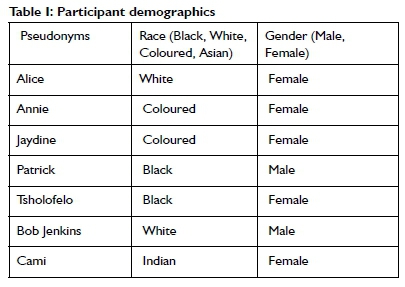
The participants included two of each race and one Indian as specified in Table I (p51), two males and five females and two of each discipline, apart from Communication Sciences Disorder where there was only one participant. The participants' disciplines were omitted from Table I to further ensure anonymity, as the class sizes were small and could potentially enable identification of individual participants.
Data collection: Individual interviews with each participant were conducted taking an interview guide approach. The interviews were 40 minutes long and were held at a place that was convenient for the participants. The interviews were audio-recorded with the consent of all participants. A focus group session on the themes that emerged from the interviews was conducted to further develop emerging themes. The focus group session contained six participants as one participant was not available. The participants included two occupational therapy students, two from communication science disorders and two physiotherapy students. This assisted in consolidating the data that emerged from the interviews and served as a form of member checking.
Data Analysis: An inductive approach was employed to analyse the information received from both the interviews and the focus group. The audio-recording of the interviews were transcribed verbatim. The transcripts were then analysed through a thematic analysis approach. The themes were used to inform the questions for the focus group. The focus group was audio-recorded and transcribed verbatim, the data were then grouped into the final theme.
Rigour: Rigour was ensured through the following strategies.
Dependability20
Credibility20
Transferibality20
FINDINGS
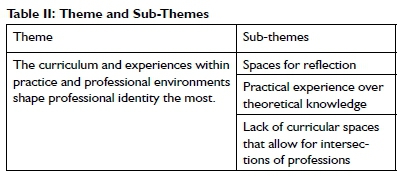
The following theme emerged 'The curriculum and experiences within practice and professional environments shape professional identity'.
This theme focuses on the way in which undergraduate curriculum programmes are structured and the opportunities afforded students through professional environments such as practice learning, that contribute to the development of their professional identities.
Sub-themes:
Spaces for Reflection
This sub-theme focused directly on what each programme had to offer as a space to reflect on the learning and experiences that occur during practice learning, as well as the personal experience each student encounters within each site. Tutorials are one learning strategy used over several platforms across the H&R programmes where this type of sharing of experiences occurs. Three out of the four programmes offer these type of tutorial spaces. Only one programme in H&R has a time scheduled for reflective space within their course curriculum.
Becoming a Rehabilitation Professional and Clinical Physiotherapy are two courses that have influenced the professional identity of one of the Physiotherapy participants as these courses taught them how to act and think as a professional in a practical and theoretical sense. However, it was not a space that encouraged reflection on clinical experiences and personal identity and positioning.
"...overall I feel like both clinicals and this course allow me to at least encompass both of those that add towards my professionalism." - Tsholofelo
Patrick provided an example of an experience he was able to share during a reflective space that positively helped him to make sense of the experience. This incident occurred during practice learning with a clinician.
"I had to interact with someone who every time they saw me they saw a representation of what was wrong with their life. So, problems they were facing like they got burgled into and it was by criminals who were supposedly black, there were protests at UCT and it meant that her daughter was going stay longer in the year and she was going to get paid more. But every time she saw me she thought, "These people". So, I was the reminder, she projected her problems onto me and then I was the horrible one. So yeah. I called her racist at the end, and she cried and I was like it's fine, you just have to admit that you're racist." - Patrick
The above quote from a student experience in practice, provides one example of how one can be perceived just by your appearance. He had to learn how to negotiate his personal identity with his professional identity in thinking about how to best respond to the situation he was in.
The participants in the study communicated that their professional identity reflected their personal identities, namely seeing how their cultural and gender identity can fit into their professional identity and how this affects their ability to practice. Jaydine described it as:
"We have two Muslim HODs in the OT department. ... it just instilled so much confidence in my personal identity as a coloured Muslim in this profession". For Patrick, connecting on cultural level was more valuable "I think for me, it's important for me to see people who I relate to on a cultural level doing what I aspire to do." - Jaydine
These two examples demonstrate that the formation of a professional identity was influenced greatly by who they are as individuals; which is considered to be factor that contributes to the process of developing a professional identity.
Gender was one of the personal identities that was highlighted by the participants in playing a role in the formation of a professional identity. There is a lack of male representation in some departments in the FHS, particularly occupational therapy and communication sciences disorders. The effects of this include being unable to position oneself within the profession, may deter from professional identity as well as having concerns for his own cultural responsibilities financially. A lack of representation was noted by a male participant in the study who commented on how this has led to a shortage of clinical male occupational therapists. There is a need for more male representatives in H&R in the form of role models, as these professions are deemed as being female dominated, resulting in males being less visible. Many male H&R professionals choose to work in the corporate sector and not in the health sector as it may be seen as more financially viable. The inability for participants to identify themselves within the profession in terms of their personal identity affects their self-efficacy.
"So, I still haven't met someone who is married and has had to make it work being an OT and you know, pay black tax. Not pay in like transaction way, but go through that experience of having to help out at home and still have a life of their own and start a family and go through the all cultural processes of a wedding, paying lobola, and make it work and see how it looks like for a black person who is an OT and who has had to go through all of that. So, for me, I still haven't seen anyone like that, and that's why I say that I haven't met a role model, I've met people that I aspire to, that I can draw inspiration from and say, I can learn from what this person has done or what they have achieved or what they have learnt through doing certain things." - Patrick
The sub-theme explored the different spaces for reflection that exist in H&R programmes. The occupational therapy division has a designated space for this type reflection which supported some participants' experiences of difference and how these experiences influenced their developing professional identity as a growing student. Other participants expressed that their divisions should also have a space available similar to that of the occupational therapy division:
"I think because you guys are studying occupational therapy you have something specifically dedicated to identity, whereas we don't." Cami
Practical Experience over Theoretical Knowledge
This sub-theme speaks to the experience that students acquire at practice learning as it relates to the theory that has been taught and the impact this experience has on their roles as emergent health professionals. Positive feedback from clients also helped to reassure the participants that their roles are important and that they are making a difference to the clients' lives. H&R students have had reported good interactions with their clients.
"Watching people be grateful when we give them hearing aids". - Annie
Participants believed that teaching theory on its own is not enough to equip them with the necessary skills they require to thrive in a clinical setting. They have raised concerns about the role of theory in other professions towards developing their professional identity. Participants also indicated that the tutorials they have had during practice learning with their supervisors have been helpful in guiding their interventions:
"You can give a student an idea [of their role] but they're not going to know until they're there". - Alice
"We do have a lot of tutorials in block where we can just come and talk about our experiences at clinics". - Cami
This sub-theme explored how positive client interactions shape professional identity, as well as how the combination of theory and practice that is experienced during practice learning can help students to discover their role, and these interactions have either a significant positive or negative impact on the participants' professional identity.
Lack of Curricular Spaces that Allow for Intersections of Professions
Interactions amongst one's peers also may shape the professional identity of a student through one's time at university. The number of social interactions amongst one's peers varies between courses due to schedules, physical settings and practice learning placements. The participants felt that their professional identity was impacted due to the lack of interactions between various health professionals.
The different professions have often been grouped together for certain courses as well as in different venues, which render socialisation between the other divisions to a minimum throughout the four years. As the number of students in each programme varies greatly, venues across the large campus are required, limiting opportunities for student interactions. This provides them with fewer opportunities for socialisation outside of their profession and they often experience feelings of isolation.:
"The physios are worse than the medics, like we don't really interact with the medics, so they don't bother me at all." - Cami
"We don't really have meridian, so we don't really interact and we all get sent here at Old Main and then you never see like the doctor students again". - Alice
The only apparent space for the different disciplines to interact is on the bus to the different practice learning sites. This is an opportunity for social interaction amongst different professionals but this is also dependent on practice learning placement, as students are not guaranteed transport to certain placements and if transport is provided, students would only be able to interact with others going to placements in the same geographical area.
"And then when your clinics start and you like take the buses together and stuff then you can interact more with the physios and the OTs" - Alice
During the focus group, whilst participants were discussing the divisions in the faculty, an issue about hierarchy in H&R surfaced, the participants came to the consensus that physiotherapists were seen as and acted as if they were at the top of the H&R food chain:
"Um ... like the physios, definitely, I won't say all of them, um most of them think they better than the rest of us. (Laughter). The OTs, Audios and Speeches are of the same sort of level".- Cami
"I've heard of that hierarchy thing amongst health and rehab. Um some OTs have come forward to me at one point in time and told me that um or asked like why we feel as if we're like the next thing or the next best thing to medicine". - Tsholofelo
Apart from Becoming a Professional (BP) and Becoming a Health Professional (BHP) course in first year, there is no other space available for different professions to interact with each other. In summary, this sub-theme speaks to how the lack of interaction between the different divisions within the FHS contributes to the dynamics on campus, ultimately perpetuating a hierarchy due to the lack of knowledge and disregard of the different professional roles within the health care setting.
Discussion
The model of 'transactionalism' offers a lens to view an individual as not being a separate entity outside of their context151155
This implies that each student's formation of professional identity will vary according to who they are even though they are taught the same content throughout their university career.
It was noteworthy that no female participants brought up the lack of male representation in their respective divisions. There is an assumption that this lack of representation was not noted by the female participants due to the lack of direct impact on their daily experiences, because the H&R department is female dominated. Productivity is encompassed by the social recognition that individuals attach to their work6
According to Phelan & Kinsella6416,5,9. To a large extent the participants of this study agreed with this as they found that learning theory alone was not as effective if it could not be implemented practically, in that theoretical knowledge is not solely sufficient for the skills in their scope of practice.
Structures that perpetuate the divide
The structural positioning of the FHS campus contributed to the divide amongst the departments of MBChB and H&R through the delegation of faculty resources and physical learning spaces. Being on the Health Sciences campus comes with the convenience of easier access to administration offices and faculty resources for medical students further isolating the H&R students and potentially limiting access to learning and further support. This could also contribute to how H&R students position themselves in relation to medical students. Nembhard and Edmondson17518
The broad issues discussed, offered an explanation to the factors that influence how professional identity is shaped for health and rehabilitation students. These factors either hindered or supported the students development in varying ways, that then continue to perpetuate the hierarchy that currently exists in the higher education environments.
Implications for practice
This study offers insights into how curricula can positively shape and contribute to the developing self as an emergent health professional. By taking into careful consideration the content we include in occupational therapy undergraduate curricula and the practice sites we use, this can ensure that every student finds resonance with the experience.
Limitations
The only limitation of this study was that it focused on student perspectives from one university and therefore findings are contextually relevant to that one university only.
Conclusion
This article highlighted and brought to the fore how critical events in higher education may have influenced the participants developing professional identity as Health and Rehabilitation students. The curriculum plays an integral role in defining how the narrative for each participant plays out and how professional and practice environments greatly shape the students' developing self.
Recommendations
It is recommended that health sciences programmes consider opportunities in their curricula to include content on reflection of professional identities as fundamental to contributing to their developing and emerging identities as health professionals.
REFERENCES
LITERATURE REVIEW
-
1. Mackey H. 'Do not ask me to remain the same': Foucault and the professional identities of occupational therapists. Australian Occupational Therapy Journal.2007; (54): 5-102. https://doi.org/10.1111/j.1440-1630.2006.00609.x
» https://doi.org/10.1111/j.1440-1630.2006.00609.x -
2. Matthews J, Bialocerkowski A. & Molineux M. Professional identity measures for student health professionals - a systematic review of psychometric properties. BMC Medical Education. 20l9; 19: 308. https://doi.org/10.1186/s12909-019-1660-5
» https://doi.org/10.1186/s12909-019-1660-5 -
3. Cloete N, Maassen P Bunting I, Pillay P & Bailey T. Universities and economic development in Africa. 20ll Retrieved from https://chet.org.za/download/file/fid/70
» https://chet.org.za/download/file/fid/70 -
4. Bassier, I, Velelo, L, Coenraad, S, Chikte, A, Wenana, C, & Murithi, G. Protesting policy: Interrogating free decolonised higher education funding. 20l5; Retrieved from https://www.news.uct.ac.za/images/userfiles/files/downloads/fepg/FundingFreeDecolonisedEducation_Long.pdf
» https://www.news.uct.ac.za/images/userfiles/files/downloads/fepg/FundingFreeDecolonisedEducation_Long.pdf -
5. Branch W, & Frankel R. Not all stories of professional identity formation are equal: An analysis of formation narratives of highly humanistic physicians. Patient Education And Counseling.2016; 99(8),1394-1399. http://dx.doi.org/10.1016/j.pec.2016.03.018
» http://dx.doi.org/10.1016/j.pec.2016.03.018 -
6. Johnson M, Cowin L.S, Wilson I and Young H. Professional identity and nursing: contemporary theoretical developments and future research challenges. International Nursing Review. 2012; (59): 562-569. https://doi.org/10.1111/j.1466-7657.2012.01013.x
» https://doi.org/10.1111/j.1466-7657.2012.01013.x -
7. Phelan S, & Kinsella E. Occupational Identity: Engaging Socio-Cultural Perspectives. Journal of Occupational Science 2009;16(2),85-91. https://doi.org/10.1080/14427591.2009.9686647
» https://doi.org/10.1080/14427591.2009.9686647 -
8. Miller G, & Nowacek D. Social construction of reality. The Blackwell Encyclopedia of Sociology. 2018;, John Wiley & Sons Ltd. https://doi.org/10.1002/9781405165518.wbeos1232
» https://doi.org/10.1002/9781405165518.wbeos1232 -
9. Sonday A, Ramugondo E, & Kathard H. Professional role transgression as a form of occupational consciousness. Journal of Occupational Science, 2019; 26(3), 366-378. https://doi.org/10.1080/14427591.2019.1630852
» https://doi.org/10.1080/14427591.2019.1630852 -
10. Brandt L. Personal professional identity formation through inter-professional learning and early patient encounter during preclinical years. Korean Journal Of Medical Education. 2017; 29(3): 203-205. http://dx.doi.org/10.3946/kjme.2017.67
» http://dx.doi.org/10.3946/kjme.2017.67 -
11. Lindquist I, Engardt M, Garnham L, Poland F & Richardson B. Physiotherapy students' professional identity on the edge of working life. Medical Teacher. 2006; 28(3): 270-276. http://dx.doi.org/10.1080/01421590600605272
» http://dx.doi.org/10.1080/01421590600605272 - 12. Turner, J. C., & Onorato, R. S. Social identity, personality, and the self-concept: A self-categorizing perspective. In Applied social research. The psychology of the social self .T. R. Tyler, R. M. Kramer, & O. P. John, Editors. Lawrence Erlbaum Associates Publishers.1999: 11-46.
-
13. Sandelowski M. What happened to qualitative description? Research in Nursing & Health. 2000; 23 (4): 334-340. https://doi.org/10.1002/1098-240X(200008)23:4%3C334::AID-NUR9%3E3.0.CO;2-G
» https://doi.org/10.1002/1098-240X(200008)23:4%3C334::AID-NUR9%3E3.0.CO;2-G -
14. Christiansen C.H. Defining lives: Occupation as identity: An essay on competence, coherence and the creation of meaning. American Journal of Occupational Therapy. 1999; 53: 547-558. https://doi.org/10.5014/ajot.53.6.547
» https://doi.org/10.5014/ajot.53.6.547 -
15. Christiansen C. Identity, personal projects and happiness: Self construction in everyday action. Journal of Occupational Science. 2000; 7: 98-107. https://doi.org/10.1080/14427591.2000.9686472
» https://doi.org/10.1080/14427591.2000.9686472 -
16. Dickie V Cutchin M, & Humphry R.(2006). Occupation as Transactional Experience: A Critique of Individualism in Occupational Science. Journal Of Occupational Science. 2006;13(1): 83-93. http://dx.doi.org/10.1080/14427591.2006.9686573
» http://dx.doi.org/10.1080/14427591.2006.9686573 -
17. Ikiugu M, & Rosso H. Facilitating professional identity in occupational therapy students. Occupational Therapy International. 2003; 10(3): 206-225. http://dx.doi.org/10.1002/oti.186
» http://dx.doi.org/10.1002/oti.186 -
18. Nembhard I.M. & Edmondson A.C. Making it safe: The effects of leader inclusiveness and professional status on psychological safety and improvement efforts in health care teams. Journal of Organizational Behavior: The International Journal of Industrial, Occupational and Organizational Psychology and Behavior. 2006; 27(7): 941-966. https://doi.org/10.1002/job.413
» https://doi.org/10.1002/job.413 -
19. Mayers P Alperstein, M, Duncan, M, Olckers, L. & Gibbs, T. Not just another multi-professional course! Part 2: Nuts and bolts of designing a transformed curriculum for multi-professional learning. Medical Teacher. 2006; 28(2): 152-157. http://dx.doi.org/10.1080/01421590600603137
» http://dx.doi.org/10.1080/01421590600603137 - 20. Creswell, J.Qualitative Inquiry and Research Design: Choosing Among Five Approaches. 3rd edition. SAGE publishing: Washington DC. 2013 :47-49.
* Ethical clearance for this study was granted prior to the enactment of the amended POPIA on 2021-07-01.