Occupational Therapy in the bereavement process: A meta-synthesis
Abstract
INTRODUCTION: Bereavement is a complex process characterised by a state of grief and suffering, which impacts the health and well-being of the bereaved, and extends to their occupational performance. Thus, occupation can be understood to be central in the expression of bereavement after the death of a loved one as it mediates identity formation, interpersonal relationships, a sense of belonging, and future perspectivesPURPOSE: To review English and Portuguese literature and identify how occupational therapists perceive and/or intervene in the bereavement processMETHOD: A meta-synthesis was conducted by database search and article analysisRESULTS AND DISCUSSION: Eight qualitative style articles were analysed. From these, three categories were derived from the content analysis: 1) Relationship between study participants and the deceased; 2) Occupational repercussions of bereavement; and 3) Occupation as a means to an end in the therapy process of the bereaved.CONCLUSIONS: Although the need for studies of the bereavement process and its implications for occupations is urgent, this study points out that occupations can be predictors of understanding the elaboration process through occupational engagement and that they also act as a potential resource to construct meaning about the death of the loved one
Occupational therapy; bereavement; grief; mourning; attitude to death
INTRODUCTION
In this study, bereavement was considered a complex process that occurs through loss, by death, of a significant other. It is a universal, singular, and painful human experience12,3,4. Contemporary authors however, state that there are differences between significant losses and death losses5,6,7. Bereavement is defined as the objective situation one faces after having lost an important person and a statement of the objective reality of the situation after death555,6,7.
A conceptual model that considers bereavement as an active process of searching for the reconstruction of meaning after losing a significant person, is proposed in literature5. It states that finding and/or reconstructing significance during the bereavement process helps the individual adapt to a changed world5. The death of a loved one leads to the bereaved individual reviewing their structure of meaning before the loss, and to identify both consistencies and inconsistencies of past structures. Consistency helps to explain the difficult event, while inconsistency leads the bereaved to revise their meaning-making nucleus, perceiving the world in a different way after finding useful meanings5
Occupation is a powerful and intrinsic source of meaning in our lives, in that meaning emerges from occupation, and occupation emerges from meaning88
In this study, the concept of occupation as defined by Wilcock was used, which defines occupation as a complex synthesis between doing, being, becoming, belonging, and establishing a complex relationship between health and well-being9, 10. In this way, it is necessary to understand occupation as a potential source of reconstructing meanings in response to bereavement. Therefore, understanding that bereavement has a direct influence on occupation, and consequently on the health and well-being of those who experience it. The purpose of this study was to review English and Portuguese literature and identify how occupational therapists perceive and/or intervene in the bereavement process.
METHODOLOGY
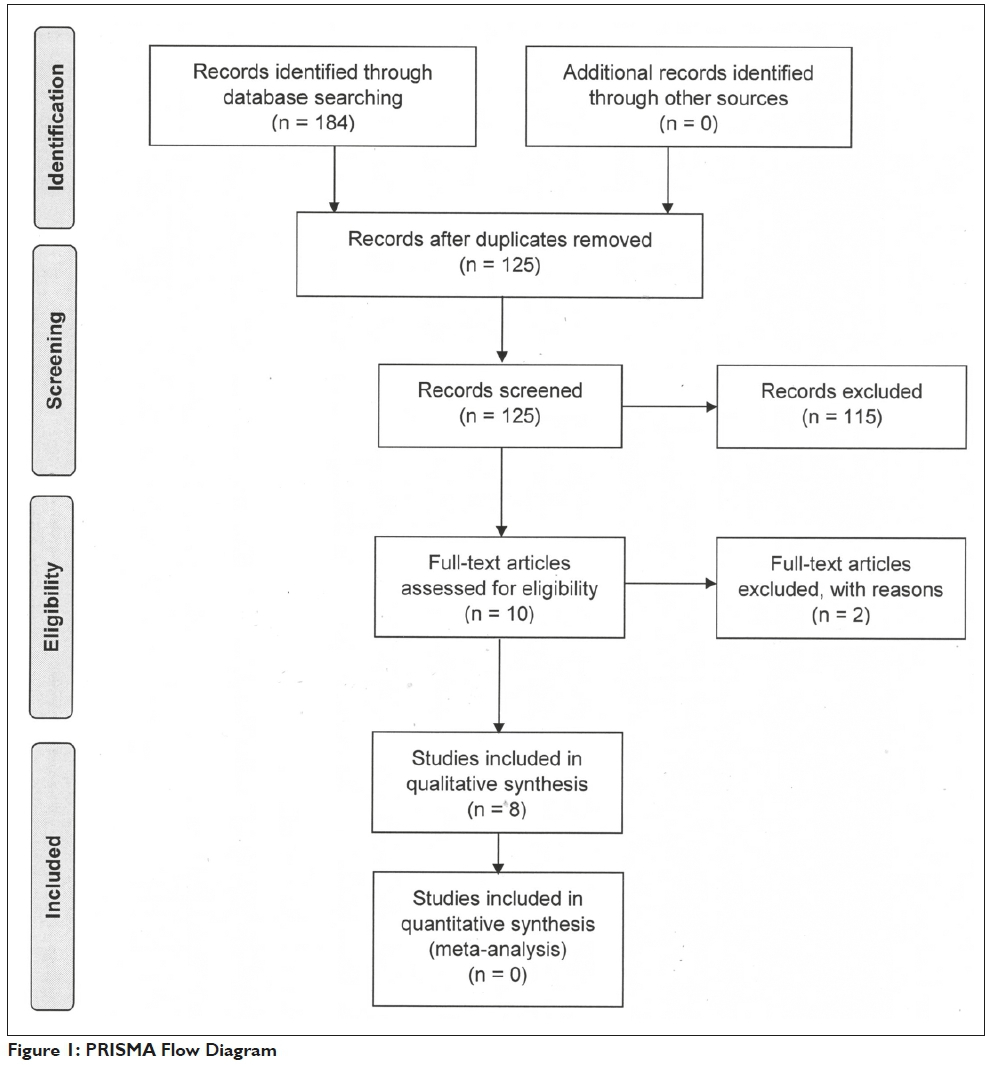
The meta-synthesis of literature performed in this study followed the PRISMA model11Figure 1 on page 13) was used for the preparation of this study. To address our research question "how do occupational therapists understand and/or intervene in the bereavement process?" we reviewed Portuguese and English articles by occupational therapists that focused on the bereavement process.
The databases used were Scopus, CINAHL Database, MEDLINE, PubMed and SciELO; The descriptors used for Portuguese were "Terapia Ocupacional" and "pesar" or "luto" or "atitudes frente a morte," and for English, "occupational therapy" and "grief" or "mourning" or "bereavement."
The inclusion criteria were: complete study articles available online, papers about death-related bereavement processes that included at least two keywords, and papers written in either English or Portuguese. No date filtering was performed.
The research was conducted during the period of June 2017 through December 2017 by two independent researchers, with seven days between each search. The articles were read and the results organised, then analysed according to the content analysis criteria as proposed by Bardin12: 1) Pre-analysis: operationalising the material by systematically organising the raw data into identified concepts, 2) Exploring of the material: defining the units of analysis through coding elements with the same meanings; and, 3) Treatment of results, inference and interpretation: interpreting the results through inferential analysis.
RESULTS
The sample
One hundred and eighty four articles were identified from the database search. Of these, 59 duplicate articles were removed. The abstracts of the remaining 125 articles were read to determine whether they met the inclusion criteria, and based on this, 115 articles were excluded. Ten papers were selected for analysis, however two of these were not available in complete format and were discarded. In total, eight articles were included in this study, with one published in Portuguese and seven in English.
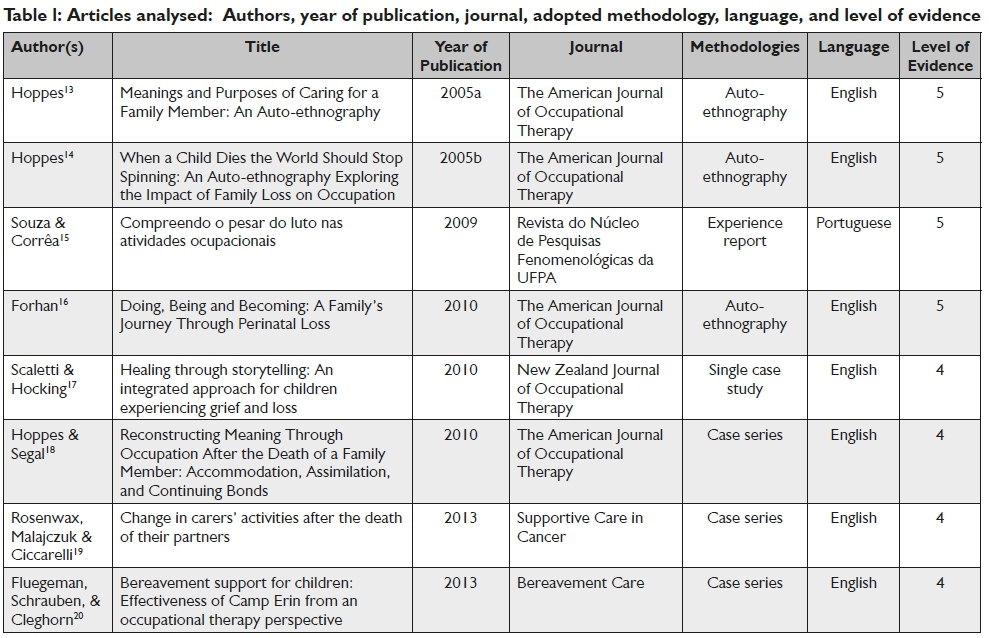
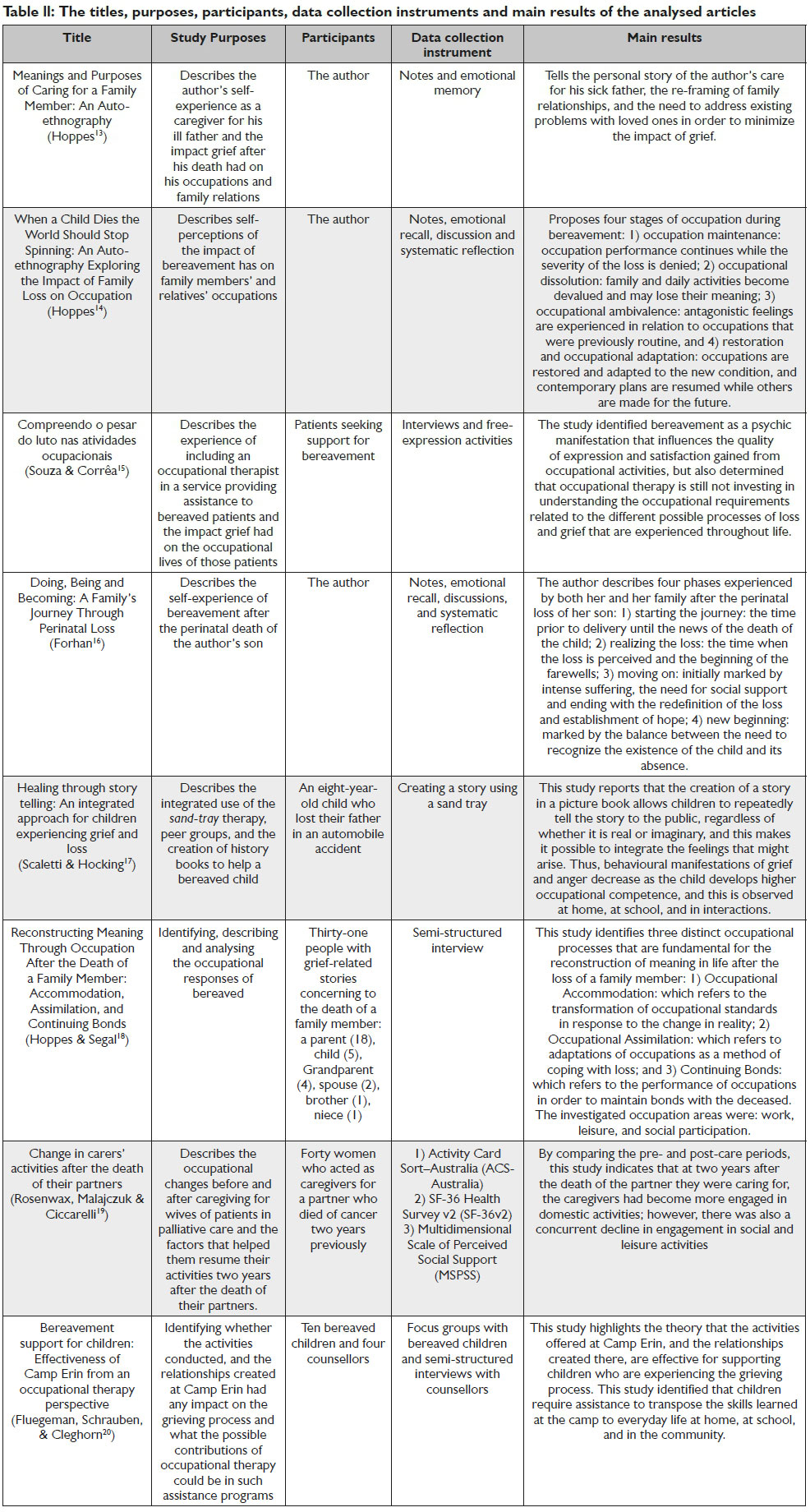
Few articles related directly to occupational therapy intervention for the bereaved and all articles in the review presented qualitative approaches. In all the studies analysed, participants had experienced the death of a family member. Table l (page 14) shows the detail on the eight articles selected for analysis namely author(s), title, year of publication, journal, methodology, language and level of evidence. Three of the articles were auto-ethnographies and three were case series, one was a case study and one was a personal experience report. Table II (pages 14 and 15 ) summarises the purpose, participants, data collection instruments used, and main findings of each of the eight selected articles.
Main findings of the studies included in this analysis
In another paper by Hoppes14
Souza and Corrêa15 and Scaletti and Hocking171517
Rosenwax, Malajczuk, and Ciccarelli1920
DISCUSSION
Bereavement receives little attention in occupational therapy literature16, 18. However, even less attention is given to publications in the Portuguese language. Adopting a qualitative perspective towards bereavement research provides an alternative paradigm to the current research methodology employed in the studies analysed. By using a wide range of techniques, including data collection, analysis, and interpretation, qualitative analysis has the potential to add depth to evaluating the bereavement process2122231818
Further insights into the impact of bereavement on occupations were gained as a result of the content analysis, from which the following three categories were identified:
Category 1: The relationship between study participants and the deceased
The impact of death creates a systemic demand on the family, at both an emotional and relational level. This crisis stems from the need of the bereaved to resume their own roles, whilst having to share the bereavement experience of other family members. Their own bereavement is therefore aggravated by the grief of other members of the family2425
When there is an interruption in a person's occupation with the deceased, changes in lifestyle arise, causing abandonment of roles or an inability to perform activities with and for the loved one who died. The bereaved consequently question what they will do without the presence of the loved one, and consequently, grieve over being forced to forgo activities that were once shared. In this way, they are required to renounce old and enjoyable shared activities, rebuild their world, and adapt to other activities that have replaced the old ones. This can be achieved by entering a new situation, adopting another way of performing such activities, or accepting another, new reality that lacks the physical presence of the loved one15,26.
Category 2: The repercussions of bereavement on occupations
When a loved one dies, the concepts held about the world (which were validated by the other person's existence), are suddenly lost. Habits of thought, built over many years will need to be revised and modified and the worldview of the bereaved will need to change225
The death of a loved one interferes with occupations that were previously performed for, or with, the person who died, changing the synthesis between doing, being, becoming and belonging. The findings of the studies we analysed confirm this premise, and continued research leading to improved understanding is of value to guiding occupational therapists in the care of the bereaved. Occupational therapists should be taught how to recognise a person's disconnection from their occupations during the bereavement process1513
For this author, occupation can serve as a compass for the construction of ways to understand bereavement and the construction of meanings in response to bereavement. The understanding of how occupations can be terribly confusing after the loss of a loved one guides our vision as occupational therapists and assists us to guide the bereaved through this process like no other professional can13
Hasselkus8 helps us consider the implications that bereavement brings to occupational meaning. For this author, occupation is a strong enabler to knowing one's self, and to know one's self is to know one's being. A way that my self becomes known to me, and one way that my self is expressed in the world, is through occupation. In the bereavement process, the self-identity of the bereaved becomes inconsistent against the reality of loss2,5,25.
Becoming holds the notion of potential and growth, of transformation and self-actualisation9,10. Many times, the bereaved see themselves without future prospects and they question their potential, which increases their grief over the loss24,25,26.
The uniqueness of the bereavement process reinforces the need for a client-centred therapeutic process, and the occupational therapist must identify the best form of interaction with the bereaved, beginning the therapeutic process by reflecting about what changes must be made to give back to the client - through therapy - their notion of potential8
Belonging is recognised by a sense of connection with another person, places, cultures, communities and times10. Belonging is a place capable of providing physical and emotional security, provide both private and community space that meets social needs and helps form a group identity27
The bereaved believe that silence about the death of a loved one modifies their sense of connection with that person and places2825,26.
The bereaved person temporarily loses the willingness to listen, but has an urgent need to speak. This brings significant changes to their ability to communicate, which may reinforce the feeling of loneliness and as a result, the intensity of the bereavement depends on the human support that the bereaved receives29
Occupation as a means-to-an-end in the therapy process of the bereaved
Participation in occupations is considered the final result of an intervention, and professionals use occupations during the intervention process as a means-to-an-end30
The use of occupations was reported as a means of understanding and intervening during bereavement15,17,20. The therapeutic use of artistic approaches such as music, creative writing, and visual arts, along with other practices and multi-mode performances, are potential resources for the construction of meanings related to grief and bereavement31,32.
Hasselkus8 believes that one way to know the meaning of experience occurring in a person's everyday life is the narrative therapy of meaning, since by telling a story, one relates his or her unique interpretation of an experience. Narrative as sources of meaning thus offer a way for us to frame the practice of occupational therapy.
Understanding that the bereavement process comes from the reconstruction of meanings, occupational therapists can use occupations to care for bereaved people, because the occupation is a powerful source of meaning. Narrative as a construction of meaning can offer us one way to understand the changes of meaning of occupations and help the bereaved to reconstruct their occupational performance. The narrative organises the discourse and the lived experience, creating stories that temporarily give meaning to the events in a social context, according to personal religious and cultural beliefs. Narrative therapies have gained space as an effective type of grief therapy because it offers strategies for the bereaved to elaborate about their bereavement experience33
In other studies,13,14,16,18,19,20, occupation is used as an end, because studies were concerned with the performance of occupations in the everyday life. Occupational therapists use their knowledge of the transactional relationship within the person, his or her engagement in valued occupations, and its context to design occupation-based intervention. Therefore, we are concerned with the end result of participation30
It is necessary to understand that a person has an individualised occupational pathway toward recovery after the death of a family member. For some people, returning to their routine will facilitate recovery; for others, new occupations are necessary and therapeutic. In helping a bereaved person, it is important not to focus on a particular strategy or on the motives for engaging in a specific occupation; rather, it is crucial to understand and accept individual responses to facilitate the bereavement process 18
The studies we analysed have shown transformations in occupational performance, ranging from the inclusion of new occupations, the adaptation of previously performed occupations, the preference of certain occupations, and the discarding of others.
For Hasselkus8
CONCLUSIONS
By understanding the individual nature of bereavement, that it is singular, culturally contextualised, and with no room for generalisation, we believe in conducting additional studies and developing enhanced theories, approaches, and practices to connect the occupational therapist with the bereaved.
This study identified that bereavement affects the occupational performance of the bereaved who has lost a loved one and that occupation can be used for the construction of new meanings in response to bereavement, helping minimise occupational impact in the everyday life of bereaved.
Occupational therapists can use the therapeutic power of occupations, either as a means or as an end, to assist the bereaved in this process.
Finally, we reiterate that further studies are necessary to provide evidence for the theoretical and practical construction of occupational therapy for these persons.
REFERENCES
- 1. Barreto P Yi P Soler C. Predictores de duelo complicado. Psicoon-cologia. 2008; 5 (2-3): 383-400.
- 2. Parkes CM. Amor e perda: as raizes do luto e suas complicaçôes. Sâo Paulo: Summus, 2009.
- 3. Worden JW. Terapia do Luto: um manual para o professional de saúde mental. Porto Alegre: Ed. Artes Médicas, 1998.
- 4. Freud S. Luto e Melancolia. In: Edição Standard Brasileira das Obras Psicológicas Completas de Sigmund Freud. Vol. XIV Freud S., Rio de Janeiro: Imago; 1996: 245-263.
- 5. Gillies J, Neimeyer R. Loss, grief, and the search for significance: Toward a model of meaning reconstruction in bereavement. Journal of Constructivist Psychology. 2006; 19(1): 31-65.
- 6. Stroebe MS, Hansson RO, Schut H, et al. Handbook of Bereavement Research and Practice: Advances in Theory and Intervention. Washington, DC: American Psychological Association, 2008.
- 7. Stroebe M, Schut H. The dual process model of bereavement: Rationale and description. Death Studies.1999; 23(3): 197-224
- 8. Hasselkus BR. Meaning of Everyday Occupation. Thorofare: Slack Incorporated; 2011.
- 9. Wilcock A. Reflections on doing, being and becoming. Aust Occup Ther J. 1999; 46: 1-11.
-
10. Hitch D, Pépin G, Stagnitti K. In the Footsteps of Wilcock, Part One: The Evolution of Doing, Being, Becoming, and Belonging. Occupational Therapy In Health Care, 2014; 28(3): 231-246. DO 1:10.3109/07380577.2014.898114
» https://doi.org/1:10.3109/07380577.2014.898114 -
11. Moher D, Liberati A, Tetzlaff J, Altman DG, & The PRISMA Group. Preferred reporting items for systematic reviews and meta-analyses: The PRISMA statement. Annals of Internal Medicine. 2009; 151(4): 264-269. DOI: 10.7326/0003-4819-151-4-200908180-00135
» https://doi.org/10.7326/0003-4819-151-4-200908180-00135 - 12. Bardin L. Análise de conteúdo. Sâo Paulo: Ediçôes 70; 2010.
-
13. Hoppes S. When a child dies the world should stop spinning: An autoethnography exploring the impact of family loss on occupation. American Journal of Occupational Therapy. 2005; 59(I), 78-87. DOI: 10.5014/ajot.59.I.78
» https://doi.org/10.5014/ajot.59.I.78 -
14. Hoppes S, Segal R. Reconstructing meaning through occupation after the death of a family member: Accommodation, assimilation, and continuing bonds. American Journal of Occupational Therapy. 2010; 64(1), 133-141. DOI: 10.5014/ajot.64.1.133
» https://doi.org/10.5014/ajot.64.1.133 -
15. Souza AM, Corrêa VAC. Compreendendo o pesar do luto nas atividades ocupacionais. Revista do NUFEN. 2009; 1(2), 131-148. <http://pepsic.bvsalud.org/scielo.php?script=sci_arttext&pid=S2175-
» http://pepsic.bvsalud.org/scielo.php?script=sci_arttext&pid=S2175 -
16. Forhan M. (20I0). Doing, being, and becoming: A family's journey through perinatal loss. American Journal of Occupational Therapy. 2010; 64(1), 142-151. DOI: 10.5014/ajot.64.1.142
» https://doi.org/10.5014/ajot.64.1.142 - 17. Scaletti R, Hocking C. Healing through story telling: An integrated approach for children experiencing grief and loss. New Zealand Journal of Occupational Therapy. 2010; 57(2), 66-71.
-
18. Hoppes S. Meanings and purposes of caring for a family member: an autoethnography. American Journal of Occupational Therapy. 2005; 59(3), 262-272. DOI: 10.5014/ajot.59.3.26225912009000200009> (9 Jun 2017)
» https://doi.org/10.5014/ajot.59.3.26225912009000200009 -
19. Rosenwax L, Malajczuk S, Ciccarelli, M. Change in carers' activities after the death of their partners. Supportive Care in Cancer. 20I4; 22(3), 619-626. DOI: 10.1007/s00520-013-2014-1
» https://doi.org/10.1007/s00520-013-2014-1 -
20. Fluegeman JE, Schrauben AR, Cleghorn SM. Bereavement support for children: Effectiveness of Camp Erin from an occupational therapy perspective. Bereavement Care. 2013; 32(2), 74-81. DOI: 10.1080/02682621.2013.812820
» https://doi.org/10.1080/02682621.2013.812820 -
21. Stroebe M, Stroebe W, Schut H. Bereavement research: Methodological issues and ethical concerns. Palliative Medicine. 2003; 17(3), 235-240. DOI: 10.1191/0269216303pm768rr
» https://doi.org/10.1191/0269216303pm768rr - 22. Ellis C, Bochner AP. Autoethnography, personal narrative, reflexivity: researcher as subject. In: Handbook of qualitative research. Denzin NK, Lincoln YS, editors. London: Sage Publications; 2000; 733-778.
- 23. Yin RK Estudo de caso: planejamento e métodos. Porto Alegre: Bookman; 2015.
- 24. Bromberg MHPF Luto: a morte do outro em si. In: Vida e morte: laços da existência. Bromberg MHPF Kovács MJ, Carvalho MMMJ, Carvalho VA, editors. Sâo Paulo: Casa do Psicólogo, 1996; 99-121
- 25. Freitas JL. Luto e fenomenologia: Uma proposta compreensiva. Revista da Abordagem Gestáltica - Phenomenological Studies. 2013; 19(1), 97-105.
- 26. Dahdah DF, Rego F, Bombarda, TB, et al. Daily Life and Maternal Mourning: A Pilot Study. Death Studies, 2018. DOI: 10.1080/07481187.20I8.1458762
-
27. Rebeiro KL, Day DG, Semeniuk B, O'Brien MC, Wilson B. Northern Initiative for Social Action: An Occupation-Based Mental Health Program. Am J Occup Therpy, 200I; 55(5): 493-500. DOI: I0.50I4/ajot.55.5.493.
» https://doi.org/I0.50I4/ajot.55.5.493 -
28. Kovács MJ. Educaçâo para a morte. Psicologia: Ciência e Profissâo, 2005; 25(3): 484-497. DOI: 10.1590/S1414-98932005000300012
» https://doi.org/10.1590/S1414-98932005000300012 - 29. Rebelo JE. Defilhar: Como Viver a Perda de um Filho. Alfragide: Casa das Letras, 2013.
-
30. American Occupational Therapy Association. Occupational therapy practice framework: Domain and process (3rd ed.). American Journal of Occupational Therapy. 20I4; 68 (Suppl.I): SI-S48. DOI: 10.5014/ajot.2014.682006
» https://doi.org/10.5014/ajot.2014.682006 - 31. Neimeyer RA, Thompson BE. Meaning making and the art of grief therapy. In: Grief and the expressive arts: Practices for creating meaning. Thompson BE, Neimeyer RA, editors. New York: Routledge; 2014: 3-13.
- 32. Neimeyer RA. Meaning reconstruction and the experience of loss. Washington DC: American Psychological Association; 2001: 261-292.
-
33. Neimeyer RA. Narrative strategies in grief therapy. Journal of Constructivist Psychology,1999; 12 (I): 65-85. DOI: 10.1080/107205399266226.
» https://doi.org/10.1080/107205399266226