Clinical utility of three sensory modulation measures for the child with ASD in South Africa: A practitioner's perspective
Abstract
BACKGROUND: There is need for the assessment of sensory modulation in children with Autism Spectrum Disorder (ASD) to be culturally, environmentally, economically and language sensitive to the South African population. It is assumed that the measures in current use are not appropriate, acceptable, practical or accessible for the South African child with ASDAIM: This study sought the practitioners' perspective on the clinical utility of three sensory modulation measures for children diagnosed with ASD in South AfricaMETHODS: A quantitative survey method was used to collect data from a purposive sample of 31 SAISI Occupational Therapy members nationwideRESULTS: Urban participants accounted for 83% of the sample, 80% were in private practice and 67% from English-speaking practices. All three measures demonstrated some level of clinical utility. The Sensory Processing Measure (SPM) was found to be more appropriate than the Sensory Profile (SP) (p<0.007), although the SP was more accessible than the SPM (p<0.002). Amongst non- English speakers the Sensory Experiences Questionnaire (SEQ) was more acceptable than the SPM (p<0.045RECOMMENDATIONS: The SPM should be used in an interview format, with recommended changes and translation into the caregivers' home language, until a South African specific sensory screening measure, which can be readily reproducible in several local languages, is developed
Sensory Profile; the Sensory Processing Measure; Sensory Experiences Questionnaire; culturally sensitive; language appropriate
INTRODUCTION
There is an identified gap in the provision of South African validated assessment tools for children diagnosed with autism spectrum disorder (ASD)1,2. One of the behavioural symptoms associated with ASD and listed in the DSM-5, is 'unusual interest in sensory features of the environment' or 'reactivity (hypo- or hyper) to sensory stimulation'34-6, with as high as 95% of these children experiencing sensory processing difficulties47
Caregiver-report measures of sensory modulation, meet the requirements for being, relatively inexpensive to administer, completed within a short timeframe and used in assessing children diagnosed with ASD. There are a number of instruments that measure sensory modulation in young children based on caregiver-reports. These include the Sensory Profile (SP)891011
Jean Ayres identified patterns of sensory integrative disorders, including difficulties with sensory reactivity/modulation, sensory discrimination and perception, vestibular processing and dyspraxia121213
A systematic review of assessment tools currently available for identifying different patterns of sensory processing in children aged three to 11 years was carried out in 201714158916166
However, with a population of 59 million in South Africa, 11 official languages and a wide range of cultures171518,19. In 2015, eight out of ten households in South Africa were headed by black Africans (80,41%)1720-22.
Interpersonal sensitivity and a good cross-cultural understanding and communication skills are needed in order to minimise potential bias in the administration of any test232425
Assessing Clinical Utility
Clinical utility, for the purposes of this study, was defined by the authors as the extent to which the identified sensory reactivity/modulation instruments assist occupational therapists in South Africa, to accurately diagnose the sensory profile of a child with ASD, and thereby prescribe appropriate therapy plans for them, within the cultural, social and developmental needs of the child.
There is an identified gap in the provision of culturally sensitive, language appropriate sensory reactivity/modulation measures for ASD children in South Africa1,2
METHODS
An electronic survey, using a cross-sectional descriptive design was used to (i) establish the occupational therapy practitioner's perspective on the clinical utility (appropriateness, accessibility, practicability and acceptability) of three sensory reactivity/modulation measures (SP SPM, SEQ) for the South African child with ASD, (ii) ascertain the challenges of using caregiver-report sensory reactivity/modulation measures; and (iii) to establish particular items of the measures that were problematic.
Population and sampling
Non-probability purposive sampling was used to recruit participants from the national database of 850 occupational therapists registered with the South African Institute of Sensory integration (SAISI). Participants had to have completed the South African Sensory Integration Course on test interpretation (SASIC3), had to have assessed children with ASD in their career and had to be working within an ASI frame of reference.
Research instrument
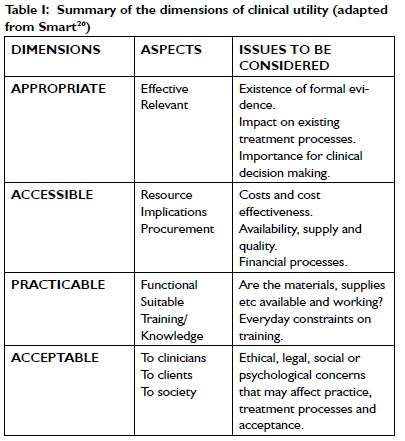
The literature review on ASI, ASD and clinical utility provided the background for the creation of the survey. The first section of the survey required participants to complete demographic information. An open-ended question sought information on challenges participants had experienced when using sensory modulation measures in their current setting. This was followed by 16 four-point Likert scale questions, in the four clinical utility domains of appropriateness, accessibility, practicability and acceptability25appropriate according to the clinical utility definitions, an instrument should yield results that can be used in clinical decision-making and impact on the child's treatment plan. To be considered accessible, it must be readily available in the work place, and the caregiver should be able to use it as a self-report measure. For the instrument to be practicable it should be functional and suitable for its use in the participants setting. For the instrument to be acceptable, it should be ethically sound, socially and culturally appropriate to both the target population and the practitioner. The final section of the survey yielded responses to open ended questions on the specific items from each sensory modulation measure that were considered problematic when used in their setting. The data collection phase spanned eight weeks, with reminders sent after three, five and seven weeks.
The following three Sensory Reactivity/Modulation Tools were included for evaluation in the survey:
The Sensory Profile (SP)
The SP assesses the responses of children over 125 commonly occurring daily experiences, with caregivers rating the frequency with which their child responds to these on a five-point Likert scale "always", "frequently, "occasionally", "sometimes", "never". The 125 items are classified into eight categories: Auditory, Visual, Activity Level, Taste or Smell, Body Position, Movement, Touch, and Social/Emotional8
The Sensory Processing Measure (SPM)
The SPM home form is caregiver rated on a four-point Likert scale, with 75 questions relating to a variety of situations relating to the child's sensory processing ability, praxis ability and social participation that may impact a child's performance in school, home, and community settings. The descriptors for the Likert scale in this instrument are "never", "occasionally", "frequently" and "always"9
The Sensory Experiences Questionnaire (SEQ)
The SEQ is al05 item caregiver-report tool, measuring the child's behavioural responses to sensory stimuli naturally occurring in daily life, sensory behaviours across sensory response patterns of hypo-responsiveness, hyper-responsiveness, sensory seeking, and enhanced perception as well as auditory, visual, tactile, gustatory, and vestibular modalities in social and non-social contexts1010
Pilot Study
Reliability of the survey questionnaire was established through the pilot study where eight expert2727
Data Collection
An invitation letter was distributed to the members of SAISI via the administrator. Those who agreed to participate, provided they met the inclusion criteria, were forwarded the survey by the principal author. Sampling bias may have been present as the therapists who met the criteria and responded to the invitation to participate, automatically became part of the final sample (n = 31). Since the invitation email was sent to all members on the SAISI database, every registered SAISI member had an equal opportunity to respond provided they met the specific inclusion criteria.
Data Analysis
Demographic information was entered onto a Microsoft Excel 2007 spreadsheet and descriptive statistics were used to analyse the frequencies of responses. The open-ended questions on challenges experienced was analysed thematically2826 27<0.5.
Full ethical approval was granted from University of KwaZulu-Natal (Ethical Clearance number: HSS/0409/0I7M). The HPCSA guidelines for ethical good practice were observed during all aspects of this study29
RESULTS
Practitioners who responded were experienced with 65% (n=20) having more than l0 years' experience as an occupational therapist. The majority (67%; n=2I) of practitioners consulted were English- speaking clients, worked mainly in private practice settings (80%; n=25) and most (83%; n=26) were based in urban areas.
Clinical Utility of the three Measures
Overall Mean Scores
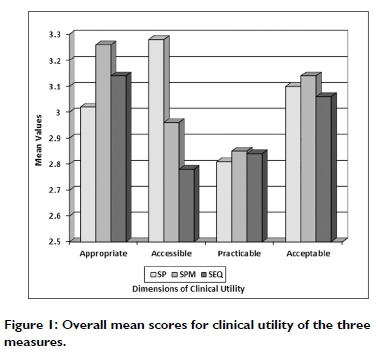
Overall mean scores for clinical utility of the SP SPM and the SEQ demonstrated no statistically significant difference (p>0.5). The mean rating was a '3' on the Likert scale which indicated agreement with the three measures' clinical utility. The three measures were then analysed for statistical significance (p<0.5) over each of the dimensions of clinical utility, which included appropriateness, accessibility, practicability and acceptability (Figure 1).
Clinical Utility: Appropriateness
A clinically significant difference between the SP and SPM was noted, in favour of the SPM (p=0.007). This was consistent when compared to practitioner experience and geographical location. However, with the group of non-English speaking or second language English speakers, the SEQ held significantly higher utility than the SP (p=0.01) and SPM (p=0.02).
Clinical Utility: Accessibility
Statistically significant differences between the three measures were noted with the SP being most accessible. The SP was more accessible than the SPM (p=0.002), and the SEQ (p=0.001) and the SPM was more accessible than the SEQ (p=0.03). The majority (90%; n=28) of the practitioners had access to the SP within their work place.
Clinical Utility: Practicability
There were no significant differences between any of the measures for practicability. Cost of the measures was a concern cited by some practitioners, with 32% (n=10) reporting the cost was too high. Other practicability measures indicate 13% found the questionnaires too long, 10% found the rating scales challenging to use and 10% reported the layout was not easy to follow.
Clinical Utility: Acceptability
There were no significant differences between the three measures for acceptability. A small number of practitioners (22%; n=7) commented that the measures were not relevant for the child with ASD in South Africa. A statistically significant preference for the SEQ (p=0.020) over the SPM was seen amongst the non-English speaking or second language English speakers with a significant preference of the SPM over the SEQ (p=0.009) noted in English speakers.
Challenges in use of caregiver-report Sensory Reactivity/ Modulation Measures
Caregiver-report sensory reactivity/modulation measures were used by 90% (n=28) of the participants, with 68% (n=19) of them using the SP 18% (n = 5) using the SP and SPM, and 14% (n=4) using only the SP. Of the 28 participants that used the measures, 27 (97%) reported challenges in the use with children with ASD.
The themes that emerged included parents' lack of insight into their child's behaviours (40%, n=ll), parents having difficulty understanding the measure due to ambiguity (74%, n=20), language barriers to using the measure (22%, n = 6), the measure being too long (30%, n=8) or misused (over-or understate the child's difficulties) (26%, n = 7), denial of the child's diagnosis (18%, n = 5) and that interviews with the parents and/or observation of the child (37%, n=l0) are often needed to supplement the information given in the sensory reactivity/modulation questionnaire.
Problematic Items on the three Measures
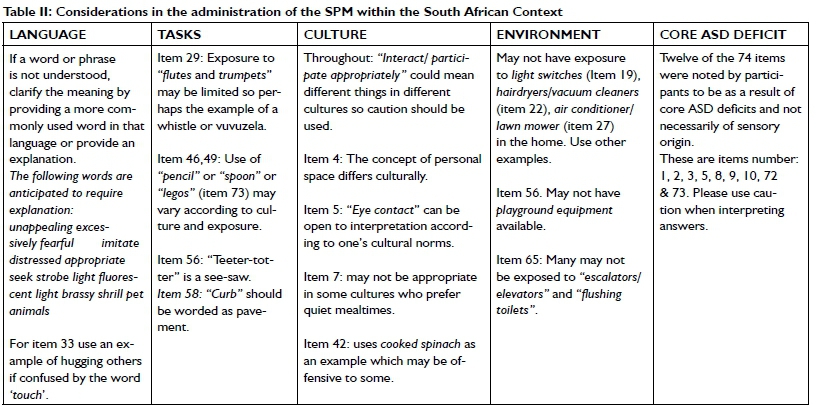
This was an optional section of the survey with and 22 participants providing responses. These included suggestions for changes in wording, phrases, task items, cultural and environmental specific changes as well as ASD core deficit comments. Particular reference was made for the use of SPM in South Africa as a caregiver-report measure for literate, first language English speakers.
Participants noted that in South Africa, the SPM can guide an interview with a caregiver to gain useful information about the child's responses to sensory input in their environment. For valid and reliable information, the caregiver's home language is preferred and analysis of items should consider cultural norms. When used with these considerations, final scores can only be used as a guide as the deviations from the normed scores threaten the validity of the measure. The considerations for the South African context from the practitioners in this study appear in Table II (p26).
DISCUSSION AND IMPLICATIONS OF THE STUDY
Considering the lack of clinical utility studies of sensory reactivity/ modulation measures, the results of this study are significant. This is in relation to practitioners' perspectives on clinical utility that will inevitably influence how sensory reactivity/modulation measures are used when assessing children with ASD in South African private practice settings. The participants were largely from English speaking, private practices located in urban areas which may have skewed the results. No single test held overall higher clinical utility than the others, and the overall rating indicated agreeability with the clinical utility of the measures as assessed across the four dimensions in this study. However, on analysis of each dimension and comparison to the data from different demographic groups, some significant findings emerged.
In establishing clinical utility appropriateness, the SPM was indicated to be more appropriate for an ASD population due to the social participation section, communication items and focus on activities of daily living (ADLs). The SEQ was considered more appropriate for the non-English speaking or second language English group, as it was short, concise, and focused on ASD-related questions. Regarding the clinical utility accessibility dimension, the SP was the most utilised measure and accessible in most of the workplaces of participants. The SEQ is not yet widely known or available in SA and therefore held the least accessibility. However, it was noted that it was easy to understand and would be used if available.
Clinical utility practicability was related to the cost of the measure and the length of time taken to complete the measures, the layout and the rating scale. The practicability results remained consistent between all three measures, across all four dimensions. The practicability scores were generally the lowest scores, from all four dimensions of clinical utility assessed, indicating overall dissatisfaction with all of the measures for their practical use. Clinical utility acceptability explored whether the practitioner would use the measure in their workplace. They answered questions about the relevance of the measures culturally, environmentally and diagnostically. Results indicate and possibly guide decision making in choice of measures, with the SPM being more relevant to the English-speaking client population, and the SEQ being more relevant to the non-English speaking population.
The findings of this study were similar to those seen in other cross-cultural studies with sensory reactivity/modulation measures. Israeli10181930
Benefits of the measures are highlighted in this study even though literacy levels and language differences in South Africa present challenges with using these caregiver-report measures. It is clear that caregiver-report sensory reactivity/modulation measures are considered valuable by the number of therapists already using them. The therapists do adapt to these challenges, by using a sensory reactivity/modulation measure as a guide to parent interviews, and used both a parent interview and observation of the child as part of their assessment in ASD, before planning an intervention. Despite the SP being the most utilised of the sensory reactivity/modulation measures in this sample (holding the highest clinical utility for 'accessibility') the SPM and SEQ demonstrated higher clinical utility than the SP in the 'appropriateness' and 'acceptability' dimensions, for the child with ASD in South Africa. Comments included finding the SPM more suitable for ASD due to the social participation, and ADL questions. The SEQ was favoured also due to the 'fascinations' sections of the questionnaire which many felt was appropriate for ASD. It was described to be shorter and easier to complete when compared to the SP and SPM. The SP had many more negative comments including being lengthy, daunting to parents, having complex questions, taking a long time to score and having too many gaps in assessing ADL for the child with ASD.
Limitations of the study include the majority of the study participants being practitioners in private practice in urban settings. Since the inclusion criteria required the practitioner to have training to SASIC level 3, it highlights that this training appears to be accessible to those in private practice. The training is however, inaccessible geographically to rural occupational therapists, as there is only one course per year and is usually presented in an urban setting.
RECOMMENDATIONSThis study highlights that the internationally, more specifically USA-developed sensory reactivity/modulation measures do not have adequate clinical utility, in all dimensions, for caregivers of children with ASD in South Africa, that may very well bias the validity of the measures. However, the majority of participants do use sensory reactivity/modulation measures as part of their ASD assessment. It is thus clear that these measures do hold some value, even though adaptations may be required in administration and interpretation. The release of the online scoring versions for the SPM and SP have made access to practitioners less financially burdensome.
In clinical practice, guidance on the choice of instrument for their client population (SPM for English language speakers, SEQ for non-English language speakers), and using the instruments to guide interview questions and assisting in parent/caregiver understanding of items are important. Further research is however recommended, with a particular focus on rural contexts with non-English first language caregivers. There may be a need for a sensory reactivity/ modulation measure, in additional languages, with terminology and phrases suitable for the culture in that language group. The measure should be concise and readily available at low cost and used thereafter to guide parent interviews and intervention. Those practitioners currently practicing sensory integration occupational therapy with children with ASD, and whose caregivers are not first language English speakers, should administer the SPM with some adaptations.
Tertiary educators and trainers in sensory integration should consider teaching the SPM with recommended adaptations until such time a South African tool becomes available. The process of culturally and linguistically fair occupational therapy assessments in South Africa should be reviewed, and research and development of such supported.
CONCLUSIONS
The literature is clear on the need for ASD assessment to be fair and just, culturally sensitive and environmentally suitable, for any such assessments to hold validity. The results of this study indicate that whilst the measures hold clinical utility for some of the South African population, this is the minority. Specifically, the sensory reactivity/modulation measures normed in the USA hold limited clinical utility for non- or second language English speaking care-givers of ASD children. In this study, practitioners reported that sensory reactivity/modulation measures are more beneficial in the caregivers' home language, and that instruments should be culturally and environmentally applicable. A sensory reactivity/modulation measure for children with ASD thus needs to be developed. The practice implication for this in occupational therapy indicates careful thought and clinical reasoning in choosing assessment instruments, specifically with the non-English speaking child or caregiver and in rural settings.
AUTHOR CONTRIBUTIONSKerry Lee Evetts conducted the research and was the primary author of the manuscript. Gina Rencken and Pragashnie Govender supervised the study and assisted in the conceptualisation, analysis and interpretation of the data and in revising the manuscript through the review process.
Declaration of Conflict
The authors declare no conflict of interest.
REFERENCES
LITERATURE REVIEW
-
1. Smith L, Malcolm-Smith S, de Vries PJ. Translation and cultural appropriateness of the Autism Diagnostic Observation Schedule-2 in Afrikaans. Autism [Internet]. SAGE Publications; 2016 May 25;21(5):552-63. Available from: http://dx.doi.org/10.1177/1362361316648469
» http://dx.doi.org/10.1177/1362361316648469 - 2. Van Jaarsveld A, Mailloux Z, Herzberg DS. The use of the Sensory Integration and Praxis tests with South African children. South African Journal of Occupational Therapy. 2012;42(3):12-18.
- 3. American Psychiatric Association. Diagnostic and statistical manual of mental disorders (DSM-5®). American Psychiatric Pub; 2013.
-
4. Dickie VA, Baranek GT, Schultz B, Watson LR, McComish CS. Parent Reports of Sensory Experiences of Preschool Children With and Without Autism: A Qualitative Study. American Journal of Occupational Therapy [Internet]. AOTA Press; 2009 Mar 1;63(2):172-81. Available from: http://dx.doi.org/10.5014/ajot.63.2.172
» http://dx.doi.org/10.5014/ajot.63.2.172 -
5. Tomchek SD, Dunn W. Sensory Processing in Children with and without Autism: A Comparative Study Using the Short Sensory Profile. American Journal of Occupational Therapy [Internet]. AOTA Press; 2007 Mar 1;61(2):190-200. Available from: http://dx.doi.org/10.5014/ajot.6L2.190
» http://dx.doi.org/10.5014/ajot.6L2.190 -
6. Baranek GT, David FJ, Poe MD, Stone WL, Watson LR. Sensory Experiences Questionnaire: discriminating sensory features in young children with autism, developmental delays, and typical development. Journal of Child Psychology and Psychiatry [Internet]. Wiley; 2005 Sep 22;47(6):591-601. Available from: http://dx.doi.org/10.1111/j.1469-7610.2005.01546.x
» http://dx.doi.org/10.1111/j.1469-7610.2005.01546.x -
7. Ben-Sasson A, Hen L, Fluss R, Cermak SA, Engel-Yeger B, Gal E. A Meta-Analysis of Sensory Modulation Symptoms in Individuals with Autism Spectrum Disorders. Journal of Autism and Developmental Disorders [Internet]. Springer Science and Business Media LLC; 2008 May 30;39(1):1-11. Available from: http://dx.doi.org/10.1007/s10803-008-0593-3
» http://dx.doi.org/10.1007/s10803-008-0593-3 - 8. Dunn W. Sensory profile. San Antonio, TX: Psychological Corporation; 1999.
- 9. Parham LD, Ecker C. Sensory processing measure (SPM). Western Psychological Services; 2007
- 10. Baranek GT. Sensory experiences questionnaire version 3.0. Unpublished manuscript.
-
11. Franz, L., Chambers, N., Von Isenburg, M., De Vries, P.J., 2017. Autism spectrum disorder in sub-saharan africa: A comprehensive scoping review. Autism Research 10(5): 723-749. https://dx.doi.org/10.1002%2Faur.1766
» https://dx.doi.org/10.1002%2Faur.1766 - 12. Schaff, R., Schoen,S., Smith Roley, S.,Lane, S., Koomar, J., May-Benson, T. A Frame of Reference for Sensory Integration IN Kramer, P & Hinojosa, J Frames of References for Pediatric Occupational Therapy 3rd edition.2010: p111-112
-
13. Lane AE, Young RL, Baker AE, Angley MT. Sensory processing subtypes in autism: Association with adaptive behavior. Journal of Autism and Developmental Disorders. 2010;40(1):112-122. https://doi.org/10.1007/s10803-009-0840-2
» https://doi.org/10.1007/s10803-009-0840-2 -
14. Jorquera-Cabrera S, Romero-Ayuso D, Rodriguez-Gil G, Triviño-Juárez J-M. Assessment of Sensory Processing Characteristics in Children between 3 and ll Years Old: A Systematic Review. Frontiers in Pediatrics. 2017; 5-57. https://doi.org/10.3389/fped.2017.00057.
» https://doi.org/10.3389/fped.2017.00057 - 15. Ayres AJ. The Sensory Integration and Praxis Tests. Los Angeles: Western Psychological Services.1989.
- 16. Windsor M, Smith-Roley SS, Szklut S. Assessment of Sensory Integration and Praxis. In: Roley SS, Blanche EI, Schaaf RC, editors. Understanding the nature of sensory integration with diverse populations. Communication Skill Builders; 2001:215.
-
17. Statistics South Africa. P03l0 - Living Conditions of Households in South Africa, 2014/2015. Available from https://www.statssa.gov.za/publications/P0310/P03102014.pdf Accessed 14 June 2021
» https://www.statssa.gov.za/publications/P0310/P03102014.pdf -
18. Caron KG, Schaaf RC, Benevides TW, Gal E. Brief Report-Cross-Cultural Comparison of Sensory Behaviors in Children with Autism. American Journal of Occupational Therapy. 2012; 66(5): e77-80. https://doi.org/10.5014/ajot.2012.004226
» https://doi.org/10.5014/ajot.2012.004226 -
19. Peña ED. Lost in translation: Methodological considerations in cross-cultural research. Child Development. 2007 Jul 1;78(4):1255-1264. https://doi.org/10.1111/j.1467-8624.2007.01064.x
» https://doi.org/10.1111/j.1467-8624.2007.01064.x -
20. Román-Oyola R, Reynolds SE. Validating the response process of the Spanish version of the Short Sensory Profile: A pilot study using cognitive interviews. Journal of Occupational Therapy, Schools, & Early Intervention. 2010;3(3):197-206. https://doi.org/10.1080/19411243.2010.515189
» https://doi.org/10.1080/19411243.2010.515189 -
21. Almomani FM, Brown C, Dahab SA, Almomani M, Nadar M. Cross cultural adaptation of the adolescent/adult sensory profile: establishing linguistic equivalency and psychometric properties of the Arabic version. Disability and Rehabilitation. 2014;36(9):765-770. https://doi.org/10.3109/09638288.2013.819386
» https://doi.org/10.3109/09638288.2013.819386 - 22. Brown C, Dunn W. Adolescent/Adult Sensory Profile manual. San Antonio, TX: Psychological Corporation. 2002.
-
23. HPCSA. Framework for Education, Training, Registration and Scope for Psychometry 2019. Available from https://www.hpcsa.co.za/Uploads/PSB_2019/Exams/Form_94_Psychometry_Framework_for_Education%20_Training_Registration_and_Scope_for_Psychometry.pdf Accessed 14 June 2021.
» https://www.hpcsa.co.za/Uploads/PSB_2019/Exams/Form_94_Psychometry_Framework_for_Education%20_Training_Registration_and_Scope_for_Psychometry.pdf -
24. He J, van de Vijver F. Bias and Equivalence in Cross-Cultural Research. Online Readings in Psychology and Culture [Internet]. Grand Valley State University Libraries; 20l2 Jun 1;2(2). Available from: http://dx.doi.org/10.9707/2307-0919.1111
» http://dx.doi.org/10.9707/2307-0919.1111 -
25. Malda M, van de Vijver FJR, Temane QM. Rugby versus Soccer in South Africa: Content familiarity contributes to cross-cultural differences in cognitive test scores. Intelligence [Internet]. Elsevier BV; 2010 Nov;38(6):582-95. Available from: http://dx.doi.org/10.1016/j.intell.2010.07.004
» http://dx.doi.org/10.1016/j.intell.2010.07.004 -
26. Smart A. A multi-dimensional model of clinical utility. International Journal for Quality in Health Care; 2006; 18(5). https://doi.org/10.1093/intqhc/mz1034.
» https://doi.org/10.1093/intqhc/mz1034 -
27. Trochim, W.M. The Research Methods Knowledge Base, 2nd Edition. Retrieved from: http://www.socialresearchmethods.net/kb/> (version current as of 2006). Accessed 15 October 2017.
» http://www.socialresearchmethods.net/kb/ -
28. Braun V, Clarke V. Successful qualitative research: A practical guide for beginners. Sage; 2013. Retrieved from https://www.researchgate.net/publication/256089360_Successful_Qualitative_Research_A_Practical_Guide_for_Beginners-analysis/. Accessed 16 March 2018.
» https://www.researchgate.net/publication/256089360_Successful_Qualitative_Research_A_Practical_Guide_for_Beginners-analysis/ -
29. HPCSA. General Ethical Guidelines for the Health Care Professions. Pretoria: HPCSA; 2016. Available from: https://www.hpcsa.co.za/Uploads/Professional_Practice/Conduct%20%26%20Ethics/Booklet%201%20Guidelines%20for%20Good%20Practice%20%20September%2020l6.pdf
» https://www.hpcsa.co.za/Uploads/Professional_Practice/Conduct%20%26%20Ethics/Booklet%201%20Guidelines%20for%20Good%20Practice%20%20September%2020l6.pdf -
30. Brown T, Leo M, Austin DW. Discriminant validity of the Sensory Profile in Australian children with autism spectrum disorder. Physical & Occupational Therapy in Pediatrics. 2008 Jan 1;28(3):253-66. https://doi.org/10.1080/01942630802224983
» https://doi.org/10.1080/01942630802224983
* Ethical approval for this study was granted prior to the enactment of the amended POPIA on 20-07-01