Learning styles in Physiotherapy and Occupational Therapy students: an exploratory study
Abstract
BACKGROUND: Learning styles of health care professionals are unique and tend to be profession- specific. This study aimed to compare the learning styles of undergraduate occupational therapy and physiotherapy students and to determine the relationship between preferred learning styles, demographic factors, and academic performanceMETHOD: The study design was a cross-sectional, descriptive study. Undergraduate occupational therapy and physiotherapy students completed a self-developed questionnaire and the Grasha-Reichmann Learning Style InventoryRESULTS: A total of 313 students with a mean age of 19.6±1.58 years participated in this study. The results showed that students preferred the collaborative (75%) learning style, with the first-year students scoring significantly higher in the collaborative style (3.97±0.48; p<0.001). The male students (2.67±0.65) scored higher in the competitive learning style than female students (2.20±0.62; p=0.001, d=0.757). The competitive learning style, when controlling for sociodemographic variables, is a significant predictor of an increase in academic performance in English language (B=2.28, [0.60-3.96]), physics (B=3.62, [0.22-7.02]) and overall academic performance (B=2.12, [0.34-3.90CONCLUSION: The predominant preferred learning styles are the collaborative and participant styles. The application in the teaching space should be carefully considered for the selection of teaching approaches and activities. This study points to the Physiotherapy and Occupational Therapy programmes need to align to the collaborative style and respond with a variety of teaching methods. The associations shown between preferred learning styles and demographic variables point to the need to pay attention to diversity when selecting teaching approaches and activities
Grasha-Reichmann Learning Style Inventory; learning styles; occupational therapy; physiotherapy; undergraduate students
INTRODUCTION
The South African higher education landscape is heavily burdened with the pressures of massification while striving to compete in the global knowledge economy. In the past two decades the enrolment rate in the occupational therapy and physiotherapy degrees at the University of the Witwatersrand have increased drastically, resulting in much higher lecturer: student ratios. In the strive to maintain the standard of education and continue to produce highly skilled occupational therapy and physiotherapy graduates, this study seeks to increase our understanding of how our student body prefers to learn.
Since the 1950s, many theories related to learning style and learning preferences have emerged, yielding over 70 different scales attempting to measure the identified constructs1,2. Rice and McK-endree232
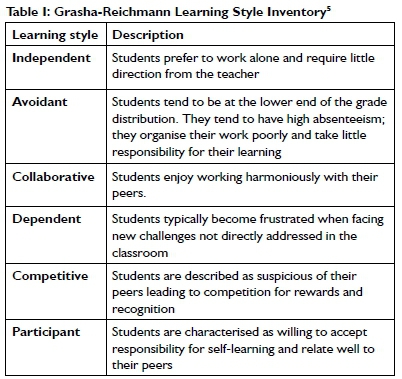
The learning styles of students in health professions have been studied using the GRSLSS internationally4151Table I, adjacent).
Learning styles are unique for health care disciplines and tend to be profession-specific 67,8, while students studying pharmacy are more inclined to adopt the 'converger' learning style (similar to the independent learning style of the GRSLSS)4,6. Studies comparing learning style preferences amongst physiotherapy and occupational therapy students are scarce9,10, although various individual studies have been conducted on the respective disciplines' learning styles1,11,12. Furthermore, the majority of studies focusing on learners in these fields have made use of other learning style inventories, particularly Kolb's Learning Style Inventory (LSI)9-11. In a review of different learning-styles instruments, Ferrell1313:1. Thus, different models of learning styles may provide novel insights. As such, the GRSLSS was chosen for this study as researchers were most familiar with this tool.
Students entering higher education in South Africa hail from highly diverse schooling contexts, with a stark disparity in access to resources, quality education, cultural experiences and rural to urban divide. Other studies have not reported differences in learning styles based on contextual categories. It is therefore important to consider the potential impact of these demographic factors on students' learning strategies. Factors influencing learning styles may include gender151617418
It has been reported that up to 30% of students prefer multiple learning styles when measured using a constitutional measure such as the VARK (Visual, Aural, Read/write, Kinaesthetic) scale; however, the majority of medical students preferred a single learning style819
METHOD
Study design
The study design was a cross-sectional, descriptive study. Quantitative analysis was used to analyse the demographic information and GRSLSS. The Strengthening the Reporting of Observational Studies in Epidemiology (STROBE) guidelines were adhered to20
Study setting and participants
Total population sampling was used for the 2017 undergraduate students, specifically first-, second- and third-year students at the Occupational Therapy and Physiotherapy Department, University of the Witwatersrand. No exclusion criteria were set and all first- to third-year students within the respective departments were invited to participate. *Ethical clearance was obtained from the Human Research Ethics Committee of the associated tertiary institution in the spirit of the Helsinki Declaration (M140540).
Assessment tools
A questionnaire was developed and administered to collect information on age, gender, career field of interest, year of study, physical activity participation and previous year's marks in the main subjects, as well as an open-ended question related to teaching philosophy. Content validity was established by a panel of experts consisting of four occupational therapists and four physiotherapists. Panel members had between 10 and 40 years of professional experience. The outcome of the open-ended question of the study is not presented in this paper.
Learning style was evaluated by using the GRSLSS, which is a 60-item standardised, self-administered questionnaire that determines an individual's preferred learning style. Six learning styles are described: independent, avoidant, collaborative, dependent, competitive and participant2122121Table II (above).
Procedure
Data were gathered using a self-administered questionnaire as described under assessment tools. A pilot study was performed and included 26 participants from the Department of Nursing Education. Following the pilot study, no changes were made to the questionnaire.
However, the suggested time taken to complete the questionnaire was increased. Instructions were adapted to include more detail. The time taken to complete the two questionnaires was twenty minutes.
For the main study, researchers made appointments with the sample groups via the student class representatives of the first, second and third year of study. Verbal, as well as written information about the study was provided to both groups. Participation was voluntary, and completion of the questionnaires implied consent. No identifiable information was collected to ensure anonymity. Students knew the researchers and to reduce participant bias, students could return the completed questionnaires to the class representatives or the departmental secretaries, from whom the completed questionnaires were then collected for analysis.
Data analysis
Quantitative data were analysed using IBM SPSS (v25) and JASP (v0.9.2) software programmes. Frequencies and descriptive statistics were produced for all variables. The Fisher 2-tail exact test was used to compare the following demographic information: Field of study, year of study, gender, and ethnicity. Comparisons of the preferred learning styles which were identified amongst (1) occupational therapy and physiotherapy students, and (2) the gender of the participants, were made using the independent t-test, except where Levene's test was significant (p<0.05), suggesting a violation of the equal variance assumption. In such cases, the Mann Whitney U test was used. For the independent t-test, the effect size is given by Cohen's d while for the Mann-Whitney test, the effect size is given by the rank bi-serial correlation. Cohen's d can generally be interpreted as 'small' effect size (0.2), 'medium' effect size (0.5), and 'large' effect size (> 0.8).
The rank bi-serial correlation (r) can be interpreted as small (0.1), medium (0.3), and large (0.5). MANOVA tests were run comparing differences in learning styles based on (1) ethnicity, (2) home province, and (3) year of study. Partial eta-squared statistics were used as measures of effect size: here an effect size of 0.01 is small, 0.06 is medium and 0.14 is large. Where significant differences were found, Bonferroni post hoc tests were run to investigate these differences further. Linear regression models were computed to determine whether learning styles predicted academic performance (Matric English, First Year Physics, Second Year Anatomy, and the average of these scores) while controlling for age, department and gender. All tests were performed using an alpha of 0.05. Missing data points were excluded on a list-wise basis.
RESULTS
Study participants
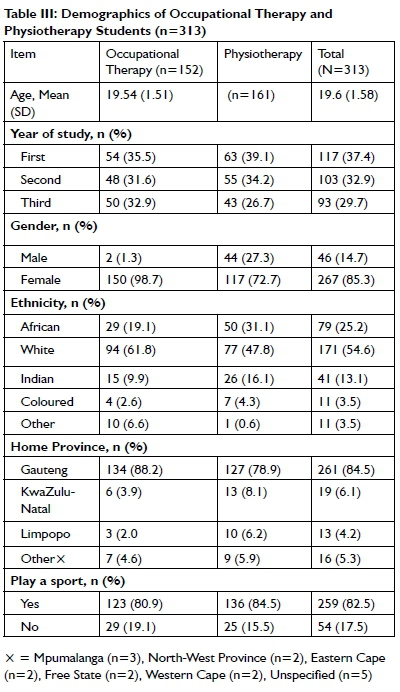
A total of 313 students with a mean age of 19.6 ± 1.58 years participated in the study and their demographics shown in Table III (p42). The group consisted of 152 (48.6%) occupational therapy students and 161 (51.4%) physiotherapy students. The majority of students were female (n=267; 85.3%), and 259 (82.5%) of the students participated in at least one sport.
Low, moderate, and high ranking of learning style preference
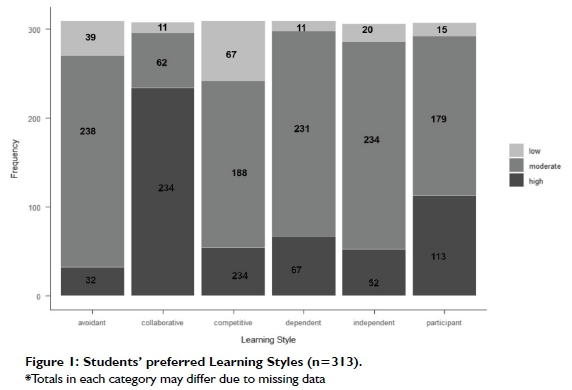
Using the classification of the learning style preference into low, moderate and high as defined by Grasha5Table II, p41), students' learning styles are shown in Figure 1 (p43). The majority (n=234; 75.0% of 308) of students scored in the high preference range for the collaborative learning style, followed by the participant learning style with 36.8% (n=113 of 307) of the students scoring in the high preference range. The competitive learning style was least preferred with 21.7% (n = 67 of 309) of the students scoring in the low preference range (Figure 1, p43).
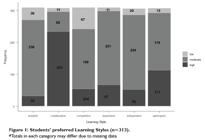
The majority of students, 58.4% (n=180), scored in the high preference range for two or more learning styles, while 9.7% (n = 30) showed no learning style scoring high enough to indicate a preference for any of the six learning styles.
Learning style preferences between physiotherapy and occupational therapy students
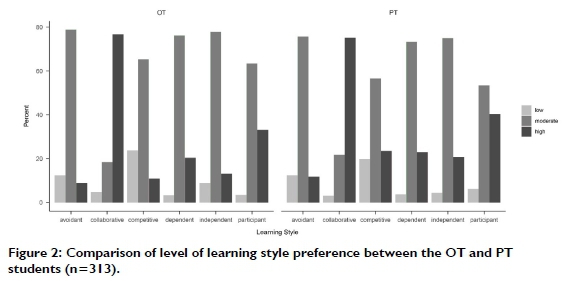
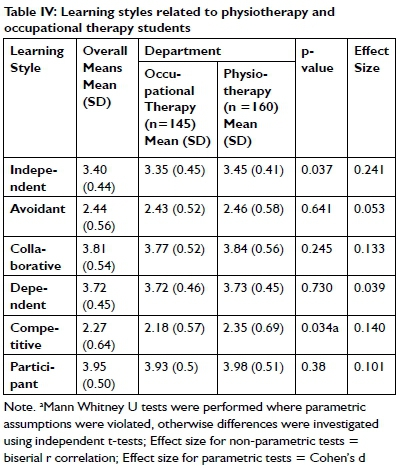
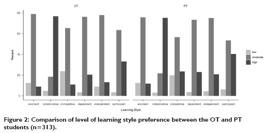
Table IV (above) shows the comparison of learning style preferences between physiotherapy students and occupational therapy students. There was a significant difference between the two professions in the independent learning style (p=0.037) and the competitive learning style (p=0.034). However, the effect size for both these findings was small (d=0.241 and d=0.140, respectively). This is further illustrated by the categorical data presented in Figure 2 (p43), where more occupational therapy students scored in the low preference range for the independent (occupational therapy n=13, 9.0%; physiotherapy n=7, 4.4%) and competitive learning styles (occupational therapy n = 35, 23.8%; physiotherapy n = 32, 19.9%) and more physiotherapy students scored in the high preference range for both styles (Independent: occupational therapy n=19, 13.1%; physiotherapy n=33, 20.6% Competitive: occupational therapy n=16, 10.9%; physiotherapy n=38, 23.6%), indicating that should a student show preference for either of these styles they are more likely to be a physiotherapy student.
Age norms and degree enrolment
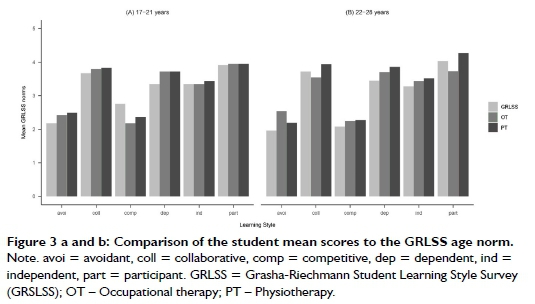
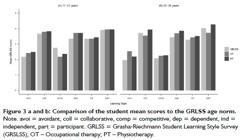
Figure 3a and 3b (p43) illustrate how the occupational therapy and physiotherapy student learning style preferences compare to the norms for the age range 17-21 years5Figure 3a, p43). Interestingly, the older student groups both score well above the Grasha-Reichmann Learning Style Scales Inventory age norm for the avoidant learning style and the occupational therapy students mean scores fall below the Grasha-Reichmann Learning Style Scales Inventory norms for the collaborative and participant learning styles.
Relationship between demographic characteristics and learning styles.
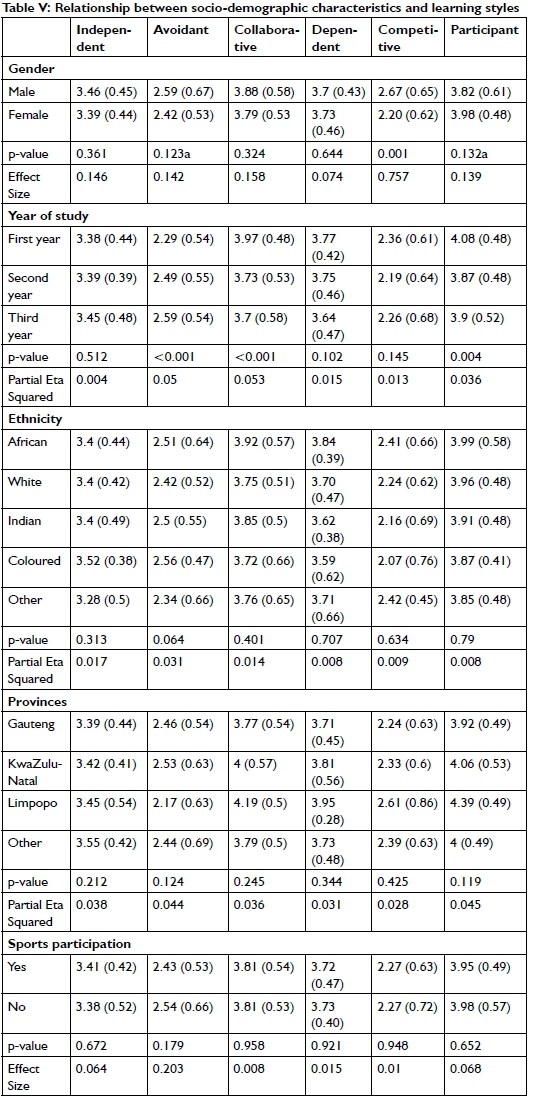
Table V (p44) outlines the comparative statistics to describe the relationship between the demographic variables and learning styles. More male students preferred the competitive learning style when compared to female students, and this finding had a large effect size (p=0.001; r=0.757). No gender difference in terms of any of the other learning styles existed (Table V, p44). First year students had significantly lower avoidant scores than both second (p=0.027) and third years (p<0.001) while having significantly higher collaborative scores than both second (p=0.003) and third-year students (p=0.001). Additionally, first-year students had significantly higher participant learning style scores than both second year (p=0.007) and third-year students (p=0.007) (Table 5 p44). No significant differences in learning styles were found based on the self-selected ethnicity of the participants. No significant differences in learning styles were found based on the home province of the students in the sample. Students could indicate whether they participated in sport or not. This information was compared to the students' learning styles. There was no significant difference between students' learning styles and their participation in sport (p > 0.05) (Table V, p44).
Academic performance and learning styles
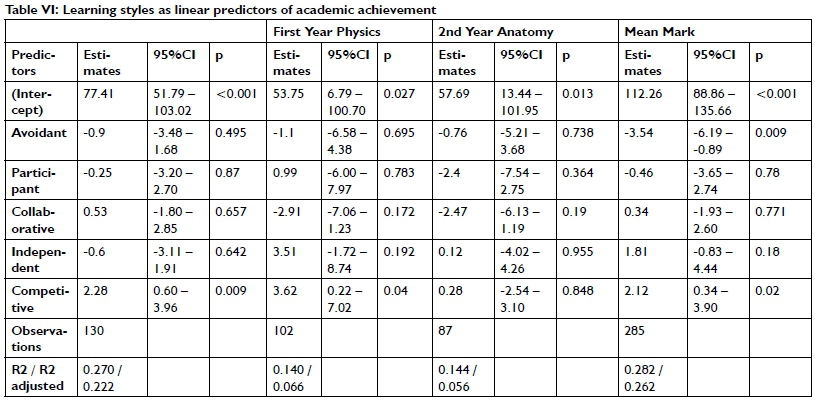
To determine the association between academic performance and learning styles, linear regression models with individual subject scores (percentages) including matric English (77.51±6.51), first-year physics (65.32±10.59), and second-year anatomy (69.21±8.65) as well as the average of these scores (69.02±10.75) were set as the dependent variables, while the learning style scores were set as predictors. The age, department, and gender of the participants were controlled for. As illustrated in Table VI (p45), participants with competitive learning were more likely to achieve higher grades in Matric English as well as first-year physics. No learning styles were significant predictors of second-year anatomy grades. When testing the means of these grades, it was found that only the competitive learning style was a significant predictor of academic achievement in the sample.
DISCUSSION AND IMPLICATIONS
Learning style is how a person prefers to learn and can be based on knowledge and/or experience2324,25, Similarly, 58.4% of the occupational therapy and physiotherapy students at the University of the Witwatersrand preferred more than one learning style when measured using the GRSLSS. The importance of understanding the learning style lies in its use and therefore for meaningful contribution, a facilitator needs to explore different strategies in learner self-awareness and articulation with learning style. Furthermore, learners can be encouraged to explore beyond their formal learning style2619
Interestingly, in this group of students, the learning styles that were dominant and in the high category as categorised through the GRSLSS ranking (Table II, p42), were the collaborative followed by participant style (Figure 1, p43), similar to the results of the Turkish study41et al.27:4 describe collaborative learning as "the extent to which the environment allows for interactions among the learners to acquire knowledge and skills and complete the tasks". The teacher needs to create opportunities for students and be approachable while students need to acquire information and share it with peers and teacher28
The learning styles of the students in this study were varied (Figure 1, p43). The learning activities these students prefer are also likely to be diverse. Students with a competitive learning style are motivated by doing better than their peers293029
Note. Differences in learning styles scores for the variables of Gender and Sports Participation were analysed using independent t-tests, or a Mann Whitney Ua test where assumptions of normality were violated. All other variables were analysed using MANOVA. Effect size for non-parametric testsa = biserial r correlation; Effect size for parametric tests = Cohen's d.
independent learners participate in projects independently and determine their personal goals and learning process15Figure 2, p43). Also, physiotherapy students scored higher in the competitive style although this finding needs to be interpreted with caution due to the small effect size (Table IV, p42).
Interestingly, despite knowing students' learning styles and adapting to them in terms of teaching approaches, the outcomes in terms of academic performance remain unchanged in a study by Dinçol et al.3131
When the occupational therapy and physiotherapy students' learning style preferences were compared to the age norms suggested by Grasha5et o/.1et o/.1
Gender played a role in the competitive learning style category where male students scored higher than female students. This was the only learning style where a large effect size in terms of gender comparison was present. In another South African study, Shead et o/.17
When looking at students' preferred learning style in this study, it is interesting to note the students' learning style seems to vary over the four years of study, with first-year students scoring higher in the collaborative and participant styles in comparison to second- and third-year students who presented with higher average scores in the avoidant learning style. First-year students come to university often excited, motivated and open to new learning experiences32333455353636
The group of students in this study were diverse in their background and ethnicity (Table I, p40). Inequalities within the education system in South Africa created by the legacy of apartheid has called on all higher education institutes to engage with diversity actively. Diversity awareness is thus currently on the agenda of all South African Universities due to the political history of the country. Diversity should be considered and incorporated into all aspects of teaching. The results of this study, however, found no relationship between students' ethnicity or the province that they came from and their learning styles. Amira and Jelas3437
In our study, no relationship between sports participation and preferred learning style could be determined. We hypothesised that those who participate in at least one sport as opposed to those who do not, may prefer certain learning styles considering that there is a link between sports participation and academic performance18
Our results show that participants with a competitive learning style were significantly more likely to achieve higher grades in matric English, first-year physics and overall marks, however this only applies to a 17.5% (n = 54 of 309) of our sample who scored in the high range for this learning style (Figure 1 p43). The avoidant learning style did not show any significant relationship with the specific subjects of physics, English and anatomy but in the overall average mark, a significant decrease was evident. These results show that the 10.4% (n = 32 of 309) of students in this study who scored in the high range for the avoidant learning style may perform in individual subjects but cumulatively their performance may be declining (Figure 1, p43). This is unsurprising given that avoidant learners are known to withdraw slowly and participate less36et al.4343415
CONCLUSION
Overall, there is little difference between the learning styles of the occupational therapy and physiotherapy students in this study, with the predominant preferred learning styles being the collaborative and participant learning styles. Both programmes are well suited to cater for the collaborative and participant learnings styles through small group teaching and the active nature of clinical skills development. Demographic variables such as age, gender and year of study seem to play a role in the choice of preferred learning style. The competitive learning style was a significant predictor of academic achievement. There may be benefit in monitoring the students who develop a tendency towards the avoidant style (which tends to happen more in the older students and later years of study), as they may be more at risk of poor academic performance than their peers. While it is important to understand learning styles for both the students and the facilitator, the application in the teaching space should be carefully considered for the selection of teaching approaches and activities.
AUTHOR CONTRIBUTIONSBenita Olivier, Lizelle Jacobs, Vaneshveri Naidoo, Nikolas Pautz, Paula Barnard-Ashton, Rulaine Smith, Hellen Myezwa and Adedayo Tunde Ajidahun, contributed to the conceptualisation of the study, collection of the data and statistical analysis of the findings. All the authors contributed to the writing of the manuscript.
Competing interest and Funding
The authors declare no competing interest. The Faculty of Health Sciences' Research Committee of the University of the Witwa-tersrand partially funded this research project.
REFERENCES
Acknowledgements
The authors acknowledge the contribution of Prof Douglas Maleka, Prof Patricia de Witt and Mrs. Julie Jay in this research.
LITERATURE REVIEW
-
1. Shead D, Roos R, Olivier B, Ihunwo A. Learning styles of physiotherapy students and teaching styles of their lecturers in undergraduate gross anatomy education. African Journal of Health Professions Education. 2018;10(4):228-34. https://10.7196/AJHPE.2018.v10i4.1070.
» https://10.7196/AJHPE.2018.v10i4.1070 - 2. Rice S, McKendree J. e-Learning. In: Swanwick T editor. Understanding medical education: evidence, theory and practice. 2nd ed. West Sussex: John Wiley & Sons Ltd; 2013. p. 161-73.
-
3. Husmann PR, O'Loughlin VD. Another nail in the coffin for learning styles? Disparities among undergraduate anatomy students' study strategies, class performance, and reported VARK learning styles. Anatomical sciences education. 2019;12(1):6-19. https://doi.org/10.1002/ase.1777.
» https://doi.org/10.1002/ase.1777 -
4. ilçin N, Tomruk M, Yesilyaprak SS, Karadibak D, Savci S. The relationship between learning styles and academic performance in TURKISH physiotherapy students. BMC Medical Education. 2018;18(1):291. https://doi.org/10.1186/s12909-018-1400-2.
» https://doi.org/10.1186/s12909-018-1400-2 - 5. Grasha AF. Teaching with style: A practical guide to enhancing learning by understanding teaching and learning styles. Pittsburgh: Alliance publishers; 1996.
-
6. Crawford SY Alhreish SK, Popovich NG. Comparison of learning styles of pharmacy students and faculty members. American Journal of Pharmaceutical Education. 2012;76(10):1-6. https://doi.org/10.5688/ajpe7610192.
» https://doi.org/10.5688/ajpe7610192 - 7. Baneshi AR, Tezerjani MD, Mokhtarpour H. Grasha-richmann college students' learning styles of classroom participation: Role of gender and major. Journal of Advances in Medical Education & Professionalism. 2014;2(3):103-7.
- 8. Barman A, Jaafar R, Rahim AFBA. Medical Students' Learning Styles in Universiti Sains Malaysia. International Medical Journal. 2009;16(4):257-60.
- 9. Brown T, Cosgriff T, French G. Learning Style Preferences of Occupational Therapy, Physiotherapy and Speech Pathology Students: A Comparative Study. The Internet Journal of Allied Health Sciences and Practice. 2008;6(3):1-12.
- 10. Brown T, Vryens V, Williams B, Jaberzadeh S, Roller L, Palermo C, McKenna L, Hewitt L, Sim J. The learning styles of undergraduate occupational therapy and physiotherapy students from one Australian university using the Kolb learning style inventory. Irish Journal of Occupational Therapy. 2009;37(2):22-8
-
11. French G, Cosgriff T, Brown T. Learning style preferences of Australian occupational therapy students. Australian Occupational Therapy Journal. 2007;54:S58-S65. https://doi.org/10.1111/j.1440-1630.2007.00723.x.
» https://doi.org/10.1111/j.1440-1630.2007.00723.x - 12. Llorens LA, Adams SP. Learning style preferences of occupational therapy students. The American Journal of Occupational Therapy. 1978;32(3):161-4.
-
13. Ferrell BG. A factor analytic comparison of four learning-styles instruments. Journal of Educational Psychology. 1983;75(1):33-9. https://doi.org/10.1037/0022-0663.75.1.33.
» https://doi.org/10.1037/0022-0663.75.1.33 -
14. Mountford H, Jones S, Tucker B. Learning styles of entry-level physiotherapy students. Advances in Physiotherapy. 2006;8(3):128-36. https://doi.org/10.1080/14038190600700278.
» https://doi.org/10.1080/14038190600700278 - 15. Azarkhordad F, Mehdinezhad V. Explaining the students' learning styles based on Grasha-Riechmann's student learning styles. Journal of Administrative Management Education and Training. 2016;12(6):241-7.
-
16. Auyeung P, Sands J. A cross cultural study of the learning style of accounting students. Accounting & Finance. 1996;36(2):261-74. https://doi.org/10.1111/j.1467-629X.1996.tb00310.x.
» https://doi.org/10.1111/j.1467-629X.1996.tb00310.x -
17. Gündüz N, Özcan D. Learning styles of students from different cultures and studying in Near East University. Procedia-Social and Behavioral Sciences. 2010;9:5-10. https://doi.org/10.1016/j.sbspro.2010.12.107.
» https://doi.org/10.1016/j.sbspro.2010.12.107 -
18. Santana C, Azevedo L, Cattuzzo MT, Hill JO, Andrade LP Prado W. Physical fitness and academic performance in youth: A systematic review. Scandinavian Journal of Medicine & Science in Sports. 2017;27(6):579-603. https://doi.org/10.1111/sms.12773.
» https://doi.org/10.1111/sms.12773 -
19. Kolb AY, Kolb DA. Learning styles and learning spaces: Enhancing experiential learning in higher education. Academy of Management Learning & Education. 2005;4(2):193-212. https://doi.org/10.5465/amle.2005.17268566.
» https://doi.org/10.5465/amle.2005.17268566 -
20. Von Elm E, Altman DG, Egger M, Pocock SJ, Gotzsche PC, Vanden-broucke JP Initiative S. The Strengthening the Reporting of Observational Studies in Epidemiology (STROBE) statement: guidelines for reporting observational studies. Journal of Clinical Epidemiology. 2008;61(4):344-9. https://doi.org/10.7326/0003-4819-147-8-200710160-00010.
» https://doi.org/10.7326/0003-4819-147-8-200710160-00010 -
21. Grasha AF. The dynamics of one-on-one teaching. College Teaching. 2002;50(4):139-46. https://doi.org/10.1080/87567550209595895.
» https://doi.org/10.1080/87567550209595895 -
22. Babadogan C, Kilic G. Learning modalities of sixth grade students and the learning and teaching modalities of the English teachers at primary schools. Procedia-Social and Behavioral Sciences. 2012;46:2467-71. https://doi.org/10.1016/j.sbspro.2012.05.504.
» https://doi.org/10.1016/j.sbspro.2012.05.504 -
23. Hsieh S-W, Jang Y-R Hwang G-J, Chen N-S. Effects of teaching and learning styles on students' reflection levels for ubiquitous learning. Computers & Education. 2011;57(1):1194-201. https://doi.org/10.1016/j.compedu.2011.01.004.
» https://doi.org/10.1016/j.compedu.2011.01.004 -
24. Nuzhat A, Salem RO, Hamdan NA, Ashour N. Gender differences in learning styles and academic performance of medical students in Saudi Arabia. Medical Teacher. 2013;35(sup 1):S78-S82. https://10.3109/0142159X.2013.765545.
» https://10.3109/0142159X.2013.765545 -
25. Alkhasawneh IM, Mrayyan MT, Docherty C, Alashram S, Yousef HY. Problem-based learning (PBL): assessing students' learning preferences using VARK. Nurse Education Today. 2008;28(5):572-9. https://10.1016/j.nedt.2007.09.012.
» https://10.1016/j.nedt.2007.09.012 -
26. Sadler-Smith E, J. Smith P Strategies for accommodating individuals' styles and preferences in flexible learning programmes. British Journal of Educational Technology. 2004;35(4):395-412. https://doi.org/10.1111/j.0007-1013.2004.00399.x.
» https://doi.org/10.1111/j.0007-1013.2004.00399.x -
27. Chen C, Jones KT, Xu S. The Association between Students' Style of Learning Preferences, Social Presence, Collaborative Learning and Learning Outcomes. Journal of Educators Online. 2018;15(1):1-16. https://eric.ed.gov/?id=EJ1168958.
» https://eric.ed.gov/?id=EJ1168958 -
28. Grasha AF. A matter of style: The teacher as expert, formal authority, personal model, facilitator, and delegator. College Teaching. 1994;42(4):142-9. https://doi.org/10.1080/87567555.1994.9926845.
» https://doi.org/10.1080/87567555.1994.9926845 -
29. Diaz DP Cartnal RB. Students' learning styles in two classes: Online distance learning and equivalent on-campus. College Teaching. 1999;47(4):130-5. https://doi.org/10.1080/87567559909595802.
» https://doi.org/10.1080/87567559909595802 -
30. Amir R Jelas ZM, Rahman S. Learning styles of university students: Implications for teaching and learning. World Applied Sciences Journal. 2011;14(2):22-6. http://www.idosi.org/wasj/wasj14(IPDL)11/5.pdf.
» http://www.idosi.org/wasj/wasj14(IPDL)11/5.pdf -
31. Dinçol S, Temel S, Oskay ÖÖ, Erdogan ÜI, Yilmaz A. The effect of matching learning styles with teaching styles on success. Procedia-Social and Behavioral Sciences. 2011;15:854-8. https://10.1016/j.sbspro.2011.03.198.
» https://10.1016/j.sbspro.2011.03.198 - 32. Kantanis T. The role of social transition in students': adjustment to the first-year of university. Journal of Institutional Research. 2000;9(1):100-10.
-
33. Ramnarain U, Schuster D. The pedagogical orientations of South African physical sciences teachers towards inquiry or direct instructional approaches. Research in Science Education. 2014;44(4):627-50. https://10.1007/s11165-013-9395-5.
» https://10.1007/s11165-013-9395-5 -
34. Amira R, Jelas ZM. Teaching and learning styles in higher education institutions: Do they match? Procedia-Social and Behavioral Sciences. 2010;7:680-4. https://doi.org/10.1016/j.sbspro.2010.10.092.
» https://doi.org/10.1016/j.sbspro.2010.10.092 -
35. Zwarenstein M, Goldman J, Reeves S. Interprofessional collaboration: effects of practice-based interventions on professional practice and healthcare outcomes. Cochrane Database of Systematic Reviews. 2009;8(3):1-26. https://doi.org/10.1002/14651858.CD000072.pub2.
» https://doi.org/10.1002/14651858.CD000072.pub2 -
36. Çolak E. The effect of cooperative learning on the learning approaches of students with different learning styles. Eurasian Journal of Educational Research. 2015;15(59):17-34. http://dx.doi.org/10.14689/ejer.2015.59.2.
» http://dx.doi.org/10.14689/ejer.2015.59.2 - 37. Zoghi M, Brown T, Williams B, Roller L, Jaberzadeh S, Palermo C, McKenna L, Wright C, Baird M, Schneider-Kolsky M. Learning style preferences of Australian health science students. Journal of Allied Health. 2010;39(2):95-103.
* Ethical clearance for this study was granted prior to the enactment of the amended POPIA on 2021-07-01