Occupational therapists' perceptions of a school-to-work transition programme for learners at a special educational needs school
Abstract
INTRODUCTION: South Africa has a high unemployment rate and few post-school employment opportunities for learners with disabilities. School-to-work transition programmes in special educational needs schools prepare learners with disabilities for work in the open labour market, optimizing post-school employment opportunities. Occupational therapists are the main key role players in facilitating school-to-work transition programme in many contexts of education. AIM: This study explores the perceptions of occupational therapists of a school-to-work transition programme at the school for learners with special needs. METHODS: This study was a descriptive qualitative study. The researchers conducted semi-structured interviews with six occupational therapists involved in delivering the programme at the school. To ensure ethical compliance, we obtained clearance from the UP-Research Ethics Committee. The collected data underwent reflective thematic analysis for interpretation. FINDINGS: Three prominent themes emerged from the data analysis: (1) The Significance of the Programme: Participants highlighted the importance and benefits of the program. (2) Facilitators affecting school-to-work transition programme: Various factors that positively influenced the smooth transition from school to the workforce were identified and discussed. (3) Barriers to school-to-work transition programme: Participants also pointed out obstacles and challenges that hindered the successful transition from school to the workforce. CONCLUSION: The school-to-work transition programme was influenced by personal, environmental, and occupational barriers and facilitators. The findings highlighted that the benefits of the programme should be viewed in a broader context, as learners mature and develop self-confidence. The value of the programme thus extends beyond employment opportunities. IMPLICATIONS FOR PRACTICE The research findings inform barriers that need to be focused on in order to have a successful and effective school-to-work transition programme. There are facilitators that show the perceived effectiveness of the school-to-work transition programme that could assist in motivating for more assistance from stakeholders of the school.
learners with disabilities; occupational therapy intervention; open labour market; supported employment; vocational rehabilitation
INTRODUCTION
From an early age, individuals often foster aspirations regarding their future occupations and the specific work that will enable them to sustain their livelihood1234
Learners who have physical or cognitive disabilities, such as the learners at the Pretoria School for LSEN, are at risk of not being employed in the open labour market (OLM) when they leave school5,6. South Africa has a high unemployment rate, estimated to be 32.6% in 2021, which includes PWD75,8. To address these unemployment rates, South Africa has developed legislative frameworks and guidelines to support learners with disabilities (LWD)910,11. The RNCS emphasizes the importance of strengthening education for learners with severe disabilities in the form of outcome-based education1210
The Pretoria School identified that their learners had poor post-school employment opportunities through informal feedback obtained from staff and parents4,12. The school realised that the actions of the government were inadequate to successfully transition LWD into the OLM and that the employment rates of these learners have historically been low5,15. The school-to-work transition model for youth with disabilities in South Africa was developed in 2002, and it was based on the successful implementation of transition models in the United States of America (USA)12
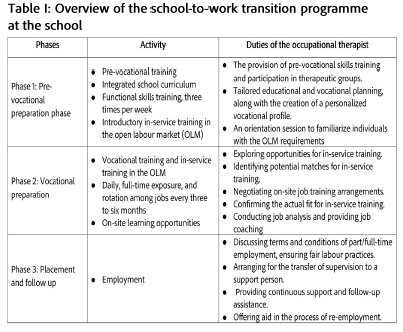
The school-to-work transition programme at the Pretoria School for LSEN comprises different elements of various models such as the Vocational Transition Model, the Youth Transition Programme Model, and the Model of Supported Employment12Table I, below)12
School-to-work transition programmes increase post-school employment opportunities for LWD12
Introduction to the school-to-work transition model at the Pretoria School for LSEN
School-to-work transition programmes prepare learners to enter the work environment and opportunities in life131325,14.
Progress of the school-to-work transition programme
Indication of positive outcomes has been observed in terms of growth in the diversity of services offered and the number of learners enrolled in the school-to-work transition programme121215,16. Evidence supports the contention that developing vocational skills will enable LWD to transition successfully and will also assist them later in life171218,12. At the Pretoria School for LSEN, limited funding and staff for the service delivery of the school-to-work transition programme negatively impacted the employment options for LWD12,16.
In the USA, vocational rehabilitation agencies are required to allocate 15% of their funding to transition services17,18. If South African legislation followed the example of the USA, LWD might have better employment outcomes197,20. When analysing school-to-work transition programmes, resources should be considered as structural factors that contribute to effectiveness19,21. The Youth Transition Programme is an example of a programme that has government funding and enough staff to facilitate an effective programme21,22. Currently, there is no literature that indicates whether lack of funding and resources are still barriers and whether LWD are employed in the OLM. Literature suggests that more research is needed to explore the perceived effectiveness of school-to-work programmes23
METHODOLOGY
This study aimed to explore the perceptions of occupational therapists on a school-to-work transition programme at the Pretoria School for LSEN.
Study design
An exploratory-descriptive research design was utilised to develop a better understanding of what is happening within the school programme. The aim of descriptive studies is to seek new insight and to ask questions that bring phenomena into new light2424-27.
Study setting
The study was conducted at the Pretoria School for LSEN which is situated in the Prinshof suburb of the Tshwane Metropolitan municipality, Gauteng44
Sampling and participants
Participants were selected using purposive sampling and snowballing28303
Data collection
Data for this study were gathered through semi-structured interviews, with accompanying field notes being taken during the process26,28. The researcher conducted a pilot interview prior to data collection to prepare for the face-to-face interviews with participants282928
Data analysis and trustworthiness
The data were thematically analysed as described by Braun and Clarke on reflective thematic analysis which acknowledges the subjectivity of the participants32333332
Ethical considerations
The Faculty of Health Sciences Research Ethics Committee of University of Pretoria granted ethical approval for the study (ethics number 804/2020). Permission to conduct the study at the Pretoria School for LSEN was obtained from the principal and the head of the occupational therapy department prior to commencing the study. All the ethical principles of non-maleficence, beneficence, and confidentiality were adhered to in the study. Informed consent was obtained in the form of written and verbal consent from the participants prior to commencing the study.
RESULTS
Demographics of participants
The participants (n = 5) were all white, female qualified occupational therapists who were all employed in the occupational therapy department at the Pretoria School for LSEN. The participants' ages ranged between 20 and 59. Two participants (Participants A&B) had been involved in the programme for more than 11 years and primarily provided services in phase two and three of the programme. Two participants (C&D) had been involved in the programme for six to ten years and provided services in phase one of the programme. Participant Ε had been involved in the delivery of phase one for two to five years
Theme 1: The value of the programme
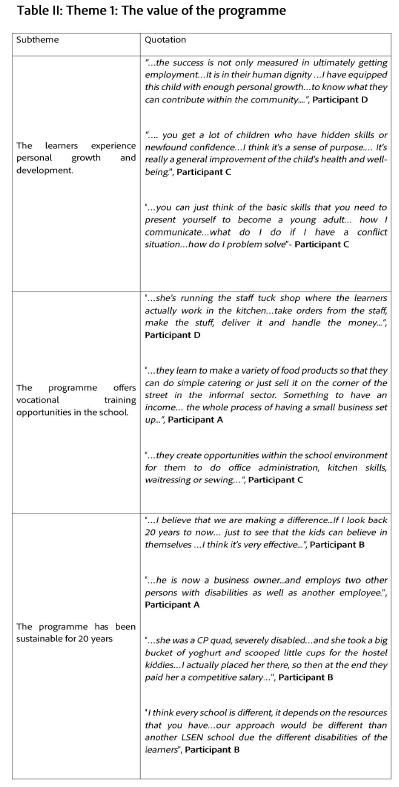
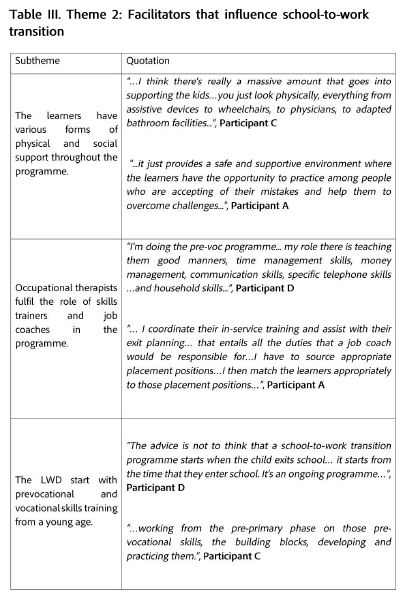
The participants agreed that the programme enabled the learners' personal growth and development. Participants explained that the programme had been running for 20 years, and that the programme had been used as a blueprint for similar programmes at other LSEN schools which again alludes to the value of the programme. The participants express ed that the effectiveness of the programme is not only measured in ultimate employment in the OLM, but it is also measured in terms of personal growth and development of the learners (Table II page 49). The school-to-work transition programme allows LWD to develop mature characteristics. Through the programme, LWD displays improved self-esteem, self-identity, and confidence leading to increased health and an experience of well-being. LWD have an opportunity to develop their unique adult roles by acquiring the appropriate prevocational skills to be employed in the OLM. This further creates a sense of purpose. The occupational therapists involved in the programme innovatively created vocational training opportunities in the school, such as the school tuck shop, due to the limited in-service training opportunities in the OLM. These training opportunities include income-generating projects that allow LWD to have a chance to practice their work habits and other prevocational skills at the school to prepare them for employment in the OLM (Table II, page 49). The participants also reported that the programme has been effective and continues to have a positive impact on the overall lives of learners for several years, therefore making the programme sustainable for 20 years. One of the participant's expressed how the programme has assisted some of the learners to start their businesses and hire other learners with disability within the businesses.
Theme 2: Facilitators that influence school-to-work transition.
LWD receive various forms of social and physical support throughout the programme and the role of occupational therapists as skills trainers and job coaches is to facilitate school-to-work transition (Table III, adjacent). The school starts with prevocational and vocational skills training from a young age which also facilitates school-to-work transition. The participants stated that the learners are given various forms of physical support. The participants mentioned that the programme has received more financial support over the years and currently has a set budget. A participant supported this by saying that most of the expenses have been accounted for. The participants also mentioned that they use a multidisciplinary team for physical and social support. The participants expressed that the programme offers social support in the form of a safe space to learn the needed prevocational and vocational skills. The multidisciplinary team provides the needed individualised support that each learner needs to flourish. The occupational therapists who are employed at the Pretoria School provide the services in the programme that contribute to the learners' work readiness and this starts from an early age. One of the services that was prominently mentioned was pre-vocational and vocational skills training. The second service that is delivered by the occupational therapists that were mentioned prominently, is skills training and job coaching.
Theme 3: Barriers that influence school-to-work transition
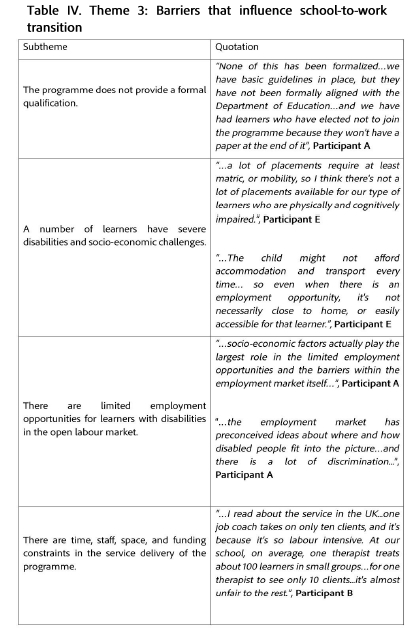
A significant barrier to the school-to-work transition programme is that the programme does not provide a formal qualification for LWD after completion. This negatively impacts the learners' employment opportunities as employers require the learners to have a formal qualification such as a certificate. A number of LWD elected not to join the programme for this reason. Participants also explained that learners with severe disabilities experience different challenges to obtaining employment and thus have greater socio-economic challenges (Table IV, page 50). The participants explained that employment in the OLM for LWD is scarce due to the poor economic status of the country. Furthermore, employers are driven to meet productivity standards to profit in the poor economic market. Barriers such as prejudice and discrimination in the workplace regarding disability are other factors that limit employers from appointing LWD. Participants explained that employers do not always know how to treat LWD in the workplace. The COVID-19 pandemic has heightened the reluctance of employers to employ LWD due to the narrowed employment market and decreased economic status of the country. The participants also expressed challenges regarding Sector Education and Training Authority (SETA) learnerships which limits employment opportunities for learners. Some employers require LWD to complete a learnership before they can be employed. The challenges with the SETA learnerships are that some learners do not qualify for the learnerships due to their disability profile or seventy of their conditions. The SETA learnerships do not provide learners with sufficient vocational skills to meet job requirements. More time and therapists are required to assess and re-assess the learners and negotiate with the employers for appropriate placement in the OLM. The participants additionally expressed that funding for assistive devices, specific skills training, and transport to and from work remain a concern despite the increased financial support that has been received over the years. Due to the funding, time, and staff constraints, there is subsequently limited space in the programme and at the school itself to accommodate all the learners with the potential for school-to-work transition.
DISCUSSION
The findings of this study provided valuable insight regarding the perceived effectiveness of the school-to-work transition programme at the Pretoria School for LSEN. The study revealed the facilitators and the barriers that influenced the school-to-work transition. These barriers and facilitators aligned with the chosen theoretical framework, the Person, Environment and Occupation (PEO) model, which guided the study in terms of how the perceives effectiveness of the school-to-work transition programme could possibly be improved.
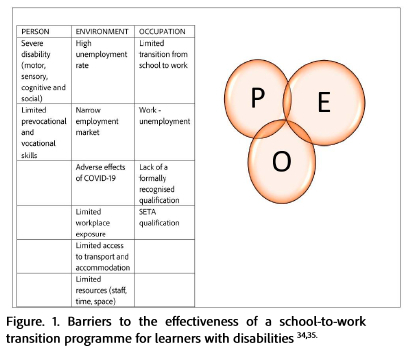
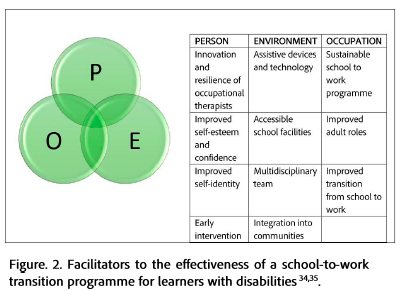
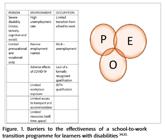
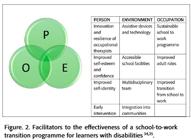
The PEO model consists of personal, environmental, and occupational spheres that need to interact optimally to ensure enhanced occupational performance34,35. Effective school-to-work transition resulting in post-school employment opportunities was considered enhanced occupational performance for LWD in this study. The personal sphere included LWD interests, values, beliefs and motor, sensory, cognitive, and social abilities35342Figure 1 below) and facilitators (Figure 2, page 51) in the three spheres of the school-to-work transition programme that influenced its effectiveness34
Personal barriers
According to the findings of the study individuals with LWD face certain personal barriers that hinder their employability. A number of the learners who were enrolled in the programme had severe disabilities that further decreased employment outcomes. Evidence supports that LWD who have either motor, sensory, cognitive or social disabilities, struggle to attain pre-vocational and vocational skills which limits their ability to effectively transition from school to work2,5,18,34.
Environmental barriers
The participants in our study explained that there were limited employment opportunities in the OLM because of the poor economic status of South Africa. South Africa has a high overall unemployment rate which will inevitably affect the disabled population due to the narrowed employment market73612125,20.
In South Africa, LWD with socio-economic challenges are also excluded from employment because they do not have access to transport and accommodation close to their place of employment19,20. Nel and van der Westuyzen121219,23. In this study, participants expressed that limited funding and staff also limited their ability to meet all the transition needs of LWD. The Pretoria School also has limited space to enrol learners in the programme and limited space at the school to offer vocational training opportunities. A government-driven transition service could further ensure a nationally recognised formal qualification, which is a real need for both prospective employees and employers. The environment sphere in figure 1 shows multiple barriers contributing to the limited occupational performance of LWD and the effectiveness of the school-to-work transition programme.
Occupational barriers
Another finding in our study was the mention of SETA learnerships. Participants explained that employers required LWD to compensate for the lack of a formal qualification by completing a SETA learnership, which is an occupational barrier for LWD. Most employers require that prospective employees have a formal qualification such as a learnership certificate3737
Personal, environmental, and occupational facilitators
We identified several personal, environmental, and occupational facilitators that increased the perceived value and effectiveness of the school-to-work transition programme. Where poor economic status of the country and socio-economic challenges of LWD was a barrier, occupational therapists involved in the programme had to be innovative to compensate for the lack of in-service training opportunities in the OLM, which usually forms part of phase two of the programme. This was seen as an occupational facilitator as the learners were given the opportunity in the school to acquire appropriate pre-vocational and vocational skills. If LWD are prepared with the appropriate skills and qualifications to work, school-to-work transition could be effective and this could result in better post-school employment options in the OLM5,14. The study revealed that the resilience and innovation of the occupational therapists, led to the sustainability of the programme and optimal service delivery, which is consistent with the literature33
Other environmental facilitators included the various forms of physical and social support offered to LWD and the involvement of occupational therapists in the programme as skills trainers and job coaches. The Pretoria School has the facilities, including disability access, assistive devices, and assistive technology to support LWD. The benefit of a multi-disciplinary team is that each team member can contribute their discipline specific knowledge to optimise the therapeutic outcomes for an individual with a disability. The involvement of occupational therapists, physiotherapists, speech therapists, psychologists, educators, and social workers enhanced transition outcomes for LWD. Participants explained that a multi-disciplinary team offered a safe space, acceptance of mistakes, and ongoing individualized support for the learners to develop their work competency skills38,39. Occupational therapists fulfil the unique role of skills trainers and job coaches to prepare LWD with the necessary pre-vocational and vocational skills2,34.
The assessment of the school-to-work transition programme focused on the successful integration and eventual employment of LWD in the OLM163312,23.
The PEO model indicates that many barriers limited occupational performance and that many facilitators enabled occupational performance33 in the Pretoria School. The PEO model thus alluded to the fact that if the identified personal, environmental, and occupational barriers were reduced and the facilitators were optimized, the occupational performance of LWD in terms of effective school-to-work transition would inevitably improve34. This results in a 'good fit' between the spheres of the PEO model and therefore improved school-to-work transition programme as shown in Figure 2 (adjacent).
Limitations
The scope of the study was restricted to exploring the experiences of the occupational therapists actively engaged in the program. Educators and other therapists were omitted from the study due to their lack of day-to-day involvement in the program. The interconnected perspectives among occupational therapists within the department, influenced by its size, led to a narrowing of the study's focus.
CONCLUSION
Using the PEO model, we explored occupational therapists' views of the school-to-work transition programme at the Pretoria School for LSEN. Barriers to the programme must be addressed while strengthening the facilitators so that the programme remains sustainable. Most of the barriers identified are environmental and this shows the impact that an environment has on one's occupational performance. The COVID-19 pandemic had a great influence on the successful implementation of the school-to-work transition programme, therefore plans needs to be in place on how to deal with future pandemics or similar events so that LWD continue to experience occupational justice. The findings provide valuable evidence for how the school-to-work transition programme at the Pretoria School for LSEN has been sustained, this shows the importance of translating the programme to other schools in South Africa. Central to this programme is a need for a formally recognised qualification to enable an easier transition to employment, collaboration with government authorities in this regard is needed.
The school-to-work transition programme should be evaluated in a broader context and the effectiveness of the programme can be measured in a variety of ways. Quantitative studies on the effectiveness of the programme are needed to provide statistical evidence of the effectiveness of the programme. This would be beneficial to the school-to-work transition programme at the Pretoria School as it will provide leverage to formalise the programme for national recognition. This will ensure that learners receive a certified qualification after completing the programme and allow the programme to be officially implemented at other LSEN schools.
Author contributions
Henry Msimango was the lead author who planned and organised the study. The sections of the article were divided among all authors and each contributed to the writing of the article. Riekie Germishuys, Megan Jamieson, Kay-Lee Avenant and Thabang Rameetse analysed the data and identified the themes and subthemes, Nthabaleng Phalatse and Henry Msimango validated the themes. All the authors finalised and approved the final manuscript.
Conflicts of interest
Authors declare that there are no conflicts of interest to declare.
REFERENCES
Acknowledgements
The authors wish to acknowledge Cheryl Tosh for language editing and constructive feedback on the article.
LITERATURE REVIEW
-
1. Komsyonu A. Supported Employment for people with disabilities in the EU and EFTA-EEA: good practices and recommendations in support of a flexicurity approach", European Union. Erişim. 2012;3:2017. [accessed 2023 February 20]. https://www.firah.org/upload/notices3/2011/supported-employment.pdf
» https://www.firah.org/upload/notices3/2011/supported-employment.pdf - 2. Ross J. Occupational therapy and vocational rehabilitation. John Wiley & Sons; 2008 Feb 19.
- 3. Charles WP, Gie L, Musakuro RN. Barriers to the em ploya bility of people with disabilities in the South African public service. African Journal of Disability. 2023 Jul 17,-12:1178.
-
4. Pretoria School for LSEN. Pretoria School for LSEN [Internet]. [Accessed 2020 Aug 18]. https://pretoriaschool.wixsite.com/pta-school/therapy
» https://pretoriaschool.wixsite.com/pta-school/therapy - 5. Maja PA, Mann WM, Sing D, Steyn AJ, Naidoo P. Employing people with disabilities in South Africa. South African Journal of Occupational Therapy. 2011;41 (1):24-32.
-
6. Hunt X, Bradshaw M, Vogel SL, Encalada AV, Eksteen S, Schneider M, Chunga K, Swartz L. Community Support for Persons with Disabilities in Low-and Middle-Income Countries: A Scoping Review. International Journal of Environmental Research and Public Health. 2022 Jul 6;19(14):8269. doi: https://doi.org/10.3390/ijerph19148269
» https://doi.org/10.3390/ijerph19148269 -
7. Department: Statistics South Africa. Stats SA [Internet]. 2020 [accessed 2020 Aug 14]. http://www.statssa.gov.za/
» http://www.statssa.gov.za/ -
8. Statistics South Africa. Community Survey 2016: Profiling Socio-economic Status and Living Arrangements of Persons with Disabilities in South Africa. Statistics South Africa; 2018. 2020. [accessed 2020 Aug 14]. http://cs2016.statssa.gov.za/wp-content/uploads/2018/07/CS-2016-Disability-Report-03-01-232016.pdf
» http://cs2016.statssa.gov.za/wp-content/uploads/2018/07/CS-2016-Disability-Report-03-01-232016.pdf -
9. South Africa. Constitution of the Republic of South Africa No. 108 of 1996. accessed 2020 Aug 14]. https://www.gov.za/sites/default/files/images/a108-96.pdf
» https://www.gov.za/sites/default/files/images/a108-96.pdf -
10. South African Government. Special Needs Education: Education White Paper 6. 2021. [accessed 2021 Aug 14]. https://www.gov.za/documents/special-needs-education-education-white-paper-6
» https://www.gov.za/documents/special-needs-education-education-white-paper-6 -
11. South Africa. Department of Social Development. White Paper on the rights of persons with disabilities. 09 March 2016. Government Gazette No. 230 [accessed 2020 Aug 14]. https://www.gov.za/sites/default/files/gcis_document/201603/39792gon230.pdf
» https://www.gov.za/sites/default/files/gcis_document/201603/39792gon230.pdf - 12. Nel L, van der Westhuyzen C, Uys K. Introducing a school-to-work transition model for youth with disabilities in South Africa. Work. 2007 Jan 1;29(1):13-8.
-
13. Achatz J, Jahn K, Schels B. On the non-standard routes: vocational training measures in the school-to-work transitions of lower-qualified youth in Germany. Journal of Vocational Education & Training. 2022 Apr 3;74(2):289-310. doi:https://doi.org/10.1080/13636820.2020.1760335
» https://doi.org/10.1080/13636820.2020.1760335 - 14. Rüta BRAZIENÈ A, Leonavičius V, Arvydas Virgilijus MATULIONIS H, Muktup Vela R, Ruškus J. School-To-Work Transition Phenomenon in Lithuania: a Case of Disabled Youth. Kaunas University of Technology; 2016.
-
15. Monareng LL, Franzsen D, van Biljon H. A survey of occupational therapists' involvement in facilitating self-employment for people with disabilities. South African Journal of Occupational Therapy. 2018 Dec;48(3):52-7. doi: http://dx.doi.org/10.17159/2310-3833/2017/vol48n3a8
» http://dx.doi.org/10.17159/2310-3833/2017/vol48n3a8 - 16. Gragoudas S. Preparing students with disabilities to transition from school to work through self-determination training. Work. 2014 Jan 1;48(3):407-11.
- 17. Collier M, Griffin MM, Wei Y. Learning from students about transition needs: Identifying gaps in knowledge and experience. Journal of Vocational Rehabilitation. 2017 Jan 1;46(1):1-0.
-
18. Wehman P, Sima AP, Ketchum J, West MD, Chan F, Luecking R. Predictors of successful transition from school to employment for youth with disabilities. Journal of occupational rehabilitation. 2015 Jun; 25:323-34 doi: https://doi.org/10.1007/s10926-014-9541-6
» https://doi.org/10.1007/s10926-014-9541-6 - 19. Dong S, Fabian E, Luecking RG. Impacts of school structural factors and student factors on employment outcomes for youth with disabilities in transition: A secondary data analysis. Rehabilitation Counseling Bulletin. 2016 Jul;59(4):224-34.
-
20. Statistics South Africa. Census 2011: Profile of persons with disabilities in South Africa. 2014; Report No. 03-01-59. [accessed 2020 Aug 14]. https://www.statssa.gov.za/publications/Report-03-01-59/Report-03-01-592011.pdf
» https://www.statssa.gov.za/publications/Report-03-01-59/Report-03-01-592011.pdf - 21. Dickinson J, Alverson C, Burr J, FitzGerald P, Johnson M, Ozols K, et al. Oregon Youth Transition Program Procedures Manual. 2nd Ed. Oregon: University of Oregon; 2015. 1-2, 102 p.
- 22. Wehman P, Schall C, Carr S, Targett P, West M, Cifu G. Transition from school to adulthood for youth with autism spectrum disorder: What we know and what we need to know. Journal of Disability Policy Studies. 2014 Jun;25(1):30-40.
- 23. Nochajski SM, Schweitzer JA. Promoting school to work transition for students with emotional/behavioral disorders. Work. 2014 Jan 1;48(3):413-22.
- 24. Creswell JW, Creswell JD. Research Design: Qualitative, Quantitative and Mixed Method Approaches [Internet]. 5th ed. Salmon H, Neve C, O'Heffernan M, Felts DC, Marks A, editors. Los Angeles: Sage Publications, Inc.; 2018. 1-540 p.
- 25. Denzin NK, Lincoln YS, editors. The Sage handbook of qualitative research, sage; 2011 Apr 27.
- 26. Creswell JW. Research Design: Qualitative, Quantitative and Mixed Methods Approaches. 4th ed. Editorial VK, Young J, Koscielak K, Bauhaus B, Typesetter: MM, editors. Thousand Oaks: Sage Publications, Inc.; 2014. 1-342 p.
- 27. Polit DF, Beck CT. Nursing research: Generating and assessing evidence for nursing practice. Lippincott Williams & Wilkins; 2008.
- 28. Polit DF, Beck CT. Nursing Research: Generating and Assessing Evidence for Nursing Practice [Internet]. Tenth. Philadelphia: Wolters Kluwer; 2017.1-1479 p. 50.
- 29. Brink H, van der Walt C, van Rensburg G. Fundamentals of Research Methadology for Healthcare Professionals. 4th ed. Singh J, editor. Cape Town: Juta and Company (Pty) Ltd; 2018. 1-224.
-
30. Tongco MDC. Purposive sampling as a tool for informant selection. Ethnobotany research and applications. 2007;5:147-58. [accessed 2020 Aug 14]. https://scholarspace.manoa.hawaii.edu/server/api/core/bitstreams/5bdc92a7-99fe-4134-aaeb-6d0970562559/content
» https://scholarspace.manoa.hawaii.edu/server/api/core/bitstreams/5bdc92a7-99fe-4134-aaeb-6d0970562559/content - 31. Botma Y, Greeff M, Mulaudzi FM WS. Research in Health Sciences. Cape Town: Pearson; 2016.
- 32. Beauchemin C, González-Ferrer A. Sampling international migrants with origin-based snowballing method: New evidence on biases and limitations. Demographic Research. 2011 Jul 1; 25:103-34.
-
33. Byrne D. A worked example of Braun and Clarke's approach to reflexive thematic analysis. Quality & Quantity. 2022; 56(3):1391-412. doi:10.1007/s11135-021-01182-y
» https://doi.org/10.1007/s11135-021-01182-y - 34. Schell BA, Gillen G, Scaffa M, Cohn ES. Willard and Spackman's occupational therapy. 12th ed. Philadephia: Lippincott Williams and Wilkins, Wolters Kluwer business; 2014.
- 35. Baptiste S, Hinojosa J, Kramer P, Royeen CB. The person-environment-occupation model. Perspectives on human occupation: Theories underlying practice. 2017 Apr 21:137-59.
- 36. Chan F, Wang CC, Fitzgerald S, Muller V, Ditchman N, Menz F. Personal, environmental, and service-delivery determinants of employment quality for state vocational rehabilitation consumers: A multilevel analysis. Journal of Vocational Rehabilitation. 2016 Jan 1;45(1):5-18.
- 37. Arndt C, Davies R, Gabriel S, Harris L, Makrelov K, Modise B, et al. Impact of Covid-19 on the South African economy. Southern Africa-Towards Inclusive Economic Development Working Paper. 2020;111.
-
38. De Louw LA. Efficacy of learnership programmes: an exploratory investigation of learner perceptions in the Cape Peninsula (Doctoral dissertation, Cape Peninsula University of Technology). 2009. [accessed 2020 Aug 14]. http://dkcput.ac.za/td cput/150
» http://dkcput.ac.za/td cput/150 - 39. Barrett BJ. Is" Safety" Dangerous? A Critical Examination of the Classroom as Safe Space. Canadian Journal for the Scholarship of Teaching and Learning. 2010;1(1):9.

Reviewed 1st round: 6 September 2023
Revised 1st round: 23 January 2024
Reviewed 2nd round: 21 February 2024
Revised 2nd round: 18 March 2024
Accepted: 18 March 2024
Editor: Hester M. van Biljon: https://orcid.org/0000-0003-4433-6457
Data availability: Upon reasonable request from the corresponding author
Funding:No funding to declare.