Doing a scoping review with undergraduate occupational therapy students in the time of the COVID-19 pandemic
INTRODUCTION
In South Africa, the COVID-19 pandemic manifested in March 2020, bringing with it severe disruption and posing unique challenges to healthcare and the education of health practitioners123
This commentary describes such an initiative. A supervised scoping review, that focused on how persons with disabilities in South Africa accessed rehabilitation services in public healthcare facilities, was undertaken with a group of five final year occupational therapy students. The reasoning was that the framework of a scoping review would introduce students to multiple examples of research methodology as well as the rigours of evidence synthesis. A discussed concern was that conducting a scoping review would be too time-consuming and difficult for undergraduate students. To address this concern, structure, and supervision with practical demonstrations, were prioritised. The educational objective was to expose the students to the realities of service users as described in published peer-reviewed primary research.
METHOD
During the week of 29 March to 1 April 2021, a group of five undergraduate final year occupational therapy students from Stellenbosch University (SU) and their two supervisors did a scoping review with the question: How do persons with disabilities access public healthcare rehabilitation services in South Africa? The Joanna Briggs Institute user manual, resources and website were used throughout45678 9
There were six phases to the review. Each phase started with an online tutorial. This was followed by a team discussion in which planning, and task allocation took place. The students were expected to work either individually or in groups and supervisor advice could be accessed when needed.
• Phase one comprised planning and preparation for the review. This included a tutorial on what a scoping reviewing is, review question formulation, eligibility criteria development and creation of extraction templates. The learning objective in this phase was to make clear to students why they were conducting a scoping review and what it entailed.
• In phase two, students were taught how to develop a search string, how to identify key words using Boolean terms and how to negotiate different data bases. Using Google Scholar and SU library databases, they ran the searches and downloaded full texts of sources into Mendeley.
• Phase three saw students selecting the sources of evidence for their scoping review and populating a PRISMA flow diagram. The learning objective was to understand the reason and rigour of blinded and systematic selection of articles and learn to use a PRISMA flow diagram in the scoping review process. Inclusion and exclusion criteria were confirmed by the group and students took part in Title and Abstract Screening and Full Text Screening using Rayyan.
• Data charting and extraction were done in phase four. Two self-developed data-extraction templates were used by the students. During the tutorial, the supervisor used one of the articles to illustrate how to find and extract data. Following this, each student received a certain section of the articles for individual extraction, collaborating when necessary.
• In phase five, students used Excel and Taguette, to summarize, analyse and synthesize the evidence they captured. This phase concluded with a group session attended by the supervisors and during which results were discussed and themes agreed on.
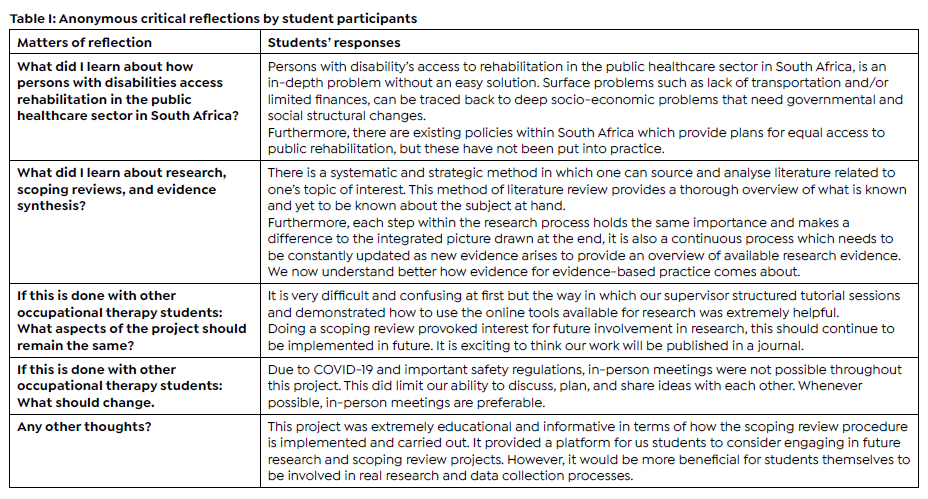
• Phase six saw students co-authored their scoping review and compiled it into a journal article. The article was submitted to a journal and the students experienced the process associated with having an article published in a scientific peer reviewed journal. They were also tasked to critically reflect on their learning experience while doing the scoping review and make suggestions to improve similar teaching initiatives in future. The first author drew up a table with open-ended questions for students to reflect on, and a section for additional thoughts (See Table I, above). The table allowed the student co-authors to reflect on and capture their individual experiences. Their responses were checked with all participants and summarised during an online group session.
RESULTS
Students' reflections on their learning experience are summarised and shown in Table I (above).
DISCUSSION
Not disregarding or denying the adverse impact that a global pandemic such as COVID-19 brings, the authors would like to reiterate the opinion that it also offers a unique opportunity for change and opportunities for the implementation of innovative and creative initiatives. This report shows that exposing undergraduate students to the rigour and process of a scoping review is beneficial as they are exposed to a large variety of research methodologies, outcomes, and diverse points of view. Reporting their findings in an article format focussed students' attention on the most important components of research and guides them to write succinctly. It was also realised that conducting a scoping review is more cost and time effective than real time field work research whilst accomplishing a similar level of exposure to the world of research. Despite popular opinion that a scoping review is too difficult for undergraduate students, this exercise illustrates that, given a well-structured process, multiple tutorials, real-time demonstrations and supervisors' consistent availability, undergraduates can do research at this level. The scoping review was submitted to the Disability, CBR and Inclusive Development journal on 10 June 2022 where it was vetted, reviewed, revised and accepted for publication in October 202210.
Limitations
The reason for doing the scoping review was to use it as an educational and learning tool. There were no data trails, and the group did not consider or address potential biases. The knowledge claim of this commentary is based on reflections by five students. More in-depth research with a wider range of data capturing is recommended. The students and supervisor only met in group sessions. Individual meetings with the supervisor and each student should have been done. This would have ensured inclusion of verbatim words and made the critical reflection more specific. It would have summarized the student's personal experiences and perspective more comprehensively to give the reader an in-depth understanding.
CONCLUSION
Students' reflections show that they gained insight into research, perceiving the activity of doing a scoping review as a largely positive experience and expressed interest to engage in future research. The prospect of their work being published, motivated them. However, they reported that they would still prefer to have done research that required face-to-face interaction and exposure to clinical settings within various contexts. Educators of occupational therapists could consider doing a scoping review with undergraduate students is as a possible future education strategy. However further research and empirical evidence would be needed to support such strategies and the possibility of exploring a hybrid approach in future is suggested.
Author contributions, conflicts of interest, bias and ethical declarations
The authors declare no bias affecting their interpretation and results of the review. No ethical clearance was sought or obtained. The review and journal article contributed towards the Bachelor of Occupational Therapy degree for Bianca Salie, Jancke van Wyk, Jessica Daniel, Lize-Mari Kersop and Michaela Naidoo, who are co-authors. They took part in the commentary and scoping review as part of their curriculum; reflections were anonymous, volunteered and did not affect the marking of their scoping review.
REFERENCES
-
1. Cecilio-Fernandes D, Parisi MCR, Santos TM, et al. The COVID-19 pandemic and the challenge of using technology for medical education in low- and middle-income countries. MedEdPublish 2020; 9: 1-7. https://10.15694/mep.2020.000074.1
» https://10.15694/mep.2020.000074.1 -
2. World Health Organization. Maintaining essential health services: operational guidance for the COVID-19 context. Geneva, Switzerland, WHO/2019, 1-61 https://www.emcdda.europa.eu/drugs-library/maintaining-essential-health-services-operational-guidance-covid-19-context_en
» https://www.emcdda.europa.eu/drugs-library/maintaining-essential-health-services-operational-guidance-covid-19-context_en -
3. World Health Organization. Rehabilitation. Newsroom, 2020, p. https://www.who.int/news-room
» https://www.who.int/news-room - 4. Peters, M.D.J., Godfrey, C., Mclnerney, P., Baldini Soares, C., Khalil, H. and Parker D. Chapter 11: Scoping reviews. Joanna Briggs Institute Reviewer's Manual. The Joanna Briggs Institute (JBI). 2017.
-
5. Mendeley Ltd. Mendeley Reference Manager. Elserivier 2020; https://www.mendeley.com/reference-management
» https://www.mendeley.com/reference-management -
6. Rayyan Sytems I. Rayyan Intelligent Systematic Review. Rayyan https://rayyan.qcri.org
» https://rayyan.qcri.org -
7. Rampin R, Rampin V, DeMott S. Taguette Version 0.10.1. hi@taguette.org 2020; BSD-3-Clause license, © https://www.taguette.org/
» https://www.taguette.org/ -
8. Microsoft. Microsoft Teams Gro up Chat Software. https://www.microsoft.com/en-us/microsoft-teams/group-chat-software
» https://www.microsoft.com/en-us/microsoft-teams/group-chat-software -
9. Koum J, Acton B, Cathcart W. WhatsApp Mobile Application. Public NASDAQ:FB 2021; https://web.whatsapp.com
» https://web.whatsapp.com -
10. van Biljon H, Salie B, van Wyk J, et al. Access to Public Healthcare Rehabilitation Services by Persons with Disabilities in South Africa: A Scoping Review. Disabil CBR Incl Dev 2022; 33: 35-61. doi 10.47985/dcidj.620
» https://doi.org/10.47985/dcidj.620
Reviewed: 20 June 2022
Revised: 13 July 2022
Accepted:28 July 2022
DATA AVAILABILITY: On reasonable request, from corresponding author
FUNDING: No funding was received.
* Final year occupational therapy students at the time of the study.