Factors to consider in planning a tailored undergraduate interprofessional education and collaborative practice curriculum: A scoping review
Abstract
BACKGROUND: Heath care students need to be practice-ready at qualification. Increased interest in and drive towards more collaborative practice necessitate consideration of teaching and learning factors unique to learning settings, to plan a tailored interprofessional education and collaborative practice curriculum, based on empirical findingsMETHOD: The Joanna Briggs Institute's scoping review methodology guided this study. Eight online databases were searched, with 72 articles included for full review. Charted data, analysed quantitatively, included year, context, study design and population. The four-dimensional curriculum framework model, consisting of future health care needs, interprofessional competencies, methods of teaching and institutional support, directed the deductive analysisRESULTS: Interprofessional education is best presented as a tailored curriculum, i.e. fitting the specific institution's needs, based on formal rather than a voluntary participation and presented longitudinally. Buy-in from institutional management assists in overcoming barriers related to resourcing and staff participationCONCLUSION: Successful interprofessional education and collaborative practice curricula are dependent on an interplay of various factors such as specific professions involved, future healthcare needs of the country, expected capabilities and competencies of graduates, content and teaching methods, and available resources. Facilitators, as well as policymakers of academic and clinical institutions, could benefit from the synthesized evidence
interprofessional learning; pre-licensure; Joanna Briggs; four-dimensional curriculum model; graduate competencies
INTRODUCTION
The increasing complexity of patients' needs has influenced health professional education and health policy and as a result, has strengthened a drive for preparing a "collaborative practice-ready" health workforce to respond to local health needs1
Literature describing IPECP curriculum planning in Africa is limited. A variety of published documents, e.g., interprofessional education and practice guides and competency frameworks from different countries, such as, Australia2345
Most models guiding curriculum development either use a linear approach or do not explicitly address IPECP competencies e.g., Kern curriculum design model, Context, Input, Process and Product (CIPP model), Biggs model6789,10, none indicated its use to develop a tailored IPECP curriculum.
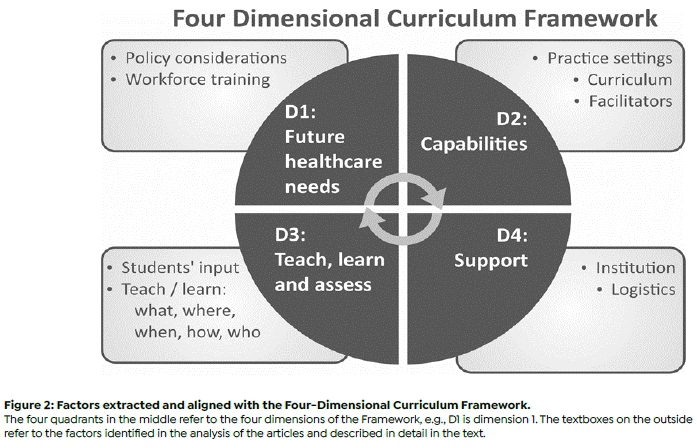
When a university plans an IPECP programme, the unique context and how it differs from what available literature describes, should be considered. The 4DF guides tailored curriculum development to include (1) health care needs and available resources; (2) application of IPECP competencies; (3) teaching, learning and assessment variations; (4) institutional support and available resources.
The African context has unique challenges related to healthcare needs of the population and in equitability of available resources to ensure quality of life. In addition, within South Africa, implementation of IPECP programmes differ vastly due to lack of clear policy, differing IPECP competency applications and the level of commitment by university management. For example, health profession accreditation bodies or councils e.g., the Health Professions Council of South Africa119
The scoping review forms part of the first author's PhD study aimed at developing an IPECP module for final year health care students at a South African university. The objective of this review was to identify the factors that affect planning of a tailored undergraduate IPECP curriculum by identifying, analysing, and synthesising relevant articles.
METHODOLOGY
The five-step Joanna Briggs12
Stage 1: Identifying the research question
The research question was: What is known, from the published, peer-reviewed literature about the factors that influence the planning of a tailored IPECP curriculum for health care professionals?
Stage 2: Identifying relevant articles
A search strategy including seven databases (MEDLINE, CI-NAHL, Science Direct, PubMed, NexusIPE, Scopus) as well as Google Scholar search engine identified articles in English between 2009 and 2020. The Boolean search phrases were:
• "Interprofessional education" AND "Collaborative practice" AND/OR "Interprofessional learning"
• "Planning" OR "Development"
• "Undergraduate students" OR "Undergraduates" OR "Pre-Qualification students" OR "pre licensure"
• "Curriculum" OR "Programme" OR "Module"
The articles reviewed included: participants who were undergraduate students enrolled in a health care professional programme, as well as course developers, and experts in IPECP. The included article context focused on curricula delivered at universities in classrooms clinical settings, and in urban or rural areas. Articles published globally were considered. Inclusion criteria for concepts covered "interprofessional education", "interprofessional learning" and/or "collaborative practice".
Initial exclusion criteria were studies that focused on single activities (e.g., oncology ward rounds), postgraduate students, qualified health care professionals, and non-health care professional students.
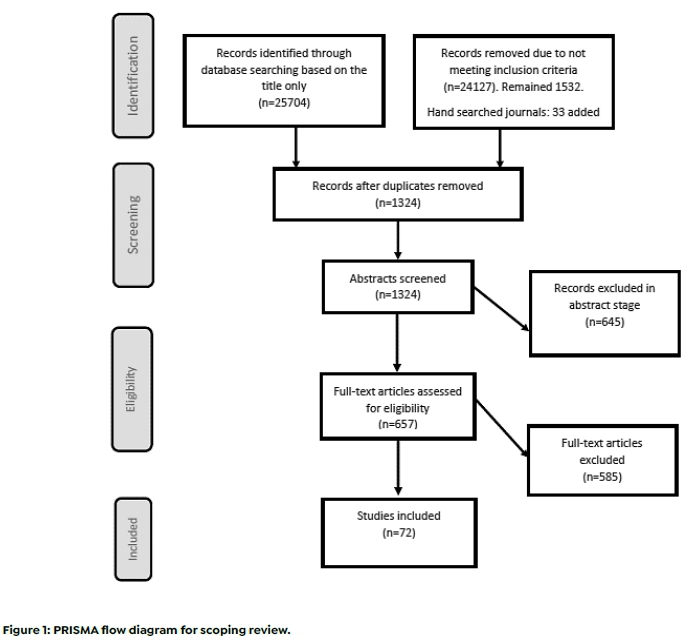
Stage 3: Study selection (please refer to PRISMA guide, Figure 1, page 80)
Selection was based on initial screening by title (n = 25704), then abstract (n=1324) and lastly full text (n=72). Two team members reviewed the articles and referred any disagreements to a third reviewer for the final decision for inclusion12Figure 1 (page 80) summarises the study inclusion process after applying the refined inclusion criteria.
Stage 4: Charting the data
The author/s, publication year, title and journal information, country (study location), context (university or clinical setting), research method/study design, study population (e.g., students or experts, their level as juniors/seniors, their professions), were charted using Microsoft Excel. See addendum A.
Stage 5: Collating, summarising, and reporting the results
Quantifiable data were analysed descriptively, and a deductive qualitative thematic analysis based on the 4DF7 directed the thematic analysis. For included articles please refer to addendum A, page 88.
RESULTS
Quantitative data are presented in a narrative descriptive format. (The included articles are identified with an asterisk* in the reference list.)
Descriptive summary of demographic information
Participants: Of the 72 articles reviewed, 15 (20.8%) included key role players, e.g., IPECP experts, or course developers as participants. The remaining 57 (79.2%) of articles consisted of students as participants.
Course progression: Twenty-eight (49%) of the 57 articles that focused on students indicated that senior students participated, 16 (28%) focused specifically on first year students, and 13 (23 %) did not specify the year group of participants. Professions: Nursing was the most represented profession with 42 (58.3%) studies followed by physiotherapy and medicine with 28 (38.8%) each, and occupational therapy and pharmacy with 26 (36%) each. A variety and different combinations of professions participated, from at least two up to 10 professions per session. The most frequent number of professionals included in a session were six as mentioned in 47 studies (65.3%), followed by five professions mentioned in 9 studies (12.5%) and three to four professions mentioned in eight studies each (22.2%).
Number of participants: A vastly different number of students were included in IPECP sessions, ranging from less than a 100 to 1 873 students. Not all studies mentioned the number of students. Of the 46 studies (64%) where the number of participants was stated, most studies, 24 (52.2%) reported on participation of less than 100 students, but seven (15.2%) involved more than 1 000 students. Fifteen studies (32.6%) reported on small group teaching, with student numbers varying between three to 14 students per group.
Country: Only five studies (6.9%) from Africa met the inclusion criteria. The majority of the included studies, 48 (66.6%), were from countries with IPECP competency frameworks - 15 (20.8%) each from USA and Australia, and nine (12.5%) each from Canada and UK.
Geographical considerations: The geographical suitability for offering joint IPECP activities refers to the availability of a variety of professions at the same university. Universities who do not offer courses to a variety of health care professions relied on nearby universities to join their IPECP initiatives1314,15,16, one study described a mobile outreach exposure1718
Focus of the programme: Six articles (8.3%) focused on the importance of a theoretical model to guide planning. The majority of articles, (45=62.5%) addressed interprofessional education in classroom settings. Eleven articles (15.3%) included only interprofessional collaboration and 10 (13.9%) focused on both education and collaboration.
Descriptive summary of factors according to the four dimensions framework
The data were analysed deductively using the 4DF. The 4DF guided the mapping of thematic data to each dimension. Findings are presented under each of the four dimensions. Figure 2 (above) provides a visual representation of the dimensions and associated factors.
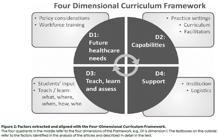
Dimension 1: Identifying future health care needs -preparing and capacity building to ensure meeting the needs of the population
The planning of an IPECP curriculum should address the training needs of the health work force, i.e., the need for and required competencies of the included professions and consider national policy related to health care worker training and health care delivery.
Policy considerations: National policies address the political, social, and cultural factors that influence health care worker training and health care delivery. Positive results were achieved with a nationally driven and coordinated approach, associated with research i.e., coordinated nationally amongst universities and departments of health and embedded in government policies19,20.
Health workforce training: An awareness of specific population health care needs, e.g., identifying care contexts and the variety of professionals needed, should inform training2018
Dimension 2: Defining and understanding interprofessional capabilities required for future success in practice
When planning to address the capabilities of the health care workers in the IPECP curriculum, environmental needs and staff requirements need consideration. IPECP Curriculum: IPECP should be part of a profession's core curriculum and not seen as optional212223624
Time frames for IPECP curriculum implementation were disputed252627Setting/environment: Positive safe spaces, which could be shared, or neutral spaces, are experienced as supportive and conducive to learning and thus enable students to explore beliefs, learn to network professionally and to reflect on their own and others' personal and professional culture and values28,29. Clinical settings need to allow students opportunities to observe the real world and learn about the respective professions and their interprofessional roles30,31. Facilitator requirements: Planning IPECP is a complex and dynamic process32333434,35.
Dimension 3: Teaching, learning and assessment to address the development of core competencies Teaching, learning and assessment: Specific teaching and learning components need to be tailored to student variables (who), context (where), timing (when), content (what) and teaching methods (how). When grouping students, planners need to appreciate, acknowledge and maximise diversity2436373839
Findings highlighted theoretical frameworks conducive to IPECP including Social Capital Theory40414224 43444546
Students input: Senior students, especially in their final year of study, can provide valuable input to curriculum development474849
Dimension 4: Supporting institutional delivery
For long-term sustainability, IPECP needs to be part of the collective institutional vision503548Characteristics of the Institution: Multi-tiered support is required from committed staff members, both academics and clinicians, institution leadership/management and governmental stakeholders5051Physical, attitudinal, and human resources: IPECP is resource and time intensive, due to significant coordination required52332453,54
DISCUSSION
This review revealed a growing body of literature that describes factors influencing IPECP planning. Articles increased steadily from 2009 to 2020, reflecting the possibility that more universities incorporated IPECP on a larger scale into their curriculum; or more research conducted into the planning of IPECP curriculum. Analysis of the 72 articles found most originated in countries where government policies as well as competency frameworks for IPECP are in place. The benefit of having such support is acknowledged. In South Africa, as in many other African countries, the policies of IPECP are emergent. Even though an abundance of international literature is available, few South African specific guidelines were found. Nevertheless, the authors gained an in-depth understanding of intertwined factors to consider when planning and IPECP curriculum and realized the gaps for the South African context.
The descriptive summary of factors according to the four dimensions reflected the dynamic interaction between the four dimensions. Specific professions, future healthcare needs, expected capabilities, curriculum content, teaching methods and available resources impacted one another.
It was evident that local, national, and international health and education policies influence IPECP application2055
Worldwide there is an increasing demand for trained health care workers. From the scoped articles it became clear that IPECP in Africa is not as established as it is in developed economies56345758
To present a tailored curriculum, the IPECP core competencies, that guide the outcomes of the IPECP curriculum and therefore the selection of learning opportunities (activities, teaching methods and assessment methods), need to determine the duration and timing of the curriculum. Selected learning opportunities should suit the student characteristics for example the needs of the year group and combination of professions involved359,3. In the South African context, it is important to pay attention to the type of case study that is most relevant to the specific professions involved and to address challenges related to diversity during IPECP group work. Examples could be stroke, head injuries, substance induced psychosis, post-traumatic stress disorder, spinal cord injuries.
Facilitators need to understand the institution and the health care system where the programme is presented. Knowledgeable, enthusiastic facilitators who make student's involvement enjoyable, contribute to students' positive attitude to future interprofessional collaboration60
Student involvement in curriculum planning increase IPECP programme acceptance and involvement60,61. Students who have experienced not only their own professions specific curriculum, but also the IPECP curriculum could share their experience of the learning opportunities' relevance29
For the sustainability of any IPECP programme, buy-in from the specific institutions' management is vital to overcome logistical barriers, such as financing and provide the necessary resources35,48.
Throughout the review and the discussion, the relevance of sources was contemplated to ensure that it supports the South African context.
Limitations of the scoping review
Due to the abundance of available literature, important articles may have been inadvertently excluded, despite rigorous effort. Only five articles originating in Africa adhered to the inclusion criteria though there was abundance of international articles. This further highlighted the paucity of South African research in IPECP in terms of planning a curriculum relevant for the country's needs. The IPECP articles from Africa focussed more on IPECP implementation and is evident of IPECP in Africa as an emerging research area. Even though the scoping review did not provide sufficient information related to planning a specific South African IPECP curriculum, the discussion did however, indicate how differences in the context could be identified and considered in planning and aligning information to the specific university context.
CONCLUSION
The results from this scoping review have the potential to guide the planning of a tailored IPECP curriculum for an African university. Several intertwined factors were presented for consideration by curriculum planners and IPECP organisers and presenters. Findings could support university management and policymakers as it provides summarised and synthesised evidence on how to establish a tailored IPECP curriculum. Key considerations include the specific professions involved, future healthcare needs of the country, expected capabilities and competencies of graduates, content and teaching methods and available resources influence one another.
Consideration of unique institutional contexts could guide planning a new or revised IPECP curriculum. A tailored curriculum will ensure that the healthcare needs of the local population is met and that students master interprofessional competencies using context-relevant teaching strategies.
AUTHOR CONTRIBUTIONSHanlie Pitout designed the study, collected, and analysed the data and drafted the initial manuscript and revised the manuscript. Fasloen Adams and Sanet du Toit contributed to the study design, supervised the data collection and analysis, and was actively engaged in the writing of the manuscript and Daleen Casteleijn assisted with refining the manuscript for publication. All authors were included in aspects of study design, data collection, analysis, interpretation of data; and/or drafting the paper; as well as final approval of the submitted version to be published and agreement to be accountable for included information.
DECLARATIONS OF COMPETING INTERESTS AND FUNDINGThe authors have no declarations of competing interests to make, and no funding was received for this research.
Please note articles included in the scoping review are indicated with a *
REFERENCES
-
1. World Health Organisation. Framework for action on interprofessional education and collaborative practice. 2010. Geneva, Switzerland https://apps.who.int/iris/handle/10665/70185. (WHO/HRH/HPN/10.3)
» https://apps.who.int/iris/handle/10665/70185 -
2. O'Keefe, M., Henderson, A. & Chick, R. (2017) Defining a set of common interprofessional learning competencies for health profession students. Medical Teacher, 39(5):463-468. doi: https://doi.org/10.1080/0142159X.2017.1300246
» https://doi.org/10.1080/0142159X.2017.1300246 - 3. Health Professions Accreditors Collaborative. (2019). Guidance on developing quality interprofessional education for the health professions. Chicago, IL: Health Professions Accreditors Collaborative.
- 4. Canadian Interprofessional Health Collaborative (CIHC). (2010). A national interprofessional competency framework. Vancouver, BC.
-
5. Reeves, S; Tassone, M., Parker, K., Wagner, SJ, & Simmons, B. (2012). Interprofessional Education: An overview of key developments on the past 3 decades. Work, 41, 233- 245. doi: https://doi.org/10.3233/WOR-2012-1298
» https://doi.org/10.3233/WOR-2012-1298 -
6 Toosi M, Modarres M, Amini M, Geranmayeh M. Context, Input, Process, and Product Evaluation Model in medical education: A systematic review. J Educ Health Promot. 2021 May 31;10(1):199. doi: 10.4103/jehp.jehp_1115_20. PMID:34250133; PMCID: PMC8249974
» https://doi.org/10.4103/jehp.jehp_1115_20 -
7. Steketee C, Forman D, Dunston R, Yassine T, Matthews LR, Saunders R, Nicol P, Alliex S. Interprofessional health education in Australia: three research projects informing curriculum renewal and development. Applied Nursing Research. 2014 May; 27(2):115-20. doi:https://doi.org/10.1016/j.apnr.2014.03.002.
» https://doi.org/10.1016/j.apnr.2014.03.002 -
8. Moran MC, Steketee, C, Forman D, Dunston R. Using a research-informed curriculum framework to guide reflection and future planning. Journal of Research in Interprofessional Practice and Education. 2015; 5(1) doi:http://dx.doi.org/10.22230/jripe.2015v5n1a187.
» http://dx.doi.org/10.22230/jripe.2015v5n1a187 -
9. Thistlethwaite JE, Moran M. Learning outcomes for interprofessional education (IPE): Literature review and synthesis. Journal of Interprofessional Care. 2010; 24(5): 503-5133. doi: http://dx.doi.org/10.3109/13561820.2010.483366
» http://dx.doi.org/10.3109/13561820.2010.483366 -
10. Ryan GS, Cuthbert K, Dryden T, Baker D, Forman D. Going 4D: Embedding the Four Dimensional Framework for Curriculum Design. In: Forman, Dawn; Jones, Marion and Thistlethwaite, Joan eds. Leading Research and Evaluation in Interprofessional Education and Collaborative Practice. 2016; London: Palgrave Macmillan, pp. 99-121. Doi: https://doi.org/10.1057/978-1-137-53744-7_6.
» https://doi.org/10.1057/978-1-137-53744-7_6 - 11. Health Professionals Council of South Africa. Core competencies for undergraduate students in clinical associates, dentistry and medical teaching and learning programmes in South Africa. Medical and Dentistry Board. 2014; Accessed 10 July 2019.
-
12. The Joanna Briggs Institute. The Joanna Briggs Institute Reviewer's Manual 2017 Methodology for JBI Scoping Reviews. 2017; Retrieved from www.joannabriggs.org.
» www.joannabriggs.org -
13. *Levett-Jones T, Burdett T, Chow YL, Jonsson L, Lasater K, Mathews LR, McAllister M, Pooler A, Tee S, Wihlborg J. Case Studies of Interprofessional Education Initiatives From Five Countries. Journal of Nursing Scholarship. 2018 May;50(3):324-332. doi:http://dx.doi.org/10.1111/jnu.12384.
» http://dx.doi.org/10.1111/jnu.12384 -
14. *Muller J, Snyman S, Slogrove A, Couper I. The value of interprofessional education in identifying unaddressed primary health-care challenges in a community: a case study from South Africa. Journal of Interprofessional Care. 2019 Jul-Aug;33(4):347-355. doi:https://doi.org/10.1080/13561820.2019.1612332
» https://doi.org/10.1080/13561820.2019.1612332 - 15. *Kickett M, Hoffman J, Flavell H. A model for large-scale, interprofessional, compulsory cross-cultural education with an indigenous focus. Journal of Allied Health. 2014 Spring;43 (1):38-44. PMID: 24598898.
-
16. *Walker L, Cross M, Barnett T. Mapping the interprofessional education landscape for students on rural clinical placements: an integrative literature review. Rural and Remote Health 2018; 18: 4336. Doi: https://doi.org/10.22605/RRH4336
» https://doi.org/10.22605/RRH4336 -
17. *Skolka M, Hennrikus WL, Khalid M, Hennrikus EF. Attitude adjustments after global health inter-professional student team experiences. Medicine. 2020; 99 (16): e19633. doi:https://doi.org/10.1097/MD.0000000000019633.
» https://doi.org/10.1097/MD.0000000000019633 -
18. *Steketee, C., Forman, D., Dunston, R., Yassine, T., Matthews, L. R., Saunders, R., Nicol, P., & Alliex, S. (2014). Interprofessional health education in Australia: Three research projects informing curriculum renewal and development. Applied Nursing Research, 27(2), 115-120. doi: https://doi.org/10.1016/j.apnr.2014.03.002.
» https://doi.org/10.1016/j.apnr.2014.03.002 -
19. *Alinier G, Harwood C, Harwood P, Montague S, Huish E, Ruparelia K, et al+. Immersive Clinical Simulation in Undergraduate Health Care Interprofessional Education: Knowledge and Perceptions. Clinical Simulation Nursing, 2014.10 (4): e 205-e216. doi:https://doi.org/10.1016/j.ecns.2013.12.006.
» https://doi.org/10.1016/j.ecns.2013.12.006 -
20. *Matthews LR, Pockett RB, Nisbet G, Thistlethwaite JE, Dunston R, Lee A, White JF. Building capacity in Australian interprofessional health education: perspectives from key health and higher education stakeholders. Australian Health Review. 2011 May;35(2):136-40. doi: https://doi.org/10.1071/AH10886.
» https://doi.org/10.1071/AH10886 -
21. *Homeyer S, Hoffmann W, Hingst P, Oppermann RF, Dreier-Wolfgramm A. Effects of interprofessional education for medical and nursing students: enablers, barriers and expectations for optimizing future interprofessional collaboration - a qualitative study. BMC Nursing. 2018 Apr 10;17:13. doi: https://doi.org/10.1186/s12912-018-0279-x.
» https://doi.org/10.1186/s12912-018-0279-x -
22. *Lockeman KS, Lanning SK, Dow AW, Zorek JA, Diaz Granados D, Ivey CK. Et al. (2017). Outcomes of Introducing Early Learners to IPE competencies in Classroom Setting. Teach ing and Learning in Medicine. 2017; 29 (4); 433-443. doi: https://doi.org/10.1080/10401334.2017.1296361.
» https://doi.org/10.1080/10401334.2017.1296361 -
23. *Junod Perron N, Cerutti B, Picchiottino P, Empeyta S, Cinter F, van Gessel E. Needs assessment for training in interprofessional skills in Swiss primary care: a Delphi study. Journal of Interprofessional Care. 2014; 28 (3): 273-275. doi: https://doi.org/10.3109/13561820.2013.878321.
» https://doi.org/10.3109/13561820.2013.878321 -
24. *Jorm C, Nisbet G, Roberts C, Gordon C, Gentilcore S, Chen TF. Using complexity theory to develop a student-directed interprofessional learning activity for 1220 healthcare students. BMC Medical Education. 2016 Aug 8;16:199. doi: https://doi.org/10.1186/s12909-016-0717-y.
» https://doi.org/10.1186/s12909-016-0717-y -
25. *Tartavoulle M, English R, Gunaldo TP, Garbee D, Mercante DE, Andrieu SC, et al. Using the IDEA framework in an interprofessional didactic elective course to facilitate positive changes in the roles and responsibility competency. Journal of Interprofessional Care. 2016; 2: 21-24. doi: https://doi.org/10.22230/jripe.2018v8n1a264.
» https://doi.org/10.22230/jripe.2018v8n1a264 -
26. *Wilbur, K., Kelly, I. Interprofessional impressions among nursing and pharmacy students: a qualitative study to inform interprofessional education initiatives. BMC Medical Education 15, 53 (2015). https://doi.org/10.1186/s12909-015-0337-y.
» https://doi.org/10.1186/s12909-015-0337-y -
27. *Imafuku R, Kataoka R, Ogura H, Suzuki H, Enokida M, Osakabe K. What did first-year students experience during their interprofessional education? A qualitative analysis of e-portfolios. Journal of Interprofessional Care. 2018 32 (3): 358-366. doi:https://doi.org/10.1080/13561820.2018.1427051.
» https://doi.org/10.1080/13561820.2018.1427051 -
28. *Engel J, Prentice D, Taplay K. A Power Experience: A Phenomenological Study of Interprofessional Education. Journal of Professional Nursing. 2017 May-Jun;33(3):204-211. doi: https://doi.org/10.1016/j.profnurs.2016.08.012.
» https://doi.org/10.1016/j.profnurs.2016.08.012 - 29. *Michalec B, Giordano C, Pugh B, Arenson C, Speakman E. Health Professions Students' Perceptions of Their IPE Program: Potential Barriers to Student Engagement with IPE Goals. Journal of Allied Health. 2017 Spring;46(1):10-20. PMID: 28255592.
-
30. *Hallam KT, Livesay K, Morda R, Sharples J, Jones A, de Courten M. Do commencing nursing and paramedicine students differ in interprofessional learning and practice attitudes: evaluating course, socio-demographics and individual personality effects. BMC Medical Education, 2016; 16: 80-89. doi:https://doi.org/10.1186/s12909-016-0605-5.
» https://doi.org/10.1186/s12909-016-0605-5 -
31. *Pardue KT. Not left to chance: introducing an undergraduate interprofessional education curriculum. Journal of Interprofessional Care. 2013 Jan;27(1):98-100. doi: https://doi.org/10.3109/13561820.2012.721815.
» https://doi.org/10.3109/13561820.2012.721815 -
32. *Croker, A., Wakely, L., & Leys, J. Educators working together for interprofessional education: From "fragmented beginnings" to "being intentionally interprofessional". Journal of Interprofessional Care, 2016. 30 (5), 671-674. Doi: https://doi.org/org/10.1111/medu.12749.
» https://doi.org/org/10.1111/medu.12749 -
33. *Fook J, D'Avray L, Norrie C, Psoinos M, Lamb B, Ross F. Taking the long view: exploring the development of interprofessional education. Journal of Interprofessional Care. 2013 27:286-291. https://doi.org/10.3109/13561820.2012.759911.
» https://doi.org/10.3109/13561820.2012.759911 -
34. *Botma Y. Consensus on interprofessional facilitator capabilities. Journal of Interprofessional Care. 2019; 33 (3)277-279. doi:https://doi.org/10.1080/13561820.2018.1544546.
» https://doi.org/10.1080/13561820.2018.1544546 -
35. *Berger S, Goetz K, Leowardi-Bauer C, Schultz JH, Szecsenyi J, Mahler C. Anchoring interprofessional education in undergraduate curricula: The Heidelberg story. Journal of Interprofessional Care. 2017 Mar;31(2):175-179. Doi:https://10.1080/13561820.2016.1240156
» https://10.1080/13561820.2016.1240156 -
36. *Lairamore C, Morris D, Schichtl R, George-Paschal L, Martens H, Maragakis A, Garnica M, Jones B, Grantham M, Bruenger A. Impact of team composition on student perceptions of interprofessional teamwork: A 6-year cohort study. Journal of Interprofessional Care. 2018 Mar;32(2):143-150. doi:https://doi.org/10.1080/13561820.2017.1366895.
» https://doi.org/10.1080/13561820.2017.1366895 -
37. *Reitsma G, Scrooby B, Rabie T, Viljoen M, Smit K, Du Preez A, Pretorius R, Van Oort A, Swanepoel M, Naude A, Dolman R. Health students' experiences of the process of interprofessional education: a pilot project. Journal of Interprofessional Care. 2019 May-Jun;33(3):298-307. doi:https://doi.org/0.1080/13561820.2019.1572600.
» https://doi.org/0.1080/13561820.2019.1572600 -
38. *Kururi N, Tozato F, Lee B, Kazama H, Katsuyama S, Takahashi M, Abe Y, Matsui H, Tokita Y, Saitoh T, Kanaizumi S, Makino T, Shinozaki H, Yamaji T, Watanabe H. Professional identity acquisition process model in interprofessional education using structural equation modelling: 10-year initiative survey. Journal of Interprofessional Care. 2016;30(2):175-83. doi:https://doi.org/10.3109/13561820.2015.1092117
» https://doi.org/10.3109/13561820.2015.1092117 - 39. *Jernigan SD, Hodgkins SR, Hildenbrand WC, Laverentz DM, Johnson K, Waxman MJ, et al. Teaching for Practice: The Impact of a Large-Scale Interprofessional Foun-dational Program. Journal of Allied Health. 2018 47 (2) e53-e59.
-
40. *Hean S, Craddock D, Hammick M, Hammick M. Theoretical insights into interprofessional education AMEE Guide no 62 Medical Teacher. 2012; 34: e78-e101. doi: https://doi.org/10.3109/0142159X.2012.650740.
» https://doi.org/10.3109/0142159X.2012.650740 -
41. *Craddock D, O'Halloran C, McPherson K, Hean S, Hammick M. A top-down approach impedes the use of theory? Interprofessional educational leaders' approaches to curriculum development and the use of learning theory. Journal of Interprofessional Care. 2013 Jan;27(1):65-72. doi: https://doi.org/10.3109/13561820.2012.736888.
» https://doi.org/10.3109/13561820.2012.736888 -
42. *Fitzsimmons A, Cisneros B, Samore J. A learner developed longitudinal interprofessional education curriculum. Journal of Interprofessional Care. 2014 Jan;28(1):66-7. doi: https://doi.org/10.3109/13561820.2013.820692.
» https://doi.org/10.3109/13561820.2013.820692 -
43. *Cerbin-Koczorowska M, Zielinska-Tomczak L, Waszyk-Nowaczy M, Michalak M, Skowron A. As the twig is bent, so is the tree inclined: a survey of student attitudes toward interprofessional collaboration supported with the curricula analysis. Journal of Interprofessional Care. 2019; 33 (6): 636-644. doi:https://doi.org/10.1080/13561820.2019.1572598.
» https://doi.org/10.1080/13561820.2019.1572598 -
44. *O'Hara C, Trotter L, Olsen C, Stinson D, McCutcheon K. Development of an e-learning programme to improve knowledge of interprofessional education. British Journal of Nursing. 2018 Nov 22;27(21):1242-1245. doi:https://doi.org/10.12968/bjon.2018.27.21.1242.
» https://doi.org/10.12968/bjon.2018.27.21.1242 -
45. *Rosenfield D, Oandasan I, Reeves S. Perceptions versus reality: a qualitative study of students' expectations and experiences of interprofessional education. Medical Education. 2011 May;45(5):471-7. doi:https://doi.org/10.1111/j.1365-2923.2010.03883.x.
» https://doi.org/10.1111/j.1365-2923.2010.03883.x -
46. *Karuguti WM, Phillips J, Barr H. Analysing the cognitive rigor of interprofessional curriculum using the Depth of Knowledge framework. Journal of Interprofessional Care. 2017 Jul;31(4):529-532. doi:https://doi.org/10.1080/13561820.2017.1310718.
» https://doi.org/10.1080/13561820.2017.1310718 -
47. *Prast J, Herlache-Pretzer E, Frederick A, Gafni-Lachter L. Practical Strategies for Integrating Interprofessional Education and Collaboration into the Curriculum. Occupational Therapy Health Care. 2016;30(2):166-74. doi: https://doi.org/10.3109/07380577.2015.1107196.
» https://doi.org/10.3109/07380577.2015.1107196 -
48. *Chicorelli J, Dennie A, Heinrich C, Hinchey B, Honarparvar F, Jennings M, Keefe C, Metro TL, Peel C, Snowdon C, Tempelman J, Wong ME, Forbes SL, Livingston LA. Canadian student leaders' perspective on interprofessional education: A consensus statement. Journal of I nterprofessional Care. 2016 Jul;30(4):545-7. doi:https://doi.org/10.3109/13561820.2016.1159187.
» https://doi.org/10.3109/13561820.2016.1159187 -
49. *Olson RE, Klupp N, Astell-Burt T. Reimagining health professional socialisation: an interactionist study of interprofessional education. Health Sociology Review. 2016; 25(1): 92-107. doi: http://dx.doi.org/10.1080/14461242.2015.1101702.
» http://dx.doi.org/10.1080/14461242.2015.1101702 -
50. *De Vries-Erich J, Reuchlin K, de Maaijer P, Monica van de Ridder JM. Identifying facilitators and barriers for implementation of interprofessional education: Perspectives from medical educators in the Netherlands. Journal of Interprofessional Care. 2017; 31: 2,170-174, doi: https://doi.org/10.1080/13561820.2016.1261099.
» https://doi.org/10.1080/13561820.2016.1261099 -
51. *Paslawski T, Kahlke R, Hatch T, Hall M, McFarlane L, Norton B, et al. Action, Reflection, and Evolution: A Pilot Implementation of Interprofessional Education across Three Rehabilitation Disciplines. Journal of Research in Interprofessional Practice and Education. 2014; 4(2): 1-10. doi: http://dx.doi.org/10.22230/jripe.2014v4n2a134
» http://dx.doi.org/10.22230/jripe.2014v4n2a134 -
52. *Lehrer MD, Murray S, Benzar R, Stormont R., Lightfoot M, Hafertepe M, et al. A. Peer-led problem-based learning in interprofessional education of health professions students. Medical Education online. 2015 20:1, 28851, doi: https://doi.org/10.3402/meo. v20.28851.
» https://doi.org/10.3402/meo. v20.28851 -
53. *Rotz ME, Dueñas G G, Grover AB, Headly A, Parvanta CF. Exploring first-year pharmacy and medical students' experiences during a longitudinal interprofessional education program. Currents in Pharmacy Teaching and Learning. 2015; 7(3): 302-311. doi:https://doi.org/10.1016/j.cptl.2014.12.002.
» https://doi.org/10.1016/j.cptl.2014.12.002 -
54. *West C, Graham L, Palmer RT, Miller MF, Thayer EK, Stuber ML, Awdishu L, Umoren RA, Wamsley MA, Nelson EA, Joo PA, Tysinger JW, George P, Carney PA. Implementation of interprofessional education (IPE) in 16 U.S. medical schools: Common practices, barriers and facilitators. Journal of Interprofessional Education and Practice. 2016 Sep;4:41-49. doi:https://doi.org/10.1016/j.xjep.2016.05.002.
» https://doi.org/10.1016/j.xjep.2016.05.002 -
55. Academy of Science of South Africa (ASSAF) Reconceptualising Health Professions Education in South Africa. 2018; https://www.usaf.ac.za/reconceptualising-health-professions-education-in-south-africa. doi:http://dx.doi.org/10.17159/assaf.2018/0021
» https://www.usaf.ac.za/reconceptualising-health-professions-education-in-south-africa -
56. Sunguya BF, Hinthong W, Jimba M, Yasuoka J. Interprofessional education for whom? --challenges and lessons learned from its implementation in developed countries and their application to developing countries: a systematic review. PLoS One. 2014 May 8;9(5):e96724. doi:https://doi.org/10.1371/journal.pone.0096724.
» https://doi.org/10.1371/journal.pone.0096724 -
57. Bachynsky N. Implications for policy: The Triple Aim, Quadruple Aim, and interprofessional collaboration. Nurs Forum. 2020 Jan;55(1):54-64. doi:10.1111/nuf.12382. Epub 2019 Aug 20. PMID: 31432533.
» https://doi.org/10.1111/nuf.12382 -
58. Frenk J, Chen L, Bhutta ZA, Cohen J, Crisp N, Evans T, Fineberg H, Garcia P, Ke Y, Kelley P, Kistnasamy B, Meleis A, Naylor D, Pablos-Mendez A, Reddy S, Scrimshaw S, Sepulveda J, Serwadda D, Zurayk H. Health professionals for a new century: transforming education to strengthen health systems in an interdependent world. Lancet. 2010 Dec 4;376(9756):1923-58. doi:https://doi.org/10.1016/S0140-6736(10)61854-5
» https://doi.org/10.1016/S0140-6736(10)61854-5 - 58. South African National Health Insurance Bill Government Gazette No. 42598, of 26 July 2019.
-
59. *Stanley K, Stanley D. The HEIPS framework: Scaffolding interprofessional education starts with health professional educators. Nurse Education and Practice. 2019 Jan;34:63-71. doi:https://doi.org/10.1016/j.nepr.2018.11.004.
» https://doi.org/10.1016/j.nepr.2018.11.004 -
60. *Gilligan C, Outram S, Levett-Jones T. Recommendations from recent graduates in medicine, nursing and pharmacy on improving interprofessional education in university programs: a qualitative study. BMC Medical Education. 2014 Mar 18;14:52. doi:https://doi.org/10.1186/1472-6920-14-52.
» https://doi.org/10.1186/1472-6920-14-52 -
61. *Mellor R, Cottrell N, Moran M. "Just working in a team was a great experience..." - Student perspectives on the learning experiences of an interprofessional education program. Journal of Interprofessional Care. 2013 Jul;27(4):292-7. doi:https://doi.org/10.3109/13561820.2013.769093.
» https://doi.org/10.3109/13561820.2013.769093