Progressive muscle relaxation for pain and wellbeing of garment workers: A pre-test post-test study
Abstract
BACKGROUND: Musculoskeletal pain is common amongst garment workers due to awkward postures, and repetitive or forceful movements. Chronic pain can have a negative impact on the mental health and quality of life of workers, leading to a decrease in productivity. Progressive muscle relaxation (PMR) is a time efficient, cost-effective and simple technique that can be used by workers at their workstations to address musculoskeletal pain. OBJECTIVE: This study aimed to determine the immediate effect of PMR on the pain and well-being of garment workers with musculoskeletal pain. METHODS: A single-group pretest-posttest design was used. Data were collected in two sessions with the workers (n=24). During the first session, consent was obtained, eligibility was determined, and the Patient Health Questionnaire-9 (PHQ-9) was administered. During the second session, the pain Visual Analogue Scale (VAS) and Stellenbosch Mood Scale (STEMS) were administered before and immediately after the PMR intervention. The intervention was offered by final year occupational therapy students in Cape Town, South Africa. RESULTS: PHQ-9 scores showed more than half the participants (n=15) presented with symptoms of depression requiring monitoring or intervention. Pain VAS scores indicated that PMR substantially decreased musculoskeletal pain (m difference = 2.67, p <.001, Cohen's d = 1.74). The STEMS showed a moderate improvement in mental wellbeing immediately after the intervention (Cohen's d = 0.34 to 0.90). CONCLUSION: PMR was effective at reducing musculoskeletal pain and improving the mood of garment workers with musculoskeletal pain. PMR is potentially a feasible intervention for workers to use while at their workstations in resource-constrained environments. IMPLICATIONS FOR PRACTICE: • A single session of PMR can be used to immediately improve musculoskeletal pain and wellbeing. • PMR can be used on its own or in combination with other modalities. • PMR scripts can be shortened, translated and recorded; and then shared with clients via WhatsApp so that they can use it themselves. • This is an effective, low-resource, quick intervention that can be useful for workplaces where pain and mental distress are common.
cognitive behavioral therapy; musculoskeletal pain; chronic pain; mental health; work place rehabilitation; good health and well-being; Visual Analogue Scale (VAS); Stellenbosch Mood Scale (STEMS); Patient Health Questionnaire-9 (PHQ-9)
INTRODUCTION
Musculoskeletal pain and mental illness are prevalent issues among garment workers, due to the physical demands of their jobs, which involves prolonged postures, repetitive movements, and the use of vibrating tools in challenging work environments1233
Several occupational risk factors contribute to the high prevalence of musculoskeletal disorders among garment workers, including prolonged sitting or standing, repetitive motions and the use of vibrating tools14,5,6. Research highlights alarmingly high rates of musculoskeletal symptoms in this workforce: 77.1% in a Bangladeshi clothing factory, compared to 26.3% in the general Bangladeshi population; and 69.94% in Indian garment workers1,6,7. Additionally, female garment workers involved in stitching duties experience persistent shoulder, wrist and hand pain at disproportionately high rates8910-13. A Canadian epidemiological study (n=118 533) found that depression rates increased alongside worsening lower back pain1415-17. Research in South Africa and Uganda suggests that pain functions as a biological stressor, significantly contributing to depression15
Relaxation techniques, including PMR, have shown efficacy in reducing pain and anxiety in various populations, from burns patients to healthcare workers experiencing occupational stress18-21. PMR has demonstrated improvements in quality of life, lower back pain in pregnant women, fatigue, and mobility limitations due to osteoarthritis22-24. Originally developed by Edmund Jacobson in 1934252526
This study aims to evaluate the immediate effects of PMR on pain relief and overall well-being among garment workers. Specifically, it seeks to:
1. Describe the characteristics of garment workers presenting with musculoskeletal pain and assess the prevalence of depressive symptoms.
2. Determine the effect of PMR on pain using the Visual Analogue Scale (VAS).
3. Assess the impact of PMR on mental well-being using the Short-Term Evaluation of Mental States (STEMS).
By exploring PMR's potential in this setting, this study may inform future workplace interventions, supporting the integration of PMR as a practical and accessible strategy for improving garment workers' health.
METHODS
This study used a pre-experimental single group pre-test post-test design. The Template for Intervention Description and Replication (TIDieR) guidelines were used in the reporting of this study27
Participants
Garment workers were recruited from a clothing factory in Cape Town, South Africa, that employs approximately 2500 people. Recruitment procedures included posters, pamphlets, meetings with factory management, a sign-up sheet at the on-site occupational health clinic, direct invitation and word of mouth. Inclusion criteria were as follows: 1) presence of musculoskeletal pain within the past seven days, 2) being 18 years of age or older, 3) capable of understanding instructions and providing consent in English, Afrikaans or isiXhosa, and 4) currently employed at the clothing factory during the data collection period (i.e. not on leave). Exclusion criteria comprised contraindications for PMR, including 1) hypertension282930313233,34, statistical power of 0.80, significance level of 0.05 and effect size of 0.60, a required sample size of 24 participants was calculated.
Intervention
The intervention, PMR, was a pre-recorded progressive muscle relaxation session prepared by an occupational therapist. The aim of the intervention was to reduce the musculoskeletal pain and improve the mental well-being of the garment workers in a clothing factory in Cape Town. The materials needed included a script to explain the nature of the intervention, a pre-recorded audio-clip in three languages (English, Afrikaans and isiXhosa), a device to play the recording, a comfortable chair, and a quiet room at the occupational health clinic in the factory. The PMR script was adapted from Payne's handbook of relaxation techniques, 4th edition35
At their pre-allocated appointment time, participants came to the consultation rooms within the occupational health centre at the factory. Participants sat in a comfortable chair, and the PMR was explained to them. After completing the pre-test measures, participants closed their eyes and followed the recorded instructions to facilitate progressive muscle relaxation. At the end of the relaxation recording, participants were gently brought back to reality and then completed the post-test measures. The intervention was delivered to each participant once during a single 30-minute session. Of these 30 minutes, 5 minutes were allocated to data collection for the before and after measures, and 20 minutes were allocated for the intervention itself. The intervention was tailored for individual participants by offering a choice in the language of administration. Each PMR intervention was delivered by one of five final year occupational therapy students. Students had received three hours of classroom-based training on the use of relaxation techniques, and some had used relaxation with other clients during their occupational therapy fieldwork. They were supervised by a lecturer with 10 years' experience working at the clothing factory and in the field of work rehabilitation, and an associate professor with 20 years' experience in mental health. Their performance was monitored by both their research supervisors as well as a clinical supervisor for six hours per week. The researchers planned to maintain intervention fidelity by using a pre-rehearsed script in English, Afrikaans and isiXhosa to explain PMR to participants, having pre-recorded PMR sessions available in all three of the above-mentioned languages, and practicing the tone of voice that will be used when interacting with all participants. Intervention fidelity was maintained throughout.
Outcomes
During the intake interview, participants completed a demographic questionnaire and the Patient Health Questionnaire - 9 (PHQ-9). The PHQ-9 is a nine-item self-reported measure of major depressive disorder36,37 that has previously been used in South Africa383938
Two pre-test post-test measures were used to assess the immediate effect of the PMR intervention. The Visual Analogue Scale (VAS) is a self-report measure of pain that consists of a 10cm line with perpendicular endpoints indicating the extreme limits of pain intensity. These anchor points were orientated horizontally from left to right, with 0 indicating "no pain" and 10 indicating "worst pain ever". The VAS is the best method for subjectively measuring pain and is a reliable outcome for measuring pain and tracking pain relief. Participants were asked to place a mark on the 10cm line representing their current level of pain404140
The second pre-test post-test measure was the Stellenbosch Mood Scale (STEMS). The STEMS424344424443
Data collection procedures
Data collection was conducted by final year occupational therapy students who were trained in use of the intake interview form and outcome measures. Prospective participants contacted the researchers by WhatsApp, and an intake interview was scheduled. A private room in the on-site occupational health clinic was used for data collection. At the intake interview, participants were provided with written information about the study, in their language of preference (English, Afrikaans or Xhosa). After their questions were answered by the researcher, they provided written consent to participate. The demographic questionnaire and PHQ-9 were then administered. Following the interview, the researchers met to confirm which participants met the inclusion criteria. These participants were invited for the intervention. At the time of the intervention, participants first completed the VAS and STEMS as pre-tests. They then participated in the PMR, and immediately thereafter completed the post-test VAS and STEMS.
Data analysis
Data were analysed using IBM SPSS Statistics (Version 28.0.1) with the assistance of a biostatistician employed by Stellenbosch University. The first objective of this study was to describe the characteristics of garment workers presenting with musculoskeletal pain. The researchers used descriptive statistics including means, frequencies and percentages to analyse the demographic characteristics of participants and identify the prevalence of depressive symptoms among participants. The second and third objectives were to determine the effect of the PMR on pain using the VAS, and mental wellbeing using the STEMS, respectively. The Shapiro-Wilk test and the normal Q-Q plots were used to test the distribution of the variables. Paired t-tests were used to determine between-participant differences in pain and mental well-being immediately before and after the intervention. Effect sizes were then calculated using Cohen's d.
Ethical considerations
This study was approved by the Health Research Ethics Committee at Stellenbosch University (U22/01/154) and was conducted in accordance with the Declaration of Helsinki. Informed consent was obtained from the institution as well as all individual participants included in the study. All human research participants provided informed consent for publication. Participants were voluntarily recruited, were provided with adequate information about the study, and provided written informed consent in their language of choice (English, Afrikaans or isiXhosa). Institutional consent was obtained from the clothing factory and the Clothing Industry Healthcare Fund (CIHCF), as well as the occupational therapy clinic practicing within the CIHCF. Participants had the right to participate or withdraw at any time. Confidentiality was maintained throughout by labelling data collection instruments with participant codes. The welfare of participants was a priority throughout the study. All sessions were conducted at the occupational health centre in the clothing factory, to ensure easy and quick access to an occupational health nurse if needed. All possible participants were screened through an intake questionnaire to rule out any factors that could have been a risk to the participant (e.g. hypertension, cardiac conditions, dystonia, severe disability). The intervention and assessments were conducted during a once-off 30-minute session, as a 30-minute occupational health consultation is allowed for each worker during regular work time. This ensured that their break times and income was not affected by the study.
RESULTS
Recruitment continued until the calculated sample size of 24 was met. Of the first 36 workers who signed up to participate in the study, 12 did not meet the inclusion criteria. Five participants did not complete all sections of the intake (demographic) questionnaire but still participated in the intervention and were included in data analysis (n=24).
Participants' demographics
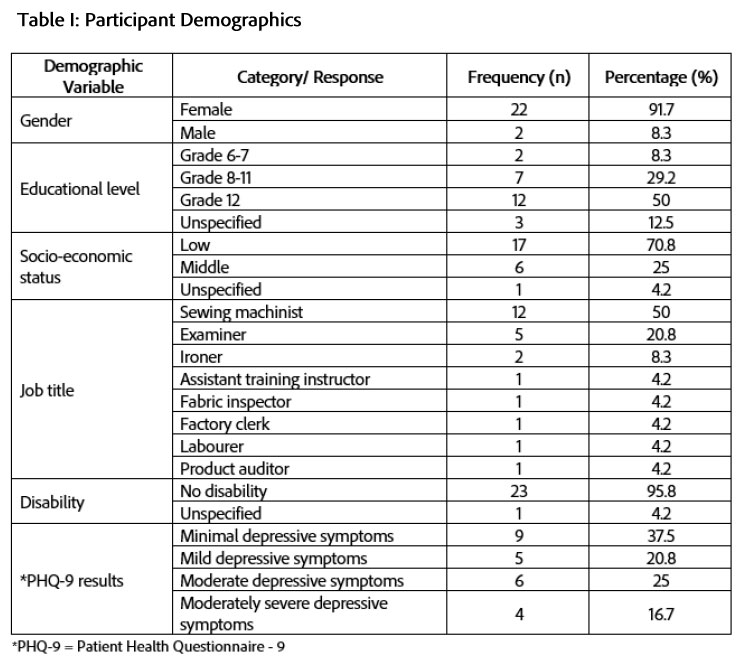
The workers' ages ranged between 24 and 54 years (m= 40.67, SD = 8.92). More women (n=22) than men (n=2) participated (see Table I page 4). The participants' highest level of education ranged from grade 6 to grade 12. Half of the participants had achieved grade 12 (n=12). The majority of workers classified themselves as low socio-economic status (n=17), followed by middle socio-economic status (n=6) and one was unspecified. No definitions for these categories were provided to participants. The majority of the participants were sewing machinists (n=12), examiners (n=5) or ironers (n=2). The period worked in their current positions ranged between 2 years and 31 years (M= 10.26 years, SD = 6.63). Almost all (n=23) participants indicated that they had no disability, and 1 participant did not specify. According to the PHQ-9 results, more than half the participants (n=15) had symptoms of depression requiring monitoring or intervention. Of these, most workers had moderate depressive symptoms (n=6), followed by mild (n=5) and moderately severe (n=4). No participants scored severe depressive symptoms on the PHQ-9. The remaining workers reported no-minimal depressive symptoms on the PHQ-9 (n=9). All 24 participants presented with musculoskeletal pain, with sharp pain being the most common type of pain (n=9). The workers also experienced burning, lingering, pins and needles, constant, cramps and non-specific pain. The workers mostly experienced pain in their shoulders (n=7) and lower back (n=6).
Pain: Visual analogue scale
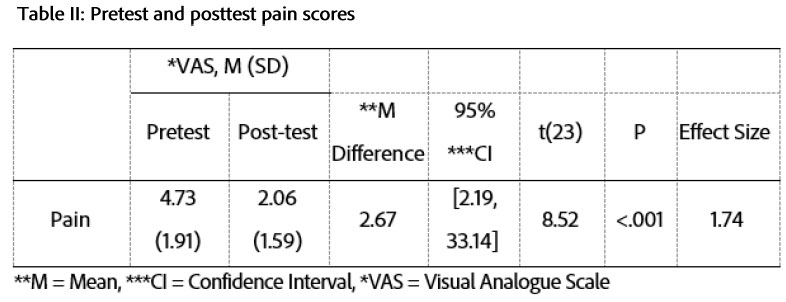
The Shapiro-Wilk test and normal Q-Q plots indicated normal distribution of the data. Parametric tests were therefore used to determine the difference in pain levels immediately before and after the PMR. Prior to the PMR, a mean score of 4.73 was obtained. Post-intervention the mean score decreased to 2.06, indicating a mean difference of 2.67, as can be seen in Table II (below). Analysis using paired t-tests indicated a statistically significant effect, t = 8.52, p < .001. Using Cohen's d, there was a very large clinical effect of the intervention on pain (Effect size = 1.74).
Mood: STEMS
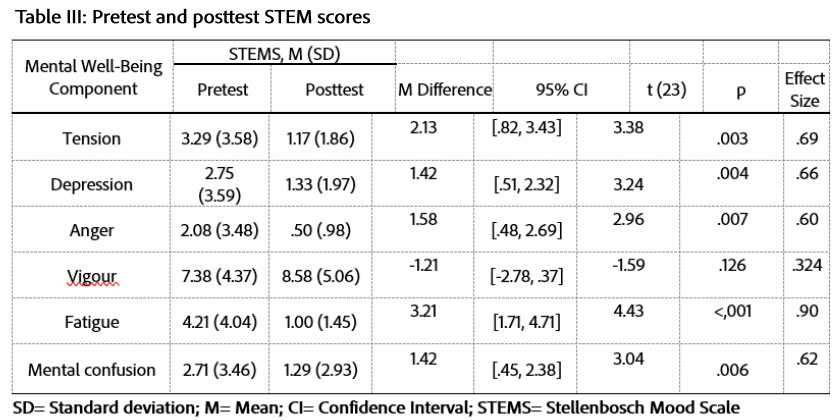
The Shapiro-Wilk test and normal Q-Q plot indicated normal distribution of the data. Mean difference pre-test to post-test demonstrated a decrease in scores in the domains of tension, depression, anger, fatigue and mental confusion see Table III (below). The Vigour Scale (also known as 'stamina') indicated an increase. The most significant mean differences were in tension and fatigue. Analysis using Cohen's d indicated a moderate to large effect of the intervention on mental well-being.
Feasibility and acceptability
In general, workers found the intervention to be acceptable and reported that they would use the PMR on their own in future. The PMR recording was sent to participants as a WhatsApp voice clip for their independent use after the study. The shortening of the PMR intervention from 30 minutes to 20 minutes, as well as the translation into simpler English, Afrikaans and isiXhosa made it significantly more user-friendly.
Data collection presented several challenges. A large number of garment workers were excluded from the study due to a history of hypertension or recurrent muscle spasms. Workers did not respond well to recruitment posters in the factory environment. A better response was found through word of mouth and direct recruitment (approaching workers who were known to experience pain through prior contact or referral). It was also difficult to schedule sessions with workers at the on-site occupational health clinic, as this required them to be away from their workstations for 30 minutes at a time, in a fast-paced production line. This had implications for the rest of the production line. However, it was significantly more accessible than interventions based outside of the workplace, as this would require more time off work as well as travel to a rehabilitation centre.
DISCUSSION
This study assessed the immediate effects of Progressive Muscle Relaxation (PMR) on musculoskeletal pain and mental well-being among garment workers in Cape Town, South Africa. The 24 participants had a mean age of 40.67 years and an average employment duration of 10.26 years. Pain was predominantly reported in the shoulders and lower back, and most participants exhibited signs of depression, with only nine scoring no-minimal depression on the PHQ-9. Following the intervention, both pain and mood improved significantly, with participants responding positively to the adapted, translated version of PMR.
Effect sizes, such as Cohen's d, provided valuable insight into the magnitude of differences observed in this study beyond statistical significance. While the results demonstrated a notable reduction in musculoskeletal pain following PMR, interpreting these findings in clinical terms is essential. The minimal clinically important difference (MCID) for the Visual Analogue Scale (VAS) typically ranges between 1.5 and 2.0 points, depending on the population and condition assessed. If the observed pain reduction exceeds this threshold, it suggests a meaningful clinical improvement rather than a negligible statistical shift. In practical terms, a large Cohen's d value indicates that PMR had a substantial effect on pain relief, reinforcing its potential as a low-cost, accessible intervention for garment workers. This finding supports its integration into workplace wellness programs, particularly in environments where conventional pain management strategies may be limited. Future research should further explore these outcomes in comparison with the MCID to validate the real-world impact of PMR on functional recovery and quality of life.
Previous research has demonstrated PMR's effectiveness in alleviating pain, enhancing quality of life19,24, and improving mood across various contexts264545
Relaxation techniques like PMR are often studied in conjunction with other interventions over extended periods. For example, Akmese and Oran1822
Limited research exists on PMR's application in the manufacturing sector. Edries et al.4626
While the majority of participants in this study were women, the potential influence of gender on the effectiveness of PMR remains unexplored. Research suggests that biological, psychological, and social factors may shape pain perception and response to relaxation interventions differently across genders. Women tend to report higher pain sensitivity and prevalence of musculoskeletal disorders, potentially due to hormonal variations, occupational exposures, and psychosocial stressors47
Limitations
The limitations of the study include a small sample size as well as the single group pre-test post-test design without a control group, which limits generalizability of the results. Data collection was challenging in the factory environment, as workers were reluctant to take even 30 minutes off work in a busy production line. Having participants use the PMR recordings during normal breaktimes may have better indicated whether the intervention is feasible in this environment.
This study only investigated the immediate effect of PMR on musculoskeletal pain and mood and thus cannot comment on the long-term effect of the intervention. Further research should be done in this area. In addition, PMR was used as a sole intervention, whereas in other studies it was a component of multi-modal intervention. The effectiveness and usefulness of PMR as a component of a multi-modal intervention with garment workers warrants further investigation, along with potential adverse effects of PMR such as muscle spasm. It must also be noted that the vast majority of participants were women, therefore inferences about the effects of the intervention on men, as well as potential gender differences in the effects of the intervention, are limited. The response rate in this study was low, possibly reflecting the difficulty of conducting research in a working factory, where productivity demands take priority.
Administering mood assessments in a language that is not the participant's first language may introduce measurement bias and affect data validity in several ways. Language plays a critical role in accurately capturing emotional states, and participants may struggle to fully comprehend nuanced psychological constructs when assessments are not available in their primary language. Misinterpretation of items, difficulty understanding complex phrasing, and cultural differences in expressing emotions may lead to responses that do not truly reflect participants' experiences.
In this study, the STEMS was not available in isiXhosa, potentially influencing the reliability of self-reported mood assessments. Participants may have found it challenging to engage with certain questions, leading to response inaccuracies, neutral or uncertain answers, and potentially underestimated psychological distress. Furthermore, language barriers can contribute to response fatigue, where participants disengage or provide answers based on general understanding rather than true emotional reflection.
Future research should consider linguistic adaptations or validated translations of mood assessments to enhance data accuracy, ensuring that measurement tools align with the language and cultural context of the study population. Such adaptations would improve participant comprehension, minimize response bias, and strengthen the validity of findings, ultimately leading to more reliable conclusions about the psychological effects of PMR in diverse workplace environments.
CONCLUSION
To our knowledge, this is the first study investigating the immediate effect of PMR on the pain and wellbeing of garment workers in a factory setting. PMR was found to be significantly effective at improving both pain and mood in a single 30-minute session. The intervention could be adapted to a single 20-minute PMR recording in the workers' language of preference. PMR is thus an effective intervention to consider for the improvement of pain and mental health in resource-constrained environments. Occupational health professionals and factory managers are encouraged to consider implementing PMR in workplaces as an effective and efficient intervention to support pain and well-being.
Data Availability
The datasets generated and analysed in this study are available from the corresponding author on reasonable request.
Conflicts of Interest
The authors have no relevant financial or non-financial interests to disclose.
Author Contributions
All authors contributed to the study conception and design. Data collection and analysis were performed by Sana Dwayi, Aqeela Ganie, Zita Jacobs, Dominique Labuscagne, Yonela Sokomani and Sonya Marais. All authors were involved in preparation of the manuscript for submission. All authors read and approved the final version of the manuscript, and agree to be accountable.
REFERENCES
-
1. Shazzad MN, Ahmed S, Haq SA, Islam MN, Abu Shahin M, Choudhury MR, et al. Musculoskeletal symptoms and disorders among 350 garment workers in Bangladesh: A cross-sectional pilot study. Int J Rheum Dis. 2018;21(12):2063-70. https://doi.org/10.1111/1756-185X.13423
» https://doi.org/10.1111/1756-185X.13423 -
2. El-Tallawy SN, Nalamasu R, Salem GI, LeQuang JAK, Pergolizzi J V., Christo PJ. Management of Musculoskeletal Pain: An Update with Emphasis on Chronic Musculoskeletal Pain. Pain Ther. 2021;10(1):181-209. https://doi.org/10.1007/s40122-021-00235
» https://doi.org/10.1007/s40122-021-00235 -
3. Korkut S, Ülker T, Çidem A, Şahin S. The effect of progressive muscle relaxation and nature sounds on blood pressure measurement skills, anxiety levels, and vital signs in nursing students. Perspect Psychiatr Care. 2021;57(4):1782-90. https://doi.org/10.1111/ppc.12749 Digital Object Identifier (DOI)
» https://doi.org/10.1111/ppc.12749 -
4. Bezzina A, Austin E, Nguyen H, James C. Workplace Psychosocial Factors and Their Association With Musculoskeletal Disorders: A Systematic Review of Longitudinal Studies. Work Heal Saf. 2023;71(12):578-88. https://doi.org/10.1177/21650799231193578
» https://doi.org/10.1177/21650799231193578 -
5. Zare A, Choobineh A, Hassanipour S, Malakoutikhah M. Investigation of psychosocial factors on upper limb musculoskeletal disorders and the prevalence of its musculoskeletal disorders among nurses: a systematic review and meta-analysis. Int Arch Occup Environ Health. 2021;94(5):1113-36. https://doi.org/10.1007/s00420-21-01654
» https://doi.org/10.1007/s00420-21-01654 -
6. Haq SA, Darmawan J, Islam MN, Uddin MZ, Das BB, Rahman F, et al. Prevalence of rheumatic diseases and associated outcomes in rural and urban communities in Bangladesh: A COPCORD study. J Rheumatol. 2005;32(2):348-53. https://www.jrheum.org/content/32/2/348
» https://www.jrheum.org/content/32/2/348 -
7. Saha TK, Dasgupta A, Butt A, Chattopadhyay O. Health status of workers engaged in the small-scale garment industry: How healthy are they. Indian J Community Med. 2010 Jan;35(1):179-82. DOI: 10.4103/0970-0218.6258
» https://doi.org/10.4103/0970-0218.6258 -
8. Punnett L, Robins JM, Wegman DH, Keyserling M. Soft tissue disorders in the upper limbs of female garment workers. Vol. 11, Scandinavian Journal of Work. 1985. https://www.jstor.org/stable/40965704
» https://www.jstor.org/stable/40965704 -
9. Sharmin S, Manan WA. Vulnerability in Female Garment Workers' Lives: A Qualitative Study from Readymade Garment Industry in Bangladesh. J Food Secur. 2022;10(2):61-9. DOI: 10.12691/jfs-10-2-3
» https://doi.org/10.12691/jfs-10-2-3 -
10. Crofford LJ. Psychological aspects of chronic musculoskeletal pain. Vol. 29, Best Practice and Research: Clinical Rheumatology. Bailliere Tindall Ltd; 2015. p. 147-55. https://doi.org/10.1016/j.berh.2015.04.027
» https://doi.org/10.1016/j.berh.2015.04.027 -
11. Mullins PM, Yong RJ, Bhattacharyya N. Associations between chronic pain, anxiety, and depression among adults in the United States. Pain Pract. 2023;23(6):589-94. https://doi.org/10.1111/papr.13220
» https://doi.org/10.1111/papr.13220 -
12. Tang B, Meng W, Hägg S, Burgess S, Jiang X. Reciprocal interaction between depression and pain: Results from a comprehensive bidirectional Mendelian randomization study and functional annotation analysis. Pain. 2022;163(1):E40-8. DOI: 10.1097/j.pain.0000000000002305
» https://doi.org/10.1097/j.pain.0000000000002305 -
13. Wong JJ, Tricco AC, Côté P, Liang CY, Lewis JA, Bouck Z, et al. Association Between Depressive Symptoms or Depression and Health Outcomes for Low Back Pain: a Systematic Review and Meta-analysis. J Gen Intern Med. 2022;37(5):1233-46. https://doi.org/10.1007/s11606-021-07079-8
» https://doi.org/10.1007/s11606-021-07079-8 -
14. Currie SR, Wang JL. Chronic back pain and major depression in the general Canadian population. Pain. 2004;107(1-2):54-60. https://doi.org/10.1016/j.pain.2003.09.015
» https://doi.org/10.1016/j.pain.2003.09.015 -
15. Wang C, Pu R, Ghose B, Tang S. Chronic musculoskeletal pain, self-reported health and quality of life among older populations in South Africa and Uganda. Int J Environ Res Public Health. 2018 Dec;15(12). https://doi.org/10.3390/ijerph15122806
» https://doi.org/10.3390/ijerph15122806 -
16. Kelsall HL, McKenzie DP, Forbes AB, Roberts MH, Urquhart DM, Sim MR. Pain-related musculoskeletal disorders, psychological comorbidity, and the relationship with physical and mental well-being in Gulf War veterans. Pain. 2014;155(4):685-92. https://doi.org/10.1016/j.pain.2013.12.025
» https://doi.org/10.1016/j.pain.2013.12.025 -
17. Zhang Q, Sun H, Xin Y, Li X, Shao X. Studies on Pain Associated with Anxiety or Depression in the Last 10 Years: A Bibliometric Analysis. J Pain Res. 2024;17:133-49. https://doi.org/10.2147/JPR.S436500
» https://doi.org/10.2147/JPR.S436500 -
18. Akmeşe ZB, Oran NT. Effects of Progressive Muscle Relaxation Exercises Accompanied by Music on Low Back Pain and Quality of Life During Pregnancy. J Midwifery Women's Heal. 2014 Sep;59(5):503-9. https://doi.org/10.1111/jmwh.12176 Digital Object Identifier (DOI)
» https://doi.org/10.1111/jmwh.12176 -
19. Kaplan Serin E, Ovayolu N, Ovayolu Ö. The Effect of Progressive Relaxation Exercises on Pain, Fatigue, and Quality of Life in Dialysis Patients. Holist Nurs Pract. 2020 Mar;34(2):121-8. DOI: 10.1097/HNP.0000000000000347
» https://doi.org/10.1097/HNP.0000000000000347 -
20. Keptner KM, Fitzgibbon C, O'Sullivan J. Effectiveness of anxiety reduction interventions on test anxiety: A comparison of four techniques incorporating sensory modulation. Br J Occup Ther. 2021 May;84(5):289-97. https://doi.org/10.1177/0308022620935061
» https://doi.org/10.1177/0308022620935061 -
21. Park E, Oh H, Kim T. The effects of relaxation breathing on procedural pain and anxiety during burn care. Burns. 2013 Sep;39(6):1101-6. https://doi.org/10.1016/j.burns.2013.01.006
» https://doi.org/10.1016/j.burns.2013.01.006 -
22. Baird CL, Sands L. A pilot study of the effectiveness of guided imagery with progressive muscle relaxation to reduce chronic pain and mobility difficulties of osteoarthritis. Pain Manag Nurs. 2004 Sep;5(3):97-104. https://doi.org/10.1016/j.pmn.2004.01.003
» https://doi.org/10.1016/j.pmn.2004.01.003 -
23. Kwekkeboom KL, Gretarsdottir E. Clinical Scholarship Systematic Review of Relaxation Interventions for Pain. Vol. 38, JOURNAL OF NURSING SCHOLARSHIP. 2006. https://doi.org/10.1111/j.1547-5069.2006.00113.x
» https://doi.org/10.1111/j.1547-5069.2006.00113.x -
24. Masoudi R, Sharifi Faradonbeh A, Mobasheri M, Moghadasi J. Evaluating the effectiveness of using a progressive muscle relaxation technique in reducing the pain of multiple sclerosis patients. J Musculoskelet Pain. 2013 Dec;21(4):350-7. https://doi.org/10.3109/10582452.2013.852150
» https://doi.org/10.3109/10582452.2013.852150 -
25. McCallie MS, Blum CM, Hood CJ. Progressive muscle relaxation. Vol. 13, Journal of Human Behavior in the Social Environment. 2006. p. 51-66. https://www.tandfonline.com/doi/abs/10.1300/J137v13n03_04?casa_token=snnNwv2_WIoAAAAA:XnWHOdFwd4KTkIcd0vW68H1NpapyjtnGFNZmFH2_Hqs1ezVcI5iukK9ysEdRfzZvBnSxFkizw0vHpA
» https://www.tandfonline.com/doi/abs/10.1300/J137v13n03_04?casa_token=snnNwv2_WIoAAAAA:XnWHOdFwd4KTkIcd0vW68H1NpapyjtnGFNZmFH2_Hqs1ezVcI5iukK9ysEdRfzZvBnSxFkizw0vHpA -
26. Sundram BM, Dahlui M, Chinna K. Effectiveness of progressive muscle relaxation therapy as a worksite health promotion program in the automobile assembly line. Industrial Health. 2015;54:204-14. https://doi.org/10.2486/indhealth.2014-0091
» https://doi.org/10.2486/indhealth.2014-0091 -
27. Hoffmann TC, Glasziou PP, Barbour V, Macdonald H. Better reporting of interventions: template for intervention description and replication (TIDieR) checklist and guide. BMJ. 2014;1687(March):1-12. https://doi.org/10.1136/bmj.g1687
» https://doi.org/10.1136/bmj.g1687 -
28. Dickinson HO, Campbell F, Beyer FR, Nicolson DJ, Cook J V., Ford GA, et al. Relaxation therapies for the management of primary hypertension in adults: A Cochrane review. Vol. 22, Journal of Human Hypertension. 2008. p. 809-20. https://doi.org/10.1038/jhh.2008.65
» https://doi.org/10.1038/jhh.2008.65 -
29. Holland AE, Hill CJ, Jones AY, McDonald CF. Breathing exercises for chronic obstructive pulmonary disease. Cochrane Database Syst Rev. 2012 Oct; https://doi.org/10.1002/14651858.CD008250.pub2
» https://doi.org/10.1002/14651858.CD008250.pub2 -
30. Mueller SM, Grunwald M. Effects, side effects and contraindications of relaxation massage during pregnancy: A systematic review of randomized controlled trials. Vol. 10, Journal of Clinical Medicine. MDPI; 2021. https://doi.org/10.3390/jcm10163485
» https://doi.org/10.3390/jcm10163485 -
31. Bleton JP. Physiotherapy of focal dystonia: A physiotherapist's personal experience. In: European Journal of Neurology. 2010. p. 107-12. https://doi.org/10.1111/j.1468-1331.2010.03061.x Digital Object Identifier (DOI)
» https://doi.org/10.1111/j.1468-1331.2010.03061.x -
32. Henschke N, Ostelo RWJG, van Tulder MW, Vlaeyen JWS, Morley S, Assendelft WJJ, et al. Behavioural treatment for chronic low-back pain. Vol. 2011, Cochrane Database of Systematic Reviews. John Wiley and Sons Ltd; 2010. https://doi.org/10.1002/14651858.CD002014.pub2
» https://doi.org/10.1002/14651858.CD002014.pub2 -
33. Plastow NA, Joubert L, Chotoo Y, Nowers A, Greeff M, Strydom T, et al. The Immediate Effect of African Drumming on the Mental Well-Being of Adults With Mood Disorders: An Uncontrolled Pretest - Posttest Pilot Study. 2018;1-7. https://doi.org/10.5014/ajot.2018.021055
» https://doi.org/10.5014/ajot.2018.021055 -
34. Tamiya N, Araki S, Ohi G, Inagaki K, Urano N, Hirano W, et al. Assessment of pain, depression, and anxiety by visual analogue scale in Japanese women with rheumatoid arthritis. 2002;(12). https://doi.org/10.1046/j.1471-6712.2002.00067.x Digital Object Identifier (DOI)
» https://doi.org/10.1046/j.1471-6712.2002.00067.x -
35. Payne RA, Donaghy M. Payne's handbook of relaxation techniques: A practical guide for the Health Care Professional. Vol. 1, PRN forum. 2010. https://cir.nii.ac.jp/crid/1971430859790887485
» https://cir.nii.ac.jp/crid/1971430859790887485 -
36. Kocalevent R daniela, Ph D, H MP, Hinz A, Ph D, Brähler E, et al. Standardization of the depression screener Patient Health Questionnaire (PHQ-9) in the general population. Gen Hosp Psychiatry. 2013;35:551-5. 10.1016/j.genhosppsych.2013.04.006
» https://doi.org/10.1016/j.genhosppsych.2013.04.006 -
37. Kurt Kroenke, MD, Robert L. Spitzer, MD, Janet B. W. Williams D, Yftig?s?iX. The PHQ-9 Validity of a Brief Depression Severity Measure. JGIM. 2001;16:606-13. https://doi.org/10.1046/j.1525-1497.2001.016009606.x Digital Object Identifier (DOI)
» https://doi.org/10.1046/j.1525-1497.2001.016009606.x -
38. Cholera R, Gaynes B, Pence B, Macphail C, Bernhardt S. Validity of the patient health questionnaire-9 to screen for depression in a high-HIV burden primary healthcare clinic in Johannesburg, South Africa. NIH Public Access J Affect Disocrd. 2015;167:160-6. https://doi.org/10.1016/j.jad.2014.06.003
» https://doi.org/10.1016/j.jad.2014.06.003 -
39. Frederick Y. Huang, MD,1 HenryChung, MD,2,3 Kurt Kroenke, MD,4,5 Kevin L. Delucchi, PhD,1 Robert L. Spitzer M. J General Internal Medicine - 2006 - Huang - Using the Patient Health Questionnaire‐9 to Measure Depression among Racially and Ethnically Diverse Primary Care Patients. 2005. p. 547-52. https://doi.org/10.1111/j.1525-1497.2006.00409.x Digital Object Identifier (DOI)
» https://doi.org/10.1111/j.1525-1497.2006.00409.x -
40. Myles PS, Reeves M, Troedel S, Boquest M. The Pain Visual Analog Scale: Is It Linear or Nonlinear? Int Anesth Res Soc. 1999;89:1517-20. DOI: 10.1213/00000539-199912000-00038
» https://doi.org/10.1213/00000539-199912000-00038 -
41. Shafshak TS, Elnemr R. The Visual Analog Scale versus Numeric Rating Scale in Measuring Pain Severity and Predicting Disability in Low Back Pain. Journal of Clinical Rheumatology. 2021;27(7):282-5. doi.org/10.1097/RHU.0000000000001320
» doi.org/10.1097/RHU.0000000000001320 -
42. Terry PC, Fogarty GJ. The stellenbosch mood scale: A dual-language measure of mood. International Journal of Sport and Exercise Psychology. 2003;1(January):231-45. https://doi.org/10.1080/1612197X.2003.9671716
» https://doi.org/10.1080/1612197X.2003.9671716 -
43. Van Wijk CH, . The Brunel Mood Scale: A South African norm study. South African Journal of Psychiatry. 2011;17(2):44-54. https://hdl.handle.net/10520/EJC66171
» https://hdl.handle.net/10520/EJC66171 -
44. Brandt R, Herrero D, Massetti T, Crocetta TB. The Brunel Mood Scale Rating in Mental Health for Physically Active and Apparently Healthy Populations. Scientific Research Public Health. 2016;8(January):125-32. doi: 10.4236/health.2016.82015.
» https://doi.org/10.4236/health.2016.82015 -
45. Bondesson E, Larrosa Pardo F, Stigmar K, Ringqvist A, Petersson I, Joud A, et al. Comorbidity between pain and mental illness - Evidence of a bidirectional relationship. European Journal of Pain. 2018;22(March):1304-11. https://doi.org/10.1002/ejp.1218 Digital Object Identifier (DOI)
» https://doi.org/10.1002/ejp.1218 -
46. Edries N, Jelsma J, Maart S. The impact of an employee wellness programme in clothing / textile manufacturing companies: a randomised controlled trial. BMC Public Health. 2013;13(25). https://doi.org/10.1186/1471-2458-13-25
» https://doi.org/10.1186/1471-2458-13-25 -
47. Nabi MH, Kongtip P, Woskie S, Nankongnab N, Sujirarat D, Chantanakul S. Factors associated with musculoskeletal disorders among female readymade garment workers in bangladesh: A comparative study between osh compliant and non-compliant factories. Risk Manag Healthc Policy. 2021;14:1119-27. https://doi.org/10.2147/RMHP.S297228
» https://doi.org/10.2147/RMHP.S297228 -
48. Hoosain M, Bosa F, Conolly NB, Janse Van Rensburg H, Mayet N, Titus T. Workplace-based rehabilitation with garment workers: A multiple case study. Work. 2022;72(2):453-62. https://doi.org/10.3233/WOR-210540
» https://doi.org/10.3233/WOR-210540

Reviewed round 1: 27 August 2025
Reviewed round 2: 23 October 2025
Revised: 29 January 2026
Accepted: 30 January 2026
First Online: 15 July 2026
EDITOR: Adele Ebrahim https://orcid.org/0000-0002-5019-980X
DATA AVAILABILITY: Datasets are available from the corresponding author on reasonable request
FUNDING: This work was supported by a grant from Stellenbosch University (Grant number RP-22-04-002), Faculty of Medicine and Health Sciences.