Determining the attitudes, knowledge, skills and practices of final-year healthcare sciences students regarding evidence-based practice
Abstract
INTRODUCTION: Evidence-based practice (EBP) is crucial for delivering optimal client care. Although healthcare sciences students, including occupational therapy students at the University of Pretoria, receive the same evidence-based practice training, their attitudes, knowledge, skills and practices in EBP remain mostly unknown. Determining these aspects in final-year students is important as it may impact their future practice. METHODS: A non-experimental cross-sectional study was conducted using the Student Evidence-Based Practice Questionnaire. The survey was electronically distributed and completed by 50 final-year healthcare sciences students. Data analysis was performed using measures of central tendency. RESULTS AND DISCUSSION: Participants have positive attitudes related to the implementation of evidence-based practice. However, gaps in practice remain. Students rate their evidence-based practice knowledge as "average", which may impact their practice after graduation. Students report that they are more skilled in certain steps of EBP than others. CONCLUSION: The survey results can be used to strengthen evidence-based practice training for healthcare sciences students, potentially improving their ability to implement evidence-based practice after graduation. Several identified barriers to the implementation of evidence-based practice may be overcome through more purposeful training. IMPLICATIONS FOR PRACTICE • Positive attitudes towards EBP do not necessarily translate into increased practice and skills in EBP. • Educators should be aware of the challenges students experience with the different steps of EBP. • Training of healthcare science students should be developed to include all five steps of EBP. • Educating students on how to effectively use resources provided by their institutions can improve the evidence they find and apply.
student training; Student Evidence-Based Practice Questionnaire; health professions education; quality education; good health and well-being
INTRODUCTION
Evidence-based practice (EBP) can be described as the process of using the best evidence in making decisions regarding the care and treatment of clients12
Evidence-based practice is important as it makes health professionals, including occupational therapists, accountable for their actions and ensures that practitioners provide their clients with the best possible care and treatment based on the latest evidence345
Multiple instruments have been developed to determine the EBP knowledge, attitudes, skills, practice and/or self-efficacy of practising health professionals. Systematic reviews have identified the measurement properties of instruments determining knowledge, skills, attitudes and behaviour536
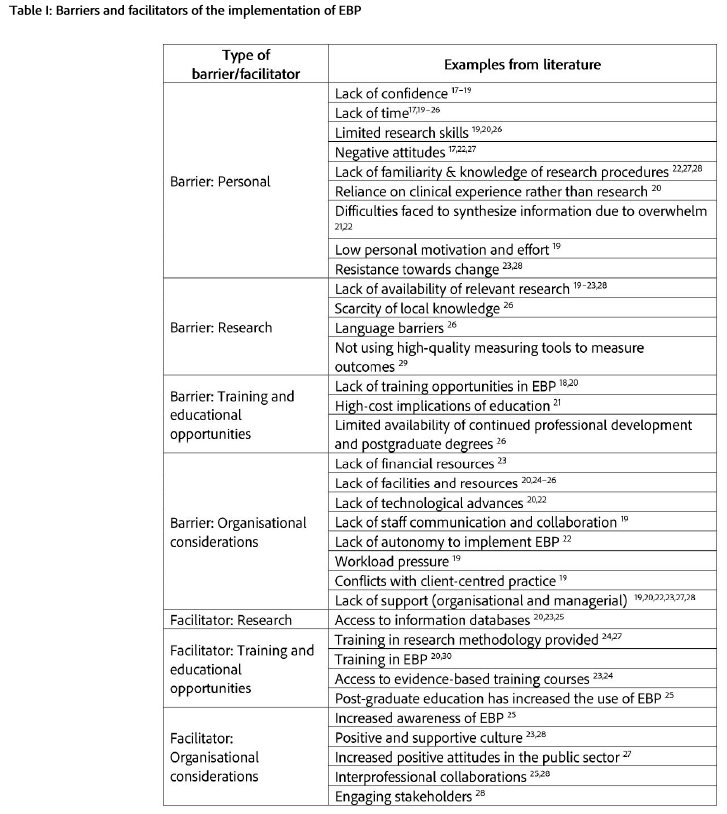
Although many health professionals reportedly have a positive attitude toward EBP, the use of EBP has been described as challenging by all, including occupational therapists318-31 in Table I (below). These barriers include the perceived lack of time3,7-9, the lack of resources9-12, insufficient training8,13, and the lack of support1414-16.


Although implementation of EBP is challenging, several facilitators that promote the use of EBP have been identified, and are summarised in Table I (page 2). These include training in the use of EBP and raising awareness of the importance of EBP8,11. Other facilitators that promote the use of EBP include active participation from students and training in research methods and usage11
The Sicily Statement recommends that all health professions and training institutions should implement strategies to train students in the health sciences to develop the attitudes, knowledge and skills necessary to implement EBP in their chosen profession22312
The healthcare sciences curriculum at the University of Pretoria aims to promote student development of knowledge, positive attitudes and skills in the implementation of EBP as recommended by the Sicily Statement2Table I (page 2), including limited exposure to training in EBP, limited research skills, and lack of EBP knowledge and implementation8,14'16
Despite comprehensive training related to EBP implemented throughout the curricula, there is limited information on the attitudes, knowledge, skills and practice of EBP as perceived by the final-year healthcare sciences students of the University of Pretoria themselves. Having access to this information could enable educators to review the undergraduate curriculum and their teaching and learning practices to improve student outcomes relatedtoEBP.
METHODOLOGY
Study design
This quantitative, non-experimental, cross-sectional study32
Survey instrument
The survey instrument had two sections. The first section included demographic questions as well as general questions regarding the students' exposure to EBP and how they accessed information. These questions were included to enable the researchers to describe the sample of students who participated in the study.
Thesecond part of the survey consisted of an existing instrument, the Student Evidence-Based Practice Questionnaire (S-EBPQ)33634333435363734353835,39 and dental37
After reviewing the S-EBPQ and considering the interdisciplinary nature of EBP within the healthcare sciences curriculum and the wide use of the S-EBPQ around the world, the researchers decided to use this self-report instrument to determine the EBP practices, attitudes, knowledge and skills of the healthcare sciences students at the University of Pretoria. To ensure that the questionnaire would be applicable and comprehensible to students from the different fields of study included in the study, it was sent to an expert panel consisting of lecturers from each of the included departments. These lecturers were involved in the RHC300 research module presented to third-year students and had an understanding of the curriculum of each of the disciplines. The panel was able to comment on the applicability of the questionnaire to the final-year students in their field of study and indicated that the instrument was suitable, with minor recommendations to adapt the language used in the survey to facilitate comprehension. No significant changes to the original questionnaire were made.
Sampling
The researchers made use of purposive sampling. The target population for this study was 233 final-year healthcare sciences students at the University of Pretoria in the year 2024. This included students in occupational therapy, physiotherapy, nursing science, human nutrition, speech and audiology, and radiography who all previously completed the RHC300 research module. These students were recruited via an announcement posted to their final-year research module on the university's learning management system. The researchers aimed for a response rate of 20% or more from the sampling population of 235 students40
Procedure
The researchers made use of an online survey to ensure full anonymity and to increase accessibility3636
Before sending out the questionnaire, the research group obtained ethical approval (621/2023) from the Health Science Ethics Committee at the University of Pretoria. The survey was piloted with five community service occupational therapists who completed their studies at the University of Pretoria in 2023. They provided feedback regarding the comprehensibility of the questionnaire and the usability of the online platform. Their suggestions were taken into consideration and changes were made with regard to grammar and the sequence of the questions.
The link to the final survey was shared via the final-year research modules on the learning management system of the University of Pretoria for the students to access. Although low response rates and self-selection bias were identified as potential limitations to the use of an online survey41
Data analysis
Descriptive statistics were performed to summarise the participants' practice, attitudes, knowledge and skills related to evidence-based practice (EBP). The frequency distribution, medians, and modes were calculated in order to provideaclearoverviewofthedata.
RESULTS
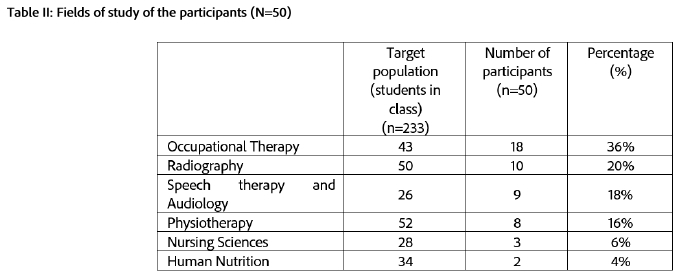
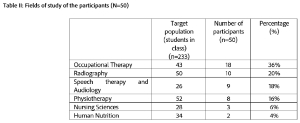
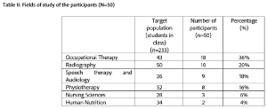
Fifty students completed the survey, with the final response rate of the study calculated as 21.25%. Table II (below) illustrates that the majority of participants were occupational therapy students (n=18, 36%), followed by radiography (n=10, 20%) and speech and audiology students (n=9,18%).
In terms of exposure to EBP, the majority of students, 96% (n=48), reported that their lecturers included EBP in their modules. It was found that 68% (n=34) of participants were aware of more than three of their modules that integrated EBP, while 32% (n=16) of participants were only aware of three or fewer modules utilising EBP.
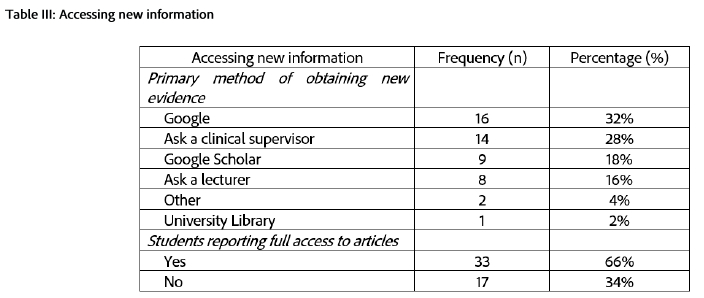
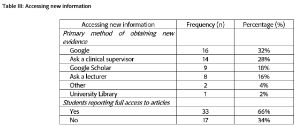
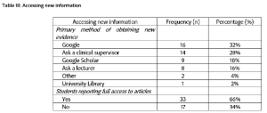
Table III (below) reflects how students accessed information. These findings show that although students do use digital search tools like Google (n=16; 32%) and seek advice from a clinical supervisor (n=14; 28%), a sizable group (n=8; 16%) also turn to lecturers for assistance. Using the university library was the least popular method to access information, as only one student reported using the library (n=1; 2%). The results also indicated that 66% (n=33) of the participants reported having full access to scholarly articles.
Subscales of the Student Evidence-Based Practice Questionnaire (S-EBPQ)
The four subscales of the S-EBPQ were utilised to organise the results obtained from the 21 items of the questionnaire that were included in the survey.
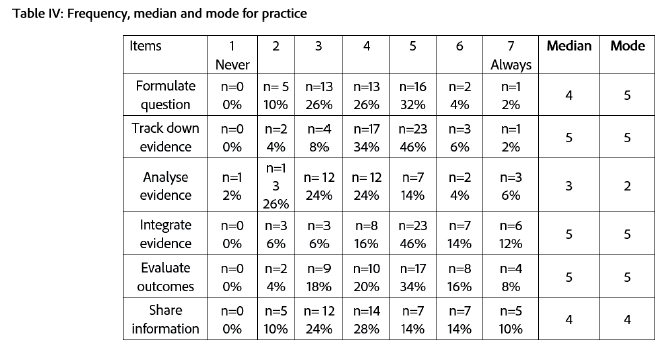
The first subscale Practice28 Table IV, page 5 The majority of participants perceived their ability to track down evidence (Mdn=5) and evaluate outcomes (Mdn=5) as higher than their ability to analyse evidence (Mdn=3). Notably, the mode for analysing evidence is 2 since 26% of participants selected that option. Analysing evidence is the only item on which a participant (n=1; 2%) indicated that they "never" analyse the data
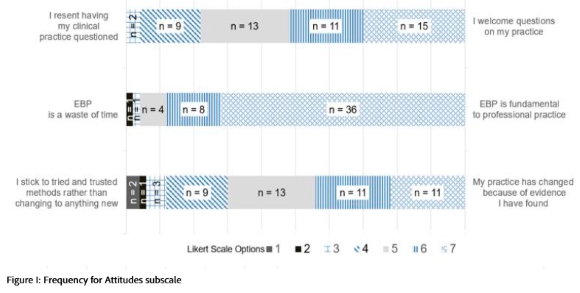
The second subscale Attitudes28Figure 1, below. In this question, participants had to indicate a position on a scale between two opposing statements, as reflected in Figure 1.
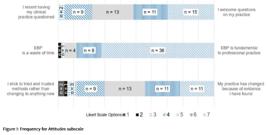
The majority (n=34, 78%) of participants have a positive attitude towards having their practice questioned. With a median of 6 and a mode of 7, it is evident that the participants perceived being questioned on their practice as positive. The majority of participants (n=44, 88%) view EBP as fundamental with the median and mode being 7. Only a small fraction (n=2,4%) of the participants view EBP as a waste of time. Most of the participants (n=35, 70%) reported being open to change based on new evidence while a smaller portion reported preferring to stick to traditional methods.
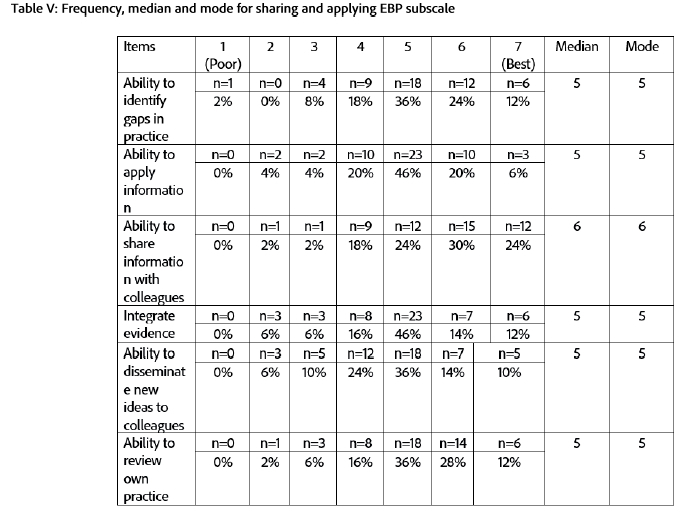
The third subscale sharing and applying EBP26Table V, page 6 Participants were asked to rate their skills from 1 (poor) to 7 (best).
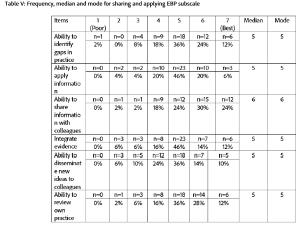
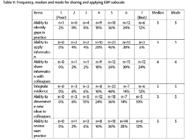
In Table V (above) it can be seen that the majority of the participants scored themselves 4 and above (n=45; 90%) for their ability to identify gaps in practice. The participants also scored themselves relatively highly for their ability to apply information (Mdn= 5), ability to share information with colleagues (Mdn= 6), ability to integrate information (Mdn= 6), and ability to disseminate new ideas to colleagues (Mdn= 5).
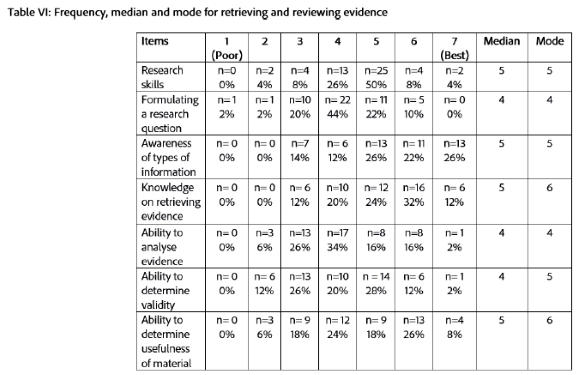
The last subscale retrieving and reviewing of evidence28Table VI, (below). Participants were asked to rate their skills from 1 (poor) to 7 (best).
The majority (n=31, 62%) of the participants perceived their research skills to be 5 or higher, with the median being 5. The majority of the participants indicated that they perceived their ability to retrieve evidence (Mdn=5) and determine the usefulness thereof (Mdn=5) to be greater than their ability to formulate a research question (Mdn=4)( analyse evidence (Mdn=4) and determine validity (Mdn =4).
DISCUSSION
The study determined the self-reported EBP practices, attitudes, knowledge and skills of final-year healthcare science students at the University of Pretoria. The results of this study are important since healthcare education should ideally equip students with the attitudes, knowledge and skills to implement EBP after graduation42434344
The study found that final-year students have a positive attitude toward EBP. This positive attitude is essential for the successful implementation of the EBP steps into daily practice453846
Additionally, it was found that participants rated themselves as more knowledgeable and skilled in certain steps of EBP such as evidence tracking, evaluating outcomes, and sharing information, while they view themselves as less knowledgeable in other steps such as formulating a research question, analysing evidence, and adapting to new evidence. The variability in knowledge and skill levels between different steps of EBP has also been reported in other studies. Researchers have identified, for example, difficulties in formulating a question47,48, as well as challenges in searching and retrieving information47,49. This may limit the implementation of EBP into practice, indicating that some steps of EBP may be used in practice less than others.
When formulating a research question, it is important to consider that an incorrect question can lead to challenges in the information retrieval process. If asking the wrong question, students may struggle to find the necessary information or end up gathering irrelevant data that they cannot use effectively. A well-formulated research question is essential for efficient and targeted information retrieval. Literature supports the notion that difficulties in formulating a research question may be a barrier to the implementation of EBP and that some steps of EBP should be emphasised when teaching healthcare professionals50
Difficulties in analysing retrieved evidence may also be seen as a barrier since participants indicated that they analyse the evidence that they gather before implementation less frequently than what they actually apply EBP. Challenges with analysing evidence have also been noted in other studies47,51. This can lead to inappropriate use of identified information5247,42,50.
The manner in which the students accessed information provides valuable insights. Interestingly, the majority of the participants preferred Google (a potentially less reliable and rigorous source) to locate evidence rather than using the university's library that enables access to the highest available levels of evidence3453
Even though it is not the participants' primary method to gather information, access to databases via the university library can be seen as a facilitator since it promotes the tracking and retrieval of evidence. This correlates to the literature stating that access to databases is a facilitator in the use of EBP353354,55.
Although participants rated their attitudes toward EBP higher than their knowledge, it was noted that most of the participants still rated knowledge regarding EBP positively. This finding contrasts with previous studies which stated that healthcare professionals reported having limited research skills and thus have challenges with implementing EBP, as they are unsure of the steps that need to be followed5,10,17. The article further contrasts with studies that identified knowledge15,16,30
Based on the results of the study, it was evident that the continuous exposure to EBP in multiple modules is a facilitator since it promoted the participants' knowledge of EBP and their understanding of the importance thereof. This correlates with the literature which stated that training in EBP is a facilitator in the implementation of EBP in trained professionals10,13. It was noted that EBP is widely used in the majority of the participants' modules. Multi-faceted education strategies4250
Recommendations
It is recommended that the students' education in terms of EBP is implemented across different theoretical modules as well as during clinical fieldwork to increase their exposure to EBP and provide ample opportunities to practice and implement EBP. All of the steps of EBP should be taught and emphasised to ensure that students have knowledge and skill in all areas of EBP. Particular attention should be given to teaching students to formulate a question and evaluate the information that they find. The students should receive training on how to effectively use the library early in their studies in order to improve the manner in which they locate information and build their confidence.
It is recommended to investigate how EBP is taught and implemented at other institutions to potentially identify strategies that foster the development of skills in EBP. The authors further recommend that specific teaching practices or programmes for EBP should be experimentally studied to determine which teaching strategies have the best results. Literature supports this recommendation, as limited rigorous studies have been conducted on this topic56
It is also recommended that this cohort of students complete the Evidence-based Practice Questionnaire again later to determine whether they retain their positive attitudes to EBP. Investigating the experiences of students during the implementation of EBP may also be helpful in highlighting the unique challenges that students in the South African context experience.
Limitations
This study does not provide data on the effect of a specific educational method or programme implemented. Since the measure was a self-report questionnaire, limitations such as personal biases should be considered. There is a possibility that the participants provided academically desired answers instead of providing answers according to their specific context and experience. Additionally, the instrument used was not validated with all the professions included in the study or in the wider South African context.
Since this questionnaire was sent out using an online platform, there was a low response rate predicted. Some of the departments had limited responses, meaning that not all the students' views have been reported on. The original questionnaire does not include an interpretation of the scores, limiting the research team's ability to analyse whether the participants' knowledge and skills on EBP are sufficient. The development of an assessment instrument with established norms for knowledge of EBP can be helpful in determining whether final -year students are prepared for practice.
CONCLUSION
This study indicates the importance of equipping undergraduate students with knowledge and skills regarding the implementation of EBP. Evidence-based practice is widely applied in the curricula of undergraduate healthcare science students, which is a positive indication of EBP development. Even though students may have positive attitudes towards EBP, there are still gaps in the implementation thereof in daily clinical practice. By addressing the gaps in the implementation through training, raising awareness of the university's available resources, and increasing exposure to EBP, the readiness of novice practitioners to enter their community service year may be improved. Students need to receive training that is specific to the steps of EBP that they find difficult and complex. The implementation of EBP can be enhanced by overcoming barriers and ensuring ongoing support to cultivate effective healthcare education for undergraduate student.
Conflicts of Interest
The authors have no conflicts of interest to declare.
Author Contributions
Karin van Niekerk: Supervision of study, conceptualisation, methodology, data analysis, editing of manuscript Suzanne Harmse: Supervision of study, conceptualisation, methodology, editing of manuscript.
Anice Gous, Liné van der Westhuizen, Anita Hellberg, Karla de Wet, Mogale Manthata: Literature review, data collection, data analysis, writing of first draft of manuscript and editing manuscript. All authors approved the final version of the manuscript.
REFERENCES
- 1. Sackett DL et al. Evidence based medicine: what it is and what it isn't. BMJ (Clinical research ed.). 1996;312(7023):71-2.
-
2. Dawes M et al. Sicily statement on evidence-based practice. BMC Medical Education. 2005;5. https://doi.org/10.1186/1472-6920-5-1
» https://doi.org/10.1186/1472-6920-5-1 -
3. Upton D, Stephens D, Williams B, Scurlock-Evans L. Occupational therapists' attitudes, knowledge, and implementation of evidence based practice: A systematic review of published research. British Journal of Occupational Therapy. 2014,-77(1):24-38. https://doi.org/10.4276/030802214X13887685335544
» https://doi.org/10.4276/030802214X13887685335544 -
4. Spring B. Evidence-based practice in clinical psychology: What it is, why it matters; what you need to know. Journal of Clinical Psychology. 2007;63(7):611-631. https://doi.org/10.1002/jclp.20373
» https://doi.org/10.1002/jclp.20373 -
5. Weng YH et al. Implementation of evidence-based practice across medical, nursing, pharmacological and allied healthcare professionals: A questionnaire survey in nationwide hospital settings. Implementation Science. 2013;8(1). https://doi.org/10.1186/1748-5908-8-112
» https://doi.org/10.1186/1748-5908-8-112 -
6. Buchanan H, Siegfried N, Jelsma J. Survey Instruments for Knowledge, Skills, Attitudes and Behaviour Related to Evidence-based Practice in Occupational Therapy: A Systematic Review. 2016. https://doi.org/10.1002/oti.1398
» https://doi.org/10.1002/oti.1398 -
7. Upton D, Upton P. Development of an evidence-based practice questionnaire for nurses. Journal of Advanced Nursing. 2006;53(4):454-458. https://doi.org/10.1111/j.1365-2648.2006.03739.x
» https://doi.org/10.1111/j.1365-2648.2006.03739.x -
8. Thomas A, Law M. Research utilization and evidence-based practice in occupational therapy: A scoping study. American Journal of Occupational Therapy. 2013;67(4). https://doi.org/10.5014/ajot.2013.006395
» https://doi.org/10.5014/ajot.2013.006395 -
9. Graham F, Robertson L, Anderson J. New Zealand occupational therapists' views on evidence-based practice: A replicated survey of attitudes, confidence and behaviours. Australian Occupational Therapy Journal. 2013;60(2):120-128. https://doi.org/10.1111/1440-1630.12000
» https://doi.org/10.1111/1440-1630.12000 -
10. Lindström AC, Bernhardsson S. Evidence-based practice in primary care occupational therapy: A cross-sectional survey in Sweden. Occupational Therapy International. 2018;2018. https://doi.org/10.1155/2018/5376764
» https://doi.org/10.1155/2018/5376764 -
11. Graham F, Rodger S, Ziviani J. Enabling occupational performance of children through coaching parents: Three case reports. Physical and Occupational Therapy in Pediatrics. 2010;30(1):4-15. https://doi.org/10.3109/01942630903337536
» https://doi.org/10.3109/01942630903337536 -
12. Lin SH, Murphy SL, Robinson JC. The issue ís··· facilitating evidence-based practice: Process, strategies, and resources. American Journal of Occupational Therapy. 2010;64(1):164-171. https://doi.Org/10.5014/ajot.64.1.164
» https://doi.Org/10.5014/ajot.64.1.164 -
13. Ubbink DT, Guyatt GH, Vermeulen H. Framework of policy recommendations for implementation of evidence-based practice: a systematic scoping review, http://bmjopen.bmj.com. https://doi.org/10.1136/bmjopen-2012
» http://bmjopen.bmj.com -
14. Thomas A et al. Individual and organizational factors associated with evidence-based practice among physical and occupational therapy recent graduates: A cross-sectional national study. Journal of Evaluation in Clinical Practice. 2021;27(5):1044-1055. https://doi.org/10.1111/jep.13518
» https://doi.org/10.1111/jep.13518 -
15. Jordan P, Bowers C, Morton D. Barriers to implementing evidence-based practice in a private intensive care unit in the Eastern Cape. Southern African Journal of Critical Care. 2016;32(2):50-54. https://doi.org/10.7196/SAJCC2016.v32i2.253
» https://doi.org/10.7196/SAJCC2016.v32i2.253 -
16. McNett M et al. A Qualitative Force Field Analysis of Facilitators and Barriers to Evidence-Based Practice in Healthcare Using an Implementation Framework. Global Implementation Research and Applications. 2022;2(3):195-208. https://doi.org/10.1007/s43477-022-00051-6
» https://doi.org/10.1007/s43477-022-00051-6 -
17. Garcia J et al. Evidence-based practice and clinical reasoning in occupational therapy: A cross-sectional survey in Chile. Australian Occupational Therapy Journal. 2021;68(2):169-179. https://doi.org/10.1111/1440-1630.12713
» https://doi.org/10.1111/1440-1630.12713 -
18. Thomas A, Law M. Research utilization and evidence-based practice Occupational Therapy. 2013;67(4). https://doi.org/10.5014/ajot.2013.006395
» https://doi.org/10.5014/ajot.2013.006395 -
19. Thomas A et al. Individual and organizational factors associated with evidence-based practice among physical and occupational therapy recent graduates: A cross-sectional national study. Journal of Evaluation in Clinical Practice. 2021;27(5):1044-1055. https://doi.org/10.1111/jep.13518
» https://doi.org/10.1111/jep.13518 -
20. Upton D, Stephens D, Williams B, Scurlock-Evans L. Occupational therapists' attitudes, knowledge, and implementation of evidence-based practice: A systematic review of published research. British Journal of Occupational Therapy. 2014,-77(1):24-38. https://doi.org/10.4276/030802214X13887685335544
» https://doi.org/10.4276/030802214X13887685335544 -
21. Graham F, Robertson L, Anderson J. New Zealand occupational therapists' views on evidence-based practice: A replicated survey of attitudes, confidence and behaviours. Australian Occupational Therapy Journal. 2013;60(2):120-128. https://doi.org/10.1111/1440-1630.12000
» https://doi.org/10.1111/1440-1630.12000 -
22. Lindström AC, Bernhardsson S. Evidence-based practice in primary care occupational therapy: A cross-sectional survey in Sweden. Occupational Therapy International. 2018;2018. https://doi.org/10.1155/2018/5376764
» https://doi.org/10.1155/2018/5376764 -
23. Jordan P, Bowers C, Morton D. Barriers to implementing evidence-based practice in a private intensive care unit in the Eastern Cape. Southern African Journal of Critical Care. 2016;32(2):50-54. https://doi.org/10.7196/SAJCC.2016.v32i2.253
» https://doi.org/10.7196/SAJCC.2016.v32i2.253 -
24. Kalavani K, Mohebbifar R, Rafiei S. Evidence based practice among healthcare providers: a cross-sectional study. International Journal of Health Care Quality Assurance. 2019;32(5):867-878. https://doi.org/10.1108/IJHCOA-08-2017-0162
» https://doi.org/10.1108/IJHCOA-08-2017-0162 -
25. Ayoubian A, Nasiripour AA, Tabibi SJ, Bahadori M. Evaluation of Facilitators and Barriers to Implementing Evidence-Based Practice in the Health Services: A Systematic Review. Galen Medical Journal. 2020;9:1645. https://doi.org/10.31661/gmj.v9i0.1645
» https://doi.org/10.31661/gmj.v9i0.1645 -
26. Lin SH, Murphy SL, Robinson JC. The issue ís··· facilitating evidence-based practice: Process, strategies, and resources. American Journal of Occupational Therapy. 2010;64(1):164-171. https://doi.org/10.5014/ajot.64.1.164
» https://doi.org/10.5014/ajot.64.1.164 -
27. Garcia J et al. Evidence-based practice and clinical reasoning in occupational therapy: A cross-sectional survey in Chile. Australian Occupational Therapy Journal. 2021;68(2):169-179. https://doi.org/10.1111/1440-1630.12713
» https://doi.org/10.1111/1440-1630.12713 -
28. Padmanabhanunni A, Sui XC. Mental healthcare providers' attitudes towards the adoption of evidence-based practice in the treatment of post-traumatic stress disorder in South Africa. South African Journal of Psychology. 2017;47(2):198-208. https://doi.org/10.1177/0081246316673244
» https://doi.org/10.1177/0081246316673244 -
29. McNett M et al. A Qualitative Force Field Analysis of Facilitators and Barriers to Evidence-Based Practice in Healthcare Using an Implementation Framework. Global Implementation Research and Applications. 2022;2(3):195-208. https://doi.org/10.1007/s43477-022-00051-6
» https://doi.org/10.1007/s43477-022-00051-6 -
30. Albarqouni L et al. Core Competencies in Evidence-Based Practice for Health Professionals: Consensus Statement Based on a Systematic Review and Delphi Survey. JAMA network open. 2018;1(2):e180281. https://doi.org/10.1016/j.apmr.2021.03.0
» https://doi.org/10.1016/j.apmr.2021.03.0 -
31. Moore JL, Graham ID. Accelerating the Implementation of Evidence-Based Practice in Physical Medicine and Rehabilitation. Archives of Physical Medicine and Rehabilitation. 2022;103(7):S252-S255. http://www.who.int/hrh/nursing_midwifery/en
» http://www.who.int/hrh/nursing_midwifery/en -
32. World Health Organization. Framework for Action on Interprofessional Education & Collaborative Practice. 2010. http://www.who.int/hrh/nursing_midwifery/en
» http://www.who.int/hrh/nursing_midwifery/en - 33. Brink H, Van der Walt C, Van Rensburg GH. Fundamentals of research methodology for health care professionals. 4th Ed. Juta and Company; 2018.
-
34. Upton P, Scurlock-Evans L, Upton D. Development of the Student Evidence-based Practice Questionnaire (S-EBPQ). Nurse Education Today. 2016;37:38-44. https://doi.org/10.1016/j.nedt.2015.11.010
» https://doi.org/10.1016/j.nedt.2015.11.010 -
35. ParkJE, HwangJI. Psychometric Evaluation of the Korean Version of the Student Evidence-Based Practice Questionnaire (S-EBPQ). Asian Nursing Research. 2021;15(1):47-52. https://doi.org/10.1016/j.anr.2020.10.0
» https://doi.org/10.1016/j.anr.2020.10.0 -
36. Beccaria L, Beccaria G, McCosker C. A Confirmatory Factor Analysis of the Student Evidence-Based Practice Questionnaire (S-EBPQ) in an Australian sample. Nurse Education Today. 2018;62(October 2017):69-73. https://doi.org/10.1016/j.nedt.2017.12.010. https://doi.org/10.1016/j.nedt.2017.12.010
» https://doi.org/10.1016/j.nedt.2017.12.010 -
37. Nantsupawat A et al. Factors influencing evidence-based practice among undergraduate nursing students: A cross-sectional analysis. International Journal of Nursing Sciences. 2023,10(3):367-372. https://doi.org/10.1016/j.ijnss.2023.06.002
» https://doi.org/10.1016/j.ijnss.2023.06.002 -
38. Baqir AH, Firman DR, Putri FM. Survey of Dental Students' Self-Perceived Practice, Attitudes, and Knowledge Toward Evidence-Based Dentistry in Indonesia. Jurnal Pendidikan Kedokteran Indonesia: The Indonesian Journal of Medical Education. 12(1):41 -48. https://doi.org/https://doi.org/10.22146/jpki.68089
» https://doi.org/https://doi.org/10.22146/jpki.68089 -
39. Madhavanprabhakaran G, Arulappan J, Achora S, Alsaraireh A. Evidence-based practice competency and barriers among undergraduate nursing students in a Middle Eastern country. Teaching and Learning in Nursing. 2023;000:1-8. https://doi.org/10.1016/j.teln.2023.07.009.
» https://doi.org/10.1016/j.teln.2023.07.009 -
40. Rojjanasrirat W, Rice J. Evidence-based practice knowledge, attitudes, and practice of online graduate nursing students. Nurse Education Today. 2017;53:48-53. https://doi.org/10.1016/j.nedt.2017.04.005
» https://doi.org/10.1016/j.nedt.2017.04.005 -
41. Van Mol C. Improving web survey efficiency: the impact of an extra reminder and reminder content on web survey response. International Journal of Social Research Methodology. 2017;20(4):317-327. https://doi.org/10.1080/13645579.2016.1185255
» https://doi.org/10.1080/13645579.2016.1185255 -
42. Siva M, Nayak DP, Siva M, Narayan KA. Strengths and Weakness of Online Surveys. IOSR Journal of Humanities and Social Sciences. 24(5). https://doi.org/10.9790/0837-2405053138
» https://doi.org/10.9790/0837-2405053138 -
43. Larsen CM, Terkelsen AS, Carlsen AMF, Kristensen HK. Methods for teaching evidence-based practice: A scoping review. BMC Medical Education. 2019;19(1). https://doi.org/10.1186/s12909-019-1681-0
» https://doi.org/10.1186/s12909-019-1681-0 -
44. Ladyshewsky RK John Colbert Building Competency in the Novice Allied Health Professional through Peer Coaching. Source: Journal of Allied Health. 2010;39(2):77-82. https://www.jstor.org/stable/10.2307/48721620.https://doi.org/10.2307/48721620
» https://www.jstor.org/stable/10.2307/48721620.https://doi.org/10.2307/48721620 -
45. van Stormbroek K, Buchanan H. Community Service Occupational Therapists: thriving or just surviving? South African Journal of Occupational Therapy. 2016,-46(3):63-72. https://doi.org/10.17159/23103833/2016/v46n3a11
» https://doi.org/10.17159/23103833/2016/v46n3a11 -
46. Padmanabhanunni A, Sui XC. Mental healthcare providers' attitudes towards the adoption of evidence-based practice in the treatment of post-traumatic stress disorder in South Africa. South African Journal of Psychology. 2017;47(2):198-208. https://doi.org/10.1177/0081246316673244
» https://doi.org/10.1177/0081246316673244 -
47. Baqir AH, Firman DR, Putri FM. Original research survey of dental students' self-perceived practice, attitude, and knowledge toward evidence-based dentistry in Indonesia. The Indonesian Journal of Medical Education. 2023,-12(1):41-48. https://doi.org/10.22146/jpki.68089
» https://doi.org/10.22146/jpki.68089 -
48. Thorsteinsson HS. Icelandic nurses' beliefs, skills, and resources associated with evidence-based practice and related factors: A national survey. Worldviews on Evidence-Based Nursing. 2013;10(2):116-126. https://doi.org/10.1111/j.1741-6787.2012.00260.x
» https://doi.org/10.1111/j.1741-6787.2012.00260.x -
49. Boström AM, Ehrenberg A, Gustavsson JP, Wallin L. Registered nurses' application of evidence-based practice: A national survey. Journal of Evaluation in Clinical Practice. 2009,15(6):1159-1163. https://doi.org/10.1111/j.1365-2753.2009.01316.x
» https://doi.org/10.1111/j.1365-2753.2009.01316.x -
50. Thorsteinsson HS, Sveinsdóttir H. Readiness for and predictors of evidence-based practice of acute-care nurses: A cross-sectional postal survey. Scandinavian Journal of Caring Sciences. 2014,-28(3):572-581. https://doi.org/10.1111/scs.12083
» https://doi.org/10.1111/scs.12083 -
51. Albarqouni L, Hoffmann T, Glasziou P. Evidence-based practice educational intervention studies: A systematic review of what is taught and how it is measured. BMC Medical Education. 2018,18(1). https://doi.org/10.1186/s12909-018-1284-1
» https://doi.org/10.1186/s12909-018-1284-1 -
52. Ross J. Information Literacy for Evidence-Based Practice in Perianesthesia Nurses: Readiness for Evidence-Based Practice. Journal of PeriAnesthesia Nursing. 2010;25(2):64-70. https://www.sciencedirect.com/science/article/pii/S1089947210000419. https://doi.org/https://doi.org/10.1016/j.jopan.2010.01.007
» https://www.sciencedirect.com/science/article/pii/S1089947210000419 -
53. Landsverk NG, Olsen NR, Brovold T. Instruments measuring evidence-based practice behavior, attitudes, and self-efficacy among healthcare professionals: a systematic review of measurement properties. Implementation Science. 2023,18(1). https://doi.org/10.1186/s13012-023-01301-3
» https://doi.org/10.1186/s13012-023-01301-3 -
54. Maggio LA et al. Impact of electronic knowledge resources on clinical and learning outcomes: Systematic review and metaanalysis. Journal of Medical Internet Research. 2019;21(7). https://doi.org/10.2196/13315
» https://doi.org/10.2196/13315 -
55. Boruff JT, Thomas A. Integrating evidence-based practice and information literacy skills in teaching physical and occupational therapy students. Health Information and Libraries Journal. 2011;28(4):264-272. https://doi.org/10.1111/j.1471-1842.2011.00953.x
» https://doi.org/10.1111/j.1471-1842.2011.00953.x -
56. Vogel KA. Librarians and Occupational Therapy Faculty. Source: Journal of Allied Health. 2012,-41(1):15-20. https://doi.org/10.2307/48721719
» https://doi.org/10.2307/48721719
Reviewed: 6 March 2025
Revised: 16 April 2025
Accepted: 1 May 2025
DATA AVAILABILITY
Upon reasonable request, from corresponding author
EDITOR
Blanche Pretorius
https://orcid.org/0000-0002-3543-0743
FUNDING
No funding was received for this study