Decolonising occupational therapy education in South Africa: a commentary on moving from conceptual ambiguity to relational praxis
Abstract
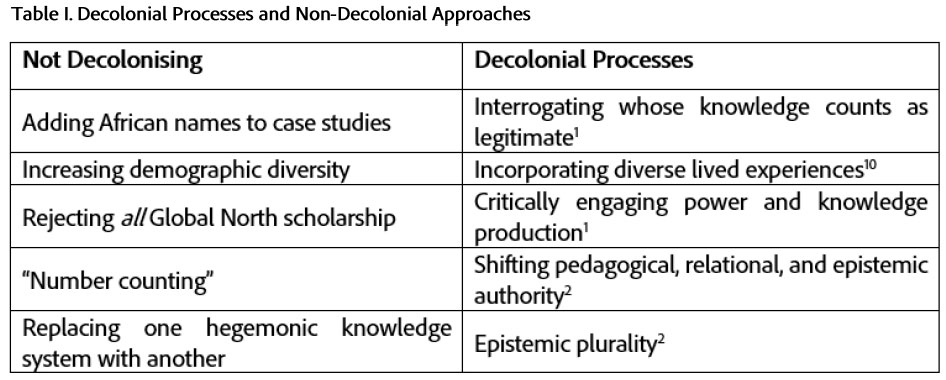
This commentary responds to growing but uneven engagement with decolonising occupational therapy education in South Africa. Drawing on personal reflections following national conversations with occupational therapy educators and from international professional discourse a striking tension exists: the profession speaks confidently about occupational justice and contextual responsiveness yet there remains a limited articulation of what decolonising occupational therapy education entails. This commentary seeks to clarify what decolonising education is and argues that decolonising is not additive reform, symbolic inclusion, or wholesale rejection of Global North scholarship. Rather, it is an ongoing epistemic, pedagogical and relational project. The commentary proposes three interrelated principles to guide national dialogue: engaging in criticality and historicity through reflexive examination of power and positionality; valuing epistemic plurality through integration of diverse knowledge systems; and embedding relational praxis that reconfigures how knowledge is co-created in education and practice. Each principle is supported by examples of smaller, everyday pedagogical practices. Decolonising occupational therapy education is framed as an ethical and professional imperative to ensure contextual relevance and epistemic justice. The article invites sustained collective engagement rather than a singular blueprint for transformation.
decolonising education; occupational therapy education; epistemic justice; plurality; relational praxis