Decolonising occupational therapy education in South Africa: a commentary on moving from conceptual ambiguity to relational praxis
Abstract
This commentary responds to growing but uneven engagement with decolonising occupational therapy education in South Africa. Drawing on personal reflections following national conversations with occupational therapy educators and from international professional discourse a striking tension exists: the profession speaks confidently about occupational justice and contextual responsiveness yet there remains a limited articulation of what decolonising occupational therapy education entails. This commentary seeks to clarify what decolonising education is and argues that decolonising is not additive reform, symbolic inclusion, or wholesale rejection of Global North scholarship. Rather, it is an ongoing epistemic, pedagogical and relational project. The commentary proposes three interrelated principles to guide national dialogue: engaging in criticality and historicity through reflexive examination of power and positionality; valuing epistemic plurality through integration of diverse knowledge systems; and embedding relational praxis that reconfigures how knowledge is co-created in education and practice. Each principle is supported by examples of smaller, everyday pedagogical practices. Decolonising occupational therapy education is framed as an ethical and professional imperative to ensure contextual relevance and epistemic justice. The article invites sustained collective engagement rather than a singular blueprint for transformation.
decolonising education; occupational therapy education; epistemic justice; plurality; relational praxis
INTRODUCTION: A PROFESSION CONFRONTING ITSELF
Over the past year, I have had the privilege of visiting each South African university offering occupational therapy programmes as part of my doctoral research. In both formal and informal conversations with educators across institutions, the term "decolonising" surfaced frequently - sometimes with enthusiasm, sometimes with uncertainty, and at times with visible frustration. For some, decolonisation has become embedded in everyday curriculum conversations. For others, it feels like a politicised buzzword - invoked to signal relevance but lacking practical clarity. This led me to reflect on where we stand as a community, tasked with educating and preparing future professionals for serving our country, on what it means and how we go about decolonising. This commentary intends to offer some of these reflections in a way that may facilitate further conversation.
Recently, I attended the World Federation of Occupational Therapy Congress (WFOT) in Bangkok and I encountered passionate calls for occupational and social justice. There were several presentations, many from global south contexts, that showcased locally adapted curricula, assessment methods, role-emerging placements, and the integration of Indigenous knowledges. Many of these innovations offer examples of how we might engage in decolonising curriculum, but oftentimes this was implicit and broader principles remained unarticulated. In addition, during the education day, speakers warned against "decorative decolonisation" of curricula and challenged educators to confront what genuine structural transformation would require.
My encounters with local institutions and international educators forced me to reflect that although occupational therapy in South Africa speaks fluently about justice and contextual responsiveness, we have not yet collectively articulated what it means to decolonise occupational therapy education. Moreover, scholarship on decolonising higher education in South Africa is extensive1-3 yet literature explicitly addressing decolonising occupational therapy education remains scant4
Considering the variety of stances encountered amongst South African educators, this commentary seeks to initiate a national conversation about what decolonising occupational therapy education in South Africa may involve. The objective is to propose what decolonising occupational therapy education is - and isn't - and provide three interrelated principles that can guide us towards action, namely 1) engaging in criticality and reflexivity, 2) valuing plurality, and 3) embedding relational praxis.
CLARIFYING THE TERRAIN: COLONIALITY AND THE UNIVERSITY
Decolonisation carries multiple meanings across contexts. Broadly understood, it refers both to resisting Eurocentric historical narratives and to a moral and political imperative to redress the enduring effects of colonial domination15, 6.
In higher education, we see coloniality manifesting through the privileging of Western epistemologies as universal, while other knowledge systems are marginalised or rendered supplementary or unworthy78
Decolonising higher education is a political, social and epistemic project that critically examines dominant structures of knowledge and their relationship to power1praxis - ongoing transformation of pedagogical, institutional and relational practices9
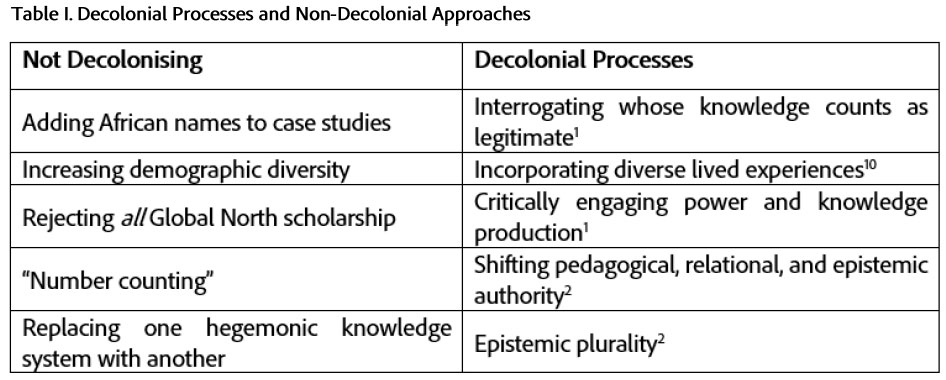
WHAT DECOLONISING OCCUPATIONAL THERAPY EDUCATION IS NOTAcross national conversations, interpretations of what it means to decolonise occupational therapy education varied widely. For some educators, incorporating African names in case studies signified decolonisation. Others cited increased demographic diversity in student cohorts. Still others proposed the elimination of Global North scholarship altogether.
While these responses reflect differing levels of engagement, they risk falling into what has been described as "soft reform" - supplementing existing curricula without challenging the epistemic architecture that determines what counts as legitimate knowledge1, 8. The table below offers suggestions of what educators may think of as decolonising, based on my reflections following national conversations, but on their own might be considered soft reform. It is important to note that the processes named under 'not decolonising' do still have a place in the process. For example, increasing demographic diversity in student populations is an essential step towards transforming the profession and the academy. Rather, it is that these processes alone are insufficient and must be met with deeper, systemic disruption.
Most importantly, decolonising occupational therapy education should not be understood as a singular event or completed outcome but as an ongoing relational and epistemic practice requiring sustained reflexivity, dialogue and institutional commitment7
WHY THIS MATTERS FOR OCCUPATIONAL THERAPYOccupational therapy claims contextual responsiveness, relationality and commitment to social justice1112, 13. If we fail to interrogate the colonial entanglements of our knowledge base, we risk engaging in what van Stormbroek and van der Merwe14
In South Africa, occupations are profoundly shaped by apartheid's spatial legacies, structural inequality, poverty, culture, and racialised access to resources1514ideological - it is essential to ensure professional relevance and validity.
De Jongh, Hess-April & Wegner1611
THREE INTERRELATED PRINCIPLES FOR DECOLONISING OCCUPATIONAL THERAPY EDUCATIONDecolonising occupational therapy education is not a universal process that will look standardised across all institutions. Therefore, rather than offering a prescriptive framework, I propose three interrelated principles that may offer starting points towards action: 1) criticality and reflexivity, 2) valuing plurality, and 3) embedding relational praxis. Within each commitment I have offered examples of smaller, everyday pedagogical practices that can reshape participation, recognition and relationality7
1. Engaging in Criticality and Reflexivity
Decolonising occupational therapy education requires engaging critically with history.17141814
In practice, engaging in criticality and reflexivity can involve examining how institutional structures and educational cultures continue to shape whose knowledge and experiences are represented within the profession17
At the level of curriculum, engaging historicity may involve critically examining the dominance of Global North frameworks while intentionally incorporating South African and Global South theories and models into teaching and practice learning. Models such as the Vona du Toit Model of Creative Ability192021, 22 may provide opportunities for students to engage with theories emerging from, or responsive to, our context. Students should be supported to critically engage with curricular content and constantly interrogate how knowledge emerges from particular historical, cultural and political conditions7
2. Valuing Plurality: Toward Ecologies of Knowledges
Plurality lies at the heart of decolonial thought. Santos'107
Valuing plurality also requires reconsidering how knowledge is engaged pedagogically within the classroom. Rather than positioning a single theoretical framework or mode of participation as universally appropriate, educators may seek to teach with greater breadth by introducing students to multiple conceptual models and approaches. This also extends to the diverse ways in which humans engage in occupations, which students should be exposed to so they can build understanding and recognition of the multiple ways of doing across our diverse country.
Plurality is not only about what is presented to students in curriculum but also about how students themselves engage with and generate knowledge. This involves recognising that there are multiple ways of communicating and demonstrating knowledge72323
Translanguaging offers a wonderful opportunity to bring plurality into teaching and learning spaces. Translanguaging involves creating opportunities for students to engage concepts across multiple languages to support deeper dialogue, broader participation and recognition of diverse ways of knowing77
3. Embedding Relational Praxis
To truly decolonise the curriculum, it is not enough to only recognise and verbalise power structures; we must move towards praxis - action grounded in critical reflection. This praxis is not only structural but relational124
Our engagement and relationships with the communities in which we learn and practice are a vital first starting point. We must move beyond viewing communities primarily as sites for student learning and instead towards reciprocal and sustained partnerships2511
Of particular importance to the South African context, is dismantling the mentality of independence that is promoted in occupational therapy2626
Lastly, relational praxis should also be embodied within the classroom, through reimagining educational relationships in ways that position students, educators and communities as co-constructors of knowledge rather than reproducing hierarchical expert-recipient models7
MOVING FORWARD: FROM SOFT REFORM TO SUSTAINED DIALOGUE
Across institutions, polarisation around decolonising occupational therapy education is evident. Some educators feel incapacitated by institutional constraints; others fear ideological imposition. Such tensions are not signs of failure but reflections of the depth of the work required. Yet rather than shying away from this discomfort we must embrace it. Universities cannot wait for society to decolonise; we must serve as sites of critical engagement and transformation.
The profession of occupational therapy in South Africa stands at a moment of possibility. We speak convincingly about occupational justice and contextual responsiveness. The challenge before us is to ensure that our educational foundations reflect those commitments. The profession cannot claim to centre occupational justice in practice while neglecting epistemic justice in education. If we are to prepare graduates capable of practising ethically and responsively in our deeply unequal society, we must move beyond ambiguity toward collective engagement. The invitation is not to agree on a single model or approach, but to commit to sustained dialogue, critical interrogation and shared responsibility.
In closing, it is essential to recognise my positionality as a white female who comes from a privileged and educated background. I was supported in my pursuit of my degrees and to follow the academic path of my choosing. I believe that with my position of privilege I must be part of the advocation for change, which led me to write this commentary. While my positionality may afford me access to particular institutional and academic spaces, it should not afford authority over the experiences and knowledges of others; rather, it calls for ongoing humility, critical reflexivity and commitment to collective dialogue, scholarship and relational engagement across the profession.
REFERENCES
-
1. Zembylas M. Decolonial possibilities in South African higher education: Reconfiguring humanising pedagogies as/with decolonising pedagogies. South African Journal of Education. 2018;38(4):1-11. https://doi.org/10.15700/saje.v38n4a1699
» https://doi.org/10.15700/saje.v38n4a1699 - 2. Fataar A. Decolonising education in South Africa: Perspectives and debates. Educational Research for Social Change. 2018;7(SPE):vi-vx
-
3. Chikoko V. Re-visiting the decolonising of South African higher education question: A systematic literature review. South African Journal of Higher Education. 2021;35(1):21-36. https://doi.org/10.20853/35-1-4420
» https://doi.org/10.20853/35-1-4420 -
4. Simaan J. Decolonising occupational science education through learning activities based on a study from the Global South. Journal of Occupational Science. 2020;27(3):432-42. https://doi.org/10.1080/14427591.2020.1780937
» https://doi.org/10.1080/14427591.2020.1780937 -
5. Grosfoguel R. The epistemic decolonial turn: Beyond political-economy paradigms Cultural Studies. 2007;21:211-23. https://doi.org/10.1080/09502380601162514
» https://doi.org/10.1080/09502380601162514 -
6. Maldonado-Torres N. On the coloniality of being. Cultural Studies. 2007;21:240-70. https://doi.org/10.1080/09502380601162548
» https://doi.org/10.1080/09502380601162548 -
7. Sibanda B. Acts of decolonial love in academic literacy: Practitioners' perspectives and transformative practices. African Perspectives of Research in Teaching and Learning. 2025;9(6):682-95. https://doi.org/10.70875/v9i6article3
» https://doi.org/10.70875/v9i6article3 -
8. Heleta S. Decolonisation of higher education: Dismantling epistemic violence and Eurocentrism in South Africa. Transformation in higher education. 2016;1(1):1-8. https://doi.org/10.4102/the.v1i1.9
» https://doi.org/10.4102/the.v1i1.9 - 9. Stein S, Andreotti V. Decolonization and higher education. In: Encyclopedia of educational philosophy and theory. Singapore: Springer 2017
-
10. Santos B. Ecologies of Knowledges. In: Epistemologies of the South: Justice against epistemicide: Routledge; 2014. https://doi.org/10.4324/9781315634876-17
» https://doi.org/10.4324/9781315634876-17 -
11. Richards L-A, Galvaan R. Developing a socially transformative focus in Occupational Therapy: insights from South African practice. South African Journal of Occupational Therapy. 2018;48(1). https://doi.org/10.17159/2310-3833/2017/vol48n1a2
» https://doi.org/10.17159/2310-3833/2017/vol48n1a2 - 12. Hammell K. Building globally relevant occupational therapy from the strength of our diversity2019: World Federation of Occupational Therapists Bulletin;
-
13. WFOT. Occupational Therapy and Human Rights 2019 [Available from: https://wfot.org/resources/occupational-therapy-and-human-rights.
» https://wfot.org/resources/occupational-therapy-and-human-rights -
14. van Stormbroek K, van der Merwe T. Becoming contextually responsive: taking hold of a shared vision for our profession. South African Journal of Occupational Therapy. 2021;51(4):54-61. https://doi.org/10.17159/2310-3833/2021/vol51no4a8
» https://doi.org/10.17159/2310-3833/2021/vol51no4a8 -
15. Galvaan R. The Contextually Situated Nature of Occupational Choice: Marginalised Young Adolescents' Experiences in South Africa. Journal of Occupational Science. 2014;22(1):39-53. https://doi.org/10.1080/14427591.2014.912124
» https://doi.org/10.1080/14427591.2014.912124 - 16. De Jongh JC, Hess-April L, Wegner L. Curriculum transformation: A proposed route to reflect a political consciousness in occupational therapy education. South African Journal of Occupational Therapy. 2012;42(1):16-20
-
17. Heleta S, Chasi S. Curriculum decolonization and internationalization: A critical perspective from South Africa. Journal of International Students,. 2023;14(2):75-90. https://doi.org/10.32674/jis.v14i2.6383
» https://doi.org/10.32674/jis.v14i2.6383 - 18. Joubert R. Exploring the history of Occupational Therapy's development in South Africa to reveal the flaws in our knowledge base. South African Journal of Occupational Therapy. 2010;40(3):21-6
- 19. Van Der Reyden D, Casteleijn D, Sherwood W, De Witt P. The Vona du Toit Model of Creative Ability: Origins, constructs, principles and application in occupational therapy. : Vona and Marie du Toit Foundation; 2019.
- 20. Galvaan R, Peters L, Richards L, Francke M. The Occupation-based community development framework. In: Routledge Companion to Occupational Therapy: Routledge; 2025. p. 290-302
-
21. Iwama MK, Thomson NA, Macdonald RM. The Kawa model: the power of culturally responsive occupational therapy. Disabil Rehabil. 2009;31(14):1125-35. https://doi.org/10.1080/09638280902773711
» https://doi.org/10.1080/09638280902773711 -
22. Phalatse N, Naidoo A, Goncalves M, Jenkinson K, Sithole J, Zwane I. Occupational therapy students' experiences of using the Kawa model as a self-reflection tool during mental health work-integrated learning. South African Journal of Occupational Therapy. 2026;56(1):1-7. https://doi.org/10.17159/2310-3833/2026/vol56no1a9
» https://doi.org/10.17159/2310-3833/2026/vol56no1a9 - 23. Winters MF. Inclusive conversations: Fostering equity, empathy, and belonging across differences: Berrett-Koehler Publishers; 2020.
-
24. Okwechime E. Relationality, decolonisation and practice-based methods: developing narratives for future making practices. Culture and Organization. 2025:1-16. https://doi.org/10.1080/14759551.2025.2566321
» https://doi.org/10.1080/14759551.2025.2566321 -
25. Baltra-Ulloa A, Vincent K, Holla C. A relational pedagogy: A YoungMILE in our decolonising social work practice journey. In: Critical Multicultural Practice in Social Work Routledge; 2020. p. 163-76. https://doi.org/10.4324/9781003115298-13
» https://doi.org/10.4324/9781003115298-13 -
26. Mahoney WJ, Kiraly-Alvarez AF. Challenging the Status Quo: Infusing Non-Western Ideas into Occupational Therapy Education and Practice. The Open Journal of Occupational Therapy. 2019;7(3):1-10. https://doi.org/10.15453/2168-6408.1592
» https://doi.org/10.15453/2168-6408.1592

Reviewed: 15 April 2026
Revised: 16 May 2026
Accepted: 25 May 2026
First Online: 14 July 2026
DECLARATION OF DATA AVAILABILITY: Data available upon reasonable request from corresponding author
FUNDING: No funding was received for this commentary