Ethical Misconduct of HPCSA-Registered Occupational Therapists in South Africa (2014-2023): A Follow-Up Trend Analysis to the 2007-2013 Study
Abstract
INTRODUCTION: In light of recent changes to South Africa's healthcare regulatory landscape, including updates to HPCSA disciplinary processes, the introduction of minimum fines, and reforms to streamline case inquiries, this study examines cases of ethical misconduct among occupational therapists reported to the Health Professions Council of South Africa (HPCSA) between 2014 and 2023. Maintaining ethical integrity in occupational therapy is important to earning public trust, strengthening the profession's identity, and ensuring accountability in patient care. Building on the findings of Nortje and Hoffman in 2015, this study analyses the types of transgressions, and the penalties imposed to better understand evolving trends in professional ethics and regulation METHODOLOGY: A qualitative historical document review approach was used to analyze archival material from the HPCSA. Available data were sorted into one of nine general categories and one of 180 subcategories, using the classification framework adapted from HPCSA disciplinary codes and tan earlier study which reviewed the ethical misconduct of HPCSA registered occupational therapists from 2007 to 2013 RESULTS: A total of 66 cases were reported; of these, fraudulent conduct was the most common transgression (61 cases), followed by professional registration misconduct, improper professional role conduct, negligence, and performing procedures without patient consent. These 66 cases were committed by a total of nine offenders, five of whom were repeat offenders. Penalties ranged from fines (R10,000 to R210,000) to suspensions of up to 2 years and mandated ethics courses. Some of these fines fell below HPCSA minimums, raising concerns about consistency and enforcement CONCLUSION: Compared to 2007-2013, the 2014-2023 period had a larger number of violations, which reflects the changing professional demands and regulatory landscapes. The penalties for these violations remain largely punitive, which undermines rehabilitation and broader efforts to deter unethical behaviour. This study highlights the need for continuous ethics training, consistent enforcement of penalties, and regular updates to regulatory frameworks to promote long-term ethical compliance and protect patient trust in occupational therapy practices IMPLICATIONS FOR PRACTICE: •Highlights the importance of integrating reflective practice and ethics education as part of continuous professional development. •Emphasizes the need for consistent enforcement of HPCSA penalties to ensure accountability and deter repeat offenses. •Supports the inclusion of rehabilitative measures, such as ethics and practice management courses, alongside financial penalties. •Importance of being and acting ethical to maintain patient trust and upholding the integrity of occupational therapists
ethical misconduct; occupational therapy; regulatory compliance; Sustainable Development Goals (SDGs)
INTRODUCTION
The Health Professions Council of South Africa (HPCSA) is a regulatory body that oversees health professionals such as medical doctors, occupational therapists, and physiotherapists to ensure they consistently adhere to ethical guidelines as set out by each professional board of the HPCSA. It sets professional standards, investigates misconduct complaints, and enforces penalties to maintain accountability and transparency1234567
Ethical complaints against health professionals are handled through a multi-step process. Most complaints are first reviewed by a Preliminary Committee of Inquiry, which decides whether the issue can be resolved with a caution, minor fine, or if it is serious enough to go to a full Professional Conduct Inquiry. Only the more severe or unresolved cases go to a formal hearing, which may result in a guilty verdict and published penalty. Therefore, many of the ethical issues are handled at the preliminary stage and may not appear in public disciplinary records8
Since 2014, there have been changes in the healthcare regulatory landscape in South Africa, including updates to the HPCSA's penalty regulations. The recent changes to the HPCSA's professional conduct inquiry process have improved efficiency and practitioner well-being89
A study by Nortje and Hoffmann10
* At the time of reporting (01-Jan-2025), the exchange rate was approximately 1 ZAR = 0.065 USD and 1 ZAR = 0.061 EUR. For comparison, this means the fines ranged from about 1,300 USD (1,220 EUR) to 13,650 USD (12,810 EUR).
A decade after the study by Nortje and Hoffmann10
Analyze guilty verdicts from 2014 to 2023 to identify the specific transgressions, penalties imposed, and trends over time.
Reflect on the impact of recent HPCSA regulatory changes and identify any limitations or potential areas for improvement in the implementation of penalties.
Examine how the transgressions among occupational therapists have evolved since the recommendations of the 2007-2013 study and explore any changes in trends related to ethical compliance and penalties.
METHODS
Sample
This study analyzed all the ethical conduct transgression cases involving registered occupational therapists reported between 2014 and 2023 in South Africa. The annual formal transgression and judgment records are publicly available on the HPCSA's website [https://www.hpcsa.co.za/?contentId=338&actionName=Publications].
Data Collection
The HPCSA annually publishes a formal list of all sanctioned professional misconduct cases across healthcare professions. These published cases are listed chronologically by the month in which the sanction was determined. Each case contains the following information:
Practitioner name
The practitioner's registration number with the HPCSA
Nature of the complaint
The issued penalty
Location / Town
The frequency of penalties and the types of transgressions for each year in the study period were analysed by a team of researchers. A mixed-methods approach was followed. The quantitative component began with a review of annual frequency data from the publicly available HPCSA disciplinary records across all regulated health professions to provide context for overall patterns of professional misconduct. Occupational therapy-specific data were then extracted for detailed analysis, including the number of guilty verdicts ("cases"), the number of specific sanctions, and sanction categories. The qualitative research component used a historical research approach; archival material from the HPCSA was the primary data source. We sorted the available data into one of nine general categories and one of 180 identified specific subcategories based on the type of transgression. This allowed us to review trends amongst specific forms of transgressions, as well as macro-level "transgression clusters."
Ethics Considerations
Formal Ethics Clearance was sought from The University of Texas MD Anderson Cancer Center (2025-0303-MDACC) and exemption was received as this did not include human subject research. All the data sourced and analyzed in this project were obtained from the publicly available records on the official HPCSA website. Although the published lists include identifying information for practitioners, such as names and registration numbers, these are not reported in this article.
Ethics approval for this study was obtained from a U.S.A. institution, reflecting the primary investigator's institutional affiliation. Serving as a continuation of Nortjé and Hoffmann's 2015 investigation, "Ethical misconduct of HPCSA registered occupational therapists in South Africa" 10
Data Analysis
All HPCSA case data were downloaded from the publicly available HPCSA website and organised into Microsoft Excel spreadsheets, which were stored locally on a password-protected computer. Data cleaning and preparation were conducted collaboratively by the research team to ensure completeness and accuracy. Practitioner registration numbers were standardized, duplicates removed, and transgression categories reviewed for consistency. The occupational therapy data were then analysed in detail, and all authors independently verified the categorized data and coding outcomes. Any discrepancies identified during this verification process were discussed and resolved through consensus, thereby enhancing the internal consistency and validity of the findings.
Following the initial analysis of the transgressions and penalties for all healthcare professional categories from the HPCSA's records1
For the penalties data, frequency tables were created in Excel to determine whether the penalties aligned with the penalty rules set by the HPCSA. Finally, the year in which each transgressor was registered to practice was subtracted from the current year (2024) to calculate the number of years of practice for each transgressor, and the mean was determined for all transgressors. This allowed for the exploration of any potential correspondence between the number of years in practice and the likelihood of recommitting an ethical transgression. The dataset includes only finalised cases in which occupational therapists were found guilty of unprofessional or unethical conduct and a sanction was issued. Situations where cases were dismissed during preliminary review, resolved through mediation, or still under investigation were not accessible and therefore excluded from analysis. The quantitative component of the study involved counting the number of guilty verdicts, categorising transgressions, and analysing penalty types. The qualitative component involved reviewing the narrative descriptions of misconduct to better understand and categorize underlying ethical concerns.
RESULTS
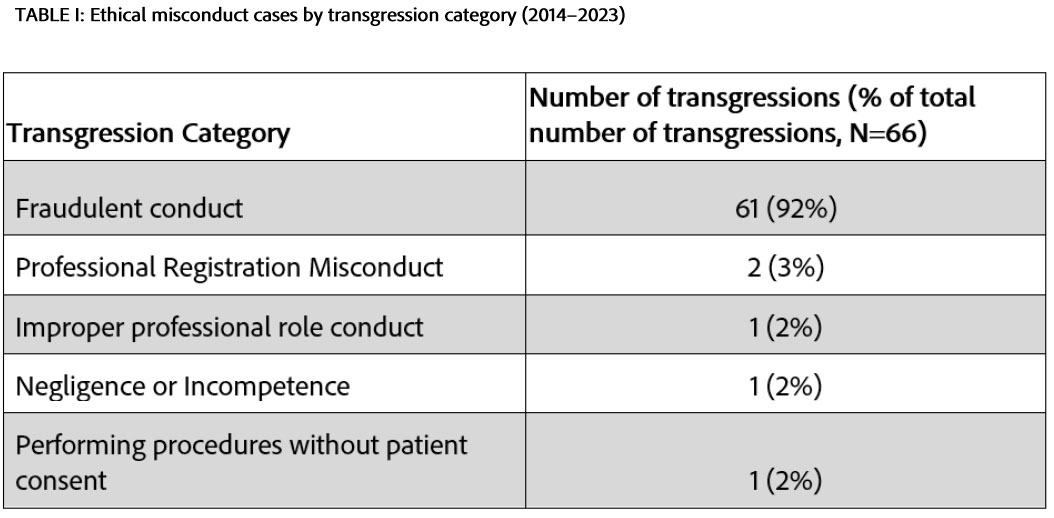
The analysis identified nine occupational therapists who committed a total of 66 transgressions between 2014 and 2023. Among these nine professionals, five were repeat offenders whose transgressions were of either the same or different types. All repeat offenders had at least one transgression in common, namely fraudulent conduct. Fraudulent conduct was found to be the most prevalent type of transgression overall, accounting for 61 out of the 66 total transgressions (92%; Table I, below). Because one practitioner alone accounted for 47 counts of fraud, we conducted a sensitivity check excluding this outlier. Even after removal, fraudulent conduct remained the most prevalent transgression (14 out of 19 cases, 74%), indicating that the overall findings were not driven solely by this outlier. The remaining five transgression categories were: professional registration misconduct; improper professional role conduct; negligence or incompetence in evaluating, treating, and caring for patients; and performing procedures without patient consent.
It is worth noting that one outlier significantly influenced the data. This practitioner was found guilty of 47 counts of fraudulent conduct, which may have skewed the overall analysis. However, even excluding this outlier, fraudulent conduct remained the most prevalent transgression recorded. Looking at the pattern of years of practice and ethical transgressions, the average length of practice at the time of the transgression was 18.89 years, with a standard deviation of 7.32 and a minimum practice period of 9 years.
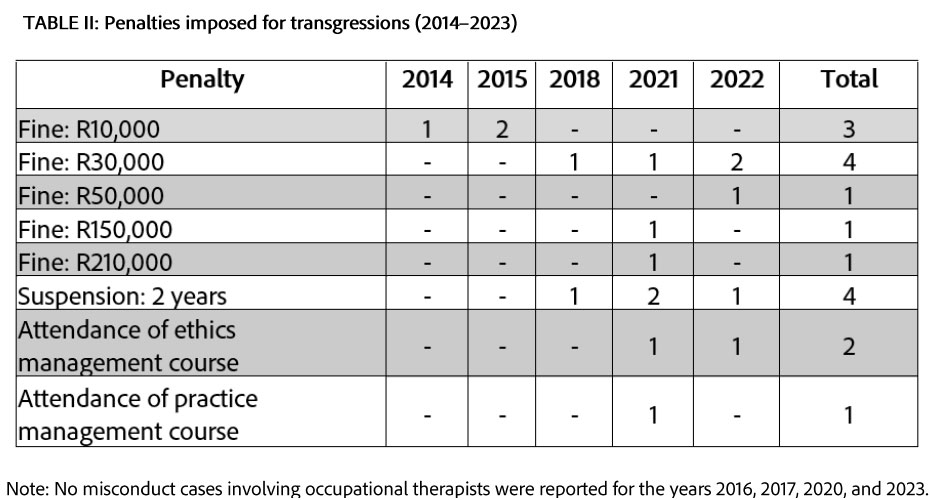
The penalties reported for the transgressions ranged from R10,000 to R210,000, with a total of 10 monetary penalties imposed (Table II, below) In addition to these fines, suspensions ranging from 3 months to 2 years were recorded in five cases. Other penalties included participation in a course on ethics (2 cases) and attendance in a practice management course (1 case). Notably, there were no recorded cases in which caution and reprimand were applied, and only a few cases required ethics courses or additional training. This indicates that the penalties were primarily focused on financial penalties and temporary suspensions.
DISCUSSION
This analysis of ethical misconduct among occupational therapists in South Africa from 2014 to 2023 highlights several noteworthy issues. The current findings consist of a wider range of ethical violations among occupational therapists, with both an increase in reported cases and variation in transgression types. We found that the most common transgression among these professionals was fraudulent conduct. This increase in fraudulent conduct, as compared to the prior study conducted by Nortjé and Hoffmann10
The global crisis of the COVID-19 pandemic had a large impact on the field of occupational therapy. During lockdown, services such as out-patient appointments, ward rounds, group therapy sessions, developmental screenings, and early intervention clinics were suspended. Although some services resumed as restrictions lifted, this varied by institution with some hospital-based occupational therapy departments remaining closed for the duration of the pandemic. It's no surprise that occupational therapists reported a decrease in workload during the COVID-19 pandemic1111
This increase in fraudulent conduct, likely influenced by the COVID-19 pandemic, suggests that current regulations may not effectively deter such behaviour, giving offenders the opportunity to reoffend. As highlighted by Evans and Porche1213
Compared to learning or rehabilitation, penalties for the 2014-2023 violations were mostly punitive, focusing more on fines and suspensions. While these measures promote accountability, reflective practice, which promotes self-awareness, critical thinking, and adherence to ethical standards, should be implemented more widely1415161718
Recommendations
Based on these findings, we propose four key recommendations to address the identified issues while also encouraging long-term ethical behaviour among occupational therapists.
Integrating comprehensive ethics training
While ethical principles are introduced early as part of Continuous Professional Development training, there is still room to strengthen their consistent application throughout a practitioner's career. Regular audits, feedback sessions, peer discussions, and documentation reviews that assess the accuracy and ethical quality of records should be integrated into routine practice. Supervisors or department heads could hold brief "ethics huddles," where staff examine real case scenarios involving consent, billing, or patient communication. This would help to embed ethics in practical, everyday use, and reinforce awareness.
Increasing penalty severity and consistency
Considering there has been inconsistency regarding penalty and fine minimums in the 2014-2023 transgressions. We need to strengthen oversight and ensure penalties meet the minimum amount set by the HPCSA. Additionally, reviewing and adjusting the monetary penalty thresholds may also be necessary to ensure they reflect the seriousness of ethical transgressions and maintain their deterrent value considering inflation and changing professional conditions. Finally, when practitioners are sanctioned, they should be required to complete follow-up ethics workshops or take part in short mentorship programs to help them understand what went wrong and how to prevent similar issues in the future. This would make penalties not only corrective but also educational and support long-term professional improvement.
Promoting reporting of unethical behaviour
Cases of unethical practices could go underreported due to fear of retaliation, lack of awareness of reporting procedures, or skepticism about whether action will be taken. Therefore, creating accessible and anonymous reporting channels can help people feel safer to report cases. Additionally, raising awareness about the importance of protection for those who report misconduct can foster a system where ethical concerns are addressed proactively. Strengthening reporting mechanisms will not only help identify and prevent unethical behavior but also reinforce a shared commitment to professionalism and integrity in patient care
Regular review and update of regulations
In the ever-changing world of healthcare, it is important to conduct regular reviews of the HPCSA regulations to adapt to the evolving nature of ethical challenges. We recommend that the HPCSA Professional Board for Occupational Therapy lead these reviews given its regulatory authority but partner with the Occupational Therapy Association of South Africa (OTASA) and academic institutions to ensure profession-specific and educational perspectives are captured. Any changes made should be adequately communicated to all professionals, students, and institutions. In the ever-changing world of healthcare, it is important to conduct regular reviews of the HPCSA regulations to adapt to the evolving nature of ethical challenges. We recommend that the HPCSA Professional Board for Occupational Therapy lead these reviews given its regulatory authority but partner with OTASA and academic institutions to ensure profession-specific and educational perspectives are captured. Any changes made should be adequately communicated to all professionals, students, and institutions. The penalties for transgressions consistently meet the minimums specified in the HPCSA regulations. It is important to emphasize the seriousness of these offenses. Stricter adherence to the established penalty ranges will increase their deterrent effect by indicating to all practitioners that unethical behavior will not be tolerated and will result in serious consequences. This consistency in penalty severity could help to reduce repeat offenses and maintain high ethical standards in the profession.
Limitations
A limitation of our analysis is that one transgressor committed 47 of the 66 incidents, which may have skewed our results. The data reported by the HPCSA is also an amalgamation of reports from each of its professional boards, which can lead to inconsistencies in terminology. We identified several inconsistencies in the HPCSA records, such as misidentifications of transgressors, double counting of certain transgressions, and unexplained omissions. Additionally, 2019 data were not available from the HPCSA, and cases resolved at the preliminary inquiry stage are not included in the published records, which may indicate potential underreporting. While these limitations affect the completeness of the dataset, we believe they do not compromise the overall validity of the findings or the usefulness of the HPCSA records in identifying major trends, since the authors meticulously identified salient terminology and addressed inconsistencies. Furthermore, nine years of data have been reported, and the one missing year may contribute on average two more transgressors.
CONCLUSION
This analysis of ethical misconduct among occupational therapists in South Africa from 2014 to 2023 highlights several critical issues. We found that the most common transgression among these professionals was fraudulent conduct. This persistent issue suggests that current regulations may not effectively deter such behaviour, allowing offenders to reoffend. As highlighted by Evans and Porche1218
Author Contributions
All listed authors contributed to developing the research plan and experimental design, collecting and gathering the data, analysing the data and drawing conclusions, and drafting and revising the manuscript. Yanet Gezu created the figures, graphs and other visual representations of the data.
Conflicts of interest
The authors declare no conflict of interest.
Acknowledgements
Yanet Gezu was supported by the CPRIT Research Training Award CPRIT Training Program (RP210028).
REFERENCES
-
1. Health Professions Council of South Africa. Official website [Internet]. Pretoria: HPCSA; [cited 2025 Oct 7]. Available from: https://www.hpcsa.co.za/
» https://www.hpcsa.co.za/ -
2. Hammond A. Occupational therapy in rheumatology. Rheumatology (Oxford). 2004;43(5):498-505. https://doi.org/10.1016/j.berh.2004.04.001
» https://doi.org/10.1016/j.berh.2004.04.001 -
3. Galheigo SM. What needs to be done? Occupational therapy responsibilities and challenges regarding human rights. Aust Occup Ther J. 2011;58(2):60-66. https://doi.org/10.1111/j.1440-1630.2011.00922.x
» https://doi.org/10.1111/j.1440-1630.2011.00922.x -
4. Ned L, Tiwari R, Buchanan H, van Niekerk L, Sherry K, Chikte U. Changing demographic trends among South African occupational therapists: 2002 to 2018. Hum Resour Health. 2020;18(1):22. https://doi.org/10.1186/s12960-020-0464-3
» https://doi.org/10.1186/s12960-020-0464-3 -
5. Gille F, Smith S, Mays N. Evidence-based guiding principles to build public trust in personal data use in health systems. Digit Health. 2022;8:20552076221111947. https://doi.org/10.1177/20552076221111947
» https://doi.org/10.1177/20552076221111947 -
6. United Nations Development Programme. Sustainable development goals [Internet]. [cited 2025 Aug 7]. Available from: https://www.undp.org/sustainable-development-goals
» https://www.undp.org/sustainable-development-goals -
7. De Jongh JC, Hess-April L, Vermeulen N. Reflecting on ethics in occupational therapy within community development practice in South Africa. In: Nortjé N, De Jongh JC, Hoffmann W, editors. African perspectives on ethics for healthcare professionals. Advancing global bioethics. Cham: Springer; 2018. p. 69-82. https://doi.org/10.1007/978-3-319-93230-9_5
» https://doi.org/10.1007/978-3-319-93230-9_5 -
8. Naidoo Y. Changes to the HPCSA's professional conduct inquiry process may improve efficiency and practitioner well-being [Internet]. 2023 [cited 2025 Sep 25]. Available from: https://www.derebus.org.za/changes-to-the-hpcsas-professional-conduct-inquiry-process-may-improve-efficiency-and-practitioner-well-being
» https://www.derebus.org.za/changes-to-the-hpcsas-professional-conduct-inquiry-process-may-improve-efficiency-and-practitioner-well-being -
9. Macrobert Attorneys. New regulations pertaining to HPCSA fines [Internet]. [cited 2025 Sep 25]. Available from: https://www.macrobert.co.za/insights/posts/new-regulations-pertaining-to-hpcsa-fines
» https://www.macrobert.co.za/insights/posts/new-regulations-pertaining-to-hpcsa-fines -
10. Nortjé N, Hoffmann WA. Ethical misconduct of HPCSA registered occupational therapists in South Africa. S Afr J Occup Ther. 2015;45(3):55-7. https://doi.org/10.17159/2310-3833/2015/v45n3a10
» https://doi.org/10.17159/2310-3833/2015/v45n3a10 -
11. Nathoo H, Gurayah T, Naidoo D. Life during Covid-19: An Explorative Qualitative Study of Occupational Therapists in South Africa. Occupational Therapy in Mental Health 2022; 39(2), 211-239. https://doi.org/10.1080/0164212X.2022.2100558
» https://doi.org/10.1080/0164212X.2022.2100558 -
12. Evans RD, Porche DA. The nature and frequency of Medicare/Medicaid fraud and neutralization techniques among speech, occupational, and physical therapists. Deviant Behav. 2005;26(3):253-70. https://doi.org/10.1080/01639620590915167
» https://doi.org/10.1080/01639620590915167 -
13. Vivanco L, Delgado-Bolton R. Professionalism. In: ten Have H, editor. Encyclopedia of global bioethics. Cham: Springer; 2015. p. 1-9. https://doi.org/10.1007/978-3-319-05544-2_353-1
» https://doi.org/10.1007/978-3-319-05544-2_353-1 -
14. Sapp K. Offender rehabilitation as a contemporary issue. In: Understanding offending populations and the power of correctional psychotherapy. Springer Briefs in Offending Populations & Correctional Psychotherapy. Cham: Springer; 2023. p. 57-75. https://doi.org/10.1007/978-3-031-45886-6_6
» https://doi.org/10.1007/978-3-031-45886-6_6 -
15. Moodley K. Teaching medical ethics to undergraduate students in post-apartheid South Africa, 2003-2006: Table 1. J Med Ethics. 2007;33(11):673-7. https://doi.org/10.1136/jme.2006.018432
» https://doi.org/10.1136/jme.2006.018432 -
16. Health Professions Council of South Africa. HPCSA CPD point requirements arranged by professional board [Internet]. 2025 [cited 2025 Sep 25]. Available from: https://www.hpcsa-blogs.co.za/hpcsa-cpd-point-requirements-arranged-by-professional-board/
» https://www.hpcsa-blogs.co.za/hpcsa-cpd-point-requirements-arranged-by-professional-board/ -
17. Ivers N, Jamtvedt G, Flottorp S, Young JM, Odgaard-Jensen J, French SD, O'Brien MA, Johansen M, Grimshaw J, Oxman AD. Audit and feedback: Effects on professional practice and healthcare outcomes. Cochrane Database Syst Rev. 2012;6:CD000259. https://doi.org/10.1002/14651858.CD000259.pub3
» https://doi.org/10.1002/14651858.CD000259.pub3 -
18. Mann K, Gordon J, MacLeod A. Reflection and reflective practice in health professions education: A systematic review. Adv Health Sci Educ Theory Pract. 2009;14(4):595-621. https://doi.org/10.1007/s10459-007-9090-2
» https://doi.org/10.1007/s10459-007-9090-2

Submitted: 12 May, 2025
Reviewed (Round 1): 25 August, 2025
Revised: 24 October, 2025
Reviewed (Round 2): 25 November 2025
Accepted: 25 November 2025
** Researcher at the University of Texas, MD Anderson Cancer Center, Houston, Texas at the time of the study
*** Undergraduate student at The University of Texas, Houston, Texas USA at the time of the study
EDITOR: Blanche Pretorius, https://orcid.org/0000-0002-3543-0743
DATA AVAILABILITY: On request from corresponding author
FUNDING: No funding was received for this study