Therapists' consensus on an infant massage programme for high-risk infants from resource constrained contexts: a delphi study
Abstract
BACKGROUND: There are various infant massage programmes designed for infants born without complications, but there are limited options available for caregivers with high-risk infants from a resource-constrained contextAIM: This study aimed to develop a caregiver-initiated infant massage programme specific for high-risk infants in a resource-constrained context to facilitate the bonding and attachment process between this dyadMETHOD: A three-round Delphi study was conducted with purposively selected physiotherapists and occupational therapists with experience in the field of high-risk babies in a resource-constrained context. The design of the round one survey was informed by the available literature, and the subsequent two rounds of surveys were designed based on the prior rounds. Iteration of results was provided prior to the subsequent roundsRESULTS: Attrition between rounds occurred from an initial 14 participants in round one to 8 participants in round three. Consensus on 19 massage strokes were achieved in addition to considerations for implementation of the programme with this populationCONCLUSION: The implication of attrition requires further study. Notwithstanding this, an infant massage programme for high-risk infants was developed with the inclusion of considerations for this dyad's social and medical context
Infant massage; Infant massage programme; High-risk infants; Delphi technique; Bonding
INTRODUCTION
The birth of a high-risk infant is frequently the result of birth trauma123
High-risk infants often do not respond appropriately to caregiver's cues which may lead to the primary caregiver feeling out of touch with their infant as well as in the infant feeling overwhelmed435,6. Alongside these social factors is that breastfeeding, which is a source of bonding between the dyad789,10.
The purpose of this study was to establish consensus on infant massage strokes deemed appropriate for high-risk infants, that can be included in a programme initiated by primary caregivers in their context, towards the aim of bonding and attachment in the mother-infant dyad.
A "high-risk infant" is an infant who requires a greater degree of monitoring and care compared to a healthy infant who was born full term111213910
In their first year, many infants who are born prematurely or with a low birth weight present with more significant deficits in mental function as well as in neuromusculoskeletal and movement-related dysfunctions compared to children born at an average birth-weight or full term14151617
Primary caregivers are also faced with various extraneous factors such as a shortage of financial resources, limited transport and under-resourced hospitals1819131818
These social factors (alongside the medical concerns of the infant, difficulty with breastfeeding and the emotional experience of the primary caregiver) hinder the bonding and attachment process. Infant massage therapy, in conjunction with other early intervention programmes, provides the supportive environment needed for attachment and bonding and appropriate stimulation for the infant and is used to optimise the infant's sensory experience which, in turn, improves development and functional outcomes2021222323
Bonding and attachment are essential developmental and neu-robehavioural processes occurring between the mother and infant, starting in pregnancy and increasing in intensity of action in the early weeks of life. The infant develops security by having its psychological needs met through nurturing touch and proximity to the primary caregiver24,25,26.
Infant massage consists of gentle, slow stroking of each part of the body through tactile stimulation by human hands27282930
A further benefit in the attachment process is that infant massage creates a purposeful and satisfying interaction between the dyad through a constructive and positive activity31312829,30,32,33.
Early identification and intervention is recommended for all infants and toddlers who are presenting with difficulties as there is much evidence that this intervention has a positive effect on the development of the child throughout her/his life3434
METHODOLOGY
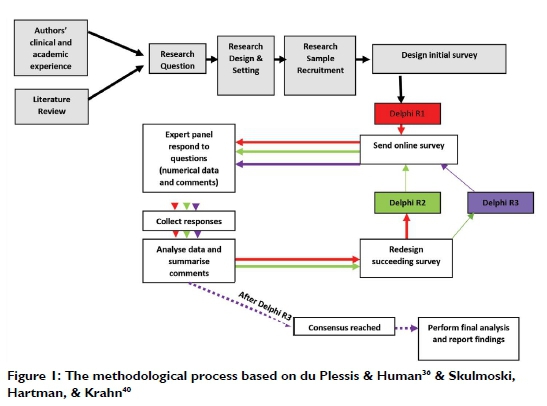
Study design: A three-round Delphi technique (Figure 1 p74) was used in this study with the aim of programme development35,36 which was based on the available time and funding as well as the consideration of participation fatigue37,38. The strength in this method lies in the stability of the group consensus rather than on individuals' opinions394038 41
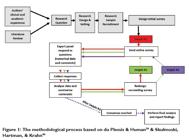
The study included the following phases:
•
Literature review (Phase 1): The initial phase of the study focused on a comprehensive literature review on the high-risk infant, the contextual considerations for this dyad from the resource-constrained context as well as on infant massage to form a basis upon which the initial online survey could be created38•
Delphi Process Round One: Item Generation (Phase 2): Purposive sampling was used for this Delphi study4235,43. Following the recruitment of the sample, the initial survey was uploaded online onto www.surveymonkey.com. The format and content of this initial survey were based upon the first authors' experience, her training as an Infant Massage Instructor through the International Association of Infant Massage (IAIM), and a comprehensive literature review38,44. Items for inclusion were based on consideration of the infant massage strokes as taught by the IAIM and the potential effect on the central nervous system and arousal levels of the high risk baby16,34. The fast paced, tickly and alerting massage strokes could be disorganising to the arousal levels of the high-risk infant, and as such were excluded. The slower, deeper-pressured, calming and organizing strokes were favoured for inclusion16,34,45.•
Delphi Process Round 2: Consensus on item generation (Phase 3): The list of infant massage techniques formulated from the initial survey and from the additions from the expert participants in round one was pared down in the round two survey4637•
Delphi Process Round 3: Consensus (Phase 4): The third round included iteration, where an organised summary of the previous round one and round two results was distributed to the participants so that they were aware of the range of opinions and positioning of the programme based on these opinions3536priori consensus threshold of >70%4748,49. • Development of the Programme (Phase 5): This phase comprised the final collation and development of the infant massage programme and was based on the consensus obtained in Round Three.Sampling and sampling techniques:
Purposive sampling was employed in the selection of experts for this study based on specific selection criteria36,43. This approach was used to ensure that a homogenous sample was maintained for this study which would yield satisfactory results even though the sample size is smaller4037424338384340
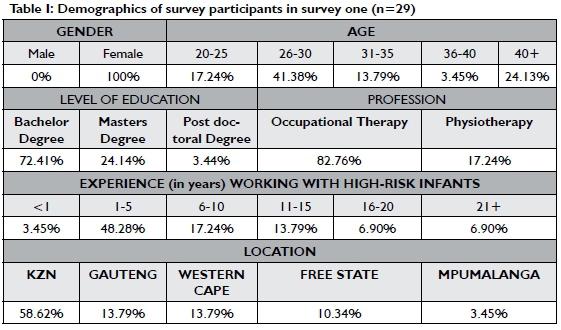
Demographic Profile of Participants
A total of 29 participants began the survey and completed the demographic section (Table I p74). Of these 14 participants completed the round one survey, 13 completed round two, and 8 participants completed round three.
Validity and Reliability: The authors were aware of the concepts of validity and reliability during the data collection and data analysis processes. Validity was maintained through the appraisal and piloting of the online surveys prior to implementation of the surveys by two expert professionals who were not participants in the study37,385031
Data analysis: Descriptive statistics assisted in determining the level of consensus by a summary of the data via central tendencies and standard deviations38513852Ethical considerations: Ethical clearance was obtained from the Humanities and Social Sciences Research Ethics Committee at the University of KwaZulu-Natal (ethical clearance number HSS/0533/017M). Participants volunteered participation via an informed consent document and were free to withdraw without prejudice. Confidentiality was ensured by the participants being given an option to include their email address for further correspondence if they chose to. Responses without this contact information were included and remained anonymous.
RESULTS
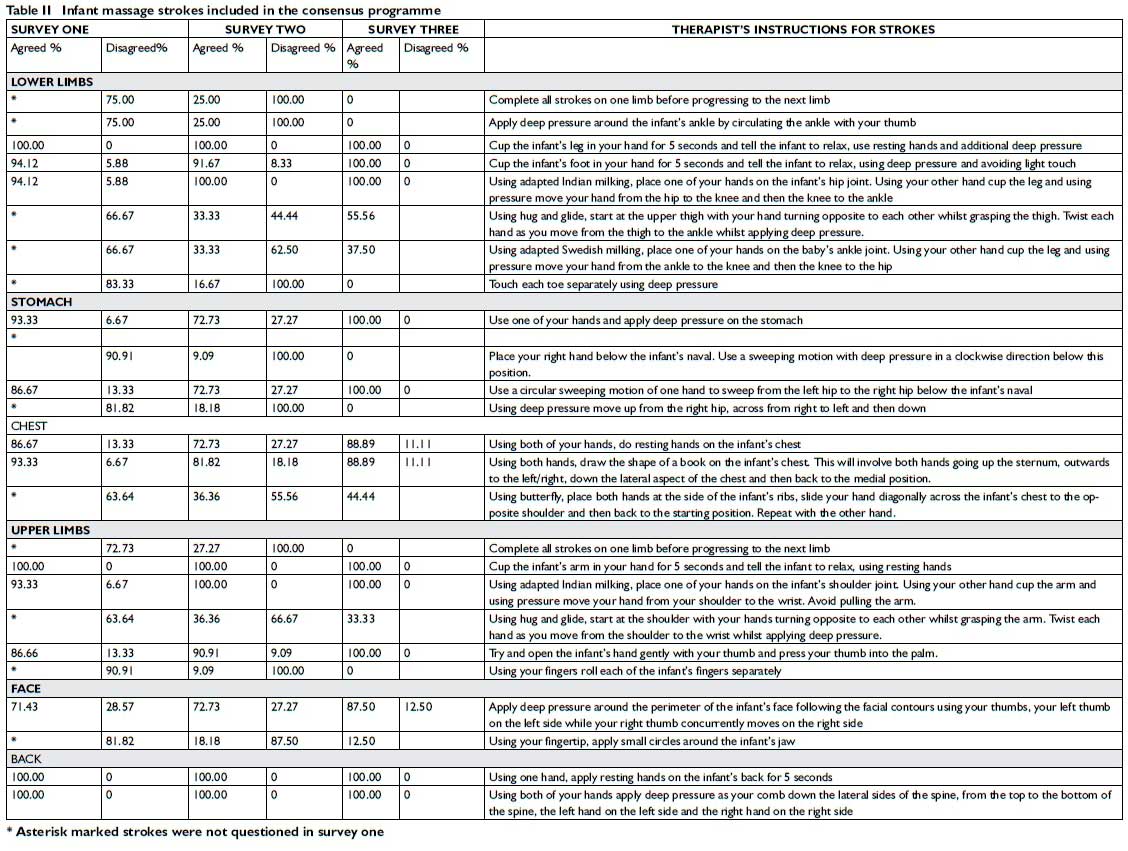
Delphi Round One Survey (n=14): Consensus was obtained on all massage strokes, which were included in the initial survey and obtained from the literature review conducted by the authors in phase one of the study38"hug and glide provides much more proprioceptive input" and which was confirmed by another participant who also noted "hug and glide (squeeze and twist)". This observation was also noted by a third participant who recommended the inclusion of "deep compression along long bones - from hip to knee and knee to heel. Calming, well tolerated in supine and good prep for therapeutic activities" which has similar characteristics to the hug and glide massage stroke. Another participant suggested the inclusion of "swedish milking". A further recommendation was "touching each toe separately". When commenting on the stomach, participants recommended "circular sweeping motion across the stomach in a clocking motion to mimic bowel movements" and "clockwise circular sweep" as well as "along large colon- up from right hip, across from right to left and then down to aid digestion and soothe cramps". It was recommended by one participant that "butterfly" be included as a massage stroke for the chest which is a technique which stimulates and deepens breathing in the infant28and glide" should be included, one participant recommended the inclusion of "swedish milking" and two participants recommended "finger rolling" or "rolling each finger separately". One participant suggested "small circles around the jaw with fingertips" as well as a further "maybe 'relax the jaw' or jaw clenching".
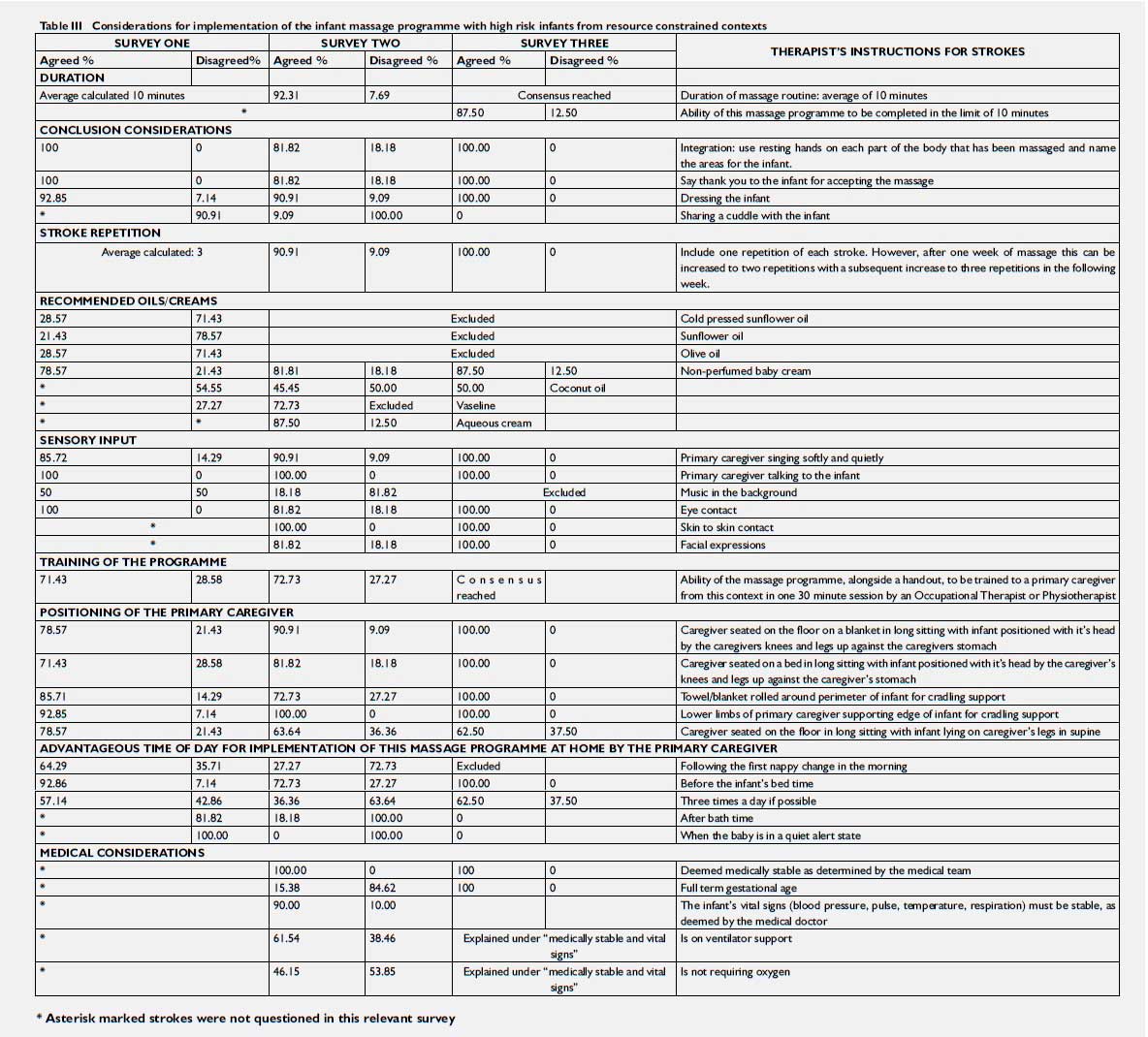
It was noted in this survey that the average recommended duration for an infant massage routine is 10 minutes as well as the repetition of each stroke three times. There was consensus obtained on excluding certain oils/creams as recommendations for this population and these included "cold pressed sunflower oil", "sunflower oil" and "olive oil".
Delphi Round Two Survey (n=13): All strokes which had obtained consensus in round one were confirmed with a subsequent consensus in round two. There was also a further consensus on six additional strokes added in round two which were based on the comments gathered in round one. However, there was a non-consensus noted for the added sub-items "hug and glide" and "swedish milking" for the lower limbs as well as "butterfly" for the chest and "hug and glide" for the upper limbs.
One of the participants recommended "a cuddle" as a conclusion consideration in survey one and this was confirmed in survey two by obtaining consensus. Participants noted in survey one that further beneficial sensory input could include "encourage skin to skin". The recommendation was also to include "facial expressions" which were confirmed with a result of consensus in survey two. Further additions included that participants recommended the inclusion of "vaseline" and "coconut oil" for use during the massage routine. The use of "coconut oil" did not obtain consensus and "vaseline" achieved consensus of not being important.
It was also recommended by participants in survey one that this routine be implemented "after bath time when cream should be applied" and "I would suggest after bath time", "when baby is happy and calm" and "so long as baby is calm-alert state" as well as "when the baby is in the quiet alert state". These were confirmed by consensus in survey two.
Delphi Round Three Survey (n=8): This survey confirmed the consensus strokes from the round one and round two surveys. However, there was a further non-consensus on the four sub-items discussed above in round two on "hug and glide" and "swedish milking" for the lower limbs as well as "butterfly" for the chest and "hug and glide" for the upper limbs. It was confirmed in this survey that this programme would be able to be completed in the recommended limit of 10 minutes. Participants suggested that should the primary caregiver be unable to complete the massage routines on the whole body in 10 minutes then they should, "complete one area, and end in the above-mentioned routine (conclusion considerations). The next session start at a missed area or only do resting hands on a previously completed area", "can complete routine later", "at the next massage, the caregiver could start where they left off' and confirmed with "start the next time with the body parts she did not do". The recommendation of completing the routine three times a day if possible did not obtain a final consensus in survey three with participants stating; "build-up to 3x per day" and "this will give mothers a number to aim for, which may get in the way, rather than promoting bonding in this dyad where separation post-birth has been necessary due to medical reasons". A further non-consensus on the recommendation of the use of "coconut oil" was noted in survey three, as in survey two. This is confirmed with comments from the participants of "new research showing coconut oil is not as good as previously thought", "I don't think this is easily accessible in this context", "may not be easily accessible" and "may be costly for population group". "Vaseline", a commercially produced mineral oil, was excluded in survey three based on its consensus of not being relevant in survey two. However, one participant did note in survey two that "although Vaseline may not be the best choice- it is most commonly used by caregivers in resource constrained settings". The inclusion of "aqueous cream" as a recommendation obtained consensus. Non-consensus was also noted in the final positioning sub-item.
DISCUSSION AND IMPLICATIONS
Massage strokes for high-risk infants
High-risk infants have a lower threshold for sensory input. They may experience difficulty tolerating tactile input from handling and interaction165353 5453
Resting hands is a simple holding technique which activates the DCML system and is especially beneficial with a medically fragile, premature or colicky baby444 5328"These babies often have quite tender feet from all the prodding and poking in NICU". The infant's fingers may also not have been mobilised very much in the unit and so the individual will be required to try and open the infant's hand gently with their thumb and press into the palm as well as roll each of the fingers. These strokes are beneficial as they are "very useful to prevent contractures and increase input into palm".
These high risk infants who have been in the neonatal unit or in kangaroo mother care have also not been mobilised very often or picked up unless it was medically necessary. Indian milking of the upper and lower limbs is included in the programme as it relaxes the limb and encourages blood flow to the infant's feet or hands28
The high-risk infant may also have experienced gastro-intestinal concerns due to the nature of their medical condition and so may be presenting with constipation. Through massage of the abdomen area of the infant, the gas and intestinal matter is moved toward the bowel as these strokes assist in mimicking the movement of the bowel and this will assist with alleviating gas and discomfort4
High-risk infants may have been overstimulated on their face during their stay in the unit in the anterolateral system, as commented; "babies who have had NGTs hate their faces being touched or heads held firmly - beware of fear response" and "babies in the NICU faces are usually overstimulated due to be oscillated, ventilated, tube feeding through the nose. Also the regular suction and wiping of the face". This may also be as a result of the high receptor density on the face which is very sensitive to touch and so can result in overstimulation5428
Touch of the infant's back activates a larger receptor field where the receptor density is low and so is less sensitive to touch5428
The study highlighted a non-consensus on the inclusion of "hug and glide" for the upper and lower limbs where the stroke involves. This massage stroke motion involves a twisting motion of the limb which would activate the anterolateral system and so result in the dysregulating effects of activating this system with this sensitive infant54
"Swedish milking" of the lower limbs was also a stroke that did not obtain consensus in this study. The purpose of this stroke is to aid circulation from the feet and back towards the heart4
The final non-consensus was regarding the "butterfly" technique on the chest. This technique is beneficial for the infant in that it stimulates and deepens breathing28
Inclusion of other sensory stimulation during massage routine
Consensus from this study highlighted the inclusion of contingent tactile stimulation, which is massage conducted alone or in conjunction with visual and/or auditory stimulation552756232347
Duration of massage routine
A consensus was not obtained in this study about the recommendation of repeating the massage routine three times a day. However, with the support from Field's protocol57build up to 3x per day it is recommended that this routine be conducted up to three times a day if the dyads are comfortable with this. This study also obtained consensus on the inclusion of infant massage before the infant's bed time or after bath time as this will help with obtaining the benefits of massage on sleep58
However, whilst keeping these recommendations as a priority it is further considered that primary caregivers initiate that infant massage routine when both they and the infant are in a state which is accepting and ready for the process as it is remembered that this dyad is also faced with many other responsibilities and contextual factors in these early days.
The massage routine should be concluded by integrating the infant's body by using resting hands on each part of the body that has been massaged and naming the areas. This should be in addition to saying thank you to the infant for accepting the massage and dressing the infant. Finally, the dyad should share a cuddle as this is a technique which will also aid in the bonding and attachment process through nurturing touch5945
Use of oils/creams
It is recommended that the massage routine is initiated with the use of oils/creams; such as non-perfumed baby cream or aqueous cream. However, it is essential to note that the substance used is non-occlusive and does not block the skin pores but allows the skin to breathe60616162not be easily accessible" and "may be costly" for this population in their resource-constrained context. It must also be noted that certain cosmetic products and baby creams such as Vaseline and Johnsons baby products are also sensitising agents as they contain formaldehyde and may contribute to allergic contact dermatitis (ACD) and so should be avoided when conducting infant massage63
LIMITATIONSThere was participant attrition between subsequent Delphi rounds in this study. The potential reasons for this attrition from the initial group of n=29 participants; could be attributed to, (i) therapists not presenting with an interest in this area of practice once they started the survey3636364038,39,40,42,48,48-50. There is limited evidence of reliability when using the Delphi technique38
CONCLUSION
A three-round Delphi technique completed by physiotherapists and occupational therapists guided the development and consensus on an infant massage programme for high-risk infants from resource-constrained contexts. It is recommended that a user-friendly format is designed which can be provided to caregivers from therapists during their intervention session as a home programme. This programme and its relevant considerations are available and accessible for therapists to use to train these primary caregivers from this context, to implement these massage techniques with their high-risk infants.
A collaborative goal of the intervention of physiotherapists and occupational therapists working with high-risk infants is to encourage and create a supportive environment which provides appropriate stimulation for the infant and which mirrors that provided in utero2220
REFERENCES
LITERATURE REVIEW
- 1. Hynan MT. The Perinatal Posttraumatic Stress Disorder (PTSD) Questionnaire. In: Evaluating stress: A Book of Resources. CP Zalaquett & RJ Wood, RJ, Editors. London, United Kingdom:The Scarecrow Press Incorporated; 1997: 199-200.
-
2. Lloyd LG, De Witt W. Neonatal mortality in South Africa: How are we doing and can we do better? South African Medical Journal [Internet]. South African Medical Association NPC; 2013 Jul 2;103(8): 518. http://dx.doi.org/10.7196/samj.7200
» http://dx.doi.org/10.7196/samj.7200 -
3. Minde K. Prematurity and Serious Medical Illness in Infancy: Implications for Development and Intervention. In: Handbook of Infant Mental Health. C Zeanah Jr, Editor. New York: Guilford Press; 1995:87-105. New York: Guilford Press; 1995. https://doi.org/10.1002/1097-0355(199523)16:3<240::AID-IMHJ2280160310>3.0.CO;2-Z
» https://doi.org/10.1002/1097-0355(199523)16:3<240::AID-IMHJ2280160310>3.0.CO;2-Z - 4. McClure V. Infant Massage: A Handbook for Loving Parents. Fourth Edition. Croydon, United Kingdom:Bantam; 2017.
- 5. Anderson B, Phillips H. Trends in the percentage of children who are orphaned in South Africa: 1995-2005. Statistics South Africa; 2006.
-
6. UNICEF Statistical data on the status of children aged 0-4 in South Africa. 2007. https://www.unicef.org/southafrica/media/1836/file/ZAF-young-lives-2007.pdf
» https://www.unicef.org/southafrica/media/1836/file/ZAF-young-lives-2007.pdf -
7. Else-Quest NM, Hyde JS, Clark R. Breastfeeding, Bonding, and the Mother-Infant Relationship. Merrill-Palmer Quarterly [Internet]. Project Muse. 2003; 49(4): 495-517. http://dx.doi.org/10.1353/mpq.2003.0020
» http://dx.doi.org/10.1353/mpq.2003.0020 -
8. Dall'Oglio I, Salvatori G, Bonci E, Nantini B, D'Agostino G, Dotta A. Breastfeeding promotion in neonatal intensive care unit: impact of a new program toward a BFHI for high-risk infants. Acta Paediatrica [Internet]. Wiley. 2007 Nov; 96(11): 1626-31. http://dx.doi.org/10.1111/j.1651-2227.2007.00495.x
» http://dx.doi.org/10.1111/j.1651-2227.2007.00495.x -
9. Weiss SJ, Wilson P Hertenstein MJ, Campos R. The tactile context of a mother's caregiving: implications for attachment of low birth weight infants. Infant Behavior and Development [Internet]. Elsevier BV 2000 Jan; 23(1): 91-111. http://dx.doi.org/10.1016/s0163-6383(00)00030-8
» http://dx.doi.org/10.1016/s0163-6383(00)00030-8 -
10. O'Brien M, Lynch H. Exploring the role of touch in the first year of life: Mothers' perspectives of tactile interactions with their infants. British Journal of Occupational Therapy. 2011 Mar; 74(3): 129-36. https://doi.org/10.4276/030802211X12996065859247
» https://doi.org/10.4276/030802211X12996065859247 -
11. Elzouki AY Harfi HA, Nazer HM, Stapleton FB, Oh W, Whitley RJ, editors. Textbook of Clinical Pediatrics. Springer Berlin Heidelberg; 2012. http://dx.doi.org/10.1007/978-3-642-02202-9
» http://dx.doi.org/10.1007/978-3-642-02202-9 - 12. Boyd J. High risk baby programme: Rehab 01. KwaZulu-Natal Department of Health. 2015. (unpublished)
-
13. van Stormbroek K, Buchanan H. Community Service Occupational Therapists: thriving or just surviving? South African Journal of Occupational Therapy [Internet]. Academy of Science of South Africa. 2016; 46(3). http://dx.doi.org/10.17159/23103833/2016/v46n3a11
» http://dx.doi.org/10.17159/23103833/2016/v46n3a11 -
14. Beck S, Wojdyla D, Say L, Pilar Bertran A, Meraldi M, Harris Requejo J, et al. The worldwide incidence of preterm birth: a systematic review of maternal mortality and morbidity. Bulletin of the World Health Organization [Internet]. WHO Press. 2010 Jan 1; 88(1): 31-8. http://dx.doi.org/10.2471/blt.08.062554
» http://dx.doi.org/10.2471/blt.08.062554 -
15. Sullivan MC, Hawes K. A decade comparison of preterm motor performance at age 4. Research in Nursing & Health [Internet]. Wiley. 2007; 30(6): 641-54. http://dx.doi.org/10.1002/nur.20220
» http://dx.doi.org/10.1002/nur.20220 -
16. Miller MQ, Quinn-Hurst M. Neurobehavioral Assessment of High-Risk Infants in the Neonatal Intensive Care Unit. American Journal of Occupational Therapy [Internet]. AOTA Press; 1994 Jun 1; 48(6): 506-13. http://dx.doi.org/10.5014/ajot.48.6.506
» http://dx.doi.org/10.5014/ajot.48.6.506 - 17. Pick R. Understanding Childhood. London: Child Psychotherapy Trust; 1999.
-
18. Saloojee GM, Rosenbaum PL, Stewart AV Using caregivers' perceptions of rehabilitation services for children with Cerebral Palsy at public sector hospitals to identify the components of an appropriate service. South African Journal of Physiotherapy [Internet]. 2011; 19;67(3): 35-40. http://dx.doi.org/10.4102/sajp.v67i3.53
» http://dx.doi.org/10.4102/sajp.v67i3.53 -
19. Lee VE, Brooks-Gunn J, Schnur E, Liaw F-R. Are Head Start Effects Sustained? A Longitudinal Follow-Up Comparison of Disadvantaged Children Attending Head Start, No Preschool, and Other Preschool Programs. Child Development [Internet]. 1990 Apr; 61(2): 495. http://dx.doi.org/10.2307/1131110
» http://dx.doi.org/10.2307/1131110 -
20. Symington AJ, Pinelli J. Developmental care for promoting development and preventing morbidity in preterm infants. Cochrane Database of Systematic Reviews [Internet]. Wiley; April 2006; 19. http://dx.doi.org/10.1002/14651858.cd001814.pub2
» http://dx.doi.org/10.1002/14651858.cd001814.pub2 -
21. Anand KJS, Scalzo FM. Can Adverse Neonatal Experiences Alter Brain Development and Subsequent Behavior? Biolo Neonate. 2000; 77(2): 69-82. http://dx.doi.org/10.1159/000014197
» http://dx.doi.org/10.1159/000014197 -
22. Westrup B, Kleberg A, von Eichwald K, Stjernqvist K, Lagercrantz H. A Randomized, Controlled Trial to Evaluate the Effects of the Newborn Individualized Developmental Care and Assessment Program in a Swedish Setting. Pediatrics [Internet]. American Academy of Pediatrics. 2000 Jan 1; 105(1): 66-72. http://dx.doi.org/10.1542/peds.105.L66
» http://dx.doi.org/10.1542/peds.105.L66 -
23. Colyvas JL, Sawyer LB, Campbell PH. Identifying Strategies Early Intervention Occupational Therapists Use to Teach Caregivers. American Journal of Occupational Therapy [Internet]. 2010; 64(5): 776-85. http://dx.doi.org/10.5014/ajot.2010.09044
» http://dx.doi.org/10.5014/ajot.2010.09044 - 24. Brazelton TB & Nugent JK. The Neonatal Behavioral Assessment Scale: Fourth Edition. United Kingdom: Mac Keith Press; 2011.
-
25. Rutter M. Clinical Implications of Attachment Concepts: Retrospect and Prospect. Journal of Child Psychology and Psychiatry [Internet]. 1995 May; 36(4): 549-71. http://dx.doi.org/10.1111/j.1469-7610.1995.tb02314.x
» http://dx.doi.org/10.1111/j.1469-7610.1995.tb02314.x -
26. Atzil S, Hendler T, Feldman R. Specifying the Neurobiological Basis of Human Attachment: Brain, Hormones, and Behavior in Synchronous and Intrusive Mothers. Neuropsychopharmacology. 2011 Aug 31; 36(13): 2603-15.: http://dx.doi.org/10.1038/npp.2011.172
» http://dx.doi.org/10.1038/npp.2011.172 -
27. Vickers A, Ohlsson A, Lacy J, Horsley A. Massage for promoting growth and development of preterm and/or low birth-weight infants. Cochrane Database of Systematic Reviews [Internet]. 2004;19. http://dx.doi.org/10.1002/14651858.cd000390.pub2
» http://dx.doi.org/10.1002/14651858.cd000390.pub2 -
28. Simpson R. Baby massage classes and the work of the International Association of Infant Massage. Complementary Therapies in Nursing and Midwifery [Internet]. 2001 Feb; 7(1): 25-33. http://dx.doi.org/10.1054/ctnm.2000.0510
» http://dx.doi.org/10.1054/ctnm.2000.0510 -
29. Shipwright S, Dryden T. Paediatric massage: an overview of the evidence. Focus on Alternative and Complementary Therapies [Internet]. 2012 Mar 30; 17(2): 103-10. http://dx.doi.org/10.1111/j.2042-7166.2012.01149.x
» http://dx.doi.org/10.1111/j.2042-7166.2012.01149.x -
30. Field TM. Massage therapy effects. American Psychologist [Internet]. American Psychological Association; 1998; 53(12): 1270-81. http://dx.doi.org/10.1037/0003-066x.53.12.1270
» http://dx.doi.org/10.1037/0003-066x.53.12.1270 -
31. Clarke CL, Gibb C, Hart J, Davidson A. Infant massage: developing an evidence base for health visiting practice. Clinical Effectiveness in Nursing [Internet]. 2002 Sep; 6(3-4): 121-8. http://dx.doi.org/10.1016/s1361-9004(02)00089-4
» http://dx.doi.org/10.1016/s1361-9004(02)00089-4 -
32. Karimi F Abolhassani M, Ghasempour Z, Gholami A, Rabiee N. Comparing the effect of kangaroo mother care and massage on preterm infant pain score, stress, anxiety, depression, and stress coping strategies of their mothers. International Journal of Pediatrics. 2020. https://doi.org/10.22038/IjFP2020.50006.3990
» https://doi.org/10.22038/IjFP2020.50006.3990 -
33. Mousavi S, Rostami S, Haghani H, Borimnejad L. Effect of mother's infant massage on neonatal weight and perceived self-efficacy of mothers with low birth weight infants. Koomesh. 2020; 22(2): 237-43. Available from: https://www.scopus.com/inward/record.uri?eid=2-s2.0-85082664842&partnerID=40&md5=c7a92379039fc7b08e93db6c75fa73cc
» https://www.scopus.com/inward/record.uri?eid=2-s2.0-85082664842&partnerID=40&md5=c7a92379039fc7b08e93db6c75fa73cc - 34. Smith-Roley S. Ayres Sensory Integration for Infants and Toddlers. The South African Institute for Sensory Integration. 2016: 1-14. (unpublished)
-
35. Hsu C, Sandford BA. The Delphi technique: making sense of consensus. Practical Assessment, Research, and Evaluation. 2007; 12(1): 10. https://doi.org/10.7275/pdz9-th90
» https://doi.org/10.7275/pdz9-th90 -
36. du Plessis E, Human SP The art of the Delphi technique: highlighting its scientific merit. Health SA Gesondheid [Internet]. 2007 Nov 17; 12(4). http://dx.doi.org/10.4102/hsag.v12i4.268
» http://dx.doi.org/10.4102/hsag.v12i4.268 -
37. Powell C. The Delphi technique: myths and realities. Journal of Advanced Nursing [Internet]. 2003 Feb; 41(4): 376-82. http://dx.doi.org/10.1046/j.1365-2648.2003.02537.x
» http://dx.doi.org/10.1046/j.1365-2648.2003.02537.x -
38. Hasson F Keeney S, McKenna H. Research guidelines for the Delphi survey technique. Journal of Advanced Nursing [Internet]. 2000 Oct; 32(4): 1008-15. http://dx.doi.org/10.1046/j.1365-2648.2000.t01-1-01567.x
» http://dx.doi.org/10.1046/j.1365-2648.2000.t01-1-01567.x - 39. Adler M & Ziglio E. Gazing into the Oracle: The Delphi Method and its Application to Social Policy and Public Health. Bristol: PA: Jessica Kingsley Publications. 1996.
-
40. Skulmoski GJ, Hartman FT Krahn J. The Delphi Method for Graduate Research. Journal of Information Technology Education: Research. Informing Science Institute. 2007; 6: 001-21. http://dx.doi.org/10.28945/199
» http://dx.doi.org/10.28945/199 - 41. Mason j. Qualitative Researching. Thousand Oaks, USA: Sage Publications. 1996.
-
42. Akins RB, Tolson H, Cole BR. Stability of response characteristics of a Delphi panel: application of bootstrap data expansion. BMC Medical Research Methodology [Internet]. 2005 Dec; 5(1). http://dx.doi.org/10.1186/1471-2288-5-37
» http://dx.doi.org/10.1186/1471-2288-5-37 -
43. Bruce J. The use of experts and their judgments in nursing research: an overview. Curationis [Internet]. 2008 Sep 28; 31(4). http://dx.doi.org/10.4102/curationis.v31i4.1061
» http://dx.doi.org/10.4102/curationis.v31i4.1061 - 44. Kerlinger F. Foundations of Behavioral Research. New York: Holt, Rinehart, and Winston. Inc. 1973.
-
45. Simpson R. Baby massage classes and the work of the International Association of Infant Massage. Complementary Therapies in Nursing and Midwifery [Internet]. 2001 Feb; 7(1): 25-33. http://dx.doi.org/10.1054/ctnm.2000.0510
» http://dx.doi.org/10.1054/ctnm.2000.0510 -
46. Schmidt RC. Managing Delphi Surveys Using Nonparametric Statistical Techniques. Decision Sciences [Internet]. 1997 jul; 28(3): 763-74. http://dx.doi.org/10.1111/j.1540-5915.1997.tb01330.x
» http://dx.doi.org/10.1111/j.1540-5915.1997.tb01330.x -
47. Cremers D, Rosenhahn B, Yuille AL, Schmidt FR, editors. Statistical and Geometrical Approaches to Visual Motion Analysis. Lecture Notes in Computer Science [Internet]. Springer Berlin Heidelberg; 2009. http://dx.doi.org/10.1007/978-3-642-03061-1
» http://dx.doi.org/10.1007/978-3-642-03061-1 -
48. Graham B. Delphi as a method to establish consensus for diagnostic criteria. Journal of Clinical Epidemiology [Internet]. 2003 Dec; 56(12): 1150-6. http://dx.doi.org/10.1016/s0895-4356(03)00211-7
» http://dx.doi.org/10.1016/s0895-4356(03)00211-7 -
49. Naidoo P Joubert RWE. Consensus on Hypotonia via Delphi Process. The Indian journal of Pediatrics [Internet]. 2013 May 17; 80(8): 641-50. http://dx.doi.org/10.1007/s12098-013-1018-7
» http://dx.doi.org/10.1007/s12098-013-1018-7 -
50. Goodman CM. The Delphi technique: a critique. Journal of Advanced Nursing [Internet]. 1987 Nov; 12(6) :729-34. http://dx.doi.org/10.1111/j.1365-2648.1987.tb01376.x
» http://dx.doi.org/10.1111/j.1365-2648.1987.tb01376.x -
51. Greatorex j, Dexter T. An accessible analytical approach for investigating what happens between the rounds of a Delphi study. Journal of Advanced Nursing [Internet]. 2000 Oct ;32(4): 1016-24. http://dx.doi.org/10.1046/j.1365-2648.2000.t01-1-01569.x
» http://dx.doi.org/10.1046/j.1365-2648.2000.t01-1-01569.x -
52. McKenna HP The Delphi technique: a worthwhile research approach for nursing? journal of Advanced Nursing [Internet]. 1994 jun; 19(6): 1221-5. http://dx.doi.org/10.1111/j.1365-2648.1994.tb01207.x
» http://dx.doi.org/10.1111/j.1365-2648.1994.tb01207.x - 53. Ayres AJ. Sensory Integration and Learning Disorders. Los Angeles: Western Psychological Services; 1972.
- 54. Bundy AC, Lane SJ, Murray EA. Sensory Integration Theory and Practice: Second Edition. Philadelphia: F.A. Davis Company; 2002.
-
55. Peláez-Nogueras M, Field T, Gewirtz jL, Cigales M, Gonzalez A, Sanchez A, et al. The effects of systematic stroking versus tickling and poking on infant behavior. Journal of Applied Developmental Psychology [Internet]. 1997 Apr; 18(2): 169-78. http://dx.doi.org/10.1016/s0193-3973(97)90034-4
» http://dx.doi.org/10.1016/s0193-3973(97)90034-4 -
56. Bystrova K, Widström A-M, Matthiesen A-S, Ransjö-Arvidson A-B, Welles-Nyström B, Wassberg C, et al. Skin-to-skin contact may reduce negative consequences of "the stress of being born": a study on temperature in newborn infants, subjected to different ward routines in St. Petersburg. Acta Paediatrica [Internet]. 2007 Jan 2; 92(3): 320-6. http://dx.doi.org/10.1111/j.1651-2227.2003.tb00553.x
» http://dx.doi.org/10.1111/j.1651-2227.2003.tb00553.x - 57. Field TM, Schanberg SM, Scafidi F Bauer CR, Vega-Lahr N, Garcia R, Nystrom J, Kuhn CM. Tactile/kinesthetic stimulation effects on preterm neonates. Pediatrics. 1986 May 1; 77(5): 654-8.
-
58. Agarwal KN, Gupta A, Pushkarna R Bhargava SK, Faridi MM, Prabhu MK. Effects of massage & use of oil on growth, blood flow & Sleep. Indian j Med Res. 2000 Dec; 112: 212-7. https://www.researchgate.net/profile/Dr_MMA_Faridi/publication/12085553_Effects_of_massage_use_of_oil_on_growth_blood_flow_sleep_pattern_in_infants/links/5861621008ae6eb871a88ce7/Effects-of-massage-use-of-oil-on-growth-blood-flow-sleep-pattern-in-infants.pdf
» https://www.researchgate.net/profile/Dr_MMA_Faridi/publication/12085553_Effects_of_massage_use_of_oil_on_growth_blood_flow_sleep_pattern_in_infants/links/5861621008ae6eb871a88ce7/Effects-of-massage-use-of-oil-on-growth-blood-flow-sleep-pattern-in-infants.pdf -
59. Schneider EF. The power of touch: Massage for infants. Infants & Young Children [Internet]. Infants anf young Chgildren. 1996 jan; 8(3): 40-55. http://dx.doi.org/10.1097/00001163-199601000-00007
» http://dx.doi.org/10.1097/00001163-199601000-00007 -
60. Dhar S. Newborn skin care revisited. Indian Journal of Dermatology [Internet]. 2007;52(1): 1. http://dx.doi.org/10.4103/0019-5154.31917
» http://dx.doi.org/10.4103/0019-5154.31917 -
61. Sankaranarayanan K, Mondkar jA, Chauhan MM, Mascarenhas BM, Mainkar AR, Salvi RY Oil massage in neonates: an open randomized controlled study of coconut versus mineral oil. Indian pediatrics. 2005 Sep 1; 42(9): 877. http://www.indianpediatrics.net/sep2005/sep-877-884.htm
» http://www.indianpediatrics.net/sep2005/sep-877-884.htm -
62. Nachman RL, Esterly NB. Increased skin permeability in preterm infants. The journal of Pediatrics [Internet]. 1971 Oct; 79(4): 628-32. http://dx.doi.org/10.1016/s0022-3476(71)80311-6
» http://dx.doi.org/10.1016/s0022-3476(71)80311-6 -
63. Moennich JN, Hanna DM, Jacob SE. Formaldehyde-Releasing Preservative in Baby and Cosmetic Products. Journal of the Dermatology Nurses' Association [Internet]. 2009 May; 1(3): 211-4. http://dx.doi.org/10.1097/jdn.0b013e3181a87888
» http://dx.doi.org/10.1097/jdn.0b013e3181a87888 -
64. Avery A, Savelyich B, Sheikh A, Cantrill J, Morris C, Fernando B, et al. Identifying and establishing consensus on the most important safety features of GP computer systems: e-Delphi study. Journal of Innovation in Health Informatics [Internet]. 2005 Mar 1;1 3(1): 3-11. http://dx.doi.org/10.14236/jhi.v13i1.575
» http://dx.doi.org/10.14236/jhi.v13i1.575

AUTHOR CONTRIBUTIONS
Lauren Michelle Perks completed this study as part of the requirements towards a Masters degree and was responsible for the conceptualisation, data collection, analysis and drafting of the first version of the manuscript. Gina Rencken & Pragashnie Govender were supervisors of the study and assisted in conceptualisation of the study, guidance on the choice of methodology as well as for critical inputs throughout the drafting of the manuscript. GR & PG were responsible for the revisions through the review process.