School-related gender-based violence: A call for action in occupational therapy
Abstract
School-related Gender-based Violence (SRGBV) is a sub-set of gender-based violence (GBV) that occurs in primary and secondary school settings. SRGBV is a daunting reality, a crime against humanity, and therefore a human rights issue. Responsive SRGBV programmes need to be dynamic, and determined by the needs of communities and learners. If the Department of Basic Education (DBE) wants to remain relevant in supporting communities into becoming safe spaces for all, it needs to promote safe community models with adequate flexibility. Although school-based occupational therapists are a human resource of the DBE, traditionally occupational therapists have not been involved in addressing SRGBV in school settings in South Africa. IMPLICATIONS FOR PRACTICE: This opinion paper elaborates on the context within which school-based occupational therapists can reframe SRGBV as an occupational injustice, and develop life skills interventions that address SRGBV. Recommendations for action are made using existing frameworks such as the Participatory Occupational Justice Framework, and the INSPIRE framework of the United Nations. It encourages school-based occupational therapists to become activists that promote occupational justice, and are leaders in the prevention of and intervention for SRGBV.
SRGBV; human rights; Department of Basic Education (DBE); school-based occupational therapy; occupational justice; life skills interventions; Participatory Occupational Justice Framework; INSPIRE framework
INTRODUCTION
School-Related Gender-Based Violence (SRGBV) is widespread problem that affects millions of children, adolescents, families, and communities around the world. In 2006, the South African Human Rights Commission highlighted that "the environment and climate necessary for effective teaching and learning is increasingly undermined by a culture of school-based violence and this is becoming a matter of national concern"1:1 Safety in schools is the key aim of the National Development Plan (NDP) which states that "in 2030 people living in South Africa...feel safe at home, at school and at work, and enjoy an active community life free of fear"2:73. In addition to this, the main objective of the National School Safety Framework (NSSF) is to create schools that nurture supportive learning environments and create a safe space where all involved in the school system feel welcome (i.e. learners, educators, principals, administrative staff, and School Governing Body (SGB) members)3
Shifting the culture of school-based violence requires a collective response from all stakeholders, including occupational therapists who work in schools. Occupational therapists view people through an occupational lens, while considering the internal and external factors which potentially influence individuals' engagement in certain occupations. According to Feldhacker, Cerny, Brockevelt and Lawler4
Understanding SRGBV and its consequences
School-related Gender-based Violence occurs in a variety of ways, in a variety of places, and between different people.
"School-related [gender-based] violence is typically defined as any acts of violence that take place inside an educational institution, when travelling to and from school or a school-related event, or during such an event. These school-based acts of violence can be both physical and non-physical and may or may not result in bodily or emotional harm to the victim. This violence typically takes the form of learner-on-learner, learner-on-educator, educator-on-educator, and educator-on-learner violence and severely disrupts the normal functioning of the schooling system"3:5.
According to UNGEI and UNESCO5
SRGBV hampers the well-being and health of those who find themselves in the school environment, while preventing many learners in South Africa from embracing their schooling experience fully6785,7.
According to UNESCO and UN Women976
The role of schools in addressing SRGBV
According to Psaki et al.10111012
Schools need to protect and promote human dignity and must therefore be free from SRGBV76713
The role of occupational therapists as change agents for SRGBV
Occupational therapists are one of the human resources available in schools who have the competencies to address some of the education and health consequences of SRGBV, as well as contribute to awareness raising and prevention. The World Federation of Occupational Therapists (WFOT)14:1 states that "the role of occupational therapist is to enable, support and promote full participation and wellbeing of students by supporting the strengths and finding solutions, reducing or removing learning activity limitations and participation restrictions". However, as an occupational therapist with extensive experience working with children and adolescents in a psychiatric hospital, and in the schooling system, the first author (SSF) noticed that the occupational therapy approach to practice was more holistic in mental health services than in the school system. This is echoed by Galvaan, Peters, and Gretschel1591616
The discipline of occupational therapy has reflected on how to become a more politically and socially responsible profession, with calls for politically informed transformative approaches171819207
Interventions informed by occupational justice and the INSPIRE framework
School-based occupational therapists can work within the parameters of existing frameworks to address SRGBV. The Participatory Occupational Justice Framework is directed towards achieving social inclusion by highlighting and addressing occupational injustices, so that people have the resources, capabilities, and opportunities to be able to participate in life and make a contribution to society2122
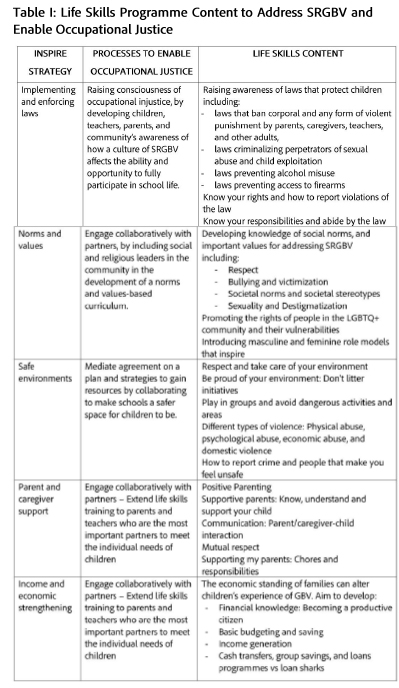
The World Health Organisation's INSPIRE strategy is a second framework using an integrated approach to assist those committed to preventing and responding to violence against children23Table I (below).
CONCLUSION
In this opinion piece, we have argued that school-related gender-based violence (SRGBV) poses a serious threat to the occupational engagement, health, and well-being of children, teachers and staff, parents, and the broader community. Because SRGBV restricts the choice of occupations, and opportunities to participate, it is a source of occupational injustice7
Author Contributions
Sylnita Swartz-Filies conceptualised and designed the piece. Literature was collected by Sylnita Swartz-Filies, and Nicola Plastow, and the manuscript was drafted by all listed authors, who also approved the final version thereof.
Conflicts of Interest
None to declare
REFERENCES
-
1. Human Rights Commission. Report of the Public Hearing on School-based Violence Chapter [Internet]. 2006. Available from: https://www.sahrc.org.za/home/21/files/School_Based_Violence_Report.pdf
» https://www.sahrc.org.za/home/21/files/School_Based_Violence_Report.pdf -
2. National Planning Commission. National development plan 2030: Our future-make it work [Internet]. Vol. 50, National planning Commission. 2012 [cited 2023 Mar 24]. p. 1-489. Available from: https://www.gov.za/sites/default/files/gcis_document/201409/ndp-2030-our-future-make-it-workr.pdf
» https://www.gov.za/sites/default/files/gcis_document/201409/ndp-2030-our-future-make-it-workr.pdf -
3. Centre for Justice and Crime Prevention (CJCP). The National School Safety Framework. Cape Town: Centre for Justice and Crime Prevention [Internet]. Cape Town. 2016 [cited 2024 Mar 24].Available from: https://www.education.gov.za/Portals/0/Documents/Publications/SchoolSafetvFramework 2016.pdf?ver=2016-02-19-133421-363_2016-02-19-133421-363
» https://www.education.gov.za/Portals/0/Documents/Publications/SchoolSafetvFramework 2016.pdf?ver=2016-02-19-133421-363_2016-02-19-133421-363 -
4. Feldhacker D., Cerny S, Brockeveit B., Lawler M. Occupations and Well-Being in Children and Youth. In: Rodriguez de la Vega, L, Toscano W, editor. Handbook of Leisure, Physical Activity, Sports, Recreation and Quality of Life [Internet]. Springer, Cham; 2018.p.119-38.Available from: http://www.sciencedirect.com/science/article/pii/S0160738315000444
» http://www.sciencedirect.com/science/article/pii/S0160738315000444 -
5. UNESCO UNGEI. School-Related Gender-Based Violence (SRGBV) UNGEI - UNESCO Discussion Paper [Internet]. 2013. Available from: https://www.ungei.org/sites/default/files/School-Related-Gender-Based-Violence-UNGEI-UNESCO-Discussion-Paper-2013-eng.pdf
» https://www.ungei.org/sites/default/files/School-Related-Gender-Based-Violence-UNGEI-UNESCO-Discussion-Paper-2013-eng.pdf -
6. SaferSpaces. Gender-based violence in South Africa [Internet]. 2022 [cited 2024 Mar 24].Available from: https://www.saferspaces.org.za/understand/entry/gender-based-violence-in-south-africa
» https://www.saferspaces.org.za/understand/entry/gender-based-violence-in-south-africa -
7. Jere CM. School-related Chitsamatanga BB, Rembe NS. School related gender based violence as a violation of children's rights to education in South Africa: Manifestations, consequences and possible solutions. J HumEcol.2020;69(1-3):65-80. doi: https://doi.org/10.31901/24566608.2020/69.1-3.3203
» https://doi.org/10.31901/24566608.2020/69.1-3.3203 - 8. gender-based violence is preventing the achievement of quality education for all - Education For All Global Monitoring Report. 2015;(March):1-16.
-
9. UNESCO and UN Women. Global guidance on addressing school-related gender-based violence; 2016 [Internet]. United States of America: United Nations Girls' Education Initiative PP - United States of America;2016.Available from: https://policycommons.net/artifacts/11123653/global-guidance-on-addressing-school-related-gender-based-violence-2016/doi: https://doi.org/10.54675/vfop6248
» https://policycommons.net/artifacts/11123653/global-guidance-on-addressing-school-related-gender-based-violence-2016/doi: https://doi.org/10.54675/vfop6248 -
10. Psaki SR, Mensch BS, Soler-Hampejsek E. Associations between violence in school and at home and education outcomes in rural Malawi: A longitudinal analysis. Comp Educ.Rev.2017;61(2):354-90. doi: https://doi.org/10.1086/691117
» https://doi.org/10.1086/691117 - 11. SIDA. Preventing and Responding to Gender-based violence. 2015;1-47. Available from:
-
12. UNESCO. Behind the numbers: ending school violence and bullying. Behind the numbers: ending school violence and bullying. 2019. doi: https://doi.org/10.54675/trvr4270
» https://doi.org/10.54675/trvr4270 -
13. SaferSpaces. National School Safety Framework (NSSF) [Internet]. 2024 [cited 2024 Mar 24]. Available from: https://www.saferspaces.org.za/be-inspired/entry/national-school-safety-framework-nssf#:~:text=lnanutsheU,and_violence-free_learning_environment.
» https://www.saferspaces.org.za/be-inspired/entry/national-school-safety-framework-nssf#:~:text=lnanutsheU,and_violence-free_learning_environment - 14. WFOT.Occupational-Therapy-Services-in-School-based-Practice-for-Children-and-Youth-updated-links-Archived. 2016.
-
15. Galvaan R, Peters L, Gretschel P. Embracing an occupational perspective to promoting learning in context. South African J High Educ. 2016;29(3):281-93. doi: https://doi.org/10.20853/29-3-498
» https://doi.org/10.20853/29-3-498 - 16. Sonday A, Anderson K, Flack C, Fisher C, Greenhough J, Kendal R, et al. School-based occupational therapists: An exploration into their role in a Cape Metropole full service school. South African J Occup Ther. 2012;42(1):2-6.
-
17. Kirsh B, Martin L, Hultqvist J, Eklund M. Occupational Therapy Interventions in Mental Health: A Literature Review in Search of Evidence. Occup Ther Ment Heal [Internet]. 2019;35(2):109-56. https://www.tandfonline.com/doi/full/10.1080/0164212X.2019.1588832
» https://www.tandfonline.com/doi/full/10.1080/0164212X.2019.1588832 - 18. Wilcock AA, Townsend EA. Occupational justice. In: Crepeau EB, Cohn ES, Schell BAB, editors. Willard & Spackman's occupational therapy. Baltimore: Lippincott Williams & Wilkins.; 2009. p. 192-9.
-
19. White B, Arthanat S, Crepeau EL. Perspectives about Occupational Justice: can poverty and occupational deprivation influence child development? 2008; The University Dialogue. 37.Available from: https://scholars.unh.edu/discovery/ud/37
» https://scholars.unh.edu/discovery/ud/37 - 20. Magalhäes MJ, Pontedeira C, Guerreiro A, Ribeiro P. Integrating the prevention of gender-based violence in the curriculum design and development with high school teachers. Eur J Curric Stud. 2016;3(2):520-31.
-
21. Whiteford G, Jones K, Rahal C, Suleman A. The Participatory Occupational Justice Framework as a tool for change: Three contrasting case narratives. J Occup Sci [Internet]. 2018;25(4):497-508. https://www.tandfonline.com/doi/full/10.1080/14427591.2018.1504607
» https://www.tandfonline.com/doi/full/10.1080/14427591.2018.1504607 -
22. Brown A. School-based gender-related violence in Namibia: causes and manifestations. Commonw Youth Dev. 2016,14(1):54-64. https://unisapressjournals.co.za/index.php/CYD/article/view/1384
» https://unisapressjournals.co.za/index.php/CYD/article/view/1384 - 23.World Health Organization (WHO). INSPIRE: Seven strategies for ending violence against children. Uptake between 2016 and 2021. World Health Organization. Licence: CC BY-NC-SA 30 IGO. 2022.
-
24.Abaoglu H, Cesim ÖB, Kars S, ÇelikZeynep. Life Skills in Occupational Therapy Occupational Therapy: Occupation Focused Holistic Practice in Rehabilitation. 2017 Jul 5;49. doi: http://dx.doi.org/10.5772/intechopen.68462
» http://dx.doi.org/10.5772/intechopen.68462 - 25.Thobane M, Artz L, Ngubane M. Educators ' perceptions of school - related gender based violence : a case study of four schools in Ethekwini, Kwazulu-Natal. 2023;(May).

Reviewed: 1st round: 31 May 2023
Reviewed: 2nd round: 23 October 2023
Revised: 26 March 2024
Accepted: 30 March 2024
Data availabiity: Not applicable
Funding: No funding was received for the research.