Relationship among diseases of the nervous-and circulatory systems, hospital length of stay and functional gain of patients in a private sub-acute hospital, Gauteng, South Africa
Abstract
INTRODUCTION: This study aimed to determine if a relationship between average length of stay of patients diagnosed with diseases of the nervous system (ICD-10 code G) and of the circulatory system (ICD-10 code I) and their functional gains private sub-acute hospital in Gauteng exists. METHOD: A retrospective chart review study of patients with diseases of the nervous system (ICD-10 code G) and patients with diseases of the circulatory system (ICD-10 code I) admitted in Gauteng, South Africa, from 2017-2021. Descriptive statistics of percentages, median and range were used to summarise the data while inferential statistics of Mann-Whitney U, Kruskal-Wallis and Spearman rank correlation were used to determine median differences and relationship between the variables during data analysis. RESULTS: A total of 380 patient records were included in the study (n=380). The records with code "G" and "I" consisted of 24.7% and 75.3% respectively. The median length of stay (LOS) for code G and I were 29 (IQR 17-59.25) and 27 (IQR 14-42) day, respectively and the median differences were statistically significant (p=0.028). The median total functional outcomes achieved by patients with code G and I was 19 (IQR 3-30.25) and 22 (IQR of 9.75-35.25) respectively. The median differences were statistically significant (p=0.034). CONCLUSION: Patients with diseases of the circulatory system (ICD 10 code I) have shorter length of stay and better functional outcomes in comparison to diseases of the nervous system (ICD 10 code G) patients. There is a direct relationship between LOS and functional outcomes of patients with diseases of the circulatory system (ICD-10 code I) but this was not seen with patients with diseases of the nervous system (ICD-10 code G). IMPLICATIONS FOR PRACTICE • Early identification of rehabilitation potential and referral to a sub-acute hospital is of utmost importance considering that patients with diseases of the nervous system (ICD 10 code G) require a longer length of stay and generally achieve less functional outcomes. • Therapists and sub-acute hospitals should consider prioritising their resources with the aim of discharge preparation of patients with diseases of the nervous system (ICD 10 code G) earlier in the rehabilitation process. • Sub-acute hospital case managers could potentially consider admission of patients with diseases of the circulatory system (ICD 10 code I) in a certain wing of the hospital considering that they displayed better functional outcomes with a shorter length of stay. Hence more patients with the same ICD-10 code could potentially be admitted more frequently to assist more patients in goal achievement. • This does not imply that patients with diseases of the nervous system (ICD-10 code G) should receive less rehabilitation than patients with diseases of the circulatory system (ICD 10-code I), instead it is suggested that therapists and clinicians readjust their focus and plan their therapy programmes to the expected functional outcomes.
cost of care; multi-disciplinary rehabilitation team; BETA scale; minimally clinically important differences; ICD-10 code; therapy programmes; hospital admission; hospital discharge; FIM; good health and well-being
INTRODUCTION
An ICD-10 code is an alphanumerical code that is assigned to a patient to describe the diagnosis for which they seek medical assistance1th revision (ICD-10) coding system is used presently as a classification system of choice in many countries23
It has been accepted that occupational therapists use the ICD-10 coding system to obtain information about a patient's diagnosis to guide their assessment. The occupational therapist considers the precautions and specific body functions and structures to assess based on the diagnosis456
Functional gains are defined as the difference between the functional score on admission and the functional score of the patient on discharge78
The BETA nursing measure consists of 18 items that were developed based on the Functional Independence Measure (FIM) scale of items. The categories of the BETA scale were culturally adapted to suit the South African nursing science environment. This scale is presently being used by the rehabilitation team including occupational therapists to measure functional gains in a sub-acute hospital. Training is needed on the use of this scale prior to administration. The scale consists of 13 motor items and five cognitive items89
Differences in diagnoses and associated functional gains in patients have been reported as well as the degree of functional independence pertaining to different diagnosis of the patient101111
Research on the length of stay in hospitals is significant as it is directly associated with cost of care. When the cost of care is known it may allow for effective budgeting for health management authorities1112
METHODS
Study/Research design
This study used a quantitative approach. This study was a retrospective chart review study consisting of past patient records from a private sub-acute hospital in Gauteng, South Africa.
Data Collection and Analysis
Request letter seeking permission to access patients' data were submitted to the hospital (dated 06/03/2023). Discharge reports and patient BETA score sheets including their sociodemographic, funding methods and discharge destinations relevant to length of stay and functional outcomes were requested from the participating hospital to be used in the study-Length of Hospital Stay: The length of stay of the patients were divided into patients who stayed 1-14 days, 15-30 days, and 31 days or more. Functional Outcomes: Functional gains were defined as the difference between the functional score on admission and the functional score of the patient on discharge. This was assessed using the BETA scale. The quantified minimally clinically important difference (MCID) as identified in a study was used1313
Data were assessed for normal distribution. Length of stay and functional gains were found to be skewed. Descriptive statistics of mean, standard deviation, frequency, percent, mode, median and interquartile range were used to describe and summarize the data on age, gender, funding methods, discharge destinations, length of stay, and functional outcomes.
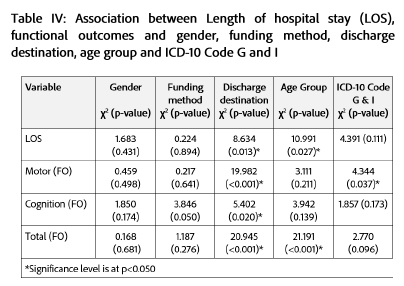
Furthermore, inferential statistics of Mann-Whitney U test were used to determine differences in the length of stay and functional gains of diseases of the circulatory system (ICD 10 code I) and diseases of the nervous system (ICD 10 code G). Spearman correlation coefficient was used to determine the relationship between length of stay and ICD-10 codes I and G. Mann-Whitney U and Kruskal-Wallis H Test were used to determine differences in length of stay and functional outcome of patients with ICD-10 codes I and G across gender, age, type of funding, and discharge destination. Chi-square were used to determine association between length of stay and gender, age, type of funding, and discharge destination. Chi-square were used to determine association between functional outcome and gender, age, type of funding, and discharge destination. Significance of p<0.050 was used throughout the analysis of the data.
A multiple regression analysis was done to examine the predictors of length of stay and functional gains. The variables included are gender, funding method, discharge destination, age, BETA scores on admission and discharge and ICD-10 codes G and I. The functional outcomes of the patients were divided into minimally clinical important difference (MCID) for motor items and cognition items.
Population and sampling
The sample size consisted of in-patients admitted to the hospital between 2017 and 2021. All the patients whose records were included received rehabilitation services while admitted to the hospital. The records from the sub-acute hospital were retrieved to determine the length of stay of patients with diseases of the circulatory system (ICD 10 code I) and diseases of the nervous system (ICD 10 code G), the average functional outcomes of these patients and other variables that could be relevant to length of stay and functional outcomes such as the gender of patients, methods of funding, ages, and possible discharge destinations.
The inclusion criteria of the past patient records were patients with a primary ICD 10 code I and G, patients that were funded by medical aid, road accident fund, or out of pocket payments (privately funded patients). Patients with complete admission and discharge records. The past patient records with incomplete discharge records and those without a diagnosis of diseases of the nervous system (ICD 10 code G) and diseases of the circulatory system (ICD 10 code I) were excluded.
Sample procedure
The sample size was estimated using the G* Power software1414
Ethics clearance was obtained from the Biomedical Research Ethics Committee (BREC) of the University of KwaZulu-Natal for approval before commencement of this study (Ref no: BREC/00005464/2023). Gatekeeper permission was obtained from the participating hospital before commencement of the study on 06/03/2023.
RESULTS
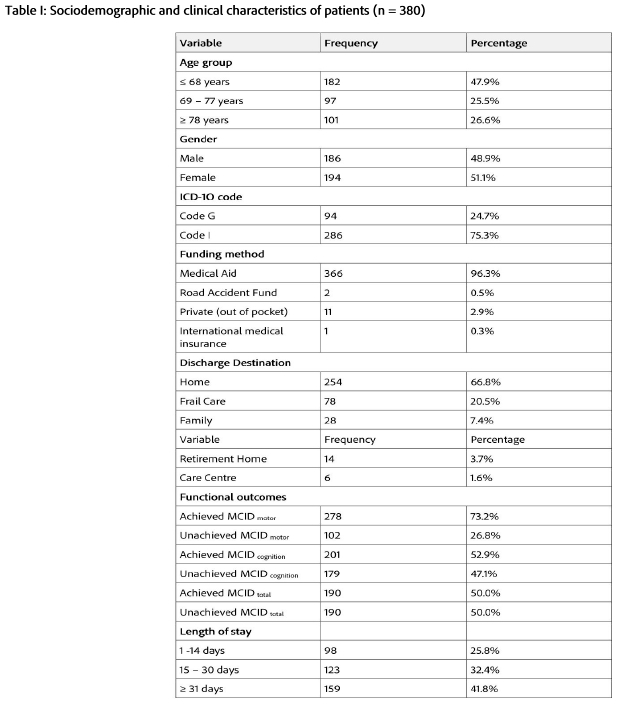
Table I (below) presents the sociodemographic and clinical characteristics of 380 patient records which were included in the study. The sample consisted of 48.9% males and 51.1% females with mean age of 66.12±16.04 (range, 18 - 96) years. Many (52.1%) were 69 years or older. The records with diseases of the nervous system (ICD 10 code G) consisted 24.7% of the data and diseases of the circulatory system (ICD 10 code I) represents 75.3% of the data. The majority of patients were funded by medical aid 366 (96.3%). The majority, 66.8% (n = 254) of the patients returned to their home upon discharge. Most patients in the study (73.2%) achieved MCID for motor function while 52.9% achieved MCID for cognition function. However, only half (50.0%) of the patients achieved MCID in overall functional gains. Most of the patients stayed in hospital for 31 days or more.


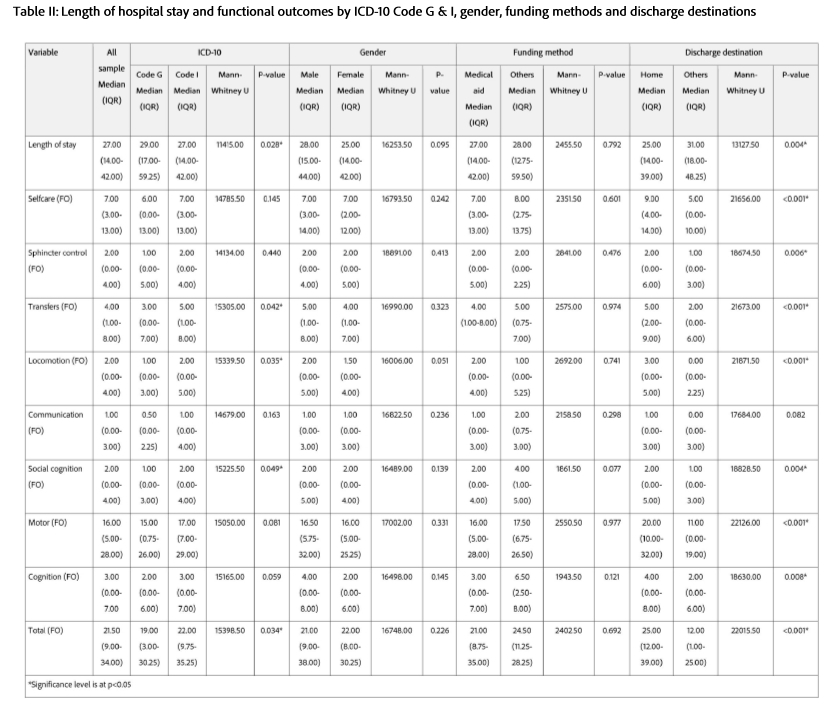
Table II (below), Illustrates the length of hospital stay and the functional outcomes achieved by patients with diseases of the nervous system (ICD 10 code G) and patients with diseases of the circulatory system (ICD 10 code I) as well as the entire sample. The median length of stay of the patients with ICD-10 code G and I was 29 (IQR 17-59.25) and 27 (IQR14-42) days respectively and were statistically significant (p=0.028). The median total functional outcomes achieved by patients with diseases of the nervous system (ICD 10 code G) was 19 (IQR = 3-30.25) while for the diseases of the circulatory system (ICD 10 code I) the median was 22 (IQR = 9.75-35.25). There was a statistically significant difference between them (p=0.034). However, when stratified by the sub-scales, the difference in functional outcomes was statistically significant for transfers (p=0.042), locomotion (p=0.035) and social cognition (p=0.049). Furthermore, Table II (below) illustrates length of stay and functional outcomes by gender. The median length of stay for males was 28 days and for females 25 days. The median functional outcomes for males was 21 and 22 for females. None of the data above were statistically significant.
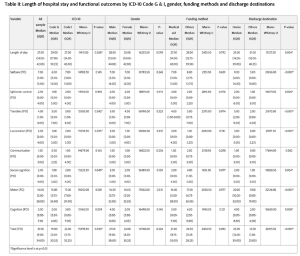
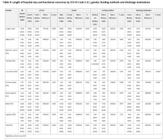
Table II (above) also illustrates the length of hospital stay and functional outcomes by funding methods. No statistically significant difference was found amongst the variables based on funding method (Table V, page 6). However, it should be noted that medical aid had less length of stay than other funding methods where the median is 27 (IQR= 14-42) and 28 (IQR=12.75-59.50) days respectively. Table II (above) presents the difference in patients' length of stay and functional outcomes between discharge destinations. All variables of length of stay and functional outcomes were statistically different between discharge destinations except communication domain (p=0.082).The median length of stay for home discharge was 25 (IQR = 14-39) days. The median length of stay for others were 31 (IQR = 18- 48.25) days. The median total functional outcomes for home discharge were 25 (IQR =12-39). The median total functional outcomes for other discharge destinations were 12 (IQR = 1-25).
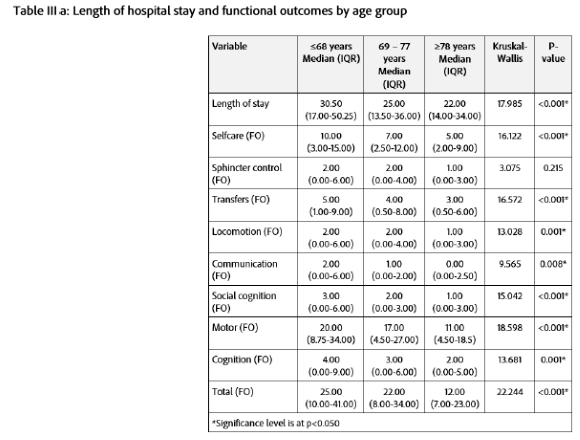
Table IIIa (page 5) presents test of difference in patients' length of stay and functional score between age groups. All variables were statistically different except sphincter control domain. The median length of stay for the age group <68 years for self-care, was 30.50 (IQR= 17.00-50.25) days and the total functional outcomes 25 (IQR=10-41).
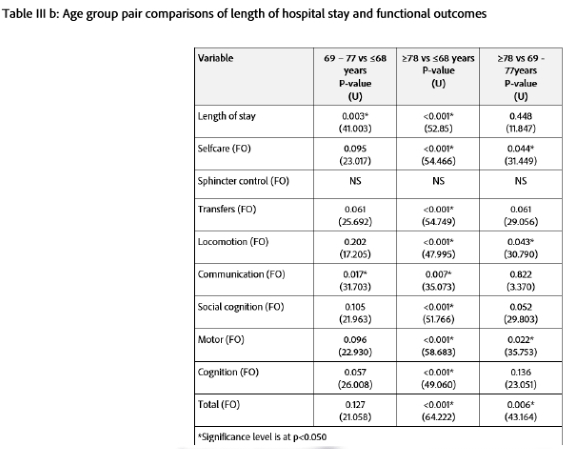
Table IIIb (page 5) indicates a statistically significant difference for all variables except for self-care and the sphincter control functions when comparing the age groups >78 vs <68 years. For age group comparison 69-77 vs <68 years statistical significance is noted with length of stay (p=0.003) and functional outcomes communication (p=0.017). Statistical significance is observed with age group comparison >78 vs 69 - 77years for functional outcomes self-care (p=0.044), locomotion (p=0.043)( motor (p=0.022) and total functional outcomes (p=0.006). Patients younger than 68 years had the longest median length of stay and displayed the most median total functional gains when compared with age group more than 78 years of age.
Table IV (page 6) indicates the association between the various variables. Evidently, there is a statistically significant association between length of stay and discharge destination. There is a statistically significant association between functional outcomes, motor and discharge destination. Also, there is a statistically significant association between functional outcomes motor and diseases of the nervous system (ICD 10 code G) & diseases of the circulatory system (ICD 10 code I). A statistically significant association was observed between with functional outcomes total and discharge destination. Length of stay and total functional gain were significantly associated with age. There is no statistically significant association between length of stay, functional outcomes total and ICD-10 codes G and I.
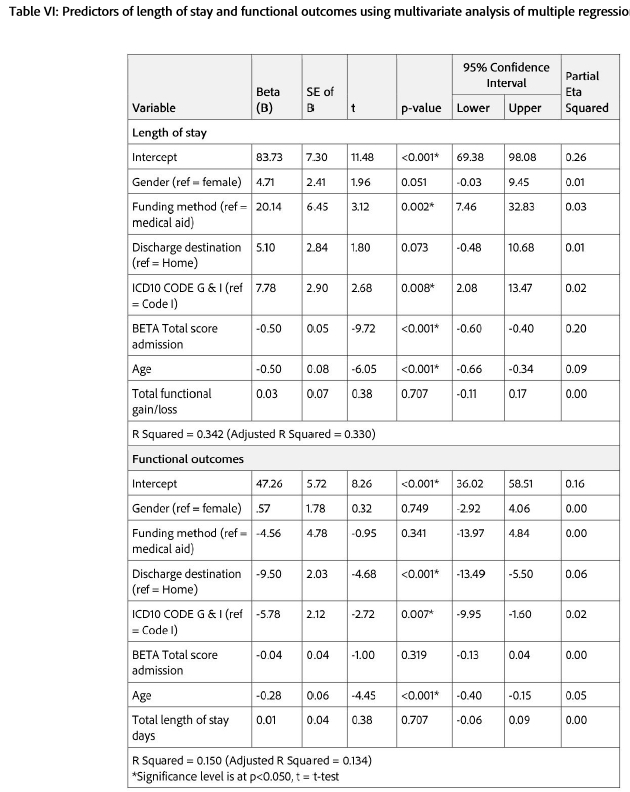
Multivariate analysis of multiple regression was used to assess the predictors length of stay and functional outcomes. Only four factors were significant predictors of length of stay and these included: funding method (medical aid), diseases of the circulatory system (ICD 10 code I), total BETA admission scores and age. These four factors accounted for 32.4% of variance. However, only admission total BETA scores have large effect size on length of stay. Functional outcomes were significantly predicted by discharge destination (home), diseases of the circulatory system (ICD 10 code I) and age which accounted for 15% of variance.
DISCUSSION
The study reviews the relationship between the median length of stay of a patient with diseases of the circulatory system (ICD 10 code I) and diseases of the nervous system (ICD 10 code G), and the functional gains achieved with regard to the identified variables. The majority of patients achieved MCID for motor function 73.2% (n=278) while 52.9% (n=201) achieved MCID for cognition function. Half of the patients achieved MCID in overall functional gains. These findings are similar to a retrospective study conducted on an inpatient rehabilitation programme in Saudi Arabia1515
No statistically significant difference was found between the length of stay for males and females and functional outcomes achieved in this study.
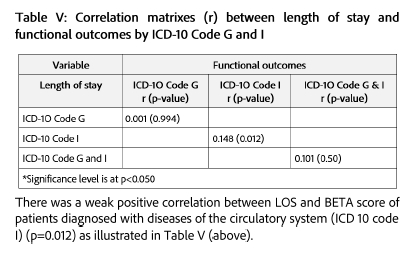
The results of this study established a positive but weak relationship between length of stay of patients diagnosed with diseases of the circulatory system (ICD 10 code I) and their functional gains in ADL It may suggest that when length of stay of patients with diseases of the circulatory system (ICD 10 code I) increases, functional outcomes improve. In contrast, in the study there exists no correlation between length of stay and functional outcomes for patients with diseases of the nervous system (ICD 10 code G).
The patients with diseases of the nervous system (ICD 10 code G) had a median length of stay of 29 days and patients with diseases of the circulatory system (ICD 10 code I) had a median length of stay of 27 days. In a study conducted in South Korea between January and December 2013, which investigated the average length of stay of patients based on their ICD-10 codes, the average length of stay of patients diagnosed with ICD-10 codes G 40-G47 and G50-59 were 5.11 days "The average length of stay of the ICD-10 codes I 63.8 and I 63.9 were 13.42 days and 13.96 days respectively. The diagnosis of the ICD-10 codes I 63.9 and I 21.9 had the longest average length of stay in hospital11
It was revealed that the median total functional outcomes achieved by patients with diseases of the nervous system (ICD 10 code G) was 19 (IQR 3-30.25) and for patients with diseases of the circulatory system (ICD 10 code I), 22 (IQR of 9.75-35.25). The total functional outcomes achieved by patients with diseases of the circulatory system (ICD 10 code I) was significantly higher than the patients with diseases of the nervous system (ICD 10 code G). However, these differences were only noted for the sub-scales of functional outcomes for transfers, locomotion, and cognition in patients with diseases of the circulatory system (ICD 10 code I).
We established that patients who were funded by medical aid had a shorter length of stay than patients funded by other methods. The difference was not statistically significant. This was contradictory with pertinent literature. According to a study conducted in a middle-income country, increased length of stay was seen with patients who were not required to pay for medical services161717
Our study also revealed a statistically significant association between length of stay and discharge destination. The majority, 66.8% of the patients returned home on discharge, length of stay was statistically significant for patients who did not go home on discharge compared with those discharged to home destinations. These discharge destinations included frail care, family care, retirement home or care centres. These patients stayed for a longer duration in hospital than those who went home on discharge. This is in accordance with literature from a study conducted regarding predictors of discharge destination with patients diagnosed with ICD-10 code G 61.8 (Guillain- Barre syndrome) in a developed country1818
A statistically significant association was revealed with total functional outcomes and discharge destination. There is a statistically significant association between motor functional outcomes discharge destination and diseases of the nervous system (ICD 10 code G) & diseases of the circulatory system (ICD 10 code I). Total functional outcomes were significantly higher for patients who went home on discharge. It is suggested that this may be ascribed to the decreased level of care these patients required upon discharge. This can be supported by studies which predicted home discharge for patients who needed less assistance on admission and discharge15-19,20,21
Significantly longer length of stay was noted for patients <68 years which was the youngest age group in this study. These patients had the longest median length of stay and displayed the most median total functional gains when compared with the age group more than 78 years of age. The subcategories of functional outcomes for self-care, transfers, locomotion, communication, social cognition, motor, and cognition were significantly higher for this age group. This is in accordance with a review study regarding predictors of gains in inpatient rehabilitation, where there is strong evidence that patients with younger age displayed better functional outcomes22
The length of stay and total functional gain were significantly associated with age. This was in accordance with a study conducted in Saudi Arabia which investigated functional outcomes by age after stroke rehabilitation2020122323
Possible predictors for length of stay were identified and includes having access to medical aid, being diagnosed with diseases of the circulatory system (ICD 10 code I), the total BETA score on admission and the age of the individual. It should be noted that only admission BETA scores had a large effect on length of stay. This might suggest that a higher BETA score on admission may indicate a shorter length of stay. It can be supported by an existing study which investigated length of stay and functional outcomes among stroke patients in Saudi Arabia.24 24
Higher functional outcomes were predicted by discharge destination (home), diseases of the circulatory system (ICD 10 code I) and age (< 68 years) better than patients with diseases of the nervous system (ICD 10 code G). This is in accordance with a study that indicated older patients had less functional gains than younger patients20
Limitations of the study
This study was the first to investigate the relationship between length of stay of patients with diseases of the nervous system (ICD 10 code G) and diseases of the circulatory system (ICD 10 code I) and the functional outcomes achieved in a private sub-acute hospital in Gauteng South Africa, using the BETA scale. These results are applicable to one private hospital in South Africa and further investigation is needed to determine if it correlates with other hospitals across the provinces. Moreover, the study did not consider the International Classification of Functioning, Disability and Health (ICF) classification in the measurement of functional outcomes.
CONCLUSION
Patients with diseases of the circulatory system (ICD 10 code I) have shorter length of stay and better functional outcomes compared patients with diseases of the nervous system (ICD 10 code G). There is a direct relationship between length of stay and functional outcomes of patients with diseases of the circulatory system (ICD 10 code I), but not with patients with diseases of the nervous system (ICD 10 code G). Initiating discharge planning for ICD-10 code G patients earlier in the rehabilitation process will be beneficial for both the patient and the subacute hospital. This does not suggest that patients with diseases of the nervous system (ICD 10 code G) should have a shorter length of stay. Instead, having realistic expectations about expected functional gains and average length of stay will guide therapists and families to plan for optimal recovery of the patient and effective management of hospital resources.
Recommendations:
• Larger studies in South African sub-acute hospitals are required to establish if our findings are in accordance with studies in other provinces of the country.
• The frequency of the use of the BETA scale in other sub-acute hospitals will provide insight into which scale of measurement is being used to measure functional improvement.
• More studies focusing on specific ICD-10 codes could provide insightful information on the expected LOS and functional improvement per diagnosis code. Based on these data, protocols could be established based on specific ICD-10 codes.
Conflicts of interest and disclaimer
The authors declare that there is no financial or personal conflict of interest that may have influenced the study or the writing of this article.
The perspectives and viewpoints conveyed in this article represent the authors and came from the research. They may not necessarily align with the official policies of any associated institution, organization, or the publisher. The authors take full responsibility for the outcomes, findings, and content of this article.
Author contributions
Elmarie Broodryk conceptualised the idea for the research study, and she was involved in formal analysis, data cu ration, writing of the original draft and the project administration. She was supervised and assisted by Nonjabulo Ndaba, Michael Ogunlana and Olufemi Oyewole. Nonjabulo Ndaba and Michael Ogunlana were involved in writing, reviewing and editing of the draft. Olufemi Oyewole was involved in the formal analysis, writing, reviewing and editing the draft. All authors agreed to the final version of the article and the order of the authors listed.
Acknowledgements
We would like to acknowledge the participating hospital for their assistance with access to the past patient records.
REFERENCES
-
1. World Health Organization. International statistical classification of diseases and related health problems. World Health Organization; 2011. https://icd.who.int/browse10/content/statichtnnl/icd10volume2_en_2016.pdf
» https://icd.who.int/browse10/content/statichtnnl/icd10volume2_en_2016.pdf -
2. Hirsch JA et al. ICD-10: History and context. American Journal of Neuroradiology. 2016;37(4):596-599. https://doi.org/10.3174/ainr.A4696
» https://doi.org/10.3174/ainr.A4696 -
3. Ministerial ICD-10 Task Team. South African ICD-10 Technical User Guide Technical User Guide. 2014, https://www.health.gov.za/wp-content/uploads/2021/02/icd-10_technical_mzuserguide.pdf
» https://www.health.gov.za/wp-content/uploads/2021/02/icd-10_technical_mzuserguide.pdf - 4. Fallahzadeh Abarghuei A, Hassani Mehraban A, Lajevardi L, Yousefi M. The clinical application of ICF model for occupational therapy in a patient with stroke: A case report. Med J Islam Repub Iran. 2018;32:65
-
5. Bruun IH, Nergaard B. Occupational therapy and physiotherapy benefit the acute patient pathway: A mixed-methods study. Journal of Nursing Education and Practice. 2014;4(4):172-182. https://doi.org/10.5430/jnep.v4n4p172
» https://doi.org/10.5430/jnep.v4n4p172 -
6. García-Pérez P, Rodríguez-Martínez MDC, Lara JP, de la Cruz-Cosme C. Early occupational therapy intervention in the hospital discharge after stroke. International Journal of Environmental Research and Public Health. 2021;18(24). https://doi.org/10.3390/iierph182412877
» https://doi.org/10.3390/iierph182412877 -
7. Ng YS et al. Functional Outcomes after Inpatient Rehabilitation in a Prospective Stroke Cohort. Vol 22 2013. https://doi.org/10.1177/201010581302200304
» https://doi.org/10.1177/201010581302200304 -
8. Loubser HJ, Casteleijn D, Bruce JC. The BETA* nursing measure: Calibrating construct validity with Rasch analyses. Health SA Gesondheid. 2015;20(1):22-32. https://doi.org/10.1016/j.hsag.2015.02.001
» https://doi.org/10.1016/j.hsag.2015.02.001 -
9. SADFM. Tools, The Beta scale. South African Database for Functional Medicine. 2022 [accessed 2023 Jun 16]. https://sadfm.co.za/tools/
» https://sadfm.co.za/tools/ -
10. Valach, Selz. Rehabilitation Programmes monitored by Functional Independence Measure: An Observational Study. International Physical Medicine & Rehabilitation Journal. 2017,2(1):173-178. https://doi.org/10.15406/ipmrj.2017.02.00039
» https://doi.org/10.15406/ipmrj.2017.02.00039 -
11. Baek H et al. Analysis of length of hospital stay using electronic health records: A statistical and data mining approach. PLoS ONE. 2018,13(4). https://doi.org/10.1371/journaLpone.0195901
» https://doi.org/10.1371/journaLpone.0195901 -
12. Pillay SC et al. Factors affecting length of hospital stay in stroke survivors in South Africa: A call for a stroke unit. African Journal of Disability. 2022;11:1-7. https://doi.org/10.4102/AJOD.V11IQ.1065
» https://doi.org/10.4102/AJOD.V11IQ.1065 -
13. Beninato M et al. Determination of the minimal clinically important difference in the FIM instrument in patients with stroke. Archives of Physical Medicine and Rehabilitation. 2006,87(1):32-39. https://doi.org/10.1016/i.apmr.2005.08.130
» https://doi.org/10.1016/i.apmr.2005.08.130 -
14. Soper DrD. A-priori Sample Size Calculator. 2019 [accessed 2023 Jun 17]. http://www.danielsoper.com/statcalc
» http://www.danielsoper.com/statcalc -
15. Bindawas SM, Mawajdeh H, Vennu V, Alhaidary H. A retrospective observational study of functional outcomes, length of stay, and discharge disposition after an inpatient stroke rehabilitation programme in Saudi Arabia. In: Medicine (United States). Vol. 95. Lippincott Williams and Wilkins; 2016. https://doi.org/10.1097/MD.0000000000004432
» https://doi.org/10.1097/MD.0000000000004432 -
16. Khosravizadeh O et al. Factors affecting length of stay in teaching hospitals of a middle-income country. Electronic physician. 2016;8(10):3042-3047. https://doi.org/10.19082/3042
» https://doi.org/10.19082/3042 -
17. Mcleod H, Ramjee Ii S. Policy and legislative framework of Medical Schemes. 2002. https://www.hst.org.za/publications/South%20African%20Health%20Reviews/9SAHR_2006-2007_Section%204.pdf
» https://www.hst.org.za/publications/South%20African%20Health%20Reviews/9SAHR_2006-2007_Section%204.pdf -
18. Kushner DS et al. Predictors of discharge to home/community following inpatient-rehabilitation in a US national sample of Guillain-Barre-Syndrome patients. PLoS ONE. 2023;18(5 MAY):1-10. https://doi.org/10.1371/journaLpone.0286296
» https://doi.org/10.1371/journaLpone.0286296 -
19. Mees M et al. Predicting discharge destination after stroke: A systematic review. Clinical Neurology and Neurosurgery. 2016;142:15-21. https://doi.org/10.1016/j.clineuro.2016.01.004
» https://doi.org/10.1016/j.clineuro.2016.01.004 -
20. Bindawas SM, Vennu V, Mawajdeh H, Alhaidary H. Functional outcomes by age after inpatient stroke rehabilitation in Saudi Arabia. Clinical Interventions in Aging 2017;12:1791-1797. https://doi.org/10.2147/CIA.S145402
» https://doi.org/10.2147/CIA.S145402 -
21. Chevalley O, Truijen S, Opsommer E, Saeys W. Physical functioning factors predicting a return home after stroke rehabilitation: A systematic review and meta-analysis. Clinical Rehabilitation. 2023. https://doi.org/10.1177/02692155231185446
» https://doi.org/10.1177/02692155231185446 -
22. Chang EY, Chang EH, Cragg S, Cramer SC. Predictors of gains during inpatient rehabilitation in patients with stroke: A review. Critical Reviews in Physical and Rehabilitation Medicine. 2013,-25(3-4):203-221. https://doi.org/10.1615/CritRevPhvsRehabilMed.2013008120
» https://doi.org/10.1615/CritRevPhvsRehabilMed.2013008120 -
23. Matizirofa L, Chikobvu D. Analysing and quantifying the effect of predictors of stroke direct costs in South Africa using quantile regression. BMC Public Health. 2021;21(1). https://doi.org/10.1186/s12889-021-11592-0
» https://doi.org/10.1186/s12889-021-11592-0 -
24. Bindawas SM et al. Length of stay and functional outcomes among patients with stroke discharged from an inpatient rehabilitation facility in Saudi Arabia. Medical Science Monitor. 2018;24:207-214. https://doi.org/10.12659/MSM.907452
» https://doi.org/10.12659/MSM.907452
1st Round Review:17 July 2024
Revised: 31 January 2025
2nd Second Review: 3 November 2024
Revised: 31 January 2025
Accepted: 12 May 2025
EDITOR
Annelize Kruger
https://orcid.org/0000-0002-7947-2929
DATA AVAILABILITY
The data that support the findings of this study are available from the corresponding author, [EB], upon reasonable request for 10 years post publication.
FUNDING
The researchers did not receive any funding to conduct this study.