Occupational therapy pain management to enable occupational engagement. Ratified by Council: March
Linda HiemstraI; Dershnee DevanII; Helen RoomeIII; Gill CoetzeeIV
IOccupational Therapy Association Of Occupational Therapy (OTASA). https://orcid.org/0009-0005-9480-5532
IIOccupational Therapy Association Of Occupational Therapy (OTASA). https://orcid.org/0000-0002-1738-6718
IIIOccupational Therapy Association Of Occupational Therapy (OTASA). https://orcid.org/0009-0001-0977-2483
IVOccupational Therapy Association Of Occupational Therapy (OTASA). https://orcid.org/0009-0009-7390-9315
Pain was defined by the International Association for the Study of Pain (IASP) in 2020 as:
"... An unpleasant sensory and emotional experience associated with, or resembling that associated with, actual or potential tissue damage" 1:1
The experience of pain is always subjective, personal, and influenced by multiple factors, namely social (including deprivation, isolation, lack of access to services), emotional factors, (including distress and previous trauma), expectations and beliefs, mental health (including anxiety, depression and post-traumatic stress disorder) and biological factors. Furthermore, the International Association for the Study Pain (IASP)11
Pain affects a person's ability to exercise, enjoy normal sleep, perform household chores, work efficiently, attend social activities, drive a car, walk, have sexual relations, maintain relationships, and find enjoyment in life2,3.
In a recent report (2019) of the Unit States Pain Management Best Practices Inter-Agency Task Force445
Acute and chronic pain are associated with many health conditions. In South Africa, the evidence suggests that 1 in 5 adults experience chronic pain with the limbs and back beingthe most common sites of pain657
PURPOSE OF DOCUMENTThis document serves to identify the role and intervention responsibilities of Occupational Therapists in the management of adult patients with primary and secondary pain conditions, or conditions in which pain is a symptom that causes loss of age-appropriate occupational performance and independence; supported by the clear compatibility of occupational therapy's foundational principles, philosophies, models, frameworks, interventions, and training.
1. Occupational therapy models applicable to pain management
Various occupational therapy models used with pain management interventions are reported in literature. These include:
• The Canadian Model of Occupational Performance and Engagement8-11
• The Person-Environment-Occupation Model12-14
• The Model of Human Occupation15-17
• Ecology of Human Performance mode18
These models emphasize the placing the person at the centre of any intervention, and encourages the therapist to consider how the person's impairment interacts with the particular barriers or enablers of occupational performance, the client's environment, and the occupations that the person has to or wants to engage in. For more information on the aspects that should be considered in the assessment and management of chronic pain, clinicians can consider the aspects highlighted in the ICF core set for chronic widespread pain1911
Occupational therapy intervention may include the use of strategies such as (amongst others)
"activity management, activity adaptation, the development of coping strategies and vocational rehabilitation and may involve working with patients at home, school or workplace in addition to clinical settings"20:451
1. Occupational therapy role in pain management
Occupational therapists working in pain management may have various goals for treatment. These include:
• Improving participation in all categories of occupations affected21
• Enabling occupational engagement and performance
• Promoting functional independence, mobility, and autonomy
• Addressing occupational balance
• Improving body mechanics and activity tolerance
• Modifying tasks and the occupational environment to allow optimum participation.
• Enhancing social interaction and facilitating community reintegration
• Vocational rehabilitation
• Prevention of further disability
• Health promotion and quality of life2223
2. Practice guidelines for occupational therapists in pain management
Pain is a prevalent symptom that forms part of multiple physical and psychiatric diagnoses in the adult population. In this position paper interventions are not categorized in according to diagnostic groups. However, the occupational therapist should be aware that pain can impact occupational performance regardless of the underlying pathology and should assess this intentionally and address any impairments or functional limitations due to pain pro-actively.
The assessments and interventions occupational therapists working in pain management use should be guided by a self-management approach24
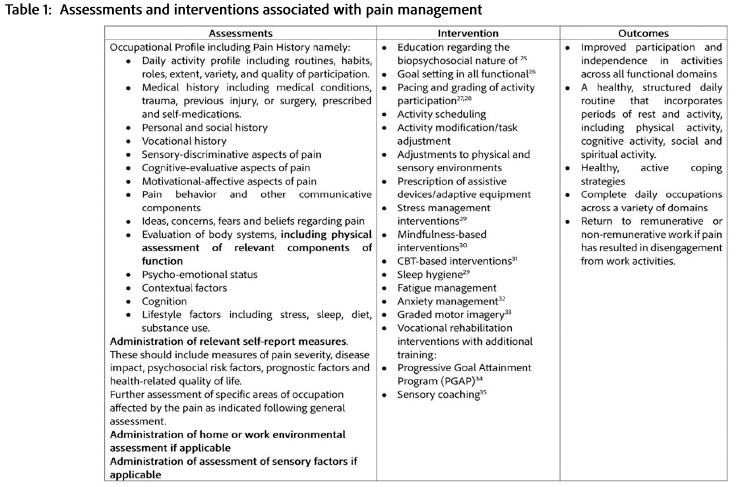
Table I (below) lists assessments and interventions associated with pain management, but it is not exhaustive. There may be interventions required by the specific presenting pathology, which are different to those required for pain management, which need to be performed in addition to those listed.
REFERENCES
-
1. International Association for the Study of Pain Terminology Working Group. IASP Revises Its Definition for the First Time Since 1979. International Association for the Study of Pain. 2020 [accessed 2022 Mar 20]:1. https://www.iasp-pain.org/publications/iasp-news/iasp-announces-revised-definition-of-pain/
» https://www.iasp-pain.org/publications/iasp-news/iasp-announces-revised-definition-of-pain/ -
2. Dorfman C. Impact of Pain on the Daily Life of Older Adults. The American Journal of Occupational Therapy. 2018;72(4_Supplement_1):7211500010p1-7211500010.doi: https://doi.org/10.5014/ajot.2018.72S1-PO2003
» https://doi.org/10.5014/ajot.2018.72S1-PO2003 -
3. World Health Organisation. World Health Organization supports global effort to relieve chronic pain. WHO, Geneva. 2004 [accessed 2022 Feb 6]. https://www.afro.who.int/news/world-health-organization-supports-global-effort-relieve-chronic-pain
» https://www.afro.who.int/news/world-health-organization-supports-global-effort-relieve-chronic-pain -
4. Cheng J, Rutherford M, Singh VM. The HHS pain management best practice inter-agency task force report calls for patient-centered and individualized care. Pain Medicine (United States). 2020;21(1):1-3. doi: https://doi.org/10.1093/pm/pnz303
» https://doi.org/10.1093/pm/pnz303 -
5. Republic of South Africa. Regulations defining the Scope of the profession of occupational therapy Health Professions Act 56 of 1974. Government Gazette 45396 29 Oct 2021.2021 [accessed 2022 Mar 11]. https://www.gov.za/sites/default/files/gcis_document/202111/45396gon1147.pdf. doi: http://dx.doi.Org/10.1097/j.pain.0000000000001869
» https://www.gov.za/sites/default/files/gcis_document/202111/45396gon1147.pdf -
6. Kamerman P., Bradshaw D, Laubscher R, Pillay-van Wyk V, Gray G., Mitchell D, Chetty S. Almost 1 in 5 South African adults have chronic pain: a prevalence study conducted in a large nationally representative sample. Pain. 2020;161 (7):1629-1635. doi: https://doi.org/10.1097/j.pain.0000000000001844
» https://doi.org/10.1097/j.pain.0000000000001844 -
7. Kahere M, Hlongwa M. A Scoping Review on the Epidemiology of Chronic Low Back Pain among Adults in Sub-Saharan Africa. International Journal of Environmental Research and Public Health. 2022;19(5):2964. doi: https://doi.org/10.3390/ijerph19052964
» https://doi.org/10.3390/ijerph19052964 - 8. Davis JA. The Canadian Model of Occupational therapy for people experiencing illness, injury or impairment: Promoting occupation and participationccupational Performance and Engagement (CMOP-E). In: Curtin M, Egan M, Adams J, editors.
- 9. Occupational therapy for people experiencing illness, injury or impairment: Promoting occupation and participation. 7th ed. London, UK: Elsevier; 2017. p. 148-168.
-
10. Persson E, Lexell JAN, Rivano-Fischer M, Eklund M. Everyday occupational problems perceived by participants in a pain rehabilitation programme. Scandinavian Journal of Occupational Therapy. 2014;20(4):306-314. doi: https://doi.org/10.3109/11038128.2013.793739
» https://doi.org/10.3109/11038128.2013.793739 -
11. Simon AU, Collins CER. Lifestyle Redesign ® for Chronic Pain Management : A Retrospective Clinical Efficacy Study. 2017. doi: https://doi.org/10.5014/ajot.2017.025502
» https://doi.org/10.5014/ajot.2017.025502 -
12. Lagueux É, Dépelteau A, Masse J. Occupational Therapy's Unique Contribution to Chronic Pain Management: A Scoping Review. Pain Research and Management. 2018;2018. doi: https://doi.org/10.1155/2018/5378451
» https://doi.org/10.1155/2018/5378451 -
13. Law M, Cooper B, Strong S, Stewart D, Rigby P, Letts L. The person-environment-occupation model: A transactive approach to occupational performance. Canadian Journal of Occupational Therapy. 1996;63(1):9-23. doi: https://doi.org/10.1177/000841749606300
» https://doi.org/10.1177/000841749606300 -
14. American Occupational Therapy Association. Position Statement - Role of Occupational Therapy in Pain Management. The American Journal of Occupational Therapy. 2022,75(3). doi: https://doi.org/10.5014/ajot.2021.75S3001
» https://doi.org/10.5014/ajot.2021.75S3001 -
15. McCarthy K, Chamberlain M, Chinn M, Pineda J, Santiago C, Spitzer J, Tran P. Social Participation in College Students with Chronic Pain. The Open Journal of Occupational Therapy. 2021;9(1):1-12. doi: https://doi.org/10.15453/2168-6408.171
» https://doi.org/10.15453/2168-6408.171 - 16. Taylor R. Kielhofner's model of human occupation: theory and application. 2017.
- 17. Brolsma A, Durbin A, Pullar C. The Benefits of Habituation Altering Occupational Therapy Interventions to Improve Engagement in ADLs and lADLs for Adults with Chronic Pain. UND Scholarly Commons. 2022.
- 18. Locke K, Ray E, Sylte J. Interventions Addressing Social and Leisure Participation for Adults with Musculoskeletal Chronic Pain. UND Scholarly Commons. 2020.
- 19. Dunn W, Brown C, McGuigan A. The ecology of human performance: A framework for considering the effect of context. American Journal of Occupational Therapy. 1994;48(7):595-607.
-
20. ICF Core Sets Projects. ICF Core Set for Chronic Widespread Pain. ICF Research Branch. 2017 [accessed 2022 Feb 27]. https://www.icf-research-branch.org/icf-core-sets-projects2/musculoskeletal-conditions/icf-core-set-for-chronic-widespread-pain
» https://www.icf-research-branch.org/icf-core-sets-projects2/musculoskeletal-conditions/icf-core-set-for-chronic-widespread-pain -
21. Hill W. The role of occupational therapy in pain management. Anaesthesia & Intensive Care Medicine. 2016,17(9):451-453. doi: https://doi.Org/10.1016/j.mpaic.2016.06.008
» https://doi.Org/10.1016/j.mpaic.2016.06.008 -
22. American Occupational Therapy Association. Occupational therapy practice framework: Domain and process (4th ed.). American Journal of Occupational Therapy. 2020;74(Suppl. 2):7412410010. doi: https://doi.org/10.5014/ajot.2020.74S2001
» https://doi.org/10.5014/ajot.2020.74S2001 -
23. Katz N. The impact of pain management on quality of life. Journal of Pain and Symptom Management. 2002;24(1):S38-S47. doi: https://doi.org/1016/s0885-3924(02)00411-6.
» https://doi.org/1016/s0885-3924(02)00411-6 - 24. Cynkin S. Occupational Therapy: Toward Health Through Activities. Boston: Little, Brown & Company; 1979.
- 25. Lorig K. Self-management of chronic illness: a model for the future. Generations: Journal of the American Society on Aging. 1993;17(3):11-14.
-
26. Moseley GL, Butler DS. Fifteen Years of Explaining Pain: The Past, Present, and Future. Journal of Pain. 2015;16(9):807-813. doi: https://doi.org/10.1016/j.jpain.2015.05.005
» https://doi.org/10.1016/j.jpain.2015.05.005 -
27. Stanos S. Focused review of interdisciplinary pain rehabilitation programs for chronic pain management. Current Pain and Headache Reports. 2012;16(2):147-152. doi: https://doi.org/10.1007/s11916-012-0252-4
» https://doi.org/10.1007/s11916-012-0252-4 -
28. Abonie US, Sandercock GRH, Heesterbeek M, Hettinga FJ. Effects of activity pacing in patients with chronic conditions associated with fatigue complaints: a meta-analysis. Disability and Rehabilitation. 2020, 42(5):613-622. doi: https://doi.org/10.1080/09638288.2018.1504994
» https://doi.org/10.1080/09638288.2018.1504994 -
29. López-De-Uralde-Villanueva I, Munöz-Garcia D, Gil-Martínez A, Pardo-Montero J, Munöz-Plata R, Angulo-Diaz-Parrenö S, Gómez-Martínez M, La Touche R. A systematic review and meta-analysis on the effectiveness of graded activity and graded exposure for chronic nonspecific low back pain. Pain Medicine (United States). 2016, 17(1):172-188. doi: https://doi.org/10.1111/pme.12882
» https://doi.org/10.1111/pme.12882 -
30. Gupta CC, Sprajcer M, Johnston-Devin C, Ferguson SA. Sleep hygiene strategies for individuals with chronic pain: a scoping review. BMJ open. 2023;13(2):e060401. doi: https://doi.org/10.1136/bmjopen-2021-060401
» https://doi.org/10.1136/bmjopen-2021-060401 -
31. Jensen MP. Psychosocial approaches to pain management: An organizational framework. Pain. 2011, 152(4):717-725. http://dx.doi.org/10.1016/j.pain.2010.09.002.
» http://dx.doi.org/10.1016/j.pain.2010.09.002 -
32. Veehof MM, Oskam MJ, Schreurs KMG, Bohlmeijer ET. Acceptance-based interventions for the treatment of chronic pain: A systematic review and meta-analysis. Pain. 2011;152(3):533-542. doi: http://dx.doi.org/10.1016/j.pain.2010.11.002
» http://dx.doi.org/10.1016/j.pain.2010.11.002 -
33. Deng G. Integrative Medicine Therapies for Pain Management in Cancer Patients. Cancer Journal (United States). 2019, 25(5):343-348. doi: https://doi.org/10.1097/PPO.0000000000000399
» https://doi.org/10.1097/PPO.0000000000000399 -
34. Bowering KJ, O'Connell NE, Tabor A, Catley MJ, Leake HB, Moseley GL, Stanton TR. The effects of graded motor imagery and its components on chronic pain: A systematic review and meta-analysis. Journal of Pain. 2013;14(1):3-13. http://dx.doi.org/10.1016/j.jpain.2012.09.007.doi: https://doi.org/10.1016/j.jpain.2012.09.007
» http://dx.doi.org/10.1016/j.jpain.2012.09.007.doi: https://doi.org/10.1016/j.jpain.2012.09.007 -
35. Sullivan MJL, Adams H, Rhodenizer T, Stanish WD. A Psychosocial Risk Factor - Targeted Intervention for the Prevention of. Physical Therapy. 2006;86(1):8-18. doi: https://doi.org/10.1093/ptj/86.1.8
» https://doi.org/10.1093/ptj/86.1.8 -
36. Voss P, Thomas ME, Cisneros-Franco JM, de Villers-Sidani É. Dynamic brains and the changing rules of neuroplasticity: Implications for learning and recovery. Frontiers in Psychology. 2017;8(OCT):1-11. doi: https://doi.org/10.3389/fpsyg.2017.01657
» https://doi.org/10.3389/fpsyg.2017.01657