Sensory processing, praxis and related social participation of 5-12 year old children with Down Syndrome attending educational facilities in Bloemfontein, South Africa
Abstract
BACKGROUND: Down syndrome is one of the most investigated and well discussed syndromes related to intellectual disability, yet little can be found in literature of the impact that sensory processing difficulties or disorders have on the functioning of individuals with Down syndrome. This study investigated the sensory processing, praxis and related social participation of children with Down syndrome with the purpose of contributing to a better understanding thereof and heightening awareness of the importance of including sensory integration therapy as part of intervention. METHODS: The study was conducted by using a cross-sectional, quantitative, descriptive study design. The Sensory Processing Measure (SPM) Home Form was used to collect information regarding the children's sensory processing, praxis and related social participation. The questionnaire was completed by a parent or caregiver of a child with Down syndrome (n=15). RESULTS: The majority of the children with Down syndrome included in the study experienced vulnerabilities in social participation (53.3%) and praxis (80.0%), whereas 100% of the children experienced vulnerabilities in sensory processing. CONCLUSION: The results of this study contribute to the emerging understanding of the sensory processing, praxis and related social participation of children with Down syndrome. The findings may be taken into consideration by occupational therapists delivering services to children with Down syndrome to ensure optimal intervention. It is recommended that further studies on larger samples investigate this topic to corroborate these findings.
Sensory processing; social participation; praxis; Down syndrome; sensory processing measure
INTRODUCTION
Available literature provides evidence that children with Down syndrome experience difficulties with functions that are largely dependent on sensory integration. Low muscle tone, poor balance and motor planning difficulties have been identified by researchers as factors contributing to poor motor development and performance in children with Down syndrome123
Deficits in sensory processing, praxis and related social participation influence an individual's engagement in everyday occupations such as eating, dressing, grooming, playing, social interaction and school-ing4
The possible implications of sensory processing difficulties do not only have relevance for individuals with Down syndrome, but also for occupational therapists' intervention for this population, if best practice is endeavoured in terms of service delivery. The researchers therefore attempted to address a gap in the literature regarding the sensory processing, praxis and related social participation of children with Down syndrome51
Down Syndrome
According to Down Syndrome South Africa, the incidence of Down syndrome is estimated to be one in 1000 live births in developed countries, one in 650 live births in developing countries, and approximately one in 500 live births in South Africa6
Down syndrome is a chromosomal disorder most commonly associated with an additional copy of chromosome 21 (trisomy 21)7889-11. It has been noted that children with Down syndrome experience challenges with adaptive behaviour, such as social skills, and therefore struggle to adjust their behaviour and/ or responses126
Sensory processing
Initially the paradigm of sensory integration was constructed by Dr. Jean Ayres138:2,3), sensory integration is a neurological process that allows for "the organisation of sensations for use" and thus the integration of sensations from one's body and from the environment makes it possible to use the body effectively in the environment. A group of occupational therapy researchers proposed a paradigm shift in 2007 regarding the terminology, suggesting that sensory integrative dysfunction be referred to as sensory processing disorder1314
Although not all occupational therapists and authors may agree, it has been suggested in recent years that sensory processing and sensory integration may be used interchangeably13
Sensory processing and function
Difficulty with sensory processing negatively influences a wide variety of basic skills, resulting in problems with everyday activities such as self-care, play, social participation and school15
Interactions between the sensory systems such as auditory, vestibular, proprioceptive, tactile and visual provide integrated information that contributes to progressively more complex be-haviour888
The term modulation, also referred to as self-organisation, is a brain process of increasing or reducing neural activity in order to maintain balance between all functions of the nervous system15 16
Praxis is a term used to describe the ideation (planning), execution, and sequencing of novel motor actions16161175,16.
The authors are of the opinion that the sensory processing difficulties experienced by children with Down syndrome do not always receive the necessary acknowledgement - and therefore limits sensory integration intervention for this population. With this study an attempt is made not only to focus on children and the sensory processing dysfunctions/difficulties they experience but also to add to the limited body of knowledge regarding the specificity thereof.
AIMThe aim of the study was to describe the sensory processing, praxis and related social participation of a selected sample of children with Down syndrome 5-12 years of age, attending educational facilities in Bloemfontein.
METHODOLOGY
This research study made use of a cross-sectional quantitative, descriptive study design18
Population and sampling procedures
The population that was considered for this research was children with Down syndrome aged between 5-12 years, attending educational facilities in Bloemfontein and whose parents or caregivers were willing to participate in the study. The Sensory Processing Measure (SPM) Home Form that was used to collect data was developed for completion by parents or caregivers of children55
A non-randomised convenience sampling method was used as the overall study population was relatively small. Therefore, all consecutive study participants that provided consent were included.
The inclusion and exclusion criteria for the study participants were as follows:
Inclusion criteria
✥ Children with Down syndrome aged 5 to 12 years and their parents or caregivers attending identified educational facilities in Bloemfontein. The SPM Home Form was standardised for this age group5
✥ Parents or caregivers who were verbally proficient in English. The SPM is currently available only in English and may not be translated due to copyright. Time limitations did not allow for the lengthy process of obtaining permission from the publishers and then translating the questionnaire if permission had been granted. The researchers were, however, available throughout the completion of the questionnaire to explain any words which caused confusion or needed clarification.
Exclusion criteria
✥ Children with co-morbid diagnoses such as attention deficit disorder and hyperactivity (ADHD) and autism were excluded due to possible influences on the results. (Congenital heart defects and mental retardation were not excluded as these conditions are common among individuals with Down syndrome).
✥ Children that at the time of the study received or had previously received sensory integration therapy from a trained Ayres Sensory Integration (ASI) occupational therapist were also excluded due to the influence thereof on the results.
Data collection instrument and procedures
The Sensory Processing Measure (SPM) was developed to obtain a profile of how a child processes sensory information, plans, executes and sequences motor actions, and how they participate in social circumstances5
For the purpose of this study, the researchers only made use of the Home Form, as the other two forms, namely the Main Classroom Form and Environment Difference Form, contain questions that are not relevant for all the children with Down Syndrome in the South African context as some of the children are in schools for children with special needs or have received school exemption.
Each of the 75 test items represents a question related to a variety of behaviours and characteristics that are evidence of the child's sensory processing, praxis abilities and related social par-ticipation55
The SPM Home Form yields a total of eight444
The questionnaire was completed by the parents or caregivers, or verbally answered where one of the researchers then filled in the form. A suitable time was arranged with parents or caregivers for completion of the SPM questionnaire at the relevant facilities, as these settings were familiar, accessable and convenient for them.
Analysis of data
The scoring of the response forms was completed by coding the data, combining the total results for each section of the questionnaire and then plotting these raw scores on the Home Form Profile Sheet to obtain the percentiles and T-scores, as well as the interpretive range for each of the eight mentioned areas. The coded demographics questionnaires as well as the coded SPM Home Forms were then analysed.
Descriptive statistics namely medians and ranges, were calculated for continuous data. Frequencies and percentages were calculated for categorical data. The Statistical Analysis software (SAS) version 9.2 was used for analysis. The analysis was done by the Department of Biostatistics, University of the Free State.
Reliability of the study
The reliability of this research study lies in the use of a standardised questionnaire and the fact that the researchers were all formally trained in the administration, scoring and interpretation of the questionnaire. One of the researchers is also an occupational therapist well versed within the field of sensory integration.
Methodological errors
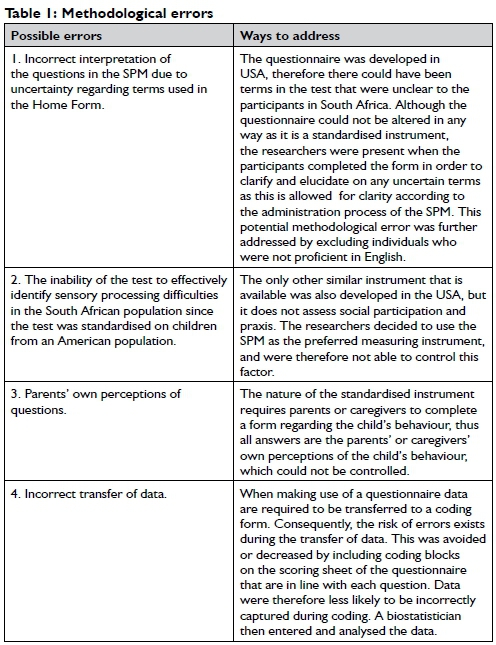
Possible methodological errors were identified and are summarised in Table 1.
Ethical aspects
Permission was obtained from the Ethics Committee of the Faculty of Health Sciences at the University of the Free State to conduct this research.
All other relevant ethical procedures were followed by obtaining permission from the Free State Province Department of Education, the relevant authorities of the educational centres, and the participating parents/caregivers.
Avoidance of discomfort
Due to the sensitivity of the topic under investigation, emotional discomfort could have been endured by the parents or caregivers during the completion of the SPM Home Form and the feedback session. The researchers arranged with a qualified occupational therapist, trained in sensory integration, to be on call during all data collection sessions in case counselling was necessary.
Voluntary participation
Participation in the study was voluntary and participants were informed upon giving consent for participation that they could withdraw from the study at any time without being penalised in any manner.
Informed consent
The proceedings of the research were explained in detail to all participants by means of an information sheet. It was ensured that individuals agreed to participate and signed an informed consent form. All consent documents were made available in the three most predominantly spoken languages in Bloemfontein, namely English, Afrikaans and Sesotho to ensure that potential participants had a clear understanding of what participation in the study would require of them.
Misleading participation
The participants were provided with an information document prior to providing consent for participation in the study. This document included all information necessary for the participant, such as that compensation would not be provided for participation and that the study included assessment only and did not imply that treatment would be provided by the researchers or any other qualified occupational therapist. This information document indicated that information obtained from the study would be used for research purposes only. Consent was also obtained to publish the findings in a relevant journal and present the results on relevant research platforms.
Privacy, anonymity and confidentiality
To ensure confidentiality, each participant was allocated a participant number which was indicated on their demographics questionnaire, as well as a participant name and number form, and only this number was indicated on the SPM Home Form, which substituted the participant's name. The name and number form was handled by only one researcher to ensure confidentiality. The researchers had to be able to identify which questionnaire correlated with which participant, in order to provide accurate feedback to the parent or caregiver on completion of the study.
Since the research involved human beings and was required to be conducted in line with ethical guidelines, it was important that the researchers not only provided the parents or caregivers with information regarding the results of their particular child, but also to inform them on the results of the entire study. Scheduled feedback sessions were held, one at each individual institution, after the results were obtained. In instances where a child presented with sensory processing issues, it was in the participant's interest that the researchers informed the relevant educational facility's occupational therapist for further attention. This allowed for the issues to be addressed should the parents or caregivers have chosen to do so. A list of names and contact details of qualified occupational therapists practicing in Bloemfontein, was made available to parents or caregivers during the feedback session should they have wished to consult a private occupational therapist trained in Ayres Sensory Integration.
Compensation
Participation in this study was voluntary and the participants were informed before consenting to participation that they would only be provided with compensation for travelling costs to and from the relevant institution, in the case that the travelling was for the sole purpose of the research and not for another appointment/visit. Study participants were also informed that compensation would have a maximum cut-off point.
RESULTS
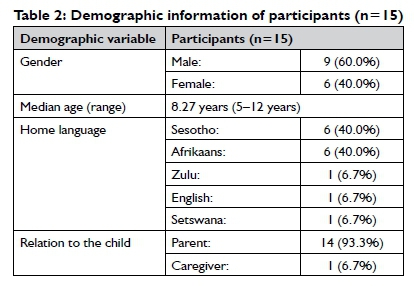
Fifteen parents or caregivers who met the inclusion criteria participated by completing the SPM Home Form questionnaires, and all the questionnaires were eligible for analysis. Table 2 summarises the demographic information of the participants.
Of the 15 study participants, 14 were parents and one was a caregiver. The children had a median age of slightly over eight years, with nine of them being male.
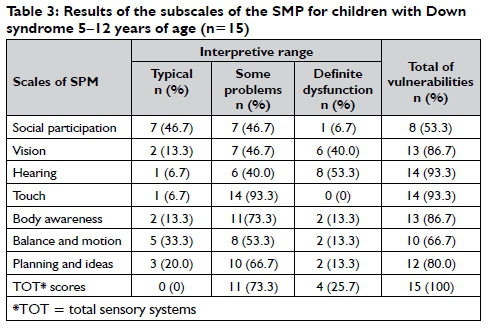
All children scoring in the 'some problems' and 'definite dysfunction' range were regarded as experiencing vulnerabilities5Table 3, only those scores indicating vulnerabilities will be discussed.
Results regarding social participation indicated that seven (46.7%) of the children scored within the typical range, while eight (53.3%) presented with vulnerabilities regarding social participation.
It was found that 13 (86.7%) of the children experienced vulnerabilities with regard to vision, and 14 (93.3%) children presented with vulnerabilities related to hearing. Fourteen (93.3%) children also presented with vulnerabilities with regard to touch, while 13 (86.7%) children experienced vulnerabilities with regard to body awareness. Vulnerabilities with regard to balance and motion were observed in 10 (66.7%) of the children.
The praxis (planning and ideas) results indicated that three (20.2%) of the children scored within the typical range, while the remainder (n=12; 80.0%) experienced vulnerabilities pertaining to planning of motor action and the generation of ideas regarding body use.
DISCUSSION
Visual input is essential for the integration of various sensations and appropriate functioning at every level of the brain in order to 'see' meaning in the environment, especially on a two-dimensional level, for example, the pages of a book15519
The auditory system contributes to the functions of hearing, speech and languageq6. The majority of the children in this study (n=14; 93.3%) presented with vulnerabilities in terms of hearing. Although it was reported that some sounds were disliked and could cause distress to individual children, the participants tended to repeatedly engaged in activities that produced certain sounds, such as flushing the toilet, indicating sensory seeking behaviour. These findings are supported by both Chen and Fang22
Tactile input is processed at lower levels of the brain and also influences emotions due to adjustments taking place in the reticular arousal system151
The functional purpose of the vestibular and proprioception systems is to develop effective posture, balance, gravitational security and muscle tone155I reported that movement sensitivity was common in 64% of their study population, and over-sensitivity to movement was experienced by only 13% of children with Down syndrome.
Body awareness, otherwise known as proprioception512 I who found that only 39% of study participants held items too tightly or too loosely.
Praxis is necessary for executing new and novel activities and also for engaging in activities of daily living independently, such as eating, dressing and brushing teeth66
Lastly, social participation forms a part of everyday activities such as play and schooling, and is an important performance area for all children, including those with Down syndrome159
CONCLUSION
This study aimed at determining the sensory processing, praxis and related social participation of children with Down syndrome. Results of this study revealed that 100% of children with Down syndrome experienced vulnerabilities in sensory processing, 80.0% of the children with praxis and 53.3% with social participation.
This study is the first of its kind done on a South African population, and the results contribute to the emergent understanding of the sensory processing, praxis and related social participation of children with Down syndrome within the South Africa context. These results need to be taken into consideration by occupational therapists delivering services to children with Down syndrome to ensure optimal intervention. Further research on larger samples is recommended.
REFERENCES
ACKNOWLEDGEMENTS
The parents and caregivers of the children with Down syndrome, for their willingness to participate in the study; Dr. Daleen Struwig, Faculty of Health Sciences, University of the Free State, for technical and editorial preparation of the manuscript.
LITERATURE REVIEW
- 1. Bruni M, Cameron D, Noy S, Dua S. Reported sensory processing of children with Down syndrome. Physical and Occupational Therapy in Pediatrics, 2010; 30(4): 280-293.
- 2. Chen Y, Fang P Sensory evoked potentials in infants with Down syndrome. Acta Paediatrica, 2005; 94(11): 1615-1618.
-
3. Lashno M. "Sensory integration: observations of children with Down syndrome and autistic spectrum disorders". Kennedy Krieger Institute. <http://www.kennedykrieger.org/patient-care/outpatient-programs/sensory_integration> (9 Feb 2016).
» http://www.kennedykrieger.org/patient-care/outpatient-programs/sensory_integration - 4. Myers C, Stephens L, Tauber S. Early intervention. In: Case-Smith J, O'Brien JC. Occupational Therapy for Children. 6th ed. Missouri: Mosby Elsevier, 2010: 681-712.
- 5. Parham DL, Ecker C, Miller-Kuhaneck H, Henry D, Glennon TJ. Sensory Processing Measure. Baltimore: Western Psychological Services, 2011.
- 6. Fidler DJ, Hepburn SL, Mankin G, Rogers SJ. Praxis skills in young children with Down syndrome, other developmental disabilities, and typically developing children. American Journal of Occupational Therapy, 2005; 59(2): 129-138.
- 7. Sadock BJ, Sadock VA. Synopsis of Psychiatry Behavioural Sciences/Clinical Psychiatry. 10th ed. Philadelphia: Lippincott Williams and Wilkin, 2010.
- 8. Schaaf RC, Smith Roley S. Sensory integration theory revisited. In: Sensory Integration: Applying Clinical Reasoning to Practice with Diverse Populations. Texas: Pro Ed; 2006: 2-7.
- 9. Dolva A, Coster W, Lilja M. Functional performance in children with Down syndrome. American Journal of Occupational Therapy, 2004; 58(6): 621-629.
-
10. Down Syndrome South Africa. <http://www.downsyndrome.org.za/main.aspx?artid=51> (9 Feb 2016).
» http://www.downsyndrome.org.za/main.aspx?artid=51 - 11. Jobling A. Motor development in school-aged children with Down syndrome: a longitudinal perspective. International Journal of Disability, Development and Education, 1998; 45(3): 283-293.
-
12. Uyanik M, Kayihan H. Down syndrome: sensory integration, vestibular stimulation and neurodevelopmental therapy approaches for children. In: Stone JH, Blouin M. International Encyclopedia of Rehabilitation. 2010. <http://cirrie.buffalo.edu/encyclopedia/en/article/48/> (9 Feb 2016).
» http://cirrie.buffalo.edu/encyclopedia/en/article/48/ - 13. Schaaf RC, Davies PL. Evolution of the sensory integration frame of reference. American Journal of Occupational Therapy, 2010; 64(3): 363-367.
- 14. Miller LJ, Lane SJ. Toward a consensus in terminology in sensory integration theory and practice: Part 1: taxonomy of neurophysiological processes. Sensory Integration Special Interest Section Quarterly, 2000; 23: 1-4.
- 15. Ayres AJ. Sensory Integration and the Child. Baltimore: Western Psychological Services; 2005.
- 16. Parham DL, Mailloux Z. Sensory integration. In: Case-Smith J, O'Brien JC. Occupational Therapy for Children. 6th ed. Missouri: Mosby Elsevier; 2010: 325-372.
- 17. Stewart KB. Purposes, processes and methods of evaluation. In: Case-Smith J, O'Brien JC, eds. Occupational Therapy for Children. 6th ed. Missouri: Mosby Elsevier, 2010: 193-215.
- 18. De Vos AS, Strydom H, Fouché CB, Delport CSL. Research at Grass Roots: For the Social Sciences and Human Service Professions. Pretoria: Van Schaik Publishers, 2011.
- 19. Uyanik M, Bumin G, Kayihan H. Comparison of different therapy approached in children with Down syndrome. Pediatrics International, 2003; 45(1): 68-73.