Expert opinion on splinting adult patients with neurological injuries
Abstract
In the light of a lack of research evidence, this study explored expert opinion for splinting in adults with neurological injuries. An exploratory, descriptive, qualitative methodology was used with 14 occupational therapists, experienced in neuro-rehabilitation. Data were analysed based on a priori themes from two models of clinical practice:- • The Model of Practice Development: - themes indicate that most value was placed on personal knowledge gained from experience in the field and being able to individualise treatment for each patient. Procedural knowledge gained from clinical experience; reflection on protocols and working with and learning from others were seen as essential in developing skills required for splinting in adults with neurological injuries. • The Three Track Model of Clinical Reasoning: - Themes indicated that the effectiveness of the splints depended on the patients' context and response as well as the therapists' ability to adapt to their preferences and goals. Procedural reasoning and goals related to client factors should not be considered in isolation and each patient must be considered individually when prescribing splints. Considering the patients' context and the support and resources they have, is also essential. Outcomes in adults with neurological injuries should consider occupational performance and client satisfaction when evaluating effectiveness of splinting.
Splinting; Adults with neurological dysfunction or conditions; Clinical reasoning; Professional development
INTRODUCTION
The effectiveness of splinting the hand and upper limb following neurological injury in adults for both stroke and non-progressive brain lesions, such as traumatic brain injury (TBI), remains controversial1231,4,5.
Despite this lack of evidence splinting is often used clinically by occupational therapists in adults following brain injury and stroke. The reasons for splinting include affecting spasticity and hypertonia or maintaining joint range and length of soft tissues5-7 even though research indicates splinting is not effective in improving or changing upper limb function, hand range of motion (ROM), pain or spastic-ity in adults after stoke and other chronic non-progressive brain lesions14
Research on the clinical reasoning used by occupational therapists has however shown that the decision to use splinting with adults with neurological dysfunction appears to be based on a number of factors other than controversial research evidence8,9. These factors include the individual differences in dysfunction with which each patient presents8,9, severity of contractures, the context of the patient and their family and the setting in which the patient is treated9,10.
This is supported by other studies which found positive results for splinting adults with neurological injury. Andringa et al1112
This study therefore explored clinical reasoning and professional development which influence expert and experienced occupational therapists' prescription of splints for adult patients with neurological dysfunction. According to Lo and Field1313
Systematic reviews completed in 2003 by Lannin and Herbert5 1411544
These findings support the literature on clinical reasoning in occupational therapy which forms the basis of providing individualised intervention162
It is important therefore to explore the clinical reasoning and decision making used by occupational therapy clinicians in identifying and determining the factors which contribute to the effectiveness of splinting adults with neurological conditions in clinical practice91718,19 in this study.
The Model of Practice Development describes the growth of professional knowledge within clinical practice which is built up through professional education (propositional knowledge), actual practice (procedural knowledge) and professional and life experiences (personal knowledge)1720
Development of clinical expertise is also supported by the development of clinical reasoning which involves the analysis of the knowledge gained as well as the appropriate application of techniques to particular patients1918,19. Clinical reasoning at this level is concerned with the application of splinting in relation to the following variables: client factors21
Interactive reasoning, the second level of clinical reasoning occurs during face-to-face interactions with the patient allowing the therapist to better understand the patient as an individual, build trust and show personal interest in the patient1922
The use of interactive reasoning therefore allows the matching of treatment goals and strategies to each individual patient in a remarkably diverse client group where no single procedural theory fits all6223
It has been shown that with the development of clinical expertise therapists are able to practice in a more effective client-centred way as a result of having achieved high levels of both professional knowledge and clinical reasoning. Experienced therapists are more able to appreciate what the patient brings to the treatment situation in terms of their own preferences, concerns and expectations16
While the use of professional knowledge and clinical reasoning may not always be a conscious process1912
The objectives of the study were therefore to:
✥ Explore the current practice of expert occupational therapists (i.e. those with post graduate training and ten or more years of experience1616
✥ Explore the use of professional knowledge and clinical reasoning by expert or experienced occupational therapists' in the prescription of splints for the hand following neurological injury in adults.
METHODOLOGY
The study made use of an exploratory, descriptive, deductive, qualitative research methodology2416
Sampling
A sample of 14 occupational therapists was purposively selected. Participants were all occupational therapists with at least five years of experience, all of whom had had postgraduate training. All participants lived in Gauteng and they all participated in one of three focus groups.
Data instruments
Two case studies, adapted from cases in an occupational therapy textbook by Curtin et al25
A discussion guide based on the current literature on splinting in adults with a neurological dysfunction was developed for use in conjunction with the case studies. This assisted in considering aspects of clinical reasoning and professional development and ensured consistency in all three groups26
Procedure
Ethical clearance for the study was obtained from the Human Ethics Research Committee at the University of the Witwatersrand. The discussion guide and case studies were piloted with a group of occupational therapists who were less experienced, to refine the discussion guide. Selected participants were then invited to attend a focus group at their convenience. The groups took place after work hours and lasted 90-120 minutes.
During the focus groups participants were asked to justify and then discuss the decisions about splinting that they would have made for the two presented case studies. The focus groups were led by the first author and audio recorded. Field notes were made by another occupational therapist, who also played the role of co-leader in the focus groups. These notes were discussed and checked by the first author immediately after the completion of each focus group.
Data analysis
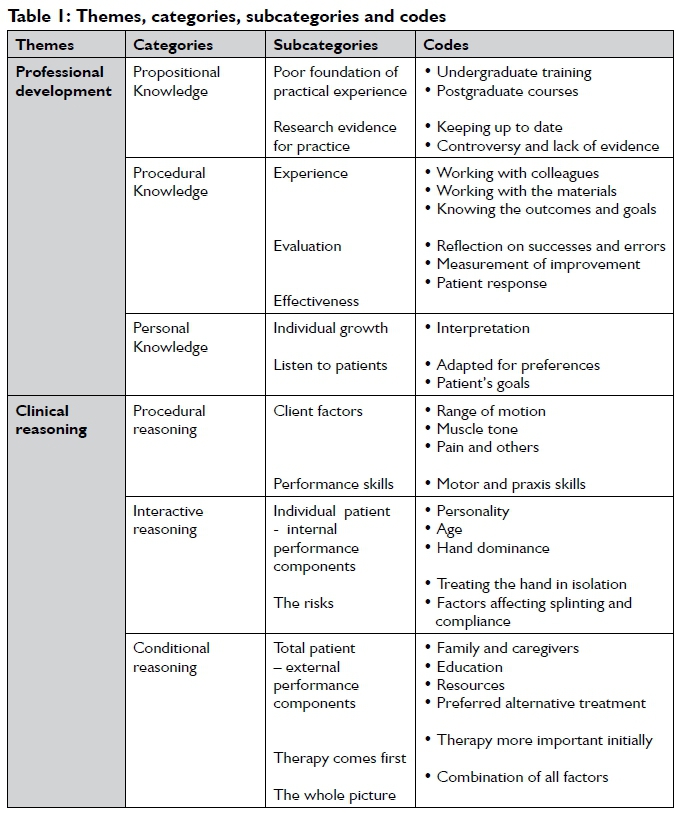
The discussion from each focus group was transcribed and analysed using deductive reasoning into a priori themes based on the Model of Practice Development1718,19(Table I).
Trustworthiness was ensured by emailing summaries of the coding to participants for member checking and for additional comments. Peer examination of codes was utilised as findings were discussed with the research supervisor as well as the occupational therapist who assisted with facilitating the focus groups. No more than three focus groups were needed to achieve data saturation. Field notes were used to inform the coding of the data.
FINDINGS
Participants had a mean of 10.2 years of neurological rehabilitation experience ranging from five to 25 years. Nine of the 14 participants had postgraduate degrees, six of these being in the field of neurology. The same number of participants had postgraduate Neurodevelopmental Therapy (NDT) training. All participants had previously worked in the public sector but were presently working in the private sector or academia at universities in Gauteng.
The a priori themes and categories can be seen in (Table I).
THEME I: Professional Development
Propositional knowledge
Participants indicated that very little knowledge about splinting patients with neurological injuries was obtained in their undergraduate courses. The knowledge and understanding gained around the basic principles and biome-chanics that govern splinting did not guide their practice in the field of neurology. Knowledge gained at postgraduate courses was not always considered easy to implement in the clinical setting:
courses are often so complicated that you couldn't after having done one, even under supervision attempt to do it somewhere else again.
While some participants felt knowledge could be gained by keeping up to date and reading up on current evidence, there was difficulty with finding consensus on which information in the available literature was of any value.
These experienced participants indicated that there was no set protocol for this type of splinting and their discussion frequently reflected words of uncertainty, such as I don't know, maybe, might, and hopefully. Other comments indicating their uncertainty and the lack of any sound research evidence and clear prescription guidelines when splinting patients with neurological conditions are reflected in the following statements
You might actually have a trial of changing the wrist position to see.
I don't know, maybe my theory is a bit wrong, but for me I like to get the thumb out, that really helps because hopefully then you are going to get an overlap, hopefully there will be some regaining of movement so then they can use the movement during the day... and then leave it on at night.
Procedural knowledge
Participants placed great emphasis on the value of their clinical experience and knowledge gained through actual practice when providing the evidence they use in splinting in neurological conditions. Working with more experienced colleagues, was consistently the most valuable contributor to the development of knowledge and clinical skill in this type of splinting. Participants' experience in working with the actual splinting materials and developing familiarity with techniques on how to use materials more effectively was also highly valued.
The most participants felt the dorsal-volar (anti-spasticity) splint would be more effective in the cases studies presented in the focus groups and the following comments were made:
I've seen successful and unsuccessful splinting and they don't always depend on the splint
the material and type of splint to me is not so much the issue. the design of the splint wouldn't be so much as important as the position, but which design would best support the position that you wanted.
The participants emphasised that achieving specific outcomes or goals was more important than the actual splint itself. The importance of comprehensive assessment and close monitoring in order to determine the need for and purpose of the splint for each patient was stressed above defining the actual splint that should be used. Constant reflection and evaluation of the splint, materials, regimen and patient's response were seen as most important. Some participants did still admit to making use of "trial and error", particularly for TBI patients who never had a clear picture and are more difficult to predict than stroke. The therapist's personal experience with using a particular splint effectively was seen as part of this process.
Objective measurement of change or outcomes was also reported as a challenge and led participants to evaluate progress in terms of the patient's response to the splint rather than the change in client factors such as spasticity and ROM.
My patients... generally they all tell (sic) me that it feels better once they have had a splint on for a while, they feel better, because now their hand is open longer, or . now the fingers can open easier, and I'm not quite sure if that is what affects tone...
Personal knowledge
Participants reported that their professional development in learning to splint the hand in neurological conditions was related to their personalised experience with individual patients which allowed critical, evaluative reflection on these experiences. They felt splinting was most effective when they involved close consultation with the patient, listening to their goals, needs and wants and observing what happened to the individual's hand when it was splinted so that treatment could be adapted to the individual patient's specific preferences.
I think it takes you a long time to listen to your patients, because you always think you know it all and sometimes if you really listen I think they have got quite good ideas
Participants indicated that the development of personal knowledge over time contributed most to effective splinting in neurological conditions. This type of knowledge provided confidence in terms of patient related client-centred outcomes which propositional knowledge did not. The component of evidence based practice that accentuated the patients' goals was considered more important than the splint design and the effect on client factors such as range of motion.
THEME 2: Clinical reasoning
The participants' development of expertise in providing evidence for splinting in patients' with neurological injuries was further analysed according to the levels of clinical reasoning.
Procedural reasoning
The components participants discussed under procedural reasoning in terms of their thought processes for their current practice related to problems in client factors and performance skills which included those commonly discussed in the literature.
Range of Motion - loss of ROM was the most common reason for splinting following neurological injury particularly to maintain the muscle length and the tendon length, maintain the ROM during the chronic stroke phase and throughout all phases following TBI unless there was active movement present in the hand. Therefore participants suggested splinting only if the passive ROM was compromised. There was also consensus amongst participants that splinting should be used to maintain the muscle length, tendon length and ROM in the presence of spasticity.
Spasticity - the reported effectiveness of splints in reducing spasticity was related to the design of the splint, which should provide ...neutral temperature, circumferential pressure and better alignment which results in a reduction in tone although improvements in spasticity are better provided by other individual occupational therapy interventions such as neuro techniques and active movement.
Pain - some participants prescribed a splint to reduce acute pain and discomfort and to manage chronic pain for patients. This was achieved by having the splint keep the hand in a good position, by ...trying to get as close as you can to your functional position.
Voluntary control of movement - there was consensus that a splint was not to be recommended once active, voluntary movement was present following TBI and stroke and thus should not interfere with active movement and functional use of the hand.
In addition to the above-mentioned client factors and performance skills, splinting was suggested for patients only if the splint assisted a motor skill such as improving grasp and lateral pinch or placing the wrist in an extended position to ...promote function of the hand. This should be combined with a comprehensive functional assessment and the application to a particular motor skill in a functional task. However, participants felt strongly that a splint should not be prescribed at the first assessment. Furthermore, the wearing schedule for any splint needed to be as simple as possible and should be combined with passive stretching.
Interactive reasoning
Interactive reasoning included considering the patients' experience of his/her disability or illness and understanding the patient with a neurological injury as a person with occupational needs. Both the intervention programme and the splint needed to be prescribed for the individual -
Every splint you make is completely individual.
The patient's hand cannot be considered in isolation and participants reported that evidence for splinting was dependent on the patient's personality, hand dominance and age. Understanding whether splinting would affect the patient's ability to function in their daily activities should be a priority.
Numerous concerns related to other factors which may present a risk for the patient need to be considered when prescribing a splint for a patient with neurological injury as these may dictate whether a splint should be provided. The risk factors discussed include increasing age which results in fragile skin, oedema, arthritis which may also compromise joints further, co-existing cognitive problems, behavioural challenges, lack of physical awareness of the limb (loss of proprioception, loss of sensation, hemianopia and neglect), a complex medical history and a history of non-compliance.
Conditional reasoning
Evidence for splinting the patient with a neurological injury when using conditional reasoning, is based on the prognosis of the patient and the impact of the patient's broader context. Effective splinting in the participants' current practice took into account the patients' response to therapy and their tolerance for intensive splinting protocols, their change in life roles associated with the neurological injury, their life milestones, lack of support systems, loss of independence as well as poorly resourced living conditions and their access to health care.
The influence of family and caregivers emerged as the most important external performance component for consideration when deciding to prescribe a splint, particularly if the patient had cognitive deficits or was dependent on a carer for proper splint application. The family and caregivers influence both effectiveness and compliance when a splint is prescribed for a patient-
His family set up, for me is a bigger determinant, because again, are they going to see he uses the splint and uses it correctly to achieve a change in function
...you actually need to work with the family or if the patient is at an inpatient facility
[you] need to decide if there is someone to put the splint on for the client because most of our clients don't have the capacity to put it on themselves.
Proper education of caregivers was considered essential for effective splinting and suggestions for this education included provision of a photo with proper application of the splint, training on warning signs for pressure areas and training on the specific programme for wearing. It was felt that social class was not the issue, rather ... Insight [was] more important than poverty.
Participants described the use of low tech splints such as bottles or a soft ball to keep the hand comfortable and prevent the fingernails from digging into the palm when it was not possible to monitor a patient's splint regularly. They felt that the effectiveness of splinting was dependent on follow-up and monitoring at regular out-patient therapy post discharge. One participant felt strongly that splinting a patient with a neurological condition was only effective if the patient attended weekly occupational therapy, which in many South African contexts is unrealistic.
Other participants felt that splinting was not a priority in the treatment of patients with a neurological condition and that they would rather address occupational performance, particularly during the acute rehabilitation stage.
My focus of therapy would be on functional rehab, getting the client transferring, getting the client more aware, so splinting at this stage, unless I see after a week of evaluation, there is a severe deterioration which would limit that functional rehab, it wouldn't be my primary treatment objective at this stage...
There was strong consensus that splinting should be used with great caution. Participants recommended .. .a problem solving process using experience to consider all the factors reported on above if splinting the hand in neurological conditions is to be as effective as possible. This is dependent on an experienced occupational therapist determining a tailor-made solution for the individual patient.
DISCUSSION AND RECOMMENDATIONS
Current level one research evidence in systematic reviews on splinting following neurological injury, reveal that there is insufficient evidence to prove the effectiveness of splinting for client factors such as spasticity, contracture formation and ROM for patients14,14,15. The experienced and expert occupational therapy participants in this study reported that, in the absence of definitive research evidence for splinting patients with neurological conditions, they rely mostly on their professional development and clinical reasoning skills. This allowed them to evaluate methods suggested in the literature, but they felt they would rather use reflection and experience to make a decision about splinting that would be effective in the treatment for each individual patient.
They acknowledged that their professional knowledge was developed over time, particularly with the skill of making splints and problem solving in this field of practice. They also acknowledge that their greatest learning was achieved through learning from other experienced colleagues and in clinical practice. Participants in this study do not use procedural reasoning considering concrete problems related to client factors and performance skills in isolation. They made use of a combination of procedural and interactive reasoning and interactive and conditional reasoning, as is expected from expert therapists18
In support of this, literature reports that therapists with less than five years of working experience use splints more frequently with adults with neurological conditions, than those with more work experience2728
Since the goal of evidence based practice is to provide optimal intervention to each patient on an individual basis2930
Outcome measures used to assess the effectiveness of splinting in neurological dysfunction, such as torque controlled passive range of motion, and the Modified Ashworth Scale (MAS)2,31 or Modified Tardieu Scale (MTS)3132
Participants explained that effective splinting of neurological conditions in South Africa is also dependent on a clear understanding of the patient's background and context32
With participants drawing from years of experience and knowledge it was clear that as expert therapists they were able to consider the 'bigger picture' and suggest treatments which were most effective in achieving the desired goals when managing the hand after neurological injury. Under most circumstances participants felt that splinting alone was not the most effective means of treatment and emphasis should be on the holistic treatment of the upper limb. Inexperienced therapists and researchers developing research evidence need to take this into consideration.
Limitations of the study
The greatest challenge of this research and for the participants was the difficulty in describing generalised intervention for individuals who present with unique deficits. What is clear is that there is no 'one therapy fits all' and each patient with neurological injury needs specific individual decisions to be made in terms of their personal context and the deficits with which they present. The findings of this study indicate no effective standardised type of splinting procedure can be described for adult patients with neurological dysfunction.
The group of participants was homogenous as most of the participants trained at the same university and all worked in private practice or at universities. Specificity to South African context could have been further explored by asking participants to specify the various contexts in South Africa where each decision could be or has been implemented or by having a more heterogeneous group involving occupational therapists from various settings.
CONCLUSION
This study has presented the challenges faced by occupational therapists when splinting the hand of adult patients with neurological injury. The results indicate this is an area of practice best addressed under the guidance of, or by experienced and expert clinicians who have acquired a high level of professional development and clinical reasoning as each splint needs to take the individual patient and their context into account.
Literature appears to be limited to describing one splinting regime imposed on all participants, a practice which is not supported by this study which found that there is no single solution for prescription of splints for adults with neurological conditions. At present, some of the outcomes measures routinely used are criticised as being impractical and unreliable, because they are not universally applicable and do not consider patients' experience and functional outcomes. Thus, the effectiveness and evidence for splinting patients with neurological conditions needs to rather consider the satisfaction and expectations of the patient and their family or caregivers, in addition to the change in their occupational performance and compliance to the splinting programme.
REFERENCES
LITERATURE REVIEW
- 1. Tyson S, Kent R. The effect of upper limb orthotics after stroke: a systematic review. NeuroRehabilitation, 2011; 28(1): 29-36.
- 2. Gracies JM. Pathophysiology of spastic paresis. I: Paresis and soft tissue changes. Muscle & nerve, 2005; 31(5): 535-551.
- 3. Pizzi A, Carlucci G, Falsini C, Verdesca S, Grippo A. Application of a volar static splint in poststroke spasticity of the upper limb. Archives of Physical Medicine and Rehabilitation, 2005; 86(9): 1855-1859.
- 4. College of Occupational Therapists and Association of Chartered Physiotherapists in Neurology. Splinting for the prevention and cor rection of contractures in adults with neurological dysfunction. Practice guideline for occupational therapists and physiotherapists. London: College of Occupational Therapists, 2015.
- 5. Lannin N, Herbert R. Is hand splinting effective for adults following stroke? A systematic review and methodological critique of published research. Clinical Rehabilitation, 2003; 17(8): 807-816.
- 6. Edmans J, Champion A, Hill L, Ridley M, Skelly F Jackson T, et al., editors. Occupational Therapy and Stroke. London: Whurr publishers, 2010.
- 7. Lannin N, Cusick A, McCluskey A, Herbert R. Effects of splinting on wrist contracture after stroke. Stroke, 2007; 38(1): 111-116.
- 8. Kuipers K, McKenna K, Carlson G. Factors influencing occupational therapists' clinical decision making for clients with upper limb performance dysfunction following brain injury. The British Journal of Occupational Therapy, 2006; 69(3): 106-114.
- 9. Rassafiani M, Ziviani J, Rodger S, Dalgleish L. Managing upper limb hypertonicity: Factors influencing therapists' decisions. The British Journal of Occupational Therapy, 2006; 69(8): 373-378.
- 10. Gustafsson L, McKenna K. Treatment approaches for clients with a stroke-affected upper limb: Are we following evidence-based practice? Australian Occupational Therapy Journal, 2003; 50(4): 205-215.
-
11. Andringa A, van de Port I, Meijer J-W. Long-term use of a static hand-wrist orthosis in chronic stroke patients: a pilot study. Stroke research and treatment, 2013. ID 546093: 1-5 http://dx.doi.org/10.1155/2013/546093.
» http://dx.doi.org/10.1155/2013/546093 - 12. Copley J, Kuipers K, Fleming J, Rassafiani M. Individualised resting hand splints for adults with acquired brain injury: a randomized, single blinded, single case design. NeuroRehabilitation, 2012; 32(4): 885-898.
- 13. Lo B, Field M. Conflict of interest in medical research, education, and practice. Committee on Conflict of Interest in Medical Research, Education, and Practice. Board on Health Sciences Policy, 2009.
- 14. Steultjens E, Dekker J, Bouter L, van de Nes J, Cup E, van den Ende C. Occupational therapy for stroke patients: a systematic review. Stroke, 2003; 37(7): 676-687.
- 15. Basaran A, Emre U, Ikbal Karadavut K, Balbaloglu O, Bulmus N. Hand splinting for poststroke spasticity: A randomized controlled trial. Topics in Stroke Rehabilitation, 2012; 19(4): 329-337.
- 16. Schell B, Schell J. Clinical and professional reasoning in occupational therapy. Baltimore: Lippincott Williams & Wilkins, 2007.
- 17. Higgs J, Titchen A. Rethinking the Practice-Knowledge Interface in an Uncertain World: a Model for Practice Development. The British Journal of Occupational Therapy, November, 2001; 64(11): 526-533.
- 18. Fleming M. The therapist with the three track mind. In: Mattingly C, Fleming M, editors. Clinical Reasoning: Forms of inquiry in a therapeutic practice. Philadelphia: F A. Davis; 1994. p. 119-136.
- 19. Higgs J. Clinical reasoning in the health professions. Elsevier Health Sciences, 2008.
- 20. Moon J. Reflection in learning and professional development: Theory and practice. Routledge, 2013.
- 21. American Occupational Therapy AAssociation. Occupational therapy practice framework: Domain and process(2nd ed.). American Journal of Occupational Therapy, 2008; 62(7): 625-683.
- 22. Seneviratne C. Overnight splinting of the wrist in a neutral or ex tended position did not prevent contracture after stroke. Evidence based nursing, 2007; 10(3): 86.
- 23. Rouillard S, De Weerdt W, De Wit L, Jelsma J. Functioning at 6 months post stroke following discharge from inpatient rehabilitation. South African Medical Journal, 2012; 102(6): 545-548.
- 24. Gray DE. Doing research in the real world. Sage, 2013.
- 25. Curtin M, Molineux M, Webb J-A. Occupational therapy and physical dysfunction: enabling occupation. Elsevier Health Sciences, 2009.
- 26. Krueger RA, Casey MA. Focus groups: A practical guide for applied research. Sage, 2009.
- 27. Reid D. A Survey of Canadian occupational Therapists' use of hand splints for children with neuromuscular dysfunction. Canadian Journal of Occupational Therapy, 1992; 59(1): 16-27.
- 28. Ericsson K, Smith J. Toward a General Theory of Expertise: Prospects and Limits. Cambridge: Cambridge University Press, 1991.
- 29. Cannon S, Boswell C. Connection between research and evidence based practice In: Cannon S, Boswell C, editors. Introduction to Nursing Research, Incorporating Evidence-Based Practice. 3rd ed. Burlington: Jones and Bartlett 2012.
- 30. Carr J, Shepherd R. Neurological Rehabilitation: Optimizing Motor Performance. Philadelphia: Butterworth-Heinemann, 2007.
- 31. Mehrholz J, Wagner K, Meißner D, Grundmann K, Zange C, Koch R, et al. Reliability of the Modified Tardieu Scale and the Modified Ashworth Scale in adult patients with severe brain injury: a comparison study. Clinical Rehabilitation, 2005; 19(7): 751-759.
- 32. Crouch R Alers V Occupational therapy in psychiatry and mental health. John Wiley & Sons, 2014.