Students' fieldwork experiences of using community entry skills within community development
Abstract
BACKGROUND: Community development has been identified as an approach that occupational therapists can use to make a unique contribution to the health of communities. There is however limited research that addresses the practical application that occupational therapists need to use when engaged in community development. This includes community development's most important phase of community entry which is defined as a prelude to any action that will take place in true partnership with the community PURPOSE: This paper explores the experiences offinal year occupational therapy students using community entry skills during community fieldwork practice METHODS: An auto-ethnographic approach was used to explore students' experiences of the use of community entry skills within community development. Data collected included the use of the students' reflective fieldwork journals, a narrative and a focus group. All data collected was critically analysed through a process of thematic analysis in order to explore the students' experiences of the use of community entry skills during community fieldwork practice FINDINGS: The findings of this study highlight that the process of community entry is a subjective experience that requires mindfulness and awareness in becoming a part of the community. This allows professionals to interact with the community and its members and it gives rise to the understanding that one receives when working in a community IMPLICATIONS: Recommendations are made regarding the support of and preparation of Occupational Therapists in the field of community development.
Community Development; Community Entry Skills; Fieldwork Education; Auto-ethnography
INTRODUCTION
According to McConnell123:319. Wilcock4:238 defines community development from an occupational therapy perspective as: "community consultation, deliberation and action to promote individual, family, and community-wide responsibility for self-sustaining development, health and well-being". In both occupational therapy definitions of community development, the early emphasis is on developing relationships and consulting with the community. However, in order for this to occur, action needs to be taken in order to bring people together and prepare them to work collectively. Tareen and Omar5
define this as community entry and state that it is a prelude to any action that will take place in a true partnership with the community. There is, however, a notable scarcity of literature about the process that health professionals engage in when involved in community development. More specifically there appears to be minimal guidance regarding the application of the primary step in community development which is community entry.
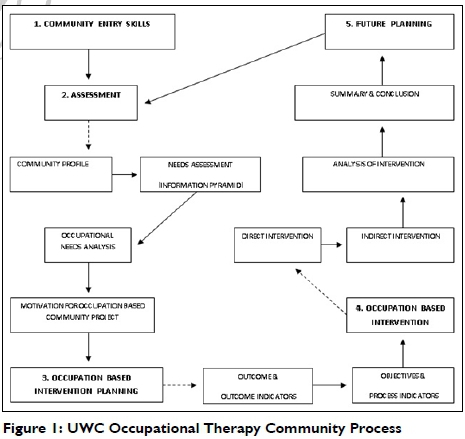
At the University of the Western Cape (UWC) in South Africa, final year occupational therapy students while in fieldwork practice in community settings, make use of the Community Process6
This article will focus primarily on the first step (see Figure 1) of the UWC Community Process which is community entry. The greater research study was undertaken by five UWC undergraduate occupational therapy students as part of their research module in which the aim of the study was to describe how they as students came to understand the culture of a community through the use of community entry. This article will highlight one aspect of the research study in which the purpose will be to describe the five occupational therapy students' experiences of community entry within community fieldwork and to provide guidelines for the practical implementation thereof.
According to a document titled Community Development and Client Participation Approaches to Addressing Health Inequalities78:260 proposed that community development is ".. .a process of organizing and/or supporting community groups in identifying their health issues, planning and acting upon their strategies for social action/social change, and gaining increased self-reliance and decision making power as a result of their activities". As such community development should strive to enable people to mobilise and develop their potential so that they are able to develop an ongoing ability to recognise and respond to their own problems.
In the last decade, the profession of occupational therapy has made significant changes in its approach to practice which has revolved around a shift from a focus on individualised treatment within a medical model to a comprehensive approach with a focus on health promotion and prevention9101,3,4,8 as a strategy that can promote social development through responding to the communities needs by emphasising empowerment and capacity building.
According to Lauckner, Krupa and Paterson1112
Community entry is a sensitive process that requires an awareness and understanding of communities, interpersonal relationships and group processes. As South Africa is rich in cultural diversity, it means that working in community development requires a sensitivity and openness toward the community913:177 adds to this by stating that community entry requires the willingness to listen and learn rather than the intensity to make things better because of an assumed authority situated in academic knowledge and professional expertise.
METHOD
The study was based in the interpretivist paradigm with a qualitative research methodological approach and an auto-ethnographic design. An interpretivist view of social reality is that there are multiple realities and that truth is experienced and created subjectively through the phenomena being studied. Key characteristics of such studies are that the focus is on the meaning derived from the participants, the lived experiences of the participants as well as the process that they have experienced15
Auto-ethnography emerged from ethnography which is an approach to research that involves immersion within, and investigation of a culture or social world161718
Participants and Research Setting
The participants in the study were five final year occupational therapy students placed in the community of Mitchells Plain, Cape Town, South Africa, for their community fieldwork placement. The duration of the fieldwork placement is seven weeks during which the students are expected to follow the steps of the UWC Community Process. As part of the research component of the undergraduate programme, these five students used their experience of their community fieldwork practice to explore their use of community entry skills within community development.
Mitchells Plain is a community located in Cape Town, approximately 20 kilometres from the city centre and has been in existence since the early I970's. The area is approximately 110, 2 km219
Data Collection
Within auto-ethnography many different data sources and collection techniques can be used. Data sources in auto-ethnography are not the typical sources and may vary extensively. These sources may include personal writing and reflection, stories from others, personal poetry, drawings, paintings, photographs, artifacts and metaphors18
Reflective journaling is a requirement of the undergraduate occupational therapy programme at UWC that is used predominantly with students who are undergoing a fieldwork component of the programme. As a result the final year students are required to write daily reflective journals during their fieldwork placements to demonstrate their learning and professional development. The reflective journals were used as a data source as they contained the students' immediate experiences of the use of community entry during their community fieldwork placement.
In addition students were then required to write personal narratives based on their own experiences, or a story of how they experienced community fieldwork practice. This approach offers multiple views of an account which potentially provides a richness and complexity while preserving the individual within the story16
In the focus group discussion each student presented their personal narratives to each other and shared their thoughts regarding what each person had written. This focus group discussion was used as a data source as it provided direct evidence about the similarities and differences in the students' opinions and experiences15
Data Analysis
All qualitative data were collected prior to the analysis to ensure that the students' personal narratives and their discussion were not influenced by analysing their reflective journals first. Narrative analysis was used to analyse the data which includes exploring terms of the broader political, cultural and structural context in the narratives16I5. As the study follows an auto-ethnographic design, the process of narrative analysis was undertaken by the students themselves. The five students collectively coded their reflective journals, their personal narratives and the transcribed focus group, sorted the codes into categories and then established themes.
FINDINGS
This section presents extracts of the data drawn from the students' reflective fieldwork journals, their narratives and the focus group discussion, along with quotes from the data to enhance the findings. Three main themes emerged from the study that tells the story of the students' experiences of using community entry skills in community fieldwork practice. These themes are: I) Challenges faced in community fieldwork practice, 2) Understanding Culture, and 3) Using Community Entry Skills.
Challenges faced in community fieldwork practice
The first challenge experienced in community fieldwork practice occurred before the students had even entered the fieldwork placement. Due to negative media commentary seen by the students about the community of Mitchells Plain, entry into their fieldwork placement occurred with preconceived notions about what the community was about. These pre-conceived notions then led to an experience of fear and anxiety about entering a community where drug and crime related incidents were rife, causing paranoia and apprehensiveness of what to expect in the community.
"I feel that because I listened to other peoples' comments about the community, read newspaper articles and watched the news about the community. I had painted a picture of the community in my mind and therefore by doing this I had judged not only the community but the community members. Most of the comments, newspaper articles and what I saw on the news about Mitchell's Plain community was so violent and gruesome that is literally made me scared to enter the community."
Being fearful and anxious about the community created a barrier between the students and the community, making the students feel unwelcome and causing them to experience the community and its people as "us and them". Being exposed to situations such as that of a young child looking after his younger sibling, while their parents sell fruit at a stall along the side of the road, or teenagers hanging around on street corners, left the students feeling frustrated and confused about the apathy they had witnessed in the community. Regardless of the feelings the students experienced by being exposed to these situations, it became evident that through spending time within the community, amongst the people, listening and looking at their way of life, is what allowed the students the opportunity to begin to learn more about the community. This in turn led to their realisation that it was their own preconceived notions that created the barrier between them and the community.
"At the same time by spending time in the community and with the members our fears about the community seemed to fade into the background. The more time we spent in the community we realised just how much our pre-conceived notions clouded our judgement."
Understanding Culture
Immersing themselves in the community the students visited the clinics, libraries and schools as well as the local shops, street vendors and were even invited into the homes of some community members. During these visits students would engage with the community members by having conversations with all three levels of Penina's Cup20
"As we started working in the community we came to see how important it was to understand this history and understand how the history affects the people of the community at the present moment. As we started to discover this history we started to see the effect it has on the Mitchell's Plain community."
Immersing themselves in gaining an understanding of the apartheid history of the community of Mitchells Plain and the impact of the 1970's Group Areas Act19
"As we came to discover, in order to understand the diversity that exists in the community we needed to first have an understanding of diversity amongst ourselves as a group before we could even begin to grasp the culture of the community."
In addition to understanding the history of the community the students realised that becoming a part of the community, by engaging with the community members in activities that are of importance to them, would further contribute towards gaining an understanding of the community and the culture of the community. Engaging with a community requires a mindfulness21
"Our aim was not to define culture as it cannot be defined but it was to gain an understanding and this can only be done once you become a part of the community. Becoming a part of the community was a conscious choice."
Using Community Entry Skills
The challenges experienced within community fieldwork practice ultimately led to the students understanding of the culture of the community but this process was achieved through the use of their community entry skills. The use of community entry skills allowed professionals to connect with the community and thereby gain an understanding of the community's culture.
"...I don't think there's any other way to actually... to gain that understanding, and to become part of the community and to make that transition from being an outsider to being part of it without using community entry skills"
The initial understanding and application of community entry was purely based on its three principles of look, listen and learn. The use of the first principle of look took place through observations of and interactions with the community, its environment, the services offered and the various policies that govern the community22
"We had spent a great deal of time just listening to what the community members had to say. Spending time in the malls, in the clinics and even in the schools was, for us, ways of hearing the community's voice and which assisted us in learning more about the people of Mitchell's Plain."
The third principle of learn, is a combination of everything seen and heard in the community and from the community members. This principle is about finding the links between what has been seen and heard and analysing the dynamics between these interactions and allowing it to inform your understanding of the community. Even though these principles are listed and explained as separate concepts, the practical implementation of them requires a continuous, interactive use of all three principles simultaneously.
"You may look at something today and listen to something tomorrow, but it is the learning that is important. It is making the connection between what you see and hear and from gaining an understanding of the community."
The use of community entry is a skill that requires practice and needs to be developed and in order for it to be effective it needs to be used continuously when working with the community. Community entry is a tool that introduces professionals to the community, that allows professionals to interact with the community and its members, and that gives rise to the understanding that one receives while working within the community.
"For us it was as simple as walking through Town Centre, driving through the community and speaking to the community members themselves. As with any skill, community entry is something that needs practice, but does improve with time."
DISCUSSION
The aim of this research study was to learn from the experiences of five occupational therapy students working in the area of community development in order to inform occupational therapy education and practice. This research provides vital information related to this field, including a description of the challenges and opportunities that were experienced and a description of the students' reflective practice in order to develop and understand the importance of community entry as a vital aspect of community development.
The experience of the use of community entry skills show that in order to effectively engage with a community a conscious decision to become a part of the community has to be made. With the continued use of community entry skills as part of community development, community entry skills can be used as a tool that introduces the professional to the community, allows them to interact with the community and its members and gives rise to the understanding that one receives when working in a community.
There has been an increasing trend in a shift of occupational therapy services from traditional hospital/institutional based practice to include the social context which has created a need for occupational therapy programmes to ensure that students are well prepared to work within this expanding area of practice9
The students' experiences of culture within the practice of community development indicates that there needs to be a greater emphasis on the importance of culture and cultural competence within occupational therapy training. This includes theoretical and practical skills as it is believed that the single most important factor in becoming culturally competent is exposure to culturally diverse situations2324
It is essential that occupational therapy programmes prepare students to work in communities, to understand what communities are, how communities form and identify themselves, how they are governed, and especially how to identify resources and facilitate change in a community25
In order for students to put their understanding of community entry skills into practice, occupational therapy programmes should provide students with the opportunity to engage with communities. Community based education, which the World Health Organisation (WHO)263
CONCLUSION
This study is but a small step in dissecting all the various components of community development thereby providing guidance to occupational therapists in clarifying their role in the community. However, further research into the use of community entry skills and the importance of understanding culture as a part of community development is needed as a validation of this contribution to the field. As community development is an emerging field, future research in this area is encouraged as it will not only strengthen the role of the occupational therapist in community development and contribute to the preparation of students but also promote a greater awareness amongst not only fellow professionals but also the communities we serve regarding the valuable contribution that occupational therapy can make to the development of communities.
REFERENCES
LITERATURE REVIEW
- 1. McConnell C. Community learning and development: The making of an empowering profession. Community Learning Scotland, 2002.
- 2. Restall G, Leclair L, Banks S. Inclusiveness through community development. OT Now, 2005: 9 - 11.
- 3. Lauckner H, Pentland W, Paterson M. Exploring Canadian occupational therapists' understanding of and experiences in community development. Canadian Journal of Occupational Therapy, 2007; 74(4): 314 - 325.
- 4. Wilcock A. An occupational perspective of health. Thorofare, NJ: Slack Incorporated, 1998.
- 5. Tareen E, Omar M. Community entry: An essential component of participation. Health Manpower Management, 1997; 23(3): 97 - 99.
- 6. De Jongh J. An innovative curriculum change to enhance occupational therapy student practice. South African Journal of Occupational Therapy, 2009; 39(1): 31 - 38.
-
7. Enothe. Community development and client participation approaches to addressing health inequalities. <www.enothe.eu/cop/cz_community_development.pdf>. (23 June 2011)
» www.enothe.eu/cop/cz_community_development.pdf - 8. Labonte R. Community, community development and the forming of authentic partnerships: Some critical reflections, 2004. In Lauckner H, Krupa T, Paterson M. Conceptualizing community development: Occupational therapy practice at the intersection of health services and community. Canadian Journal of Occupational Therapy, 2011; 78(4): 260 - 268.
- 9. Adams F, Wonnacott H. Group learning experiences in rural communities. In Lorenzo T, Duncan M, Buchanan H, Alsop A. (Eds.). Practice and service learning in occupational therapy: Enhancing potential in context. John Wiley & Sons Ltd, 2006.
- 10. Watson R. A population approach to transformation. In Watson R, Swartz L. (Eds.). Transformation through occupation (pp. 51 - 65). London: Whurr, 2004.
- 11. Lauckner H, Krupa T, Paterson M. Conceptualizing community development: Occupational therapy practice at the intersection of health services and community. Canadian Journal of Occupational Therapy, 2011; 78(4): 260 - 268.
- 12. Swanepoel H, De Beer F. Community development: Breaking the cycle of poverty (5th Ed). Juta and Co Ltd, 2011.
- 13. Duncan M. Group processes in practice education. In Lorenzo T, Duncan M, Buchanan H, Alsop A. (Eds). Practice and service learning in occupational therapy: Enhancing potential in context. John Wiley & Sons Ltd, 2006.
-
14. Parasyn C. Aharenmen! Who better understands a community than those who live in it? <http://www.engagingcommunities2005.org/abstracts/Parasyn-Christina-final.pdf>. (16 April 2010).
» http://www.engagingcommunities2005.org/abstracts/Parasyn-Christina-final.pdf - 15. Babbie E, Mouton J. The practice of social research, South African Edition. Cape Town: Oxford University Press, 2001.
- 16. Goodley D, Lawthom R, Clough P Moore M. Researching life stories: Methods, theory and analyses in a biographical age. Cornwall: Routledge Falmer, 2004.
- 17. Denzin N, Lincoln Y The qualitative inquiry reader. London: Saga Publications, Inc, 2002.
-
19. The Group Areas Act. No.4I of 1950. http://www.historicalpapers.wits.ac.za/inventories/inv_pdfo/ADI 812/AD1812-Em3-1-2-011-jpeg.pdf (27 November 2014)
» http://www.historicalpapers.wits.ac.za/inventories/inv_pdfo/ADI 812/AD1812-Em3-1-2-011-jpeg.pdf -
20. Croucamp A, Gasa N, Levendal E, Hutton B. Community Involvement and Participation. http://www.saavi.org.za/facmodule7.pdf (27 November 2014)
» http://www.saavi.org.za/facmodule7.pdf -
21. Cullen M. Mindfulness-Based Interventions: An Emerging Phenomenon. www.margaretcullen.com/docs/MBI-An_Emerging_Phenom-enon_Margaret_Cullen.pdf (28 November 2014)
» www.margaretcullen.com/docs/MBI-An_Emerging_Phenom-enon_Margaret_Cullen.pdf - 22. Annett H, Rifkin S. (I995). Guidelines for rapid participatory appraisal to assess community health needs: A focus on health improvements for low-income urban and rural areas. Geneva, World Health Organization. (WHO/SHS/DHS/95.8).
- 23. Forwell S, Whiteford G, Dyck I. Cultural competence in New Zealand and Canada: Occupational therapy students' reflections on class and fieldwork curriculum. The Canadian Journal of Occupational Therapy, 2001; 68(2): 90-103.
- 24. Bennett M. Towards ethnorelativism: A developmental model of intercultural sensitivity. In Paige M. (Ed). Education for the intercultural experience. Yarmouth, ME: Intercultural Press, 1993.
- 25. McColl M. What do we need to know to practice occupational therapy in the community? The American Journal of Occupational Therapy, 1997; 52(I): 11 - 18.
- 26. World Health Organization. Community based education of health personnel: A report of a WHO study group. World Health Organization Technical Report, Series 746, 1987.
Nicola Vermeulen
Occupational Therapy Department
University of the Western Cape
Modderdam Road, Belville, Cape Town