From marginalisation to belonging: The transformative value of adult daycare centres for adults with disabilities
Abstract
INTRODUCTION: This opinion piece reflects on the perspectives of adults with severe-profound disabilities attending Adult Daycare Centres (ADCs) in the Western Cape, South Africa, a country where such services are crucial for promoting dignity and well-being in a society that can be marginalizing. This article portrays the voices of adults with disabilities from four ADCs and identifies eight core values of such centres. DISCUSSION: The core values, namely activity participation, a safe environment, social participation, improved mental health, spirituality, health promotion, purpose, and community living, reflect the essence of ADCs. The findings challenge occupational therapy's dominant focus on productivity and independence, emphasizing dignified being and belonging as therapeutic outcomes for wellbeing. CONCLUSION: ADCs play a crucial role in promoting human rights and quality of life for adults with disabilities by fostering occupational participation, social interaction, and personal growth. These insights advocate fora shift in the definition of ADCs from mere physical care and "doing", to fostering a sense of being and belonging. Implications for practice The findings call for increased funding, training, and support for ADCs. Occupational therapists are vital in community-based practice as clinicians, facilitators, educators, and advocates, to ensure access to essential services for persons with disabilities
severe-profound disabilities; activity participation; safe environment; social participation; mental health; faith- and values-based practice; health promotion; community based occupational therapy; community living of persons with a disability
INTRODUCTION
"Nothing about us without us" underscores the principle of participation of all persons with disabilities12
While some research is conducted on this population, perspectives directly from adults with disabilities are often sidelined in favour of those from caregivers and medical professionals, a trend that contradicts the principle of inclusion and creates a tradition of research "on" rather than "with" them34
This piece aims to amplify the voices of adults attending ADCs in the Western Cape, shedding light on the essence of ADCs and prompting critical reflection about the concepts of being and belonging in the lives of adults with severe and profound disabilities.
CONTEXT OF ADULT DAYCARE CENTRES IN SOUTH AFRICAIn first world settings, ADCs are primarily associated with respite care for the elderly567Box 1 below).

In South Africa, ADCs are essential in the case of caregiver absence or where families are unable to provide constant care. ADCs often provide the only place where persons with disabilities are protected and cared for, aligning with the Convention of the Rights of Persons with Disabilities (CRPD), Article 19, which mandates independent living, community inclusion and access to community support services for persons with disabilities8
BACKGROUND
Senecio Support for People with Disabilities provides training and on-site support to ADCs across the Western Cape, empowering staff and management to enhance quality of life for persons with disabilities. During support visits to four ADCs (predominantly from lower socioeconomic settings), value clarification activities were facilitated to foster motivation among the adult beneficiaries. Approximately 70 adults with a range of physical and intellectual disabilities ranging between the ages of 25 and 79 years old, were included in group discussions at their various ADCs, where they were asked why they liked coming to the ADC and why the ADC is important. Their comments were summarised as an overarching theme, confirmed by the rest of the group, and written on a poster.
While this was not performed as part of, or with the intention of being a study, the importance of these conversations became evident upon further reflection of the virtually identical values expressed at different ADCs. In view of the valuable information contained in the understated values, the author asked the adults and ADC managers for their permission to share the information in an article.
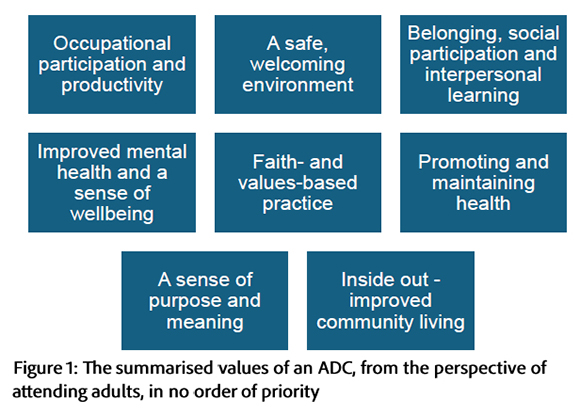
VALUES OF AN ADCThe themes emerging in discussions were summarised into the following eight values, shown in Figure 1 (adjacent) in no order of priority. The terms "value" and "values" are used interchangeably, as the values identified by adults with disabilities directly showcase the value of an ADC.
Occupational participation and productivity
Participants at all four ADCs highlighted the value of learning new things, productivity and "doing things with our hands", emphasising the importance of occupational participation and productivity. One adult excitedly said, "I now even know how to knit a little piglet', and another, "I never thought I'd be able to make such a variety of beautiful things". Considering that humans are occupational beings9
At three ADCs, participants further described that being at an ADC helps occupy their time and makes time pass faster. Gable et al.11
A safe, welcoming environment
The concept of safety emerged prominently across all ADCs, confirming the Policy on Disability's identification of daycare facilities to prevent secondary abuse12"getting out of the house" is a primary reason for attending their ADC. However, a subtle difference between "being safe" and "feeling safe" is noteworthy. The statement, "Coming to the ADC helps me to escape from problems at home", hints at more than just the need for a change of scenery and disruption of monotony. The physical environment of an ADC also influences the subjective concept of safety, emphasised by the statements that everyone is welcome at an ADC, "even with different disabilities". One adult with intellectual disability beautifully stated: "Oui there I have to be someone 'better'. Here I can be myself".
Both the physical and social aspects of an environment are highlighted, showing how a welcoming environment contributes to physical, emotional and social wholeness. Understanding that spaces influence self-identity13
Belonging, social participation and interpersonal learning
Participants at all four ADCs mentioned company, stating their love for meeting new people and building relationships. They shared their struggle with this in the broader community due to marginalisation, stigma and bullying, and that the ADC creates opportunity for interpersonal connection because "everybody understands what it is like to have a problem". This reliance on day-service settings for social satisfaction is a familiar concept10
Three ADCs' participants expressed the perception of unity in that they have become "family", with the fourth stating "we are one". Considering that persons with disabilities "experience substantially higher rates of social isolation, loneliness, and lackof social support than people without disabilities"14
Learning from each other or sharing knowledge was unanimously valued, a concept which increases feelings of belonging and value15
Two ADCs' participants mentioned learning how to work together, with one group narrating how they had to learn patience and conflict resolution while working in the garden. This demonstrates the transaction between humans and their environment resulting in occupation9
Improved mental health and a sense of wellbeing
All four ADCs' participants mentioned fun, joy enjoyment and laughter as part of their experiences, with three centres noting feelings of calm, relaxation and reduced stress. One adult worded it as, "It makes me feel good to be here". As mental distress is almost five times more prevalent in adults with disabilities16
Faith- and values-based practice
Participants from three ADCs highlighted the importance of spirituality as the "foundation" of their program and interactions. Prayer, discussion groups and religious readings often form part of the daily programme of centres, but participants emphasised the value of'living it out' rather than simply observing it.
The Canadian Model of Occupational Performance and Engagement (CMOP-E) places spirituality at the core of the person, explaining its importance in providing meaning, purpose and truth in life1717
Although the religion of most beneficiaries was homogenous in each centre, there was a wide variety in the beliefs and practices surrounding their faith. It was astonishing to witness that this diversity facilitated compassion, inclusion and understanding, demonstrating that spirituality does not have to be a barrier.
Promoting and maintaining health
Three ADCs' participants discussed the importance of health maintenance, especially through exercise. One group mentioned how they get reminded of clinic appointments, while another valued health education talks at the ADC.
The OTPF 4th edition4
A sense of purpose and meaning
Participants from three ADCs valued ADCs for providing purpose, meaning and something to look forward to. One adult stated that it gets her "away from the TV, aligning with McCausland et al.'s10
Literature states that people with a higher sense of purpose report higher self-efficacy, healthier behavioural decisions, and an increased will to live18
Inside out - improved community living
Participants from three ADCs noted how the programme helped them to take responsibility and ownership of their lives beyond the ADC. One group shared the street safety tips they learnt at the ADC to navigate their community better. The ADC was further valued to keep them "out of trouble", and one participant mentioned that at the ADC she gets encouraged for "a better life outside of (ADC)". This statement highlights how the ADC fosters a sense of responsibility, law-abiding behaviour, and hope, motivating individuals to work towards personal goals and adopt healthier habits.
Literature states that people tend to acquire the interests, behaviours and values of the group they belong to1313
What was not mentioned
It is noteworthy that the traditional constructs of ADCs, focussing on physical care and assistance with daily activities (ADLs), were not mentioned by any of the participants as primary reasons for attending ADCs. While these aspects were acknowledged upon prompting, they were not central to participants' reflections, indicating a shift in priorities in line with Maslow's hierarchy of needs19
Interestingly, none of the participants mentioned the improvement of motor and cognitive skills, which are often emphasised by funders and regulators. For adults with lifelong disabilities, the pressure to keep on being "better" or "different" can be frustrating. Instead, ADCs should focus on programs that foster participation in meaningful social, restorative and selfcare activities, aligning with each individual's existing abilities, to enhance dignity and quality of life. This shift, from skill remediation to supporting meaningful engagement, is key to successful service delivery at ADCs.
BEING AND BELONGING - THE BIGGER PICTURE
As occupational therapists, we often describe our role as helping people gain independence or return to doing what is important to them. This focus is vital, as seen in the first value of occupational participation, yet we must also recognise the importance of nurturing individuals' sense of being and belonging, not merely as byproducts of their doing or becoming. Dominant occupational therapy models emphasise the occupational areas of self-care, productivity and leisure, often "stuffing in" concepts such as social participation, contributing to the well-being of others, and strengthening cultural identities beneath them15
Through working with adults with severe-profound disabilities, the author pondered that the concept of "dignified being" could even be considered a therapeutic outcome in itself. The feedback from facilitating dignified being through comfort and group participation, in contrast to ambitious therapy and handling to promote objective "doing", have impacted the author's perception of occupational therapy drastically.
This challenges the dominant Western ideology that prioritizes individualistic contributions, potentially marginalising those who value interdependence and relationships, particularly in diverse cultural contexts like South Africa1515
It is also important to understand that shared occupation is often a higher regarded goal than independence or activity participation1515do, but from their belonging. Regarding belonging as the ultimate goal helps one to appreciate the potential of ADCs to enhance quality of life through a more holistic and culturally sensitive approach.
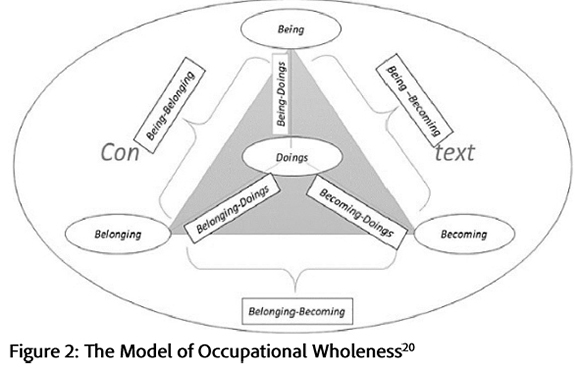
Drawing from the Model of Occupational Wholeness20Figure 2, below), it should be noted that doing is merely the brush with which the bigger picture of being and belonging are painted. Reflecting on our profession's eagerness to advocate for people to do and become, a prompt to incorporate the colours of being and belonging with the same urgency is proposed.
IMPLICATION OF FINDINGS
This retrospective documentation of valuable information obtained during group discussions that formed the background to this opinion piece highlights that the involvement of persons with disabilities and those actively involved in their care should be non-negotiable in the creation and implementation of legislation and policies related to ADCs. Using a person-directed advocacy approach, this opinion piece aims to combat marginalisation and promote the consideration of adults with disabilities' perspective in matters that concern their own lives. Their voices call for raising the quality of programmes designed for their wellbeing.
The eight values identified in this article demonstrate that ADCs are essential agents in the promotion of human rights, dignity and quality of life for persons with disabilities and their families. Staff and carers are the lifelines in making these values a reality in ADCs, but their knowledge, capacity and resources are often limited. We can therefore never stop advocating for their increased funding, training and support.
Occupational therapists, as experts in facilitating participation through adaptation of activities and environments, play pivotal roles in the planning and implementation of programmes in ADCs. The classification of ADCs under "rehabilitation" in the Policy on Disability12
CONCLUSION
ADCs should serve as catalysts for occupational participation in safe environments, allowing a sense of belonging, personal growth and wellbeing among adults with severe to profound disabilities in South Africa. By prioritising dignified beingand belonging, overthe mere doing of occupation, ADCs uphold the principles of human rights and model the concept of occupational wholeness, where individuals are valued for who they are and what they can contribute, rather than solely for their functional abilities. Using a person-directed advocacy approach, this article offers valuable insight for occupational therapists, especially in community-centred practice. It calls for increased quality services and financial support across all sectors to ensure the sustainability and growth of ADCs, to continue challenging traditional notions of disability and pave the way for a society where all individuals can thrive.
AI Declaration
ChatGPT was used for grammar and language checking.
Acknowledgements
Ruth Boshoff for proof-reading the manuscript. All ADC's and the adults attending them for their openness and permission to share the discussion we had.
REFERENCES
- 1. Harpur, Paul (2017). Nothing About Us Without Us: The UN Convention on the Rights of Persons withDisabilities. doi:10.1093/acrefore/9780190228637.013.245. ISBN 978-0-19022863-7.
-
2. National Youth Development Agency. Annual Report 2021/2022.2022. [accessed 2024 May 27]. https://www.nyda.gov.za/Portals/0/downloads/NYS-Report-2022.pdf
» https://www.nyda.gov.za/Portals/0/downloads/NYS-Report-2022.pdf -
3. Diaz MA, Bickenbach JE, Sabariego C, Bernard RM. Qualitative methodological approaches involving participants with intellectual disabilities: Scoping review of literature exploring death and dying. Journal of Applied Research in Intellectual Disabilities. 2024; 37:14-29. https://doi.org/10.1111/jar.13119
» https://doi.org/10.1111/jar.13119 -
4. American Occupational Therapy Association. Occupational therapy practice framework: Domain and process (4th Ed). American Journal of Occupational Therapy. 2020; 74:1-87. https://doi.org/10.5014/ajot.2020.74s2001
» https://doi.org/10.5014/ajot.2020.74s2001 -
5. Elder-Well. The Growing Value of Adult Day Care, [accessed 2024 May 271. https://elderwelladultday.com/the-growing-value-of-adult-day-care/
» https://elderwelladultday.com/the-growing-value-of-adult-day-care/ - 6. Department of Health. National Mental Health Policy Framework and Strategic Plan 2023-2030. Pretoria: Department of Health; 2023.
- 7. Boshoff R. Handbook for Adult Daycare Centre Programmes. Somerset West: Senecio Support for People with Disabilities; 2024.
-
8. United Nations: Division for Inclusive Social Development. Convention on the Rights of Persons with Disabilities (CRPD). 2006. [accessed 2024 May 27]. https://social.desa.un.org/issues/disability/crpd/convention-on-the-rights-of-persons-with-disabilities-crpd
» https://social.desa.un.org/issues/disability/crpd/convention-on-the-rights-of-persons-with-disabilities-crpd -
9. Turnbull D, Barnard R. A preliminary investigation of what occupational science is doing. Qeios. 2023. https://doi.Org/10.32388/9su3tn.2
» https://doi.Org/10.32388/9su3tn.2 -
10. McCausland D, Guerin S, Tyrrell J, Donohoe C, O'Donoghue I, Dodd P. A qualitative study of the needs of older adults with intellectual disabilities. Journal of Applied Research in Intellectual Disabilities. 2021; 34(6): 1560-8. https://doi.org/10.1111/jar.12900
» https://doi.org/10.1111/jar.12900 -
11. Gable PA, Wilhelm AL, Poole BD. How Does Emotion Influence Time Perception? A Review of Evidence Linking Emotional Motivation and Time Processing. Frontiers in Psychology. 2022; 13. https://doi.org/10.3389/fpsvg.2022.848154
» https://doi.org/10.3389/fpsvg.2022.848154 -
12. Department of Social Development. Policy on Disability, [accessed 2024 May 27]. www.socdev.gov.za
» www.socdev.gov.za -
13. Harrison M, Angarola R, Forsyth K, Irvine L. Defining the environment to support occupational therapy intervention in mental health practice. British Journal of Occupational Therapy. 2015; 79: 57-9. https://doi.org/10.1177/0308022614562787
» https://doi.org/10.1177/0308022614562787 -
14. Rimmer JH, Quach PTM, Ward S, Young HI, Singh H, Lai B. The Silent Majority: Understanding and Supporting Access and Inclusion for People with Disabilities Living in Predominantly Low-Resource Communities. Disabilities. 2023; 3(4): 639-47. https://doi.org/10.3390/disabiÍities3040041
» https://doi.org/10.3390/disabiÍities3040041 -
15. Whalley Hammell KR. Belonging, occupation, and human well-being: An exploration. Canadian Journal of Occupational Therapy. 2014; 81(1): 39-50. https://doi.org/10.1177/0008417413520489
» https://doi.org/10.1177/0008417413520489 -
16. UDS Foundation. Significance of Mental Health and People with Disabilities. 2022 [accessed 2021 May 28]. https://udservices.org/mental-health-and-people-with-disabilities/
» https://udservices.org/mental-health-and-people-with-disabilities/ - 17. Polatajko HJ, Townsend EA, Craik J. The Canadian Model of Occupational Performance and Engagement. In: Townsend EA & Polatajko HJ. Enabling Occupation II: Advancing an Occupational Therapy Vision of Health, Well-being, & Justice through Occupation. Ottawa: CAOT Publications ACE; 2007: 22-36.
-
18. Nakamura JS, Chen Y, VanderWeele TJ, Kim ES. What makes life purposeful? Identifying the antecedents of a sense of purpose in life using a lagged exposure-wide approach. SSM - Population Health. 2022; 19. https://doi.Org/10.1016/j.ssmph.2022.101235
» https://doi.Org/10.1016/j.ssmph.2022.101235 -
19. Mcleod S. Maslow's Hierarchy of Needs. 2018 [accessed 2024 May 28]. https://www.simplypsychology.org/maslow.html
» https://www.simplypsychology.org/maslow.html -
20. Yazdani F, Fekri N. The Model of Occupational Wholeness. In: Yazdani F. Occupational Wholeness for Health and Wellbeing: A Guide to Re thinking and Re-planning Life. London: Routledge; 2023:14-33. https://dx.doi.org/10.4324/9781003034759-2
» https://dx.doi.org/10.4324/9781003034759-2
Reviewed: 9 October 2024
Revised: 5 November 2024
Accepted: 8 November 2024
EDITOR
Blanche Pretorius https://orcid.org/0000-0002-3543-0743
DATA AVAILABILITY
Upon reasonable request, from corresponding author
FUNDING
No funding was received