Impact of one-to-one instruction on activity participation, playfulness and enjoyment in children with Autism Spectrum Disorder in Rwanda: A quasi-experimental study
Abstract
BACKGROUND: Children with autism spectrum disorder often have limited engagement in daily activities, particularly in low-resource settings. This study aimed to evaluate whether individualised therapist-led intervention increases activity participation, enjoyment, and playfulness among children with autism compared with standard group-based care. METHODS: A quasi-experimental study was conducted at two centres involving 86 children with autism spectrum disorder (n=86), aged 3-12 years. Participants were assigned to either the intervention group (n = 43) which received 9 months' one-to-one instruction or a comparison group (n = 43) which received standard care. The Children's Assessment of Participation and Enjoyment, Children's Preferences for Activities, and the Test of Playfulness were used to evaluate the children both before and after the intervention. RESULTS: Significant, statistically robust improvements were observed with one-on-one instruction in some activities. Participation increased across domains with the largest effects for quiet recreation and hobbies (Cohen's d ≈ 1.0-1.2; p<0.001) while enjoyment (p = 0.046, d = 0.45, ηp2 = 0.21) and a marked improvement of playfulness (p<0.001). Preference shifts occurred within the intervention group but were not significantly different from controls after covariate adjustment. CONCLUSION: Individualised one-to-one instruction yielded meaningful participation gains and is promising for low-resource settings. Future research should include fidelity measurement, longer follow-up, and a larger sample to confirm effectiveness. IMPLICATIONS FOR PRACTICE: • One-to-one instruction should be considered as an effective option in clinical and school settings to increase participation and playfulness for children with autism spectrum disorder • Routine use of validated tools and fidelity audits is recommended to monitor outcomes, detect preference shifts, and guide individualised goal setting. • Interventions should target playfulness (extent, intensity, and skilfulness) alongside participation frequency because improvements in play quality drive meaningful engagement. • Pilot one-to-one instructional programmes in district centres, funding staff, training, and monitoring to broaden access in low-resource settings.
individualised instruction; playfulness; neurodevelopmental disorders; resource-limited settings
INTRODUCTION
Autism Spectrum Disorder (ASD) is a neurodevelopmental condition characterized by persistent differences in social communication and interaction, alongside restricted and repetitive patterns of behaviour, interests, or activities. Recent evidence indicates that ASD is a growing global public health concern. Beyond these core characteristics, children with ASD frequently experience participation restrictions in everyday occupations, including play, leisure activities, social interactions, school participation, and community engagement1,2,3. These participation challenges are often associated with social communication difficulties, sensory processing differences, repetitive behaviours, and environmental barriers, which can limit opportunities for meaningful engagement and affect overall wellbeing4,5.
A systematic review and meta-analysis involving more than 30 million individuals estimated the global prevalence of ASD at approximately 0.6%, with regional estimates ranging from 0.4% to 1.7%67899,10. These service gaps may result in reduced participation in everyday activities, poorer developmental outcomes, increased caregiver burden, and restricted opportunities for social inclusion1112
Although population-based prevalence estimates for ASD in Rwanda remain limited, available evidence from Rwanda and neighbouring countries suggests increasing recognition of developmental disabilities and growing demand for assessment, educational, rehabilitation, and family support services13,14. Understanding prevalence and service demand is important because it informs health and education planning, workforce development, resource allocation, and the design of effective intervention programmes1514
Efforts to strengthen disability-inclusive services have expanded in recent years through policies promoting inclusive education, disability rights, and community-based rehabilitation. The Government of Rwanda has adopted policies aligned with the United Nations Convention on the Rights of Persons with Disabilities (UNCRPD), which emphasize equal participation and inclusion for persons with disabilities16,17. However, implementation challenges remain, including limited specialist services for children with developmental disabilities, shortages of rehabilitation professionals, insufficient autism-specific programmes, and unequal access to services between urban and rural areas1818,19. Consequently, many children continue to experience restricted engagement in home, school, and community activities.
Participation is a central concept within occupational therapy and refers to involvement in life situations and engagement in meaningful occupations122021,10. These participation difficulties often extend beyond task performance to affect enjoyment, engagement, autonomy, and quality of life20
Among childhood occupations, play is particularly important because it supports cognitive, social, emotional, language, and physical development121210,22. Such challenges may further contribute to reduced participation and social isolation2021
Occupational therapists play a key role in supporting children with ASD through occupation-focused interventions that address participation restrictions and promote engagement in meaningful activities21,12. Common occupational therapy approaches include activity adaptation, environmental modification, sensory integration-informed strategies, play-based interventions, caregiver coaching, social participation support, and individualised goal-directed programmes21,23. These approaches aim not only to improve functional skills but also to enhance participation, enjoyment, autonomy, and overall occupational engagement12
A variety of intervention approaches have been used with children with ASD across disciplines. These include behavioural interventions, developmental interventions, parent-mediated programmes, peer-mediated approaches, social skills training, group-based interventions, and individualised interventions12,24. Programmes such as Developmental, Individual Differences, Relationship-Based (DIR/Floortime), Pivotal Response Training (PRT), and the Early Start Denver Model (ESDM) have demonstrated positive outcomes in communication, social interaction, play, and adaptive functioning24,25,26. While group-based interventions offer opportunities for peer interaction and may be more resource efficient, individualised interventions allow intervention goals, teaching strategies, sensory supports, and environmental adaptations to be tailored to the specific needs of each child12,27. Emerging evidence suggests that individualised interventions may be particularly effective in improving participation and play outcomes among children with ASD12,28.
The present study is informed by Whiteford's Participatory Occupational Justice Framework, which conceptualises participation as a dynamic interaction between personal capacities, environmental opportunities, social structures, and occupational engagement2929
Although previous studies have demonstrated benefits of individualised interventions, most evidence originates from high-income countries12,28,30,27,31. Limited research has examined participation-focused interventions for children with ASD in sub-Saharan Africa, and little is known about their effects on participation, enjoyment, preferences, and playfulness within low-resource contexts9,10. Furthermore, few studies have evaluated individualised therapist-led interventions using occupational therapy outcomes as primary endpoints21,23. This knowledge gap limits evidence-informed service development for children with ASD in Rwanda and similar settings. Therefore, this study aimed to evaluate the impact of an individualised therapist-led intervention on activity participation, enjoyment, preferences, and playfulness among children with ASD in Rwanda compared with standard group-based services.
METHODS
Ethics
Ethical approval for this study was obtained from the Institutional Review Board (IRB) of the University of Rwanda, College of Medicine and Health Sciences (CMHS/IRB/511/2023). Permission to conduct the study was subsequently obtained from the relevant authorities overseeing the participating centres, including centre management and administrative leadership, before participant recruitment commenced. Following institutional approval, parents or legal guardians of eligible children were approached by the research team and provided with detailed information about the study, including its purpose, procedures, potential benefits, potential risks, confidentiality measures, and the voluntary nature of participation. Written informed consent was obtained from all parents or legal guardians prior to enrolment. Participants were informed that they could withdraw from the study at any stage without any consequences for the services received by their children.
Assent was sought from children whenever developmentally appropriate. Because the study included children aged 3-12 years with autism spectrum disorder, the assent process was adapted to each child's communication abilities and developmental level. The research team used age-appropriate language, simple explanations, visual supports, and behavioural observations to determine the child's willingness to participate. Children were informed about the activities they would be involved in and were given opportunities to indicate agreement verbally, through gestures, or through affirmative behavioural responses. For children with significant communication impairments or cognitive limitations who were unable to provide meaningful verbal or written assent, researchers relied on parental consent while continuously monitoring the child's behavioural responses throughout data collection and intervention sessions. Any indication of distress, resistance, withdrawal, or unwillingness to participate was respected immediately, and the child was not required to continue with the activity.
All study procedures were conducted in accordance with the ethical principles outlined in the Declaration of Helsinki and relevant national research ethics guidelines. Participant confidentiality was maintained using unique identification codes, secure storage of study records, and restricted access to research data by authorized members of the research team only. The research adhered to the ethical principles outlined in the World Medical Association's Declaration of Helsinki for studies involving human subjects32
Design and Setting
This study employed a quasi-experimental non-equivalent control group design and was conducted between January and September 2024 at two specialized centres providing educational and rehabilitation services for children with autism spectrum disorder (ASD) in Kigali, Rwanda.33
Both centres served children from Kigali and surrounding districts and operated as day programmes. Services were delivered by multidisciplinary teams comprising special education teachers, occupational therapists, speech-language therapists, psychologists, and support staff. Children with ASD Levels I, II, and III attended the centres and participated in educational and therapeutic activities adapted to their developmental profiles, communication abilities, and support needs. Routine services at both centres included structured classroom activities, communication and language sessions, play activities, self-care training, social interaction opportunities, sensory-based activities, and scheduled breaks.
The intervention centre implemented an individualised therapist-led model in which children received scheduled one-to-one intervention sessions targeting participation, play, communication, self-care, and social skills. Intervention goals were individualised according to each child's strengths, challenges, interests, sensory processing needs, and occupational participation priorities. In contrast, the comparison centre provided usual care consisting primarily of group-based classroom instruction, structured play, communication activities, social interaction opportunities, and behavioural support delivered within small groups. Therapeutic input was provided according to routine centre schedules, with individualised intervention generally limited to addressing immediate educational or behavioural concerns.
Children in the intervention group received the study's structured individualised intervention programme delivered within a coordinated multidisciplinary framework, whereas children in the control group received routine services only and did not receive the individualised intervention protocol, therapist supervision procedures, or fidelity monitoring processes. The use of these two naturally occurring service models enabled comparison of individualised therapist-led intervention with standard group-based services within a real-world educational and rehabilitation setting.
Population and Sampling
The study population comprised children with autism spectrum disorder (ASD) enrolled in specialized educational and rehabilitation centres in Kigali, Rwanda, and their parents or primary caregivers. Two centres were purposively selected because they were among the few facilities providing specialized ASD services and represented different service delivery models: one offered individualised therapist-led interventions, while the other provided standard group-based educational and rehabilitation services.
Children aged 3-12 years were eligible if they had a documented ASD diagnosis from a qualified healthcare professional, had attended the participating centre for at least three months, and were able to participate in routine educational and therapeutic activities. Children with severe medical conditions limiting participation or those receiving another intensive intervention programme were excluded. Parents or primary caregivers were eligible if they were aged 18 years or older, provided informed consent, and had sufficient knowledge of the child's daily activities to complete the study measures.
A census sampling approach was used, whereby all eligible children enrolled at the participating centres during the recruitment period were invited to participate. Of the 110 children enrolled across both centres, 86 met the eligibility criteria and were recruited, resulting in 43 participants in the intervention group and 43 in the comparison group. Group allocation was determined by the centre attended. Children with ASD were the primary study participants, while parents or caregivers served as proxy respondents for selected outcome measures. Teachers and therapists contributed to intervention delivery and provided supplementary information when required but were not included as study participants.
Intervention
Children in the intervention group received an individualised therapist-led participation-focused intervention delivered three times per week over a nine-month period. Each session lasted approximately 45 minutes, resulting in 135 minutes of individualised intervention per week. The intervention was designed to improve participation, enjoyment, playfulness, and engagement in meaningful occupations through individualised goal-directed activities.
The intervention was informed by principles derived from Developmental, Individual Differences, Relationship-Based (DIR/Floortime), Pivotal Response Training (PRT), and the Early Start Denver Model (ESDM)24,25,26. These approaches were not implemented as independent intervention programmes; rather, selected evidence-based strategies from each approach were incorporated within a participation-focused occupational therapy framework. DIR/Floortime principles were used primarily to promote child-led engagement, shared attention, emotional regulation, and social interaction. PRT strategies were used to enhance motivation, responsiveness, communication, and initiation through naturalistic teaching opportunities. The principles of ESDM guided developmental sequencing, play-based learning, and the incorporation of social communication objectives into daily activities. The incorporation of these methodologies was informed by studies demonstrating their efficacy in enhancing involvement, communication, social engagement, and play outcomes for children with ASD24,25,26.
Before the intervention, each child completed a thorough evaluation that encompassed the examination of clinical records, carer interviews, occupational profile, participation assessment, activity choice assessment, and observation of play behaviours. Data gathered from the CAPE, PAC, Test of Playfulness, carer reports, teacher feedback, and clinical observations was utilised to determine participation priorities, preferred activities, sensory processing requirements, environmental obstacles, and tailored intervention objectives. Intervention activities were chosen and modified based on each child's interests, participation objectives, developmental capabilities, communication profile, and sensory processing traits. Occupational therapists employed activity analysis, environmental modification, sensory control strategies, play facilitation approaches, and carer coaching to enhance engagement in meaningful activities. Examples encompassed play activities, self-care responsibilities, social engagement opportunities, leisure pursuits, and educational occupations that aligned with each child's specified preferences and participation requirements.
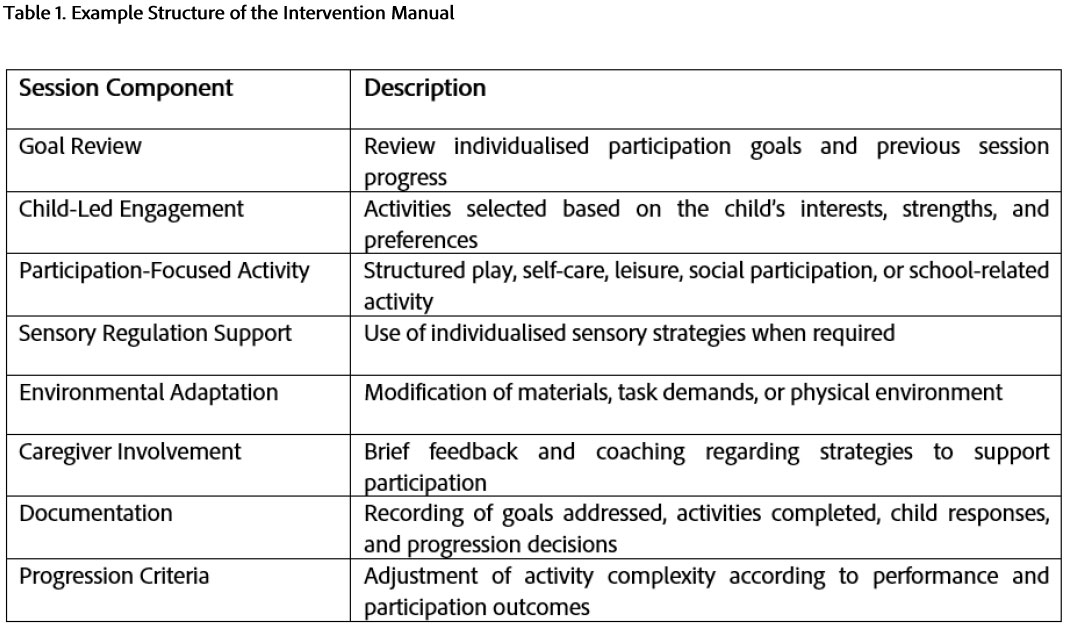
A standardised intervention procedure was established before the trial commenced to ensure uniformity among therapists and sessions. The protocol delineated intervention objectives, session format, treatment techniques, progression criteria, documentation requirements, and processes for customising activities to meet individual participant needs. Despite the individualised nature of activities, therapists adhered to a standardised framework to guarantee consistency in intervention delivery while remaining attuned to each child's occupational objectives and interests.
Intervention Fidelity
Several procedures were implemented to promote intervention fidelity. Prior to study commencement, therapists involved in intervention delivery received training on the intervention protocol, session structure, documentation procedures, and outcome measures. A standardized intervention manual was used throughout the study to guide implementation and ensure consistency across therapists. Therapists documented intervention goals, activities implemented, participant responses, and progression decisions following each session. Regular supervisory meetings with caregivers were conducted to review intervention records, discuss implementation challenges, review progress toward participation goals, discuss barriers to participation, provide feedback regarding intervention strategies, identify opportunities for supporting participation within home and community environments and ensure adherence to the protocol. The principal investigator periodically reviewed documentation to verify consistency between planned and delivered intervention activities.
Although intervention activities were individualised according to participant needs, all sessions adhered to the same overarching framework, including goal-directed participation-focused activities, child-centred engagement strategies, caregiver involvement, and structured documentation procedures. However, checklist completion supported supervisory review, quantitative fidelity scores were not formally analysed. These measures were implemented to enhance treatment consistency while preserving the individualised nature of the intervention.
Research Tools
Prior to full data collection, all instruments were piloted to assess clarity, feasibility, cultural relevance, and psychometric suitability within the study context. Based on expert review and caregiver feedback, minor linguistic and contextual refinements were made to improve comprehension without altering the conceptual meaning of the instruments.
A structured sociodemographic questionnaire was administered to parents or primary caregivers at baseline to obtain information on children's age, sex, educational placement, and family characteristics. Clinical data, including autism spectrum disorder (ASD) severity, language impairment, and behavioural disorders, were extracted from existing medical and educational records maintained at participating centres and verified through caregiver interviews. These records were originally compiled by qualified multidisciplinary professionals, including developmental paediatricians, psychologists, psychiatrists, and speech-language therapists. Behavioural disorders referred to documented conditions such as aggression, self-injury, hyperactivity, impulsivity, emotional dysregulation, and other clinically significant behavioural difficulties. No additional diagnostic assessments were conducted for research purposes.
The Children's Assessment of Participation and Enjoyment (CAPE) and the Preferences for Activities of Children (PAC) demonstrated acceptable internal consistency in the pilot sample, supporting their use in this context (CAPE domain α = 0.78-0.89; PAC α = 0.81). The CAPE was further reviewed by paediatric occupational therapy experts to assess cultural relevance and contextual appropriateness within the Rwandan setting. This review prompted minor modifications and the elimination of activities that were either infrequently accessible or culturally irrelevant, while maintaining the instrument's conceptual framework. To maintain contextual relevance, certain CAPE questions were removed a priori due to their limited applicability in the study environment. The items included pets (Item 12), martial arts (Item 16), gymnastics (Item 18), horseback riding (Item 19), snow sports (Item 35), volunteer work (Item 49), paid employment (Item 51), and pet care (Item 55). Despite the removal of these elements, the remaining activity set maintained congruence with the original conceptual framework of the CAPE, thereby preserving the interpretability of the diversity construct.
The Test of Playfulness (ToP) Version 4.0 (05/05 revision) is a standardized observational measure designed to assess the quality of children's play experiences in naturalistic or structured settings. It evaluates playfulness across three constructs: extent, defined as the degree and continuity of engagement in play; intensity, defined as the level of energy, enthusiasm, and emotional expression demonstrated during play; and skilfulness, defined as the child's ability to adapt, organise, and sustain play behaviour in response to environmental and social demands. Higher scores indicate greater observed playfulness across these domains. The ToP demonstrated good to excellent internal consistency for playfulness constructs in the pilot sample (α = 0.80-0.87). Inter-rater reliability was confirmed during assessor training and pilot observations, demonstrating satisfactory concordance among raters (ICC = 0.82). All assessors had standardised training on ToP administration and scoring protocols before data collection to guarantee uniformity in observation and interpretation.
The CAPE, PAC, and ToP instruments were all administered and scored according to standardized procedures. Collectively, pilot testing confirmed that the adapted instruments were feasible, culturally appropriate, and demonstrated acceptable reliability and content validity for use in the study population.
Procedures for Language Adaptation and Administration
Data collection was executed via the language favoured by participants. When required, professional research assistants offered verbal clarifications and translations to guarantee that carers comprehended the questionnaire items and interview enquiries thoroughly. Special emphasis was placed on preserving the conceptual integrity of assessment questions throughout the translation and administration processes. Participants were urged to request clarification if needed, and standardised administration protocols were adhered to in order to ensure uniformity among responders.
Data Analysis
Data were analysed using IBM SPSS Statistics version 25, with statistical significance set at p < 0.05. Continuous variables were summarized using means and standard deviations, while categorical variables were reported as frequencies and percentages. Baseline comparability between the intervention and comparison group was assessed using independent-samples t-tests for continuous variables and chi-square (χ2
Before conducting inferential analyses, the assumptions of normality and homogeneity of variance were assessed using the Shapiro-Wilk and Levene's tests, respectively, and were determined to be satisfactorily fulfilled. The effects of the intervention on participation, enjoyment, activity preferences, and playfulness outcomes were analysed using mixed-model analysis of variance (mixed ANOVA), with group (intervention vs. comparison) as the between-subjects factor and time (baseline vs. post-intervention) as the within-subjects factor. The group × time interaction was the principal measure of intervention efficacy.
To investigate notable findings, paired-samples t-tests were employed to evaluate intra-group changes over time, whereas independent-samples t-tests analysed inter-group differences at designated assessment intervals. Effect sizes were calculated to aid interpretation of the magnitude of observed effects. A complete-case analysis approach was adopted, including only participants with complete baseline and post-intervention data. Missing data were minimal and showed no evidence of systematic bias; therefore, no imputation procedures were performed.
RESULTS
Participant Characteristics
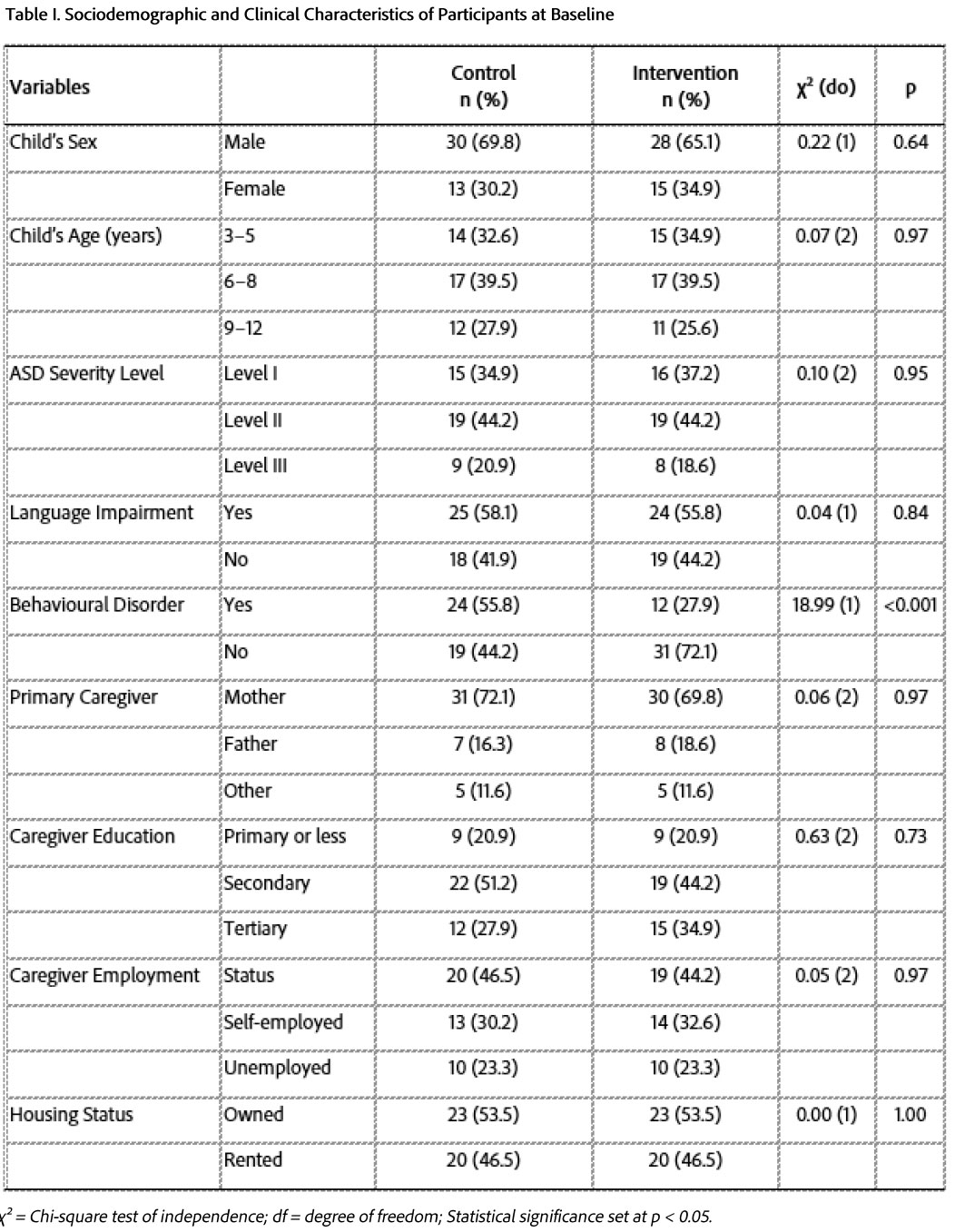
Table I (page 6) indicates that the intervention and comparison group were partially comparable at baseline across most sociodemographic and clinical characteristics. No statistically significant differences were observed for child sex (χ22222222
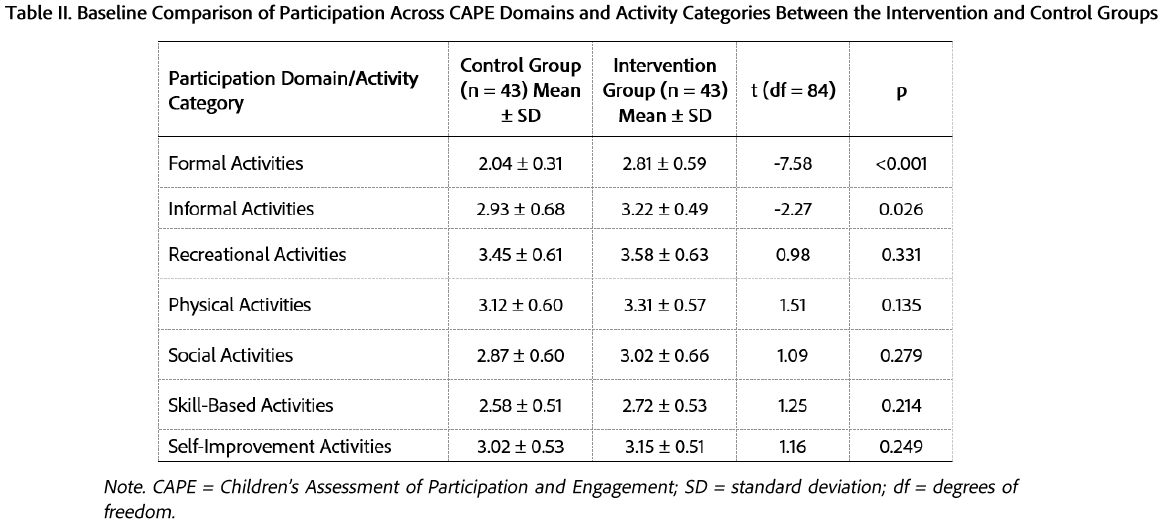
At baseline, CAPE-derived diversity scores (based on a culturally adapted item set) indicated that the intervention and comparison group were generally comparable across most activity domains, except for formal and informal activities. The intervention group demonstrated significantly higher diversity in formal activities (t(84) = -7.58, p < 0.001) and informal activities (t(84) = -2.27, p = 0.026), compared to the control group. No statistically significant differences were observed between groups in recreational, physical, social, skill-based, and self-improvement activities (all p > 0.05), indicating baseline equivalence across most participation domains.
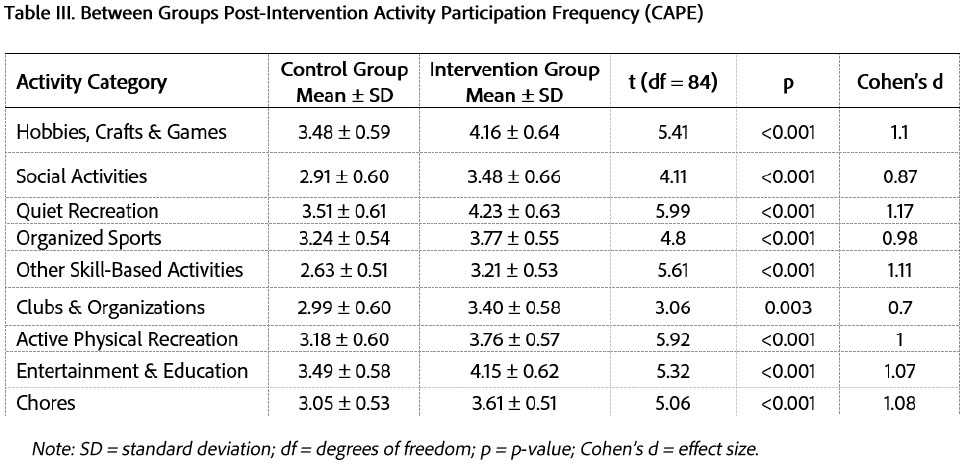
Post-intervention, Table III (below), however, the intervention group demonstrated significantly higher participation frequencies across all domains. The largest effects were observed in quiet recreation (4.23 ± 0.63 vs. 3.51 ± 0.61; t = 5.99, p < 0.001, d = 1.17) and hobbies, crafts, and games (4.16 ± 0.64 vs. 3.48 ± 0.59; t = 5.41, p < 0.001, d = 1.10), with additional improvements in active physical recreation, entertainment and education, and chores (all p < 0.001, d ≈ 1.0); indicating broad-based increases in participation following one-to-one instruction.
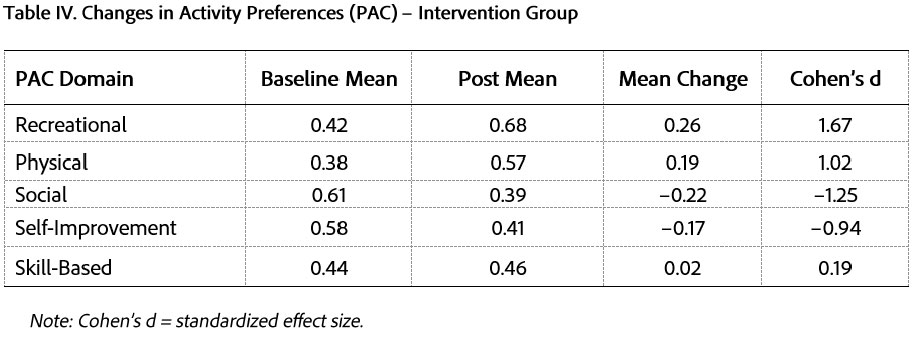
Within the intervention group, large shifts in activity preferences were observed over time, shown in Table IV (below). Preferences for recreational activities increased from 0.42 to 0.68 (d = 1.67), while physical activity preferences increased from 0.38 to 0.57 (d = 1.02). Conversely, preferences for social activities decreased from 0.61 to 0.39 (d = -1.25), and self-improvement activities decreased from 0.58 to 0.41 (d = -0.94). Preferences for skill-based activities remained relatively stable (d = 0.19). These results indicate selective changes in preferences rather than generalized shifts.
Enjoyment of activity participation
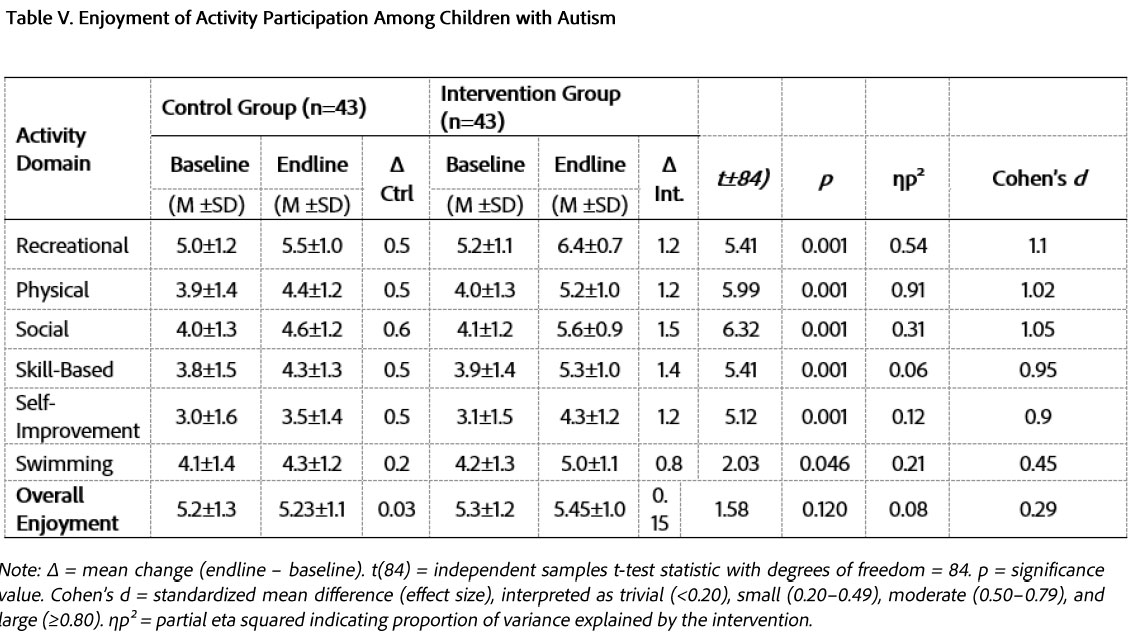
Results in Table V (below) indicates that the intervention group demonstrated significant increases in enjoyment across all activity domains, with large effect sizes for recreational (Δ = 1.2, t(84) = 5.41, p < 0.001, ηp2222222
Playfulness
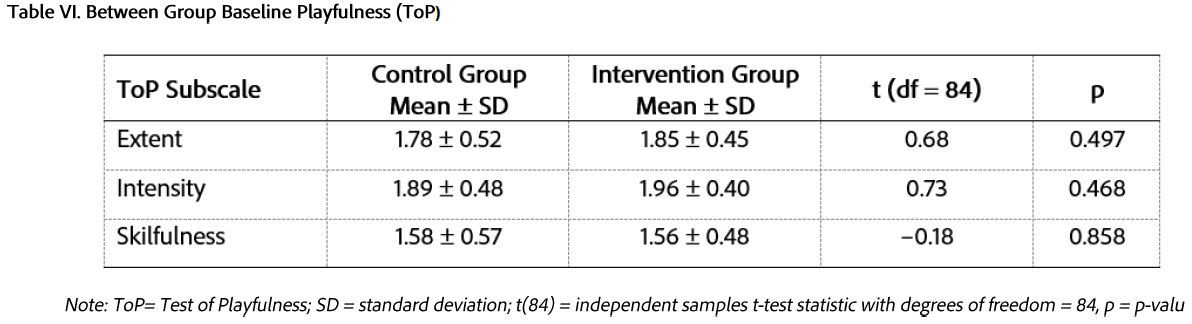
At baseline Table VI (below), playfulness scores did not differ significantly between groups across any ToP subscales, indicating comparable starting levels of playfulness. Mean playfulness extent was 1.78 ± 0.52 in the control group and 1.85 ± 0.45 in the intervention group (t = 0.68, p = 0.497), with similarly non-significant differences observed for intensity (t = 0.73, p = 0.468) and skilfulness (t = -0.18, p = 0.858). These results confirm that both groups began the study with similarly low levels of playfulness.
Post-intervention Table VII (page 9), the intervention group achieved significantly higher scores than the control group across all ToP subscales. The largest between-group difference was observed for playfulness extent, with mean scores of 3.20 ± 0.50 and 1.80 ± 0.50, respectively (t = 14.20, p < 0.001, d = 2.80). Significant differences were also found for intensity (2.45 ± 0.55 vs. 1.85 ± 0.46; t = 5.91, p < 0.001, d = 1.15) and skilfulness (2.30 ± 0.60 vs. 1.55 ± 0.53; t = 6.32, p < 0.001, d = 1.24).
DISCUSSION
Activity Participation
A primary finding of this study is that one-to-one instruction significantly increased activity participation across most domains of the CAPE, with notable mean gains in Quiet Recreation (from 3.58 to 4.23) and Skill-Based Activities (from 2.72 to 3.21). In contrast, the control group's participation remained relatively static, reinforcing and extending existing evidence supporting individualised interventions for children with ASD. A substantial increase was also observed in participation in Hobbies, Crafts and Games, with a mean increase of 0.68, which aligns with findings reported by Huang and Kang, who demonstrated that interest-based interventions can enhance engagement in leisure and creative play activities among children with ASD34et al., who reported that individualised support and structured guidance can facilitate greater participation in solitary and recreational activities among autistic children28
Importantly, these findings should be interpreted within the context of children with ASD, whose participation patterns are often influenced by sensory processing differences, preferences for predictability and routine, focused or repetitive interests, and challenges associated with complex social demands. From an occupational therapy perspective, activity analysis provides a useful framework for understanding these results. Many quiet recreational and hobby-based activities, such as puzzles, drawing, crafts, reading, construction activities, and computer-based games, are characterized by clear structure, predictable sequences, lower sensory stimulation, and opportunities for sustained engagement in areas of personal interest. These characteristics may align particularly well with the strengths and participation preferences commonly observed among children with ASD, which is consistent with literature describing the role of play and leisure activities in supporting engagement among autistic children10,35. In addition, such activities often allow solitary or parallel participation, thereby reducing the social communication and interaction demands that can create barriers to engagement in other occupations11,35.
The individualised nature of the intervention may have further enhanced participation by enabling therapists to select, adapt, and grade activities according to each child's interests, sensory profile, developmental abilities, and occupational goals. Through activity adaptation, environmental modification, sensory regulation strategies, and individualised scaffolding, therapists were able to create conditions that supported successful engagement and occupational competence. These intervention strategies are consistent with occupational therapy approaches outlined in the Occupational Therapy Practice Framework and participation-focused intervention models for children with ASD2020,29.
Differentiating Participation from Preference
Statistically significant differences between-group changes in preferences as measured by the PAC (no PAC domain showed a significant Group × Time interaction after covariate adjustment) were noted. However, within the intervention cohort, children demonstrated notable and specific shifts in preferences, particularly showing increases in Recreational (d = 1.67) and Physical activities (d = 1.02). This supports the effectiveness of personalized, play-based interventions in enhancing children's interest in self-directed and active pursuits31
Preferences for social and self-improvement activities decreased significantly within the intervention group. Traditionally, this decline could be seen negatively; however, from a neurodiversity-affirming perspective, it signifies success. One possible explanation for the observed decrease in preferences for social and self-improvement activities is that the intervention enabled children to make more differentiated choices regarding the activities they found meaningful and enjoyable. This interpretation is somewhat corroborated by Kestner and colleagues, who indicated that choice-oriented interventions may affect children's prioritisation of activities according to perceived personal value and interest36
The noted alterations in activity preferences signify domain-specific rather than universal shifts in participation patterns, suggesting that the intervention affected the relative intensity of preferences within specific activity areas rather than engendering uniform change across all domains. Rises in recreational and physical activity preferences, along with declines in social and self-improvement choices, indicate a reallocation of engagement tendencies across professional domains. Within the PAC framework, this pattern reflects changes in the salience of specific activity types rather than an overall increase or decrease in participation preference. Consistent with CAPE/PAC literature, intervention effects in children's participation are typically expressed as differential changes across activity domains rather than generalized shifts37
Importantly, the decreases observed in social and self-improvement preferences should not be interpreted as evidence of reduced social competence, diminished social interest, or poorer functional abilities. Prior research has demonstrated that therapies focusing on social participation, communication, play, and functional abilities can enhance social engagement and adaptive functioning in children with ASD11,12,25,31,38. Interventions targeting activities of daily living and self-care skills have shown beneficial outcomes on occupational performance and autonomy20,25. Consequently, the current findings may indicate alterations in the relative appeal or perceived worth of activity areas rather than declines in fundamental abilities.
Playfulness Transformation
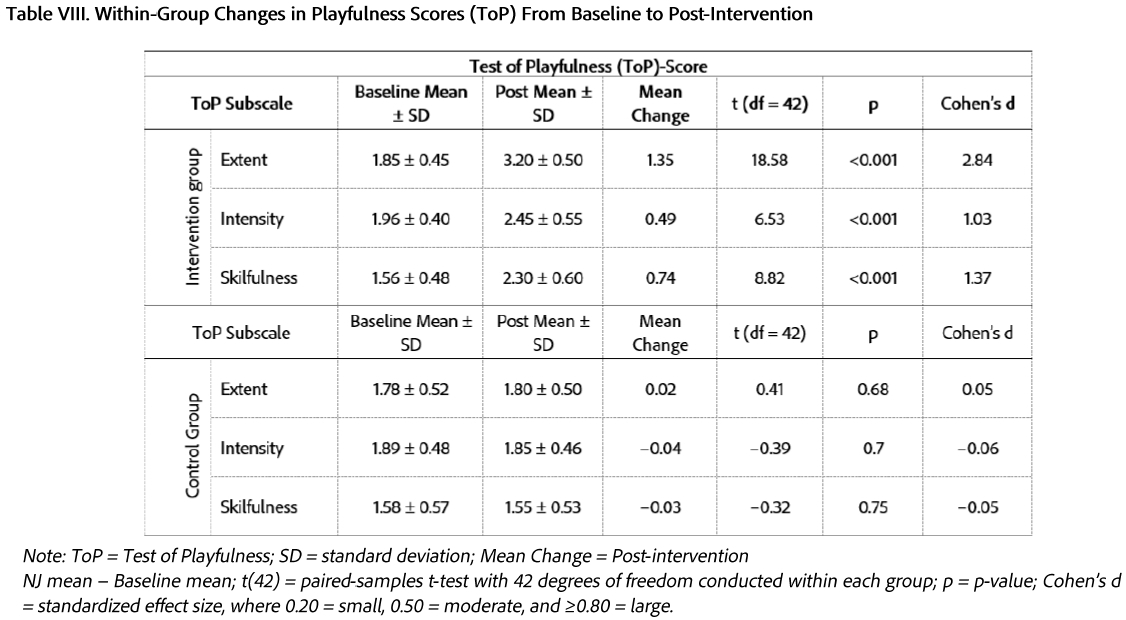
One-to-one instruction significantly improved playfulness in participants, with substantial gains observed in the ToP compared to minimal changes in the control group. Initially, ASD participants had low ToP scores, indicating significant play deficits commonly documented in ASD populations3522
The largest effect emerged in the Extent subscale (d=2.84), indicating a vast expansion in the children's repertoire of playful actions. Saral and Ulke-Kurkcuoglu quite similarly reported functionally related increases in the frequency and diversity of children's pretend play3938
Furthermore, the uniform improvements across all underlying ToP domains (Intrinsic Motivation, Internal Control, and Framing) contrast with reports of uneven gains in group-based interventions suggesting that the individualised, dyadic nature of this intervention may be uniquely suited to targeting all facets of play in ASD23,40. Improvements in playfulness exceeded the changes observed in activity participation frequency, indicating that the intervention had a more substantial impact on the quality of children's experiences rather than solely increasing activity quantity. Enhanced playfulness is associated with increased exploration, spontaneity, and overall wellbeing, which may account for the greater willingness to engage in diverse activities following the intervention.
The Contours of Enjoyment
This study indicates that the intervention significantly enhances enjoyment, with improvements for the intervention group markedly greater than the control group, highlighting the context-dependent nature of its impact on positive affect. Similar findings were reported by Kim P.C Kuypers4142
However, when enjoyment was aggregated across all 44 activities, the between-group difference, while favouring the intervention group, did not reach statistical significance. Eversole and colleagues noted similar findings where they reported that older children with ASD enjoyed overall recreational, and self-improvement activities less than younger children, with no differences noted among typically developing age groups43
The most telling finding emerged at the individual activity level, where only swimming exhibited a statistically significant between-group difference in enjoyment. Similar finding was reported by Tsolaki and colleagues, where they concluded that swimming significantly improved aquatic readiness and emotional satisfaction for children with ASD44
Initial exposure to particular activities may have affected the noted alterations in satisfaction. If certain youngsters possessed past experience with swimming or analogous leisure activities, their initial enjoyment levels may have been heightened, thereby restricting apparent changes over time. Conversely, in instances when activities were newly implemented or organised differently, heightened enjoyment may indicate both the impacts of the intervention and involvement stemming from novelty. It is essential to recognise that enhancements in enjoyment may not be exclusively linked to the personalised therapist-led intervention format, but also to the inherent motivational and sensory attributes of the activities themselves, such as swimming or recreational play. Therefore, while the structured individualised intervention may have facilitated engagement, enjoyment outcomes are likely influenced by a combination of instructional context and the inherent characteristics of the activities22,4.
From an occupational therapy perspective, the observed improvements are clinically meaningful because participation, playfulness, and enjoyment are considered key indicators of occupational engagement and wellbeing3204,45.
Although individualised intervention was associated with improvements in participation and playfulness, group-based interventions may offer unique advantages for peer interaction, social learning, and generalisation of skills. Therefore, the findings should not be interpreted as suggesting that individualised intervention is universally superior to group-based service models.
The nine-month duration of the intervention necessitates consideration of possible maturation consequences. Children with growth, continuous educational experiences, and regular treatment interventions. The incorporation of a comparison group getting regular care enhances the assurance that the observed enhancements were not only due to maturation. Although some developmental progress was anticipated in both groups over a nine-month duration, significantly more advancements were noted in toddlers getting personalised one-on-one training. Nevertheless, because participants were not randomly assigned and maturation effects cannot be completely separated from intervention effects in a quasi-experimental design, causal interpretations should be made cautiously.
Strengths
- The research utilised a quasi-experimental pre-test/post-test approach with a comparison group, facilitating the assessment of temporal changes and offering a more robust framework for analysing intervention effects compared to a single-group or cross-sectional design.
- The study utilised a systematic occupational therapy intervention with standardised protocols, conducted repeated pre- and post-intervention evaluations, and included a comparison group, so augmenting the evaluation's rigour.
- A variety of validated outcome measures (CAPE/PAC and Test of Playfulness (ToP)) were employed, facilitating a thorough evaluation of involvement patterns, activity preferences, and engagement.
- The use of both participation and playfulness metrics yielded a more comprehensive insight into intervention results across occupational domains.
Limitations
- Participants were allocated according to the centres they attended rather than through individual randomization, introducing the possibility of selection bias and residual confounding despite statistical adjustment.
- Although the intervention followed a manualized protocol and received supervisory oversight, formal fidelity audits using standardized checklists were not conducted, limiting certainty regarding intervention consistency.
- Certain participation outcomes depended on carer proxy reports due to communication difficulties faced by several children, which hindered accurate self-reporting.
- Various evaluators may have conducted baseline and follow-up assessments, leading to potential inter-rater variability and measurement inconsistency.
- Result assessors were cognisant of participants' group assignments, so introducing the potential for observer bias and possibly affecting result evaluations.
- Participant reaction, known as the Hawthorne effect, may have transpired, as youngsters modified their behaviour due to their awareness of being observed and included in the intervention.
Recommendations
- Future research should utilise individual randomisation, cluster randomisation, or stepped-wedge designs to enhance causal inference and mitigate selection bias.
- Researchers ought to standardise intervention dosage among study groups or statistically adjust for treatment intensity to more effectively separate intervention-specific effects.
- Future research should employ blinded outcome assessors to mitigate the potential for observer bias.
- Longitudinal studies with extended follow-up periods are needed to determine the durability of intervention effects over time.
- Larger sample sizes should be considered to increase statistical power, particularly for detecting changes in affective outcomes such as participation enjoyment.
- A detailed intervention manual accompanied by formal fidelity procedures should be developed to support replication and integration into routine occupational therapy practice.
CONCLUSION
This study suggests that an individualised therapist-led intervention was associated with improvements in activity participation and playfulness among children with Autism Spectrum Disorder attending two specialised centres in Rwanda. Children who received the intervention demonstrated greater gains in participation across several activity domains and higher levels of playfulness compared with those receiving standard group-based services. Although activity preferences changed over time, these changes were domain-specific rather than uniform across all participation areas.
The results endorse the potential efficacy of personalised, occupation-centered methodologies that integrate activity modification, play-oriented participation, sensory regulating techniques, environmental adjustments, and carer engagement. Nonetheless, due to the quasi-experimental design, non-randomized group allocation, variations in intervention intensity, and other methodological constraints, the results should be regarded with care and do not establish conclusive causal relationships. Additional research employing randomised or stepped-wedge designs, blinded outcome assessment, formal fidelity monitoring, and extended follow-up durations is necessary to validate effectiveness, assess outcome sustainability, and ascertain the feasibility and scalability of personalised interventions in low-resource environments.
Conflict of interests
The authors declare no competing interest
AI/LLM declaration
Authors declare that no AI tools were used in the preparation of this manuscript
Author Contributions
All authors contributed substantially to the conception and design of the study. Data collection was undertaken by the primary author with support from the co-authors. Data analysis and interpretation were conducted collaboratively. The first author drafted the initial manuscript, and all authors critically reviewed, revised, and approved the final version of the manuscript. All authors agree to be accountable for all aspects of the work and have read and approved the final manuscript.
REFERENCES
Acknowledgments
We would like to extend our sincere gratitude to Benjamin Canter, OTD from the Rehabilitation Science Department at Boston University and Mr. Jean Claude Tuyishime, Master of Occupational Therapy graduate from Stellenbosch University Faculty of Medicine and Health Sciences and Lecturer at the Baptist School of Public Health in Mutengene, Cameroon. Their insightful review of our proposal, along with his valuable comments and recommendations, significantly helped us refine and polish the study. We would also like to thank Anita Bundy, ScD, OTR, FAOTA and the CanChild Centre for Childhood Disability Research for access to the assessment tools utilized in this study.
Activity Participation Preferences
-
1. Wager MGT and JFS, RBenjamin S. Social Participation Among Young Adults with an Autism Spectrum Disorder. Bone [Internet]. 2013;23(1):1-7. Available from: https://www.ncbi.nlm.nih.gov/pmc/articles/PMC3624763/pdf/nihms412728.pdf
» https://www.ncbi.nlm.nih.gov/pmc/articles/PMC3624763/pdf/nihms412728.pdf -
2. Lauren M. Little, Karla Ausderau, John Sideris GTB. Activity Participation and Sensory Features Among Children with Autism Spectrum Disorders Lauren. 2019;45(9):2981-90. Available from: https://doi.org/10.5014/ajot.2014.009894
» https://doi.org/10.5014/ajot.2014.009894 -
3. Law M. Participation in the Occupations of Everyday Life. Am J Occup Ther. 2002 Nov 1;56(6):640-9. Available from: https://doi.org/10.5014/ajot.56.6.640
» https://doi.org/10.5014/ajot.56.6.640 -
4. Schaaf RC, Benevides T, Mailloux Z, Faller P, Hunt J, Van Hooydonk E, et al. An intervention for sensory difficulties in children with autism: A randomized trial. J Autism Dev Disord. 2014;44(7):1493-506. Available from: https://doi.org/10.1007/s10803-013-1983-8
» https://doi.org/10.1007/s10803-013-1983-8 -
5. Shattuck PT, Orsmond GI, Wagner M, Cooper BP. Participation in social activities among adolescents with an autism spectrum disorder. PLoS One. 2011;6(11). Available from: https://doi.org/10.1371/journal.pone.002717
» https://doi.org/10.1371/journal.pone.002717 -
6. Salari N, Rasoulpoor S, Rasoulpoor S, Shohaimi S, Jafarpour S, Abdoli N, et al. The global prevalence of autism spectrum disorder: a comprehensive systematic review and meta-analysis. Ital J Pediatr [Internet]. 2022;48(1). Available from: https://doi.org/10.1186/s13052-022-01310-w
» https://doi.org/10.1186/s13052-022-01310-w -
7. Arinda A, Nakasujja N, Odokonyero R. Prevalence of autism spectrum disorder symptoms in a paediatric neurology clinic at a tertiary hospital in Uganda. South African J Psychiatry. 2021;27:1-8. Available from: https://doi.org/10.4102/sajpsychiatry.v27i0.1548
» https://doi.org/10.4102/sajpsychiatry.v27i0.1548 -
8. Duffy FH, Als H. Autism, spectrum or clusters? An EEG coherence study. BMC Neurol. 2019;19(1):1-13. Available from: https://doi.org/10.1186/s12883-019-1254-1
» https://doi.org/10.1186/s12883-019-1254-1 -
9. Collins SP, Storrow A, Liu D, Jenkins CA, Miller KF, Kampe C, et al. Medical specialists in LMICs; a systematic review and best-fit framework synthesis of the evidence on their roles and contribution to health systems". 2021;167-86. Available from: https://doi.org/10.1101/2025.01.06.25320057
» https://doi.org/10.1101/2025.01.06.25320057 -
10. Elbeltagi R, Al-Beltagi M, Saeed NK, Alhawamdeh R. Play therapy in children with autism: Its role, implications, and limitations. World J Clin Pediatr. 2023;12(1):1-22. Available from: https://doi.org/10.5409/wjcp.v12.i1.1
» https://doi.org/10.5409/wjcp.v12.i1.1 -
11. Ziegler SMT, Morrier MJ. Increasing Social Interactions of Preschool Children With Autism Through Cooperative Outdoor Play. J Spec Educ. 2022;56(1):49-60. Available from: https://doi.org/10.1177/00224669211032556
» https://doi.org/10.1177/00224669211032556 -
12. Kent C, Cordier R, Joosten A, Wilkes-Gillan S, Bundy A. Can We Play Together? A Closer Look at the Peers of a Peer-Mediated Intervention to Improve Play in Children with Autism Spectrum Disorder. J Autism Dev Disord [Internet]. 2020;50(8):2860-73. Available from: https://doi.org/10.1007/s10803-020-04387-6
» https://doi.org/10.1007/s10803-020-04387-6 -
13. Franz L, Carolina N, Chambers N, Von Isenburg M, De Vries P. Autism Spectrum Disorder in Sub-Saharan Africa: A Comprehensive Scoping Review. Autism Res. 2017;10(5):723-49. Available from: https://doi.org/10.1002/aur.1766
» https://doi.org/10.1002/aur.1766 -
14. Kakooza-Mwesige A, Ssebyala K, Karamagi C, Kiguli S, Smith K, Anderson MC, et al. Adaptation of the "ten questions" to screen for autism and other neurodevelopmental disorders in Uganda. Autism. 2014;18(4):447-57. Available from: https://doi.org/10.1177/1362361313475848
» https://doi.org/10.1177/1362361313475848 -
15. Baxter AJ, Brugha TS, Erskine HE, Scheurer RW, Vos T, Scott JG. The epidemiology and global burden of autism spectrum disorders. Psychol Med. 2015;45(3):601-13. Available from: https://doi.org/10.1017/S003329171400172X
» https://doi.org/10.1017/S003329171400172X -
16. MINEDUC. Revised special needs and inclusive education policy. 2018;44. Available from: https://www.mineduc.gov.rw/fileadmin/user_upload/Mineduc/Publications/EDUCATION_POLICIES/Special_Needs_Strategic_Plan.pdf
» https://www.mineduc.gov.rw/fileadmin/user_upload/Mineduc/Publications/EDUCATION_POLICIES/Special_Needs_Strategic_Plan.pdf -
17. Degener T. 10 Convention on the Rights of Persons With Disabilities. Netherlands Q Hum Rights. 2017;35(3):152-7. Available from: https://doi.org/10.3390/laws5030035
» https://doi.org/10.3390/laws5030035 -
18. Rwanda MoH. A Situation Assessment of Rehabilitation In Republic of Rwanda. 2021;(January). Available from: https://www.moh.gov.rw/index.php?eID=dumpFile&t=f&f=31658&token=e3a1ea5eeb2fb8bcae6dff5ae0adf19add1c9b14
» https://www.moh.gov.rw/index.php?eID=dumpFile&t=f&f=31658&token=e3a1ea5eeb2fb8bcae6dff5ae0adf19add1c9b14 -
19. Scherer N, Nemerimana M, Nanyunja C, Kitema GF, Sadoo S, Iradukunda F, et al. Early childhood intervention for children at risk of developmental disabilities and their caregivers in Rwanda: study protocol for the PDC/Baby Ubuntu cluster randomised trial. Trials [Internet]. 2026;27(1). Available from: https://researchonline.lshtm.ac.uk/id/eprint/4681777/1/Scherer-etal-2026-Early-childhood-intervention-for-children.pdf
» https://researchonline.lshtm.ac.uk/id/eprint/4681777/1/Scherer-etal-2026-Early-childhood-intervention-for-children.pdf -
20. Boop C, Cahill SM, Davis C, Dorsey J, Gibbs V, Herr B, et al. Occupational Therapy Practice Framework: Domain and Process Fourth Edition [Internet]. Fourth Edi. Vol. 74, American Journal of Occupational Therapy. 2020. 1-87 p. Available from: https://carrieschmittotd.com/wp-content/uploads/2021/04/AOTA-Occupational-Therapy-Practice-Framwork-OTPF-4th-edition.pdf
» https://carrieschmittotd.com/wp-content/uploads/2021/04/AOTA-Occupational-Therapy-Practice-Framwork-OTPF-4th-edition.pdf -
21. Neville RD, Draper CE, Cooper TJ, Abdullah MM, Lakes KD. Association between engagement in physical activity and adaptive behavior in young children with Autism Spectrum Disorder. Ment Health Phys Act. 2021;20. Available from: https://doi.org/10.1016/j.mhpa.2021.100389
» https://doi.org/10.1016/j.mhpa.2021.100389 -
22. Bundy AC, Nelson L, Bingaman K. Validity and Reliability of a Test of Playfulness. Occup Ther J Res. 2001;21(4):276-92. Available from: https://doi.org/10.1177/153944920102100405
» https://doi.org/10.1177/153944920102100405 -
23. Briet G, Le Maner-Idrissi G, Seveno T, Le Marec O, Le Sourn-Bissaoui S. Peer mediation in play settings for minimally verbal students with autism Spectrum disorder. Autism Dev Lang Impair. 2023;8. Available from: https://doi.org/10.1177/23969415231204837
» https://doi.org/10.1177/23969415231204837 -
24. M. Meamarbashi Aval, A. Amin Yazdi, H. Karshki SA. Determining Interactive and Individual Characteristics of Preschool Children with Anxiety Disorders Based on Developmental, Individual Differences, Relationship Based Model (DIR). Arch Anesthesiol Crit Care. 2016;68(11):1055-64. Available from: https://doi.org/10.48308/APSY.2022.227769.1349
» https://doi.org/10.48308/APSY.2022.227769.1349 -
25. de Korte MWP, van Dongen-Boomsma M, Oosterling IJ, Buitelaar JK, Staal WG. Pivotal Response Treatment (PRT) parent group training for young children with autism spectrum disorder: a pilot study. Sci Rep [Internet]. 2022;12(1):1-9. Available from: https://doi.org/10.1038/s41598-022-10604-2
» https://doi.org/10.1038/s41598-022-10604-2 -
26. Stahmer AC, Dufek S, Rogers SJ, Iosif AM. Study Protocol for a Cluster, Randomized, Controlled Community Effectiveness Trial of the Early Start Denver Model (ESDM) Compared to Community Early Behavioral Intervention (EBI) in Community Programs serving Young Autistic Children: Partnering for Autis. BMC Psychol [Internet]. 2024;12(1). Available from: https://doi.org/10.1186/s40359-024-02020-0
» https://doi.org/10.1186/s40359-024-02020-0 -
27. Kim SJ. Dyadic Drum Playing and Social Skills : Implications for Rhythm-Mediated Intervention for Children with Autism Spectrum Disorder Dyadic Drum Playing and Social Skills : Implications for Rhythm-Mediated Intervention for Children with Autism Spectrum Disord. 2022;(November). Available from: https://doi.org/10.1093/jmt/thy013
» https://doi.org/10.1093/jmt/thy013 -
28. Shannon CA, Olsen LL, Hole R, Rush KL. Research in Developmental Disabilities " There ' s nothing here ": Perspectives from rural parents promoting safe active recreation for children living with autism spectrum disorders. Res Dev Disabil [Internet]. 2021;115(May):103998. Available from: https://doi.org/10.1016/j.ridd.2021.103998
» https://doi.org/10.1016/j.ridd.2021.103998 -
29. Whiteford G, Jones K, Rahal C, Suleman A, Whiteford G. The Participatory Occupational Justice Framework as a tool for change: Three contrasting case narratives The Participatory Occupational Justice Framework as a tool for change : Three contrasting case narratives. 2018;7591. Available from: https://doi.org/10.1080/14427591.2018.1504607
» https://doi.org/10.1080/14427591.2018.1504607 -
30. Zarei H, Norasteh AA, Dehghani N, Lieberman LJ, Ertel MW, Brian A. Effects of exercise training programs on motor skills of individuals with intellectual disabilities: a systematic review and meta-analysis. Disabil Rehabil [Internet]. 2024;46(25):6001-10. Available from: https://doi.org/10.1080/09638288.2024.2318486
» https://doi.org/10.1080/09638288.2024.2318486 -
31. Deniz E, Torgerson C, Toseeb U. Play-based interventions for mental health : A systematic review and meta-analysis focused on children and adolescents with autism spectrum disorder and developmental language disorder. 2022; Available from: https://doi.org/10.1177/23969415211073118
» https://doi.org/10.1177/23969415211073118 -
32. Holstila E, Vallittu A, Ranto S, Lahti T, Manninen A. Ethical Principles for Medical Research Involving Human Subjects. Cities as Engines Sustain Compet Eur Urban Policy Pract. 2016;175-89. Available from: https://doi.org/10.4324/9781315572093-15
» https://doi.org/10.4324/9781315572093-15 -
33. Friedland AJ, Folt CL. Experimental Design and Methods: Writ Success Sci Propos. 2025;(8):106-23. Available from: https://doi.org/10.2307/j.ctt1npcnv.15
» https://doi.org/10.2307/j.ctt1npcnv.15 -
34. Huang C ching, Kang L ju. Participation in Play and Leisure Activities of Young Children with Autism Spectrum Disorder and Typically Developing Children in Taiwan : A Preliminary Study. 2021; Available from: https://www.mdpi.com/journal/ijerph
» https://www.mdpi.com/journal/ijerph -
35. Westby C. Playing to Pretend or Pretending to Play: Play in Children with Autism Spectrum Disorder. Semin Speech Lang. 2022;43(4):331-46. Available from: https://doi.org/10.1055/s-0042-1750348
» https://doi.org/10.1055/s-0042-1750348 -
36. Kestner KM, Finch KR, Kolb RL. Systematic Review of Procedures and Outcomes of Choice-Based Interventions with Children. Educ Treat Child [Internet]. 2023;46(1):77-106. Available from: https://doi.org/10.1007/s43494-023-00088-3
» https://doi.org/10.1007/s43494-023-00088-3 -
37. King, G., Law, M., King, S., Hurley, P., Hanna, S., Kertoy, M., Rosenbaum, P., & Young N. Children's Assessment of Participation and Enjoyment (CAPE) and Preferences for Activities of Children (PAC) [Internet]. San Antonio, TX; 2004. Available from: https://canchild.ca/resources/43-measures-of-children-s-participation-and-enjoyment-cape-pac/
» https://canchild.ca/resources/43-measures-of-children-s-participation-and-enjoyment-cape-pac/ -
38. Rautenbach G, Conolly B, Hoosain M, Zunza M, Plastow NA. The Effect of Play-Based Occupational Therapy on Playfulness and Social Play of Children with Autism Spectrum Disorder: A Systematic Review. J Occup Ther Sch Early Interv [Internet]. 2025;18(2):248-80. Available from: https://doi.org/10.1080/19411243.2024.2360414
» https://doi.org/10.1080/19411243.2024.2360414 -
39. Saral D, Ulke-Kurkcuoglu B. Using Least-To-Most Prompting to Increase the Frequency and Diversity of Pretend Play in Children with Autism. Topics Early Child Spec Educ. 2022;42(1):33-49. Available from: https://doi.org/10.1177/0271121420942850
» https://doi.org/10.1177/0271121420942850 -
40. Wade J, Sarkar A, Swanson A, Weitlauf A, Warren Z, Sarkar N. Process measures of dyadic collaborative interaction for social skills intervention in individuals with Autism Spectrum Disorders. ACM Trans Access Comput. 2017;10(4):1-19. Available from: https://doi.org/10.1145/3107925
» https://doi.org/10.1145/3107925 -
41. Kuypers KP. Context-dependent emotional empathy in virtual reality. Adv Soc Sci Res J. 2018;5(4). Available from: https://doi.org/10.14738/assrj.54.4514
» https://doi.org/10.14738/assrj.54.4514 -
42. Ahmad CB, Ramzi NR. Recreational Participation of Children with Autism Spectrum Disorder (ASD). Built Environ J. 2021;18(1):87. Available from: https://doi.org/10.24191/bej.v18i1.12990
» https://doi.org/10.24191/bej.v18i1.12990 -
43. Eversole M, Collins DM, Karmarkar A, Colton L, Quinn JP, Karsbaek R, et al. Leisure Activity Enjoyment of Children with Autism Spectrum Disorders. J Autism Dev Disord. 2016;46(1):10-20. Available from: https://doi.org/10.1007/s10803-015-2529-z
» https://doi.org/10.1007/s10803-015-2529-z -
44. Tsolaki C, Kokaridas D, Batsiou S, Baxevani M, Kofou G. Therapeutic Swimming Program in Sports for All Settings and Its Effect on the Aquatic Readiness and Emotional Satisfaction of Children With Id and Asd. Eur J Phys Educ Sport Sci. 2023;10(3):29-45. Available from: https://doi.org/10.46827/ejpe.v10i3.5037
» https://doi.org/10.46827/ejpe.v10i3.5037 -
45. Novak I, Honan I. Effectiveness of paediatric occupational therapy for children with disabilities: A systematic review. Aust Occup Ther J. 2019;66(3):258-73. Available from: https://doi.org/10.1111/1440-1630.12573
» https://doi.org/10.1111/1440-1630.12573

Reviewed: 8 May 2026
Revised: 2 July 2026
Accepted: 4 July 2026
First online: 3 August 2026
DATA AVAILABILITY: The dataset produced and/or analysed during this study can be obtained from the corresponding author upon request for 10 years post-publication.
FUNDING: The Centre of Excellence, Biomedical Engineering and e-Health, University of Rwanda is acknowledged for partial sponsorship of this research.