People-centeredness in health system reform. Public perceptions of private and public hospitals in South Africa
Abstract
INTRODUCTION: South Africa's planned National Health Insurance system seeks to transform and integrate public and private healthcare services, as part of wider efforts to realise universal health coverage. Ensuring quality, acceptable care is crucial for public buy-in to these changes. In this study the public perceptions of the country's private and state hospitals are explored. A better understanding may guide improvements in public sector services, and strengthen confidence and trust in health system reforms. METHODS: Eight qualitative focus group discussions were held with 54 participants delineated by race ('black' and 'white' South Africans) and experience (recent or indirect) of public and private hospital services. The views on quality of care, cleanliness, satisfaction, staff attitudes, origins of perceptions, and suggestions for improving state hospitals were explored. FINDINGS/RESULTS: Thematic content analysis revealed an almost-automatic initial perception that private hospitals are "good" and state hospitals "bad". However, on further exploration, a more nuanced understanding surfaced around the costs and affordability of private and public hospitals, and trust in and acceptability of health services. CONCLUSION: Health systems are also human systems, with personal encounters at their heart. In order to acceptably serve people and society, policy emphasis is needed to build a culture of person-centred care in the public sector.
National Health Insurance; people-centeredness; health system reform; universal health coverage; public perceptions
INTRODUCTION
"We are working to reduce the exorbitant cost of private healthcare and make sure the public healthcare system is of good quality " (South African Minister of Health, Dr Aaron Motsoaledi, August, 2015)1
Globally, many countries, including South Africa, are striving for universal health coverage (UHC). In an ongoing effort to address persistent injustice and access barriers, South Africa is implementing a National Health Insurance system (NHI) in which affordable, quality health care will be available for those who need it, regardless of 'who' they are, 'where' they live or their ability to pay2334-6. As an integral part of healthcare, Occupational Therapy services are offered across all levels and sectors of the health system and as such any health sector reform will have an influence on these services.
On the financing side, the policy envisages that a single purchaser will integrate the private and public sectors and that a unified central fund will reduce the fragmentation and inequities inherent in the system7-9. The policy emphasises the need to reduce costs in the private sector, and also, to tackle perceived and real problems with quality of care (QoC) in the public sector. NHI reforms are currently being piloted at a district level and efforts are underway to tackle QoC with primary health care re-engineering (2011), the National Core Standards for Health Establishments (2011), and the introduction of an Office of Health Standards Compliance (2012), which aim to provide a benchmark for QoC across South Africa7-9. Furthermore, facility-based and district-wide reforms such as the Ideal Clinic, Integrated Chronic Disease Management, Ward-Based Outreach Teams, and the contracting of privately-based general practitioners into state clinics are intended to improve the accessibility of services, while looking at innovative ways to draw together actors working in private and public care, including occupational therapists.
Ensuring good QoC at all levels is not only important for the NHI but should be a goal of any well-functioning health system4,5,8,10. Alongside efforts to strengthen primary health care , there is also an emphasis on improving hospital services311,12. In South Africa, occupational therapy and other rehabilitation services are delivered through both the public and private sectors. The NHI White Paper31311,14. Confidence can be demonstrated by, among other things, public willingness to access public healthcare facilities as their provider of choice. Choice of health service providers is influenced not only by cost and affordability, but also by perceptions and experiences of the public and private sector health care available15,16.
This paper focuses on public perceptions of state and private hospitals in South Africa and people's willingness to utilise available health services, which include occupational therapy services. We highlight issues surrounding the acceptability of health services, including trust and confidence in the health system and how these issues may be addressed to ensure buy-in from the public for the NHI system.
Why does South Africa need NHI? The persistence of inequity
Built in the interests of white capital, the apartheid health system reproduced massive racial and spatial inequalities in the availability of care and population health outcomes. In the early 1970s, for example, one doctor served 1 5,000 people living in the (black African) Bantustans compared to 1,700 in the rest of the country, and tuberculosis rates and deaths were much higher in black and so-called coloured populations than amongst whites17,18. Utilisation of the then-expanding private health sector was also racially-skewed towards white users, and human and financial resources were increasingly drawn into private care. By 1980, 40% of doctors worked in the private sector, increasing to over 60% by 199012,18.
Since the country's first democratic elections in 1994, access to health care has remained inequitable, despite a number of progressive policies aimed at redressing past inequities191912,20.
Human resources are similarly mal-distributed between the private and public sectors. Private hospitals are generally better equipped in terms of resources, staffing and infrastructure12,21; attracting an estimated 79% of all doctors, with one specialist doctor serving fewer than 500 people on average (compared to nearly 11,000 people in the public sector)11,12. There has also been a substantial decrease in the nurse-to-population ratio in the public sector, falling from 149 to 110 professional nurses per 100,000 between 199822182324
The ratio between patients and health workers does not only reflect human resource shortages, but may have a negative impact on health worker attitudes, leading to reduced quality of care and demotivation among health workers in the public sector1225-27. This has fuelled perceptions that the public health system is strained, under-resourced and has 'worsened' over time289,23,29.
Acceptability and why perceptions matter
Acceptability of care cannot be understood outside of context25,303125,30. In South Africa, race and socio-economic status influence perceptions and expectations of care, as well as actual care provided3220
QoC manifests clinically, and also as service quality, responsiveness, patient satisfaction, trust, staffing, and cleanliness of facilities; all of which constitute the acceptability of health care services10,17,33-35. If a health system cannot be trusted to guarantee a threshold level of quality, it may remain underutilised254,36. Evidence suggests that people actively 'seek out' quality care, while (where possible) avoiding care perceived to compromise or undermine their health3637,38. Andaleeb37391711,40,41. A better understanding of perceptions may guide NHI efforts to improve public sector services, and strengthen confidence and trust in health system reforms. In this study, we explore how members of the South African public perceive private and public hospitals, as well as their preferences for health care providers.
METHODOLOGY
Study design
In order to explore perceptions of private and public hospitals, an exploratory qualitative approach was followed. Qualitative methods are particularly suitable for exploring the 'hows' and 'whys' (reasons for) as well as the 'whats' (perceptions) under research4243311811, 40,4111,41
Sampling and participants


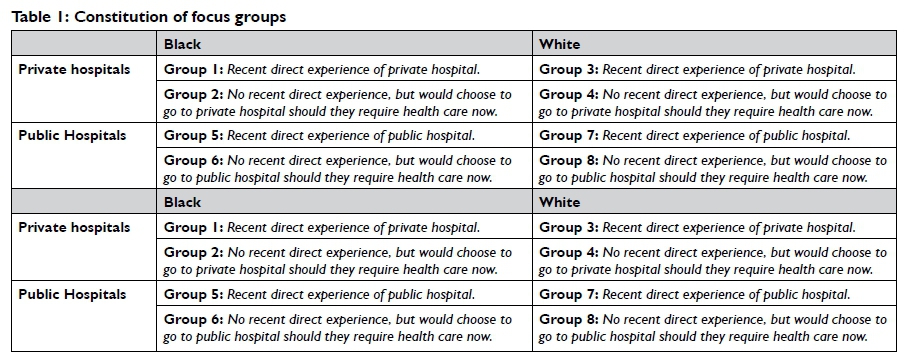
A total of eight focus groups were constituted according to race (black and white participants), and previous experience with public and private hospitals, as illustrated in Table 1 above.
Given the complex configuration of these groups, snowball sampling was used to recruit participants4443,44. Of the 129 people who were approached to take part in the study, a total of 54 participated.
Data Collection
FGDs were run between March and November 2011 in Johannesburg, at venues and times convenient for participants. Discussions were facilitated in English (with white participants), and Sesotho and English (with black participants). Sessions took between 90120 minutes and were audio-recorded and immediately translated and transcribed verbatim. Translation was confirmed with trusted Sesotho-speakers to get consensus on the choice of terminology.
A topic guide was used to facilitate discussion around perceptions of public and private hospitals and whether participants would use these services in the future. Key points of discussion included quality of care, cleanliness, patient satisfaction, staff attitudes, the extent to which views were shared within the group, the origins of participants' perceptions, and recommendations for improving the state of public hospitals.
Data Analysis
Thematic content analysis was employed to explore the themes that emerged inductively from the groups and through the anticipated categories based on the literature and research questions (deductive analysis). Inductive and deductive codes were developed and analysis proceeded until saturation was reached.
Primary coding - grounded in the text by using the words of the respondents - was initially carried out, followed by higher order coding to consolidate these primary codes. Thematic development then followed where the higher order codes were converted into themes and sub-themes313131
Ethics
Ethical clearance was obtained from the University of the Witwa-tersrand Committee for Research on Human Subjects- Medical. Written informed consent was obtained from each participant; including permission to audio-record the FGDs.
FINDINGS
Previous studies have shown that white patients are more likely to report excellent service in health care overall than their black African counterparts, and that recent users of both sectors report better satisfaction with services than those with no direct recent experi-ence22,23. In this study, differences in perceptions based on race and experience of private or public hospitals did not emerge, although those with recent direct experience of a public hospital held a more positive view of the public sector as compared to those without. For those without recent direct experience of either sector, perceptions were derived from hearsay, word-of -mouth and media reports.
For all groups, regardless of race or experience, three broad themes emerged. The first was an almost-automatic initial perception that private hospitals are "good" and state hospitals "bad". We call this theme "Beauty and the Beast" to convey the positive and negative split in representation between private and public hospitals, explored through sub-themes around hospitality and patient empowerment. The second theme suggests "A more complex picture", which challenges "the thin line between good and bad", particularly in light of costs and quality of care in private and public hospitals. The third theme pertains to "The need to build trust and confidence in public health services" in order to convince "unconvinced users" of the value of public sector care.
Theme 1: Beauty and the Beast: the Private-Public Split
When asked about their perceptions of public and private hospitals, for all groups, there was an immediate splitting of private into 'good' and public into 'bad'. This dichotomy was expressed around sub-themes of hospitality, with private facilities emerging as hospitable and caring; and as disempowerment for patients using public hospitals.
Hospitality and the cared-for private patient
Positive comments regarding private hospitals included respectful, caring staff, their medical expertise and skills, as well as their productive work ethic.
...everybody knows their job, they know what they're supposed to do (G2: Black, no recent experience, would choose private).
By contrast, public hospitals were immediately associated with negative, even abusive staff attitudes, neglect, and feeling unsafe and uncared for:
...they have poor attitudes, a very poor attitude towards their job, towards you as a patient (G2: Black, no recent experience, would choose private).
Furthermore, poor facility maintenance, shortages of equipment and supplies, and large workloads were raised. These were seen to impact negatively on productivity and quality of care.
'You take what you get and play by their rules'- the disempowered public patient vs the empowered private patient
In discussing their immediate reflections on the public sector, participants spoke of disempowerment, particularly through patient relationships with nurses. Some recent users of public hospitals explained that they had resigned themselves to silently 'putting up' with abuse and ill-treatment without complaining so as to avoid further victimisation, not only from a particular nurse, but from the entire staff, in front of other patients, which would have left them feeling even more powerless and vulnerable.
You just take what you get, you have no choice but to grin and bear it, what can I do [...] We have less power, have to play by their rules, you take what you get. (G5: Black, recent experience public)
By contrast, participants in all the groups felt that patients are more empowered in private hospitals because, as fee-paying customers, they feel they have the right to complain, whereas in public hospitals that right was taken away by virtue of the service being 'free':
I have the power to complain in a private hospital, I don't have to tolerate all the nonsense. (G2: Black, no recent experience, would choose private)
Theme 2: A More Complex Picture: The Thin Line between Good and Bad
As the discussions progressed in each group, there was a shift away from representing private and public hospitals as 'all good versus all bad' to a more complex understanding of both. Methodologically, this shift highlights the importance of group dynamics, as well as the ways that group discussions may change over the course of time43
Doubts about the 'goodness' of private hospitals emerged around quality of care and affordability. For example, some participants acknowledged that infections could be acquired in either sector:
She got an infection in a private hospital; [yet] it's more acceptable when it happens in a private hospital which is a dangerous way of looking at things. (G3: White, recent experience private)
Participants also noted that private hospitals are expensive and only accessible to those with medical insurance, while simultaneously lauding public hospitals as affordable.
Even if you would have to pay [in the government hospital], but you would never pay as much as you do in the private. (G2: Black, no recent experience, would choose private)
Over-servicing for profit gains was another negative concern expressed about private hospitals. Even those who would choose to go to a private hospital felt that certain medical procedures might be carried out unnecessarily.
Those tests can be very expensive. And sometimes you get the feeling they don't actually need to do it but they do it anyway because they can. (G4: White, no recent experience, would choose private)
Some participants also felt that there was less overcrowding in the private hospitals and that they are well resourced to provide health care services, whereas government hospitals are expected to deliver the same quality of service with fewer resources:
It's easy to say that the nurses in the private hospitals do their jobs and it's true they do, but they have no reason not to. They have all the equipment they need at their fingertips so they actually have no excuse for not doing their jobs properly. (G4: White, no recent experience, would choose private)
Even within resource constraints, though, some suggested that public hospital personnel are skilled and well-qualified to do their jobs. There was also acknowledgement that expert specialists, as well as good treatment and care, are available in public hospitals along with multi-disciplinary team interventions.
Theme 3: The Unconvinced Service User: The Need to Build Trust and Confidence in the Public Health Sector
Although a more nuanced shift occurred from a "Beauty and the Beast" split, to a "More Complex Picture" in the course of each focus group discussion, it is noteworthy that none of the participants said that they would willingly choose future public care if they could afford treatment in the private sector instead. While sympathetic to the constraints in the public sector, these remained a barrier to their decisions. This indicates that there may be a difference between sympathising with the public sector context and actually utilising public health services. Public hospital users felt that they had no choice in the matter due to financial constraints, but were similarly suspicious and doubtful about future quality of public sector care.
It s like flying an airline that you know has been crashing a lot of planes, you wouldn't trust them completely ever again. (Gl: Black, recent experience public)
Experiences and perceptions influence future health-seeking decisions. Unacceptable care and broken public trust are difficult to restore. However, most of the participants across all eight groups felt that public hospitals would be willingly accessed by more members of the public if improvements were made and there was visible proof of positive change.
I would probably go, but will have to be 100% sure that they have improved (Gl: Black, recent experience public).
When asked to suggest specific ways to improve public hospitals, recommendations included: benchmarking public hospitals against private hospitals, the government making financial investment into public hospitals, improvements in security, buildings and equipment, increased staffing and improvements in staff attitudes, and better communication. These suggestions can be mapped onto many of the initiatives that are currently part of the NHI as discussed in the next section.
DISCUSSION
To facilitate South Africa's journey towards universal health coverage UHC, it is important to understand public views and perceptions. NHI will require public funds and the public - people - are intended to benefit through improvements in quality of care, access and equity310,40,41.
Perceptions matter
QoC is closely linked to acceptability of health services. Acceptability involves the extent to which public perceptions, expectations and experiences of care are 'fitted' to the actual care provided1645373710
Addressing issues of discipline, such as improving the clinic facility aesthetics and cleanliness, will be vital for instilling patient confidence and trust377,45. Within districts, the Ideal Clinic (introduced in 2015) along with infrastructural improvements, are also important initiatives38,45,46. While these measures should go some way to addressing the acceptability issues raised in this study, their impact would need to be monitored and evaluated.
The willingness of staff members to be helpful and to provide prompt service - responsiveness - is an important component of QoC. So too is assurance that providers are capable and able to deliver quality, needed care3738
Acceptability of services is just one aspect of accessible care -affordability and availability barriers may still prevent people from reaching services, even if in-facility care is acceptable and built on trust16,29. Going forward, while improving quality of care, there is a simultaneous need to find ways to address issues such as distances to health facilities and transport costs. Some NHI reforms, for example contracting of general practitioners into clinics, Ward-based Outreach Teams of community health workers, and the provision of maternity waiting homes intend to do this, and could simultaneously enhance acceptability of public services.
Limitations
In this study, there was no differentiation between the 'types' of public hospitals discussed (district, secondary, tertiary, etc.). Thus further exploration of public hospitals recognising the different levels of care delivered will be important. Furthermore, perceptions of public health services go beyond hospitals and include clinics and outreach services too. Although discussion was focused on hospitals, there is the risk that participants were presenting perceptions of healthcare across all layers of the system.
CONCLUSION
Ultimately health system reform in any avenue has an impact on all facets of health care services, Occupational Therapy included. It is through acceptability and trust that any health system reform will eventually gain approval and buy-in from the public. Even where public service users are rendered 'choiceless' due to affordability barriers to private services, acceptable public care is a necessary condition for achieving UNC9
DECLARATIONNo funding was received for this research and there is no possible bias of any of the authors' affiliation to subject matter.
REFERENCES
ACKNOWLEDGMENTS
We acknowledge the support of the South African Research Chairs Initiative programme of the Department of Science and Technology, administered by the NRF (87369). We thank Ermin Erasmus who contributed to the initial conceptualisation and design of the project and express our sincere gratitude to all who took part in the study and generously shared their stories. We are indebted to the two peer reviewers and editors for the insightful, constructive comments that have helped to shape this article.
LITERATURE REVIEW
- 1. Gqirana T. NHI to reduce cost of healthcare. Mail and Guardian. 2015.
- 2. Global Coalition for Universal Health Coverage. Health for All: Universal Health Coverage Day; 2015.
- 3. Health NDo. National Health Insurance for South Africa. In: Health NDo, (ed.). Pretoria; 2017.
- 4. Sheikh K and Gilson L. Science and practice of people-centred helath systems. Health Policy and Planning. 2014; 29.
- 5. World Health Organization. The World Health Report [2010]: Health Systems Financing; the Path to Universal Coverage; 2010.
- 6. World Health Organization. Towards people-centred Health Systems: An Innovative Approach for better helath outcomes. In: World Helath Organization Regional Office for Europe doHSaPH, (ed.); 2013.
- 7. Moleko W, Msibi E and Marshall C. Recent developments in ensuring qualty of care in health establishments in South Africa. In: Padarath A and English R, (eds.). South African Health Review. 2013/14. Durban; 2014.
- 8. Minister of health. National Health Insurance. Policy Paper. Government Notice 657. Pretoria; 2011.
- 9. Health Mo. White paper on National Health Insurance. In: Health Do, (ed.). Pretoria; 2015.
- 10. McIntyre D, Okorafor O, Ataguba J, et al. Health care access and utilisation, the burden of out-of-pocket payments and perceptions of the health system: Findings of a national househols survey; 2009a.
- 11. McIntyre D, Thiede M, Nkosi M, et al. Shield Work Package 1 Report: A Critical Analysis of the current South African Health System; 2007a.
- 12. Krugg E and Alarcos C. Strengthening health systems to provide rehabilitation services. Bulletin of the World Health Organization. 2017; 95.
- 13. Goudge J, Akazili J, Ataguiba J, et al. Social solidarity and willingness to tolerate risk-and income related cross subsidies within health insurance: experiences form Ghana, Tanzania and South Africa. Health Policy and Planning. 2012; 27: i55-i63.
- 14. Broomberg J. Consultative investigation into low income medical schemes. 2006.
- 15. World Health Organization. Primary Helath Care (Now more than ever). In: Organization WH, (ed.). World Health Report. Geneva; 2008.
- 16. McIntyre D, Thiede M, Nkosi M, et al. Health care Financing and Expenditure. . In: Harrison S BR, Ntuli A, (ed.). South African Health Review 2007. Durban: Health Systems Trust; 2007b.
- 17. Coovadia H, Jewkes R Baron P Sanders D and D M. The health and health system of South Africa: historical roots of current public helath challenges. The Lancet. 2009; 374: 817-34.
- 18. Ataguba J and McIntyre D. Paying for and receiving benefits from helath services in South Africa:is the health system equitable? Health Policy and Planning. 2012; 27: i35-i45.
- 19. Wale K. SA Reconciliation Barometer Survey: 2013 Report. Institute for justice and reconciliation; 2013.
- 20. Zwi A, Bruhga R and Smith E. Private healthcare in developing countries. BMJ. 2001; 323: 463-4.
- 21. Day C and Gray A. Health related indicators. In: A N, (ed.). South African Health Review 1998. Durban: Health Sytems Trust, 1998. 3-16.
- 22. Rispel L, Blaauw D, Chirwa T and de Wet K. Factors influencing agency nursing and moonlighting among nurses in South Africa. Global Helath Action. 2014; 7.
- 23. Pillay R. Combined Public Sector Report. National Forum for Occupational Therapy in the public sector; 2017.
- 24. Gilson L. Trust and the development of health care as a social institution. Social Science & Medicine. 2003; 56: 1453-68.
- 25. Gilson L and Erasmus E. Supporting the retention of health resources for health: SADC policy context. In: (HST) RNfEiHiSAEaHST, (ed.). Centre for Health Policy, School of Public Health University of Witwatersrand; 2005a.
- 26. Gilson L, Palmer N and Schenider H. Trust and health worker performance: exploring a conceptual framework using South African performance. Social Science & Medicine. 2005b: 1418-29.
- 27. Schneider H, Barron P and Fonn S. The promise and the practice of transformation in South Africa's helath system. In: State of the nation South Africa. State of the nation South Africa; 2007.
- 28. Rispel L, de Jager P and Fonn S. Exploring corruption in the South African helath sector. Health Policy and Planning. 2015; 0: 1-11.
- 29. Thiede M, Akweongo P and McIntyre D. Exploring the dimensions of access. In: McIntyre D and Mooney G, (eds.). The economics of health equity. Cambridge University Press; 2007: 103-23.
- 30. Ulin P, Robinson E and Tolley E. Qualitative methods in Public health- A field giude for applied research. United States of America: Jossey-Bass, 2004.
- 31. Myburgh N, Solanki G, Smith M and Lalloo R. Patient satisfaction with helath care providers in South Africa: the influence of race and socioeconomic status. International journal of Quality Health Care. 2005; 17: 473-7.
- 32. Holthof B. Total quality in acute care hospitals: guidelines for hospital managers. Health Policy. 1991; 18: 243-50.
- 33. Kalda R, Polluste K and Lember M. Patient satisfaction with care is associated with personal choice of physician. Health Policy. 2003; 64: 55-62.
- 34. National Department of Health. National Core Standards for Health Establishments in South Africa. In: Department of Health, (ed.). Tshwane, South Africa: National Department of Health; 2011.
- 35. Sandoval A, Barnsley J, Berta W, Murray M and Brown A. Sustained public preference on hospital performance across Canadian provinces. Health Policy. 2007; 83: 246-56.
- 36. Lafond K. Improving the quality of investements in health: Lessons on sustainability. Health Policy and Planning. 1995; 10: 63-76.
- 37. Andaleeb S. Service quality perceptions and patient satisfaction: a study of hospitals in a developing country. Social Science & Medicine. 2001; 52: 1359-70.
- 38. Fryatt R and Hunter J. The ideal clinic in South Africa: Planning for implementation. In: Padarat A, King, J and English R, editors. South African Health Review; 2015.
- 39. Bratton M. Are you being served? Popular sstisfaction with health and education services in Africa. Afro barometer Working Paper no 65; 2007.
- 40. Gauteng DOH and CIET Africa. Social Audit on Health Service Performance. In: Department of Health, (ed.); 2003.
- 41. Kaiser Foundation. Kaiser National Household Survey. In: Foundation K, (ed.); 1998.
- 42. Gaskell G. Qualitative Researching with text, image and Sound. A practical handbook; 2000.
- 43. Kitzinger J. Introducing focus groups in qualitative research. In: Mays N and Pope C, (eds.). Health Care. London: BMT Publishing Group; 1996: 36-45.
- 44. Pope C and Mays N. Qualitative Research in Health care. England: Oxford University Press; 2006.
- 45. Gilson L. Acceptability, trust and equity. In: D M and Mooney G, (eds.). The economics of health equity. England: Cambridge University Press; 2007: 124-47.
- 46. Ramjee S, Vierya T, Abraham M, Kaplan J and Taylor R. National Health Insurance and South Africa's private sector. In: Padarath A and English R, (eds.). South African Health Review. Durban; 2013/14.
- 47. National Department of Health. Department of Health Strategic Plan 2015/16 - 2019/20. In: National Department of Health, (ed.). Pretoria, South Africa; 2015.