Considerations when assessing urban South African children with the Developmental Test of Visual Perception 2nd edition (DTVP-2)
Abstract
INTRODUCTION: The Developmental Test of Visual Perception second Edition (DTVP-2) is frequently used by South African (SA) occupational therapists, despite the suitability of its US-based norms for SA children being questioned, and the 2014 release of the updated DTVP-3. This study investigated the suitability of the DTVP-2 norms for SA English-speaking children aged 5y 6mo-5y 11mo. SA sample scores were compared to American norms. Motor-reduced subtest scores were compared with and without the stop rule. Gender differences were tested. METHODS: A quantitative, descriptive study used 134 English speaking children. Motor-enhanced subtests were administered as prescribed, but motor-reduced subtests were administered without the prescribed stop rule, allowing prescribed and adapted scores to be computed. RESULTS: Scores of SA children varied from American norms, especially in visual closure, visual-motor speed and form constancy. Better visual closure scores were obtained when the stop rule was excluded. Boys and girls differed only on figure-ground, where girls scored higher. CONCLUSION: The DTVP-2 is valuable, but caution is recommended when measuring visual perceptual skills for this age band. Alternative instruments should be used, or local norms, or even more contextually relevant instruments, must be developed locally. At least, occupational therapists should apply US norms with care.
Developmental Test of Visual Perception 2nd edition (DTVP-2); visual perceptual skills; 5-year-old children; urban South Africa; suitability
INTRODUCTION
Occupational therapists are professionally trained to assess various developmental occupational performance components and skills of children12
Visual perceptual skills can be assessed during clinical observations, informal assessment and by means of standardised measurement instruments34
The lack of context-specific standardised assessment instruments is a universal problem in all fields of occupational therapy practice in South Africa (SA). In the field of paediatric practice, no comprehensive visual perceptual skills measuring instruments that have been standardised on a representative SA population, are currently available5-8. Therefore, occupational therapists in SA make use of measurement instruments standardised in other countries to measure children's visual perceptual skills5-8.
Internationally standardised measurement instruments most often used by paediatric occupational therapists in SA are, in order of preference9th or 6thedition)10nd edition (DTVP-2)11121314
According to Van der Merwe, Smit and Vlok9151617
Despite claims that the subtests of the DTVP-2 are unbiased for culture118,18,19. Consequently, the norms of the DTVP-2 do not translate well to the SA context and the suitability of the DTVP-2 as a measurement instrument to assess visual perceptual skills in SA children is questioned by researchers8,18,19,20, as well as occupational therapists working in clinical settings. Aspects questioned are, for example, item linearity and level of difficulty and therefore adapted administration and scoring methods have been investigated8,20,21. However, in order to analyse item linearity of any subtest of the DTVP-2 for research purposes, results of all the items are required8
With regard to gender performance, SA researchers8,18,19,20 have not differentiated and/or reported gender-specific findings on the DTVP-2 in SA. Visser et al.821
Although a revised version of the DTVP-2, the Developmental Test of Visual Perception 3rd edition (DTVP-3)17
This article reports on a study that aimed to investigate the suitability of the DTVP-2 norms for SA by firstly describing the differences in DTVP-2 scores among SA boys and girls, and secondly, relating how results of a sample of SA children compares to the norms derived from the American normative sample. Thirdly, the results of the prescribed scoring method and an adapted scoring method for the four motor-reduced subtests and composite scores are compared.
According to the Occupational Therapy Practice Framework12415,21,22. If a child's culture is inadequately represented in the normative sample, "test results should be interpreted with caution"1150-51. Under- or over-identification of visual perceptual difficulties should be avoided since under-identification of visual perceptual skill difficulties can denote misdiagnosis or the child not receiving therapy6,7, while over-identification can lead to excessive recommendations, resulting in misuse of educational and medical resources7
DTVP-2
The DTVP-2 was developed and standardised in 1992 on a sample of 1 972 English-speaking children from different cultures inherent to the American population, residing in 12 American states mainly in urban settings1111
The DTVP-2's psychometric properties display the test as a valid and reliable measurement instrument to assess visual perceptual and VMI skills11
Different stop rules apply for the subtests of the DTVP-2. With regard to the motor-enhanced subtests, EH has no stop rule and all items are administered; in CO and SR, testing is continued until a ceiling of 3 consecutive incorrect items is reached; VMS has no stop rule, but a 1-minute time constraint applies. The motor-reduced subtests (PS, FG, VC and FC) are administered until the child achieves a ceiling point of 3 incorrect responses out of 5 consecutive items11
Subtests are individually calculated in order to generate a total raw score (RS) for each subtest. Raw scores obtained can be converted to an age equivalent (not recommended), percentile and/or standard score (SS) by means of normative tables in the Examiner's Manual of the DTVP-2. Since no South African norms exist, South African occupational therapists use the US-based norms when testing South African children. Interpretation should not only rest on subtest scores, but also on the basis of the composite quotient scores171111171111
To date, limited research has been conducted in SA to investigate the impact of culture, language and socio-economic status on the DTVP-2's psychometric properties, and norms have not been establish specifically for the SA population. Despite the lack of research, the use of the DTVP-2 in SA as a psychometric instrument was condoned by the Health Professions Council of South Africa (HPCSA)238,18,19,20 and some important concerns were raised.
This problem with VC scoring when using the stop rule may be related to the item linearity of the VC subtest. Richmond and Holland2020
Even though VC has been identified as the biggest concern emanating from the DTVP-2, it is also noteworthy that the majority of the Grade 1 children scored below average on the PS and SR subtests of the DTVP-2181888
Acknowledging the value and the popular use of the DTVP-2, the suitability of the DTVP-2 norms is, however, questioned in SA and other countries. Cheung et al.2122151522
The rationale of this study is therefore supported by South African and international literature, aiming to build on previous research to further investigate the DTVP-2 in a South African context, so as to translate evidence into practice.
METHOD
Study design
A quantitative, descriptive, observational study was conducted.
Population and sampling
The study sample was recruited using stratified random sampling from urban schools located in the City of Tshwane metropolitan area. The Gauteng Department of Education divides the geographical area that falls within the City of Tshwane into four educational districts, namely Gauteng North, Tshwane North, Tshwane South and Tshwane West2417
This study population was limited to exclusively English-language speakers since the DTVP-2 was standardised in English and is not available in any other SA language. English-language speakers were defined as children who had attended an English Language of Learning and Teaching (LOLT) school for at least two years and spoke English as their first, second or third language. The time frame of two years was supported by Du Plessis and Louw25256,26,27.
Although the population comprised a heterogeneous group of children, ethnicity, culture, language and socio-economic status were not included and controlled in the study since these variables would have necessitated a larger study sample, which was beyond the scope of the study. However, gender and age were controlled based on the findings reported by Cheung et al2128
Furthermore literature indicates that visual perceptual skills demonstrate an increase in development from 5 years of age618198
Although previous studies looked at the whole 5 year age group, this study delineated the population to only one of the DTVP-2 age intervals: the 5 years and 6 months to 5 years and 11 months interval, in order to perform a more in-depth analysis. Because this study was temporally and financially limited, substantial numbers of study participants (a minimum of 10 boys and 10 girls per interval) were included equally within each of the one-month intervals of 5 years and 6 months to 5 years and 11 months.
Children were excluded from the study if their parents/ caregivers/teachers suspected developmental delays, or they had been diagnosed with sensory, physical, emotional or intellectual impairment, or any other condition not mentioned that could influence participation and/or their results on the DTVP-2. These conditions included (i) autism spectrum disorder; (ii) attention deficit disorder/attention deficit hyperactivity disorder (ADD/ ADHD); (iii) cerebral palsy; (iv) Down's syndrome; (v) learning disability; and (vi) psychiatric conditions such as conduct disorder or oppositional defiance disorder. Children having been tested with the DTVP-2 within the previous 6 months, or those who had previously received or were currently receiving occupational therapy or any other kind of therapy that could influence a child's visual perception, were also excluded. Children whose parents or caregivers had not given informed consent for their child to participate in the study, or children who had not given assent to participate, were excluded.
A list of 108 eligible nursery/pre-primary and 43 primary schools, spread across the four educational districts was compiled from various sources (Department of Basic Education (Gauteng), the Yellow Pages, Internet searches, and community-information-search results, obtained from the Tshwane Community Library). A total of 92 schools were contacted randomly by telephone and in relatively equal proportions per district, to request permission to conduct the study at the school. From these 92 schools, 17 schools refused participation, a number of nursery schools were unreachable, some schools did not have children who met the inclusion criteria and other schools had to be excluded since they used dual language teaching. Information was emailed to the remaining 69 schools, of which 29 schools provided permission. These 29 schools comprised two private, two primary and 25 nursery/pre-primary schools.
School principals and teachers at the 29 schools identified 391 potential children that fell within the correct age bracket of 5 years 6 months and 0 days to 5 years 11 month and 29 days during the data collection period. Parents/caregivers of these children received research information packs containing a research information pam phlet, a self-administered screening questionnaire and an envelope. One hundred and eighty-three (183) children's parents/caregivers provided consent by completing and returning the questionnaire, resulting in a low-average response rate of 46.8%, where around 55% is considered as a norm for paper-based surveys according to Nulty29

Data collection
The DTVP-2 was administered individually, in English, with all the children (134), by the researcher. The following method was used: Instructions and administration for the motor-enhanced subtests followed the prescribed methods exactly. However, for the DTVP-2 motor reduced subtests, the prescribed instructions were followed, but the administration was modified by abrogating the stop rules, thus allowing all children to complete all the test items. Scores were calculated after testing in two ways: one imitating the scoring had the stop rule been used, and the other providing a score on all the items. Even though, if the subtest items were truly linear (with a monotonic increase), this should not have changed the children's scores materially, it should be noted that this use of the adapted method was purely for research purposes and was not aimed at changing the DTVP-2, nor to undermine the prescribed test administration and scoring, but rather to have scores on all the test items for each subtest for more extensive data analysis in item linearity (which may form the focus of a later article).
Use of a single administrator eliminated the problem of inter-rater reliability, and administrator bias was controlled for by using instruction cue cards during administration of the DTVP-2 and by strictly following administration procedure as set out in the Examiner Manual of the DTVP-217
Data analysis
For this article, categorical data are described using frequencies and percentages. Continuous data are reported using means and/ or medians with inter-quartile ranges (IQRs).
Gender differences were examined by means of Student's t-tests, paired t-tests were conducted to establish differences in prescribed and adapted test scores, and single-sample t-tests were used to test the difference between the mean scores for this sample, and the means reported in the DTVP-2 manual for the normative sample. The data analysis was done by the Department of Biostatistics, University of the Free State (UFS) using SAS/STAT software, Version 12.3 of the SAS System for Windows (©2012 SAS Institute Inc.).
Ethics
Approval for this study was obtained from the Ethics Committee of the Faculty of Health Sciences at the University of the Free State. To ensure ethical conduct, written permission was received from Pro-Ed Inc., publishers of the DTVP-2, the Gauteng Department of Education and the participating schools' principals. Consent was obtained from all parents/caregivers of participating children, and assent from children prior to the study.
RESULTS AND DISCUSSION
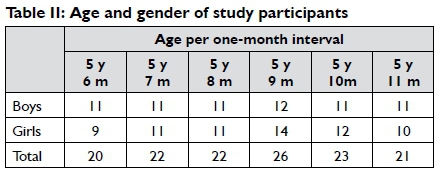
Of the sample of 134 typically developing children, 65 (48.5%) were boys. The children were distributed reasonably evenly across the ages 5 years 6 months and 0 days through 5 years 11 months and 29 days. Table II shows the distribution across gender and age. Thirty-five (26.1%) of the children were enrolled in grade RR and 99 (73.9%) in grade R.
The study sample was heterogeneous, with the majority of study participants indicating English as their first language (25.4%), followed by Setswana (17.9%), Sepedi (9.0%), Northern Sesotho (6.7%), isiZulu (6.7%), Afrikaans (6.0%), five other South African languages totalling 14.9%, and foreign languages (e.g., French, Italian, Shona, Chinese) being the first language of 13.4% of the children. This distribution was slightly different to official statistics30
Differences in the DTVP-2 scores among boys and girls of the SA sample
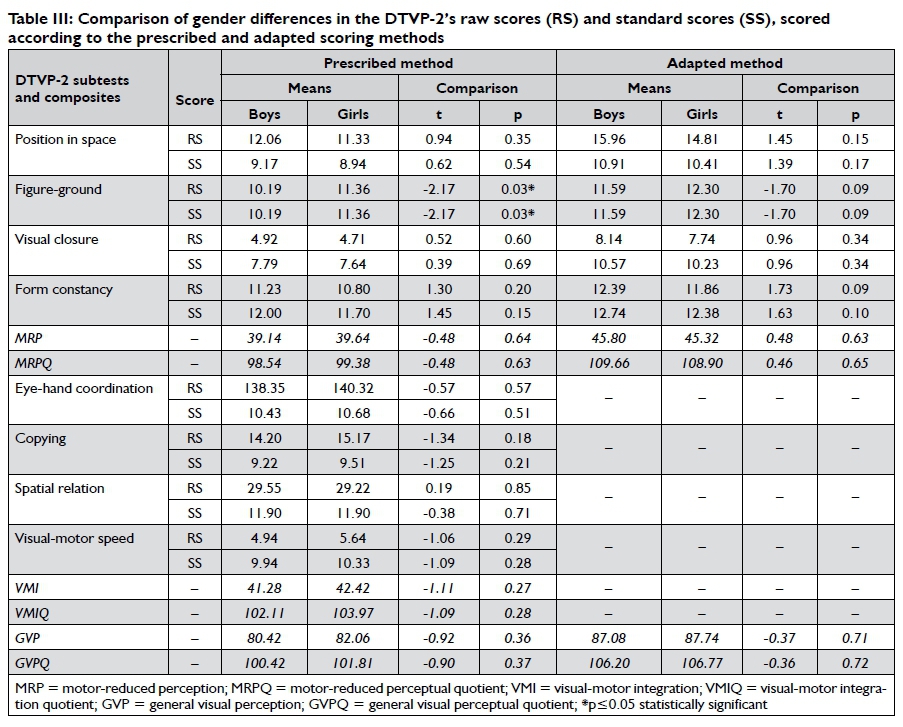
Owing to differential developmental milestones in children, the best gender comparison is considered to be based on standard scores (SSs), which would allow for developmental differences. Since the American norms might not be entirely suitable for a sample of the SA population, Table III on page 55 presents a comparison of both raw scores (RSs) and SSs for the boys and girls. Comparisons were calculated by means of Student's t-tests.
Boys and girls obtained similar SSs on all the subtests of the DTVP-2 when using the prescribed scoring method, with the exception of FG where a statistically significant difference (p=0.03) in both RSs and SSs was evident, with girls obtaining on average one SS higher than boys. When the stop rule was not implemented in the adapted method, scores for both groups increased, but boys' scores increased slightly more, so that boys and girls obtained similar RSs, SSs and composite scores for all subtests, which showed no statistically significant differences.
Although literature is available to describe the DTVP-2 test performance for SA children8,18,19,20, no gender comparisons have been reported that could be compared with the results from this study. Even though the DTVP-2 was designed to minimise gender bias1721. It could therefore be concluded that the DTVP-2 might be relatively free of gender bias in this specific age group in a SA population, with the exception of FG (under the assumption that Occupational therapists will use the DTVP-2 according to the prescribed scoring method).
The DTVP-2 raw scores of the SA sample in comparison to the American normative sample
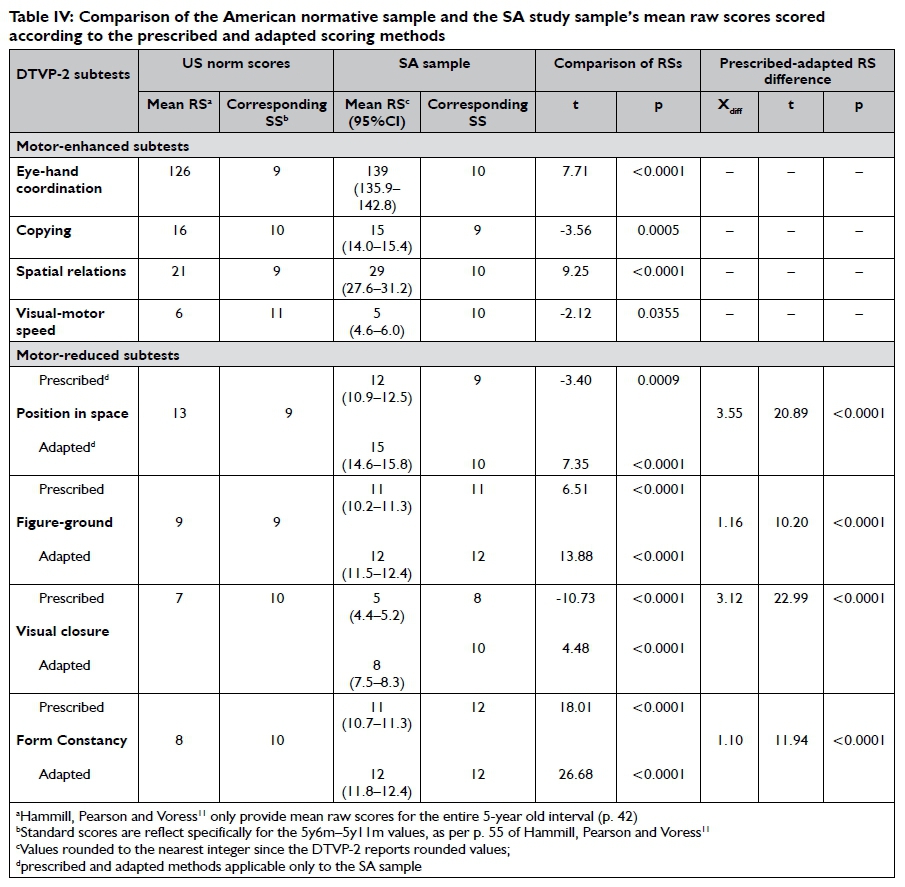
The RS of each subtest is calculated as the sum of the items answered correctly11Table IV on page 56 presents the DTVP-2 subtests' mean RSs of the study sample in comparison to the mean RSs of the 5-year-old American normative sample, tested with a single sample t-test for the difference in the sample mean obtained in this study, using the American normative mean as the hypothesised mean. The final columns of the table show paired t-test values for the comparison between the prescribed and adapted scoring methods. The RS were used for this table, as they give the best indication of how the SA sample compared to the normative US sample, without having the interpretive filter of normalisation applied. It should be noted, though, that RSs are not to be used in the interpretation of test results. Because of the different number of items and different scoring for each subtest, a RS on one subtest cannot be compared to a RS on another subtest for the same individual, but comparisons amongst RSs for different samples on the same subtest remain valid comparisons, if only for illustrative purposes.
Although all the t-test results were statistically significant (bearing in mind that for VMS, the significance was less than 5% but considerably more than 1%), this underscores the difference between statistical significance and clinical meaningfulness. For ex- ample, with reference to PS, it has been noted that a RS difference of one less for the SA sample still equates to the same equivalent SS for that age interval. The difference is thus statistically significant, but not clinically meaningful. Nonetheless, it is evident that the SA sample also obtained statistically significantly higher scores than the American norm sample for EH, FG, SR, and FC, all of which also appeared to be clinically meaningful. Although the single point difference in RS for VMS does not appear considerable, the VMS subtest consists of only eight items, which equates to one SS less for the SA sample when compared to the American norm sample. We observed that the SA sample performed worse on CO and even worse on VC than the American norm.
The SA sample's DTVP-2 subtest' standard score distribution scored according to the prescribed method along with the American norm distribution
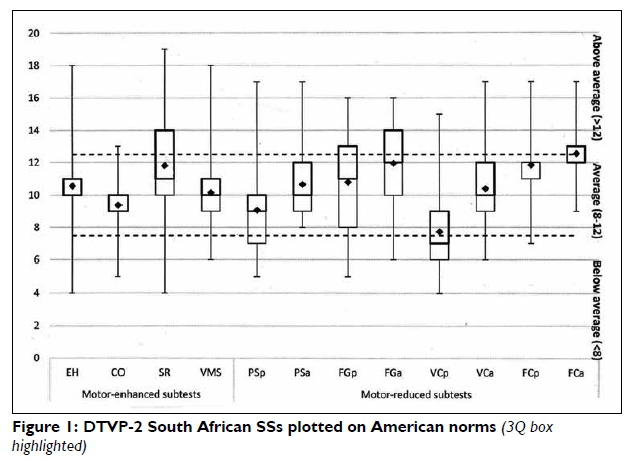
Raw scores are converted into SSs (with a mean of 10 and an SD of 3) for clinical interpretation using tables in the DTVP-2 Examiner's Manual. Accordingly, SSs are descriptively rated as average for SSs between 8 and 12, below average for SSs of 7 and less, and above average for SSs of 13 and more11Figure 1.
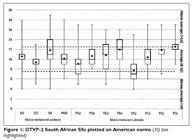
We found notably large numbers of participants with similar scores, which was evident in the third quartile (3Q) scores that have been highlighted in the chart. If, for example, 35% of the respondents obtained a SS of 10 for EH, the second quartile (2Q) collapses to a single point [the median is 10, and the entire inter-quartile range (IQR) is 10-1 1]. Similar effects were seen with CO, FC adapted score (FCa), and FC prescribed score (FCp), where the 3Q is represented by a single point, which in itself was not extremely problematic. What was more of an issue were those subtests where the 2Qs and 3Qs lay outside the average range and showed major deviations from the American norm sample. The SA sample obtained much higher than normative scores for SR, FG when using the prescribed scoring method, and even more so when using the adapted scoring method. Form constancy skewed high, but within the norm, for the prescribed scoring method, and well above the norm for the adapted scoring method, with 59.7% of the sample scoring >12. Only PS and VC appeared to fare worse than the American norms, although this might again be attributed to problems with the item linearity which render the stop rule inappropriate, as both of these subtests only appeared so when using the prescribed scoring method, but when the adapted scoring method was used, the scores were well within the norms. (See Figure 1 on page 57).
It should be noted at this point that these differences need to be put into context. Firstly, in the chapter in interpreting the DTVP-2 scores, the DTVP-2 authors1111
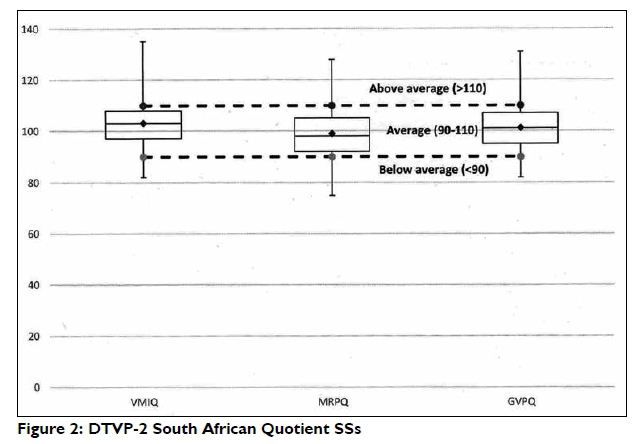
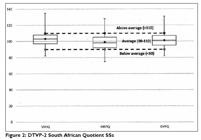
However, it should further be noted that occupational therapists should not be over-reliant on individual subtest scores, as the DTVP-2 authors11Figure 2 shows that, for the quotient scores, the South African sample showed a distribution that is well within the bounds set by the authors.
The findings of the study thus appear to be consistent with findings in both South African8,18,19,20 and international literature2,15,21,22,31, where it was speculated that children from other cultures might perform differently to American children. Differences could occur either because of cultural artefacts, or because of different sociocul-tural contexts where children are exposed to certain tasks at different ages in different cultures, or simply because the items have been practiced and learnt through similar task exposure.
Some specific recommendations for some subtests could be made, although it should be noted that many of these would need to be confirmed through further investigation and may have been addressed in the DTVP-3. However, the authors of this study find themselves walking a delicate tightrope across the conundrum presented by the two versions of the DTVP: While it must be conceded that the DTVP-3 should be a superior test to the DTVP-2, it cannot be recommended that clinicians switch to the DTVP-3 as a means to avoiding these problems in particular, until the DTVP-3 has been subjected to similar testing and has proved to eliminate these problems on a South African sample of children. The authors would thus not want to create the opinion that they are opposed to clinicians "upgrading" to the DTVP-3, but want to caution clinicians to note that it has not yet been demonstrated that the DTVP-3 is not also prone to these biases in a South African sample. Concerns raised here should thus at least be given consideration when children are tested with the DTVP, regardless of which version. However, the antipode to this is that the researchers do not want to make clinicians unnecessarily suspicious of the DTVP-3, because neither has it been demonstrated to be prone to these biases. In the end, more research in this area, specifically now with the DTVP-3, is urgently needed. Furthermore, because the DTVP-3 no longer includes the PS, SR and VMS subtests, occupational therapists in practice may still prefer to use the DTVP-2, which would make these recommendations still valid.
Regarding the individual subtests: Copying could also benefit from more specific administration instructions, detailed scoring guidelines and detailed scoring practice. Currently a 2, 1, or 0 score is awarded depending on the quality of the drawing1117
The scoring criteria for SR are also a point of concern. The subtest is scored by awarding one point per dot that the pencil mark touches for reasonable attempts to copy the design. No points are subtracted for incorrect dots touched. It is therefore recommended that research be conducted to examine whether points should be deducted for incorrect dots touched, since spatial relations are defined as the ability to apply direction to objects, as well as to see the relation between objects28
The authors concur with Cheung et al21
The motor-reduced subtests of the DTVP-2 are discussed with reference to both Figure 1 and Table IV, which show the DTVP-2's motor-reduced subtests' mean prescribed and adapted RSs of the SA sample in comparison to the mean RSs of the 5-year-old American normative sample and the SSs of the American normative sample from the same age band (5y6m-5yl 1m). It should be remembered that the purpose of a stop rule is to reduce test fatigue for the testee and also reduce the administrative burden for the testor. The assumption underlying the stop rule is that, given a monotonic increase in the difficulty of items, when a testee has not succeeded in a certain number of items, then that testee should also not succeed in performing the remaining items, and the test can be stopped without materially impacting on the testee's score. Conversely, having the testee complete all items from that point will delay the completion of the test, but should not change the outcome of the test. The rationale behind the adaption to the scoring of the motor-reduced subtests examined in this study arose from previous studies on the DTVP-2. Richmond and Holland208
These results reported here serve as a further impetus (in addition to earlier findings8,18,19,20) to question the item difficulty and subsequent item linearity of the motor-reduced subtests. In summary, the motor-reduced subtests of the DTVP-2 vary significantly from the norms reported in the DTVP-2 Examiner's Manual. Similarities, differences and correlations are apparent in reports from Thailand15212231
Limitation, implications for practice and recommendations
The limitations associated with this study were, firstly, the study population that was relatively small, on one age band of DTVP-2, and not representative of the whole of SA. Secondly, the population was selected from an urban area, geographically restricted to the City of Tshwane, consisting of children who were proficient in English and attending formal educational settings. Thirdly, no differentiation other than language has been made between cultural/ethnical groups within this relatively small English-speaking sample. Lastly, although the DTVP-3 was published in 20l4 this study was conducted when the DTVP-2 was still widely used by SA Occupational therapists. It must also be noted that not all Occupational therapists might have the funding for regular upgrading of measuring instruments, and/or might not choose the 20l4 DTPV-3 version since certain subtests were omitted, and may continue to use the DTVP-2. The findings of this study thus still remain germane.
Considering these limitations, implications for practice are that these results may not be generalised to similar SA populations. Care must be taken when interpreting and conveying scores to parents/ caregivers and other healthcare professionals.
Based on the results and conclusions drawn from this study, the authors make the following recommendations with regard to future research, whether initiated by occupational therapists in the clinical field, at universities or by the OT association of SA (OTASA):
✥ investigation of the suitability of the DTVP-3 norms on a representative sample of SA children;
✥ investigation of the suitability of other available and commonly used visual perceptual instruments such as the Beery VMI and the TVPS-R;
✥ concurrent validity studies of the DTVP-2 with the DTVP-3 in order to compare norms, as well as the measurement properties of these two respective tests in SA; and
✥ development of visual perceptual measurement instruments standardised on the SA population.
Recommendations in terms of practice include the following:
✥ to train undergraduate students in the use of a variety of instruments and the limitations of the non-context-specific instruments such as the DTVP-2; and
✥ to do appropriate translation (such as conceptual equivalent translation) of the prescribed instructions of measuring instruments used, into the SA official languages, rather than developing SA specific versions.
CONCLUSIONS
Results of this study provide evidence of differences in DTVP-2 scores between boys and girls, how the scores of a small SA study sample within a specific age band (children aged 5 years and 6 months to 5 years and ll months), compared to those of the American normative sample, and how the prescribed scoring method compares to the adapted scoring method for the motor-reduced subtest cluster. Although the DTVP-2 is considered a comprehensive measurement instrument, certain subtests for this specific age band of the test seems to be problematic in their current form (norms and/or item linearity).
While no context-specific visual perceptual measuring instrument is currently available in SA, occupational therapists should thoughtfully consider the methods in which they use these tests, and perhaps ask themselves the following questions: Do I interpret and use the results of the DTVP-2 with care? Do children need to be assessed with an appropriately translated version of the instructions? Can I contribute to the development of a context-specific, culturally suitable visual perceptual measuring instrument for the assessment of children's important occupational performance components and skills such as visual perception in SA?
REFERENCES
ACKNOWLEDGEMENTS
Dr. Daleen Struwig, Faculty of Health Sciences, UFS, is acknowledged for editorial and technical preparation of the manuscript. The authors would like to thank a reviewer for pointing out the use of the SEM in interpreting individual scores, as recommended in the DTVP2 manual.
LITERATURE REVIEW
- 1. American Occupational Therapy Association. Framework: Domain and Process, 3rd ed. American Journal of Occupational Therapy. 2014; 68(SupplI): SI-S48.
- 2. Brown T, Rodger S, Davis A. Factor structure of the four motorfree scales of the Development Test of Visual Perception, second edition (DTVP-2). American Journal of Occupational Therapy. 2008; 62(5):502-513.
- 3. Richardson PK. Use of standardised tests in pediatric practice. In Case-Smith J (ed). Occupational Therapy for Children. 6th ed. St. Louis, MO: Elsevier/Mosby, 2010: 216-243.
- 4. Thorley M, Lim SM. Considerations for occupational therapy assessment for indigenous children in Australia. Australian Occupational Therapy Journal. 2011; 58(1): 3-10.
- 5. Clutten SC. The development of a visual perception test for learners in the foundation phase. M Ed Research Report. Pretoria: University of South Africa; 2009.
- 6. Eksteen T. The evaluation of the reliability of the Motor-free Visual Perceptual Test (third edition) when translated into Afrikaans, on an Afrikaans first language urban population (east of Pretoria, South Africa) aged 8 years 0 months to 8 years II months. MSTSH Research Report. Johannesburg: University of Witwatersrand; 2007.
- 7. Rens Z. The standardisation of the Beery-Buktenica Developmental Test of Visual-Motor Integration with Supplemental Developmental Tests of Visual Perception and Motor Coordination (4thEdition, Revised, 1997) on an Eastern Cape population aged 7 years 0 months to 7 years 3 months. MSTSH Research Report. Johannesburg: University of Witwatersrand; 2008.
- 8. Visser MM, Cronje M, Kemp B, Scholtz M, Van Rooyen W, Nel M. The DTVP-2 visual closure subtest: a closer look. South African Journal of Occupational Therapy. 2012; 42(2): 21-25.
- 9. Van der Merwe J, Smit N, Vlok B. A survey to investigate how South African Occupational Therapists in private practice are assessing and treating poor handwriting in foundation phase learners: Part I demographics and assessment practices. South African Journal of Occupational Therapy. 2011; 41(3): 3-11.
- 10. Beery KE, Buktenica NA, Beery NA. Developmental Test of VisualMotor Integration. 5thed. Minneapolis, MN: Pearson Assessments; 2004.
- 11. Hammill DD, Pearson NA, Voress JK. Developmental Test of Visual Perception. 2nded. Texas: Pro-Ed Inc.; 1993.
- 12. Gardner MF. Test of Visual Perceptual Skills (Non-Motor) - Revised. Hydesville, CA: Psychological and Educational Publications; 1996.
- 13. Ayres AJ. Sensory Integration and Praxis Tests. Los Angeles, CA: Western Psychological Services; 1989.
- 14. Harris DB. Children's Drawings as Measures of Intellectual Maturity: A Revision and Extension of The Goodenough Draw-A-Man Test. Harcourt, NY: Brace & World Inc.; 1963.
- 15. Guntayuong C, Chinchai S, Pongsaksri M, Vittayakorn S. Determination of normative values of the Developmental Test of Visual Perception (DTVP-2) in Thai children. International Journal of Medicine and Pharmaceutical Sciences. 2013; 3(2): 113-I26.
- 16. Burtner PA, Bordegaray J, Moedl D, Roe RJ, Savage AR, Wilhite C. Critical review of visual perceptual tests frequently administered by pediatric therapists. Physical and Occupational Therapy in Pediatrics. 1997; 17(3): 39-61.
- 17. Hammill DD, Pearson NA, Voress JK. Developmental Test of Visual Perception. 3rd ed. Texas: Pro-Ed Inc.; 2013.
- 18. Van Romburgh JA. Die voorkoms van visuele-persepsieprobleme en die effektiwiteit van Arbeidsterapie groepbehandeling onder Gr. I kleurlingkleuters. MOT Research Report. Bloemfontein: University of the Free State; 2006.
- 19. Visser MM. The association of an omitted crawling milestone on pencil grasp and control in a 5 and 6 year old population. MSTSH Research Report. Johannesburg: University of Witwatersrand; 2004.
- 20. Richmond J, Holland K. Correlating the Developmental Test of VisualPerception-2 (DTVP-2) and the Test of Visual Perceptual Skills-Revised (TVPS-R) as assessment tools for learners with difficulties. South African Journal of Occupational Therapy. 2011; 41(1): 33-37.
- 21. Cheung PP Poon M, Leung M, Wong R. The development test of visual perception-2 normative study on the visual perception function for children in Hong Kong. Physical and Occupational Therapy in Pediatrics. 2005; 25(4): 29-43.
- 22. Lai MY, Leung FKS. Visual perceptual abilities of Chinese-speaking and English-speaking children. Perceptual and Motor Skills. 2012; 114(2): 433-445.
-
23. HPCSA (Health Professions Council of South Africa). List of classified and certified psychological tests. (Board Notice 93 OF I5) 2010. http://www.hpcsa.co.za/PBPsychology/Guidelines (accessed 26 June 2017).
» http://www.hpcsa.co.za/PBPsychology/Guidelines -
24. Department of Basic Education. Educational Districts: Gauteng 2017. http://www.education.gov.za/Informationfor/EducationDistricts.aspx (accessed 30 May 2017).
» http://www.education.gov.za/Informationfor/EducationDistricts.aspx - 25. Du Plessis S, Louw B. Challenges to preschool teachers in learners' acquisition of English as language of learning and teaching. South African Journal of Education. 2008; 28: 53-75.
- 26. Josman N, Abdallah TM, Engel-Yeger B. A comparison of visual-perceptual and visual-motor skills between Palestinian and Israeli children. American Journal of Occupational Therapy. 2006; 60(2): 215-225.
- 27. Maree K. First Steps in Research. Pretoria: Van Schaik Publishers; 2007.
- 28. Schneck, CM. Visual perception. In Case-Smith J (ed). Occupational Therapy for Children. 6th ed. St. Louis, MO: Elsevier/Mosby. 2005; 373-403.
- 29. Nulty DD. The adequacy of response rates to online and paper surveys: what can be done? Assessment & Evaluation in Higher Education. 2008; 33 (3): 301-314.
-
30. Stats SA. 2012. Census 2011. www.statssa.gov.za. Date of access: 05/01/2015. http://www.statssa.gov.za/census/census_2011/census_products/Census_ 2011_Census_in_brief.pdf.
» www.statssa.gov.za - 31. Brown T, Hockey SC. The validity and reliability of the Developmental Test of Visual Perception - 2nd edition (DTVP-2). Physical and Occupational Therapy in Pediatrics. 2013; 33(4): 426-439.