An exploration of the roles and the effect of role expectations on the academic performance of first year occupational therapy students: a University of the Free State case study
Abstract
First-year students in occupational therapy enter higher education and take on different roles while engaging in occupations such as academics, instrumental activities of daily living (IADL) and social participation. Some of the roles are new and pose challenges to students which in turn influence their academic performance. A qualitative research approach was applied by making use of a case study research design to explore possible factors that influence the students' academic performance. Eighteen first-year occupational therapy students from the University of the Free State were randomly selected to take part in the study. Data were collected from documentation and Nominal Group Technique discussions. The aim of this article is to report on some of the significant findings from the initial study, namely the roles students adopt to meet the challenges during their first year at university. Four roles were identified: role of a student, role of an independent young adult, role of a friend and role of a member of a campus residence. The identification of these roles should make educators take note of the need for support to the first-year student on a departmental as well as faculty level.
Academic performance; First-year Occupational Therapy students; Occupational engagement; role fulfilment
INTRODUCTION
Engaging in meaningful occupation is part of an individual's everyday life121
The role expectations during the first year in higher education are characterised by an adjustment period with new academic, social, and emotional challenges3,4,5. Likewise, first-year occupational therapy students start to engage in different higher education occupations where new roles are also adopted, which in turn impose social and academic demands on them66
Reports in the literature4,7,8 have indicated academic-, personal-, cognitive- and social factors, among others, to have an influence on the academic performance of first-year students. However, these factors are typically discussed in isolation, creating a gap in the literature with no inclusion integration of possible academic performance factors. A study was conducted to explore all the possible factors influencing first year occupational therapy students' academic success5
Findings showed that adopting different new roles proved to be a challenge to first-year occupational therapy students.
The higher education environment offers a variety of new occupations in which first-year students engage. Wilcock9:4 referred to this meaningful engagement in activity as "doing", which she perceived as synonymous with "occupation". In doing or engaging in academic occupations, students will adopt different roles, some of which are new. These life roles are "sets of behaviour expected by society and shaped by culture and context..."2
Hitch, Pepin and Stagnitti10
The occupations students engage in that are significant for the aim of this article, are academic occupation, instrumental activities of daily living (IADL) and social participation. These occupations are discussed below.
Academic occupations
Students enter the higher education environment with various expectations regarding their lives and experiences at university. They envision their new journey filled with freedom to have fun, meet new friends and having stimulating academic experiences4,11. Kan-tanis43,4,8 identify workload as a possible factor that negatively influences academic performance. Coping with the large volume of work is a reality that overwhelms the first-year student. Adjusting to the faster pace of the new learning environment poses another challenge to the first-year student3
To succeed, students need to be motivated to engage in the academic environment31171213
In addition, the higher education environment also requires students to adopt an independent learning focus747
To ease the adjustment, Kantanis46
Instrumental activities of daily living
Many students leave home to study at higher education institutions, often far from home and their known environment72,14, all of which are time consuming. These expectations present much larger challenges than what they had anticipated and exacerbate the already heavy academic workload that has to be managed14
Social participation
Social participation is defined as: "Organised patterns of behaviour that are characterised and expected of an individual or a given position in a social system"1:633. The first-year student is not only a member of a student body, but also a member of a social community at university. This community includes the student's physical and social environments26
Social participation is a fundamental component of the Millennial generation. Millennials are the cohort born during the mid-1990s to early 2000s151617
However, Dixon, Rayle and Chung18
METHODOLOGY
The original study from which this article was derived, explored the factors which play a role in the academic success of first-year occupational therapy students at the UFS. The analysis of the data obtained from this study (the methodology of which is outlined below), revealed clear roles adopted by students in their first year. Only the findings pertaining to these roles will be discussed in this article.
The original study followed a qualitative approach, and a collective case study design was applied19,20. This study design was chosen for the value it adds for in-depth study2122
The Sample
Random sampling was used to select participants from a list of English- and Afrikaans-speaking first-year occupational therapy students registered for the first time at the UFS in 2013. A total of eighteen (18) students - nine English- and nine Afrikaans-speaking students, were selected. As the academic achievements were varied throughout the class, a random sample was needed to have representation of all students.
Data collection and analysis
Two Nominal Group Technique (NGT) discussions and documentation data were used to collect data in the study19,23,24.
NGT discussion is a method of collecting data during a group discussion with priority lists as an end-product to the discussions24
Two NGT discussions took place on separate occasions. A person with experience in NGT discussions facilitated the English- and Afrikaans- speaking groups. During the two NGT discussions, the following questions were posed to the students by the facilitator:
✥ Which factors positively influence your academic success in the first year of occupational therapy?
✥ Which factors negatively influence your academic success in the first year of occupational therapy?
An adapted multiple group NGT data analysis, as described by Van Breda25
Documented data were collected from two sections of the first-year occupational therapy students' portfolio reflections. Portfolios were submitted twice a year and assessed by members of staff in the Department of Occupational Therapy. After the assessment was completed, the researcher analysed the reflections of all 18 participants.

The students firstly reflected on factors influencing their academic performance in the first-year by making use of the Kawa River Model26
The rocks in the river represent life and the challenges that the individual has to face26
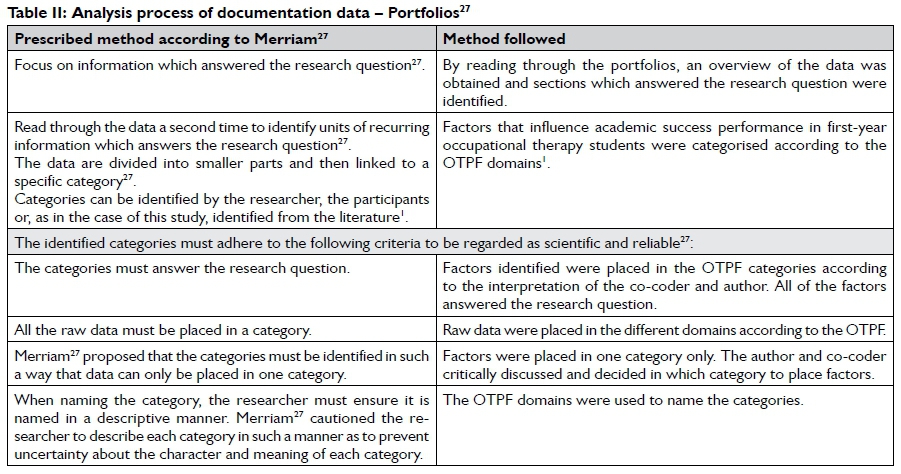
Documentation data obtained from the portfolios were subsequently analysed thematically19,27 by grouping similar categories of data together. The five domains of the OTPF21Table II below.)
Trustworthiness and credibility
Trustworthiness and credibility of the study were established with regard to the researcher and the research method. In addition, a complete research proposal was peer-reviewed and approved.
Triangulation was used to increase the credibility of the research study28
Secondly, investigator triangulation was applied28
Finally, method triangulation23
The veracity of the data was ensured through member checking. The facilitator of the NGT discussions presented the factors influencing the students' academic achievements positively and negatively19
The interpreted findings were presented to the Department of Occupational Therapy where the participants were present.
Ethical considerations
The Ethics Committee of the Faculty of Health Sciences at the UFS granted ethical clearance for this study29
FINDINGS AND DISCUSSION
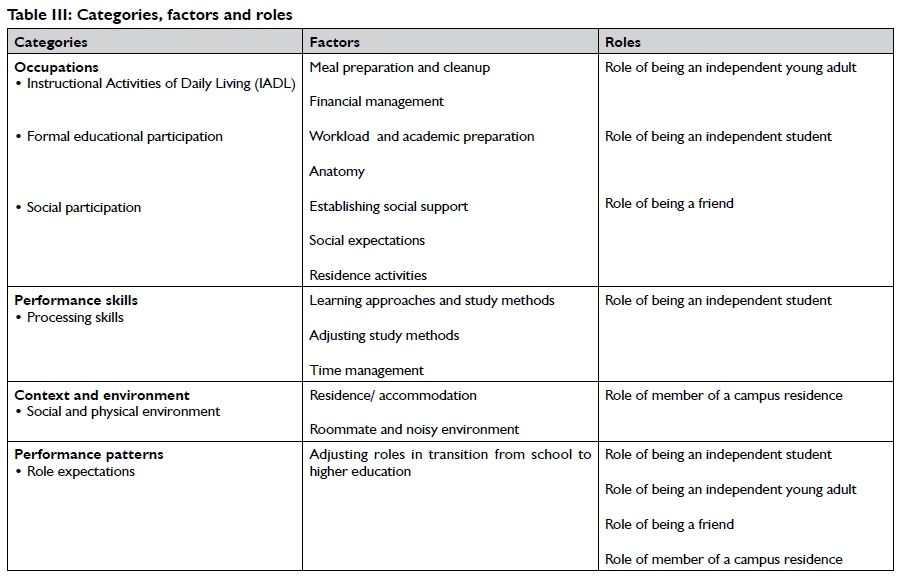
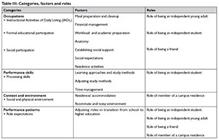
The five domains of the OTPF were used as categories and sub-categories for the study. Factors mentioned by students as either negatively or positively affecting their performance in each domain were then identified, where after the roles associated with each factor were allocated. A summary of the categories, associated factors and roles adopted within each category (as identified by students) is shown in Table III on page 19.
IDENTIFIED ROLES AND EXPECTATIONS
Role of being an independent student
Being a student in the first year of the programme is challenging. Students are soon confronted with the challenge of a much larger workload than what they were used to at school. This was a reality for students 1 and 7.
I realised the workload was a lot more than school... (Student 7)
...the workload and academic pace of university pose a big stumbling block and adjustment... (Student 1)
The large volume of work, which needs to be read, comprehended and studied in a fairly short period of time, poses real challenges to students434,10 concurred that the higher education workload is much larger than what the students were used to in school. Furthermore, the lectures occur at a much faster pace and cover more work per contact session4
Students who are selected for the occupational therapy programme at the UFS are selected mainly on their academic abilities. The inference is thus that students made use of effective study methods at school. Unfortunately, the methods they used are not always effective in higher education.
I will seriously have to start working on a new study method now that the volume of work is increasing exponentially. (Student 3)
The statement of student 3 illustrates the sentiment of the majority of participants' need to change their study method. The students' reflections seemed to echo the statement by Lowe and Cook7
Once the students enter the higher education environment they are expected to function as independent learners30
The world where decisions are mostly made for us and where everything seems to go our way is definitely one of the past. (Student 15)
At school, students are taught in a teacher-centred environment. This means that all learning activities are directed by the teacher30
There is consensus in the literature that students in higher education need to adopt an independent learning approach30,31,32, thus taking on the role of being an independent learner. The independent learner presents with the following characteristics:
Firstly, the learner is able to take control of his/her learning30,31. Students must realise that a change is needed in their study methods in order to cope with the academic demands of the programme. They must decide "when, where, what and how" to study313133
A second attribute of an independent learner is to take responsibility for his/her own learning31
Role of being an independent young adult
Several students leave home to study at a university and experience IADL challenges. "Adult independence" as expected from adults is a new reality for students entering higher education8
At this stage I also started to realise just how big my new responsibilities were: I had to manage my own finances, had to cook for myself... (Student 9)
Far from home, self-care activities take up time. (NGT statement)
The student who resides in campus accommodation or in a student house must now take care of her-/himself. This is often a new role expected from the students. Unfortunately, home man-agement tasks such as health management, grocery shopping, meal preparation and clean-up, are time-consuming and take up time that students would rather spend on academic activities.
A number of students needed to manage their own finances and voiced it as a stressor.
Financial stress - managing my finances... food and living expenses are very expensive and are cutting my budget short (Student 15)
Many students receive an allowance, and have to manage their finances to accommodate both living and additional academic expenses. This can cause stress for the first-year student, thus influencing their academic performance34,14,18. Pancer et al.14
Role of being a friend
Students move out of the known school environment where social connections were made over several years. Consequently, they experience the loss of school friends who are studying elsewhere or in other programmes.
I was also excited to meet new people, but sad to leave my old friends(Student 6)
Yet first-year students face the social expectations of making new friends and enjoying the new freedom university life brings4
My friends, the ones that study other courses, do not really understand what exactly it entails to be a first-year OT student. Due to this, I have lost contact with many friends. (Student 9)
Friends in programmes less challenging may place social demands on the occupational therapy student. Due to the heavy workload, students are not always in the position to meet the social demands of engaging with their new friends as often as they would like to. First-year occupational therapy students often find themselves in a conflicting position where, on the one hand, friendships are important, but on the other hand, the workload of the academic programme prevents socialisation.
I have a good... environment filled with love from my family and friends, the old friends and the new friends. (Student 8)
Nevertheless, it is important for the students to establish a new social support system8,18. Fortunately, as student 8 pointed out, some students are able to establish new friendships while maintaining old ones. Social contact and social support are high on the Millennial generation's priority list16,35. For the adolescent, it is very important to establish friendships19418
Role of member of a campus residence
Being a member of a campus residence is deemed an important factor influencing academic performance in more than one way, and is the cause of stress for many students7
Hostel activities kept me very busy and the seniors do not want to understand that I must study, because they feel everybody write tests not just me. (Student 4)
Engaging in residence activities, such as rag, "sêr" (serenade), stage door and lengthy residence meetings, is compulsory and can be time consuming for first-year students. "Sêr" and stage door are two platforms where residences compete in small group singing competitions. This is time-consuming as members of the groups have regular compulsory rehearsals.
I am very involved in my hostel's activities and this causes problems with my time management and endurance. (Student 10)
For the student facing increased academic demands, lengthy residence meetings add to existing levels of stress. Furthermore, students might not have made the transition to self-directed learning yet, and consequently fail to take responsibility for their learn-ing30,31,32. Students receive timetables and a residence programme in advance and can use this information to assist in planning ahead for busy times. The first-year student who did not acquire time management skills in secondary school, will find it challenging to organise their time.
In addition to the activity demands placed on students in residences, the physical environment is at times not conducive to studying. Dusselier et al.34
Res is a noisy place which is a very negative experience for me. (Student 4)
The residence is students' home away from home. It is understandable that students want to relax, play music and visit with their friends in the residence rooms. Regrettably, not all students might be equally accommodating towards fellow students' study needs.
First-year occupational therapy students are in the process of becoming Occupational Therapists and independent adults. However, Hitch et al.10
LIMITATIONSA limitation of the study was the randomised sampling. A criterion sampling method is advised for a study of this nature where academic performance is explored. During the planning phase of the study it was decided to use Anatomy marks as indicative of academic performance. However, when sampling had to be done, the students' first semester average marks for Anatomy were not yet available, and consequently, randomised sampling had to be used. The lack of gender and race diversity was a further limitation of the study.
CONCLUSION
The aim of this article was to describe the roles that first-year occupational therapy students adopt once entering higher education, and their perceptions of associated factors influencing their academic performance. The findings described the different roles adopted by the first-year occupational therapy student and the consequent challenges posed by these roles. The value of and need for friends and social support was evident. Yet, the heavy workload of the academic programme hinders students' engagement in much needed social participation occupations. As independent young adults, they now have to manage time-consuming IADL tasks amidst a full academic programme. This article has not only reiterated the influence of the different roles adopted by first-year occupational therapy students, but also the role conflict that exists and the influence thereof on the academic performance of these students. As educators of the next generation of therapists, we need to take note of the challenges they have to face. The author recommends that students should be made aware of support structures available at training institutions. Academic time tables can be planned to accommodate the first-year students during the initial adjustment period.
REFERENCES
LITERATURE REVIEW
- 1. AOTA. (American Occupational Therapy AAssociation). Occupational therapy practice framework: domain and process 2nd ed. American Journal of Occupational Therapy. 2008; 62: 625-645.
- 2. AOTA. (American Occupational Therapy Association). Occupational therapy practice framework: domain and process 2nd ed. American Journal of Occupational Therapy. 2014; 68(1): s4-s28.
- 3. Friedlander LJ, Reid GJ, Shupak N and Cribbie R. Social support, self-esteem and stress as predictors of adjustment to university among first-year undergraduates. Journal of College Student Development. 2007; 48(3): 259-270.
- 4. Kantanis T. The role of social transition in students' adjustment to first-year to the first year of university. Journal of Institutional Research. 2000: 1-8.
- 5. Sevni S and Gizir CA. Factors negatively affecting university adjustment from the view of first-year university students: The case of Mersin University. Educational Sciences: theory and practice. 2014; 14(4): 1301-1308.
- 6. Swanepoel A. Factors influencing academic success of first year occupational therapy students at the University of the Free State. M Occ Ther dissertation. Dept of Occupational Therapy. University of the Free State; 2014.
- 7. Lowe H and Cook A. Mind the Gap: are students prepared for higher education? Journal of Further and Higher Education. 2003; 27(1): 53.
- 8. Nel C, Tronskie-de Bruin C and Bitzer E. Students' transition from school to university: Possibilities for a pre-university intervention. SAJHE. 2009; 23(5): 974-983.
- 9. Wilcock AAA. Reflection on Doing, being and becoming. Australian Occupational Therapy Journal. 1999; 46: I-II.
- 10. Hitch, D. Pepin, G. & Stagnitti, G. In the footsteps of Wilcock, Part One: The evolution of doing, being, becoming and belonging. Occupational Therapy In Health Care. 2014; 28(3): 231-246.
- 11. Strydom JF, Mentz M and Kuh GD. Enhancing success in higher education by measuring student engagement in South Africa. Acta Academica. 2010; 2.
- 12. Busato V V Prins FJ, Elshout JJ and Hamanker C. Intellectual ability, learning style, personality, achievement motivation and academic success of psychology students in higher education. Personality and Individual Differences. 2000; 26(6): 1057-1068.
- 13. McGuire SY The impact of supplemental instruction on teaching students how to learn. New Directions for Teaching and Learning. Wiley Inter Science, 2006; 106: 3-4.
- 14. Pancer SM, Hunsberger B, Pratt MW and Alistat S. Cognitive complexity of expectations and adjustment to university in the first year. Journal of Adolescent Research. 2000; 15(1): 38-57.
- 15. Twenge JM. Generational changes and their impact in the classroom: teaching Generation Me. Medical Education. 2009; 43: 398-405.
- 16. Nimon S. Generation Y and higher education: The Other Y2K. Journal of Institutional Research. 2007; 13(1): 24-41.
- 17. Weiler A. Information-seeking behaviour in generation y students: Motivation, critical thinking and learning theory. The Journal of Academic Librarianship. 2005; 31(1): 46-53.
- 18. Dixon Rayle A and Chung K. Revisiting first-year college students' mattering: social support, academic stress, and the mattering experience. Journal of College student retention. 2007-2008; 9(1): 24, 30.
- 19. Cresswell JW. Research design qualitative, quantitative and mixed method approaches. Third Edition. California: Sage, 2009.
- 20. Fouche CB and Schurink W. Qualitative research designs. In: de Vos AS, Strydom, H Fouche, CB and Delport CSL. Research at grass roots for the social and human service professions. Fourth Edition. Pretoria: Van Schaik; 2011: 322.
- 21. Flyvbjerg B. Case Study. In Denzin NK, Lincoln YS. The sage handbook of qualitative research. Fourth Edition. California: Sage; 2011: 307.
- 22. Creswell JW. Educational research planning, conducting and evaluating qualitative research. Fourth edition. Boston: Pearson, 2012.
- 23. Maree K. First steps in research. Revised tenth impression. Pretoria: Van Schaik; 2012.
- 24. Potter M, Gordon S and Hamer P The nominal group technique: A useful consensus methodology in physiotherapy research. New Zeeland Journal of Physiotherapy. 2004; 32: 126-130.
- 25. Van Breda AD. Steps to analysing multiple group NGT data. The social work practitioner-researcher. 2005; 17(1): 1-14.
- 26. Iwama MK Thomson N A and Macdonald RM. The Kawa model: The power of culturally responsive occupational therapy. Disability and Rehabilitation. 2009; 31(14): 1125-1135.
- 27. Merriam SB. Qualitative research a guide to design and implementation. San Francisco: Jossey-Bass; 2009.
- 28. Flick U. Triangulation in qualitative research. In Flick U, Von Kardorff and Steinke I. A Companion to qualitative research. London: Sage; 2004: 178 -183.
- 29. UFS EC 29. (University of the Free State). Ethics Committee of the Faculty of Health Sciences. General Guidelines; 2012.
- 30. Amin Z and Eng KH. Basics in medical education. Singapore: World Scientific Publishing; 2003.
- 31. Dent JA and Harden RM. A practical guide for medical teachers. Second Edition. London: Elsevier; 2005.
- 32. Harden RM and Laidlaw JM. Essential skills for a medical teacher. An introduction to teaching and learning in medicine. London: Churchill Livingstone; 2012.
- 33. UFS.(University of the Free State). Department Occupational Therapy. General Skills Portfolios; 2013.
- 34. Dusselier L, Dunn B, Wang Y Shelley MC and Whalen DF Personal, health, academic and environmental predictors of stress for residence hall students. Journal of American College Health; 2005, 54(I): 15-24.
- 35. Sandars J and Morrison C. What is the net generation? The challenges for future medical education. Medical Teacher. 2007; 29: 85,86.