Visual Perceptual Deficits in Different Types of Cerebral Palsy
Abstract
INTRODUCTION: Children with cerebral palsy (CP) have been found to present with visual perceptual impairments (VPI). Research indicates differences in VPI in various subtypes of CP However, visual perceptual deficits in children with CP has not been investigated in terms of occupational therapy assessment and treatment in a South African context. The purpose of this study was to determine the specific VPI in learners aged 4-18 years with various subtypes of CP attending a school for learners with special needs in Johannesburg, South AfricaMETHOD: The Test ofVisual Perceptual Skills 3rd ed. (TVPS-3) was used to assess 80 learners. Their subtest scores and composite scores were compared according to their subtype of CP as well as other demographic variables including age, and the Gross Motor Function Classification System (GMFCS) levelRESULTS: All the subtypes of CP were found to present with VPI, with the right spastic unilateral (hemiplegic) group having the fewest number of impairments and the ataxic group the greatest number of impairments. A significant difference in visual discrimination and figure ground scores were found based on the subtype of CP while the Basic Processes composite scores on the TVPS-3 differed significantly for both the subtypes of CP and gender. No significant differences were found for VPI based on age and GMFCS levelsCONCLUSION: Visual perceptual impairments were found in a high percentage of participants with CP with significant differences between the subtypes of CP and according to gender but not for age and GMFCS levels
Cerebral Palsy; Visual Perception; TVPS-3; Visual Perceptual Impairment; Occupational Therapy; Gross Motor Function Classification System
INTRODUCTION
Cerebral palsy (CP) occurs as a result of an early, non-progressive lesion to the central nervous system (CNS) in children. These children present with a variety of different developmental disorders depending on the area of the lesion in the brain122
Initial studies completed in the 1960s - in which perceptual assessments were administered to children with dyskinetic, bilateral spastic and unilateral spastic (right and left) CP - indicated differences in VPI in children with various subtypes of CP833,8-11. Gaining a better understanding of the specific visual perceptual impairments for each subtype of CP will in turn allow occupational therapists to provide specifically targeted intervention. This is particularly true in South Africa where resources for the treatment of children with CP are limited, especially in the public sector where caseloads are high12
The subtypes of CP are classified using the Surveillance of Cerebral Palsy in Europe (SCPE)13131415161617181615,18.
The different cerebral lesions responsible for the subtypes of CP (according to the SCPE classification) result in comorbid cognitive impairments. In the definition of Cerebral Palsy by Rosenbaum, the motor disorders are often accompanied by disturbances of perception1920209213
Studies have reported VPI in children with CP2,3,22 as a result of a malfunctioning of the associative visual systems rather than the posterior visual pathways233 3321824
When assessing VPI in children with CP, Abercrombie888252625,26. Some early studies used assessment tools that required motor control that could have directly impacted on the results. These studies were inconclusive as they did not clarify specific VPI deficits in children with different subtypes of CP27
With the advent of validated assessments of visual perception which are motor free and more reliable, Stiers et al.202020
The more severe VPI in children with spastic subtypes of CP has been attributed to cortical damage where visual perceptual processing predominantly occurs262828
No detail on the types of visual perceptual deficits were identified in the different subtypes of CP in the literature, and no literature on VPI for children with CP in South Africa was sourced. This study therefore aimed to determine the specific VPI in children with different subtypes of CP attending a school for learners with special educational needs (LSEN) in Johannesburg, South Africa.
METHOD
A quantitative and cross-sectional design was used to determine the visual perceptual deficits in children with different types of CP. The data compared the participants' scores to normative data as well as the cluster of the scores and each child was assessed once2935 17
Research Instrument
A demographic questionnaire was designed by the researcher to capture demographic information and included date of birth, gender, diagnosis, GMFCS level, grade, or class, whether they receive occupational therapy and the length of time they have received occupational therapy. It was also used to determine if the child met the inclusion criteria for the study. The Test of Visual Perceptual Skills 3rd ed. (TVPS-3) was used to assess each participant. This standardized test, includes seven subtests: Visual Discrimination, Visual Memory, Spatial Relationships, Form Constancy, Visual Sequential Memory, Figure Ground, and Visual Closure30313230
On completion of the assessment, the raw scores were converted into scaled scores and percentile ranks. The scaled scores were grouped into the appropriate index scores, which included a composite score for the overall test, Basic Processes, Sequencing and Complex Processes. These composite scores allowed the examiner to compare the skills that are related to each other, such as Basic Processes, which includes visual discrimination, visual memory, spatial relations, and form constancy; Sequencing which includes visual sequential memory and Complex Processes which includes figure-ground and visual closure. Scores were converted to standard scores and percentile ranks30
Although the validity of using visual perceptual tests including the TVPS-3 with children with cognitive disability has been under scrutiny3332,34.
Research procedure
Ethical clearance for the study was obtained from the Human Research Ethics Committee (HREC) at the University of the Witwatersrand (M170817) and permission to conduct the study was obtained from the Gauteng Department of Education. Class lists were screened, and therapists were consulted to identify which of the children they were treating met the inclusion criteria of the study. Consent forms, information sheets and demographic questionnaires were sent to the parents of these identified children. When parental-signed informed consent was obtained and the child met the inclusion criteria, the child was included on the list for assessment. Where the child gave witnessed verbal assent, testing was completed by the researcher who has experience in using the TVPS-3. The test was administered individually in the standardised manner, in accordance with the manual, in a quiet assessment room in Forest Town School's Occupational Therapy Department. Subtests were concluded when the child reached a ceiling and could no longer identify the correct answers after three attempts.
Data Analysis
The demographic data, subtypes of cerebral palsy and the other information related to motor function levels and education were analysed using descriptive statistics and frequencies. The frequency of the scaled scores for the TVPS-3 were calculated for the different subtypes of CP. These scores were compared for each subtest of the TVPS-3 as well as the standard scores for the composite sections of the TVPS-3 using the Kruskal-Wallis test to determine if a significant difference existed. The composite standard scores for the TVPS-3 were also compared according to the variables of gender, age, and motor function on the GMFCS using the Kruskal-Wallis test to determine if a significant difference -based on these variables - existed.
RESULTS
Demographics
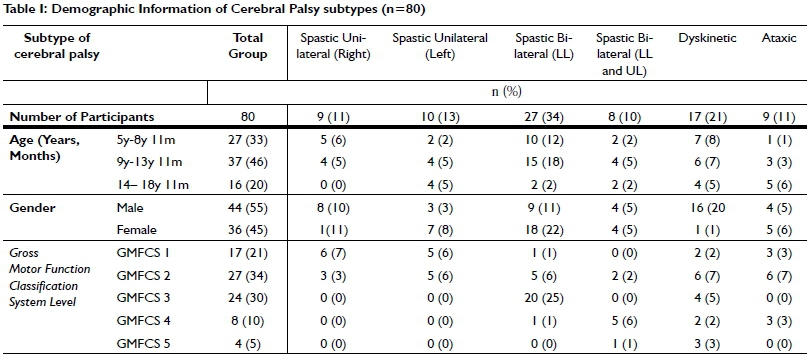
Table I (p21) presents the age, gender and GMFCS level demographics of the participants for different Cerebral Palsy subtypes in the study. Most participants had spastic bilateral (LL) CP were male and fell within the age group of 9 years - 13 years 11 months. Only 15% of participants were on GMFCS levels 4 and 5.
Visual Perceptual Impairment in children with Cerebral Palsy
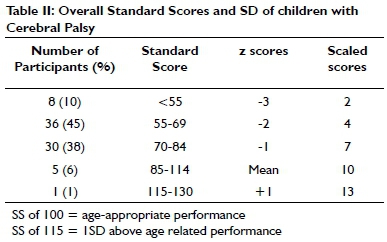
Table II, (p21) indicates that six out of the 80 participants (7%) scored within normal range or above average for their age group. That means that 93% of the participants presented with overall visual perceptual difficulties and z scores below -ISD.
Comparison of the Subtests of the Test of Visual Perceptual Skills -3rd Edition according to the Cerebral Palsy subtypes
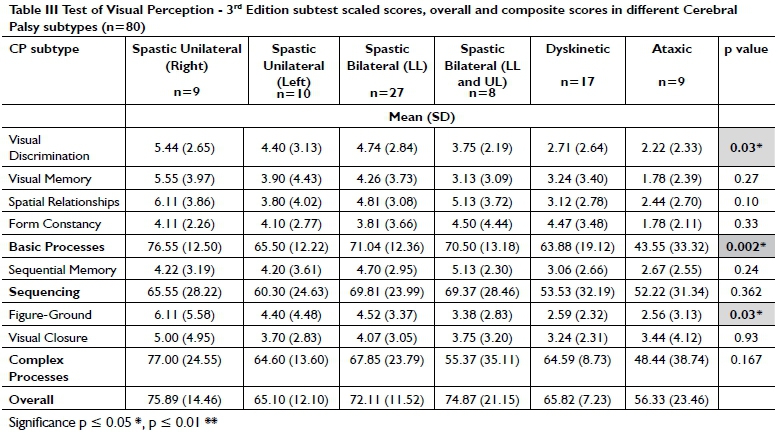
Table III (22) presents the results for the comparisons between the TVPS-3 subtests' overall and composite scores for the subtypes of CP It was found that scores for the visual discrimination (p=0.03) and the figure-ground (p=0.03) subtests had statistically significant differences between the subtypes of CP. The scores for visual memory, spatial relations, form constancy, sequential memory and visual closure were not statistically significantly different when the CP subtypes were compared. When comparing the overall scores of the different subtypes of CP it is evident that the spastic unilateral (right) CP subtype had the highest scores with a mean standard score of 76.55. The spastic bilateral (LL and UL) CP subtype had the second highest score, followed by spastic bilateral (LL) CP subtype, dyskinetic and spastic unilateral (left) CP subtype. The ataxic group had the lowest scores, with mean standard score of 43.55.
There was a significant difference in the Basic Processes standard scores (p=0.002) of the different subtypes of CP The Basic processes score is comprised of visual discrimination, visual memory, spatial relations and form constancy. There was no significant difference found in the composite scores for Complex Processes and Sequencing of the different CP subtypes.
When the spastic bilateral CP subgroups were compared, the spastic bilateral (LL) CP group scored higher than the spastic bilateral (LL and UL) group in the visual discrimination, visual memory, figure-ground and visual closure subtests. The spastic bilateral (LL & UL) CP subgroup had higher scores on the spatial relationships, form constancy and sequential memory subtests. The composite scores of these two subtypes of spastic bilateral CP are very similar with the spastic bilateral (LL) CP group having higher scores in the Basic Processes, Sequencing and particularly the Complex Processes.
Comparison of the Composite Scores of the Test of Visual Perceptual Skills -3rd Ed to Gender, Age and GMFCS Level
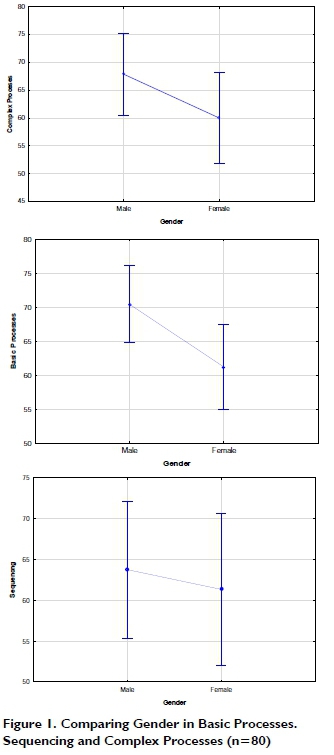
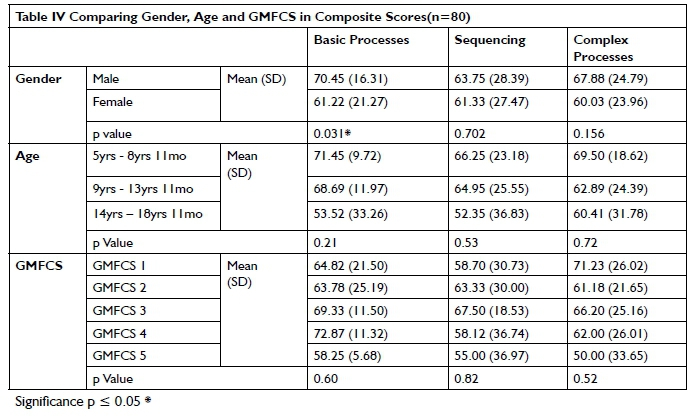
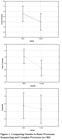
A significant difference was found (p=0.03l) in the Basic Processes standard scores of male and female participants. Males had significantly higher scores than females in the Basic Processes scores. The Sequencing standard scores (p = 0.702) and Complex Processes standard scores (p=0.156) of males and females did not have significant differences. When looking at gender differences, Figure 1 indicates that males had higher standard scores in all areas including Basic Processes, Sequencing and Complex Processes.
There was no significant difference in the standard scores for the different age groups and GMFCS levels on any of the composite scores on the TVPS-3 (Table IV, p22).
DISCUSSION
South African learners from Forest Town LSEN School participated in this study and were sourced using total population sampling. A total sample of 80 learners with CP participated in the study, 55% were male and 45% were female. The slightly higher percentage of males was supported by other studies that have found that CP is more common in males than in females353,35 with the nearly 70% of the participants having a diagnosis of spastic CP followed by dyskinetic (21%) and ataxic (11%) CP subtypes respectively.
Visual perceptual impairment in children with Cerebral Palsy
In this study, the prevalence of visual perceptual impairment in this population of participants with CP was 93%. According to Stiers et al., the prevalence of visuo-motor and perceptual impairment can range from 39% to 100% for children with CP20328
In this study, the overall scores on the TVPS-3 for all the spastic CP subtypes were higher than the dyskinetic CP subtype except for the spastic unilateral (left) CP subtype. The participants with dyskinetic and spastic unilateral left CP subtype achieved lower scores with the lowest overall scores being achieved by the ataxic subtype. The visual perceptual deficits vary between the subtypes depending on the specific areas of the brain and vision that is affected. The different subtypes of CP are associated with damage to different areas of the brain and the extent of deficits for each subtype is considered:
Spastic Unilateral CP- The participants with left spastic unilateral CP had consistently lower scores on all subtests and composite scores than those with right spastic unilateral CP. This was supported by Wedell263410363710.
Spastic Bilateral CP- The results for this subtype of CP indicate that the extent of physical dysfunction does not necessarily impact on the visual perceptual scores of the participants with CP supported by research completed by Hamid et al.9272038
In the current study the spastic bilateral (LL & UL) CP subgroup had higher scores on the spatial relationships, form constancy and sequential memory subtests. However, the spastic bilateral (LL) CP group had higher scores than the spastic bilateral (LL and UL) group in the visual discrimination, visual memory, figure-ground and visual closure subtests. The spastic bilateral (LL) CP group had higher scores in the Basic Processes, Sequencing and particularly the Complex Processes. Although other studies found that children with dyskinetic and ataxic CP had higher visual perceptual scores than all the children with different subtypes of spastic CP none of these studies used the motor free TVPS-38,38. The children with dyskinetic and ataxic CP had lower scores than the children with spastic CP subtypes.
Dyskinetic CP- All the scores for the dyskinetic CP group fell at -2 SD and -3 SD below the mean. Their lowest scores were on visual discrimination in Basic Processes and figure-ground in Complex Processes. Both these TVPS-3 subtests require the participant to focus on the very intricate details to either discriminate between the objects or to find the objects in very busy, distracting backgrounds. Visual impairment difficulties could contribute to these poor scores since Ipata et al.394041
Ataxic CP- On the TVPS-3 results of the ataxic subgroup, the scores for all the subtests fell -2 SD below the mean, thus indicating visual perceptual impairment. Many children with ataxic CP have cerebellar ocular nystagmus1820
The findings in this study do not correlate with the findings of other studies which concluded that visual perceptual impairment is associated with CP where spasticity is dominant8,20. However, the ataxic group in this study were older and in the modified section in the school so may have presented with added cognitive difficulties as they were unable to follow the academic programme. Sigurdardottir et al.424243
The analysis of VPI in children with CP according to demographic factors indicated a significant difference (p=0.03l) in the Basic Processes scores of male and female participants, with males scoring higher than females. There were no significant differences between Sequencing and Complex Processes scores. Stadskleiv et al.42443245nd Edition. In their study, males and females had similar scores on all the subtests of the DTVP-2 except the figure-ground subtest which had a significant difference (p=0.03), with females scoring higher than males45
No significant differences for age were found in this study for Basic Processes, Sequencing and Complex Processes scores. In all the index scores, a trend that younger participants appeared to have slightly higher scores than older participants, was noted. This could be attributed to younger children having more exposure to therapy at the school which considers visual perceptual impairments. Stadskleiv et al.4444Basic Processes composite scores and the scores of the GMFCS level 3 participants were highest in the sequencing composite scores. These results correlate with the research completed by Hamid et al.99
LIMITATIONSThe acuity and eye movements of the participants were not considered in this study and therefore, a comparison between their visual impairment and their visual perceptual scores could not be made. The results for visual perceptual skills of the current study have been considered in relation to the reported visual impairment by subtype in the literature.
The sample in this study had different number of participants in each CP subtype and the small number of participants in some groups may have affected the results. However, the number did reflect the prevalence of CP subtypes and the number of participants seen in other studies.
CONCLUSION
This study aimed to describe the differences between the specific VPIs in children with different subtypes of CP attending a school for learners with special educational needs (LSEN) in Johannesburg. The results in this study found that learners with all subtypes of CP have VPI which indicates that all children with CP should be assessed for visual perceptual deficits as many of them may require therapy for visual perceptual deficits.
The spastic unilateral (right) CP groups had the highest overall scores and the ataxic group had the lowest scores. The different subtypes of CP showed different trends in VPI. There was a significant difference in the visual discrimination and figure-ground subtest scores as well as the composite Basic Processes scores between the different subtypes of CP as well as between males and females. Participants with unilateral spastic CP had greater impairment in sequential memory and spatial components while the participants with bilateral spastic CP had greater impairments in visual discrimination related components. No significant differences are found between different ages and GMFCS levels.
RECOMMENDATIONSThe results of this study have implications for future clinical practice with children with CP in an LSEN school in South Africa. Due to the findings that almost all the children with CP have VPI, practitioners working with children with CP need to be aware of these impairments and provide appropriate accommodations or compensations for these impairments not only when working on VP skills, but also in day-to-day life, as they have a major impact on function and ADLs. The trends that were found in this study can assist with the grouping of CP subtypes in therapy. The extent of VPI of the different subtypes of CP were identified and therefore in this setting children can be grouped accordingly. This should however be done with caution and individual treatment for children should still be administered where possible.
Recommendations for further research
Further research is required when considering VPI in children with CP in a South African context. It is recommended that future studies on VPI in children with CP, be completed on a larger population and in a variety of different schools in order to further validate these results. Qualitative studies could further identify the way in which occupational therapists could design interventions to address the VPIs found in this study.
Future research that takes visual impairment into consideration when assessing VPI in children with CP would be beneficial. Thus, a comparison between the extent of visual impairment and VP scores could be compared to determine the impact that vision has on VP scores.
ROLE OF AUTHORSSharna Berelowitz - postgraduate student who conceptualised and completed the research - conceptualisation and contribution to the article.
Denise Franzsen - supervisor of the project - data analysis and conceptualisation of results and discussion - conceptualisation and contribution to the article
REFERENCES
-
1. Eunson P Aetiology and epidemiology of cerebral palsy. Paediatrics and Child Health (United Kingdom). 2016;26(9): 367-372. http://doi.org/10.1016/j.paed.2016.04.011
» http://doi.org/10.1016/j.paed.2016.04.011 -
2. Schmetz E, Magis D, Detraux JJ, Barisnikov K, Rousselle L. Basic visual perceptual processes in children with typical development and cerebral palsy: The processing of surface, length, orientation, and position. Child Neuropsychology. 2019;25(2): 232-262. http://doi.org/10.1080/09297049.2018.1441820
» http://doi.org/10.1080/09297049.2018.1441820 -
3. Ego A, Lidzba K, Brovedani P, Belmonti V, Gonzalez-Monge S, Boudia B, et al. Visual-perceptual impairment in children with cerebral palsy: A systematic review. Developmental Medicine and Child Neurology. 2015;57(s2): 46-51. http://doi.org/10.1111/dmcn.12687
» http://doi.org/10.1111/dmcn.12687 -
4. Tsai LT, Lin KC, Liao HF Hsieh CL. Reliability of two Visual-Perceptual tests for children with cerebral palsy. American Journal of Occupational Therapy. 2009;63(4): 473-480. http://doi.org/10.5014/ajot.63.4.473
» http://doi.org/10.5014/ajot.63.4.473 - 5. Case-Smith J, O'Brein JC. Occupational Therapy for Children.. 6th Editio. Elsevier; 2010.
-
6. Ramkumar S, Gupta A. A Study on Effect of Occupational Therapy Intervention Program Using Cognitive-Perceptual and Perceptual-Motor Activities on Visual Perceptual Skills in Children with Cerebral Palsy. Indian Journal of Physiotherapy and Occupational Therapy. 2016;10(3): 60. http://doi.org/10.5958/0973-5674.2016.00083.6
» http://doi.org/10.5958/0973-5674.2016.00083.6 - 7. Cho M, DeokJu K, Yeongae Y Effects of visual perceptual intervention on visual-motor integration and activities of daily living performance of children with cerebral palsy. Journal of Physical Therapy Science,27(2). 2015;27(2): 411-413.
- 8. Abercrombie MLJ. Perceptual and Visuo-Motor Disorders in Cerebral Palsy. Pediatrics. 1964;34(5): 745-745.
- 9. Hamid D, Mostafa E, Saeid F, Allah HH, Akbar B. Comparison of Visual Perceptual skills in children with cerebral palsy based on the severity of gross motor function. Journal of Clinical Research in Paramedical Sciences. 2016;5(2): 155-163.
-
10. Lidzba K, Staudt M, Wilke M, Krägeloh-Mann I. Visuospatial deficits in patients with early left-hemispheric lesions and functional reorganization of language: Consequence of lesion or reorganization? Neuropsychologia. 2006;44(7): 1088-1094. http://doi.org/10.1016/j.neuropsychologia.2005.10.022
» http://doi.org/10.1016/j.neuropsychologia.2005.10.022 -
11. Koeda T, Takeshita K. Visuo-Perceptual Impairment and Cerebral Lesions in Spastic Diplegia with Preterm Birth. Brain and Development. 1992;14(4): 239-244. http://doi.org/10.1016/S0387-7604(12)80237-3
» http://doi.org/10.1016/S0387-7604(12)80237-3 -
12. Davies L. Current occupational therapy and physiotherapy practice in implementing home programmes for young children with cerebral palys in South Africa. University of the Witwatersrand; 2016. Available from: http://wiredspace.wits.ac.za/handle/10539/21369
» http://wiredspace.wits.ac.za/handle/10539/21369 -
13. Cans C. Surveillance of cerebral palsy in Europe: a collaboration of cerebral palsy surveys and registers. Developmental Medicine and Child Neurology. 2007;42(12): 816-824. http://doi.org/10.1111/j.1469-8749.2000.tb00695.x
» http://doi.org/10.1111/j.1469-8749.2000.tb00695.x - 14. Van den Broeck C, Himpens E, Vanhaesebrouck P Influence of gestational age on the type of brain injury and neuromotor outcome in high-risk neonates. European Journal of Pediatrics. 2007;17(9):1005-1009.
-
15. Waters F. Understanding cerebral palsy-a guide for parents and professionals. International Journal of Disability, Development and Education. 2013;60(2): 173-174. http://doi.org/10.1080/1034912x.2013.786570
» http://doi.org/10.1080/1034912x.2013.786570 -
16. Koman L, Smith B, Shilt J. Cerebral palsy. Lancet. 2004;363: 1619-1631. http://doi.org/10.1016/b978-0-444-52901-5.00038-1
» http://doi.org/10.1016/b978-0-444-52901-5.00038-1 - 17. Turlough Fitzgerald MJ, Gruener G, Mtui E. Clinical Neuroanatomy and Neuroscience. Clinical Neuroanatomy and Neuroscience. 6th ed. Elsevier Saunders; 2012. p. 349-350.
-
18. Ferrari A, Cioni G. The Spastic forms of cerebral palsy: A guide to the assessment of adaptive functions. The Spastic Forms of Cerebral Palsy: A Guide to the Assessment of Adaptive Functions. Dordrecht, 2010. 1-359 p. http://doi.org/10.1007/978-88-470-1478-7
» http://doi.org/10.1007/978-88-470-1478-7 - 19. Rosenbaum P, Paneth N, Leviton A, Goldstein M, Bax M, Damiano D, et al. A report: the definition and classification of cerebral palsy. Developmental Medicine and Child Neurology. 2006;109(suppl 109): 8-14.
-
20. Stiers P Vanderkelen R, Vanneste G, Coene S, De Rammelaere M, Vandenbussche E. Visual-perceptual impairment in a random sample of children with cerebral palsy. Developmental Medicine and Child Neurology. 2002;44(6): 370-382. http://doi.org/10.1111/j.1469-8749.2002.tb00831.x
» http://doi.org/10.1111/j.1469-8749.2002.tb00831.x -
21. Van Den Hout BM, De Vries LS, Meiners LC, Stiers P Van Der Schouw YT, Jennekens-Schinkel A, et al. Visual perceptual impairment in children at 5 years of age with perinatal haemorrhagic or ischaemic brain damage in relation to cerebral magnetic resonance imaging. Brain and Development. 2004; http://doi.org/10.1016/S0387-7604(03)00163-3
» http://doi.org/10.1016/S0387-7604(03)00163-3 -
22. Kozeis N, Anogeianaki A, Mitova DT, Anogianakis G, Mitov T, Klisarova A. Visual function and visual perception in cerebral palsied children. Ophthalmic and Physiological Optics. 2007;27(1): 44-53. http://doi.org/10.1111/j.1475-1313.2006.00413.x
» http://doi.org/10.1111/j.1475-1313.2006.00413.x -
23. Fazzi E, Bova SM, Uggetti C, Signorini SG, Bianchi PE, Maraucci I, et al. Visual-perceptual impairment in children with periventricular leukomalacia. Brain and Development. 2004;26(8): 506-512. http://doi.org/10.1016/j.braindev.2004.02.002
» http://doi.org/10.1016/j.braindev.2004.02.002 -
24. Schenk T, Mcintosh RD. Do we have independent visual streams for perception and action ? Cognitive Neuroscience 2010;1(1): 52-78. http://doi.org/10.1080/17588920903388950
» http://doi.org/10.1080/17588920903388950 - 25. Skatvedt M. Sensory perceptual and other non-motor deficits in cerebral palsy. Child Neurology and Cerebral Palsy. London: William Heinemann; 1960.
-
26. Wedell K. The Visual Perception of Cerebral Palsied Children. Journal of Child Psychology and Psychiatry. 1960;1(3): 215-227. http://doi.org/10.1111/j.1469-7610.1960.tb01995.x
» http://doi.org/10.1111/j.1469-7610.1960.tb01995.x -
27. Menken C, Cermak SA, Fisher A. Evaluating the Visual-Perceptual Skills of Children With Cerebral Palsy. American Journal of Occupational Therapy. 1987;41(10): 646-651. http://doi.org/10.5014/ajot.41.10.646
» http://doi.org/10.5014/ajot.41.10.646 - 28. Pueyo R, Junique C, Vendrell P, Narberhaus A, Segarra D. Neuropsychologic impairment in bilateral cerebral palsy. Pediatric Neurology. 2009;40(1): 19-26.
-
29. Da Silva L (2011) Quantitative Research Methods and Tools. Available at: http://www.fraserhealth.ca/media/2011_11_14_Quantitative-Research-Methods-and-Tools.pdf
» http://www.fraserhealth.ca/media/2011_11_14_Quantitative-Research-Methods-and-Tools.pdf - 30. Martin N. Test of Visual Perceptual Skills.. 3rd ed. Los Angeles: Academic Therapy Publications; 2006.
-
31. Brown T, Elliot S, Bourne R, Sutton E, Wigg S, Morgan D. Test of Visual Perception - Adolescent and Adult , and Test of Visual Perceptual Skills ( non-motor ) - third edition when used with adults. 2012;75(March 2011): 134-143. hhttp://doi.org/10.4276/030802212X13311219571783
» http://doi.org/10.4276/030802212X13311219571783 -
32. Visser M, Nel R Jansen T, Kinmont L, Terblanché S, van Wyk J. Visual perception of five-year-old English-speaking children in Bloemfontein using the Beery VMI-6, DTVP-3 and TVPS-3. South African Journal of Occupational Therapy. 2017;47(2): 17-26. http://doi.org/10.17159/231-3833/1017/v47n2a4
» http://doi.org/10.17159/231-3833/1017/v47n2a4 - 33. Brown T. The Concurrent Validity of Three Visual Perception Tests Used with Adults. Occupational Therapy In Health Care. 2009;23(2): 99-118.
- 34. Harris M. The Validity and Reliability of Visual Perceptual Standardised Tests in Children from the Gauteng Province, South Africa. 2017.
-
35. Johnston M V., Hagberg H. Sex and the pathogenesis of cerebral palsy. Developmental Medicine and Child Neurology. 2007;49(1): 74-78. http://doi.org/10.1017/S0012162207000199.x
» http://doi.org/10.1017/S0012162207000199.x - 36. Rey A. Lexamen psychologique dans les cas d'encéphalopathie traumatique. (Les problems.). [The psychological examination in cases of traumatic encepholopathy. Problems.]. Archives de Psychologie. 1941; 28(2): 215-285.
- 37. Stumpf, H. & Fay E. Tube Figures test Schlauchfiguren. Gottingen: Hogrefe; 1983.
-
38. Stiers P, De Cock P, Vandenbussche E. Impaired visual perceptual performance on an object recognition task in children with cerebral visual impairment. Neuropediatrics. 1998;29(2): 80-88. http://doi.org/10.1055/s-2007-973540
» http://doi.org/10.1055/s-2007-973540 -
39. Ipata AE, Cioni G, Bottai P Fazzi B, Canapicchi R Duin JVH. Acuity card testing in children with cerebral palsy related to magnetic resonance images , mental levels and motor abilities. 1994; Brain and Development, 16(3), pp.195-203. https://doi.org/10.1016/0387-7604(94)90069-8.
» https://doi.org/10.1016/0387-7604(94)90069-8 -
40. Ghasia F Brunstrom J, Gordon M, Tychsen L. Frequency and severity of visual sensory and motor Deficits in children with cerebral palsy: Gross motor function classification scale. Investigative Ophthalmology and Visual Science. 2008;49(2): 572-580. http://doi.org/10.1167/iovs.07-0525
» http://doi.org/10.1167/iovs.07-0525 -
41. Ibrahimi D, Mendiola-Santibanez JD, Gkaros AFP Analysis of the potential impact of strabismus with and without amblyopia on visual-perceptual and visual-motor skills evaluated using TVPS-3 and VMI-6 tests. Journal of Optometry. 2020;(article i. http://doi.org/10.1016/j.optom.2020.04.002
» http://doi.org/10.1016/j.optom.2020.04.002 -
42. Sigurdardottir S, Eiriksdottir A, Gunnarsdottir E, Meintema M, Arnadottir U, Vik T. Cognitive profile in young Icelandic children with cerebral palsy. Developmental Medicine and Child Neurology. 2008;50(5): 357-362. http://doi.org/10.1111/j.1469-8749.2008.02046.x
» http://doi.org/10.1111/j.1469-8749.2008.02046.x -
43. Critten V, Campbell E, Farran E, Messer D. Visual perception, visual-spatial cognition and mathematics: Associations and predictions in children with cerebral palsy. Research in Developmental Disabilities. 2018;80(7): 180-191. http://doi.org/10.1016/j.ridd.2018.06.007
» http://doi.org/10.1016/j.ridd.2018.06.007 -
44. Stadskleiv K, Jahnsen R, Andersen G, von Tetzchner S. Neuropsychological profiles of children with cerebral palsy. Developmental Neurorehabilitation. 2018;21(2): 108-120. http://doi.org/10.1080/17518423.2017.1282054
» http://doi.org/10.1080/17518423.2017.1282054 -
45 Smith, M., Visser, M.M., van Heerden, R. and Raubenheimer, J., 2018. Considerations when assessing urban South African children with the Developmental Test of Visual Perception 2nd edition (DTVP-2). South African Journal of Occupational Therapy, 48(1), pp.51-59. http://dx.doi.org/10.17159/2310-3833/2017/vol48n1a9
» http://dx.doi.org/10.17159/2310-3833/2017/vol48n1a9