Online Assessment and Feedback Experiences of Occupational Therapy Students
Abstract
INTRODUCTION: The COVID-19 pandemic brought about a global crisis in higher education, where students were required to transition to emergency remote teaching (ERT). This study explored students' experiences of online assessments and feedback during the pandemic to inform future practice. METHODOLOGY: This study utilised a descriptive cross-sectional quantitative design with purposeful sampling to describe student's experiences of online assessments. Data were collected from occupational therapy students in 2022. The Assessment Experiences Questionnaire was sent to all eligible participants (n=166). Data were analysed using SPSS version 28. RESULTS: Students reported that 'tackling' assignments made them apply their learning more deeply (79.75%; n=63). More than half of the students learned more from doing assignments than studying course material (61.25%; n=49). Majority of students felt they did not receive timely feedback through online assessments (67.5%, n=54)( which impacted their learning. More than half of the students use feedback in preparation for assignments (56.25%; n=45), hence timely and quality feedback is needed. CONCLUSION: Occupational therapy students had a positive experience of online assessments; however, the transition was challenging. It is recommended for lecturers to consider the challenges of online assessments, the number of assessments and timely feedback for an effective online learning process. IMPLICATIONS FOR PRACTICE • For online learning to be effective, relevant and timely access to resources and support systems are required. These include internet access, resources like laptops and smartphones which facilitate engagement with remote learning. • The provision of institutional and academic support can positively influence students' experiences of online learning. • Timing and quality of feedback is essential to the online learning experience. Delayed feedback can negatively impact learning, emphasising the importance of timely feedback to aid student growth and improved learning outcomes. • Students' experiences and perceptions of how they receive feedback change over time. Thus, personalised feedback focusing on improvement rather than comparison to peers should be emphasised in the learning environments to which they are exposed. • The importance of effective time management in students is emphasised for online learning and students need to be equipped with these skills for this mode of learning.
COVID-19; occupational therapy students; online healthcare education; online pedagogy; online learning; occupational therapy curricula
INTRODUCTION
The COVID-19 pandemic brought about a global crisis in higher education, including healthcare education1
Transitions were thus required to preserve the academic year, one of which was emergency remote teaching as opposed to blended learning with in-person lectures and practical sessions involving applying theoretical concepts into practice. It also included learning how to use various online platforms for teaching and learning. For occupational therapy students enrolled in the programme at the University of KwaZulu Natal (UKZN), various practical components contribute to the student's final weighted mark23
This transition was not without its challenges. Since transitioning to emergency remote teaching, UKZN students had to be familiar with Zoom technology21
Several factors have been identified in studies that either promote or impede successful online assessments during the COVID-19 pandemic. Online assessments were found to be more prone to experience technical difficulties, resulting in class disruption and decreased participation456748
There are advantages to online learning and assessments despite drawbacks. The benefits of UKZN online teaching and learning include having instant access to content on any device, making content easily accessible910
Given that online assessments have been embedded into the occupational therapy curricula, it is essential to evaluate students' experiences of these online assessments as an understanding of student perspective can be useful in identifying barriers and enablers of using online tests in undergraduate education11
Online Learning and Teaching
Since the advent of higher education in South Africa, most South African universities and schools have depended on in-person teaching and learning. In-person teaching and learning provide real-time and practical contact with resources such as libraries within a specified time, resulting in quick and understandable feedback for students12777
As students faced COVID-19, there was a swift adjustment to emergency remote teaching, which left them feeling despondent and anxious, as this new way of life differed from what students and lecturers were accustomed to139
Some of the advantages of online learning and teaching included online discussions, which allowed students to participate in the discussion without the fear of excessive attention or confrontation and to engage in the lessons from the comfort of their environments14991515
Online Assessments
Online assessments consisted of multiple-choice questions, short and long answer questions. This became the core method of student assessment and learning during the pandemic. Lecturers preferred students to have access to required resources to enhance their knowledge and understanding of the content while ensuring examination integrity16317
In a study conducted at a university in the southeast of the United States1818
Feedback during the learning process and following assessment is essential, and feedback should enhance learning919202121
Measuring the Response of Students to Assessments
The Assessment Experiences Questionnaire (AEQ) was used in this study. The AEQ correlated with the research questions about the experiences and assessment preparation related to online assessments21222324
METHODOLOGY
Aim
This study aimed to describe University of KwaZulu-Natal occupational therapy students' experiences of online assessments and feedback during the COVID-19 pandemic in South Africa.
Study Design
This study utilised a descriptive cross-sectional quantitative design25
Study Setting
The study was undertaken at the University of KwaZulu-Natal, located in South Africa and the only tertiary institution offering a Bachelor of Occupational Therapy programme in the province.
Study Population and Sampling
The participants were limited to occupational therapy students within the College of Health Sciences due to the accessibility of Occupational Therapy students able to participate in the study. The sample was selected using non-probability purposive sampling26
Data Collection
The AEQ27
Following ethical approval, the link to access the google documents form was distributed to all registered UKZN occupational therapy students for 2022 via WhatsApp and Email. The survey was opened for six weeks and reminders were sent across all year groups on WhatsApp twice per week and weekly to the administration distributor via email.
Data Analysis
The data from Google Forms were manually imported to an MS Excel spreadsheet in preparation for the analysis conducted on the Statistical Package for Social Sciences (SPSS) version 28. A p-value < 0.05 was considered statistically significant. The demographic data were converted into categorical data. The categorical variables were described as counts and percentage frequencies. To determine the association between categorical variables, Chi-Square Test and p-values were used.
Factor analysis was used, working alongside the statistician, to take all of the information collected in the study and synthesise it into data sets grouped into categories, which reduced variables by extracting their commonalities, making data more understandable and manageable2828
Validity and Reliability
A study conducted by Batten and colleagues2424
Ethical approval and considerations
Gatekeeper permission from the Registrar of the UKZN and ethical approval from the University of KwaZulu-Natal's Human and Social Sciences Research Ethics Committee (HSSREC/00004148/2022) was obtained prior to the commencement of the study. Ethical principles of anonymity were adhered to in this study by de-identifying biographical data.
RESULTS
A total of 80 students (19 first-years, 19 second-years, 20 third-years and 22 fourth-years) voluntarily participated in the study. The majority of the students indicated being at the proficient level of computer literacy (n=60; 75%) and having access to electronic devices at home (n=75; 93.8%) and internet access (n=66; 82.5%).
Time Management | Amount of Study Time and Effort Students invest towards learning
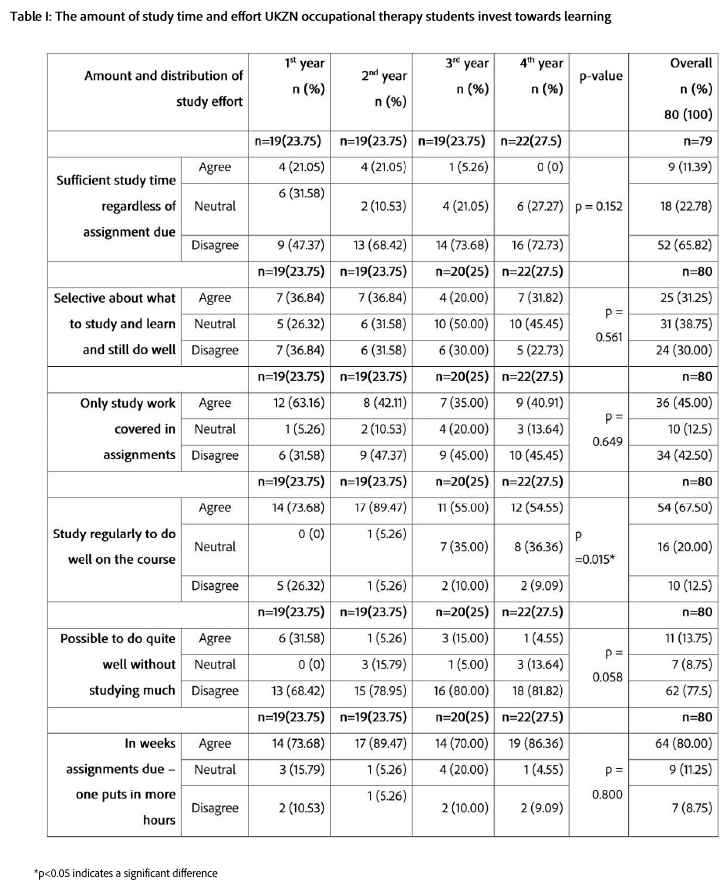
Most students across the years reported that they do not study the same amount each week, regardless of whether an assignment is due or not (65.82%; n=52).The first years (n=12; 63.16%) reported that they only study topics that are going to be covered in the assignments. Across all years, the majority of the students reported that in weeks that assignments are due, they put in more hours (80% n=64). However, more than half of the students across all years felt that studying regularly is required to do well on the course (67.5%; n=54) and the majority also reported that it is not possible to do quite well without studying in the Occupational Therapy course (77.5%; n= 62). All p-values were p>0.05 (in section on amount and distribution of study effort) across all years, except for studying regularly to do well on the course (p = 0.015), indicating a significant difference between the years (Table I, below).


Students' Experiences of Online Assessments and Learning
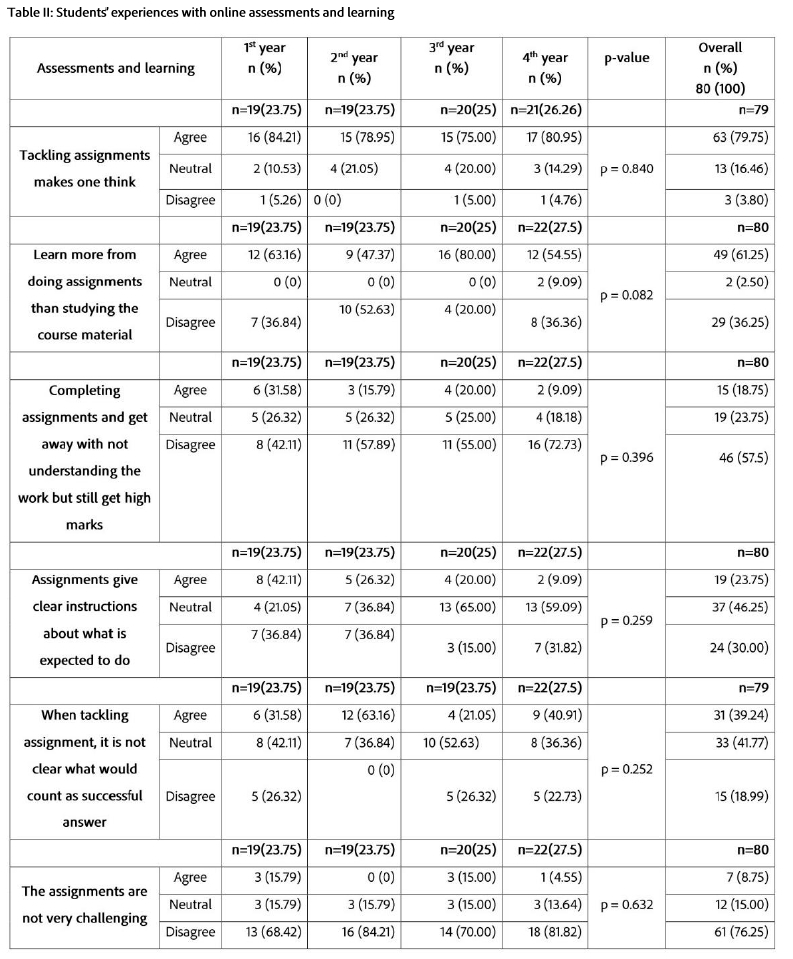
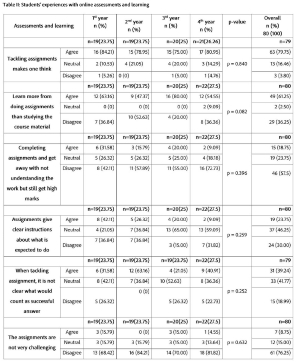
There were no significant differences between years with p>0.05 for all items (Table II below). Most students across the years found that tackling assignments made them think (78.75%; n=63), and they found the assignments, mainly of long answer questions, to be very challenging (76.25%, n=61). More than half of the students across all years felt that they learn more from doing the assignments than studying the course material (61.25%; n=49) and agreed that you cannot get away with not understanding the work but still get high marks (57.5%; n=46) since assessment drives learning.
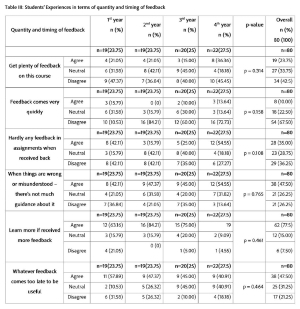
Students' Experiences of Frequency and Timely Feedback All p-
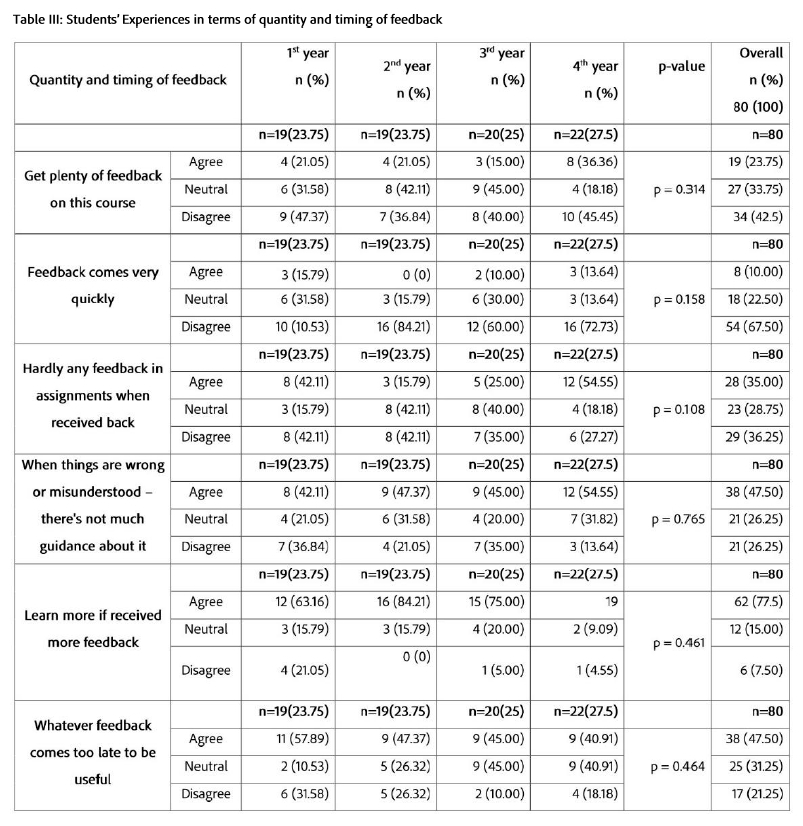
values were above p>0.05, indicating no significant difference between years (Table III, below). Several students across the years felt that on this course, they do not get sufficient feedback on how they are doing (42.5%; n=34), and more than half of the students reported that the feedback is not delivered timeously (67.5%, n=54). Many students across all years found that whatever feedback they get comes too late to be useful (47.5%, n=38), and the majority agreed that they would learn more if they received more feedback (77.5%, n=62).
Students' Experiences in terms of Quality of Feedback
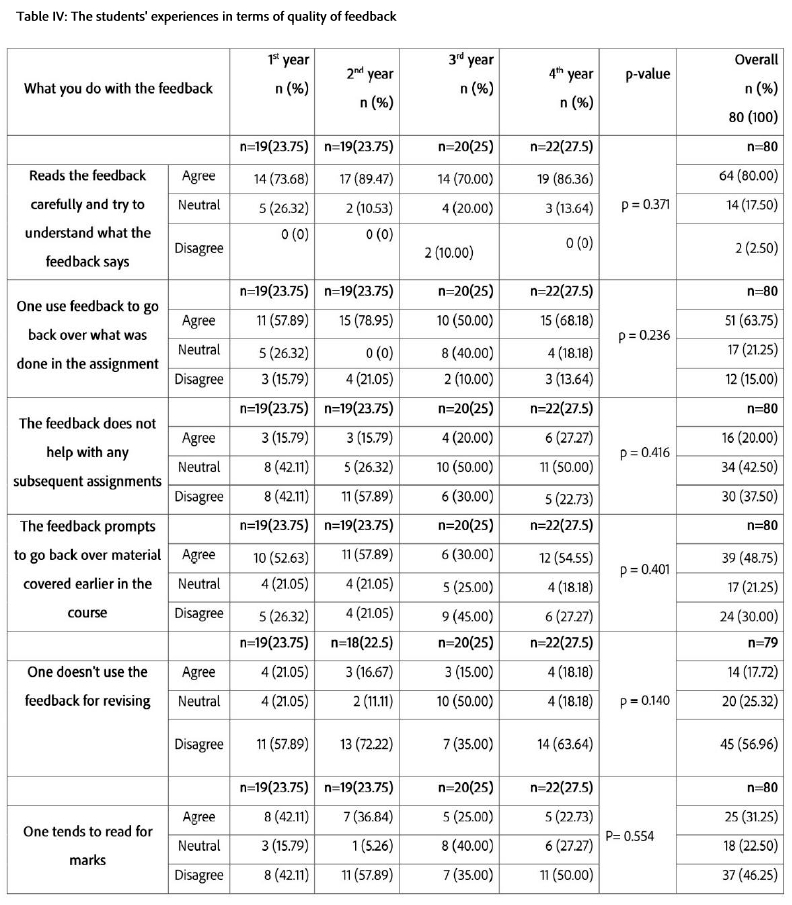
All of p-values were above p>0.05, except of the question of that feedback mainly told them how well they are doing in relation to others (p = 0.015) which indicated a significant difference between years (Table IV, page 81). Majority of the students in 2nd year stated that feedback does not mainly inform them on how they are doing in relation to others (84.21%; n=16). Both 3rd (55% n= 11) and 4th (36.36% n=8) year students are neutral and equal to the number of students that disagree about how feedback mainly tells them how they are doing.
The majority of the students across all years agreed that once they received and read feedback, they could understand why they got the mark they did but can seldom see from the feedback what they needed to do to improve (47.5%; n=38). (Table IV, page 81).
Utilisation of Feedback from Online Assessments given to Students: All of p-values were above p>0.05, indicating no significant difference between years (Table V, page 82). The majority of the students across the years found that once they read the feedback carefully and tried to understand what the feedback was saying, they could work on improving (80%; n=64). More than half of students across all years reported that they used the feedback to go back over what they had done in the assignments (63.75%, n=51), and more than half of students from across all years did use the feedback for revising (56.25%; n=45).
Students Experiences of Examination and Online Learning across all years
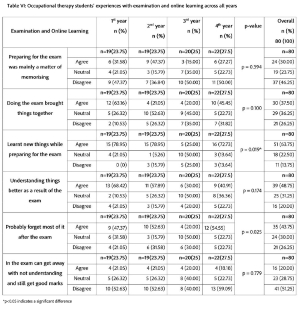
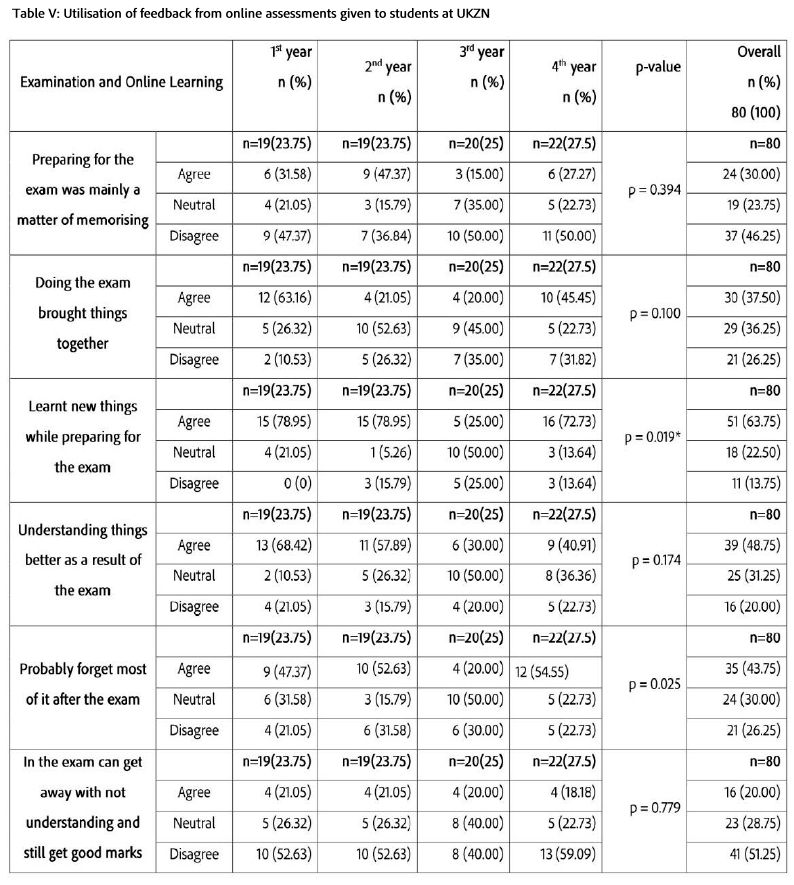
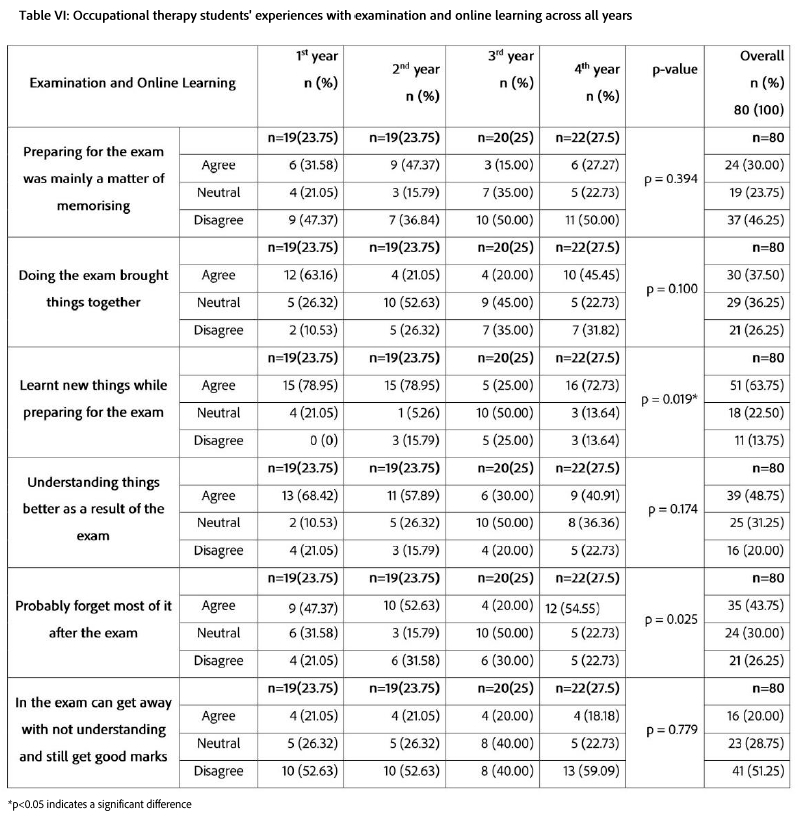
All of p-values were above p>0.05, except one which indicates that students forget most of the learning after the exam n=51; 63.75%, (p = 0.019), indicating a significant difference between years (Table VI, above). The majority of the students in 1st, 2nd and 4th year reported that they probably forgot all the learning after the exam (47.37% n=9); 52.63% n=10 and 54.55% n=12 respectively). Half of the students in 3rd year reported that they were neutral (50% n=10).
The majority of students across all years agreed that they found it difficult to learn new content while preparing for the exam (63.75% n=51), but more than half agreed that in the examination, you cannot get away with not understanding and still get good marks (51.25%; n=41). (Table VI, page 83).
DISCUSSION
This study provided insight into the University of KwaZulu-Natal occupational therapy students' experiences with online assessments and feedback during the COVID-19 pandemic in South Africa. The study identified that the majority of student's had access to the internet and resources such as operational laptops and smartphones, which facilitated the engagement with remote learning. This was due to UKZN and NSFAS counteracting student issues by providing IT support for laptops29
The first aspect that this study focused on was the experiences of students in terms of the distribution of time and effort to their studies, which varied according to the years of study. The results revealed that students felt that study time and effort are allocated narrowly to assessed topics and that regular studying is required to do well in the degree. A previous study concluded that to ensure that students are learning effectively, remote teaching requires students to complete more assignments than traditional courses. Additionally, assignments may aid students in making up for a lack of one-on-one time with lecturers18
The study also identified the experiences of students' pertaining to assignments and online learning. Majority of students across all years experienced assignments as very challenging and tackling them made them think. They reported that they learn more from doing assignments than studying the course material and cannot get good marks without understanding the work content. Overall, it was revealed that occupational therapy students had a positive experience with online assessment. The above results are reinforced by a study which revealed that online learning promoted seIf-learning, where the student actively participates in the learning process3030
Regarding frequency and timing of feedback, the results revealed that most students did not feel that they received feedback in time through online assessments. Delayed feedback impacted their learning as they reported that when they did receive feedback, it was useful and enabled them to understand why they got the mark which they were allocated. This enabled them to learn from the feedback and ensure assessments were sufficient. These statements were true across all the years of study, indicating that the quality and timing of feedback given throughout the degree are insufficient and need improvement. A study shows that students have used teacher feedback to gauge their progress, and by usingthe lecturers' input, they can also assess their internal growth3131
Once received, students perceived the quality of feedback to be very informative regarding understanding concepts better and allowing them to see how to improve in the future. Understanding the feedback also helped students understand why they achieved their marks, which further contributed to their learning process. A research study found that giving students marks, feedback, and discussion on their answers provided the most efficient guidance for effective learning to take place32
In contrast, the majority of third years remained neutral and fourth years equally disagreed and remained neutral. The study did not include how they think they are doing in relation to achieving the learning outcomes. This shows that as the years of study progress, there is a shift regarding how students perceive the feedback they receive. In the senior years of study (years three and four) feedback should primarily be used by students to improve their own performance, which does not appear to be the case, as many use it to compare to other peers. There is evidence that giving written feedback with explanations is more effective than giving marks3232
The majority of the students had a positive perception regarding the use of feedback from online assessments. According to the study results, students across different years reported that reading the feedback carefully and trying to understand it assisted in allowing the students to go back over what they have done in the assignments for revision purposes and exams. Upon reading and understanding the feedback, students found it useful. They were, therefore more interactive and engaged with the feedback, which assisted them more with regard to their assignments and exams. This collated with a study done by Kim-Daniel333399
Over half of the students across all years had a positive experience with examinations and online learning; it allowed them to study more and learn new topics while preparing for the exam; assessments also functioned as a factor that brought things together for their understanding. This correlates with studies done 30,34 that reflected that examinations and online learning allow learners to access online materials around the clock. Moreover, it also encouraged self-directed learning, where students also play a role in learning. This could be the outcome of a variety of factors, some of which include: having access to voice-recorded PowerPoints and tutorials which they could revisit any time for revision and exam, the university working with NSFAS to ensure that students have access to data, laptops and every student getting an opportunity to participate in the discussion without the fear of excessive attention or confrontation and to engage in the lessons from the comfort of their own environments16
Online assessments consisted of various question styles, including short answers, long answers, multiple choice questions and essays. The type of online assessment also affected the student's online learning experiences. Students were also urged to interact with academic professionals if they required further assistance in clarifying theoretical subjects; this was also a positive factor that resulted in the students having a positive experience9
Limitations of the study
The lack of clarity and specificity in the AEQ were said to influence the validity of the AEQ negatively, with some items in the questionnaire being open to misinterpretation by being quite vague, making it difficult for respondents to answer accurately25
CONCLUSION
The COVID-19 pandemic has rapidly changed how teaching, learning, and assessment are carried out. It brought about a global crisis in higher education as students were required to rapidly transition from in-person teaching, learning, and assessments to an online platform. This study describes how the UKZN occupational therapy student's experienced online assessments during the COVID-19 pandemic in South Africa. The results reveal that students had a positive experience with online assessments; however, the transition was challenging. Most students across all years experience assessments as challenging as it made them think critically, allowing for improved learning. Students report that they learn more from doing assessments than studying the actual course material which also ensures better learning and the need for feedback helps students understand the course and where they can improve. Therefore, emphasis is placed on receiving feedback in time. It is therefore recommended that lecturers consider the above factors, such as the difficulty levels of assessments, the number of assessments, timely and quality of feedback of assessments and the quality of assessments to ensure an effective and valuable online learning process for students.
Conflicts of interest
All authors have no conflict of interest to declare.
Author contributions
The study was conceptualised and designed by Pragashnie Govender & Gina Rencken. Tasneem Hoosen, Faatimah Salajee, Merissa Naidoo, Nokwanda Ntombela, Tasmiya Aron and Nothando Mchunu were responsible for the data acquisition with analysis an interpretation occurring together with Pragashnie Govender and Gina Rencken. All authors were responsible for the drafting the work; Pragashnie Govender, Gina Rencken and Tasneem Hoosen revised it critically for important intellectual content; and final approval of the version to be published.
REFERENCES
Acknowledgements
The COVID-19 pandemic influenced the nature of the reported work. All participants who engaged in the research study voluntarily consented to participate. The authors would like to acknowledge the biostatistician's contribution to this study.
LITERATURE REVIEW
-
1. Govender P, Naidoo D, Van Wyk, JM. A 3Ts (teaching in troubled times) response to COVID-19 in South Africa. The Clinical Teacher. 2020; 17(4): 427-429. https://doi.org/10.1111/tct.13213
» https://doi.org/10.1111/tct.13213 -
2. Gurayah T. Practice Learning for Occupational Therapy in a Time of the Global COVID 19 Pandemic. International Journal of Practice-based Learning in Health and Social Care. 2021; 9(2): 82-84. doi: https://doi.org/10.18552/ijpblhsc.v9i2.728
» https://doi.org/10.18552/ijpblhsc.v9i2.728 - 3. Songca SP. Teaching and Learning Catch-up Plan during the COVID-19 related restrictions. 2020 [accessed 2021 November 15]. Doi:
-
4. Mukhtar K, Javed K, Arooj M, Sethi A. Advantages, Limitations and Recommendations for online learning during COVID-19 pandemic era. Pakistan Journal of Medical Sciences. 2020; 36. doi: https://doi.org/10.12669/pjms.36.COVID19-S4.2785
» https://doi.org/10.12669/pjms.36.COVID19-S4.2785 -
5. Singh M. The Advantages and Disadvantages of an Online Examination System. 2018 [accessed 2021 September 26]. https://blog.mettl.com/advantages-disadvantages-online-examination/
» https://blog.mettl.com/advantages-disadvantages-online-examination/ -
6. Vithal R. Policies on Assessment. UKZN Research Office: Policies & Procedures.2021 .[Accessed September2021] http://research.ukzn.ac.za/PoliciesProcedures.aspx
» http://research.ukzn.ac.za/PoliciesProcedures.aspx -
7. University of KwaZulu-Natal. Principles of the Teaching and Learning Project Plan during the COVID-19 related restrictions for students and for academic staff. 2021. [Accessed 2021 September] http://research.ukzn.ac.za/PoliciesProcedures.aspx
» http://research.ukzn.ac.za/PoliciesProcedures.aspx -
8. Mandasari B. [PDF] the impact of online learning toward students' academic performance on Business Correspondence Course: Semantic scholar [Internet], undefined. 1970 [accessed 12 October 2022]. doi: https://doi.org/10.29062/EDU.V4l1.74
» https://doi.org/10.29062/EDU.V4l1.74 - 9. Ndaba N, Mafuleka S, Naidoo D & Govender P. Occupational Therapy Educational Programmes' Response to the COVID-19 pandemic in South Africa: The National Perspective (in review). 2020 [accessed 12 September 2022].
-
10. Knowly. Advantages and disadvantages of online examination system. Online Exam Builder. 2020. [Accessed September 26, 2021] https://www.onlineexambuilder.com/knowledge-center/exam-knowledge-center/advantagesand-disadvantages-of-online-examination-system/item10240
» https://www.onlineexambuilder.com/knowledge-center/exam-knowledge-center/advantagesand-disadvantages-of-online-examination-system/item10240 -
11. Khan S, Khan RA. Online assessments: Exploring perspectives of university students. [Internet]. Education and Information Technologies. Springer. Nature. 2018 [cited 11 October 2022]. doi: http://dx.doi.org/10.1007/s10639-018-9797-0
» http://dx.doi.org/10.1007/s10639-018-9797-0 -
12. Black P, William D. (2009). Developing the theory of formative assessment. Educational assessment evaluation and accountability. J Personnel Evaluation Education 21(1):5-31. https://doi.org/10.1007/s11092-008-9068-5
» https://doi.org/10.1007/s11092-008-9068-5 -
13. Jefferson F. A Comparative Analysis of Student Performance in an Online vs. Face-to-Face Environmental Science Course From 2009 to 2016:2009.doi:https://www.frontiersin.org/articles/10.3389/fcomp.2019.00007/full
» https://www.frontiersin.org/articles/10.3389/fcomp.2019.00007/full - 14. Robles MM, Braathen, SJ. Online Assessment Techniques. The Delta Pi Epsilon Journal. 2022.44, 39-49.
-
15. Baczek M, Zaganczyk-Baczek M, Szpringer M, Jaroszynski A, Wozakowska-Kapton B. Students' perception of online learning during the COVID-19 pandemic: a survey study of Polish medical students. Medicine. 2021; 100:7(e24821). doi: 10.1097/MD.0000000000024821
» https://doi.org/10.1097/MD.0000000000024821 -
16. Vithal R. Principles of the Teaching and Learning Project Plan during the COVID-19-related restrictions for students and for academic staff ;2016.https://ulop.ukzn.acza/wp-content/uploads/2022/08/Principles-of-emergency-online-teaching-new.pdf
» https://ulop.ukzn.acza/wp-content/uploads/2022/08/Principles-of-emergency-online-teaching-new.pdf -
17. Vithal R .Policies on Assessment. UKZN Research Office: Policies & Procedures.2021.doi:http://research.ukzn.ac.za/PoliciesProcedures.aspx
» http://research.ukzn.ac.za/PoliciesProcedures.aspx -
18. Almahasees Z, Mohsen K, Amin MO. Faculty's and students' perceptions of online learning during COVID-19 Frontiers. Frontiers ,2021. Doi https://doi.org/10.3389/fcomp.2019.00007
» https://doi.org/10.3389/fcomp.2019.00007 -
19. Lizzio A, Wilson, K Feedback on assessment: students' perceptions of quality and effectiveness, Assessment & Evaluation in Higher Education,2008,263-275.doi: https://doi.org/10.1080/02602930701292548
» https://doi.org/10.1080/02602930701292548 -
20. Spivey MF, Mcmillan JJ.Classroom versus online assessment. Journal of Education for Businesm, 2014, 89: 450-456. doi: https://doi.org/10.1080/08832323.2014.937676.
» https://doi.org/10.1080/08832323.2014.937676 - 21. Gibbs G, Simpson C. Conditions Under Which Assessment Supports Students' Learning." Learning and Teaching in Higher Education, 2004, 1: 3-29
-
22. Dawson P, Henderson M, Mahoney P, Phillips M, Ryan T, Boud D, Molloy E. What Makes for Effective Feedback: Staff and Student Perspectives." Assessment & Evaluation in Higher Education ,2019 :44 (1): 25-36. doi: https://doi.org/10.1080/02602938.2018.1467877
» https://doi.org/10.1080/02602938.2018.1467877 -
23. Jessop T, Maleckar B. The Influence of Disciplinary Assessment Patterns on Student Learning: A Comparative Study. Studies in Higher Education. 2016; 41(4): 696-711.doi: https://doi.org/10.1080/03075079.2014.943170
» https://doi.org/10.1080/03075079.2014.943170 -
24. Batten J, Batey J, Shafe, L, Gubby, L, Birch, PDJ. The influence of reputation information on the assessment of undergraduate student work. Assessment & Evaluation. 2013; 38(4): 1-19 doi: https://doi.org/10.1080/02602938.2011.640928
» https://doi.org/10.1080/02602938.2011.640928 -
25. DJS Research. Qualitative and Quantitative Research Methods. 2021. https://www.djsresearch.co.uk/glossary/item/Qualitative-and-Quantitative-Research-Methods [accessed 2021 November].
» https://www.djsresearch.co.uk/glossary/item/Qualitative-and-Quantitative-Research-Methods -
26. Patton, MQ. Qualitative research and evaluation methods. 2002. [accessed 2021 November]. https://www.ncbi.nlm.nih.gov/pmc/articles/PMC4012002/#:~:text=As%20Patton%20%282002%2C%20p.%20240%29%20explains%2C%20%E2%80%9Cthe%20purpose,homogeneous%20sample.%E2%80%9D%20Challenges%20to%20use%20of%20purpos eful%20sampling
» https://www.ncbi.nlm.nih.gov/pmc/articles/PMC4012002/#:~:text=As%20Patton%20%282002%2C%20p.%20240%29%20explains%2C%20%E2%80%9Cthe%20purpose,homogeneous%20sample.%E2%80%9D%20Challenges%20to%20use%20of%20purpos eful%20sampling -
27. Gibbs, GR, Simpson, C. Measuring the response of students to assessment: The Assessment Experience Questionnaire. 2003; [accessed 2021 November]. https://www.researchgate.net/publication/228602826_Improving_student_learning_through_changing assessment_-_a_conceptual_and_practical_framework
» https://www.researchgate.net/publication/228602826_Improving_student_learning_through_changing assessment_-_a_conceptual_and_practical_framework -
28. Marsh, HW, Morin, AJS, Parker, PD, Kaur, G. Exploratory Structural Equation Modeling. An Integration of the Best Features of Exploratory and Confirmatory Factor Analysis. 2014; 55(1) doi: https://doi.org/10.1146/annurev-clinpsv-032813-153700
» https://doi.org/10.1146/annurev-clinpsv-032813-153700 - 29. 09 June 2020 ( Notice(5)ukzn.ac.za) University of KwaZulu- Natal.
-
30. Gautam, P. Advantages and Disadvantages of Online Learning eLearninglndustry. 2020 [Accessed 2022 October 14] https://elearningindustry.com/advantages-anddisadvantagesonline-learning
» https://elearningindustry.com/advantages-anddisadvantagesonline-learning -
31. Al-Bashir M, Kabir R, Rahman I. The Value and Effectiveness of Feedback in Improving Students Learning and Professionalising Teaching in Higher Education. Journal of Education and Practice. 2016; 7(16) 38-41. doi; https://eric.ed.gov/?id=EJ1105282
» https://eric.ed.gov/?id=EJ1105282 -
32. Hendry G, Bromberger N, Armstrong S. Constructive guidance and feedback for learning the usefulness of exemplars, marking sheets and different types of feedback in a first year law subject. Assessment & Evaluation in Higher Education.2009; doi: https://doi.org/10.1080/02602930903128904
» https://doi.org/10.1080/02602930903128904 -
33. Kim-Daniel Vattøy, Siv M. Gamlem, Wenke Mork Rogne. Examining students feedback engagement and assessment experiences: a mixed study, Studies in Higher Education. 2020; doi: https://doi.org/10.1080/03075079.2020.1723523
» https://doi.org/10.1080/03075079.2020.1723523 -
34. Adedoyin, OB, Soykan, E. "Covid-19 pandemic and online learning: the challenges and opportunities". 2020; doi: https://psvcnet.apa.org/doi/10.1080/10494820.2020.1813180
» https://psvcnet.apa.org/doi/10.1080/10494820.2020.1813180
Reviewed: 11 September 2023
Revised: 16 January 2024
Accepted: 18 January 2024
Editor: Blanche Pretorius: https://orcid.org/0000-0002-3543-0743
Data Availabiity: All data derived from this study are presented in this manuscript and available upon reasonable request form the corresponding author.
Funding: No funding was received for the research.