Co-morbidities of hearing loss and occupational therapy in preschool children
Abstract
INTRODUCTION: Many children with hearing impairment present with one or more health-related conditions defined as a co-morbidity in addition to hearing loss. Families and professionals are then faced with various challenges that often complicate the assessment, management and educational placement of these children. Appropriate holistic intervention is essential for the development and quality of life of the child. This study describes the co-morbidities within the field of occupational therapy, speech therapy and physiotherapy that pre-school children with hearing loss present with at the Centre for Language and Hearing Impaired Children (CLAHIC) and its implications for management. METHOD: A descriptive, retrospective research design was employed. Using a non-probability, purposive sampling strategy the records of 62 children diagnosed with a hearing loss that attended the CLAHIC from 1999 to 2010, were reviewed. RESULTS: The prevalent co-morbidities identified in this study were found mostly within the field of Occupational Therapy and included fine and gross motor delay, visual motor integration disorders and bilateral integration disorders. Further findings indicated that co-morbidities of hearing loss are independent of the degree of the hearing loss. CONCLUSION: The findings suggest that pre-school children with hearing loss, irrespective of the etiology and degree of hearing loss, should be screened for prevalent co-morbidities, such as fine and gross motor difficulties
Co-morbidities; hearing loss; interdisciplinary team; occupational therapy
INTRODUCTION
Parents of children with hearing loss and the health care professionals involved are faced with numerous challenges when a child with a hearing loss presents with additional health-related difficulties defined as co-morbid delays and/or disorders1,2 such as delayed fine motor development. Access to appropriate healthcare and resources, financial costs and appropriate educational placement are just some of the possible challenges that are intertwined in the dynamic decision-making and management processes for these children.
As hearing loss may negatively affect health-related quality of life34
Disparities exist across medical and educational settings for children with therapeutic and support services needs such as for children diagnosed with hearing loss5
Hearing Loss
It is estimated that in South Africa 6 in every 1000 babies in the public health sector and 3 in 1000 infants in the private health sector are born with a hearing loss67878
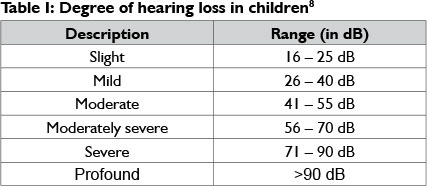
Hearing loss is further categorised according to the degree of hearing loss which is measured in decibels (dB). The point at which a person starts to hear sound is referred to as a dB of 0 and normal hearing for children is described as being between 0 and 15dB. The degrees of hearing loss for children range from slight to profound (See Table I).
Depending on the degree of hearing loss, everyday communication may be difficult or even impossible without a great deal of effort. As a result infants and children may experience a delay in speech, language, motor and social development as well as educational achievement9
Etiology of Hearing Loss
The causes of hearing loss may have a significant impact on the management and care of individuals with a hearing loss. Genetic and environmental factors contribute to the etiology of hearing loss101011121310
Co-Morbidities of Hearing Loss
Co-morbidity is defined as the presence of additional conditions in relation to a specific index condition1,2. In the present study a comorbidity will refer to a disorder that is in addition to hearing loss. Co-morbidities of hearing loss include motor impairment, cognitive or learning difficulties (LD), global developmental delay described as a significant delay in two or more developmental domains141516
It has been found that attention disorders, learning disorders and intellectual difficulties are the most prevalent co-morbidities that children with hearing loss present with. The other prevalent co-morbidities of hearing loss that have been identified are sensory integration disorders and motoric problems161616
Implications for the Assessment and Management Approach
Holistic intervention and management is essential to meet the needs of children that present with co-morbidities of hearing loss and their families. One approach to the holistic management is the interdisciplinary team approach when team members collaborate to produce a comprehensive intervention plan1718
Assessment of children with hearing loss should in addition to the audiological aspects, include the assessment of all developmental domains including cognition, communication and language, behaviour, social-emotional skills, and motor skills19
Research has confirmed that early diagnosis, appropriate amplification and prompt entry into early intervention programmes are factors that potentially affect the auditory and spoken language outcomes of children with severe and profound hearing loss20,21. Early intervention for infants and children with hearing loss should build communication skills that will facilitate social and cognitive development16
In addition, the educational placement of these children requires careful selection of a setting that will meet their needs as well as those of their families. Educational programmes should ideally offer an integrated curriculum that nurtures speech, language, literacy development, innovations in the areas of auditory perception, social emotional learning, motor development, and vestibular function to enhance outcomes22
Rationale for the Study
The move towards inclusive education in South Africa for children with disabilities is positive. However, the dearth of information on the prevalence of co-morbid disorders and/or delays that preschool children with hearing loss present with may impact on the availability of appropriate educational placements and intervention for these children23
METHOD
Aim
The primary aim of the study was to describe the co-morbidities that pre-school children with hearing loss at an early intervention center for children with language and hearing impairment present with, and their implications for management. In order to achieve the primary aim, the prevalence of the different types of co-morbidities was identified and the services provided to these children described. A secondary aim of the study was to determine if there was any relationship between the severity of the hearing loss and the co-morbidities identified.
Research Design
A descriptive, retrospective record review24
Population and Sample Procedure
The Centre for Language and Hearing Impaired Children (CLAHIC), situated in Johannesburg, is an early intervention centre that provides a language-enriched learning environment for children with delayed language development and/or hearing loss. The CLAHIC has six classes with only eight children per class, and offers a range of additional professional services to the children and their families if required. These services include audiology, speech therapy, occupational therapy, physiotherapy and educational psychology.
Using a non-probability, purposive sampling strategy, the archived records of children attending the CLAHIC between 1999 and 2010 were reviewed. A total of 62 records of children diagnosed with hearing loss were included in the study. The gender of the sample was evenly distributed and the average age of the participants was 5.0 years (range 3.0 to 7.7; standard deviation [SD] = 1).
Measures
A checklist was developed, using the literature findings, to assist in the record review. The checklist comprised of six sections:
- Section one and two contained biographical information and hearing status. This assisted in the description of the participants.
- The third section contained the medical history of each participant and provided information on the etiology of hearing loss that could have implications for the type of specialised services and referrals that might be required. Confirmed diagnosis of ADHD by a paediatric psychiatrist, learning disorders diagnosed by an educational psychologist and visual impairment identified by an optometrist, were also recorded in this section.
- The fourth section contained information on the specialist intervention provided by occupational therapists, physiotherapists and speech therapists. The co-morbidities identified were based on the test results and findings of individual assessments (and subsequent diagnoses) detailed in each of the professionals' report. These co-morbidities included gross and fine motor development, vestibular disorders that can be characterised by atypical movements; poor spatial relations; visual acuity problems etc.252627
- The fifth section identified the external medical professionals these children were referred to, whilst the last section looked at the educational placement of children.
Procedures
Ethical considerations: Various ethical considerations were implemented throughout the study. The researcher obtained ethical clearance from the University of the Witwatersrand's Research Ethics Committee before the research was conducted. Written informed consent was obtained from the CLAHIC. On admission to the CLAHIC, parents sign and provide consent that information from their child's file may be used for research purposes. Confidentiality was assured as files were allocated a participant number and no identifying information was reported.
Data collection and analysis. A systematic review of all records and reports in the files was conducted. Data were captured on a MS Excel spreadsheet and thereafter tabulated into ordinal categories for statistical analysis. A coding method of using 0 as false indicator and 1 as a true indicator for the co-morbidity present was implemented. Pivot tables were created to interrogate the data as well as perform calculations within the various sets of data. Descriptive statistics were utilised to analyse those data, and included averages, range, SD, frequency and percentages.
Reliability. The use of the term reliability in communication disorders research is related to the general trustworthiness of the data and is synonymous with dependability, consistency, predictability and stability24
Validity. A comprehensive literature review was conducted and served as an underpinning for the measurement instrument of this study, the checklist. The validity of the study was increased by conducting a pilot study. The data collected from the pilot study was used in the final analysis of the main study to add to the sample size, and it can therefore be referred to as an internal pilot28
RESULTS
Hearing status
The majority of the participants (98%; n = 61) had a bilateral hearing loss. The types of hearing loss included sensory-neural hearing loss (89%; n = 55), conductive hearing loss (6%; n = 4) and mixed hearing loss (5%; n = 3). The degrees of hearing loss ranged from moderate to profound, with the majority of participants (47%; n = 29) diagnosed with a profound hearing loss.
Medical Diagnosis
Sixty percent of the children (n = 37) presented with medically related conditions. Of these, congenital anomalies, such as cleft-lip and palate, respiratory conditions and dysmorphic features, were evident in 15% (n = 9) of the participants, whilst 11% (n= 7) were diagnosed with a syndrome prior to admission into the CLAHIC. These syndromes included Goldenhar syndrome (n = 2), Waardenburg Syndrome (n= 1), Connexin 26 mutation (n= 1) and Respiratory Distress Syndrome (n= 2). Sixteen percent (n = 10) were born prematurely and 6% (n = 4) of the participants had very low birth weights. Recurrent middle ear infections were experienced by 16% (n= 10) of the participants. The remaining 11% (n = 7) included ototoxicity, infections, jaundice and birth asphyxia.
Co-morbidities
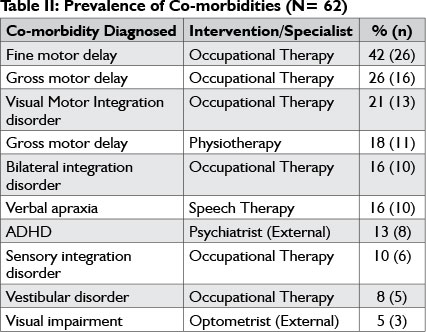
Information obtained from the medical diagnosis and specialist intervention sections were used to determine the types of co-morbidities that the participants presented with in addition to hearing loss. Each co-morbidity was diagnosed by the relevant specialist based upon assessment findings for each child. The results are presented in Table II.
It is evident from the findings that the more frequently occurring conditions that participants presented with, were in the field of occupational therapy. The most prevalent co-morbidity diagnosed was a delay in fine motor skills (42%; n = 26), followed by delays in gross motor development (26%; n = 16) that included crossing of the body midline, sequencing in gross motor co-ordination and postural control, followed by visual motor integration disorders (21%; n = 13). Further co-morbidities diagnosed within the field of occupational therapy were bilateral integration disorders (16%; n = 10); sensory integration disorders (10%; n = 6) and vestibular disorders (8%; n = 5). The co-morbidity of a gross-motor delay diagnosed by a physiotherapist was 18% of the participants (n = 11) that included disorders in postural control and positioning, flexion and extension control and balance integration. Sixteen percent of the participants (n = 10) presented with verbal apraxia and received intervention by speech therapists.
The prevalence of the co-morbidities were then identified in children with the same degree of hearing loss bilaterally, to determine if there was a relationship between degrees of hearing loss and co-morbidities.

Statistical analysis did not reveal a significant occurrence or pattern of co-morbidity in relation to the degree of hearing loss.
Referrals
In addition to the occupational therapy, physiotherapy and speech therapy interventions, referrals were made to a number of other medical professionals after admission to the CLAHIC. Twenty four percent of children (n = 15) were referred to a developmental specialist, whilst 15% (n= 9) were referred to a psychologist as they presented with behavioural and/or emotional problems. Referrals to a geneticist for genetic testing after admission to CLAHIC were limited to 3% (n= 2) of participants.
Educational Placement
A large number of the participants (37%; n = 23) were referred for placement in a remedial school. Of these participants, 52% (n= 12) presented with a delay in fine motor skills, whilst the remaining participants presented with visual motor integration difficulties. Nineteen percent of participants (n= 12) were recommended to continue at the CLAHIC, whilst a further 19% (n=12) were referred to schools that offered education using sign language. Mainstream schooling was only recommended for 15% (n= 9) of the participants. Two of these participants presented with fine motor difficulties and vestibular disorders. The remaining 10% of participants were referred to schools for learners with special educational needs.
Discussion
It is evident from the findings that the most prevalent co-morbidities that children with hearing loss enrolled at CAHIC presented with, was in the field of occupational therapy. These specific co-morbidities included delays in fine and gross motor delay as well as VMI disorders. Research has found that auditory deprivation as a result of pre-lingual deafness may lead to the atypical development of specific motor skills292930
Visual motor integration (VMI) disorders were the next more frequently occurring co-morbidity (21%; n = 13). The children who had VMI disorders also presented with fine motor difficulties and had hearing losses that ranged from moderate to profound degrees. A VMI disorder is the ability of the eyes and hands to work together in smooth, efficient patterns and it involves visual perception and eye-hand co-ordination26
Interestingly, eight percent of the participants that had fine- and gross motor delays also presented with vestibular disorders. As the vestibular system is linked to the visual system, it plays an important role in eye movements which could influence spatial awareness and fine motor co-ordination313131
Cochlear implants are becoming a more accessible and feasible option of amplification for children with hearing loss. Cochlear implants are surgically implanted electronic devices coupled to external components that provide useful hearing to children and adults with severe-to-profound hearing loss and ultimately leads to improved spoken communication3232,33. Contradictory findings however highlight the potential risk of vestibular deficits after cochlear implantation and thus motor function34
A small percentage of participants in this study also presented with SI disorders. SI disorders are often associated with specific language impairments35
The overall finding of this study indicates that the most common occurring co-morbidity of hearing loss in children enrolled at the CLAHIC is fine motor difficulty. This supports findings of other studies that indicated that auditory deprivation, as in the case of a hearing loss, may lead to atypical development of specific motor and language skills that share common cortical processes29
CONCLUSION AND RECOMMENDATIONS
The findings suggest that pre-school children with hearing loss, irrespective of the degree of hearing loss, should be screened, assessed and monitored for prevalent co-morbidities, such as fine and gross motor difficulties. It is suggested that an interdisciplinary team approach should be followed when working with children with hearing loss that present with co-morbid delays and/or disorders. The results of this study should be cautiously interpreted in light of its small sample size and context limitations. Further research should address the replication of this study with a larger sample size in various pre-schools that include children with hearing loss to allow for the generalisation of findings to the broader South African context. In addition, the relationship between the degree of hearing loss and the presence of co-morbidity should be determined
REFERENCES
LITERATURE REVIEW
-
1. Granberg S, Danermark B. "The development of ICF core sets for hearing loss." 2010. http://journals.asha.or^perspectives/terms.dtl (1 Feb 2012)
» http://journals.asha.or^perspectives/terms.dtl - 2. Danermark B, Cieza A, Gange J, Gimigliano F Granberg S, Hickson L, Russo L, Stomgren JP Stucki G, Swanepoel D. International classification of functioning, disability, and health core set for hearing loss: A discussion paper and invitation. International Journal of Audiology, 2004; 49:256-262.
- 3. Conelly LB. Health-related quality of life, hearing loss and assistive technologies. A Draft Report for the Australian Communication Exchange, 2008; 1:1-35.
- 4. Abrams BH, McArdle R, Chisolm TH. From outcomes to evidence: establishing best practices for audiologists. Seminars in Hearing, 2005; 26(3):157-169.
- 5. Benedict RE. Child health services. Health Services Research, 2006; 41(1):103-124.
- 6. Swanepoel D, Storbeck C, Friedland P. Early hearing detection and intervention in South Africa. International Journal of Pediatrics, Otorhinolaryngol, 2009; 73:783-786.
- 7. American Speech-Language-Hearing Assocation. "Factsheet: Deafness and hearing impairment factsheet." 2010. <l> (1 Feb 2012)
- 8. Tharpe AM. Disorders of Hearing in Children. In Plante E, Beeson PM, editors. Communication and communication disorders: A clinical introduction. USA: Pearson Education, 2004: 267-269, 281.
- 9. Cole EB, Flexer C. Children with hearing loss: Developing listening and talking. Oxfordshire Plural Publishing: 2007.
- 10. Keats BJB, Berlin CI, Gregory P Epidemiology of genetic hearing loss. Seminars in Hearing, 2006; 27(3):136-147.
-
11. World Health Organization (WHO). "International Statistical Classification of Diseases and Related Health Problems." 2006. http:// www.who.int/classifications/apps/icd/icdl0online/ (9 Nov 2011)
» http:// www.who.int/classifications/apps/icd/icdl0online/ - 12. Schultz J. Waardenburg Syndrome. Seminars in Hearing, 2006; 27(3):171-181.
- 13. Shi G, Gong L, Xu X, Nie W, Lin Q, Qi Y GJB2 gene mutations in newborns with non-syndromic hearing impairment in Northern China. Hearing Research, 2004; 197:19-23.
- 14. Cleary MA, Green A. Developmental delay: when to suspect and how to investigate for an inborn error of metabolism. Archive of Disorders in Children, 2005; 90:1128-1132.
- 15. Bundy AC, Lane SJ, Murray EA. Sensory Integration: Theory and Practice. 2nd ed. Philadelphia: FA. Davies Company, 2002.
- 16. Suarez H, Angeli S, Suarez A, Rosales B, Carrera X, Alonso R. Balance sensory integration in children with profound hearing loss and cochlear implants. International Journal Paediatric Otorhinolaryngol-ogy, 2007; 71:629-637.
- 17. Diller L. Fostering the interdisciplinary team: Fostering research in a society in transition. Archives of Physical Medicine and Rehabilitation, 1990; 71:275-278.
- 18. Crow G, Pounder D. Interdisciplinary teacher teams: Context, design, and process. Educational Administration Quarterly, 2000; 36:216-254.
- 19. Brown AS, Holstrum WJ, Ringwalt, SS. Early intervention. Seminars in Hearing, 2008; 29(2):178 195.
- 20. Samson-Fang L, Simons-McCandless LM, Shelton C. Controversies in the field of hearing impairment: Early identification, educational methods, and cochlear implants. Infants and Young Children, 2000; 12(4):77-88.
- 21. Yoshinaga-Itano C, Sedey AL, Coulter DK, Mehl AL. Language of early and later identified children with hearing loss. Pediatrics, 1998; 102(5):1161-1172.
- 22. Mellon NK, Ouellette M, Greer T, Gates-Ulanet PAchieving developmental synchrony in young children with hearing loss. Trends in Amplification, 2009; 13:223-240.
- 23. Swanepoel D. Infant hearing screening at maternal and child health clinics in a developing South African community. Early intervention for infants with hearing loss: A critical evaluation. Pretoria, 2005: University of Pretoria.
- 24. Schiavetti N, Metz DE. Evaluating Research in Communicative Disorders. 4th rev. ed. Boston: Allyn and Bacon, 2002.
- 25. Gaye W, Cronin OTD, Rose Marie Rine PT. Pediatric Vestibular Disorders: Recognition, Evaluation and Treatment, 2012.
- 26. Sanghavi R Kelkar R. Visual motor integration and learning disabled children. The Indian Journal of Occupational Therapy, 2005; 37(2), 33-38.
- 27. Miller LJ, Anzalone ME, Lane SJ, Cermak SA, Osten EJ. Concept Evolution in Sensory Integration: A Proposed Nosology for Diagnosis. American Journal of Occupational Therapy, 2007; 61(2):135-140.
- 28. Arain M, Campbell M J, Cooper CL, Lancaster CA. Whatlislalpilot or feasibility study? A review of current practice and editorial policy. BMC Medical Research, 2010.
- 29. Horn DL, Pisoni DB, Miyamoto RT. Divergence of fine and gross motor skills in prelingually deaf children: Implications for cochlear implantation. Laryngoscope, 2006; 116:1500-1506.
- 30. Rajendran V Roy FG. Comparison of health related quality of life of primary school deaf children with and without motor impairment. Italian Journal of Paediatrics, 2010; 36(75):1-5.
- 31. Ayres AJ. Sensory integration and the child: Understanding hidden sensory challenges. 25th rev.ed. Los Angeles: Western Psychological Services, 2005.
- 32. Zwolan TA. Cochlear Implants. In Katz J, editor, Handbook of Clinical Audiology. New York: Lippincott Williams & Wilkins, 2002.
- 33. Incesulu A, Vural M, Erkam U. Children with cochlear implants: Parental perspective. Otology and Neurotology, 2003; 24:605-61 1.
- 34. Gheysen F Loots G, Van Waevelde H. Motor development of deaf children with and without cochlear implants. Journal of Deaf Studies and Deaf Education, 2007; 13(2):215-224.
- 35. Van der Linde J. The sensory profile of children with speech and language disorders in London and the South of England. Johannesburg: University of Witwaterstrand, 2008.