Occupational therapists' intervention of substance-related and addictive disorders in South Africa
Abstract
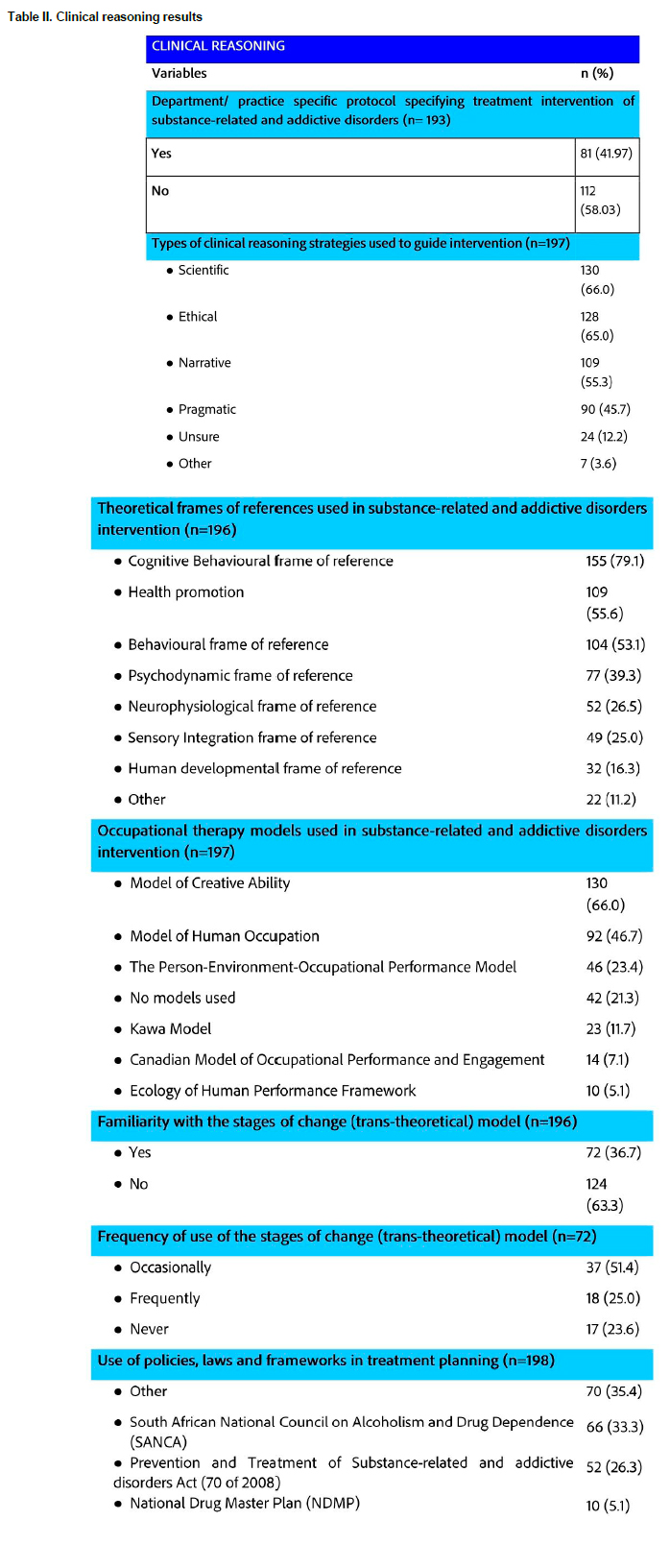
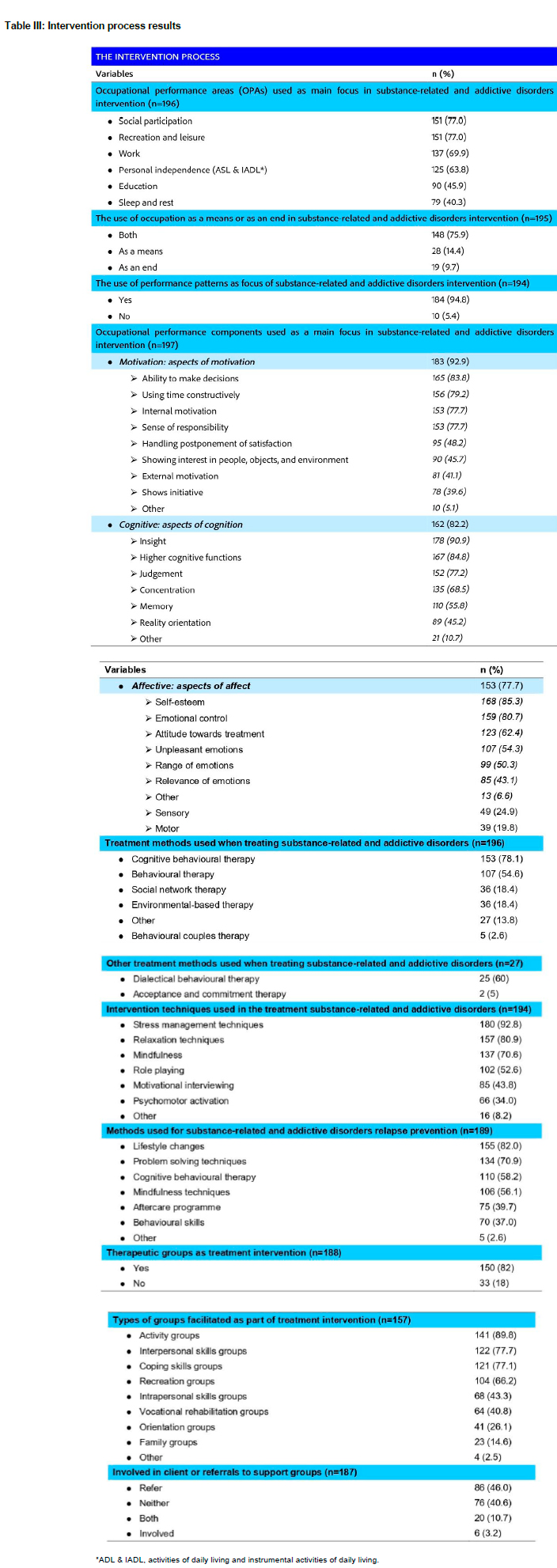
INTRODUCTION: South Africa is one of the top ten substance-abusing countries worldwide. South African literature vaguely defines intended occupational therapy interventions to address this problem and it is still unclear what interventions are applied in practice. AIM: The study aimed to explore the intervention programmes South African occupational therapists follow when working with clients who struggle with substance-related and addictive disorders. Furthermore, it explored how occupational therapists select, motivate, and implement their intervention programmes. METHOD: This quantitative exploratory study used a self-developed questionnaire that was distributed by discriminative snowball sampling. Occupational therapists across South Africa who treat substance-related and addictive disorders were requested to complete the questionnaire. RESULTS: Two-hundred-and-nineteen occupational therapists participated in this study. The participants provided a variety of evidence-based interventions focusing on social participation (n=169; 77.2%), leisure (n=169; 77.2%) and work (n=147; 67.1%). When selecting intervention methods, motivation (n=204; 93.2%), ethical reasoning strategy (n=142; 64.8%), Model of Creative Ability (VdTMoCA) (n=145; 66.2%) and cognitive behavioural therapy (CBT) (n=171; 78.1%) were identified as the main methods when selecting, motivating, and implementing intervention. Relapse prevention and aftercare received insufficient attention. CONCLUSION: This study provides insight into the interventions South African occupational therapists use when treating substance-related and addictive disorders. The findings provide a basis to inform evidence-based interventions and outcomes. IMPLICATIONS FOR PRACTICE • This research study provides an understanding of occupational therapists' interventions for substance-related and addictive disorders in South Africa. • The results can be used to determine the effectiveness of interventions done in South Africa to improve recovery outcomes. • The results from the research study can be used as a source of literature for future studies. • This study fills a gap in South African occupational therapy literature with regard to substance-related and addictive disorders.
Model of Creative Ability (VdTMoCA); ethical reasoning strategy; cognitive behavioural therapy; relapse prevention; good health and well-being; evidence-based interventions and outcomes