Occupational therapists' intervention of substance-related and addictive disorders in South Africa
Abstract
INTRODUCTION: South Africa is one of the top ten substance-abusing countries worldwide. South African literature vaguely defines intended occupational therapy interventions to address this problem and it is still unclear what interventions are applied in practice. AIM: The study aimed to explore the intervention programmes South African occupational therapists follow when working with clients who struggle with substance-related and addictive disorders. Furthermore, it explored how occupational therapists select, motivate, and implement their intervention programmes. METHOD: This quantitative exploratory study used a self-developed questionnaire that was distributed by discriminative snowball sampling. Occupational therapists across South Africa who treat substance-related and addictive disorders were requested to complete the questionnaire. RESULTS: Two-hundred-and-nineteen occupational therapists participated in this study. The participants provided a variety of evidence-based interventions focusing on social participation (n=169; 77.2%), leisure (n=169; 77.2%) and work (n=147; 67.1%). When selecting intervention methods, motivation (n=204; 93.2%), ethical reasoning strategy (n=142; 64.8%), Model of Creative Ability (VdTMoCA) (n=145; 66.2%) and cognitive behavioural therapy (CBT) (n=171; 78.1%) were identified as the main methods when selecting, motivating, and implementing intervention. Relapse prevention and aftercare received insufficient attention. CONCLUSION: This study provides insight into the interventions South African occupational therapists use when treating substance-related and addictive disorders. The findings provide a basis to inform evidence-based interventions and outcomes. IMPLICATIONS FOR PRACTICE • This research study provides an understanding of occupational therapists' interventions for substance-related and addictive disorders in South Africa. • The results can be used to determine the effectiveness of interventions done in South Africa to improve recovery outcomes. • The results from the research study can be used as a source of literature for future studies. • This study fills a gap in South African occupational therapy literature with regard to substance-related and addictive disorders.
Model of Creative Ability (VdTMoCA); ethical reasoning strategy; cognitive behavioural therapy; relapse prevention; good health and well-being; evidence-based interventions and outcomes
INTRODUCTION
According to the United Nations Office on Drugs and Crime, 35 million people worldwide suffered from a substance-related and addictive disorder in 2018 and required some form of treatment123
South Africa is one of the top ten substance-abusing countries worldwide456,?, although, the true percentage is speculated to be significantly higher89
Substance-related and addictive disorders are a mental health problem described in the Diagnostic and Statistical Manual of Mental Disorders, 5th edition (DSM-V), referring to the repeated and increased use of a substance of any sort, that may result in an urge continuously use the substance resulting in symptoms of distress, that may include physical and mental deterioration10,11 if these substances are not consumed. Consequently, this can result in an individual's failure to fulfil their life role responsibilities at work, home, or school. These disorders have negative consequences on social participation, recreational activities, and activities of daily living, which may cause occupational imbalance and decrease a person's quality of life12
In South Africa, using or abusing substances is regarded as a norm in various cultures131415
The need for occupational therapy intervention in substance-related and addictive disorders
Occupational therapists view participation in occupations as the key to health and well-being1920,21. Literature suggests that discontinuing the use of a substance requires a shift in the individual's occupational identity from being an addict to that of being a recovering addict2217
Type of occupational therapy interventions described in the literature
Occupational therapists look at clients holistically and assess the impact of substance-related and addictive disorders on occupational performance182317
According to international literature, individuals recovering from substance-related and addictive disorders can benefit from treatment methods such as cognitive behavioural therapy (CBT), dialectical behaviour therapy (DBT), behavioural therapy, social network therapy, environment-based therapy and behavioural couples therapy24,25. Moreover, techniques such as role playing, mindfulness, motivational interviewing, relaxation therapy and group therapy can be valuable for individuals to prevent relapses and equip the client with coping strategies to return to daily occupations2426
Due to substance-related and addictive disorders being a chronic relapsing disease, relapse prevention forms an essential part of intervention. It focuses on the causes of addictive behaviours, which may be environmental, physical, situational or emotional in nature. The goal is to create a person-centred relapse prevention plan to support and promote sustaining abstinence242418
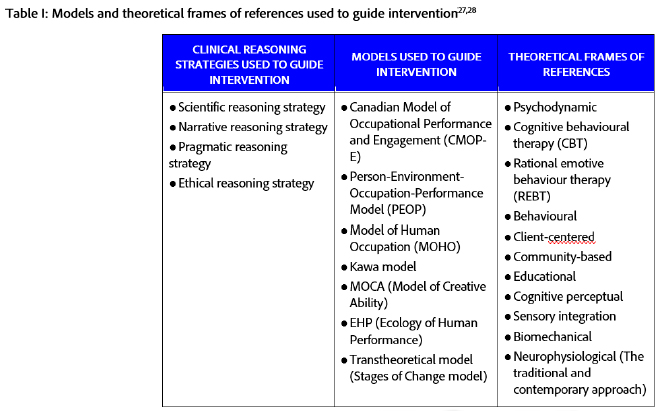
In order to select which of the above interventions are the most applicable to their client, occupational therapists can use a variety of clinical reasoning strategies, models and theoretical frames of references as listed in Table I (below). A non-occupational therapy model that can be used to clinically reason is the Stages of Change model (Transtheoretical model). This model focuses on six stages that a person who is addicted to substances must go through in order to change their behaviour. According to the literature, it is important to focus on this model to understand where the occupational therapist's role is effective18


Occupational therapy intervention in the South African context
To understand the implementation of these interventions in South Africa, the already established treatment system should be described. Treatment programmes are regarded as ineffective and unsustainable with national relapse rates as high as 65% for users leaving treatment facilities291330
There is a need for a paradigm shift from that of the traditional disease model to a more holistic approach, which has the potential to maintain long-term recovery. Occupational therapy intervention is characterised by a holistic approach and therefore has a role in the recovery process. The literature review conducted demonstrates the theoretical basis of treatment in substance-related and addictive disorders internationally. However, the occupational therapy intervention process in South Africa (i.e., select, motivate, and implement) has not yet been described.
Problem Statement
Occupational therapy intervention has been reported to make use of occupation-based intervention which promotes recovery and therefore, occupational therapists have an essential role to play in the treatment process1718
The South African research base for substance-related and addictive disorders treatment, especially occupational therapy treatment, is limited and current literature used to guide intervention is based almost exclusively on research conducted in non-African contexts1615
The findings of this study will not yet support any hypothesis, but rather lay a foundation to bridge the gap within the field of occupational therapy. By doing so, a road is paved for future studies to explore how these treatment interventions can be improved, in order to increase treatment efficacy, decrease relapses, and alleviate the burden on the South African healthcare system. Thus, the aim of this study was to determine the intervention programmes South African occupational therapists follow when working with clients who struggle with substance-related and addictive disorders. With four main objectives being 1. To determine the percentage of occupational therapists treating substance-related and addictive disorders in South Africa; 2. To determine what intervention programmes South African occupational therapists select when treating substance-related and addictive disorders; 3. To determine how South African occupational therapists motivate their choice of intervention programmes for substance-related and addictive disorders; 4. To determine how South African occupational therapists implement their intervention programmes for substance-related and addictive disorders.
METHODOLOGY
Study design
A quantitative exploratory research study design was employed, which aimed to establish tne intetvention arcmrammes Souta African occupational therapists apply when working with clients who struggle with substance-related and addictive disorders.
Research population and sampling
In the year 2021, 8 808 occupational therapists were registered with the Health Professions Council of South Africa (HPCSA). The research population was found using exponential discriminative snowball sampling (a form of non-probability sampling). To be eligible to participate in this study, the occupational therapist had to be registered with the HPCSA; be practicing in South Africa; and must have treated substance-related and addictive disorders, either as a primary or secondary focus at any time in their years as a practicing occupational therapist in South Africa.
Measurement tool
The measurement tool was a researcher-developed, anonymous, online questionnaire that was developed in collaboration with a biostatistician guided by literature with a focus on substance-related and addictive disorders interventions, clinical reasoning in occupational therapy, occupation-based interventions, and assessment procedures18,20,23,24
The questionnaire consisted of three main sections; 1. Biographical information section, 2. Clinical practice section focusing on specific substance-related and addictive disorders intervention and 3. The occupational therapists' attitudes towards these types of intervention. Most of the questions in the questionnaire were in the form of closed-ended questions, although the participants were provided with "other boxes" where they could insert additional information. The questionnaire required approximately 10 minutes to complete and the time to complete was determined via a pilot study because there are a variety of validity-related issues that may arise when using a questionnaire, e.g., asking double-barrelled questions, asking leading questions, and not using simple language31,32. However, literature does provide counter measures to limit these errors, which were incorporated into the design of the questionnaire. The questionnaire was uploaded to EvaSys© (a web-based, University-approved survey tool) for distribution.
Before distributing the questionnaire to the study sample, a pilot study was conducted to test the feasibility of the study looking at the effectiveness of the research method and procedure4444
After incorporating the feedback from the pilot study participants, adaptations were made to the questionnaire. A cover letter, which was used in the final questionnaire, was also finalised, and designed according to guidelines in the literature33
Sampling, data collection and analysis
The sampling methods that were used in this study were both purposive and snowball sampling. In purposive sampling, participants are selected with a specific purpose in mind and thus purposive sampling was used in this to select occupational therapists with the purpose of getting information that will answer the research question4445
The questionnaire was available between 26 April 2021 and 14 May 2021. After this period, the data collected was submitted to the Department of Biostatistics at the University of [removed to ensure blind review] for data analysis. The assigned biostatistician determined descriptive statistics such as frequencies and percentages for categorical data.
Ethical considerations
Approval to perform this research was obtained from the Health Science Research Ethics Committee (HSREC) of the University of Free State (ethicalclearance number: UFS-HSD2021/0n8/2505).The participants' participation in the study was voluntary and completing the questionnaire implied that they gave informed consent to participate in the study.
RESULTS
Of the 8 800 occupational therapists registered with the HPCSA in 2021, 219 participated in the study (response rate = 2.5%). The researchers believe that the survey tool is repeatable and will yield similar results when repeated under similar circumstances (reliability). EvaSys®is an accredited survey tool that is paid for by the University of Free State but other tools like Google Forms and Survey Monkey are equally suited for this purpose. The research team did consider all three of the above-mentioned tools but essentially decided on EvaSys® based on research expertise within the department of occupational therapy, University of the Free State. The research team also consulted closely with the Biostatistician on choice of survey platform.
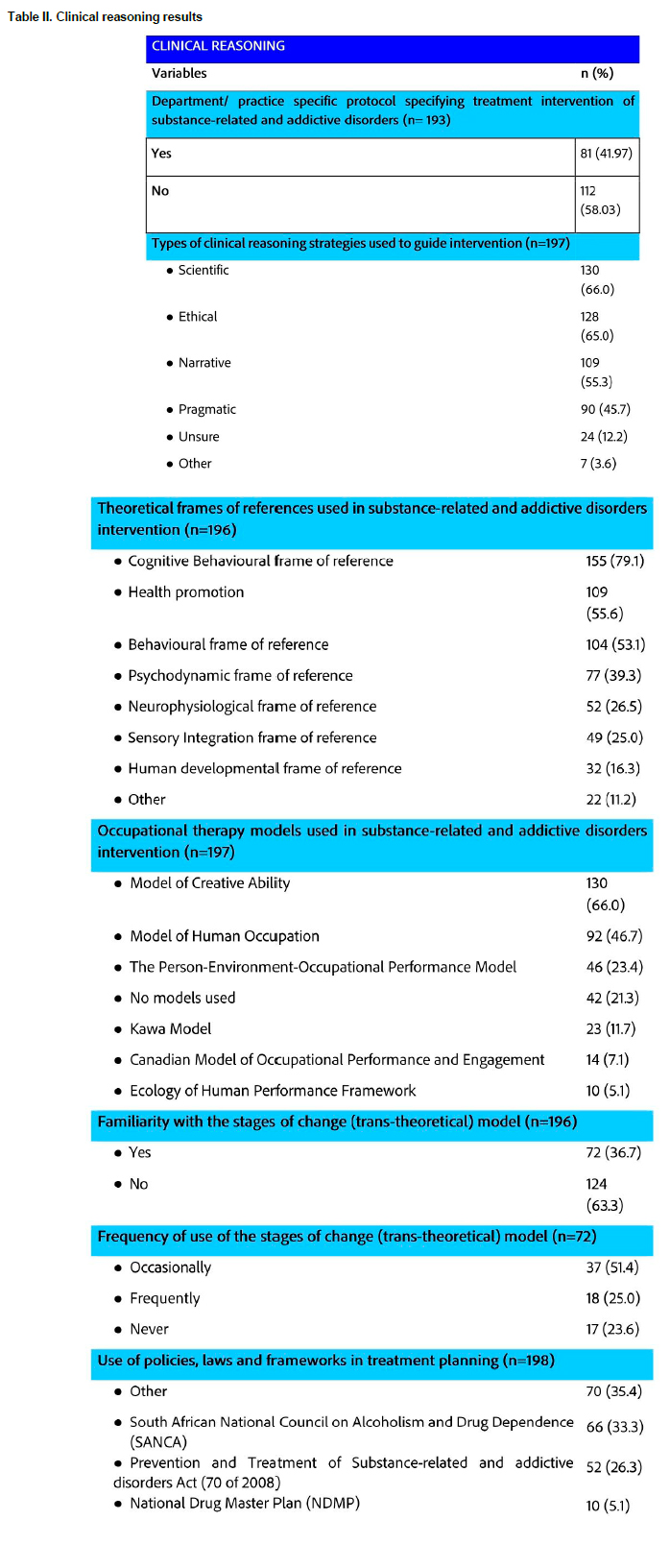
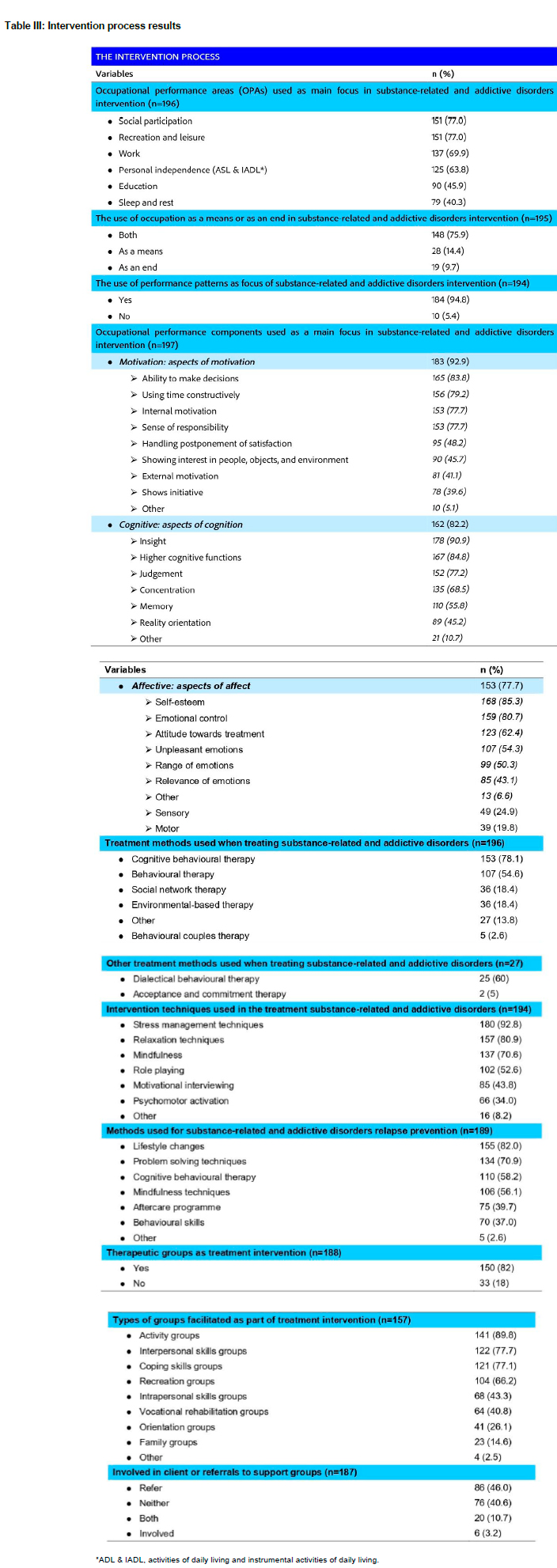
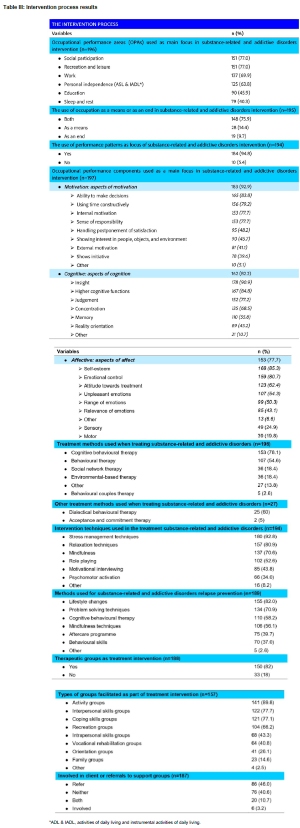
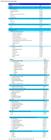
In terms of content validity, the research team benefited from sending a draft survey to a pilot study population who were qualified occupational therapists with knowledge of occupational therapy theory, processes, and practice, but who were not directly involved in substance-related and addictive disorders treatment. Paediatric occupational therapists were selected for this purpose; however, any other group of occupational therapists could have been selected as long as they did not practice in substance-related and addictive disorders. This was done to separate trial/draft survey results from formal survey results (after pilot study). The researchers did not want any of the already small group of participants to repeat the survey as their responses might have been different when presented with the survey a second time or they would not have completed the formal survey at all, thinking that they have already done so previously. Results of the questionnaire are summarised in Tables II (below) and III (page 5 ). Substance-related and addictive disorders were treated as a primary focus by 26 (11.9%) of the participants, as a comorbidity by 105 (47.9%), and as both by 88 (40.2%) of the participants.
Most of the participants were situated in the Gauteng (n=96; 43.8%) and Western Cape (n=48; 221.9%) provinces where more than half (n=123; 56.2%) of the therapists practised in the private sector. One hundred and eighteen (118 - 53.9%) were younger than 30 years of age and 110 (50.2%) had less than 6 years' experience in practice. Participants mostly worked in acute facilities (n=96; 43.8%), where most of the clients were treated in an in-patient context (n=74/96; 77.1%) for a period of 2-4 weeks (n=43/96; 44.8%). The minority of participants (n=35; 16.0%) provided treatment in a community-based setting. Close to 60% (n=125; 57.1%) of departments or practices did not have a protocol specifying treatment interventions. However, 112 (51.1%) of all the participants had attained further training in treating substance-related and addictive disorders.
DISCUSSION
Clinical reasoning used to select Intervention programmes when treating substance-related and addictive disorders
Clinical reasoning strategies
"Clinical reasoning is an essential part of the planning and performing strategies of occupational therapy used to control and monitor effective therapy"27:608. It was found that the participants in the study use a variety of clinical reasoning strategies. According to findings shown in Table II (page 4), 58% (n=193) of participants did not have a set area specific treatment protocol for substance-related and addictive disorders in their practices and made use of various intervention methods in their practice. Additionally, 12.2% (n=24/197) of the participants reported they were unsure of what clinical reasoning strategy they used. Results further showed that participants followed a variety of national policies34-36 to guide their reasoning.
Theoretical frames of reference
Internationally, the Cognitive Behavioural frame of reference is frequently and effectively used to clinically reason the treatment of substance use disorders371338
Models
According to international literature, the Model of Human Occupation (MOHO) is used as a guide to design intervention plans specifically when addressing mental health problems such as substance-related and addictive disorders394018Table II (page 4).
Implementation of intervention programmes
Occupations
As shown in Table III (page 6), it was found that most of the participants in the study (75.9%) used occupation both as a means and as an end when addressing substance-related and addictive disorders problems. This finding indicates that South African occupational therapists are versatile in their approach to treatment. The areas of occupation that the participants mostly addressed included social participation (77.0%), leisure and recreation (77.0%) and work (69.9%), which was similar to what occupational therapists addressed internationally4120
Treatment methods derived from theoretical frames of references
It was found that the majority of the occupational therapists employed specific methods within CBT (78%) and behavioural therapy (55%) in their intervention programmes. This is confirmed in the literature as these methods are beneficial in substance-related and addictive disorders recovery24
Relapse prevention
The data collected in this study showed that the key focus points during relapse prevention were lifestyle changes (82%) and problem-solving techniques (70.9%). Therefore, the relapse prevention methods used by participants corresponded with evidence-based methods reported in the literature241542
Therapeutic groups
As shown in Table III (page 6), a large percentage of occupational therapists used different types of group activities in the treatment of substance-related and addictive disorders, which was a positive observation. It was found that clients involved in group interventions experienced a lower relapse rate compared to those who received only pharmacological and individual treatment interventions43
Techniques
In this study, the majority of participants indicated that they used evidence-based techniques such as stress management (92.8%); relaxation (80.9%); and mindfulness (70.6%). Other techniques with proven efficacy, such as role playing, motivational interviewing and psychomotor activation, were commonly used by participants. The use of these techniques by occupational therapists in this study supports evidence-based treatment, improving the chances of outcomes being reached. However, these coping strategies and techniques are not sufficient in isolation, and intervention should still include finding purposeful, meaningful activities to restore life roles24
CONCLUSION
The data collected in this study identified a variety of evidence-based methods occupational therapists in South Africa use to select, motivate and implement substance-related and addictive disorders interventions. The participants in the study mainly used occupational therapy models such as the MOHO and VdTMoCA, as well as the cognitive behavioural theoretical frame of reference to select interventions and inform clinical reasoning. Additionally, it was found that the intervention methods commonly used by the participants included CBT, DBT and behavioural therapy. Techniques used by numerous participants to reach treatment outcomes included stress management, relaxation, and mindfulness techniques, as well as group therapy.
The participants used occupation as a means to address performance deficits, and as an end through improving engagement in constructive occupations. They also understood addiction as an occupation and its effects on occupational engagement. Thus, it was clear that the participants provided occupation-based interventions, which are essential in the recovery process of substance-related and addictive disorders. While findings suggest that South African occupational therapists employed some evidence-based interventions, insufficient focus was placed on relapse prevention methods such as aftercare and support groups. The methods currently used for relapse prevention are based on international literature and do not address the complexities found in South African communities.
The research findings give the researchers insight into which interventions South African occupational therapists apply when treating substance-related and addictive disorders. The unique contribution occupational therapists make in these interventions has been demonstrated in individuals' recovery and fostering healthy occupational engagement patterns. In conclusion, since the type of interventions South African occupational therapists use have been identified, it is up to individuals in this profession to use this knowledge to inform evidence-based treatment planning and improve treatment outcomes.
RECOMMENDATIONSThe researchers recommend the following based on the results of this study:
• It is recommended that facilities should develop and implement area specific treatment protocols for substance-related and addictive disorders intervention that are applicable to their practice.
• The researchers recommend that aftercare programmes for relapse prevention should be investigated. Further recommendations in this regard include that relapse prevention methods specific to the African context should be investigated and implemented to ensure context-specific intervention.
• It is recommended that the results of the study be used to inform undergraduate curricula to ensure the relevance of information being provided in a specific context.
• It is recommended that a follow-up study be conducted to investigate the effectiveness of determined methods used by occupational therapists in South Africa.
• Many of the participants commented that clients returned to environments and situations that counteract the interventions provided. Therefore, it is recommended that occupational therapists provide services in community-based settings - either directly (e.g., facilitating aftercare programmes) or indirectly (e.g., researching community-based interventions).
Limitations
• The researchers did not make responding to all the questions compulsory, causing a discrepancy in the number of participants who answered each question, as this allowed them to navigate to the CPD activity without having to respond to the questionnaire. As seen in Table III (page 6) and Table II (page 4), where participants omitted numerous questions continually throughout the questionnaire and thus not giving a full picture of their clinical practice.
• As no direct clinical observations were made and the questionnaire was completed online, one could not determine whether the results reflected the reality of what happened in practice.
• The sample size of this study could also limit the genera Usability of the results in the South African context.
• Additionally, due to the innate limitations of quantitative studies, this study could not provide an in-depth understanding of the treatment interventions that occupational therapists provide from a subjective viewpoint (e.g., no interviews were done) and thus could not get in-depth information on how occupational therapists select, motivate, and implement their intervention for clients with substance related and addictive disorders
The lack of published research available regarding occupational therapy treatment in substance-related and addictive disorders might have limited the comprehensiveness of the questionnaire.
Conflicts of Interest:
The authors have no conflicts of interests to declare.
Author contributions
All authors of this study involved in all the stages of this research from the conceptualisation of the study, protocol development, data collection, data analysis, writing of the article and submission for publication.
REFERENCES
Acknowledgements
The authors acknowledge all the occupational therapists who participated in the study and Dr Daleen Struwig, medical writer/editor, Faculty of Health Sciences, University of the Free State, for technical and editorial preparation of the manuscript.
LITERATURE REVIEW
-
1. United Nations Office on Drugs and Crime (UNODC). Annual Report 2018. Available from: https://www.unodc.org/documents/AnnualReport/Annual-Report_2018.pdf (accessed 3 October 2022).
» https://www.unodc.org/documents/AnnualReport/Annual-Report_2018.pdf -
2. Jager J, Keyes K M. Is substance use changing because of the COVID-19 pandemic? Conceptual and methodological considerations to delineating the impact of the COVID-19 pandemic on substance use and disorder. Addiction. 2021,-116(6):1301-1303. http://dx.doi.org/10.1111/add.15414
» http://dx.doi.org/10.1111/add.15414 -
3. Wan W, Long H. 'Cries for help': Drug overdoses are soaring during the coronavirus pandemic. The Washington Post, 1 July 2020. Available from: https://www.washingtonpost.com/health/2020/07/01/coronavirus-drug-overdose/ (accessed 3 October 2022).
» https://www.washingtonpost.com/health/2020/07/01/coronavirus-drug-overdose/ -
4. Carelse S, Green S. Social work services by non-profit organisations for adults with substance use disorders. Southern African Journal of Social Work and Social Development. 2019;31(3):15. https://doi.org/10.25159/2415-5829/4814
» https://doi.org/10.25159/2415-5829/4814 -
5. Mbunge E. Effects of COVID-19 in South African health system and society: an explanatory study Diabetes & Metabolic Syndrome. 2020;14(6):1809-1814. http://dx.doi.Org/10.1016/i.dsx.2020.09.016
» http://dx.doi.Org/10.1016/i.dsx.2020.09.016 -
6. Herman AA, Stein DJ, Seedat S, Heeringa SG, Moomal H, Williams DR. The South African Stress and Health (SASH) study: 12-month and lifetime prevalence of common mental disorders. South African Medical Journal. 2009;99(5 Pt 2):339-344. Available from: http://www.samj.org.za/index.php/samj/article/view/3374 (accessed 3 October 2022).
» http://www.samj.org.za/index.php/samj/article/view/3374 -
7. Pasche S, Kleintjes S, Wilson D, Stein DJ, Myers B. Improving addiction care in South Africa: development and challenges to implementing training in addictions care at the University of Cape Town. International Journal of Mental Health and Addiction. 2015;13:322-332 https://doi.org/10.1007/s11469-014-9537-7
» https://doi.org/10.1007/s11469-014-9537-7 -
8. Pasche S, Myers B. Substance misuse trends in South Africa. Human Psychopharmacology 2012;27(3):338-341. http://dx.doi.org/10.1002/hup.2228
» http://dx.doi.org/10.1002/hup.2228 - 9. Maluleke R. Statistical release: P0301.4. Census 2022. Statistics South Africa
- 10. Sadock, BJ, Sadock VA, Ruiz P. Kaplan & Sadocks Synopsis of Psychiatry: Behavioural Sciences/Clinical Psychiatry 11th ed. Philadelphia, PA: Wolters Kluwer; 2015.
- 11. American Psychiatric Association. Diagnostic and Statistical Manual of Mental Disorders. 5th ed. Washington, DC: American Psychiatric Association; 2013.
-
12. Rawat H, Petzer SL, Gurayah T The effects of substance-related and addictive disorders on the roles and occupations of women with substance use disorders. South African Journal of Occupational Therapy. 2021;51(1):54-62 http://dx.doi.org/10.17159/2310-3833/2021/vol51n1a8
» http://dx.doi.org/10.17159/2310-3833/2021/vol51n1a8 -
13. Mpanza DM, Govender P. Rural realities in service provision for substance-related and addictive disorders : a qualitative study in uMkhanyakude district, KwaZulu-Natal, South Africa. South African Family Practice. 2017;59(3):111-113. http://dx.doi.org/10.1080/20786190.2016.1272232
» http://dx.doi.org/10.1080/20786190.2016.1272232 -
14. Trangenstein P, Morojele N, Lombard C, Jernigan DH, Parry C Heavy drinking and contextual risk factors among adults in South Africa: findings from the International Alcohol Control study. Substance-related and addictive disorders Treatment, Prevention, and Policy 2018,-13(43):43. http://dx.doi.org/10.1186/s13011-018-0182-1
» http://dx.doi.org/10.1186/s13011-018-0182-1 -
15. Jeewa A, Kasiram M. Treatment for substance-related and addictive disorders in the 21st century: a South African perspective. South African Family Practice. 2008;50(6):43-44. http://dx.doi.org/10.1080/20786204.2008.10873782
» http://dx.doi.org/10.1080/20786204.2008.10873782 - 16. Zhang X, Shi J, Tao R. Substance and non-substance addiction. Advances in Experimental Medicine and Biology. 2017;1010:3-19.
-
17. Pritchard K, Kaneshiro K, Wasmuth S. Occupation-based intervention for addictive disorders: a systematic review. American Journal of Occupational Therapy. 2015;69(Suppl 1):–19. http://dx.doi.org/10.5014/ajot.2015.6-9S1-PO3103
» http://dx.doi.org/10.5014/ajot.2015.6-9S1-PO3103 - 18. Crouch R, Wegner L Substance use and abuse: intervention by a multidisciplinary approach which includes occupational therapy, In: Crouch R, Alers V, eds. Occupational Therapy in Psychiatry and Mental Health. 5th ed. West Sussex, UK: Wiley Blackwell; 2014,446-464.
- 19. Wilcock AA An Occupational Perspective of Health. 2nd ed. Thorofare, NJ: Slack Incorporated; 2006.
-
20. Wasmuth S, Crabtree J, Scott P. British Journal of Occupational Therapy. 2014,77(12):605-613. http://dx.doi.org/10.4276/030802214X14176260335264
» http://dx.doi.org/10.4276/030802214X14176260335264 -
21. Kiepek N, Magalhães L. Addictions and impulse-control disorders as occupation: a selected literature review and synthesis. Journal of Occupational Science. 2011;18(3):254-276. https://doi.org/10.1080/14427591.2011.581628
» https://doi.org/10.1080/14427591.2011.581628 -
22. Luck K, Beagan B. Occupational transition of smoking cessation in women: "You're restructuring your whole life". Journal of Occupational Science. 2014,-22(2):183-196. https://doi.org/10.1080/14427591.2014.887418
» https://doi.org/10.1080/14427591.2014.887418 -
23. American Occupational Therapy Association. Occupational Therapy Practice Framework: Domain and Process. 3rd ed. American Journal of Occupational Therapy. 2014;68(Suppl 1):S1-S48. http://dx.doi.org/10.5014/ajot.2014.682006
» http://dx.doi.org/10.5014/ajot.2014.682006 - 24. Lancaster J, Chacksfield, J. Substance misuse. In: Bryant W, Fieldhouse J, Bannigan K, eds. Occupational Therapy and Mental health. Creek's Occupational Therapy and Mental Health. 5th ed. Edinburgh: Elsevier; 2014, 439-456.
-
25. Giannelli E, Gold C, Bieleninik L, Ghetti C, Gelo OCG. Dialectical behaviour therapy and 12-step programmes for substance use disorder: a systematic review and meta-analysis. Counselling and Psychotherapy Research. 2019;19(3):274-285. https://doi.org/10.1002/capr.12228
» https://doi.org/10.1002/capr.12228 - 26. Yalom I. The Theory and Practice of Group Psychotherapy. 2nd ed. New York. NY: Basic Books; 1975.
- 27. Chapparo C, Ranka J. Clinical Reasoning in Occupational Therapy. In: Higgs J, Jensen GM, Loftus S, Christensen N, eds. Clinical Reasoning in Health Professions. 4th ed. Edinburgh: Elsevier; 2019,271-284.
- 28. Unsworth C. The evolving theory of clinical reasoning. In: Duncan EAS, ed. Foundations for Practice in Occupational Therapy. 5th ed. Edinburgh: Elsevier; 2013, 600-643.
-
29. Ramlagan S, Peltzer K, Matseke G. Epidemiology of drug abuse treatment in South Africa. South African Journal of Psychiatry. 2010;16(2):40-49. https://doiiOrc/10.4102/sajpspsy¡atry.c16i2.172
» https://doiiOrc/10.4102/sajpspsy¡atry.c16i2.172 - 30. Doll J. Program Development and Grant Writing in Occupational Therapy: Making the Connection. Sudbury, MA: Jones and Bartlett Learning; 2010.
- 31. Maree K, Pietersen J. Surveys and the use of questionnaires. In: Maree K, ed. First Steps in Research. 3rd ed. Pretoria: Van Schaik Publishers; 2020,195-212.
- 32. Pietersen J, Maree K. Standardisation of a questionnaire. In: Maree K, ed. First Steps in Research. 3rd ed. Pretoria: Van Schaik Publishers; 2020, 259-269.
- 33. Delport CSL Quantitative data collection methods. In: De Vos AS, Strydom H, Fouché CB, Delport CSL, eds. Research at Grass Roots. 3rd ed. Pretoria: Van Schaik Publishers; 2005,159-191.
-
34. Department of Social Development, Republic of South Africa. National Drug Master Plan (NDMP) 2013-2017. Available from: https://www.gov.za/documents/national-drug-master-plan-2013-2017 (accessed 11 October 2022).
» https://www.gov.za/documents/national-drug-master-plan-2013-2017 -
35. South African National Council on Alcoholism and Drug Dependence (SANCA). Treatment. Available from: https://www.sancanational.info/what-we-offer (accessed 15 December2022).
» https://www.sancanational.info/what-we-offer -
36. Republic of South Africa. No. 70 of 2008: Prevention of and Treatment for Substance-related and addictive disorders Act, 2008. Government Gazette. 2009;526(32150):1-37. Available from: https://www.gov.za/sites/default/files/gcis_document/201409/32150436. (accessed 11 October 2022).
» https://www.gov.za/sites/default/files/gcis_document/201409/32150436 -
37. McHugh R, Hearon B, Otto, M. Cognitive behavioral therapy for substance use disorders. Psychiatric Clinics of North America. 2010;33(3):511-525. http://dx.doi.org/10.1016/j.psc.2010.04.012
» http://dx.doi.org/10.1016/j.psc.2010.04.012 -
38. Isobell D, Kamaloodien K, Savahl S. A qualitative study of referring agents' perceptions of access barriers to inpatient substance abuse treatment centres in the Western Cape. Harm Reduction Journal. 2015;12(1):36. http://dx.doi.org/10.1186/s12954-015-0064-z
» http://dx.doi.org/10.1186/s12954-015-0064-z -
39. Cheung P, Fung X. A review on the case studies of using the model of human occupation. Social Health and Behavior. 2020;3(1):3-9. Available from: https://www.scinapse.io/papers/3010774297 (accessed 12 October 2022).
» https://www.scinapse.io/papers/3010774297 - 40. De Witt P. Creative ability: a model for individual and group occupational therapy for clients with psychosocial dysfunction. In: Crouch R, Alers V, eds. Occupational Therapy in Psychiatry and Mental Health. 5th ed. Hoboken, NJ: Wiley Blackwell; 2014, 3-32.
-
41. Wasmuth S, Pritchard K, Kaneshiro K. Occupation-based intervention for addictive disorders: a systematic review. Journal of Substance-related and addictive disorders Treatment. 2016; 62:1-9. http://dx.doi.org/10.1016/j.jsat.2015.11.011
» http://dx.doi.org/10.1016/j.jsat.2015.11.011 -
42. Mpanza DM, Govender P, Voce A. Aftercare services to people with substance use disorders: analysis of South African policy. Drugs: Education, Prevention and Policy. 2021,-28(2):138-155. http://dx.doi.org/10.1080/09687637.2020.1742661
» http://dx.doi.org/10.1080/09687637.2020.1742661 -
43. Ezhumalai S, Muralidhar D, Dhanasekarapandian R, Nikketha BS. Group interventions. Indian Journal of Psychiatry. 2018;60(8 Suppl 4): S51-4S521. https://dx.doi.org/10.4103/psychiatry.IndianJPsychiatry_42_18
» https://dx.doi.org/10.4103/psychiatry.IndianJPsychiatry_42_18 -
44. Emerson RW. Convenience sampling, random sampling and snowball sampling: How does sampling affect the validity of research? J Vis Impair Blind. 2015;109(2):164-8. http://dx.doi.org/10.1177/0145482x1510900215
» http://dx.doi.org/10.1177/0145482x1510900215 -
45. Bossuyt P, Louis E, Mary JY, Vermeire S, Bouhnik Y. Defining endoscopic remission in ileocolonic Crohn's disease: Let's start from scratch. Vol. 12, Journal of Crohn's and Colitis. 2018.1245-1248 p. http://dx.doi.org/10.1093/ecco-jcc/jjy097
» http://dx.doi.org/10.1093/ecco-jcc/jjy097
1st Review: 6 August 2023
Revised: 6 February 2024
2nd Review: 21 February 2025
Revised: 16 March 2025
Accepted: 24 April 2025
EDITOR
Blanche Pretorious
https://orcid.org/0000-0002-3543-0743
DATA AVAILABILITY
Upon reasonable request from corresponding author
FUNDING
Funding for this undergraduate research was received from the Department of Occupational Therapy at University of The Free State.