Identifying the gap in assessing activities of daily living in resource-constrained rural settings: An integrative review of existing frameworks and instruments
Abstract
INTRODUCTION: The non-availability of indoor piped water and electricity results in alternate forms of personal care and domestic tasks in resource-constrained rural settings. This article examines the applicability of existing measures for the contextual assessment of basic and instrumental Activities of Daily Living (bADLs and iADLs) in these settings. METHOD: An integrative review guided by the approach of Lübbe et al. (2020) was conducted. Structured database searches of CINAHL, Scopus and Sabinet identified published articles which were subjected to eligibility criteria. Microsoft Excel was used to synthesize data RESULTS: The search strategy yielded 591 articles that met the inclusion criteria, from which 187 ADL instruments were identified. Three instruments suited to resource-constrained rural settings were identified. CONCLUSION: Occupational therapists should consider that existing ADL frameworks and instruments appear silent on the impact of limited access to household amenities in resource-constrained settings. This constitutes epistemic injustice as many rural households globally do not have potable water or adequate household energy supply. Global South occupational therapy curricula must include contextually relevant ADL frameworks and development of contextually relevant instruments should be prioritised. IMPLICATIONS FOR PRACTICE The findings suggest that existing ADL instruments have limitations when utilised in the Global South, particularly in resource-constrained rural settings. As such, occupational therapists practicing in such settings need to interpret instrument scores with caution and apply contextual clinical reasoning in the best interests of service users. Furthermore, training institutions in the Global South must ensure that the limitations of existing ADL frameworks, models and instruments are made overt within curricula and that research efforts are directed towards the development of contextually relevant ADL instruments.
ADL assessment instruments; rural rehabilitation; household amenities; epistemic injustice; good health and wellbeing
INTRODUCTION
Most existing Activity of Daily Living (ADL) frameworks and assessment instruments were developed in the Global North and may be fundamentally flawed in that they have limited applicability to rural resource-constrained contexts. Given that more than two billion people worldwide do not have access to safe potable water and a similar number use fuelwood as their primary household energy source, it is clear that significant daily occupations have historically been overlooked by occupational therapists1-3.
The household amenities available to people living in resource constrained communities differ significantly from those typically available in urban setting42,5,6.
Water and energy sources are arguably the most important amenities when it comes to the performance of bADLs and iADLs in rural contexts789,10. Water is also essential for the performance of personal and household hygiene tasks. Similarly, an adequate supply of electricity also opens up the potential for a household to make use of labour-saving appliances, which have an impact on the way bADL and iADL tasks are done. The presence of an electrical geyser to heat indoor-piped water for personal hygiene and doing laundry would eliminate the necessity for fuelwood to heat water on a fire.
The disjuncture between the environmental resources in less resourced contexts and the traditional ADL ontology presents challenges to occupational therapy service provision5,11. Occupational therapists are experts in assessment of individuals' performance in bADLs and iADLs including their occupational forms, performance patterns, habits, routines, methods, environmental context, and challenges regarding execution12,13.
Activities of daily living are all tasks people carry out on a regular basis, as part of their day-to-day routines14131516
Frameworks such as the OTPF IV1315,17-19. This is contrary to the OTPF IV classification which defines iADLs as activities that support daily life both within the home and the community, including shopping, communication management, financial management, home establishment and management, meal preparation and clean-up, driving and community mobility, care of others, care of pets and animals, child rearing, safety and emergency maintenance, and religious and spiritual expression131613
Occupational therapists in South Africa provide an essential service to claimants seeking compensation in the medico-legal and insurance industries. Performance in bADLs and iADLs is assessed during Functional Capacity Evaluations as independence in this regard is viewed asa prerequisite of workability. An understanding of the household amenities available to clients becomes crucial if the medico-legal occupational therapist is to make appropriate and legally defensible recommendations so individuals with disabilities can be awarded adequate compensation to optimise their independence and quality of life.
The integrative literature review reported in this article formed part of a larger doctoral study which arose from the first author's perspective on the performance of bADLs and iADLs in rural resource-constrained contexts and the impact of their accurate assessment on medico-legal practice. It is acknowledged that South African occupational therapists working in the medico-legal field often make use of non-validated assessment procedures regarding performance of these occupations, such as an interview with the client or their caregiver, or observation of simulated tasks20
The aim of this integrative literature review is therefore to interrogate existing standardised bADL and iADL assessment measures used globally and in South Africa, and critique their application against the background of widespread limited access to water, sanitation and electricity in a rural resource-constrained context. The limitations of existing ADL frameworks and assessment instruments are considered and recommendations for contextually relevant curriculum development, further research and ADL assessment instrument development are made.
METHOD
The integrative literature review follows five steps as described by Lübbe et al.21
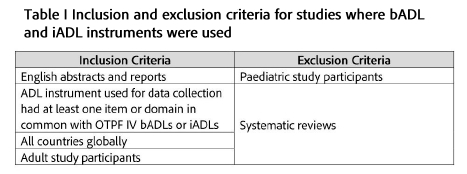
The sampling of the literature (Step 2) included searching, screening and selection of research articles in peer reviewed journals. The inclusion and exclusion criteria are presented in Table I (below):
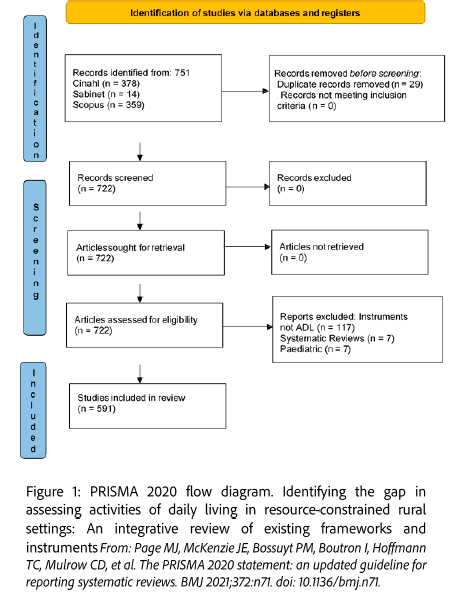
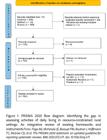
Inclusions were limited to English abstracts and reports where a standardised ADL instrument that included at least one bADL or iADL item or domain as defined in the OTPF IV was used for data collection. An initial search limited to studies conducted in Africa yielded very few articles. Similarly, a broader search limited to resource-constrained settings yielded a relatively low number of articles and showed that standardised bADL and iADL instruments developed in well-resourced settings were also being used for data collection in low resourced settings. The authors therefore broadened the literature search to include all geographical areas globally. Multidisciplinar/ articles were included as ADL is reported as a broader construct with extensive literature across numerous disciplines. The keywords 'ADL instruments' AND 'ADL scales' OR 'iADL instruments' AND 'iADL scales' were utilised and revealed numerous articles published until January 2024. The database searching process is presented below in a PRISMA flow diagram (Figure 1) and identified 751 publications, with 378 publications on CINAHL, 359 on SCOPUS and 14 on Sabinet Online. The abstracts and methodology sections were screened by the first author and 29 duplicates were removed. The remaining articles were examined for evidence that an ADL instrument was used for data collection. Excluded literature comprised 7 systematic reviews, 7 publications where research participants were children and 117 articles where an ADL or iADL instrument was not utilised for data collection in the study.
For the critical appraisal (Step 3) articles were included with methodologies where data was collected using one or more standardised ADL or iADL instrument or scale, or domains and items of an ADL or iADL instrument or scale13
The data extraction and synthesis (Step 4) was then completed for 591 articles. A Microsoft Excel data extraction sheet was used to extract information of authors, date, publication name, bADL and iADL instrument/s used, country in which the instrument was developed, location of study, methodology, reported validity and reliability studies for the instruments, and domains and items reported in the instruments (available in supplementary file). Where multiple ADL instruments were used for data collection in a study, data from all instruments were extracted.
The frequencies of all the instruments and scales utilised in the studies were calculated to identify instruments commonly used and presented in the supplementary file. Data synthesis was achieved with the analysis of three components of the bADL and iADL instruments. This included identifying the frequency with which the instruments were reported in the literature, the geopolitical location The ten most frequently used instruments in studies conducted worldwide and in the Global South, as well as those conducted of the country in which the study was completed and the relevance of the domains and items to rural, resource-constrained contexts. The standardised bADL and iADL instruments were screened by the first author for the presence of domains or items reflective of occupations typical of rural, resource-constrained contexts. A comprehensive activity analysis which formed part of the broader doctoral study underpinned the screening process7
In alignment with the research question for this study, the nine ADL instruments used in the six South African studies were extracted to establish if rural contexts were considered in local research. Finally, a textual analysis to identify bADL and IADL assessment instruments' items and domains that overlapped with the bADLs or iADLs as described in the OTPF IV13
The final step (Step 5) included the presentation and discussion of the data for the bADL or iADL instruments as described in Step 421
RESULTS
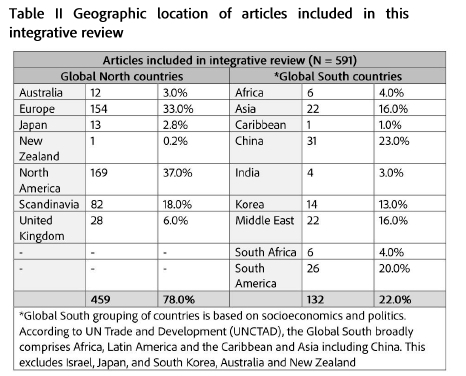
From the 591 studies included in this integrative review, a total of 187 standardised assessment instruments and scales were extracted and contained at least one domain or item that overlapped with the bADLs or iADLs as described in the OTPF IV13Table II (below.) shows that the studies were predominantly carried out in developed countries (78.0%), with 28.0% conducted in the Global South and 4.0% conducted in South Africa respectively.
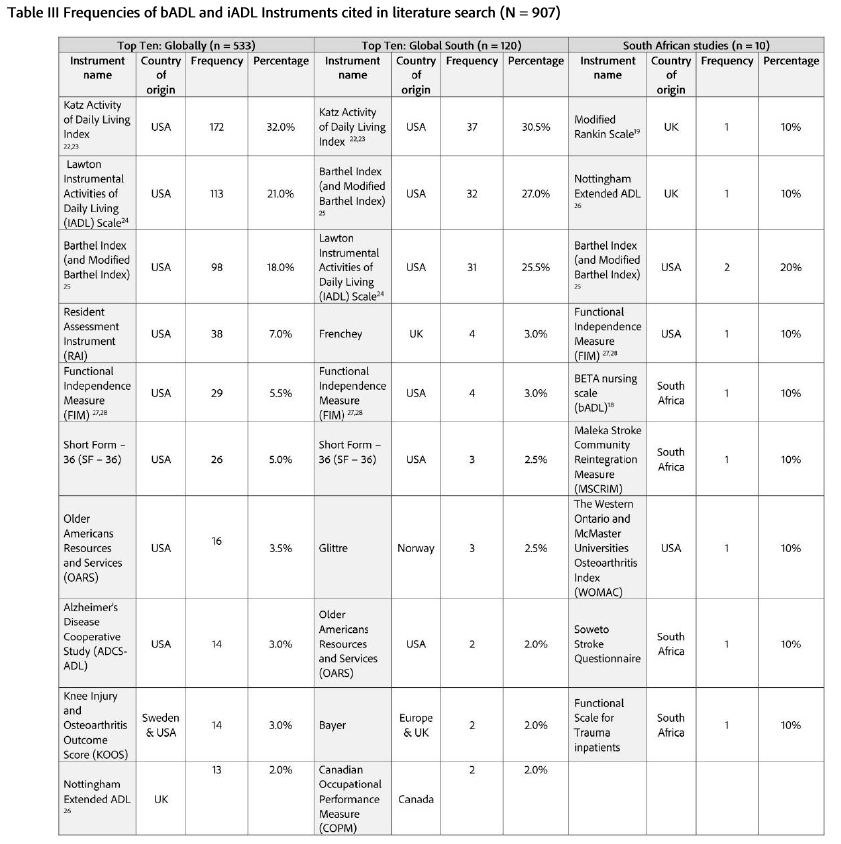
The ten most frequently used instruments in studies conducted worldwide and in the Global South, as well as those conducted in South Africa are presented in Table III (page 4).

Many of the identified studies made use of multiple bADL and iADL instruments and scales and included descriptive cross-sectional surveys with examination of functional or disability status, outcomes of clinical interventions, as well as validation of new and existing instruments. The Katz Activity of Daily Living Index was the most commonly used bADL instrument worldwide (32.0%) and in the Global South countries (30.5%) but was not found to have been used in the South African studies. Similarly, the Lawton Instrumental Activities of Daily Living Scale was the most frequently used iADL instrument, comprising 21.0% and 25.5% of the instruments used worldwide and in the Global South respectively. The Barthel Index was used in all three categories analysed, with frequencies of 18%, 27% and 20% respectively in the worldwide, Global South and South African studies. The Katz, the Lawton and the Barthel Index together comprise 72% of those most commonly utilised worldwide and 83% of those most commonly used in the Global South studies.
Of the 187 bADL and iADL assessment instruments and scales identified in the literature search, nine had been utilised in South African studies (Table III, above). All but five instruments identified were found to have been developed in countries from the Global North. It is of note that four of those developed in the Global South were developed and validated in South Africa18,29.
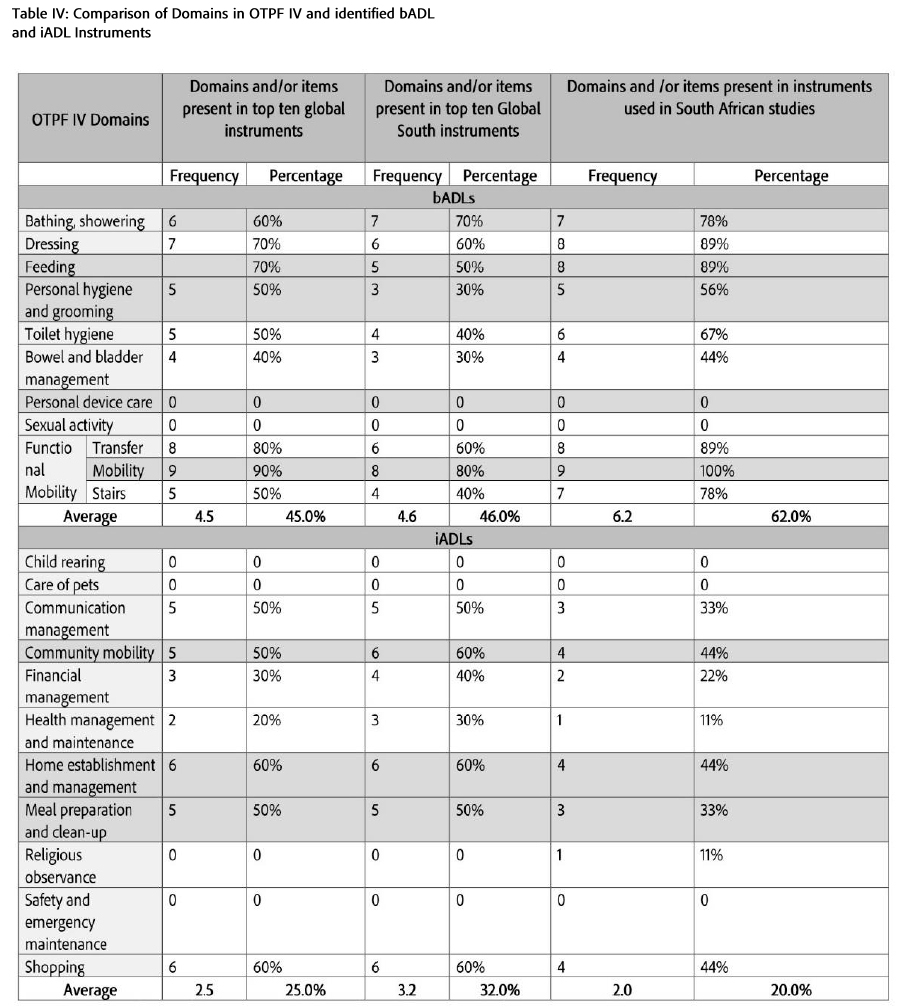
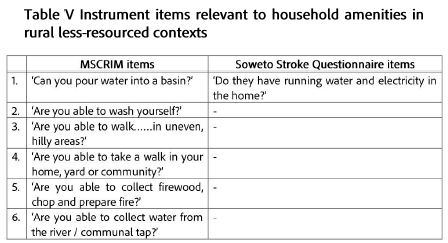
A comparison of the domains and items in the eight instruments utilised most commonly in the worldwide and Global South studies and the South African studies as defined in the OTPF IV, is presented in Table III (above). Most (90%, 80% and 100% for the worldwide, Global South and South African studies respectively) included mobility, while many (60%, 70% and 78% for the worldwide, Global South and South African studies respectively) included equivalents of bathing or showering. Items relating to transfers were present in 80%, 60% and 89% of instruments used in worldwide, Global South and South African studies. The inclusion of iADL domains and items was lower, with 60%, 60% and 44% of the instruments used in Overall more bADL domains than iADL domains where included in the instruments with an average of 45.0%, 46.0% and 62.0% bADL items or domains for the worldwide, Global South and South African studies respectively. The iADLs had items or domains as defined in the OTPF IV had an average representation in 25.0%, 32.0% and 20% for the worldwide, Global South and South African Utilising principles of activity analysis, items and domains particularly related to access to water and household energy were identified, as shown in the highlighted sections of Table IV (page above)7Table V (page 6).
DISCUSSION
Suitability of instruments for resource-constrained rural contexts
The instruments and scales identified in this study focus on either bADLs or iADLs, with some focusing on both. These findings are similarto the finding of a systematic review of bADL and iADLscales used with neurological conditions30
Both the Soweto Stroke Questionnaire and the Maleka Stroke Community Reintegration Measure spoke to amenities typical of rural, less-resourced contexts. Both instruments have items that acknowledge piped water may not be available in homes, while the latter refers to the use of fuelwood for household energy. Additionally, the wording is contextually appropriate as it does not imply that a bathtub or shower is used and describes terrain that may be challenging to traverse. While both of these instruments have good contextual utility, there are arguably shortcomings. Both instruments were developed with a population of stroke survivors in mind, and there are important item omissions when compared to the OTPF IV, including toileting, bowel and bladder management and community mobility. However, several other studies identified outside of this current integrative review do make mention of the limited access to piped water, electricity and sanitation in the literature, study setting or discussion sections31-35.
While these three most commonly used instruments are generically applicable and their usage is free, many of the instruments identified in this current study were developed for application to a particular medical condition. Numerous instruments were developed for survivors of stroke and individuals living with various neurological conditions such as Parkinsons, Multiple Sclerosis and Myasthenia Gravis including the Myasthenia Gravis-Specific Activities of Daily Living Scale (MG-ADL-T), the Schwab and England Activities of Daily Living Scale (SEADL) and the Activities of Daily Living Self-Care Scale for Multiple Sclerosis Persons (ADL-MS)363839-41. The Knee Injury and Osteoarthritis Outcome Score (KOOS), Foot and Ankle Ability Measure (FAAM) and the Disabilities of the Arm, Shoulder and Hand Questionnaire (DASH) instruments were developed for use with individuals living with orthopaedic conditions42-44. Eight South African studies used the Barthel Index (Bl), the Modified Rankin and the Stroke Impairment Scale (SIS) to investigate the clinical outcomes for stroke survivors. Only one study made mention of the challenges relating to water collection4536
Usefulness of modified versions for rural South African settings
Modified versions of bADL and iADL assessment instruments have been produced for use in different countries. The Barthel Index (Bl) is the third most widely used and is regarded as the bADL assessment instrument of choice in many settings worldwide, with numerous modified versions being utilised46-48. Where modified versions of the Bl assessment instrument have been created for different countries, validity studies have utilised methodologies focused only on language translation. In identifying linguistic differences regarding bADL task item descriptors, some authors have also commented on the need for conceptual translation as several differences in the way a bADL task was conducted were uncovered. For example, some studies found that the term bathing was inappropriate in cultural settings where personal hygiene was achieved by using a damp cloth to wash the body, rather than making use of a tub or a shower. However, authors only recommended modifications to certain item descriptors and fell short of eliminating irrelevant items or adding new ones 5,46-48. In most validity studies associated with the development of the modified versions of the Bl minimal attention is paid to differing cultural practices as a limiting factor.
One South African study explored the validity of the Modified Barthel Index (MBI) considering differences in the way South Africans living in resource constrained contexts carry out bADLs5. Two factors leading to bADLs being done differently in these contexts were identified, namely resource and accessibility barriers. Limited access to running water and electricity within households was linked to socio-economic status and led to increased demands in terms of carrying out bADLs. Examples include emptying out a basin of dirty water after completing personal hygiene, as well as walking over rough terrain to reach outdoor toilet facilities. Given the limitations in access to water, sanitation and electricity described earlier, it is not surprising that the functional mobility domain was ranked highest for inclusion in the South African version of the MBI. The study recommends the addition of an item to reflect obtaining supplies necessary to carry out bADLs and while it was concluded that the MBI could be appropriate for the South African stroke population, the importance of the MBI not assuming resources in terms of household amenities was emphasised5.
Thus, despite having been modified, many instrument domains and items remain inappropriate for rural settings in South Africa, and some important items and domains appear to have been completely omitted.
Increased physical burden of daily activities in rural contexts
A Chinese study on the modification of the Bl noted that some mobility items were not translatable due to constraints imposed by specific physical environments. The implications of the degree of physical demand of conducting the bADL task in these different environments were noted as similar to those described above for the South African context. Another instrument identified in the current integrative review in a South African study, namely the MSCRIM, also included an item that referenced the increased physical burden of walking in a challenging terrain, Other South African studies identified outside of the current integrative review also evaluated the increased effort required by those with functional disability in rural settings32,34,35,49,50 using the WHODAS-2.0 as one of the data collection instruments. The study by Schatz et al3734
In a further study also carried out in Agincourt, 42% of participants reported experiencing musculoskeletal pain scores which correlated with bad or very bad functional ability according to the WHODAS-2.05051
Inadequacy of standard walking tests for rural contexts
Water infrastructure in rural South Africa is built in accordance with the Reconstruction and Development Programme (RDP) Water Policy for domestic water supply, which states that potable water needs to be within 200m from each dwelling52
Thus, walking and mobility were the bADLs with the highest level of reported impairment in a number of additional South African studies33,45,49 Given that walking mobility is a prerequisite for completion of water and fuelwood tasks, presumably a walking impairment could translate into difficulties with collecting from sources outside of the homestead. Although some studies included variables known as Household assets and Socioeconomic circumstances, which included availability of piped water, electricity and sanitation, none of the studies carried out directly examined an association between household amenities and walking or mobility impairment32,35. Of the ADL instruments reviewed only the Katz Index of Independence in Activities of Daily Living has a question about 'walking across a room'. The objective measure was a timed walk, with walking speed being measured over only 2.5m distances. However, none of the ADL instruments used in South African settings in the publications in this integrative review considered walking distances, terrains and loads realistic for rural settings. Only other assessments used in South African studies such as the Stroke Impact Scale mention 'walking one block'175331,33.
The analysis of the literature regarding bADLs and iADLs in resource-constrained settings in South Africa and globally is important as it highlights a gap in assessment instruments that do not take the bADL and iADL tasks typical of the rural context into account5,6,11. The validity and reliability of existing instruments are therefore called into question when applied in rural populations further compounding some occupational therapists' limited understanding of environmental factors such as the rough terrain and limited infrastructure that impact their clients'ability to perform daily activities7,11. Furthermore, many bADL and iADL instruments identified in this current integrative review are condition-specific, signifying an emphasis on a medical model view of function across health and rehabilitation professions. South African occupational therapists currently have no alternative but to base their professional opinions regarding recommendations for rural dwellers regarding reasonable accommodations, assistive devices and caregiving requirements on non-standardised assessment techniques or bADL and iADL assessment instruments that were developed in Western, well-resourced countries and are not occupation-based13,15,16,54,55. At best, this shortcoming illustrates the need for the development of a contextual bADL and iADL assessment instrument that takes contextual factors into account to ensure the provision of appropriate interventions for rural dwellers. More realistically, it highlights the need for occupational science and therapy disciplines to apply critical reflexivity and unpack taken-for-granted assumptions regarding household amenities on a global scale56-58. The hegemony implicit in the assumption that ADL instruments formulated for well-resourced Western contexts have global utility is arguably a form of epistemic injustice.
Limitations of the study
Using only English language articles may have biased the results as articles from the Global South may have been excluded from the literature search. The study would have been strengthened by article identification being carried out by more than one of the authors in Step 2 of the methodology. Additional articles identified outside of the integrative review may have been found had search terms included environmental descriptors such as piped water, sanitation and household amenities.
CONCLUSION
Despite limited access to water, sanitation and energy being global issues affecting billions of people, the daily task of accessing these essential resources does not appear to be included in commonly used bADL and iADL assessment tools. It is therefore critically important to enable occupational therapists to accurately evaluate performance in bADLs and iADLs in a range of contexts, including those in rural resource-constrained areas with limited household amenities.
The historical exclusion of the impact of limited access to household amenities on bADL and iADL performance from assessment instruments and occupational therapy frameworks is arguably an example of epistemic injustice and a manifestation of the pervasive bias towards Western and well-resourced contexts. The findings of the current study can inform and support the drive towards more inclusive South African undergraduate occupational therapy curricula. The review of ADL frameworks and assessment instruments that are taught will ensure that South African graduates are equipped to provide contextually relevant intervention.
Further research into the factors affecting the type and form of bADLs and iADLs in resource-constrained rural contexts to inform the revision of ADL instruments is recommended. The development of a valid, cost-effective, contextually relevant occupation-based bADL and iADL assessment resource-constrained settings instrument appears justified. The identification of the gaps in occupational therapy frameworks and bADL and iADL assessment tools is important for the practice of occupational therapy in South Africa and internationally.
Contributions
Jennie McAdam - post-graduate student who conceptualised and completed the research and contributed to the article. All four criteria for authorship met. Daleen Casteleijn and Denise Franzsen -supervisors and conceptualisation of the research project and contributed to the article. All four criteria for authorship were met.
Acknowledgment
Research assistance by Ms Ntomfuthi Tshongaye is acknowledged.
REFERENCES
-
1. Hollands AF, Daly H. Modelling the integrated achievement of clean cooking access and climate mitigation goals: An energy systems optimization approach. Renewable and Sustainable Energy Reviews. 2023;173:1-14. https://doi.org/10.1016/j.rser.2022.113054
» https://doi.org/10.1016/j.rser.2022.113054 -
2. McAdam JC, Franzsen D, Casteleijn D. Identification of occupations in a South African rural less-resourced community. Journal of Occupational Science. 2019, 26(3). https://doi.org/10.1080/14427591.2019.1614476
» https://doi.org/10.1080/14427591.2019.1614476 - 3. United Nations Children's Fund (UNICEF), World Health Organisation (WHO). Progress on household drinking water, sanitation and hygiene 2000-2022: special focus on gender. New York; 2023.
-
4. Statistics South Africa. Provincial profile Limpopo: Community survey 2016. Pretoria, South Africa; 2018. http://cs2016.statssa.gov.za/wp-content/uploads/2018/07/Limpopo.pdf
» http://cs2016.statssa.gov.za/wp-content/uploads/2018/07/Limpopo.pdf -
5. Breytenbach F. Content Validity of the Modified Barthel Index for stroke patients in South Africa [Masters]. University of the Witwatersrand;2016. http://hdl.handle.net/10539/21178
» http://hdl.handle.net/10539/21178 -
6. Naidoo D, Van Wyk J, Joubert RWE. Exploring the occupational therapist's role in primary health care: Listening to voices of stakeholders. African journal of primary health care & family medicine. 2016;8(1):e1-e9. https://doi.org/10.4102/phcfm.v8i1.1139
» https://doi.org/10.4102/phcfm.v8i1.1139 -
7. McAdam JC. Development and validation of the Rural Activities of Daily Living Manual Handling Sort [Doctor of Philosophy]. University of the Witwatersrand; 2019. https://hdl.handle.net/10539/30434
» https://hdl.handle.net/10539/30434 -
8. McAdam JC, Franzsen D, Casteleijn D. Identification of occupations in a South African rural less-resourced community. Journal of Occupational Science. 2019, 26(3):379-393. https://doi.org/10.1080/14427591.2019.1614476
» https://doi.org/10.1080/14427591.2019.1614476 -
9. McAdam JC, Rose CM. Opinion piece: People need nature to thrive - a case for inclusion of environmental sustainability in occupational therapy in rural South Africa. World Federation of Occupational Therapists Bulletin. 2020, 1(1):1-7. https://doi.org/10.1080/14473828.2020.1734307
» https://doi.org/10.1080/14473828.2020.1734307 -
10. United Nations. United Nations Global Issues - Water. 2018 [accessed 2018 Aug 20]. www.un.org/en/sections/issues-depth/water/
» www.un.org/en/sections/issues-depth/water/ -
11. Naidoo D, Wyk J Van, Joubert R, Africa S, Africa S. Community stakeholders' perspectives on the role of occupational therapy in primary healthcare : Implications for practice. African Journal of Disability. 2017;6:1-12. http://dx.doi.org/10.4102/ajod.v6i0.255
» http://dx.doi.org/10.4102/ajod.v6i0.255 -
12. World Federation of Occupational Therapy. Position Statement: Activities of Daily Living. 2012. https://wfot.org/resources/activities-of-daily-living
» https://wfot.org/resources/activities-of-daily-living -
13. American Occupational Therapy Association. Occupational therapy practice framework: Domain and process (4th ed.). American Journal of Occupational Therapy. 2020;74(Suppl.2). https://doi.org/10.5014/ajot.2020.74S2001
» https://doi.org/10.5014/ajot.2020.74S2001 -
14. Fricke J. Activities of Daily Living. International Encyclopedia of Rehabilitation. 2010 [accessed 2006 May 20]. http://cirrie.buffalo.edu/encyclopedia/en/article/37/
» http://cirrie.buffalo.edu/encyclopedia/en/article/37 -
15. Functioning and Disability Reference Group. The ICF: An Overview. World Health Organization. 2010:1-10. https://www.who.int/standards/classifications/international-classification-of-functioning-disability-and-health
» https://www.who.int/standards/classifications/international-classification-of-functioning-disability-and-health - 16. Turpin M, Iwama MK. Using Occupational Therapy Models in Practice A Field Guide. Edinburgh: Churchill Livingstone Elsevier; 2011.
-
17. Duncan PW, Wallace D, Min Lai S, Johnson D, Embretson S, Laster U. The Stroke Impact Scale Version 2.0 Evaluation of Reliability, Validity, and Sensitivity to Change. Stroke. 1999;30(10):2131-2140. https://doi.org/10.1161/01.STR.30.10.2131
» https://doi.org/10.1161/01.STR.30.10.2131 -
18. Loubser HJ, Bruce JC, Casteleijn D. The BETA nursing measure: Its development and testing for nursing utility. Health SA Gesondheid. 2013, 18(9). http://www.hsag.co.za. https://doi.org/10.4102/hsag.v18i1.697
» http://www.hsag.co.za -
19. Wilson JTL, Hareendran A, Hendry A, Potter J, Bone I, Muir KW. Reliability of the modified Rankin Scale across multiple raters: Benefits of a structured interview. Stroke. 2005;36(4). https://doi.org/10.1161/01.STR.0000157596.13234.95
» https://doi.org/10.1161/01.STR.0000157596.13234.95 - 20. Van Biljon H. Opinion piece: Occupational therapists in medico-legal work - South African experiences and opinions. South African Journal of Occupational Therapy. 2013;43(2):27-33.
-
21. Lübbe W, ten Ham-Baloyi W, Smit K. The integrative literature review as a research method: A demonstration review of research on neurodevelopmental supportive care in preterm infants. Journal of Neonatal Nursing. 2020;26(6):308-315. https://doi.Org/10.1016/j.jnn.2020.04.006
» https://doi.Org/10.1016/j.jnn.2020.04.006 -
22. Katz S, Downs TD, Cash HR, Grotz RC. Progress in Development of the Index of ADL The Gerontologist. 1970;10(1):20-30. https://doi.org/10.1093/geront/10.1_Part_1.20
» https://doi.org/10.1093/geront/10.1_Part_1.20 -
23. Katz S, Ford AB, Moskowitz RW, Jackson BA, Jaffe MW. Studies of illness in the aged. The index of ADL: A standardized measure of biological and psychosocial function. Journal of the American Medical Association. 1963;185(12):914-919. https://doi.org/10.1001/jama.1963.03060120024016
» https://doi.org/10.1001/jama.1963.03060120024016 -
24. Lawton MP, Brody EM. Assessment of older people: Self-maintaining and instrumental activities of daily living. The Gerontologist. 1969;9(3):179-186. https://doi.org/10.1093/geront/9.3_Part_1.179
» https://doi.org/10.1093/geront/9.3_Part_1.179 -
25. Collin C, Wade DT, Davies S, Hörne V. The Barthel ADL Index: A reliability study. Journal of International Disability Studies. 1988:10(2):61-63. https://doi.org/10.3109/09638288809164103
» https://doi.org/10.3109/09638288809164103 -
26. Nouri FM, Lincoln NB. An extended activities of daily living scale for stroke patients. Clinical Rehabilitation. 1987;1(4):301-305. https://doi.org/10.1177/026921558700100409
» https://doi.org/10.1177/026921558700100409 - 27. Hamilton BB, Granger C V, Sherwin FS. Functional Independence Measure Scale: a uniform national data system for medical rehabilitation. In: Rehabilitation Outcomes: analysis and measurement. First. Baltimore: Paul H. Brookes; 1987. p. 137-147.
-
28. Dodds TA, Martin DP, Stolov WC, Deyo RA. A validation of the functional independence measure and its performance among rehabilitation patients. Archives of Physical Medicine and Rehabilitation. 1993;74(5):531-536. https://doi.org/10.1016/0003-9993(93)90119-U
» https://doi.org/10.1016/0003-9993(93)90119-U -
29. Loubser HJ, Bruce JC, Casteleijn D. The GAMMA" nursing measure: Its development and testing for nursing utility. Health SA Gesondheid. 2014. https://doi.org/10.4102/hsag.v19i1.749
» https://doi.org/10.4102/hsag.v19i1.749 -
30. Pashmdarfard M, Azad A. Assessment tools to evaluate activities of daily living (ADL) and instrumental activities of daily living (IADL) in older adults: A systematic review. Medical Journal of the Islamic Republic of Iran. 2020, 34(1). https://doi.org/10.47176/mjiri.34.33
» https://doi.org/10.47176/mjiri.34.33 -
31. Harling G, Payne CF, Davies JI, Gomez-Olive FX, Kahn K, Manderson L, Mateen FJ, Tollman SM, Witham MD. Impairment in Activities of Daily Living Care Receipt, and Unmet Needs in a Middle-Aged and Older Rural South African Population: Findings From the HAALSI Study. Journal of Aging and Health. 2020, 0(0):1-27. https://doi.org/10.1177/0898264318821220
» https://doi.org/10.1177/0898264318821220 -
32. Nyirenda M, Chatterji S, Falkingham J, Mutevedzi P, Hosegood V, Evandrou M, Kowal P, Newell ML. An investigation of factors associated with the health and well-being of HIV-infected or HIV-affected older people in rural South Africa. BMC Public Health. 2012;12:259. https://doi.org/10.1186/1471-2458-12-259
» https://doi.org/10.1186/1471-2458-12-259 -
33. Payne CF, Xavier Gómez-Olivé F, Kahn K, Berkman L. Physical Function in an Aging Population in Rural South Africa: Findings From HAALSI and Cross-National Comparisons With HRS Sister Studies. Journal of Gerontology: Social Sciences. 2017,72(4):665-679. https://doi.org/10.1093/geronb/gbx030
» https://doi.org/10.1093/geronb/gbx030 -
34. Schatz E, Ralston M, Madhavan S, Collinson MA, Xavier Gómez-Olivé F. Living Arrangements, Disability and Gender of Older Adults Among Rural South Africa. Journal of Gerontology: Social Sciences. 2018,73(6):1112-1122. https://doi.org/10.1093/geronb/gbx081
» https://doi.org/10.1093/geronb/gbx081 -
35. Xavier Gómez-Olivé F, Thorogood M, Bocquier P, Mee P, Kahn K, Berkman L, Tollman S. Social conditions and disability related to the mortality of older people in rural South Africa. International Journal of Epidemiology. 2014,43(5):1531-1541. https://doi.org/10.1093/ije/dvu093
» https://doi.org/10.1093/ije/dvu093 -
36. Burns TM, Conaway MR, Cutter GR, Sanders DB. Construction of an efficient evaluative instrument for Myasthenia Gravis: The MG composite. Muscle and Nerve. 2008;38(6):1553-1562. https://doi.org/10.1002/mus.21185
» https://doi.org/10.1002/mus.21185 -
37. Su-Yun Lee; Sung Kwan Kim; Sang-Myung Cheon; Jung-Wook Seo; Min Ah Kim; Jae Woo Kim; Lee S-YKSKCS-MSJ-WKMAKJW. Activities of daily living questionnaire from patients' perspectives in Parkinson's disease: a cross-sectional study. BMC Neurology. 2016;16:1-7. https://bmcneurol.biomedcentral.com/articles/10.1186/s12883-016-0600-9
» https://bmcneurol.biomedcentral.com/articles/10.1186/s12883-016-0600-9 -
38. Wynia K; Middel B; van Dijk JP; de Ruiter H; De Keyser J; Reijneveld SA. The Multiple Sclerosis Impact Profile (MSIP). Development and testing psychometric properties of an ICF-based health measure. Disability & Rehabilitation. 2008;30(4):261-274. https://doi.org/10.1080/09638280701256868
» https://doi.org/10.1080/09638280701256868 -
39. Livingston G, Katona C, Roch B, Guilhaume C, Rive B. A dependency model for patients with Alzheimer's disease: Its validation and relationship to the costs of care - The LASER-AD Study. Current Medical Research and Opinion. 2004, 20(7):1007-1016. https://doi.org/10.1185/030079904125003980
» https://doi.org/10.1185/030079904125003980 -
40. Thivierge S, Jean L, Simard M. A randomized cross-over controlled study on cognitive rehabilitation of instrumental activities of daily living in Alzheimer disease. American Journal of Geriatric Psychiatry. 2014;22(11):1188-1199. https://doi.org/10.1016/j.jagp.2013.03.008
» https://doi.org/10.1016/j.jagp.2013.03.008 -
41. Hindmarch I, Lehfeld H, de Jongh P, Erzigkeit H. The Bayer Activities of Daily Living Scale (B-ADL). Journal of Dementia Geriatrics Cognitive Disorders. 1998;9(Suppl. 2):20-26. https://doi.org/10.1159/000051195
» https://doi.org/10.1159/000051195 -
42. Roos EM, Roos HP, Lohmander LS, Ekdahl C, Beynnon BD. Knee Injury and Osteoarthritis Outcome Score (KOOS) - Development of a self-administered outcome measure. Journal of Orthopaedic and Sports Physical Therapy. 1998;28(2). https://doi.org/10.2519/jospt.1998.28.2.88
» https://doi.org/10.2519/jospt.1998.28.2.88 -
43. Hudak, P. L, Amadio, P. C, Bombardier, C. Development of an upper extremity outcome measure: the DASH (disabilities of the arm, shoulder, and head). American journal of industrial medicine. 1996;29(6):602-608. https://doi.org/10.1002/(sici)1097-0274(199606)29:6%3C602::aid-ajim4%3E3.0.co:2-l
» https://doi.org/10.1002/(sici)1097-0274(199606)29:6%3C602::aid-ajim4%3E3.0.co:2-l -
44. González-Sánchez M, Zhi Li G., Ruiz Muñoz M, Cuesta-Vargas AI. Foot and ankle ability measure to measure functional limitations in patients with foot and ankle disorders: a Chinese cross-cultural adaptation and validation. Disability & Rehabilitation. 2017;39(21):2182-2189. https://doi.org/10.1080/09638288.2016.1219772
» https://doi.org/10.1080/09638288.2016.1219772 -
45. Cunningham N, Rhoda A. Outcomes of stroke patients discharged from an in-patient facility in the Eastern Cape, South Africa: A mixed methods design. South African Journal of Physiotherapy. 2014,70(3):26-31. https://doi.org/10.4102/sajp.v70i3.265
» https://doi.org/10.4102/sajp.v70i3.265 -
46. Kucukdeveci AA, Yavuzer G, Tennant A, Suldur N, Sonel B, Arasil T. Adaptation of the modified Barthel Index for use in physical medicine and rehabilitation in Turkey. Scandinavian journal of rehabilitation medicine. 2000;32(2):87-92. https://doi.org/10.1080/003655000750045604
» https://doi.org/10.1080/003655000750045604 -
47. Leung SOC, Chan CCH, Shah S. Development of a Chinese version of the Modified Barthel Index - validity and reliability. Clinical Rehabilitation. 2007;21:912-922. https://doi.org/10.1177/0269215507077286
» https://doi.org/10.1177/0269215507077286 -
48. Oveisgharan S, Shirani S, Ghorbani A, Soltanzade A, Baghaei A, Hosseini S, Sarrafzadegan N. Barthel Index in a Middle-East Country: Translation, Validity and Reliability. Cerebrovascular Diseases. 2006;22:350-354. https://doi.org/10.1159/000094850
» https://doi.org/10.1159/000094850 -
49. Phaswana-Mafuya N, Peltzer K, Ramlagan S, Chirinda W, Kose Z. Social and health determinants of gender differences in disability amongst older adults in South Africa. Health SA Gesondheid. 2013, 18(1):1-9. https://doi.org//10.4102/hsag.v18i1.728
» https://doi.org//10.4102/hsag.v18i1.728 -
50. Xavier Gómez-Olivé F, Thorogood M, Clark B, Kahn K, Tollman S. Self-reported health and health care use in an ageing population in the Agincourt sub-district of rural South Africa. Global Health Action. 2013, 6(1):181-192. https://doi.org/10.3402/gha.v6i0.19305
» https://doi.org/10.3402/gha.v6i0.19305 -
51. Nyirenda M, Evandrou M, Mutevedzi P, Hosegood V, Falkingham J, Newell ML. Who cares? Implications of care-giving and-receiving by HIV-infected or-affected older people on functional disability and emotional wellbeing. Aging & Society. 2015;35:169-202. https://doi.org/10.1017.s0144686x13000615
» https://doi.org/10.1017.s0144686x13000615 -
52. Department of Water Affairs and Forestry. A history of the first decade of Water Service delivery in South Africa 1994 to 2004. Pretoria; 2004. www.dwaf.gov.za/documents/Publications/firstdecade.pdf
» www.dwaf.gov.za/documents/Publications/firstdecade.pdf - 53. Üstün TB. Kostanjesek N, Chatterji S, Rehm J, World Health Organisation. Measuring Health and Disability: Manual for WHO Disability Assessment Schedule WHODAS 2.0. World Health Organization. 2010.
- 54. James AB. Activities of Daily Living and Instrumental Activities of Daily Living. In: Boyt Schell BA, Gillen G, Scaffa ME, editors. Willard and Spackman's Occupational Therapy. 12th ed. Baltimore: Lippincott Williams and Wilkins; 2014. p. 610-652.
-
55. World Health Organisation. International Classification of Functioning, Disability and Health (ICF). 2001 [accessed 2007 Aug 201. http://www.who.int/classifications/icf/en/
» http://www.who.int/classifications/icf/en -
56. Rauch van der Merwe T, Ramugondo EL, Keet A. Crafting a Foucauldian Archaeology Method: A Critical Analysis of Occupational Therapy Curriculum-as-Discourse, South Africa. Social Sciences. 2023, 12(393). https://doi.org/10.3390/socsci12070393
» https://doi.org/10.3390/socsci12070393 -
57. Kinsella EA, Whiteford GA. Knowledge generation and utilisation in occupational therapy: Towards epistemic reflexivity. Australian Occupational Therapy Journal. 2009;56:249-2\58. https://doi.org/10.1111/j.1440-1630.2007.00726.x
» https://doi.org/10.1111/j.1440-1630.2007.00726.x -
58. Farias L, Laliberte Rudman D, Magalhaes L. Illustrating the Importance of Critical Epistemology to Realize the Promise of Occupational Justice. OTJR: Occupation, Participation and Health. 2016;36(4):234-243. https://doi.org/10.1077/1539449216665561
» https://doi.org/10.1077/1539449216665561
Reviewed: 12 August 2024
Revised: 30 September 2024
Accepted: 2 October 2024
Editor: Hester M. van Biljon https://orcid.org/0000-0003-4433-6457
Data avilability: The data will be available for 10 years post-publication from the corresponding author
Funding: No funding was received for this research