Experiences of online occupational therapy education during the COVID-19 pandemic at a South African university
Abstract
INTRODUCTION: The COVID-19 pandemic resulted in a worldwide shift of academic programmes towards a predominantly online forum. There was therefore a need to explore how students experienced these shifts to ensure optimal learning. This study describes students' experiences of online teaching, learning and assessment and perception of their mental health during the COVID-19 pandemic METHODS: A descriptive cross-sectional quantitative study was employed using a four-part self-administered online survey. Following a pilot study with 11 community service occupational therapists, the survey was sent to all eligible participants (N=118) with a response rate of 85% (n=91). Data were collected from second to fourth year registered occupational therapy students at the University of KwaZulu-Natal in 2021. Data were analysed descriptively using R Studio Suite RESULTS: Over 50% of the students reported a positive online experience. Adequate access to infrastructure enabled optimal online learning. However, students experienced difficulty with structuring self-study time, theoretical application and time allocated for online tests. Additional challenges included stress and time management and managing the increased requirements for self-directed learning. Coping was enhanced by the availability and access to student support services CONCLUSION: The key issues identified in the study need to be addressed to enhance online delivery of the curriculum IMPLICATIONS FOR PRACTICE Online teaching, learning, and assessment in occupational therapy curriculum requires review and adaptation to facilitate optimal student learning On an online platform, or with digital learning, students require support with aspects such as structuring of their self-directed learning time, personal time and stress management An understanding of the online experiences of students may assist in the development and revision of curricula that are responsive to students' needs and which may aid in optimal learning outcomes.
online curriculum; occupational therapy students; online learning; online teaching; online assessment; student mental health; student support services
INTRODUCTION
The World Health Organization (WHO) declared the coronavirus outbreak (COVID-19), a global pandemic in March 2020123,4,5 due to the need to rapidly implement an alternate format of teaching and learning5
Additionally, the health science programmes had difficulty developing effective methods to present both theory and practical aspects of courses6
Occupational Therapy students at UKZN enrol in a four-year degree programme that comprises theoretical and practical or fieldwork components. The fieldwork components at non-governmental organisations and government hospitals allow for the integration of theory into practice7,8. The delivery of both the fieldwork and theory components required adaptation in response to the challenges posed by COVID-19. There was a need to investigate the UKZN occupational therapy students' experience of teaching, learning and assessment. This study, therefore, aimed to (i) describe the students' experiences of teaching, learning and assessment, (ii) describe the students' mental health experiences, (iii) to explore the barriers and enablers to teaching, learning and assessment of the 2nd-, 3rd- and 4th-year Occupational Therapy students' at UKZN.
Following the lockdown, all of the universities in South Africa resumed their academic programmes at different times, which resulted in delays; UKZN was further delayed due to a lack of infrastructure, as previously noted. At the onset of the pandemic, universities were mostly focused on establishing infection control protocols and attending to the biomedical aspects of COVID-19, rather than the effect the pandemic was having on students mental health9,10. Students in Higher Education Institution's (HEIs) experienced increased anxiety1112331310
Challenges Experienced
Advantages of Online Teaching, Learning and Assessment in Higher Education
The transition to the online platform created an opportunity for telehealth3,20 within health science programmes1321211022226,19 (ii) reduced travel time; (iii) improved interactions and (iv) satisfaction with academic performance. Academic staff were forced to re-evaluate the curriculum as the transition to an online platform encouraged "problem-solving, critical thinking and applied understanding, by using a holistic and integrated approach" to teaching, learning and assessment methods and approaches 6:1. Three main principles applied by higher education institutions to provide support engagement in online learning included, (i) equitable access to online resources through data provision and zero-rated resources, (ii) adapting the academic programme to ensure students meet the clinical requirements of the respective regulatory bodies and (iii) ensuring mental health preservation323242415,25.
As a result, the various highlights and challenges experienced by occupational therapy students from a specific and unique context in South Africa during the COVID-19 pandemic were explored. The experiences would provide insight and lessons to improve online learning and well-being amongst students in a rapidly changing HEI.
METHODS
Study Design
This quantitative descriptive study used an online self-administered survey. The survey was designed by the authors using relevant pre-existing literature. The study explored occupational therapy students' experiences on their teaching, learning and assessment experiences and mental health experiences during the COVID-19 pandemic.
Study Setting
The study was located in the province of KwaZulu-Natal, South Africa at the only institution that offers occupational therapy training in the province, namely, the University of KwaZulu-Natal.
Study Population and Sampling
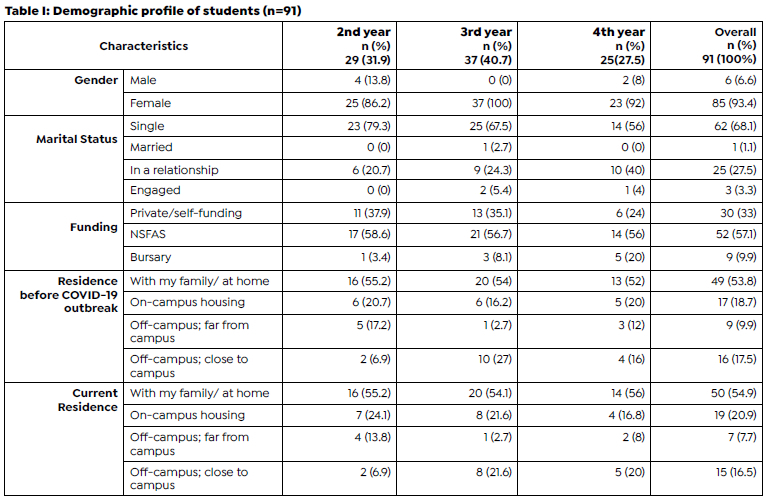
The target population for this study included second-, third- and fourth-year students who were enrolled in the occupational therapy programme at the institution for the 2021 academic year (N=118). This included 37 second-year students, 47 third year and 34 fourth-year students. Non-probability census sampling was used to access all eligible students for the study. The pilot study participants (n=11) included community service occupational therapists who were registered students at UKZN and completed their final year of study in 2020. The minimum response rate required for the study to be reliable was 70% (n=83) students according to the Cronbach's Alpha Interval Estimation26Table I, above).
Data collection and ethical considerations
Potential participants were sent an invitation via email, which included attachments of the information document, consent form; gatekeepers' permission and ethical approval (reference HSSREC/00002508/2021). Informed consent was mandatory prior to accessing the survey. A non-pervasive incentive (as approved by the ethics committee) was offered to increase voluntary participation. The survey was hosted on Google Forms. Three areas were investigated using a four-point Likert scale ranging from strongly agree (1) to strongly disagree (4). Section A included seven demographic questions, section B included 24 questions related to teaching and learning experiences at an undergraduate level, section C included 10 questions on experiences of students related to the structure of online assessment and section D included eight questions on students' mental health and coping during the COVID-19 pandemic. The survey was opened for a period of six weeks within the midyear period of the academic programme (June-July 2021).
Data analysis
The data from Google Forms were imported to a MS Excel spreadsheet in preparation for analysis which was conducted in R Statistical computing software of the R Core Team, 2020, version 3.6.327. The demographic profile data were converted into categorical data, and the remaining three sections were converted into statistical data for interpretation. The categorical variables were described as counts and percentage frequencies. Likert plots were used for handling the multidimensional presentation of the categorical data. To determine the association between categorical variables, Chi-Square Test was used. When the distribution of the cross-tabulations contained an expected value of less than five, Fischer's exact test was applied. The internal consistency of a set of items was assessed using the Cronbach alpha and the itemrest correlation. To improve the Cronbach alpha, items with opposite scale direction were reversed and those suppressing the Cronbach were dropped. All the inferential statistical analysis tests were conducted at 5% levels of significance.
Validity and reliability
This study included the quantitative measures of (i) internal validity; (ii) external validity, (iii) reliability. and (iv) objectivity283031
RESULTS
A total of 91 students (n=29) second year, (n=37) third year, and (n=25) fourth year voluntarily participated in the study. This correlated to a response rate of 85%.
Students access to resources
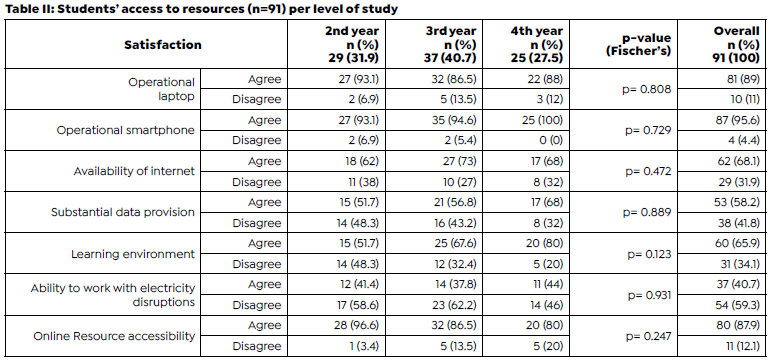
Most of the students across the years were satisfied with their access to an operational laptop (89%; n=81); operational smartphone (95.6%; n=96); availability to the internet (68.1%; n=62); accessibility to online resources (87.9%; n=80); substantial data provision (58.2%; n=53) and having a conducive learning environment (65.9%; n=60). More than half of the students across the years (59.3%; n=54), found it challenging to work around electricity disruptions such as load-shedding (Table II, above).
Students' online teaching and learning experience
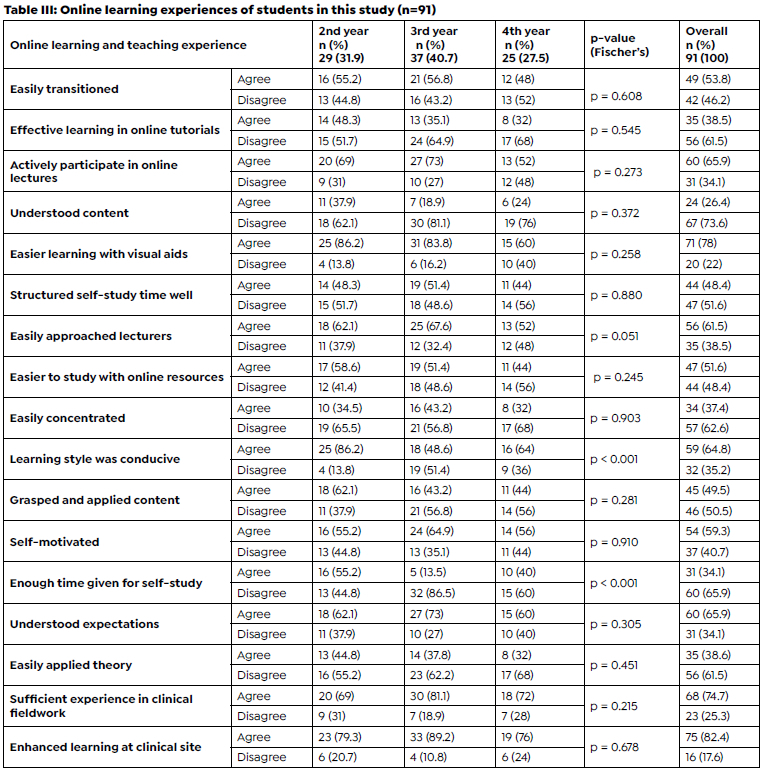
More than half of the students across the years felt that they transitioned easily (53.8%; n=49), could actively participate in lectures (65.9%; n=60), could approach their lecturers easily (61.5%; n=56) and understood the course expectations (65.9%; n=60). More than half of the students were self-motivated (59.3%; n=54); however, there were a large percentage of students who experienced difficulty in structuring their self-study time well (51.6%; n=47) and found inadequate time provided for self-study (65.9%; n=60). Most of the students found it difficult to concentrate during online learning (62.6%; n=57). Although the students across the years found that their learning style was conducive to online learning (64.8%; n= 59) and found it easier when using online resources (51.6%; n=47) and visual aids (78%; n=71); they felt that the online tutorials were not adequate (61.5%; n=56) and struggled to understand the content (73.6%; n=67). Although the students found it challenging to apply the theory (61.5%; n=56), a large percentage felt they had sufficient clinical experience (74.7%; n=68) and that the clinical experience enhanced their learning (82.4%; n=75). All of Fischer's p-values were above p>0.05, except where the students felt they had enough self-study time and a conducive learning style (p<0.001), indicating a significant difference between years (Table III, above).
Student's online assessment experience
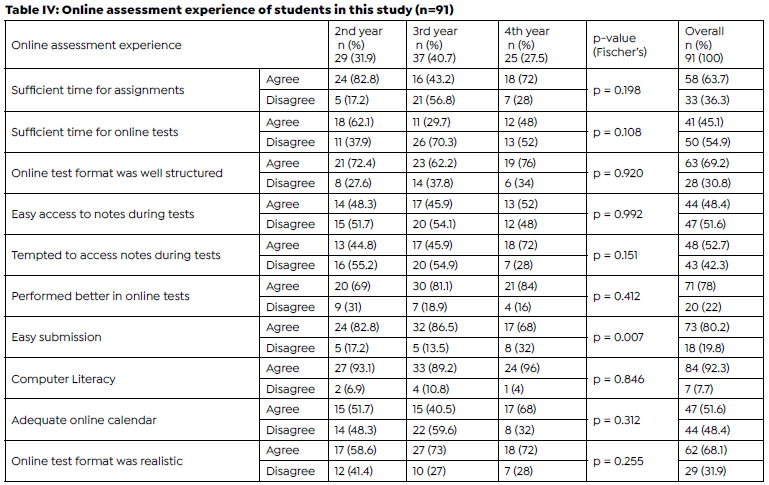
Most of the students across the years (63.7%; n=58) felt that they had enough time to complete assignments and the online calendar was adequate (51.6%; n=47); however, majority of the third year (70.3%; n=26) and fourth year (52%; n=13) students felt that they did not have enough time for online tests. Most of the students across the years (69.2%; n= 63) felt that the online test format was well structured and that the format was realistic (68.1%; n=62), resulting in better test performance (78%; n=71). Most of the students felt tempted to access their notes (52.7%; n=48), especially the fourth-year students (72%; n=18); although 51.6% (n=47) of all the students found that it was not easy to access their notes during the online tests. Most of the students across the years felt that it was easy to submit online assessments (80.2%; n=73) and that they were competent in computer literacy (92.3%; n=84). Fischer's p-values were above the recommendation of p>0.05; except submission of assignments (p= 0.007), which indicates a significant difference in experiences of the ease in submissions between the years (Table IV, above).
Student mental health
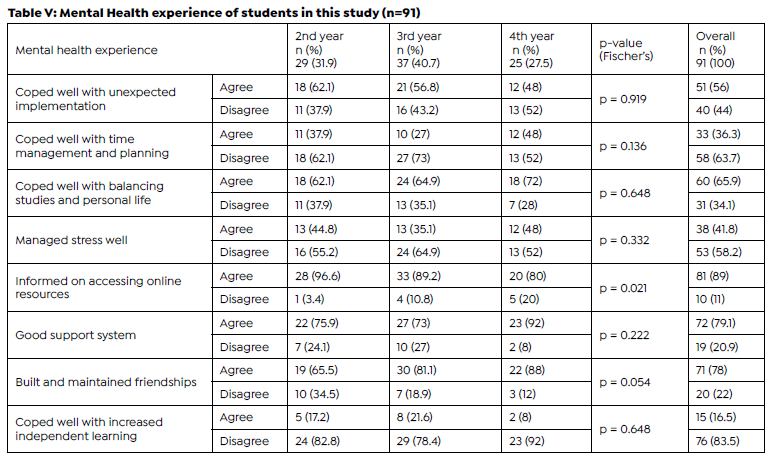
Although a large portion of the students across the years felt that they coped well with the unexpected implementation of online learning (56%; n=51) and with balancing their personal lives and studies (65.9%; n=60), the results revealed that the students did not cope with time management and planning (63.7%; n=58) and increased self-directed learning (83.5%; n=76). The students felt that they were informed on how to access online resources for mental health assistance (89%; n=81); however, Fischer's p-value was p=0.021, resulting in a significant difference between the years. Many of the students felt that they did not manage their stress well (58.2%; n=53), despite having good support systems (79.1%; n=72) and being able to build and maintain their relationships (78%; n=71) (Table V, page 61).
DISCUSSION
This study provided insight into students' experiences of teaching, learning, assessment and mental health during their transition onto a complete online platform during the COVID-19 pandemic at one higher education institution in South Africa. The study identified that most students had access to infrastructure and resources such as an operational laptop/ smartphone and Wi-Fi, which facilitated engagement with online learning. Existing literature indicates that adequate internet connections have predominantly been a challenge in rural and marginalised communities15323
Less than half of the students found the sudden implementation and transition to online learning difficult156233222222
Challenges in students maintaining their attention for extended periods of time22247
Overall, more than half of the students felt that they did not manage their stress well. This could result from the sudden implementation of online learning, trying to manage their time and increased self-directed learning. Kathard, Galvaan and Kleintjes23331137
CONCLUSIONS AND RECOMMENDATIONS
The COVID-19 pandemic brought about a rapid shift in the way that teaching, learning, and assessment were conducted. In this study, we found that overall, students adapted to online learning and had notable experiences at their HEI during the pandemic which has implications for online learning and blended learning approaches in occupational therapy education. In terms of online assessments, students mostly had a positive experience, and this was reflected in their performance. With regards to the student's mental health, they felt that they coped adequately and found that their learning style was conducive. However, issues arose as a result of having increased self-directed learning and in managing their time and stressors. Providing students with adequate online learning infrastructure; online resources; continuous communication, and mental health support will help ensure optimal and effective online learning. Moreover, further consideration is required around learning during tutorials; understanding content; applying theory into practice; and managing self-study time.
A number of specific recommendations have emanated from this study. These include student assessment which may be enhanced by limiting accessibility to learning materials during the test period and in regulating the duration of online tests. Students should be guided on how to optimise self-directed learning, with particular focus on increased structure103,22. Future research should focus on exploring means to optimise effective online teaching and learning by restructuring of theoretical content of the curriculum and delivery of online tutorials.
Limitations of the study
We acknowledge several limitations of this study. Firstly, exploration of students mental health could not be adequately captured using quantitative methods and therefore in-depth exploration via qualitative methods may provide a more comprehensive and authentic picture of students' mental health and challenges. Thus a future studies could delve deeper into the lived experiences of students. Secondly, the timing of the study can be considered as a limitation as the initial experiences of online learning had passed; most students were already 18 months into this process and it is very likely that the more positive experiences were as a result of initial challenges being addressed. The results may rather then reflect residual challenges that students had experienced.
Author contributions
Nonjabulo Ndaba, Pragashnie Govender and Deshini Naidoo as supervisors of the study, co-conceptualised the study. Nicole van Heerden, Jessica Heaver, Sonali Rambhuron, and Fariyah Khan, as registered students at UKZN, collected data and completed initial analysis of the data. Pragashnie Govender and Deshini Naidoo assisted in data interpretation, together with Nonjabulo Ndaba. Nicole van Heerden, Jessica Heaver, Sonali Rambhuron, and Fariyah Khan drafted the first version of paper. Pragashnie Govender, Deshini Naidoo and Nonjabulo Ndaba revised the paper and reviewed the final version of the paper.
Conflict of interest
The authors declare no conflict of interest in relation to publication of this article.
Acknowledgements
The biostatistician, Dr. Partson Tinarwo, is duly acknowledged for his assistance in the data analysis process.
References
-
1. Mhlanga D, & Moloi, T. COVID-19 and the Digital Transformation of Education: What Are We Learning on 4IR in South Africa? Education Sciences. 2020;10(7):180. https://dx.doi.org/10.3390/educsci10070180.
» https://dx.doi.org/10.3390/educsci10070180 -
2. Ramaphosa, C. Speeches | South African Government [Internet]. Gov.za. 2020. Available from: https://www.gov.za/speeches/president-cyril-ramaphosa-extension-coronavirus-covid-19-lockdown-end-april-9-apr-2020-0000
» https://www.gov.za/speeches/president-cyril-ramaphosa-extension-coronavirus-covid-19-lockdown-end-april-9-apr-2020-0000 -
3. Govender P, Naidoo D, van Wyk JM. A 3Ts (teaching in troubled times) response to COVID-19 in South Africa. The Clinical Teacher. 2020;17(4):427-9. https://dx.doi.org/10.1111/tct.13213.
» https://dx.doi.org/10.1111/tct.13213 -
4. Abbasi MS, Ahmed N, Sajjad B, Alshahrani A, Saeed S, Sarfaraz S, Alhamdan RS, Vohra F, Abduljabbar T. E-Learning perception and satisfaction among health sciences students amid the COVID-19 pandemic. Work. 2020:1-8. https://dx.doi.org/10.3233/WOR-203308.
» https://dx.doi.org/10.3233/WOR-203308 -
5. Daniel J. Education and the COVID-19 pandemic. Prospects, 2020; 49(1): 91-6. DOI: https://dx.doi.org/10.1007/s11125-020-09464-3.
» https://dx.doi.org/10.1007/s11125-020-09464-3 -
6. Hedding DW. Payouts push professors towards predatory journals. Nature. 2019;565(7737):267-8. Available from: https://go.gale.com/ps/i.do?id=GALE%7CA573274180&sid=googleScholar&v=2.1&it=r&linkaccess=abs&issn=00280836&p=HRCA&sw=w&userGroupName=anon%7E60b97b68
» https://go.gale.com/ps/i.do?id=GALE%7CA573274180&sid=googleScholar&v=2.1&it=r&linkaccess=abs&issn=00280836&p=HRCA&sw=w&userGroupName=anon%7E60b97b68 -
7. Naidoo D, & Van Wyk J. Fieldwork practice for learning: Lessons from occupational therapy students and their supervisors. African Journal Of Health Professions Education,. 2016;8(1):37. https://dx.doi.org/10.7196/AJHPE.2016.v8i1.536.
» https://dx.doi.org/10.7196/AJHPE.2016.v8i1.536 -
8. University of KwaZulu-Natal. Hands-On Opportunities -Discipline of Occupational Therapy [Internet]. 2021. Available from: https://ot.ukzn.ac.za/hands-onopportunities
» https://ot.ukzn.ac.za/hands-onopportunities -
9. Nguse S, Wassenaar D. Mental health and COVID-19 in South Africa. South African Journal of Psychology. 2021;5:304-313. https://journals.sagepub.com/doi/pdf/10.1177/00812463211001543
» https://journals.sagepub.com/doi/pdf/10.1177/00812463211001543 -
10. Sahu P. Closure of universities due to coronavirus disease 2019 (COVID-19): impact on education and mental health of students and academic staff. Cureus. 2020;12(4). https://dx.doi.org/10.7759/cureus.7541.
» https://dx.doi.org/10.7759/cureus.7541 - 11. Shenoy V, Mahendra S, Vijay N. COVID 19 lockdown technology adaption, teaching, learning, students engagement and faculty experience. Mukt Shabd Journal. 2020;9(4):698-702.
-
12. Gittings L, Toska E, Medley S, Cluver L, Logie C, Ralayo N et al. 'Now my life is stuck!': Experiences of adolescents and young people during COVID-19 lockdown in South Africa. Global Public Health [Internet]. 2021;16(6):947-963. https://dx.doi.org/10.1080/17441692.2021.1899262.
» https://dx.doi.org/10.1080/17441692.2021.1899262 -
13. Sy MP, Pineda RC, Yao DP, Guevara CA, Delos Reyes RC, Castro IM. Shared voices of Filipino occupational therapists during the COVID-19 pandemic: reflections from an online forum. World Federation of Occupational Therapists Bulletin. 2020;76(1):60-4. https://dx.doi.org/10.1080/14473828.2020.1761575
» https://dx.doi.org/10.1080/14473828.2020.1761575 -
14. Zhu X, Liu J. Education in and After Covid-19: Immediate Responses and Long-Term Visions. Postdigital Science and Education, 2020; 2(3): 695-699. https://dx.doi.org/10.1007/s42438-020-00126-3.
» https://dx.doi.org/10.1007/s42438-020-00126-3 -
15. Visser M, Law-van Wyk E. University students' mental health and emotional wellbeing during the COVID-19 pandemic and ensuing lockdown. South African Journal of Psychology. 2021;51(2):229-243. https://www.ncbi.nlm.nih.gov/pmc/articles/PMC8144883/
» https://www.ncbi.nlm.nih.gov/pmc/articles/PMC8144883/ -
16. Adnan M, Anwar K. Online Learning amid the COVID-19 Pandemic: Students' Perspectives. Online Submission. 2020;2(1):45-51. https://flles.eric.ed.gov/fulltext/ED606496.pdf
» https://flles.eric.ed.gov/fulltext/ED606496.pdf -
17. Burns R. A COVID-19 panacea in digital technologies? Challenges for democracy and higher education. Dialogues in Human Geography. 2020;10(2):246-249. https://doi.org/10.1177%2F2043820620930832
» https://doi.org/10.1177%2F2043820620930832 -
18. Jacob O, Abigeal I, Lydia A. Impact of COVID-19 on the Higher Institutions Development in Nigeria. Electronic Research Journal of Social Sciences and Humanities [Internet]. Eresearchjournal.com. 2020 [cited 16 October 2021]. Available from: http://www.eresearchjournal.com/wp-content/uploads/2020/04/0.-Impact-of-COVID.pdf
» http://www.eresearchjournal.com/wp-content/uploads/2020/04/0.-Impact-of-COVID.pdf -
19. Mpungose C. Emergent transition from face-to-face to online learning in a South African University in the context of the Coronavirus pandemic [Internet]. 2020. https://dx.doi.org/10.1057/s41599-020-00603-x.
» https://dx.doi.org/10.1057/s41599-020-00603-x -
20. de Wit M. Navigating Telerehabilitation for student training: Sharing experiences. South African Journal of Occupational Therapy. 2021;51(1):2. https://sajot.co.za/index.php/sajot/article/view/747/454
» https://sajot.co.za/index.php/sajot/article/view/747/454 -
21. Toquero CM. Challenges and opportunities for higher education amid the COVID-19 pandemic: The Philippine context. Pedagogical Research. 2020;5(4). https://dx.doi.org/10.29333/pr/7947.
» https://dx.doi.org/10.29333/pr/7947 -
22. Fatonia NA, Nurkhayatic E, Nurdiawatid E, Fidziahe GP, Adhag S, Irawanh AP, Julyantoj O, Azizik E. University students online learning system during Covid-19 pandemic: Advantages, constraints and solutions. Systematic Reviews in Pharmacy. 2020;11(7):570-6. Available from: https://www.sysrevpharm.org/articles/university-students-online-learning-system-during-covid19-pandemic-advantages-constraints-and-solutions.pdf
» https://www.sysrevpharm.org/articles/university-students-online-learning-system-during-covid19-pandemic-advantages-constraints-and-solutions.pdf -
23. Kathard H, Galvaan R, Kleintjes S. COVID-19 higher education response: how are we being equitable and inclusive? -HELTASA [Internet]. HELTASA. 2021. Available from: https://heltasa.org.za/covid-19-higher-education-response-how-are-we-being-equitable-and-inclusive/
» https://heltasa.org.za/covid-19-higher-education-response-how-are-we-being-equitable-and-inclusive/ -
24. Makgahlela M, Mothiba T, Mokwena J, Mphekgwana P. Measures to Enhance Student Learning and Well-Being during the COVID-19 Pandemic: Perspectives of Students from a Historically Disadvantaged University. Education Sciences. 2021;11(5):212. https://dx.doi.org/0.3390/educsci11050212.
» https://dx.doi.org/0.3390/educsci11050212 -
25. Mailizar M, Almanthari A, Maulina S, Bruce S. Secondary School Mathematics Teachers' Views on E-learning Implementation Barriers during the COVID-19 Pandemic: The Case of Indonesia. Eurasia Journal of Mathematics, Science and Technology Education. 2020;16(7): 1-9. https://doi.org/10.3390/educsci11050212
» https://doi.org/10.3390/educsci11050212 -
26. Ptenklooster nl. Cronbach's alpha interval estimation [Internet]. 2020. Available from: https://ptenklooster.nl/sample-size-calculators/cronbachs-alpha-interval-estimation/
» https://ptenklooster.nl/sample-size-calculators/cronbachs-alpha-interval-estimation/ -
27. Citing R and RStudio - ORGANISING CREATIVITY [Internet]. Organizingcreativity.com. 2020. Available from: https://www.organizingcreativity.com/2020/08/citing-r-and-rstudio/
» https://www.organizingcreativity.com/2020/08/citing-r-and-rstudio/ -
28. Farrelly P. Issues of trustworthiness, validity and reliability. British Journal of School Nursing. 2013;8(3):149-51. https://dx.doi.org/10.12968/bjsn.2013.8.3.149.
» https://dx.doi.org/10.12968/bjsn.2013.8.3.149 - 29. Welman J, Kruger F, Mitchell B, Huysamen G. Research Methodology. 3rd ed. Cape Town: Oxford University Press. 2011.
-
30. Rodriguez JG. Commentary: Generalisability and validity in qualitative research. British Medical Journal. 1999;319(7207):421. Available from: https://go.gale.com/ps/anonymous?id=GALE%7CA55670112&sid=googleScholar&v=2.1&it=r&linkaccess=abs&issn=17592151&p=AONE&sw=w
» https://go.gale.com/ps/anonymous?id=GALE%7CA55670112&sid=googleScholar&v=2.1&it=r&linkaccess=abs&issn=17592151&p=AONE&sw=w -
31. Heale R, Twycross A. Validity and reliability in quantitative research. Evidence-Based Nursing. 2015;18: 66-67. https://dx.doi.org/10.1136/eb-2015-102129.
» https://dx.doi.org/10.1136/eb-2015-102129 -
32. Saleh M, Sari R, Alim P. University Students' Perception on The Implementation of Online Learning During The Covid-19. Nazhruna: Jurnal Pendidikan Islam [Internet]. 2021;4(1):1-17. https://dx.doi.org/10.31538/nzh.v4i1.1022.
» https://dx.doi.org/10.31538/nzh.v4i1.1022 -
33. Copeland WE, McGinnis E, Bai Y, Adams Z, Nardone H, Devadanam V, Rettew J, Hudziak JJ. Impact of COVID-19 pandemic on college student mental health and wellness. Journal of the American Academy of Child & Adolescent Psychiatry. 2021;60(1):134-141.e2. https://dx.doi.org/10.1016/j.jaac.2020.08.466
» https://dx.doi.org/10.1016/j.jaac.2020.08.466

Reviewed: November 2022
Revised: December 2022
Accepted: January 2023
Published: August 2023
Funding:The first author is a recipient of Fee Remission from the University of KwaZulu-Natal. The principal author is funded via the New Generation of Academics Programme (nGAP) under the auspices of the Department of Higher Education and Training in South Africa.