The History of the South African Journal of Occupational Therapy (SAJOT), 1953-2025: Charting the Evolution of a Profession's Voice
Introduction
In this, the second of a three-part editorial series to celebrate the 80th Anniversary of our publisher, the Occupational Therapy Association of South Africa (OTASA), a brief overview of the history of our Journal is outlined.
The South African Journal of Occupational Therapy (SAJOT), launched in the early 1950s, reflects the growth, development, and maturation of our profession in South Africa and across the continent. From its inaugural issue in 1953 through to 2025, this overview shows how the SAJOT contributes to the OTASAs Mission Statement which states "dynamic growth of quality occupational therapy with a focus on occupation and a distinct South African identity", not only its content and mission, but also the transformations in its size, layout, format, and scope-including its transition to an electronic format in 2011.
The Founding Years: 1953-1960s
To mark the 10th anniversary of occupational therapy in South Africa, our association published its first journal. The SAJOT was conceived as a means for practitioners, educators, and students to share knowledge, experiences, reflections, and innovations in practice.
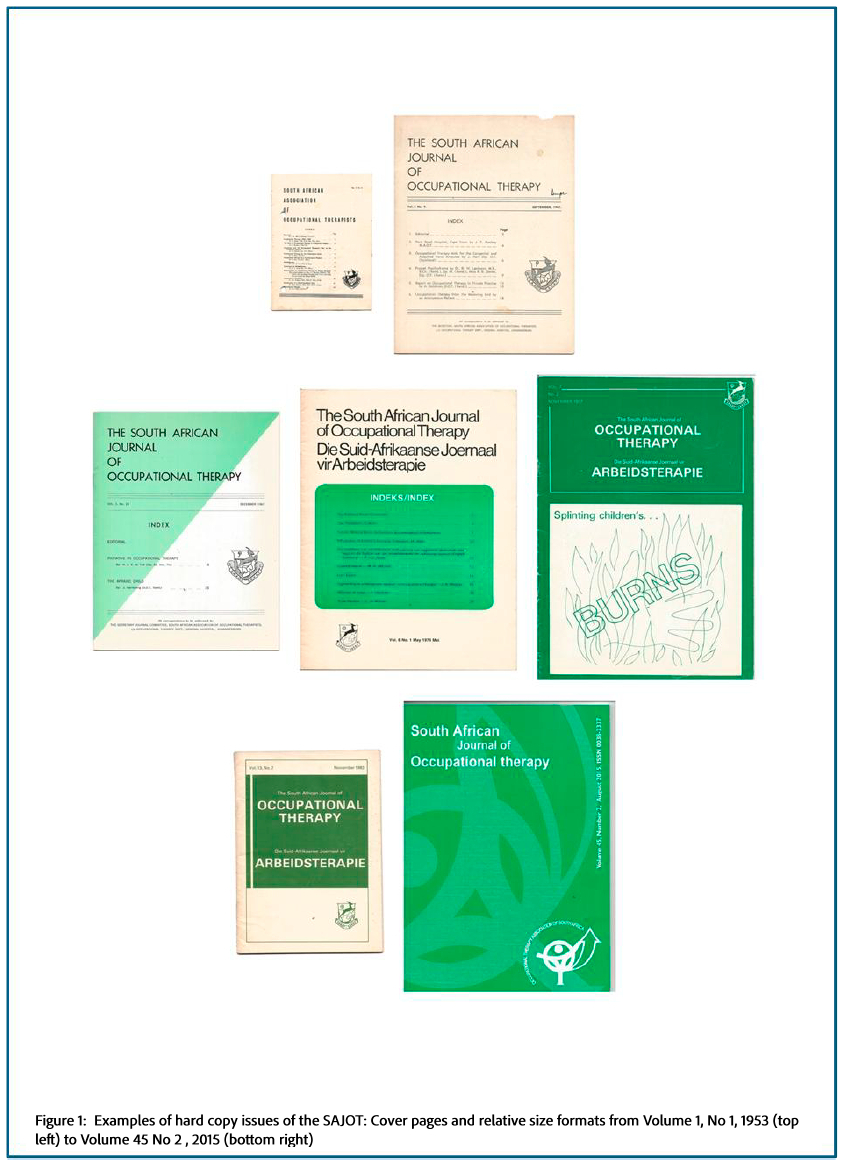
The very first editions of SAJOT were modest in both appearance, scope, content and reach (Figure 1, page 2). Produced in hard copy, the original issues featured typewritten articles (some issues featuring only 3 or 4 'articles'), black-and-white photographs, hand-drawn illustrations, and many advertisements relevant to the profession as it was practiced then. The initial size was relatively small-some even smaller than an A5 booklet. The journal was distributed primarily through postal services, and circulation and readership were therefore limited to registered members of the then South African Association of Occupational Therapists (SAAOT) and a handful of libraries and universities.
Despite these humble beginnings, the journal provided a much-needed platform to share mainly practice experiences, and in this way, it helped to unify occupational therapists in a country marked by its diversity and complex social challenges.
Growth and Change: 1970s-2000s
During this period, occupational therapy gained prominence and became a recognised and valued allied health profession. By the 1970s, and 80s, the former diploma courses became degree courses, and post-graduate courses were introduced at training institutions, and as a result, the quality of the content saw several changes to the journal's physical format, quality and especially, its content. The size was increased to a larger, magazine-style format (A4), allowing for longer articles, improved graphics, and a more professional appearance (Figure 1, page 2).
The layout now incorporated professional typesetting, clearer headings, and standardised referencing. Colour was sometimes introduced on the cover or in diagrams, reflecting both technological advances and the broader aspiration to align with international publishing standards. The content of SAJOT broadened to include research articles, theoretical discussions, book reviews, conference reports, letters from readers and opinion pieces on a variety of topics. Articles began to address not only clinical practice but also advocacy, policy, and education, mirroring the expanding role of occupational therapy in society.
By the late 1980s, the hard copy issues featured glossy covers, professional photographs, and more expansive use of graphic elements. The number of articles published annually increased, and the length of each issue grew to accommodate a rising volume of submissions which included more scientific research content.
The 1990s brought profound changes to South Africa, as the end of apartheid and the dawn of democracy opened new avenues for research, collaboration, and global engagement. Author ethnicity became more diverse, and contributions from practitioners and scholars outside major urban centres increased.
With the advent of desktop publishing technologies, SAJOT's production process became more efficient and visually appealing. The layout adopted two-column formats, consistent fonts, and improved readability. This modernisation made the journal more competitive with international publications and more attractive to potential authors and readers alike.
Entering the digital era: 2011-2025
In response to changing reader expectations and the evolution in the digital era, a true milestone in SAJOT's history came in 2011 with the launch of its first electronic edition, Volume 41 Number 2. Recognising the growing importance of online access for both practitioners and researchers, SAJOT digitised its production process and began distributing issues electronically (although hard copies were still distributed to members of OTASA until 2015).
From 2014, all published material were allocated Digital Object Identifiers (DOIs), which were registered on CrossREF by ScieLO (Scientific Library Online). The implications of this negatively affected the statistics on our SAJOT website, as all users who accessed published material by means of the DOI, were taken to the specific article on the ScieLO site, and not the SAJOT site. SAJOT also obtained its own unique International Standard Serial Number (ISSN-Online) that uniquely identifies serial publications like newspapers, journals, and magazines. The ISSN helps in the citation, retrieval, and management of the journal.
All online issues were open access, which allowed readers from around the globe access to all published material, free of charge. Non-OTASA member authors were charged article processing costs up to 2023, when OTASA waived these costs and SAJOT obtained its Diamond Open Access Seal. The implications and advantages of these changes were mainly:
• Wider, global accessibility, broadening SAJOT's reach and influence.
• Faster publication timelines, allowing research and practice insights to be shared more promptly.
• Multimedia capabilities, including the ability to publish colour images, supplementary data, and hyperlinks to related content or external resources.
• Enhanced searchability, making it easier for readers to locate specific articles or topics of interest.
• Cost and environmental benefits, as reliance on print production and postal distribution ceased.
During this period, the journal adopted an online submission and double-blind peer review system, streamlining editorial processes and aligning SAJOT with international best practice standards in academic publishing.
The journal's website was enhanced, featuring publication policies and ethical standards, author and reviewer guidelines, and resources for both readers and contributors. To further increase its visibility and readership, SAJOT applied for and was granted indexing on various platforms, including SCieLO, EBSCO Host, AJOL (African Journals Online), OTDBase and Proquest.
Editorial leadership focused on maintaining rigorous SAJOT as the authoritative voice for occupational therapy in Southern Africa and Africa.
The digital format enabled new forms of scholarship, such as systematic/rapid/narrative-/literature reviews, meta-analyses, commentaries and opinion pieces, while also supporting traditional research and reflective practice articles. As can be seen from Fig. 1 (page. 2), the journal's design was periodically refreshed to improve useability and readability, ensuring it remained visually appealing and accessible on a range of devices.
Towards the end of 2023, SAJOT moved to the ASSAf/Khulisa platform, which will continue to ensure broader accessibility and exposure. All DOIs of published material were re-registered on CrossREF to ensure that users are taken directly to the ASSAf/Khulisa platform (not ScieLO) which greatly improved the viewer statistics on our own website.
By 2025, SAJOT had established itself as a respected, internationally recognised publication, with a robust digital presence and a loyal readership. Its archives provide a rich record of the evolution of occupational therapy in South Africa and beyond, documenting advances in theory, models, approaches, education, and clinical practice.
CONCLUSION
From its inception in 1953 as a modest hard copy publication to its current status as a dynamic, digital journal, the SAJOT has mirrored the journey of the profession itself. Changes in size, layout, format and scientific content have reflected broader shifts in society, technology, and the needs of practitioners. The transition to an electronic edition in 2011 was a pivotal moment, ensuring SAJOT's relevance and accessibility in the digital age. As it moves beyond 2024, SAJOT remains committed to fostering excellence in occupational therapy scholarship, supporting practitioners, educators, and researchers in South Africa and around the world.
In the 3rd Editorial which will be published in the December 2025 Edition of the SAJOT, an analysis of the developments in terms of content (i.e. types of research, areas of practice, specific diagnostic categories, levels of evidence) from 1953 through to 2025, will be shared with our readers. Through this, we would like to highlight the contribution of our publisher, OTASA, to the development and sustainability of not only our Journal but especially, to our profession.
REFERENCE
-
1. OTASA Strategic Plan (2023-2027): Mission Statement. https://www.otasa.org.za/about-otasa/
» https://www.otasa.org.za/about-otasa/