Determining the research priorities for the profession of occupational therapy in South Africa
INTRODUCTION
Occupational Therapy is a profession that focuses on enhancing the functioning of individuals who experience functional limitations particularly when engaging in occupation related activities. The setting of research priorities is seen as an important activity for every organisation1
METHOD
The scientific investigation was conducted in two phases, namely, a quantitative descriptive research design was used in phase one of the study and phase two used a qualitative research design. The aim of phase one of the study was to determine the views of occupational therapists about the research priority focus areas for the profession of occupational therapy in South Africa. Phase two of the study was to analyse a shared university database in order to describe the main research areas in which occupational therapists conducted research for the period 2017 to 2019.
During phase one of the study the researcher conducted a survey with all 3304 occupational therapists registered with the Occupational Therapy Association of South Africa (OTASA) at the time of the study. However only 97 individuals completed the survey that focused on what the research priorities. The questionnaire used in the current study was adapted from the WHO research priority questionnaire, it was used to identify research priorities for the occupational therapy profession1
In phase two of the project the researchers utilised content analysis in order to analyse a research database linked to all 8 universities in South Africa. The research database consists of all published research and unpublished research (degree and non- degree purposes) that have been documented by the 8 universities who offer occupational therapy training programmes in South Africa. The Framework for Disability Strategy and Rehabilitation2
RESULTS
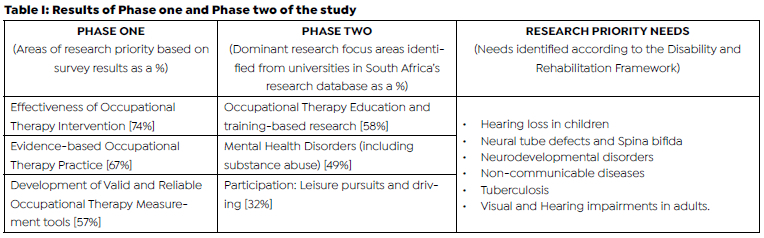
The results of phase one of the study indicated that the following research focus areas were regarded as areas of priority for future research: effectiveness of occupational therapy intervention, evidence-based occupational therapy practice and the development of valid and reliable occupational therapy measurement tools. The results of phase two of the study indicated that Occupational Therapy Education and training-based research and Mental Health Disorders (including substance abuse) were the most common areas of occupational therapy research in South Africa (Table I page 7).
CONCLUSION
The research evidence-based hierarchy as described by Miller & Forest33
Recommendations and Implications for practice
Departmental research committees develop Think Tanks together with clinicians, communities and faculty in order to plan research that focus on the priority research areas identified in this study.
Emphasis be placed on developing the research methods skills of undergraduate students, post graduate students, clinicians and academic skills particularly in designing Level 1 A and Level 1B research studies.
Research funding and awards be prioritised for Level 1A and Level 1B type of research in Occupational Therapy.
Acknowledgements
The authors would like to acknowledge the OTASA Research Committee members for their contribution to the current research project.
REFERENCES
-
1. World Federation of Occupational Therapists, Mackenzie L, Coppola S, Alvarez L, Cibule L, Maltsev S, Loh S, Mlambo T, Ikiugu MN, Pihlar Z, Sriphetcharawut S, Baptiste S, Ledgerd R. International Occupational Therapy Research Priorities: A Delphi Study OTJR: Occupation, Participation and Health. 2017. DOI: https://doi.org/10.1177/1539449216687528
» https://doi.org/10.1177/1539449216687528 -
2. National Department of Health. Framework and Strategy for Disability and Rehabilitation services in South Africa (2015- 2021). 2015; Retrieved from https://www.google.com/url?sa=t&rct=j&q=&esrc=s&source=web&cd=1&ved=2ahUKEwjJ8fCWy93nAhVGUxoKHR6LAZ8QFjAAegQIBBAB&url=http%3A%2F%2Fwww.health.gov.za%2Findex.php%2F2014-08-15-12-54-26%2Fcategory%2F266-2016-str%3Fdownload%3D1569%3Aframework-and-strategy-final-pnnt-ready-2016&usg=AOvVaw2uYb8wa_nydK8ZolMLz3GB
» https://www.google.com/url?sa=t&rct=j&q=&esrc=s&source=web&cd=1&ved=2ahUKEwjJ8fCWy93nAhVGUxoKHR6LAZ8QFjAAegQIBBAB&url=http%3A%2F%2Fwww.health.gov.za%2Findex.php%2F2014-08-15-12-54-26%2Fcategory%2F266-2016-str%3Fdownload%3D1569%3Aframework-and-strategy-final-pnnt-ready-2016&usg=AOvVaw2uYb8wa_nydK8ZolMLz3GB -
3. Miller SA, Forrest JL. Translating evidence-based decision making into practice: appraising and applying the evidence. Journal of Evidence Based Dental Practice. 2009; 9(4), 164-82. DOI: https://doi.org/10.1016/jjebdp.2009.03.017
» https://doi.org/10.1016/jjebdp.2009.03.017

Accepted: February 2023
Published: April 2023
Funding: No funding was received for this research.