An occupational therapy perspective on the identification of possible supportive structures for individuals with developmental dyslexia: a Scoping Study
Abstract
INTRODUCTION: Although early identification and diagnosis of individuals with dyslexia is important, the role of supportive structures to enable optimal occupational performance and participation cannot be neglected in the holistic management of individuals with dyslexia. AIM: Through the application of a scoping study, literature will be reviewed and mapped to identify supportive structures that could inform and guide occupational therapy practice for individuals with developmental dyslexia within the South African context. METHOD: A scoping study was conducted according to the outline provided by Arksey and O'Malley. Fifteen electronic databases were searched for articles published between January 2010 and June 2023 resulting in the review of 78 articles. RESULTS: The environmental (extrinsic) factors of the Person-Environment-Occupation Model (PEOP model) were used to delineate five themes descriptive of supportive structures each with subdivisions to illuminate the theme's content with social support as major contributor. CONCLUSION: One of the major contributors to support individuals with dyslexia is the social support system that may include support from family and peers as well as practical support. The prevalence as well as implications of different support systems are discussed. Recommendations for furtherresearcharemade. IMPLICATIONS FOR PRACTICE • Environmental Structuring: Occupational therapists should recognise and leverage the role of environmental supports, such as practical and emotional social support, accessible learning environments, and institutional accommodations to enhance participation for individuals with developmental dyslexia. • Multidisciplinary Collaboration: The findings reinforce the necessity for coordinated, team-based interventions. Occupational therapists should actively engage with educators, psychologists, and speech-language therapists to implement cohesive support systems informed by evidence-based practices. • Technology Integration: The use of assistive technology including speech-to-text software, audio tools, and visual learning aids emerged as a key support structure. Therapists can play a critical role in recommending, training, and supporting the use of such tools to improve occupational performance in educational and workplace settings. • Policy and Advocacy: Institutional and government policy emerged as significant enablers of support. Occupational therapists are encouraged to advocate for the development and implementation of inclusive policies, accommodations, and awareness campaigns that support individuals with dyslexia at systemic levels. • Contextual Relevance: Considering South Africa's unique linguistic and cultural landscape, therapists should adapt support strategies to be culturally responsive and contextually feasible. Further local research is essential to determine the accessibility and implementation of these structures within South Africa.
supportive structures; quality education; good health and well-being optimal occupational performance; Person-Environment-Occupation Model; social support system
INTRODUCTION
Dyslexia affects an estimated 5-10%1,23 of the global population and may be defined as a neuro-developmental disorder3 with a genetic origin characterised by a cognitive profile and noted by behavioural signs4. Although difficulty in the phonological component of language may be one of the primary indicators of dyslexia, the behavioural signs noted extends beyond linguistic difficulties and will manifest over the lifespan of an individual3.
Different theories have developed to unravel the complexity of developmental dyslexia with explanations ranging from a phonological awareness deficit56, confusion that stems from a perceptual deficit5, the deficit in processing rapidly changing or successive visual or auditory stimuli5 or a more integrated deficit including the visual, auditory and tactile systems7. The attempt to summarise or explain the different theories lead to the development of models to aid in the description of the origin of dyslexia.
From an occupational therapy perspective, a model will aid in the understanding of the challenges faced by a dyslexic individual. Although genetic profiling of dyslexia may not be perfect yet, a model where genetic and environmental risk factors are instrumental for early identification, intervention and support of dyslexic children may be considered8. Both a multi-factorial model9 or the three- level framework developed by Frith in 19993 support the concept of a multi-factorial aetiology of dyslexia. The Frith model include the biological (genetic contribution and neuro-anatomical factors), cognitive (information-processing mechanisms) and behavioural component (learning to read and write) of dyslexia as well as the influences the environment has on all three of these levels3. South-African researchers Holmes and Fourie10 developed the Multi-dimensional Interactive Model for developmental dyslexia. This model covers neurological, interpersonal as well as intrapersonal factors without neglecting the importance of emotional and behavioural factors10. These models highlight the fact that dyslexia is not only the inability to read according to age expected norms but is far more complex.
Within occupational therapy the Person-Environment-Occupation (PEOP) model created by Charles Christiansen and Carolyn Baum11 the person and environment are joined by occupational performance and participation emphasising the role of occupation. Based on the multi-factorial models described above, the complex interaction that exists between a person (intrinsic factors) as well as the environment (extrinsic factors) forms the basis for occupation. This highlights the importance of occupational therapy involvement in individuals with dyslexia noting that these factors can either form a supporting structure, enable or restrict an individual in their occupational performance and participation11,12.
Before the interplay of intrinsic and extrinsic factors leading to occupational performance and participation can be understood in the context of an individual with dyslexia, it will be important to note the occupational markers that may be present. Occupational markers can be defined as the behavioural signs observed in a dyslexic individual preventing occupational engagement and performance in meaningful activities (occupational challenges) or behaviour that enables the individual to excel in a unique manner during participation in meaningful activities (occupational strengths). Currently literature only refers to these markers as 'behaviour' or 'behavioural signs', thus only viewing certain traits in isolation as diagnostic for dyslexia. If, however, the diagnosis of developmental dyslexia is viewed from an occupational marker or behavioural perspective it would allow the inclusion of co-occurring occupational challenges and strengths, thus creating a dyslexic profile13. The knowledge an occupational therapist has regarding a dyslexic profile, as well as the occupational markers contributing to the profile, will enable better understanding of the effect and influence of the occupational performance of an individual. A better in-depth understanding of these occupational markers and the way they may be integrated can lead to the development of a supportive structure for occupational participation for dyslexic individuals within the South African context.
A supportive structure may be described as tailored occupational therapy intervention strategies for dyslexic individuals, enhancing occupational performance and participation using occupations to facilitate the experience of occupational competence14 These structures need to incorporate a multi-disciplinary approach to the management of developmental dyslexia with intervention that is holistic and client centred.
The PEOP model14 can be used as a guideline to describe the presence of occupational markers, but in order to aid in the accurate description of supportive structures for dyslexic individuals or allow for the identification of areas which lack supportive structures, the following needs to be considered. The PEOP model, as introduced by Christiansen and Baum, expands on the understanding of how individuals engage in meaningful occupations within the context of their personal characteristics and environmental conditions. Rather than viewing these factors in isolation, the model emphasises the dynamic and reciprocal relationship between the person and environment, showing how this interaction directly influences activity performance, task completion, and role fulfilment. Importantly, it positions occupational therapy as a discipline that identifies barriers, strengthens enablers, and applies client-centred strategies to promote participation and optimise occupational performance14. The model further recognises the position of occupational therapy as a provider of tailored intervention through client centred strategies that engage either an individual or group in occupational performance14.
To better understand the enablers and barriers, the different components of the PEOP model need to be clarified. Within the model the person or intrinsic factors act as intrinsic enablers of performance and include neurobehavioral, physiological, cognitive, psychological, emotional and spiritual factors. With the current study in mind the cognitive as well as psychological and emotional factors deserve more attention. Cognition is the component that may be influenced the most by developmental dyslexia due to the inclusion of language (comprehension and production), task organization and memory. These factors become visible through occupational markers when an individual participates in an occupation. In the case of an individual with developmental dyslexia, these cognitive functions may be impaired, thus creating a barrier to effective learning visible in the dyslexic learner's decreased ability to read fluently with good speed and accuracy while retaining good comprehension of the text15. These deficits can also be accompanied by a decrease in spelling ability2. The phonological deficits also become visible when sounds need to be interpreted or manipulated thus limiting the recognition of individual sounds, blending, decoding as well as encoding that needs to take place for language patterns to be recognized15,16. The phonological deficits are a known primary occupational marker for the presence of dyslexia16.
The influence of developmental dyslexia reaches beyond the phonological component of written languages to include the performance patterns and skills of an individual thus preventing successful occupational engagement and performance. Dyslexia also impacts the psychological and emotional factors that may include the self- identity (self-concept, self-esteem, and self-efficacy) of an individual as well as their sense of well-being, interests, values and attitudes. This may shape their behaviour and interpretation of events10,13,17.
The profile of an individual with dyslexia may thus include internalising (social withdrawal, sadness, loneliness, fear, anxiety, suicidal ideation, depression, and somatic complaints) or externalizing (aggression, rule breaking behaviour, destroying property, lying, stealing, cheating, threatening people, bad temper, lack of guilt and substance abuse)18 behaviour which may differ in the manner they present. The individual may display these behaviours in their occupational engagement or as part of prominent performance patterns. The negative behavioural traits may also be visible in their social interaction skills. Not all individuals with dyslexia face psychological and emotional difficulties, but if present these difficulties have a negative influence on the individual's occupational performance and participation.
The impact of dyslexia may either be enabled or disabled by the support received from the environmental or extrinsic factors. In the PEOP model, the extrinsic factors entail the environment in which occupations take place and may include those built (including tools or assistive devices as well as technology), the natural (geographicfeatures), and cultural (values, beliefs, customs and behaviours that are specific to a group of people and passed on from one generation to the next) environments, social and economic systems (resource availability) and social interaction14
In occupational therapy the application of the factors in the PEOP model to individuals with dyslexia may identify either barriers to occupational performance or supportive structures that may enhance or facilitate meaningful occupational performance. This scoping study assessed the presence of supportive structures for dyslexic individuals to determine the extent of the current structures in place, or lack thereof, as described in international literature. The current research was preceded by an initial scoping review to determine occupational markers for the early identification of individuals with dyslexia. With the knowledge of these occupational markers, the current scoping study aimed to apply the knowledge of occupational markers in the identification of supportive structures, as described in literature, to guide tailored occupational therapy intervention for individuals with dyslexia, specifically within the South African context.
METHODOLOGY
The current research employed a scoping study, which differs subtly from a scoping review in its emphasis. While both approaches aim to map key concepts, types of evidence, and research gaps, a scoping study extends this function by exploring feasibility and informing future research directions. Scoping studies enable knowledge synthesis19 by addressing broader topics with different study designs20. Knowledge synthesis is gained through systematically searching literature aiming to answer an exploratory research question formulated to identify and map either key concepts or types of evidence in the field of study, but could also serve to identify existing gaps in research related to the outlined study area19. This approach aligns with Arksey and O'Malley's framework21, further developed by Levac et al.22, and is particularly useful in emerging or under-researched areas such as the occupational therapy support structures for individuals with developmental dyslexia. Arksey and O'Malley21 identified different reasons to conduct a scoping study. Unlike systematic reviews, which seek to answer narrowly defined questions with strict inclusion criteria, this scoping study offered a broader exploratory lens to understand the nature and extent of supportive structures reported in international literature.
Using the basic framework proposed by Arksey and O'Malley21 the scoping study was conducted in 5 stages:
Stage 1: Identifying the research question.
To enable effective research, the research question should be broad yet should clearly define the scope of inquiry20. The guiding research question for this article was:
What structures are identified in literature as supportive to individuals with developmental dyslexia?
Stage 2: Identifying relevant studies.
Through the scoping study the topic outlined in the research question should be comprehensively investigated21. The assistance of a medical librarian was enlisted, and a search was conducted utilizing fifteen electronic databases (Academic Search Ultimate, Africa-Wide Information, APA PsycArtides, APA Psyclnfo, CAB Abstracts, CI NAH L with Full Text, Communication & Mass Media Complete, ERIC, Health Source - Consumer Edition, Health Source: Nursing/Academic Edition, Humanities Source Ultimate, MasterFILEPremier, MEDLINE, Open Dissertations, Sociology Source Ultimate, SPORTDiscus with Full Text). The following search terms, or combination thereof, were used: "environment* or "executive function*" or behavio* or influenc* or perform* or strength* or sign or signs or indicat* or comorbidit* n2 dyslex*. and ti dyslex*. Initially, articles relevant to occupational markers were identified, thereby defining the research population. To determine if literature describes supportive structures for individuals with developmental dyslexia, noted by the presence of occupational markers, the search term support was applied after the articles (n=591) used in the initial study were removed.
Only available peer reviewed articles published in English between January 2010 and June 2023 were included. Studies including a geriatric population23 as well as studies broadly referring to learning disabilities without specific reference to developmental dyslexia were also excluded.
Stage 3: Selecting articles.
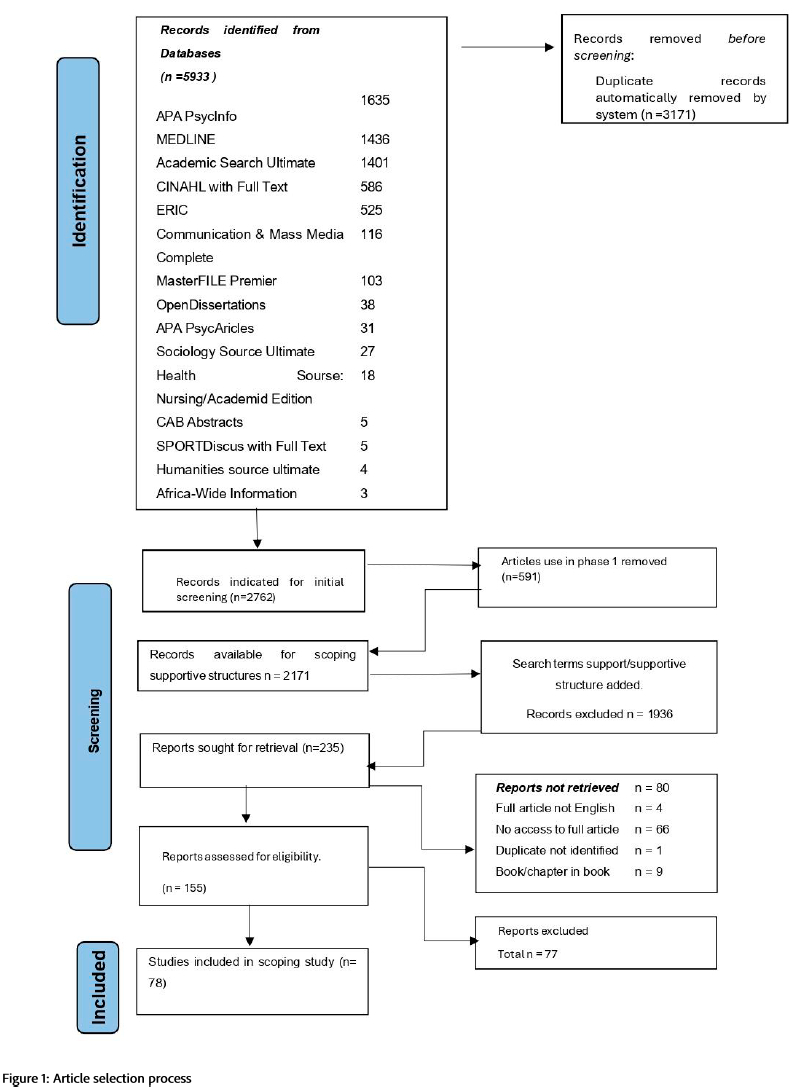
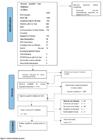
Article selection is outlined in Figure 1 (page 4). The initial electronic database search provided 5 933 abstracts with 2 762 after automatic system deduplication to identify the presence of occupational markers and 591 articles used in phase 1 of the study were removed. Two thousand one hundred and seventy-one (2171) studies remained and the search term support was added to determine the eligibility of articles to be included in the current study. Another 1936 articles were excluded based on the search terms and 235 records were indicated for inclusion in the current study. To determine eligibility, 235 records were sought for retrieval of which 80 could not be retrieved. The remainder of the studies (155) were assessed for eligibility of which 77 were excluded. The scoping study consisted of 78 records with full reports on each studt.
Stage 4: Charting the data
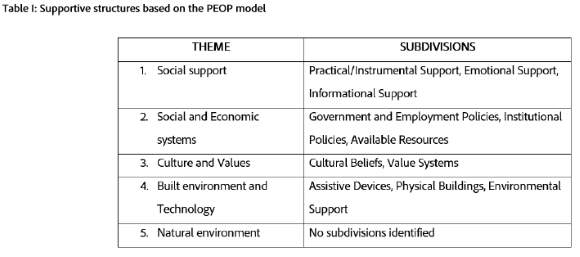
Data charting aims to provide a logical and descriptive summary of research results with the purpose of aligning the results with the initial research question as well as the objectives of the study24. The supportive structures described in literature were noted on an excel sheet. According to the PEOP model's descriptors for extrinsic factors (environment) as supportive structure to enable occupational performance and participation11. The extrinsic or environmental descriptors include social support, social and economic systems, culture and values and the built environment and technology as well as the natural environment as overarching themes with their own subdivisions to illuminate the content of the theme. Themes can be outlined as illustrated in Table I (below)
Stage 5: Collating, summarizing, and reporting the results.
The headings of the themes were determined through the application of the extrinsic or environmental factors in the PEOP model. Each of these factors were noted as a theme in the current research. Subdivisions in each theme were also obtained from the PEOP model as they identify and describe the content of each overarching theme11. Within each subdivision components were indicated as these components emerged from scoping the literature. Results will be tabulated followed by a description of the literature trends observed.
Ethics:
No ethical clearance was required for this study as no human subjects were involved.
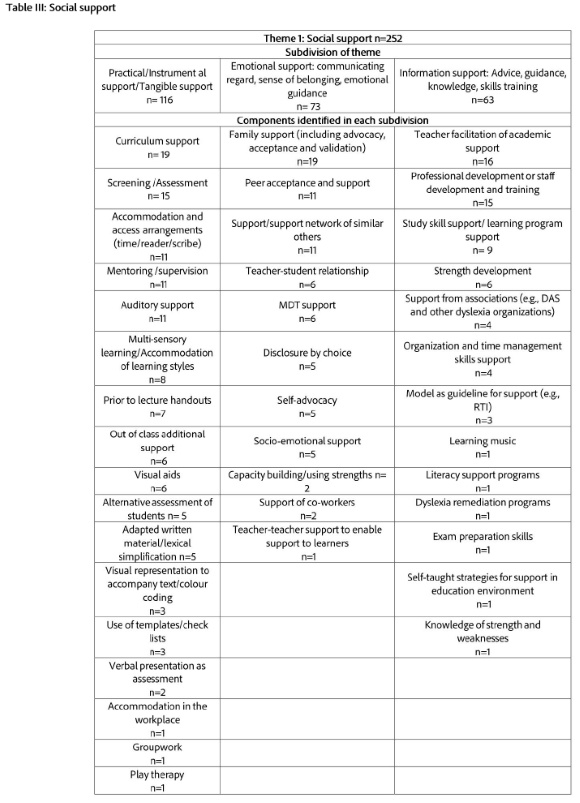
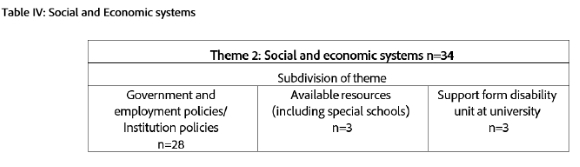
The results are reported per identified theme with subdivisions and components and summarized in Tables III (page 6), IV (page 7) and V (page 7). The number of articles referring to a specific component are indicated by the 'n' value in the table. Some articles may bear reference to multiple components.
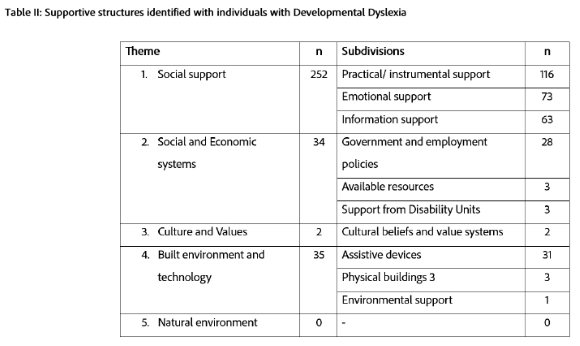
The analysis identified 323 references to supportive structures across five themes. Table II (below) presents the distribution of these references and their subdivisions.
THEME 1: Social support
Theme 1 (n = 252) described social support delineated by practical or instrumental support (n = 116), emotional support (n = 73) and information support (n = 63)11. Within the subdivision of instrumental support, results indicated that assessment or screening as well as accommodation and access arrangements (specifically referring to additional time, reader, or scribe), mentoring or supervision, curriculum and auditory support, multi-sensory learning, or the accommodation of learning styles where the types of instrumental or tangible support mostly indicated by literature as means of support to learners with developmental dyslexia. Curriculum support can be singled out in this subdivision as a major contributor.
Informational support includes advice, guidance, knowledge and skills training11. Study skill or learning program support, teachers as facilitators of academic support and professional development or staff development and training were noted as the primary contributors in this section of support to dyslexic individuals.
Emotional support is noted as a communicating regard, creating a sense of belonging or emotional guidance11. Within this section family support (that includes advocacy, acceptance and validation) was the major contributorwith peer acceptance and support as well as the support or supportive network of similar others also largely contribute to this subdivision.
THEME 2: Social and Economic systems
The results in theme 2 (n = 34) referred to social and economic systems and could be divided into available resources (n = 3) - with specific reference to schools accommodating learners with dyslexia, government and employment policies or the policies upheld by institutions (n = 28) and the support from disability units at tertiary training institutions (n = 3).
THEME 3: Culture and values
Theme 3 (n = 2) refers to culture and values. Limited reference to culture and values as a contributor toward support for dyslexic individuals indicated.
THEME 4: Built environment and technology n= 35
The built environment and technology (n = 35) described in theme 4 is noted in the subdivision's tools and appliances that supports activity and rest including assistive devices (n = 31), physical buildings (n = 3), and environmental support (n = 1)

Tools and appliances that supports activity and rest were noted most in literature as supportive structures for individuals with dyslexia and include the provision of tailored assistive devices
THEME 5: Natural Environment
Within the scope of this study and with the search terms used, no study indicated that the natural environment (n = 0) as described in theme 5 could provide a supportive structure for individuals with developmental dyslexia
DISCUSSION
The objective of this study was to identify supportive structures, as described in international literature, for individuals with developmental dyslexia. The PEOP model indicated five (5) overarching external descriptors11. These descriptors - social support, social and economic systems, culture and values, built environment and technology and natural environment - were used as indicators to identify five (5) themes for supportive structures derived from 78 articles representing 24 countries from across the globe, confirming these supportive structures' presence across international borders.
The first theme describes social support as means of support for individuals with developmental dyslexia and was strongly represented in literature. Social support within the PEOP model can be described as the support experienced rather than observed by an individual and the amount of support may vary between individuals11. The first subdivision refers to practical support. Practical support is tangible and can also be described as instrumental support. Results indicate that curriculum support25,26 was the biggest contributor and could include how theory was translated into practice. Screening or assessment26,27 was also seen as a positive contributor to the social support individuals with dyslexia receive. Early identification proves to be valuable especially in predicting positive outcomes on tertiary level26. Arrangements to accommodate and give individuals with developmental dyslexia access to learning material or assessment opportunities are also regarded as a big contributor toward social support. This may include but is not limited to oral examinations, discussions sessions or dialogue opportunities26. The provision of extra time to complete assessments opportunities or the provision of a reader or scribe may also be beneficial to the individual with dyslexia27. According to literature individuals with dyslexia indicated mentoring and supervision as valuable social support27,28,29 with auditory support also featuring as one of the important social support structures. This may include the recording of classes27, dictating notes, using internet-based audio resources, using speech -to -text recognition programs and speech recognition software30.
Research also indicates multi-sensory learning or accommodation of learning styles as well as prior lecture handouts28 as valuable resources for individuals with dyslexia. Although not common, out of class additional support,28 as well as visual aids30 have been described as social support. Additional social support may also include adapted written material or material with lexical simplification30, visual representation to accompany text or colour coding30, use of templates or check lists30, accommodation in the workplace30 as well as groupwork and play therapy. Practical support includes a variety of supportive structures to enhance occupational performance and participation in individuals with dyslexia.
The second subdivision describes information support that may include advice, guidance, knowledge and skills training11. Teachers or lecturers as primary role players in the facilitation of academic support was highlighted in this subdivision2629. The results of the research also indicate professional development or staff development and training as a dominant contributor to information support3l32.With increased knowledge about dyslexia, support for individuals with dyslexia will increase, thus enhancing the occupational performance and participation of an individual with dyslexia. Adaptation in the way learning material is presented or alternative ways to study was also indicated as study skill support or learning program support26'28,33 and may differ between institutions. As part of the profile of an individual with dyslexia, strengths are listed. The acknowledgement and development of the unique strengths possessed by an individual with dyslexia are also regarded as a supportive structure34,35. Individuals with dyslexia may have difficulty with organization and time management and may require support in this regard27,28. Students also acknowledge the role of dyslexia organizations as a supportive structure26. Informational support may also include literacy support programs36, dyslexia remediation programs3612, exam preparation skills28, self-taught strategies for support in education environment37, knowledge of strengths and weaknesses, model as guideline for support38 and learning music39.
Emotional support concludes the third subdivision within the theme of social support and include aspects describing the communication of regard, sense of belonging as well as emotional guidance. Family support that includes advocacy, acceptance as well as validation proves to be the biggest contributor to the theme of social support40. Apart from family support the support of similar others17 as well as peer acceptance and support was noted26. This emotional support also extends toward the teacher-student relationship as support within the academic environment41 accompanied by socio-emotional support36,42. Support from the multi-disciplinary team, including the involvement from school nurses43, are indicated in literature. Disclosure of the dyslexic identity, if by choice, also serves as emotional support27 linking to self-advocacy44 by the individual with dyslexia. Indirect emotional support was noted by teacher-to-teacher support to enable learners as well as co-worker support.
Within this theme family support as well as the support provided by a curriculum was noted to be the biggest contributors toward social support. Underlining the above was the importance of early identification and screening, the involvement of teachers arranging academic support, mentors, and supervisors as well as the support provided by peers and similar others. This clearly indicates the importance of the variety of social supportive structures available to individuals with dyslexia and noting the important role of family, teachers (and the education system, especially the role of curriculum support) as well as peers and similar others.
The second theme revolves around the social and economic systems as means of social support and can be described as the available infrastructure, policies and legislation that may affect participation, the availability as well as access to resources and economic security and independence11. The current results described government and employment policies, institutional policies, availability of resources and the support from disability units at universities. The biggest contributor was indicated as policies (either on government or institutional level) in place to assist individuals with dyslexia26,28,29. Examples of such policies include legislation mandating inclusive education practices, also acknowledging that learners with dyslexia in general may differ from those of students with dyslexia in higher education,5 disability equity acts that require academic accommodations28, institutional policies addressing examination accommodations or alternative assessment methods26and support in environments where practical learning needs to take place29 highlighting the importance of structured referral pathways to disability support units 28,30.The different support structures as well as routes to access these structures should be made know to the students37.
Culture and values were indicated as theme 3 and included societal factors. The cultural environment can be recognized as expected norms for time and space use, behaviour, and activities as well as the expectations of a specific society regarding age and gender roles. It may also extend to the shared explanations of health, well-being, and ill health. The societal factors' focus is on social acceptance, stereotyping and attitudes toward differences or social prejudice11. Only two articles indicated the cultural environment as supportive structure for individuals with dyslexia. If, however, the description of culture and values as delineated in the PEOP model are reviewed, it underlines the importance of the knowledge of the culture of an individual in the identification, assessment and support given to an individual with dyslexia45. This knowledge would also be of vital importance in the planning of tailored and client centred occupational therapy intervention.
Theme 4 describes the built environment and technology that includes physical buildings as well as tools and appliances that supports activity and rest (including assistive devices)3. Within this theme the importance of assistive technology was noted as a particular supportive structure for individuals with dyslexia46,47,48.
In the context of environmental adaptations, physical spaces were occasionally adapted to reduce sensory distractions (e.g., quiet rooms, soundproofed study areas)49, particularly in schools and higher education settings. Digital learning platforms offering multimodal content delivery (visual, auditory, and interactive)37,46, were also noted as beneficial in accommodating diverse learning styles.
The role of occupational therapists in recommending, training, and supporting the use of these technologies was emphasised across several studies. These technologies not only improve academic functioning but also promote independence and self-efficacy, contributing significantly to occupational participation in education and work environments51,52
The dyslexic student should however always be able to choose the kind of support needed to ensure a good match between the student and the support provided and to avoid technological overload51,52.
Theme 5 indicates the contribution of the natural environment, noted as the geographical features like terrain, sunlight, climate and air quality, as supportive structure11. Within the current research no literature was found that could indicate that the natural environment could act as supportive structure to individuals with dyslexia.
Although supportive structures were indicated overa broad spectrum of themes with subdivisions, social support remains the biggest contributor and could thus be best applied as supportive structure for individuals with dyslexia. Within this theme the practical support included the provision of curriculum support, screening, and assessments, mentoring or supervision as well as accommodation and access arrangements that may include extra time, the use of a reader or a scribe. Provision of these supportive structures are closely linked to government and employment policies or policies provided by a specific institution4 - also indicated as a supportive structure. Without much needed guidelines provided by governing bodies, support for individuals with dyslexia cannot be claimed. This leads back to screening and assessment of individuals with dyslexia. Support can only be provided once an individual with dyslexia has been identified4,53.
The understanding of the dyslexic profile and the impact dyslexia has on the occupational participation and performance of an individual3,13 will always be the starting point for the provision of support thus underpinning the results of the research indicating screening or assessment as a contributor toward support. Once an individual with dyslexia has been identified, the additional practical supportive structures can be deployed if the governing bodies allow and underpin the support needed. The knowledge of the possible practical support available internationally thus begs the question: Are these supportive structures also available in South Africa promoting occupational participation and performance and upholding social justice? And if so, is the support easily accessible and supported by governing an institutional guideline to promote support and awareness?
CONCLUSION
This scoping study identified four different themes, each outlined by their own subdivisions that contribute to the overview of supportive structures internationally available to individuals with dyslexia. With these supportive structures at their disposal individuals with dyslexia navigate through the daily challenges that they may face. Building on this thematic overview, it becomes evident that a deeper understanding of dyslexia is essential for developing effective support strategies.
Knowledge and a clear understanding of the scope of dyslexia remains important. This was echoed by information support that includes advice, guidance, knowledge, and skills training especially indicated for professionals who will directly be involved in the management of individuals with dyslexia. Individuals with dyslexia will thus also benefit from indirect support provided to staff and professionals assisting them. This leans to a shift in attention of occupational therapists from direct client intervention toward case management and staff training in order to promote better understanding of dyslexia and support needed. Through research, the knowledge of South African professionals directly working in institutions where individuals with dyslexia may prominently feature (thus facilities of teaching and learning) would indicate the availability of social support available. The results may inform governing bodies toward the development of training programs as supportive structures for individuals with dyslexia as well as the provision of guidelines for assistance. This evolving role of occupational therapists highlights the broader systemic implications and the need for targeted professional development.
As per research results the core of social support for individuals with dyslexia remains within their family or peer group. Again, the support provided by families within the South African context and their knowledge and perception of dyslexia should be investigated. Although culture was not indicated as a supportive structure for individuals with dyslexia, the perception of what dyslexia entails, and the management thereof may greatly be influenced by cultural perceptions of dyslexia45. This knowledge should then also inform the occupational therapist on the intervention and support that should be provided to an individual with dyslexia. In parallel with professional development, technological advancements offer additional avenues for supporting individuals with dyslexia.
Apart from social support, technology may also contribute as a supportive structure for individuals with dyslexia and may include online programs46 as well as different social media and digital platforms. These digital platforms may not only assist with work and education as occupation but will support social and leisure engagement while promoting independence as well54. Although most of these digital platforms were not designed with dyslexia in mind, the support they offer to individuals with dyslexia are invaluable. However, the effectiveness of these supports may be shaped by cultural and societal diversities within the South African context.
A supportive structure should be tailored to the needs of the individual, enhance occupational performance and participation and facilitate the experience of occupational competence through the use of occupation29,49,31. The results of this research give guidelines of the type of support that can be provided to an individual with dyslexia - either through direct or indirect intervention. Occupational therapy is further ideally situated to continue with research relevant and applicable to the South African context considering the rich linguistic and cultural landscape and the influence supportive structures may have on all individuals with dyslexia in South Africa. Recognising these cultural nuances is crucial for tailoring interventions that truly meet individual needs and promote occupational competence.
Recommendations
This study intended to investigate the landscape of supportive structures available to individuals with dyslexia. The results, however, reflects an international landscape. Further research will be needed to determine the availability as well as accessibility of these structures to all South Africans. Occupational therapy is well positioned to lead research in the field of supportive structures for individuals with developmental dyslexia within the South African context. The management of developmental dyslexia will however involve multi-disciplinary team members. To optimally support individuals with dyslexia and promote interprofessional communication, a model for the interdisciplinary management of developmental dyslexia within the South African contexts should be investigated.
Limitations
Due to time constraints, the current study was limited to a scoping study without implementing stage 6 of the structure indicated by Arksey and O'Malley21. Further research should be conducted to determine the presence of supportive structures specific to the South African context.
Conflicts of Interest
None to declare
Author Contributions
Both listed authors contributed to the conceptualisation and design of the study, the acquisition, analysis and interpretation of the data, and drafting and final approval of the manuscript. Both authors agreed to be accountable for all aspects of the work in ensuring that questions related to the accuracy or integrity of any part of the work are appropriately investigatedand resolved.
Acknowledgements
We would like to acknowledge the University of the Free State Librarian, for gathering the literature for our study
REFERENCES
-
1. Snowling MJ. Early identification and interventions for dyslexia: a contemporary view. Journal of Research in Special Educational Needs. 2013;13(1):7-14. http://dx.doi.org/10.1111/j.1471-3802.2012.01262.x
» http://dx.doi.org/10.1111/j.1471-3802.2012.01262.x -
2. Al Otaiba S, Rouse AG, Baker K. Elementary Grade Intervention Approaches to Treat Specific Learning Disabilities, Including Dyslexia. Language, Speech, and Hearing Services in Schools. 2018;49(4):829-42. http://dx.doi.org/10.1044/2018_LSHSS-DYSLC-18-0022
» http://dx.doi.org/10.1044/2018_LSHSS-DYSLC-18-0022 -
3. Frith U. Paradoxes in the definition of dyslexia. Dyslexia. 1999;5:192-214. http://dx.doi.org/10.1002/(SICI)1099-0909(199912)5:4<192::AID-DYS144>3.0.CO:2-N
» http://dx.doi.org/10.1002/(SICI)1099-0909(199912)5:4<192::AID-DYS144>3.0.CO:2-N -
4. Bishop DVM. Ten questions about terminology for children with unexplained language problems. International Journal of Language & Communication Disorders. 2014;49(4):381-415. http://dx.doi.org/10.1111/1460-6984.12101
» http://dx.doi.org/10.1111/1460-6984.12101 -
5. Habib M. The neurological basis of developmental dyslexia. Brain. 2000:123(12):2373-99. http://dx.doi.org/10.1007/s00390-009-0100-x
» http://dx.doi.org/10.1007/s00390-009-0100-x -
6. Gabay Y, Thiessen ED, Holt LL Impaired statistical learning in developmental dyslexia. Journal of Speech, Language, and Hearing Research. 2015;58:934-45. http://dx.doi.org/10.1044/2015_JSLHR-L-14-0324
» http://dx.doi.org/10.1044/2015_JSLHR-L-14-0324 -
7. Ramus F, Rosen S, Dakin SC, Day BL, Castellote JM, White S, et al. Theories of developmental dyslexia: Insights from a multiple case study of dyslexic adults. Brain. 2003;126(4):841-65. http://dx.doi.org/10.1093/brain/awg076
» http://dx.doi.org/10.1093/brain/awg076 -
8. Miller, B., McCardle P. Moving closer to a public health model of language and learning disabilities: The role of genetics and the search for etiologies Brett. Behavioural genetics 2011,-41(1):1-5. http://dx.doi.org/10.1007/s10519-010-9439-9.Moving
» http://dx.doi.org/10.1007/s10519-010-9439-9.Moving -
9. Bishop DVM. Genes, cognition, and communication: Insights from neurodevelopmental disorders. Annals of the New York Academy of Sciences. 2009;1-18. http://dx.doi.org/10.1111/j.1749-6632.2009.04419.x
» http://dx.doi.org/10.1111/j.1749-6632.2009.04419.x -
10. Holmes, Lynn C; Fourie J V. An Instrumental Single Case study: The development of a Multi-Dimensional Interactive Model that illustrates Barriers faced by a man with Developmental Dyslexia. Asia Pacific Journal of Developmental Differences 2021;8(2):302-34. http://dx.doi.org/10.3850/S2345734121000141
» http://dx.doi.org/10.3850/S2345734121000141 - 11. Turpin M, Iwama M. Using Occupational Therapy Models in Practice. Using occupational therapy models in practice a field guide. 2011;1-187.
- 12. Christiansen, CH. and Baum, CM., 1991. The Person-Environment-Occupation Performance Model: A transactive approach to occupational performance. In: CH. Christiansen and CM. Baum, eds. Occupational therapy: Overcoming human performance deficits. Thorofare, NJ: Slack, pp. 47-70.
-
13. Brimo K, Dinkier L, Gillberg C, Lichtenstein P, Lundström S, Asberg Johnels J. The co-occurrence of neurodevelopmental problems in dyslexia. Dyslexia. 2021;27(3):277-93. http://dx.doi.org/10.1002/dvs.1681
» http://dx.doi.org/10.1002/dvs.1681 - 14. Christiansen, CH; Baum CHJ. Occupational therapy : performance, participation, and well-being. 3rd ed. Charles H. Christiansen CMB, editor. Occupational Therapy in Health Care. SLACK Incorporated; 2005.
-
15. Peterson RL, Pennington BF. Developmental dyslexia. In: The Lancet. 2012. p. 1997-2007. http://dx.doi.org/10.1016/S0140-6736(12)60198-6
» http://dx.doi.org/10.1016/S0140-6736(12)60198-6 -
16. Tunmer W, Greaney K. Defining dyslexia. Journal of Learning Disabilities. 2010;43(3):229-243 http://dx.doi.org/10.1177/0022219409345009
» http://dx.doi.org/10.1177/0022219409345009 -
17. Smith-Spark JH. A review of prospective memory impairments in developmental dyslexia: evidence, explanations, and future directions. Clinical Neuropsychologist. 2018;32(5):816-35. http://dx.doi.org/10.1080/13854046.2017.1369571
» http://dx.doi.org/10.1080/13854046.2017.1369571 -
18. Dahle AE, Knivsberg AM, Andreassen AB. Coexisting problem behaviour in severe dyslexia. Journal of Research in Special Educational Needs. 2011;11(3):162-70. http://dx.doi.org/10.1111/i.1471-3802.2010.01190.x
» http://dx.doi.org/10.1111/i.1471-3802.2010.01190.x -
19. Colquhoun HL, Levac D, O'Brien KK, Straus S, Tricco AC, Perrier L, et al. Scoping reviews: Time for clarity in definition, methods, and reporting. Journal of Clinical Epidemiology 2014. http://dx.doi.org/10.1016/j.jclinepi.201403.013
» http://dx.doi.org/10.1016/j.jclinepi.201403.013 -
20. Dijkers M. What is a scoping review? KT Update. 2011,4(1):1-5 http://dx.doi.org/10.1089/ten.tea.2015.0121
» http://dx.doi.org/10.1089/ten.tea.2015.0121 -
21. Arksey H, O'Malley L. Scoping studies: Towards a methodological framework International Journal of Social Research Methodology. 2005;8(1):19-32 https://doi.org/10.1080/1364557032000119616
» https://doi.org/10.1080/1364557032000119616 -
22. Levac D, Colquhoun H, O'Brien KK. Scoping studies: Advancing the methodology. Implementation Science. 2010;5(1):1-9 https://doi.org/10.1186/1748-5908-5-69
» https://doi.org/10.1186/1748-5908-5-69 -
23. Carawan LW, Nalavany BA, Jenkins C. Emotional experience with dyslexia and self-esteem: The protective role of perceived family support in late adulthood. Aging and Mental Health. 2016;20(3):284-94. https://doi.org/10.1080/13607863.2015.1008984
» https://doi.org/10.1080/13607863.2015.1008984 -
24. Khalil H, Peters M, Godfrey CM, Meinerney P, Soares CB, Parker D. An Evidence-Based Approach to Scoping Reviews. Worldviews on Evidence-Based Nursing 2016,-13(2):118-23. https://doi.org/10.1111/wvn.12144
» https://doi.org/10.1111/wvn.12144 - 25. Child J, Langford E. Exploring the learning experiences. Art & Science 2011;25(40):39-46.
-
26. Holgate P. Developing an inclusive curriculum of architecture for students with dyslexia. Art, Design and Communication in Higher Education. 2015,-14(1):87-99. https://doi.org/10.1386/adch.141.87_1
» https://doi.org/10.1386/adch.141.87_1 -
27. Baker J, Widdowson M. An Inquiry Into the Experience of the Dyslexic Transactional Analysis Psychotherapist. Transactional Analysis Journal. 2020,-50(1):24-40. https://doi.org/10.1080/03621537.2019.1690236
» https://doi.org/10.1080/03621537.2019.1690236 -
28. Dobson S. A documentary analysis of the support services offered to adult learners with dyslexia in higher education. Journal of Further and Higher Education 2019;43(9):1181-95. https://doi.org/10.1080/0309877X.2018.1463359
» https://doi.org/10.1080/0309877X.2018.1463359 -
29. Griffiths S. "Being dyslexic doesn't make me less of a teacher". School placement experiences of student teachers with dyslexia: Strengths, challenges and a model for support. Journal of Research in Special Educational Needs. 2012;12(2):54-65. https://doi.org/10.1111/j.1471-3802.2011.01201.x
» https://doi.org/10.1111/j.1471-3802.2011.01201.x -
30. Locke R, Alexander G, Mann R, Kibble S, Scallan S. Doctors with dyslexia: strategies and support. Clinical Teacher. 2017;14(5):355-9. https://doi.org/10.1111/tct.12578
» https://doi.org/10.1111/tct.12578 -
31. Gwernan-Jones R, Burden and RL Are They Just Lazy? Student Teachers' Attitudes About Dyslexia. Dyslexia. 2009;16:66-86. https://doi.org/10.1002/dvs.393
» https://doi.org/10.1002/dvs.393 - 32. Ramli S, Idris IB, Omar K, Harun D, Surat S. Development of Dyslexia Health Education Module (DHEM) for preschool teachers. Malaysian Journal of Medicine and Health Sciences. 2020,-16(9):1-7.
-
33. RazakT, Asmuri S, Wang A, of ELAPJ, 2021 undefined. Progress monitoring of dyslexic primary school learners enrolled in an English Exam Skills Programme. DasOrgSg. 2021;8(1):5-29. https://doi.org/10.3850/S2345734121000019
» https://doi.org/10.3850/S2345734121000019 -
34. Rappolt-Schlichtmann G, Boucher AR, Evans M. From Deficit Remediation to Capacity Building: Learning to Enable Rather Than Disable Students with Dyslexia. Language, Speech, and Hearing Services in Schools. 2018,-49(4):864-74. https://doi.org/10.1044/2018 lshss-dyslc-18-0031
» https://doi.org/10.1044/2018 lshss-dyslc-18-0031 -
35. Marland B. Reimagining Dyslexia through Inclusive Pedagogies and the Importance of Centralised Support. Kairaranga. 2018;19(2):3-744. https://doi.org/10.54322/kairaranga.v19i2.3
» https://doi.org/10.54322/kairaranga.v19i2.3 - 36. Beatrice CYE. "A Happy and Caring School": Capturing the Voices of Dyslexic and Non-dyslexic Learners about Their Ideal and Actual School Experiences. 2020.
-
37. Thompson LS. The dyslexic student's experience of education. South African Journal of Higher Education 2021,-35(6). https://doi.org/10.20853/35-6-4337
» https://doi.org/10.20853/35-6-4337 - 38. Huffman S, Thompson A. Meeting the Needs of Students with Dyslexia: Librarians, Teachers, and Students Working Together Hand-in-Hand :161-73.
- 39. Nelson KP. Kent Peter Nelson Successful strategies of individuals with dyslexia in the field of music: A comparative case study. 2014.
-
40. Nalavany BA, Carawan LW, Sauber S. Adults with dyslexia, an invisible disability: The mediational role of concealment on perceived family support and self-esteem. British Journal of Social Work 2015,-45(2):568-86. https://doi.org/10.1093/bjsw/bct152
» https://doi.org/10.1093/bjsw/bct152 -
41. Rowan L. Learning with dyslexia in secondary school in New Zealand: What can we learn from students' past experiences? Australian Journal of Learning Difficulties. 2010,-15(1):71-9. https://doi.org/10.1080/1940415090352455
» https://doi.org/10.1080/1940415090352455 - 42. Alexander-Passe N. How Children with Dyslexia Experience School: Developing an Instrument to Measure Coping, Self-Esteem and Depression. 2004.
-
43. DeBrewJK An Unlikely Advocate: The Role of the School Nurse With Children Who Have Dyslexia. NASN School Nurse. 2013;29(2):60-62. https://doi:10.1177/1942602X13508984
» https://doi:10.1177/1942602X13508984 -
44. Soni A. Students' experiences of academic success with dyslexia: A call for alternative intervention. Support for Learning. 2017,-32(4):387-405. https://doi.org/10.1111/1467-9604.12182
» https://doi.org/10.1111/1467-9604.12182 -
45. Elbeheri G, Everatt J, Reid G, Mannai H al. Dyslexia assessment in Arabic. Journal of Research in Special Educational Needs. 2006;6(3):143-52. https://doi.org/10.1111/j.1471-3802.2006.00072.x
» https://doi.org/10.1111/j.1471-3802.2006.00072.x -
46. Sidhu MS, Manzura E. An effective conceptual multisensory multimedia model to support dyslexic children in learning. International Journal of Information and Communication Technology Education. 2011,7(3):34-50. https://doi.org/10.4018/iicte.2011070104
» https://doi.org/10.4018/iicte.2011070104 -
47. Locke R, Scallan S, Mann R, Alexander G. Clinicians with dyslexia: a systematic review of effects and strategies. The Clinical Teacher. 2015;12:394-398 https://doi.org/10.1111/tct.12331
» https://doi.org/10.1111/tct.12331 -
48. De Beer J, Engels J, Heerkens Y, Van Der Klink J. Factors influencing work participation of adults with developmental dyslexia: A systematic review. BMC Public Health. 2014;14(1). https://doi.org/10.1186/1471-2458-14-77
» https://doi.org/10.1186/1471-2458-14-77 -
49. Dorsey J. Occupational Therapy Scope of Practice. American Journal of Occupational Therapy. 2021;76(December):1-9. https://doi.org/10.5014/AJOT.2021.75S3005
» https://doi.org/10.5014/AJOT.2021.75S3005 -
50. Amini DA, Kannenberg K, Bodison S, Chang PF, Colaianni D, Goodrich B, et al. Occupational therapy practice framework: Domain & process 3rd edition. American Journal of Occupational Therapy. 2014. https://doi.org/10.5014/aiot.2014.682006
» https://doi.org/10.5014/aiot.2014.682006 -
51. Björklund M. Dyslexic Students: Success Factors for Support in a Learning Environment. The Journal of Academic Librarianship. 2011;37(5):423-429 https://doi.org/10.1016/i.acalib.2011.06.006
» https://doi.org/10.1016/i.acalib.2011.06.006 -
52. Gotesman E, Goldfus C. The Impact of Assistive Technologies on the Reading Outcomes of College Students with Disabilities. Educational Technology. 2010,-50(3):21-25 https://www.istor.org/stable/44429798
» https://www.istor.org/stable/44429798 -
53. Colenbrander D, Ricketts J, Breadmore HL. Early Identification of Dyslexia: Understanding the Issues. Language, Speech, and Hearing Services in Schools. 2018;49(4):817-28.https://doi.org/10.1044/2018_lshss-dyslc-18-0007
» https://doi.org/10.1044/2018_lshss-dyslc-18-0007 -
54. Barden O. Facebook levels the playing field: Dyslexic students learning through digital literacies. Research in Learning Technology. 2014,-22(1063519):1-19. https://doi.org/10.3402/rlt.v22.18535
» https://doi.org/10.3402/rlt.v22.18535
Reviewed (1st Round): 18 May 2025
Revised: 31 July 2025
Reviewed (2nd Round): 3 August 2025
Revised: 9 September 2025
Accepted: 11 September 2025
EDITOR
Blanche Pretorius
https://orcid.org/0000-0002-3543-0743
DATA AVAILABILITY
Upon reasonable request, from corresponding author
FUNDING
No funding was obtained