The use of Danielson's Framework in developing a new fieldwork training setting for 3rd year occupational therapy students from the University of the Western Cape
Abstract
Charlotte Danielson developed a framework for teaching to assist novice educators. Her framework considers four domains, namely Planning and Preparation, The Classroom Environment, Instruction and finally Professional Responsibilities. This article describes the adaptation of Danielson's Framework in the development of a new fieldwork setting for third year occupational therapy students. The description of the process that was followed illustrates how the four domains were used to guide the development of a new fieldwork setting, which would meet the requirements of the university as well as the needs of a group of six third year occupational therapy students who were doing their first fieldwork practice in this new setting. The conclusion shows that this Framework proved to be a suitable one to guide the process of developing a fieldwork setting.
Fieldwork site development; Danielson's Framework; Student training; supervision
INTRODUCTION
The undergraduate occupational therapy curriculum requirements as set by the World Federation of Occupational Therapists (WFOT) Revised Minimum Standards for the Education of Occupational Therapist state that every training institution must include a field-work component which encourages integration of theory and practice and provides a platform in which to develop clinical skills. To this end, students from the University of the Western Cape (UWC) are placed in a variety of fieldwork settings during the course of the four year training programme. The interventions provided by the students in these settings can be with either individual clients or groups of clients or both, depending on the needs of the setting.
As interest in and understanding of the field of Occupational Therapy grows, so do the number of students enrolled in the BSc. Occupational Therapy course at UWC. The result of this growth in numbers is that existing fieldwork settings are over-subscribed, thus new fieldwork settings need to be developed to address the clinical needs in training. This is not just a local or South African phenomenon, but a worldwide predicament. The South African Minimum Standards for the training of Occupational Therapists2 3
As a result, with three training institutions within the Western Cape, such fieldwork settings tend to become 'over supplied' with students, causing the supervising therapists to feel overwhelmed by the constant stream of students needing supervision. Cook and Cusick4
In May 2011 the principal of a primary school approached the occupational therapy department with a request to place students at the school. He understood the value of occupational therapy within the school setting, and as there was no occupational therapy services offered in either the school or surrounding area, he felt that the department might be able to provide the service he required. The UWC occupational therapy department felt that developing this fieldwork setting would begin to address the need for added fieldwork sites. As one of the clinical fieldwork supervisors (CFS) the first author was given the task of developing this setting and she used Danielson's Framework5
Charlotte Danielson5
This article will describe the process in the development of one such fieldwork setting based at a primary school in one of the suburbs of Mitchells Plain, Cape Town. The article will also highlight how the Framework developed by Danielson5
Danielson's framework for teaching
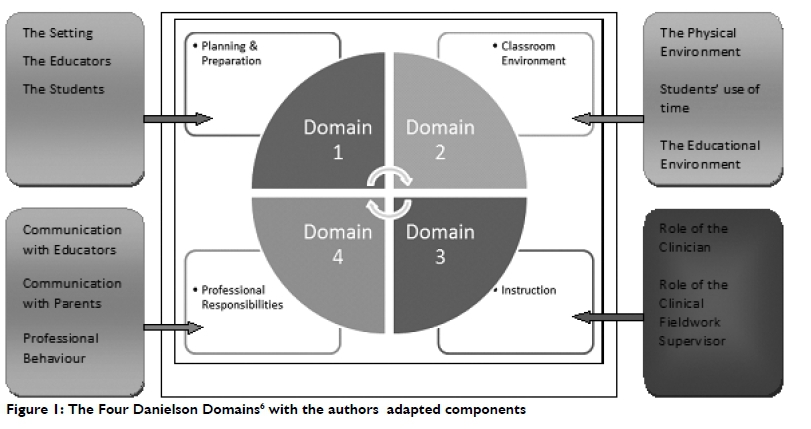
The framework developed by Danielson is used to identify the aspects that teachers should consider in their teaching that aim to promote student learning. Due to the complex nature of teaching, the framework can be used as an outline which teachers can use to develop their areas of competence in their profession. Danielson has divided these areas of competence into twenty-two components which are grouped into four domains of teaching responsibility. These are: Planning and Preparation; The Classroom Environment; Instruction and Professional Responsibility.
The first domain of Planning and Preparation highlights the teacher's design of the content that she expects students to learn. Included in this are the content and pedagogy; the ability to demonstrate knowledge of the students; selecting instructional goals and knowledge of resources. The teacher should also be able to design comprehensible instruction and methods of assessing student learning.
The second domain of The Classroom Environment highlights the non-instructional interactions that occur in a classroom. In this domain teachers are required to create an environment of respect and understanding among the students and towards the teacher. This domain also includes establishing a culture for learning, managing classroom procedures, managing student behaviour as well as organising the physical space of the classroom.
The third domain of Instruction consists of the core of teaching - the engagement of students in learning. The aspects of this domain include clear communication and the ability to correctly use questioning and discussion techniques to engage students in learning as well as to provide clear feedback to students while demonstrating flexibility and responsiveness.
The fourth and final domain of Professional Responsibilities highlights the teachers' responsibilities outside of the classroom arena. This includes the teachers' ability to reflect on their teaching while growing and developing professionally as well as consistently showing professionalism. It is also vital that teachers maintain accurate records, communicate with families and contribute to the school and district.
The following section will highlight how the framework was adapted to suit the supervision of third year occupational therapy students during their fieldwork practice. Each domain will be discussed by highlighting the adapted components of the fieldwork placement and the supervision of the students.
Domain 1: Planning and preparation
According to Danielson5
The Setting
The selected primary school is a mainstream school situated in Westridge, one of the more affluent suburbs of Mitchells Plain66
The Educators
After meeting with the school Principal, and in agreement with the school's Governing Body, the next step was to set up a meeting with the educators of Grade R, 1, 2 and 3 as interventions were to be provided to the learners in the Junior Primary phase. The educators were provided with an overview of the process the third year students would engage in and were guided to select appropriate learners for intervention. In line with the universities fieldwork expectations of a third year student, each student would be responsible for providing occupational therapy intervention to two selected learners as well as facilitating and co-facilitating a gross motor group with ten learners, twice a week for the six weeks.
Preparation of the occupational therapy students to be placed at the school
Prior to the inception of the fieldwork practice, third year students received the necessary theory lectures in terms of occupational therapy process and paediatric clients. These lectures cover theory about normal development of children, appropriate levels of play and the various assessments appropriate to use within a paediatric setting. Third year students are also orientated to fieldwork and provided with a fieldwork manual which contained all the necessary information required for fieldwork training. Bonello7
Domain 2: The classroom environment
This domain is concerned with the classroom environment and the components considered by Danielson5
The physical environment
The school's population consisted of more than l000 learners and physical space at the school was very limited, with no school hall or free classroom space to offer the third year students as a venue in which to provide their interventions. There was however a prefabricated structure which had been earmarked as a library but was not yet in use. The structure was a free standing building separate to the rest of the school, but placed on the playground near to some of the class rooms. This was to be the physical setting in which the students would provide their occupational therapy service. The venue contained shelves of books, six round tables each with six wooden chairs around each table, and a desk on which was placed the computer and printer. On their first day at the school the third year students rearranged the furniture in the library in order to create a 'therapy area'. Gross motor activities were done in either the middle of the room and weather permitting outside in a courtyard and on the grass playground. All equipment was either provided by the third year students or by the UWC occupational therapy department.
Students' use of time
The duration of fieldwork for the six third year students lasted for a period of six weeks, from Monday to Thursday, 08h00 to l5h00. Students were provided with the expectations for the fieldwork placement in terms of written work deadlines, dates and times for evaluation opportunities and general expectations of how time would be spent. Roger et al8
The educational environment
Due to the physical environment, the students' first fieldwork training experience and the minimal contact they had with their CFS, building interpersonal relationships and developing an environment of mutual respect and a safe space to learn were vital. Initially the students were very anxious about 'performing' in front of each other, but as noted by Svidén910
Domain 3: Instruction
The role as a clinician
As a clinician the CFS was responsible for overseeing each student's practical application of occupational therapy assessments and interventions with their clients. Acting as a role model to the students as suggested by Tompson and Ryan11
The role as CFS
The role of the CFS is as a liaison between the university and the fieldwork setting. This ideally entails visiting the students once or twice a week during their fieldwork placement, making sure that all the fieldwork expectations were being met in terms of academic requirements and liaising with the clinician to ensure the students were beginning to integrate the theory into practice while in fieldwork.
As a CFS the first author was therefore responsible for the academic aspects of the students' fieldwork placement. The students were expected to follow the Individual Process Model as discussed by De Jongh12131415et al16
Domain 4: Professional Responsibilities
The final domain from Danielson's Framework55
Communication with the educators
The students were expected to play an active role in the facilitation of the learners' occupational performance within the classroom setting. This entailed spending time in the classroom observing and assessing their learners' occupational performance during the daily educational process. From these assessments the students then had to draw up what they perceived the learners problems to be and give this feedback to the educators. Students provided the educators with information of the physical structuring of their classrooms, suggestions of where to place the learner within the classroom and general information on possible gross and fine motor activities that would be of benefit to all concerned. To do this effectively the students had to make use of literature which strengthened their argument. They were also required to use said information in drawing up an information file that was left at the school and served as a resource to the wider educator body. The students found that these planned sessions with the educators needed to take into account the fact that the educators had years of experience and that the students did not attempt to 'tell the teacher how to teach'. The students used literature on adult handling principles to guide them in presenting these sessions.
Communication with the parents
As the occupational therapy service was new to the school and the parents, the students had to get permission from the learners' parents before they could begin the occupational therapy process with each specific learner. Therefore, written consent forms were drawn up explaining briefly the service to be offered by the students.
Only once the forms had been returned with the necessary consent could the students begin with their occupational therapy process. As with most schools, time was set aside once a term when parents were invited to come and meet with their child's educator to discuss the learner's academic progress. The students were invited along to these meetings so that they could meet and give feedback to their specific learners' parents. The students were quite anxious about these meetings, worried that the parents would have expectations that they would be unable to meet. These meetings were in fact very successful and the students felt able to share information in a manner that the parents understood. They gave a brief overview of the assessment results, what their interventions entailed and were also able to discuss and make some suggestions to the parents with regard to basic home programmes and ways that they could assist their children at home.
Professional behaviour
The university had clear documentation on the expectations of students placed within the fieldwork setting. Students all received this information and were aware of their professional and ethical obligations. The six students had high expectations of themselves both academically and professionally as they felt they were leading the way in terms of this new fieldwork setting. During the course of the six week fieldwork placement the students made use of the various learning opportunities to begin to develop confidence in their abilities to problem solve, apply their knowledge in terms of the use of therapeutic activities and reason clinically17
DISCUSSION
The headings of the domains as described by Danielson55 Planning and Preparation which were considered in terms of The Setting, The Educators and The Students. The junior primary staff and learners at the school were prepared for the arrival of the six students which added to the overall experience of their first fieldwork placement. The components of Communication with Educators and Professional Behaviour considered in Domain Four ensured that the educators were kept abreast of the students' interventions with the learners. The educators appreciated the involvement of the students within their classrooms and were keen to apply suggestions made by the students in terms of classroom structure, gross-motor activities and how best to assist the learners who were struggling with their engagements in learning occupations. Academically the students were prepared for the expectations of the placement, and were able to begin to apply their knowledge practically as suggested in Domain 1.
Domain 3 which considers the aspect of Instruction with the adapted components of The Roles of the Clinician and Fieldwork Supervisor suggests that supervision should involve one clinician to one or two students, and weekly supervisory visits by a fieldwork supervisor. In the context of establishing the new fieldwork setting where there was no clinician the CSF had to fulfil a dual role. As the supervisor student ratio was 1:6 the students had to be disciplined about making and keeping individual appointments, and as Martin and Edwards18Preparation and Planning component of The Students preparation in the first domain and the Professional Behaviour component of the fourth domain which highlighted the need for third year students to begin to integrate their theory knowledge practically.
It was important for the CSF that students felt at ease within the learning environment, as corroborated by Mulholland, Derdall and Roy1617Classroom Environment and the Instruction of the Students with the adapted components of The Students use of Time and the Roles of the Clinician and the CFS considered how to provide feedback, act as a role-model, when integrating theory into practice, provide emotional support, create learning opportunities and generally make sure that all the expectations of both the students and the university were met.
Using the Danielsons5
CONCLUSION AND IMPLICATIONS FOR FURTHER PRACTICE
Fieldwork plays a vital role in the development and growth of occupational therapy students as this is where students get to apply the skills learned within the classroom setting. Here they are afforded the opportunity to observe clinicians in action and are able to put into practice their own knowledge, skills and attitudes. Marton and Saljol9 found that student learning in a real life context or setting provided more concrete and practical learning. The development of this fieldwork site meant that an environment was created in which the students were able to consolidate their learning, put into practice the skill learned and begin to develop their clinical and professional skills. The clients at the fieldwork site were provided with an occupational therapy service which fulfilled their occupational needs in educational barriers and provided meaningful interventions to all concerned.
REFERENCES
- 1. Hocking C, Ness N.E. Introduction to the revised minimum standards for the education of occupational therapists - 2002. WFOT Bulletin, 46: 30-33.
-
2. Professional Board for Occupational Therapy and Medical Orthotics/ Prosthetics and Arts. "Minimum Standards for the training of Occupational Therapists." 2009. <http://www.hpcsa.co.za> (June 2012)
» http://www.hpcsa.co.za - 3. Thomas Y, Penman M, Williamson P Australian and New Zealand fieldwork: Charting the territory for future practice. Australian Occupational Therapy Journal, 2005; 52(1): 78-81.
- 4. Cook C and Cusick A, . Preparing students for their first fieldwork placement using on-campus practicums. Australian Occupational Therapy Journal, 1998; 45(3): 79-90.
- 5. Danielson, C. Enhancing Professional Practice: A Framework for Teaching. Association for Supervision and Curriculum Development, 1996.
-
6. Wikipedia, The free encyclopaedia. (10 Aug. 2012) <http://en.wikipedia.org/wiki/Mitchell's_Plain> (13 June 2011).
» http://en.wikipedia.org/wiki/Mitchell's_Plain - 7. Bonello M. Fieldwork within the Context of Higher Education: a Literature Review. British Journal of Occupational Therapy, 2001; 64(2): 93-99.
- 8. Rodger S, Fitzgerald C, Davila W, Millar F, Allison H. What makes a quality occupational therapy practice placement? Students' and practice educators' perspectives. Australian Occupational Therapy Journal, 2011;58(3): 195-202.
- 9. Svidén G. Different Approaches to Learning among Occupational Therapy Students. Scandinavian Journal of Occupational Therapy, 2000; 7(3): 132-137.
- 10. Flood B, Haslam L, Hocking C. Implementing a collaborative model of student supervision in New Zealand: Enhancing therapist and student experiences. New Zealand Journal of Occupational Therapy, 2010; 57(1): 22-26.
- 11. Tompson M, Ryan G. Influences on students during their early fieldwork placements. Canadian Journal of Occupational Therapy, 1996; 63(3): 173-182.
- 12. De Jongh J. An innovative curriculum change to enhance occupational therapy student practice. South African Journal of Occupational Therapy, 2009; 39(1): 31-38.
- 13. Laight J, Asghar M, Aslett-Bentley A. Investigating Conceptions and Practice of Formative Assessment in Hight Education. Literacy Information and Computer Education Journal, 2010; 1(3): 192-199.
- 14. Buchanan H, Moore R Van Niekerk L. The Fieldwork Case Study: Writing for Clinical Reasoning. American Journal of Occupational Therapy, 1998; 52(4): 291-295.
- 15. Mulholland S, Derdall M, Roy B. The Student's Perspective on What Makes an Exceptional Practice Placement Educator. British Journal of Occupational Therapy, 2006; 69(12): 567-571.
- 16. Rodger S, Thomas Y Holley S, Springfield E, Edwards A, Broad-bridge J, Greber C, McBryde C, Banks R, Hawkins R. Increasing the occupational therapy mental health workforce through innovative practice education: A pilot project. Australian Occupational Therapy Journal, 2009; 56(6): 409-417.
- 17. Cooper R, Raine R. Role-emerging placements are an essential risk for the development of the occupational therapy profession: the debate. British Journal of Occupational Therapy, 2009; 72(9): 416-418.
- 18. Martin M, Edwards L. Peer Learning on Fieldwork Placements. British Journal of Occupational Therapy, 1998; 61(6): 249-252.
- 19. Marton F, Saljo R. On qualitative differences in learning: l - Outcome and process.British Journal of Educational Psychology, 1976; 46: 4-11.
Jane Erasmus
Occupational Therapy Dept, University of the Western Cape
Private Bag Xl7, Bellville 7535