Development of a task-based bilateral fine motor skill assessment for grade 0 children in South Africa
Abstract
The need for an assessment for Grade 0 children, to establish their school readiness in the area of fine motor skills, resulted in the development of the Task Based Assessment (TBA). The aim of the assessment was to include task-based items based on every day activities required at school and for personal management. Aspects of fine motor skills in terms of efficiency, accuracy, motor skill and time were considered. The development of the items and the psychometric testing for aspects validity and reliability are reported. Testing included the focus groups and pilot studies to field test the TBA and align the items with fine motor skills appropriate for Grade 0 children. Construct and convergent validity and test-retest reliability were found to be at acceptable levels. Field testing on 130 participants from different socioeconomic backgrounds was completed to assess the sensitivity to change over time.
Assessment; Bilateral fine motor skills; Task-based; Grade 0 children
INTRODUCTION
The National Education Department has emphasised the need for the early identification of "barriers to learning" which prevents learners from achieving success in the classroom1234
Children show the most improvement in more complex bilateral fine-motor control in the year before entering Grade 1, at 5 to 6 years567
The purpose of the study was to develop such an assessment, based on the fine motor skills for typically developing South African children between 5 and 6 years attending Grade 0. As occupational therapy is concerned with the child's level of participation in daily activities, a bilateral fine motor skills assessment should include everyday tasks that reflect the personal management and vocational activities of these children rather than the paper based assessments found in the many standardised tests available8,9. The use of these everyday occupational performance activities in the assessment allows the occupational therapist to analyse the steps involved in each task and thereby to evaluate the child's ability to perform each step in either the personal management, recreational or vocational related activities chosen10
The inclusion of a number of activities was important as a greater variety of items in the assessment would provide for a range of skills and yield a more accurate picture of the child's development of bilateral hand function. Bilateral fine motor tasks were therefore considered in relation to the needs and skills of typical 5-6 year old South African children and those selected to be part of the test were identified as being in the repertoire of 5-6 year old children's everyday occupational performance activities in personal management and schoolwork. By this age children, according to the literature, should be completing self-care tasks such as buttoning and tying shoelaces4
At this age children should be doing activities in terms of school-work that prepare them for Grade 1, so they become school-ready. According to the literature they should be using a preferred hand for fine motor tasks and also a tripod pinch when holding a pencil. They should be able to cut on straight and curved lines and shapes, use one hand to stabilise an object and the other to perform a separate activity and manipulate small objects within the hand11,12.
Teachers who had experience in pre-school as well as in grade classes, were consulted as to which fine motor tasks best represented these abilities and which they included in the daily routine of their classes. Activities such as shaping play dough, cutting and colouring were mentioned. They felt that the ability to trace, draw within lines and free drawing as well as threading beads, cutting and folding paper were all important skills that should be achieved before the children started Grade 1. Working with thick triangular pencils and colouring pencils, as well as felt tipped pens, was emphasised as they felt that children should move away from wax crayons at this stage, except for use in art classes.
These activities were analysed and tasks requiring different levels of difficulty in relation to bilateral hand function or coordination were included. Activities were considered in terms of asymmetrical bilateral tasks, where the dominant hand leads and the non-dominant hand stabilises. Further, asymmetrical differentiated bilateral tasks were considered. In these tasks the dominant hand leads and the non-dominant hand performs a different action13
DEVELOPMENT OF THE TASK BASED ASSESSMENT (TBA)
Identification of activity components
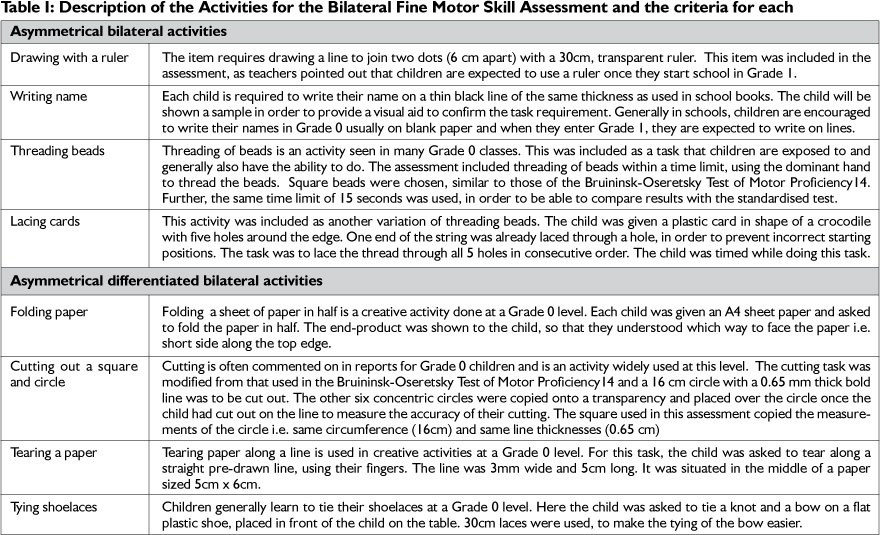
From the literature and the discussions with the teachers activities were identified and the expected execution of each described (Table I).
Each activity was broken down into motor components and both movement (mobility) and stabilisation (stability) were considered in each activity and based on the assessment of motor skills. The following 4 criteria were identified and utilised when analysing the tasks:
A = accuracy [evaluation of the end product of the task];
M = motor components [observing how the task is performed, including the positioning of the body and grasp of tools];
T = time [timing the task];
E = efficiency of movement [are components of the task performed without any difficulties and are all steps in the task included to make it efficient10
The use of the criteria allowed the activities to be broken down into easily observable task components, which could be consistently scored. This makes the assessment more reliable as it does not rely as much on the experience of the therapist. After analysing and dividing the tasks into motor components, the eight bilateral tasks that had been selected were finalised as the initial test items.
A scoring system was developed for these items so that clinical observation and measurement of the outcomes could be recorded. On consultation with the statistician the scores were allocated according to the correct response, thus the higher the score, the better the performance of the child.
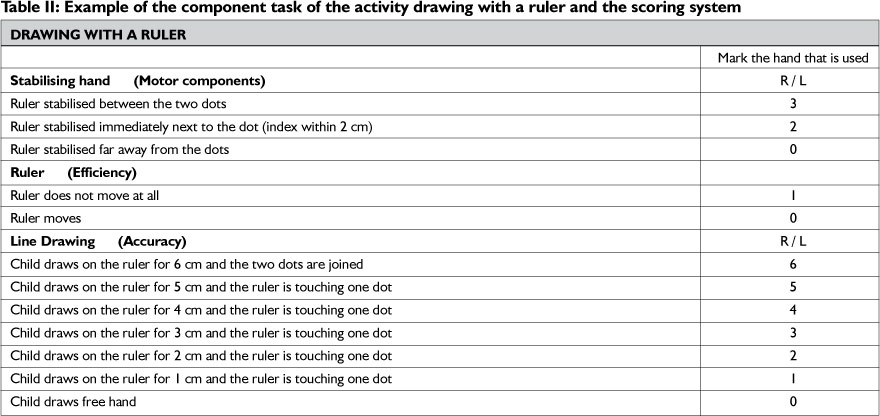
Observation sheets were developed for the various assessments either using a point system or yes/no answers, which enabled the researcher to work out percentage scores. An example of the components for drawing a line with a ruler is presented in Table II. This item is not timed but some items were and the score was noted in seconds.
The items were designed to produce an end product to guide the child as to what was required and to use simple two to eight word instructions only. These simple instructions could be translated easily if necessary. This was important for the South African context where a number of different languages are spoken and translating instructions may affect the results of an assessment.
PSYCHOMETRIC ASSESSMENTSValidity and Reliability studies of the TBA
This section describes the validity and reliability studies done in order to determine the extent to which the TBA measured the bilateral fine motor skills of Grade 0 children. As described in the development of the test all items and scoring was designed based on motor skill theory and in consultation with Grade 0 teachers. This was further validated from the information from the parents as to what activities the children did at home.
Three types of validity were considered in the development of this assessment.
Content Validity
This is the extent to which content of a scale is representative of the conceptual domain of bilateral fine motor skills; assessed through expert opinion. Twelve experienced occupational therapists who have been working in the paediatric field for at least eight years were asked to judge the test for content validity. A focus group was held and individual items on the assessment were discussed. Generally therapists felt that all items included were bilateral tasks and also relevant to grade 0 children. It was suggested, that one further item be included in the assessment, namely another personal management activity. Initially, eating with a knife and fork was suggested but this was impractical in the classroom setting, and therefore, putting on a shirt and fastening the buttons were chosen as additional items.
The same group of therapists were asked to weight the assessment items according to their importance for Grade 0 children as each item scored a different number of total points. Scoring on the TBA was weighted for the items according to their importance and then adjusted by using the ratio and logarithms. The order of importance placed cutting with scissors at the top of the list followed by tearing; tying shoelaces; folding paper; name writing; threading beads; lacing; and finally drawing with a ruler.
Construct and Convergent Validity and Test-Retest Reliability
All other validity and reliability studies required field testing of the TBA on Grade 0 children. Thus Pilot Study 1 was completed on 10 participants conveniently selected from the four Grade 0 classes by the principal of a public primary school in Johannesburg. The parents of the participants were asked to sign informed consent and give permission for their children to participate in the testing. A parent questionnaire, relating to the children's activities in the afternoon, and the equipment available to the children at home was included with the consent form. Children gave witnessed verbal assent for participation.
The researcher administered the TBA to each of the 10 participants in a room at the school that was made available for testing. A suitable table with two chairs were used. Each assessment took approximately 1 5 minutes and the participants were presented with the eight original items and the new dressing item in varying order. The researcher scored each participant's performance on the scoring sheet as per the criteria that had been set, while they were completing the activities. Responses were scored in terms of the motor components used, the efficiency, as well as the time taken to complete a task. Accuracy scoring was done afterwards on the actual paper the children used for drawing with a ruler, writing on the line, tearing on a line, cutting and drawing around an object.
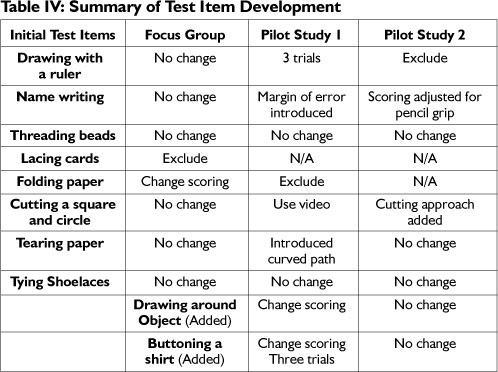
Participants were re-assessed by the researcher four days later. As one child was absent, only 9 children were re-assessed. Exactly the same procedure was followed in the re-assessment. The researcher was blinded to the results of the first assessment during the second assessment to eliminate bias. At the end of this pilot study lacing was removed as all aspects under consideration could be scored in the other items and this item did not contribute to any new observations.
Construct Validity
Construct validity provides evidence that each scale measures a single construct and that items can be combined to form summary scores; assessed on the basis of evidence of good internal consistency and correlations between scores.
A correlation matrix for the four constructs of fine motor skills, on which items were measured, indicated high correlations except for time. The correlation ranges across items for the different constructs were as follows:
Accuracy (0.99 to 0.96); Motor control (0.99 to 0.72); Time (0.90 to -0.94); Efficiency (0.90 to 0.50). All correlations were significant at p<0.0l.
The correlation of the scores for the participants indicated that similar constructs were being measured in each item across the assessment for accuracy, motor control and efficiency, but not for the time scores. The variation in the correlations found for the time scores was accounted for by the difference in the time participants took on the separate occasions they were assessed and indicated the need for practice sessions to be added to some of the timed components.
Convergent validity
Convergent validity requires evidence that items on the assessment are correlated with other measures of bilateral fine motor skills. This validity was established by the use of two items (cutting out a circle and threading beads) on the TBA which was the same as those used in the Bruininsk-Oseretsky Test of Motor Proficiency1414
When comparing the scores for the bead threading on the Bruininsk-Oseretsky Test of Motor Proficiency1414
Test-Retest Reliability
The test-retest reliability of the TBA was established to determine the stability of the test over repeated administrations and the extent to which items in a scale measure the same construct.
Reliability testing is done to determine the degree of consistency from one test administration to the next. The test was administered and then re-administered four days later to the same participants and cluster analysis using random-effect multi-level regression determined the similarity between the two scores15
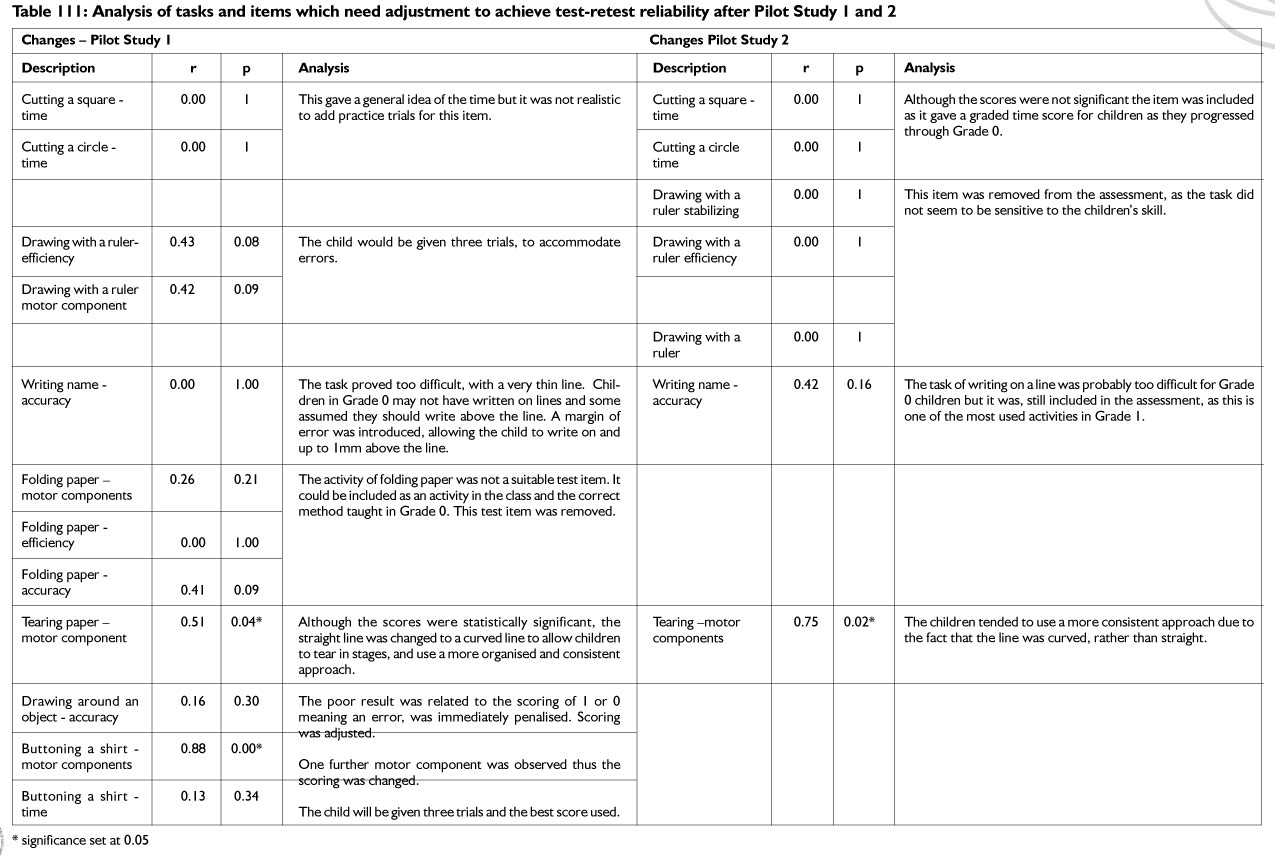
All the scores were captured on a grid, documenting all the items tested as well as the first and re-assessment scores for each child. The data were then analysed for test-retest reliability. A number of the task analyses of the items failed to reach the required test-retest correlation required at a significance of p < 0.05, these tasks were subsequently analysed and adjusted (Table III).
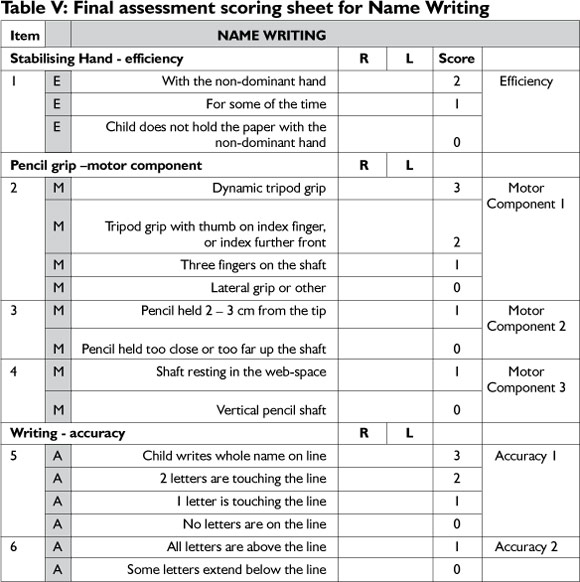
Adjustments were made to the scoring of the motor components for name writing and drawing around an object, since several of the children used different methods for the tasks than those described on the observation form. The differences were recorded on the individual observation sheets, revised and added onto the assessment sheets when the children were re-assessed for the second time. The items that were timed (using a stopwatch) were also moved to the end of the assessment, so participants did not rush through initial tasks where no emphasis was placed on timing.
Once the TBA had been revised to accommodate all the changes needed a further Pilot Study 2 to establish test - retest reliability on the changed items was completed on five Grade 0 children. The remaining eight items of the test were used once paper folding had been removed. As for the initial study, permission was obtained from the children's parents and who gave verbal assent for the children to take part and to be videotaped. The revised TBA sheets were filled in while the children were undertaking the tasks. The researcher videotaped and simultaneously timed the children cutting the square and circle. All children were re-assessed three days later. The data were then analysed for test-retest reliability as above (See Table III).
After completion of Pilot Study 2 for the test-retest reliability the drawing with a ruler item was removed, leaving seven items in the assessment. Timing was kept in as a construct to be measured with three trials being allowed for buttoning a shirt. It was not possible to give trials for cutting around a square and a circle as this would have made the assessment too tedious and long. The timing was retained for observation in the assessment to establish the effect of intervention and maturity over the Grade 0 year. Videotaping for the cutting task was retained as well.
Final Version of the TBA
Table IV summarises the changes made to the TBA items during validity and reliability testing and the final items included.
The final version of the TBA ultimately consisted of seven items which were name writing; drawing around an object; tearing on a line; threading beads; tying shoelaces; cutting around a circle and a square; and buttoning a shirt. While the child was completing the various tasks, the therapist was recording the observations step-by-step, filling out the observation sheet. An example of this can be seen in Table V. This table reflects all changes made throughout Pilot Study 1 and Pilot Study 2.
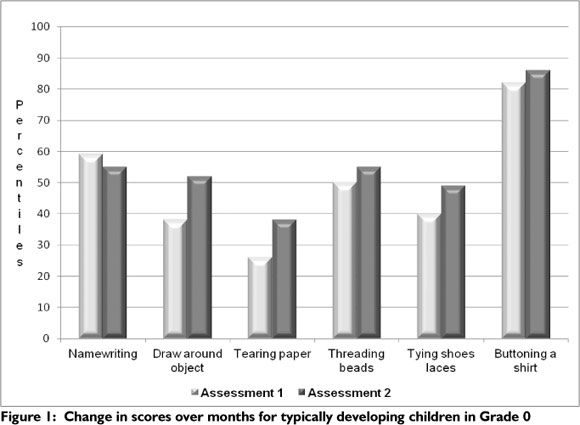
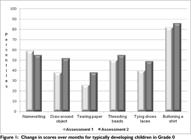
Preliminary results on the field testing of the TBA on 130 children in Grade 0 across a variety of socio-economic backgrounds in Johannesburg measured the responsiveness of the assessment to change over time in the performance of bilateral fine motor skills. Assessments were completed at the beginning of the year and three months later on the participants. It can be assumed that during that time there was some input in terms of fine motor skills in the Grade 0 classroom and this was confirmed with the test components indicating a small positive change, although marginal in this time for most items, particularly for tearing paper and tying shoelaces (Figure 1). This test is therefore responsive to expected small changes over time in typically developing children in Grade 0.
CONCLUSION
The TBA has been designed as a school readiness test to identify fine motor problems in children in Grade 0. The test consists of 7 items, covering the areas of personal management, recreation and vocation. These items form part of the day-to-day routine of children of this age. While children perform the tasks, the therapist completes the observation sheets. These contain all of the items broken down into step-by-step task components as well as approaches to the tasks. Thus all of the items were analysed for motor components, accuracy, efficiency and time taken. The test does not rely on the therapist's own observation and interpretation skills but rather being made aware of all the components to be scored. This makes the therapist's comments about the child's function in the classroom more standardised and objective. It enables the occupational therapist to identify and confirm problems in task-based bilateral fine motor skills of pre-school children.
Acknowledgements
I would like to acknowledge the Wits O.T. Department and the statistician Dr. P. Becker for their valuable input. Final scores and per-centiles as well as complete observation sheets for the TBA are available from the first author.
REFERENCES
- 1. Prinsloo E. Working towards inclusive education in South African classrooms. South African Journal of Education, 2001; 21(4): 344-348.
- 2. Nel N, Müller H, Rheed-ers E. Support services within inclusive education in Gauteng: The necessity and efficiency of support. Mevlana International Journal of Education (MIJE), 2011; 1(1): 38-53.
- 3. American Occupational Therapy Association. Occupational Therapy Practice Framework: Domain and Process, 2nd Edition. The American Journal of Occupational Therapy, 2008; 62(6):625-642.
- 4. Case-Smith J, Rogers J. School-based Occupational Therapy.. In Case-Smith J. Occupational Therapy for Children. 5th ed.: Elsevier Mosby; 2005. p. p. 795-805.
-
5. Pearson Education Inc. Fine-Motor Skills. Pearson Education Inc; 2009 [cited 201 1 March 12]. Available from: http://www.ncbtp.org/ pdf_documents/para/handouts/aug_2009/05_fine_motor_skills.pdf.
» http://www.ncbtp.org/ pdf_documents/para/handouts/aug_2009/05_fine_motor_skills.pdf -
6. Fingergym Fine Motor Skills. Fingergym Fine Motor Skills School readiness program. 2011 [cited 2012 May 23]. Available from: HYPERLINK "www.fingergym.info/downloads/Finemotordevpp 1 -4.pdf" www.fingergym.info/downloads/Finemotordevppl-4.pdf .
» www.fingergym.info/downloads/Finemotordevpp 1 -4.pdf - 7. Donald D, Lazarus S, Lolwana P Educational psychology in social context. Cape Town: Oxford University Press; 2002.
- 8. Henderson S, Sudgen D, Barnett A. Movement Assessment Battery for Children-2, 2nd Edition New York: Pearson Assessment; 2007.
- 9. Beery K. The Beery-Buktenica Developmental Test of Visual-Motor Integration (VMI): Administration, Scoring and Teaching Manual, 6th Edition. Parsippany NJ: Modern Curriculum Press, 2010.
- 10. Radomski M, Trombly C. Occupational Therapy for Physical Dysfunction: 6th edition Philadelphia: Lippincott: Williams & Wilkins, 2007.
- 11. Edwards S, Buckland D, McCoy-Powlen J. Developmental & Functional Hand Grasps. Thorofare: Slack Incorporated, 2002.
- 12. Ratcliffe I, Concha M, Franzsen D. Analysis of cutting skills in four to six year olds attending nursery schools in Johannesburg. South African Journal of Occupational Therapy, 2007; 37(1): 4-9.
- 13. Erhardt R. The Erhardt Hand Preference Assessment. Maplewood: Erhardt Developmental Products, 2006.
- 14. Bruininks R Bruininks B. Manual for the Bruininks-Oseretsky Test of Motor Proficiency, Second Edition (BOT-2). San Antonio: Pearson Education, Inc, 2005.
- 15. McCulloch C, Neuhaus J. Prediction of random effects in linear and generalized linear models under model misspecification. Biometrics, 2011; 67(1): 270-279.
 Correspondence:
Ingrid Ratcliffe