Activities of daily living with grasp types and force measurements during object manipulation
Abstract
BACKGROUND: Limited scientific evidence guides hand rehabilitation towards improved hand function, and safe early return to work. Grasp types, the subunits of object manipulation and the forces which may improve functional outcomes, have been identified as missing links that may inform rehabilitation after second to fifth metacarpal fractures, through progression of basic and instrumental activities of daily living (ADL). The aim of the study was to collect ADL forces through grasp types to inform hand rehabilitation for second to fifth metacarpal fractures. METHODS: This cross-sectional, quantitative study included 32 conveniently sampled healthy adults aged 20 and 59 years. Thirty-one (31) ADLs, both basic and instrumental, each associated with a predominant grasp type, were tested. The participants donned two testing gloves, with force sensing resistors (FSRs) glued to the fingertips, the ADLs were performed, and forces measured. The researcher imported the force data into an Excel spreadsheet for both descriptive and inferential analyses with STATA. RESULTS: Fourteen males and 18 females, with a mean age of 37 years, participated. Statistically significant differences between genders were found for seven grasp types. Three thumb-adducted power palm grasps, three thumb-abduction precision pad grasps, and one thumb-abduction power palm grasp constituted the testing. Light and heavy ADLs and their associated grasp types were identified CONCLUSION: To ensure optimal hand function, early safe return to ADLs should be the goal of second to fifth metacarpal fracture rehabilitation and may be achieved by incorporating active grasp types as exercises with graded resisted grasp types and ADLs. IMPLICATIONS FOR PRACTICE: • Occupational therapists can incorporate grasp types in their observation during assessments of individuals who sustained second to fifth metacarpal fractures to determine the subcomponents of functional deficits. • Hand rehabilitation may be augmented by incorporating grasp types in isolation during unresisted active joint range of motion. • Occupational therapists, guided by the analysis of hand functioning, can incorporate ADLs with the predominant grasp types which may improve hand function. • Grasp force data may guide safe and early return to function.
human grasp; manipulation; hand rehabilitation; ctivities of daily living; grasp force data
INTRODUCTION
Hand function plays a crucial role in an individual's ability to perform daily tasks, and a hand injury can have devastating consequences. The primary role of the human hand lies in the manipulation of objects to achieve specific goals11
Hand rehabilitation involves more than just face to face consultations; it also includes home exercise programs (HEP). Adherence to these programmes has a significant impact on the effectiveness and outcomes of hand therapy interventions45
Valdes et al.66:569 stated that "Generally speaking, an HEP for an individual attending hand therapy tends to be multimodal so that information is taught in the clinic is carried over into the home environment." They suggest that home exercises should be integrated into clients' daily routines while protecting the injured body structure. Although there is a growing body of literature advocating for enhanced hand rehabilitation and improved adherence, the authors found a dearth of studies incorporating grasp types and force sensor data, especially incorporating 10 fingers during ADLs, to back the inclusion of daily routines, grasp types and ADLs into HEPs safely.
Incorporating grasp types, which are the subunits of manipulation during ADLs, into hand rehabilitation may improve hand function and can ideally be included in HEPs. However, there is currently a lack of force sensing scientific evidence on when to incorporate safe grasping based on the force production on injured hand structures.
Previous studies have investigated grasp types and their frequency of use in common manipulation tasks. For example, Bullock991011
Studies measuring forces with limited fingers and grasps and using sensors on a glove or objects have been performed12-15. Castro and Cliquet, for instance, investigated the grasping of cylindrical objects and measured the associated static forces with FSRs1415
In hand rehabilitation, after having sustained second to fifth metacarpal fractures, individuals may interpret returning to light function differently, leading to inappropriate bending, torsion, and shear loading between the two fracture ends, thus disrupting the bone healing process1616
The study aimed to gather force sensing data through grasp types and forces during ADLs, intended for the advancement of hand rehabilitation specifically tailored for second to fifth metacarpal fractures. The objectives of this cross-sectional study were to determine the basic and instrumental task forces exerted by the human hand through its grasps on the objects that it manipulates, as well as the associations between mean maximum forces and gender among a purposively sampled group of healthy human adults between the ages of 20 and 59 years, and with the aid of FSRs.
METHODS
In a previous published study1718191919
To ensure reliability, the demographic questionnaire, FSR measurements, and grip strength measurements were conducted using a standardised and piloted method led by one researcher and a trained research assistant. The finger force sensor measurement data collected during the piloted feasibility study1711
Participants
The research study included adult human participants residing and working in east Gauteng, specifically in the city of Kempton Park and its neighbouring areas within the Ekurhuleni municipality. The researcher purposively selected individuals from the local community, considering their age range (20-59 years), language spoken (English or isiZulu), and
their residence's proximity to the testing facility. Individuals under 20 years of age were excluded due to skeletal immaturity2021
Instrumentation
The instrumentation used to measure ADL forces was previously described in Keller et al.17
Arduino Uno hardware consists of circuit boards and a microcontroller placed on the Arduino Uno. The Arduino Uno is a programmable microprocessor specifically designed to record changes in V. An image of an Arduino Uno board is included in Image 1 (below). Each Arduino Uno board has the capability to monitor up to five FSRs. Therefore, in this study, two Arduino Uno boards were employed to monitor ten FSRs, one for each finger. The microcontroller chip, located on the circuit board's crystal resonator, controls the speed of the microcontroller's operations. This chip enables the upload of custom software from a computer to the main microcontroller via a USB cable, facilitating communication between the computer and Arduino.

To prepare the hardware for testing, the researcher downloaded Arduino software from the Arduino.cc website and installed it on their laptop. This software provided the necessary tools to create a sketch that could receive and process V measurements from the FSRs.
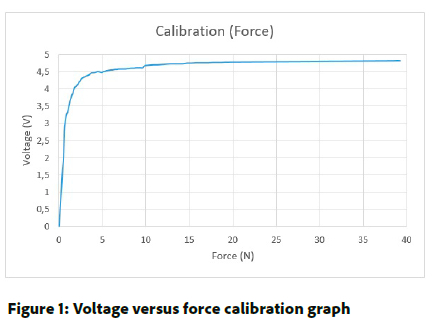
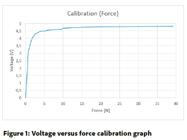
Prior to the experiments, the FSRs underwent calibration using a range of calibrated weights spanning from 1 gram to 10 kilogrammes (kg). For each weight, the corresponding V was recorded. This process enabled the researcher and technical expert to construct a graph illustrating the relationship between V and weight. By utilising the equation F = m × g, where F represents force in N, g is the gravitational acceleration (m/s2Figure 1 (below) presents the V versus force graph obtained from this calibration process. This graph allows the conversion of any recorded V from the Arduino's FSRs to a corresponding force value. To determine the general equation for the V force graph, a curve-fitting program was employed. The resulting equation was found to be 0.5917 * tan(0.3223 * max value). The Arduino's were programmed to capture ten measurements per second.
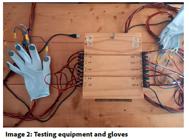
In order to measure the force exerted by each finger, two gloves were equipped with FSRs, with one FSR attached to each finger. Image 2 (below) depicts the gloves featuring the attached FSRs.
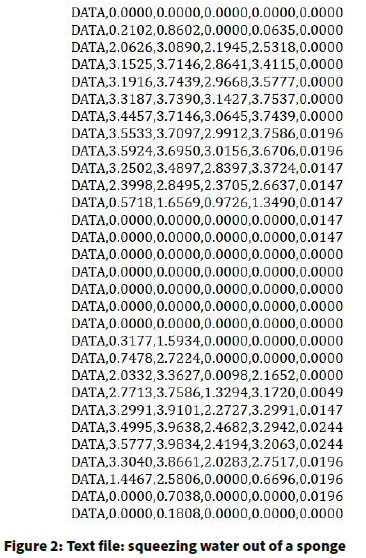
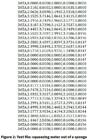
All measurements taken during the tasks were meticulously recorded and stored in comma-delimited text files. To facilitate this process, the software package Realterm was utilised. Subsequently, the comma-delimited text files were imported into Excel, where the V measurements were converted to forces using the aforementioned equation. An example of the text file capturing measurements from the five fingers of the left hand is presented in Figure 2 (below). For each grasp type, both the left and right hands, encompassing all ten fingers, were included in the text file. The researcher imported the data from the Excel spreadsheet into STRATA statistics software, using StataCorp, after which a statistician conducted data analysis.
Testing procedure
Pilot testing preceded the main data collecting during a feasibility study1717
At the outset, participants underwent Covid-19 screening conducted by a proficient research assistant who had received thorough training in the screening process and was fluent in English and isiZulu. Subsequently, the participants completed a demographic questionnaire. Grip-strength measurements were then conducted using a calibrated Jamar hand-held dynamometer, following the standardised measurement guidelines outlined by the American Society of Hand Therapy. These grip-strength measurements preceded the force testing using FSRs. To ensure that the participants would not be fatigued and, that the validity of the force measurements, were not compromised, the grip-strength measurements with the hand-held dynamometer were taken by the primary author, after sixteen tasks and at the completion of the 31 tasks. Average grip strength of either the dominant or non-dominant hands differed by two kgs, based on an average of three maximal attempts, participants were granted an additional five minutes of rest before testing resumed. Through pilot testing, it was determined that five minutes provided sufficient resting time for participants to feel ready to continue with the testing.
Participants wore gloves with FSRs attached to both their right and left hands. After putting on the testing gloves, they were instructed to perform the tasks in a manner consistent with their normal activities at home. Participants performed ADLs such as putting washing on a washing line with pegs or dusting and squeezing water out of a sponge. Standardised instructions regarding data collection and testing procedures were provided to the participants. The researcher read out the tasks from the grasp types tested per type and per category sheet, ensuring that the necessary equipment for each task was within the participants' reach and that no additional objects needed to be manipulated, thereby allowing the FSRs to solely measure the forces exerted during the tasks.
Reliability and validity
Reliability was ensured through the utilisation of a single laboratory equipped with standardised, calibrated, and piloted FSRs and instrumentation. Grip strength testing employed a calibrated dynamometer. Both FSRs2223
Data analysis
Descriptive statistics were employed to summarise the demographic characteristics of the participants as well as the finger force measurements. Two-sample t-tests were utilised to analyse differences in grip strength and force measurements based on gender.
Ethical considerations
This research was approved by the HSREC of the University of the Free State under the number (UFS-HSD2019/0046/2602-0002) obtained in 2021. Any associated research materials pertaining to the obtained results will be made accessible through the primary author's ORCID account.
RESULTS
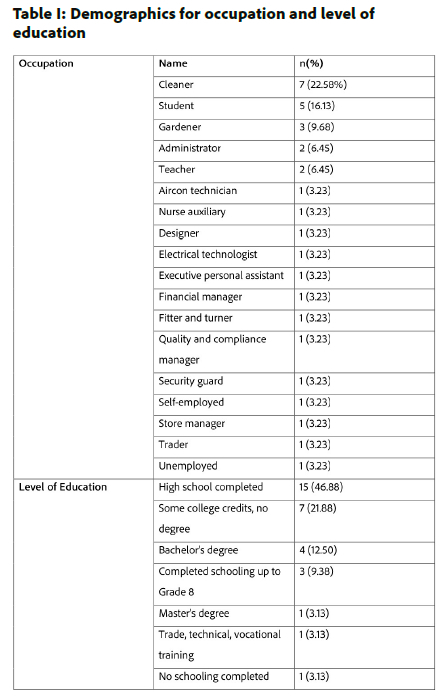
A total of thirty-two (32) participants, comprising 18 females and 14 males, with a mean age of 37 years, willingly agreed to take part in the study. Among the participants, two (6.25%) were left-handed, while the majority, thirty participants (93.75%), were right-handed. To gain insight into the participants' demographics, refer to Table I (adjacent), which provides information on their occupations and education levels.
Supplementary File 1 (attached as metadata) presents the means, standard deviations, as well as the minimum and maximum N force measurements for grasp force. For a detailed examination of maximum forces, please refer to Supplementary File 2 (attached as metadata). The grasp types per ADL were categorised into light, medium, and heavy demand categories, allowing us to identify which grasp types and ADLs could be employed in progressive hand rehabilitation. It is important to note that clinical reasoning should always guide hand rehabilitation, taking into consideration each individual patient's unique injury and comorbidities to ensure a safe rehabilitation process. The data provided in Supplementary File 2 is invaluable when prescribing a HEP with specific ADLs and grasp types. Each finger interacts with the manipulated object differently, and depending on the finger fracture and the individual's functional limitations, other ADL grasp types may be employed following an assessment. The precise results per category, as indicated in Supplementary File 2, will now be highlighted.
Light ADLs, accompanied by their associated grasp types11
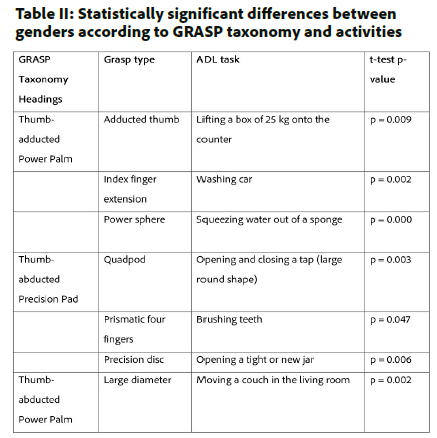
An analysis of the force measurements for grasp types per ADL task, conducted using the GRASP Taxonomy11Table II (below), revealed statistically significant gender differences. However, no statistically significant difference in grasp forces was observed for the remaining 25 tested tasks.
Furthermore, a two-sample t-test with equal variance was performed to assess gender differences in grip strength measurements taken prior to the force testing. The results indicated no statistically significant difference, with p = 0.0958.
DISCUSSION
When comparing the data for healthy participants in this research to the results of Riddle et al.12
In another study by Castro and Cliquet1415
Several studies investigating finger and grasp forces have explored potential associations with gender. Rice, Leonard, and Carter1314
CONCLUSION AND LIMITATIONS
The collection of force-sensing data during the 31 ADL tasks provided a substantial contribution to the existing knowledge base, shedding light on different hand manipulations. However, due to the inherent complexities and individual differences among participants, drawing absolute conclusions from the data remains challenging, even with larger sample sizes. It is important to acknowledge that the use of FSRs on gloves to measure grasp forces may introduce variations compared to grasping without gloves, as the hand relies on sensory feedback from the skin.
While the error rate on the FSR sensors during testing was minimal and no data was lost, future research should consider increasing the sample size and directly attaching FSRs to the skin. Additionally, efforts should be made to ensure a balanced representation of genders, handedness, and various occupations, as the current sample primarily consisted of students and cleaners, limiting the generalisability of the study's findings.
The insights gained from this study's findings have implications for the development of clinical hand rehabilitation guidelines, particularly regarding the forces involved in predominant grasp types. These findings can inform physiotherapists and occupational therapists in designing effective exercise programmes and prescribing home exercises for individuals who sustained second to fifth metacarpal fractures.
Clinical Implications
Incorporating grasp types as free active exercises while the injured finger is immobilised may be started early to maintain joint range of motion and improve hand function. The researcher suggests that starting ADLs falling into the light category with immobilisation may be beneficial as long as no pain is experienced, and the treating doctor has been consulted about early functional rehabilitation and HEP. Clinical reasoning should be used, as well as the extent of the fracture and associated injuries.
Author contributions
Monique Keller proposed the topic for the research, wrote the protocol for ethical approval and the first version of the article. The protocol and article were read, elaborated upon, and refined by Monique Keller, Roline Barnes and Corlia Brandt.
Conflicts of interest
None to declare.
Acknowledgements:
The authors acknowledge Thomas Feix for permitting the use of the GRASP Taxonomy, Paul Keller and JeanPaul Heynek for their technical support, the participants, and Zvifadzo Matsena Zingoni at the University of the Witwatersrand for her statistical assistance.
REFERENCES
-
1. UKEssays. The Major Function Of Human Hand Psychology Essay [Internet]. November 2018. [Accessed 12 December 2023]; Available from: https://www.ukessays.com/essays/psychology/the-major-function-of-human-hand-psychology-essay.php?vref=1.
» https://www.ukessays.com/essays/psychology/the-major-function-of-human-hand-psychology-essay.php?vref=1 -
2. Robinson LS, Sarkies M, Brown T, O'Brien L. Direct, indirect and intangible costs of acute hand and wrist injuries: A systematic review. Injury, 2016; Dec; 47(12): 2614-2626. http://dx.doi.org/10.1016/j.injury.2016.09.041.
» http://dx.doi.org/10.1016/j.injury.2016.09.041 -
3. Gudmundsen TE, Borgen L. Fractures of the fifth metacarpal. Acta Radiologica, 2009; Apr; 50(3): 296-300. http://dx.doi.org/10.1080/02841850802709201.
» http://dx.doi.org/10.1080/02841850802709201 -
4. Groth GN, Wilder DM, Young VL. The impact of compliance on the rehabilitation of patients with mallet finger injuries. Journal of Hand Therapy, 1994; 7(1): 21-24. http://dx.doi.org/10.1016/s0894-1130(12)80037-8.
» http://dx.doi.org/10.1016/s0894-1130(12)80037-8 -
5. Gülke J, Leopold B, Grözinger D, Drews B, Paschke S, Wachter NJ. Postoperative treatment of metacarpal fractures-Classical physical therapy compared with a home exercise program. Journal of Hand Therapy, 2018; Jan 1: 31(1): 20-28. https://doi.org/10.1016/j.jht.2017.02.005.
» https://doi.org/10.1016/j.jht.2017.02.005 -
6. Valdés K, Naughton N, Algar L. Usefulness of a hand therapy application. Journal of Hand Therapy, 2022; 35(4): 569-574. http://dx.doi.org/10.1016/j.jht.2021.03.007.
» http://dx.doi.org/10.1016/j.jht.2021.03.007 -
7. Kimmerle M, Mainwaring L, Borenstein M. The functional repertoire of the hand and its application to assessment. American Journal of Occupational Therapy, 2003;57:489-98. http://dx.doi.org/10.5014.ajot.575.489
» http://dx.doi.org/10.5014.ajot.575.489 -
8. Valdés K, Naughton N, Cantero-Téllez R, Szekeres M. The use of occupation-based interventions and assessments in hand therapy: A cross-sectional survey. Journal of Hand Therapy, 2023;Jan1;36(1):214-220. https://doi.org/10.1016/j.jht.2021.10.008.
» https://doi.org/10.1016/j.jht.2021.10.008 -
9. Bullock IM, Zheng JZ, De La Rosa S, Guertler C, Dollar AM. Grasp frequency and usage in daily household and machine shop tasks. IEEE Trans Haptics, 2013; 6(3): 296-308. http://dx.doi.org/10.1109/TOH.2013.6.
» http://dx.doi.org/10.1109/TOH.2013.6 - 10. Sperling L, Jacobson-Sollerman C. The grip pattern of the healthy hand during eating. Scandinavian Journal of Rehabilitative Medicine, 1977;9(3):115-21.
-
11. Feix T, Romero J, Schmiedmayer HB, Dollar AM, Kragic D. The GRASP Taxonomy of Human Grasp Types. IEEE Trans Human-Machine Systems, 2016;46(1):66-77. http://dx.doi.org/THMS.2015.2470657.
» http://dx.doi.org/THMS.2015.2470657 -
12. Riddle M, MacDermid J, Robinson S, Szekeres M, Ferreira L, Lalone E. Evaluation of individual finger forces during activities of daily living in healthy individuals and those with hand arthritis. Journal of Hand Therapy, 2020; 33(2): 188-197. http://dx.doi.org/10.1016/j.jht.2020.04.002.
» http://dx.doi.org/10.1016/j.jht.2020.04.002 -
13. Rice MS, Leonard C, Carter M. Grip Strengths and Required Forces in Accessing Everyday Containers in a Normal Population. American Journal of Occupational Therapy, 1998; 52(8):621-626. http://dx.doi.org/10.5014/ajot.52.8.6.621.
» http://dx.doi.org/10.5014/ajot.52.8.6.621 -
14. Castro MCF, Cliquet A. J. A low-cost instrumented glove for monitoring forces during object manipulation. IEEE Trans Rehabilitative Engineering, 1997; 5(2): 140-147. http://dx.doi.org/10.1109/86.593280.
» http://dx.doi.org/10.1109/86.593280 -
15. Romeo RA, Cordella F, Zollo L, Formica D, Saccomandi P, Schena E, et al. Development and preliminary testing of an instrumented object for force analysis during grasping. Annual International Conference of the IEEE Engineering in Medicine and Biology Society, 2015; 2015: 6720-6723. http://dx.doi.org/10.1109/EMBC.2015.7319935
» http://dx.doi.org/10.1109/EMBC.2015.7319935 -
16. LaStayo PC, Winters KM, Hardy M. Fracture healing: Bone healing, fracture management, and current concepts related to the hand. Journal of Hand Therapy, 2003; 16(2): 81-93. http://dx.doi.org/10.1016/s0894-1130(03)80003-0.
» http://dx.doi.org/10.1016/s0894-1130(03)80003-0 -
17. Keller MM, Barnes R, Brandt C. Evaluation of grip strength and finger forces while performing activities of daily living. Occupational Health Southern Africa, 2022; 28(5): 187-190. https://journals.co.za/doi/abs/10.10520/ejc-ohsa_v28_n5_a6
» https://journals.co.za/doi/abs/10.10520/ejc-ohsa_v28_n5_a6 -
18. Hudak PL, Amadio PC, Bombardier C. Development of an upper extremity outcome measure: the DASH (disabilities of the arm, shoulder and hand) [corrected]. The Upper Extremity Collaborative Group (UECG). American Journal of Industrial Medicine. 1996; 29(6): 602-608. Erratum in: American Journal of Industrial Medicine, 1996; 30(3): 372. PMID: 8773720. http://dx.doi.org/10.1002/(SICI)1097-0274(199606)29:6<602:AID-AJIM4>3.0.CO;2-L.
» http://dx.doi.org/10.1002/(SICI)1097-0274(199606)29:6<602:AID-AJIM4>3.0.CO;2-L -
19. Han W, He W, Yang W, Li J, Yang Z, Lu X, et al. The osteogenic potential of human bone callus. Scientific reports. Nature Publishing Group, 2016; 6: 36330. http://dx.doi.org/10.1038/srep36330.
» http://dx.doi.org/10.1038/srep36330 -
20. De Sanctis V, Di Maio S, Soliman A, Raiola G, Elalaily R, Millimaggi G. Hand X-ray in pediatric endocrinology: Skeletal age assessment and beyond. Indian Journal of Endocrinology and Metabolism, 2014; 18: S63-71. http://dx.doi.org/10.4103/2230-8210.145076.
» http://dx.doi.org/10.4103/2230-8210.145076 -
21. Nakashian MN, Pointer L, Owens BD, Wolf JM. Incidence of metacarpal fractures in the US population. Hand, 2012; 7(4): 426-430. Available from: https://www.ncbi.nlm.nih.gov/pmc/articles/PMC3508027/pdf/11552_2012_Article_9442.pdf. http://dx.doi.org/10.1007/s11552-012-9442-0.
» https://www.ncbi.nlm.nih.gov/pmc/articles/PMC3508027/pdf/11552_2012_Article_9442.pdf. http://dx.doi.org/10.1007/s11552-012-9442-0 -
22. Sadun AS, Jalani J, Sukor JA. Force Sensing Resistor (FSR): a brief overview and the low-cost sensor for active compliance control. Proceedings of SPIE, 2016, Jul 11. https://doi.org10.1117/12.2242950.
» https://doi.org10.1117/12.2242950 -
23. Mathiowetz V. Comparison of Rolyan and Jamar dynamometers for measuring grip strength. Occupational Therapy International, 2002: Aug 1; 9(3): 201-209. https://doi.org/10.1002/oti.165
» https://doi.org/10.1002/oti.165
Reviewed: 21 October 2023
Revised: 19 December 2023
Accepted: 21 December 2023
Data availability: Available on request from corresponding author.
Funding: The study was funded by the FRC Seed funding grant (001 254 8491105 5121105 000000 0000000000 5254) obtained from the University of the Witwatersrand and the South African Society of Physiotherapy Research Foundation grant (RF2020/08/01).