Occupation-based treatment approaches and outcome measures in South African hand therapy: a cross-sectional survey
Abstract
INTRODUCTION: South African occupational therapists provide hand therapy in various health sectors and there is a need for a clearer understanding of the use of occupation-based hand therapy among therapists. This study aimed to describe how South African occupational therapists working in hand therapy perceive and use occupation-based treatment approaches and outcome measures to assess clients' participation in activities and occupations. METHODOLOGY: A quantitative cross-sectional survey design was used. Using convenience sampling, the survey was distributed through occupational therapy societies and social media platforms. Respondents completed an online survey which consisted of demographic information and thereafter focused on the use of occupation-based treatment approaches and outcome measures. Descriptive statistics were calculated using Microsoft Excel. RESULTS: Seventy-two respondents completed the questionnaire. While 80.6% of respondents believed occupation-based treatment approaches and outcomes measures are extremely important, 66% used these interventions less than half of their time. 95.8% of respondents used clinician-rated body function and structure outcome measures often/very often and few (18.1%) used clinician-rated occupation-based outcome measures often/very often. CONCLUSION: Although respondents regarded the use of occupation-based intervention as extremely important, less than half reported using these approaches consistently. This has broad implications for occupational therapists working in hand therapy, because occupation-based approaches are a core feature of occupational therapy. IMPLICATION FOR PRACTICE • Occupational therapists in South Africa value occupation-based approaches in hand therapy as 80.6% of respondents believe it is "extremely important" to address clients' occupational needs. • Despite recognising the importance, therapists spend limited time using occupation-based approaches in practice as 66% of respondents reported spending less than half their treatment time using occupation-based approaches. • Several barriers limit the implementation of occupation-based approaches which include lack of familiarity with occupation-based instruments, limited resources, funding constraints, and restricted treatment time. • Occupational therapists working in the field of hand therapy in South Africa focus more on aspects of body functions and structures rather than activity and participation. In addition, environmental barriers to participation are not frequently addressed in treatment. • There seems to be a lack of clear understanding of occupation-based approaches, moreover occupation-based outcome measures are used infrequently in South African hand therapy. • When occupation-based approaches are employed work-related tasks, dressing, and self-care are commonly used in treatment, mirroring findings from American studies.
upper limb rehabilitation; activity and participation; activity as a means; hand therapy; assessment instruments; good health and well-being
INTRODUCTION
Occupational therapy was founded on the premise that engaging in meaningful occupations serves to restore and improve emotional well-being and physical health. Throughout its history, occupational therapy has focused on occupation-based practice, emphasising the importance of including occupations throughout the treatment process to improve patients' participation in meaningful activities and life roles1
In South Africa, hand therapy is a focus service are within the broader field of occupational therapy12, p.1 as: "the art and science of rehabilitation of the upper limb, which includes the hand, wrist, elbow and shoulder girdle". A similar definition is provided by the South African Society of Hand Therapist (SASHT), adding that the focus is to regain maximum use of a person's upper limb after injury, surgery or the onset of disease34,5. Occupation-based hand therapy (OBHT) for upper limb injuries and conditions involves balancing the use of biomechanical principles with the utilisation of functional activities125-8.
It is the occupational therapists' responsibility to provide holistic hand therapy services by combining a biomechanical and occupation-based approach193,4 . In South Africa, hand therapy services are provided by occupational therapists in both the private and public health sectors 91010144
The importance of including occupation in hand therapy assessment and treatment is well documented1,2,5,7,8,11-15. Several quantitative and qualitative studies have concluded that occupation-based intervention improves the transference of skills as well as patient compliance, satisfaction and motivation, because treatment sessions are geared towards the client's interests, daily life and personal responsibilities1,2,5,7,8,11-15
When considering occupation-based hand therapy, it is useful to use a structuring framework such as the International Classification of Functioning, Disability and Health (ICF), which was developed by the World Health Organisation (WHO)15,16. Occupation-based treatment approaches and outcome measures fall within the domains of "activity" and "participation" in the ICF, while biomechanical treatment approaches and outcome measures fall within the domains of "body functions" and "body structures"44,7,9,17,1S.
Despite the perceived importance of occupation-based approaches, the use of such approaches remains limited in hand therapy worldwide16-1817-19 The field of hand therapy has traditionally been based on a medical model, focusing on the patient's physical impairments, which can detract from the client-centeredness of the treatment provided 117"extremely important', and a further 33% (n = 103) reported that it is "very important"17. However, majority of the respondents did not report that they use occupation-based outcome measures routinely in practice1717-19. This trend has similarly been found in South Africa 92017
There are several reasons for the limited use of occupation-based interventions by hand therapists 6,11,17,19 . Respondents in the study by Valdes et. al.176,11,19 highlighted time, physical work environments, equipment, treatment protocols and unfamiliarity with occupation-based approaches as limiting factors to the utilisation of occupation-based hand therapy.
As a low to middle-income country, South Africa faces unique barriers to the implementation of occupation-based hand therapy, due the unique social and cultural context of the country44,20 have identified the following barriers to the use of occupation-based approaches in hand therapy: limited time, expectations and poor perceptions from colleagues, poor client follow-up, limited space and resources, language barriers, limited knowledge regarding occupation-based approaches as well as limited literature on occupation-based practice in comparison to biomechanical approaches. Vorster and Buchanan also considered the knowledge, attitudes and practice trends in occupation-based practice in South Africa 202017
There is a paucity of research on the specific occupation-based outcome measures and treatment approaches currently used by South African occupational therapists in the field of hand therapy. For this reason, it was thought useful to conduct a study similar to the cross-sectional survey by Valdes et. al.174,20 to facilitate a better integration of the occupation-based approaches in the South African hand therapy context.
The aim of this study was to describe how South African occupational therapists perceive and use occupation-based treatment approaches in hand therapy and what outcome measures they use to assess their clients' participation in their activities and occupations. The following objectives were forumulated:
1. To describe the demographic characteristics of occupational therapists' participating in the study.
2. To describe the occupational therapists' perceptions of the importance of occupation-based treatment approaches and outcome measurement.
3. To establish the time spent addressing each domain of the International Classification of Functioning, Disability and Health (ICF).
4. To identify the types of occupation-based treatment approaches and outcome measures used by occupational therapists.
METHODS
The study is reported according to the Checklist for Reporting Results of Internet Ε-Surveys (CHERRIES)20Supplementary File 1 to view the checklist used in this study.
Study Design
This study used a quantitative cross-sectional survey design. The choice of design has addressed similar research questions in this field of study4,19,20.
Population and Sampling
The population targeted all South African occupational therapists registered with the Health Professions Council of South Africa (HPCSA), who were practicing in the field of hand therapy or a general healthcare setting, treating at least one patient with a hand or upper limb condition per week in both public and private settings. The SASHT had 108 occupational therapy members in 2023. However, there are also occupational therapists practicing hand therapy who are not members of the SASHT. Therefore, there is uncertainty about the exact size of this population. Convenience sampling was therefore used to recruit respondents by distributing the survey online through the Occupational Therapy Association of South Africa (OTASA), SASHT, and various Instagram and Facebook groups from January to April 2024.
Research Tool
An online questionnaire was used to collect the data. The questionnaire was designed and distributed using SUNsurveys. The questionnaire from the study conducted by Valdes, Naughton, Téllez and Szekeres 17
The survey included questions to establish the demographic profile of the respondents. The remaining questions focused on the respondents' use of occupation-based treatment approaches and outcome measures, specifically: how often they use them, some examples of occupation-based treatment approaches and outcome measures they currently use in practice and how important the respondents perceive them to be in hand therapy practice. See Supplementary File 2 for the survey used.
Both rating scales and multiple-choice questions were included, as they are quick to complete, improving the response rate. These questions also allow for simple analysis and provide specific information224
Pilot Test
The survey was pilot tested among three occupational therapists actively practicing in South Africa in the field of hand therapy, to improve the validity and relevance of the survey for the South African context. Each of the pilot study participants represented a different professional context - one practicing in a private healthcare setting, one practicing in a public healthcare setting and one in academia, all three had prior knowledge and/or publications in the field of OBHT. The pilot study participants were contacted via email and asked to complete the survey within a three-week period. They were also asked for feedback (via email) on the following matters: the relevance of the survey items for the South African context, the comprehensiveness and appropriateness of the options, whether key concepts were clear, and the consistency of the response options. The researchers discussed these comments and made final changes to the survey based on this input. Changes made include rephrasing of the demographic questions and including examples of activities based on the ICF framework.
Survey Distribution
The survey was distributed via email to members of OTASA and SASHT as well as Instagram and Facebook groups for hand therapy in South Africa. The survey link was open for 12 weeks (from 19 March to 11 June 2024). Participation was voluntary, with the option to enter a lucky draw for a R1000 Takealot voucher on completion of the survey. Participants were asked to sign a digital consent form before gaining access to the questions. A separate link was used to capture the contact details of respondents for the lucky draw, to ensure anonymity. These contact details were stored on a password protected computer and deleted after the lucky draw.
Data Analysis
The raw data were received from SUN surveys. Microsoft Excel was used to calculate percentages and frequencies from the responses. A form of text mining was used to analyse the responses from the short, typed question by grouping similar responses together into categories and counting the number of responses in each category 23,24.
Ethics
Permission was obtained to conduct the research through the Undergraduate Health Research Ethics Committee of Stellenbosch University (ethics reference number: U23/11/297). Anonymity and confidentiality were upheld throughout the entire research process. The survey did not gather any identifying information from respondents and survey responses could not be linked to respondents. Responses were also kept on a password protected computer which only researchers had access to.
RESULTS
Of the 210 individuals who opened the survey, a total of 72 completed the survey, as calculated via the SUN survey platform. Despite the survey questions being compulsory, one respondent entered numeric values instead of words in item 13 which requested respondents to list at least six occupation-based interventions that they commonly use. All the other items were answered in full, and the numbers were not included during the analysis of item 13.
Demographic Information
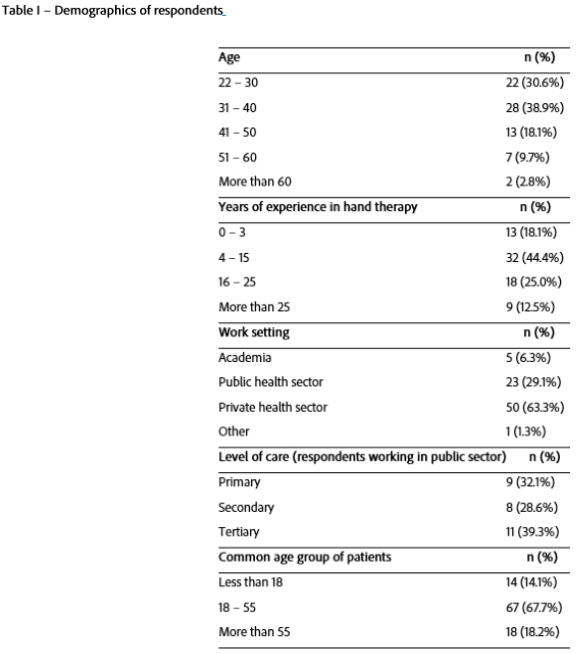
Table I (page 4) outlines the demographic characteristics of the respondents. Of the 72 respondents, the highest proportion were aged 31-40 years (n=28, 38.9%), had 4-15 years of experience in the field of hand therapy (n=32, 44.4%) and worked in the private sector (n=50, 63.3%). Most of the respondents working in the public health care sector work at tertiary level (n=11, 39.3%), however, respondents could select more than one option if needed and therefore this section exceed the total number of respondents.
Perceptions of the Importance of Occupation-Based Treatment Approaches and Outcome Measures
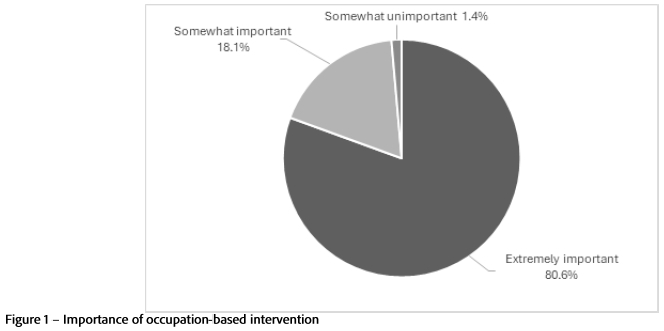
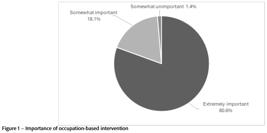
Figure 1 (below) depicts how important respondents felt it is to provide interventions that directly address client occupational needs. Most (n= 58, 80.6%) indicated that it is extremely important. Of the respondents, 1.4% (n=1) indicated that the use of occupation-based interventions is somewhat unimportant, and none of the respondents indicated that it is not important.


Time Use
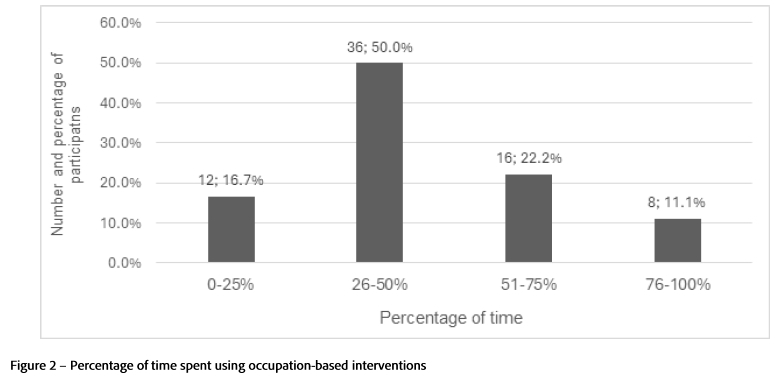
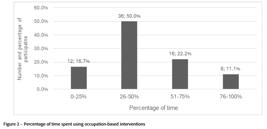
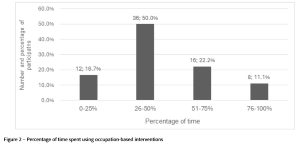
Percentages for time spent on occupation-based activities are presented in Figure 2 below, which shows that 66% (n=48) of respondents use occupation-based activities half, or less than half of the time.
Time Spent on Direct Intervention Addressing Each Domain of the ICF
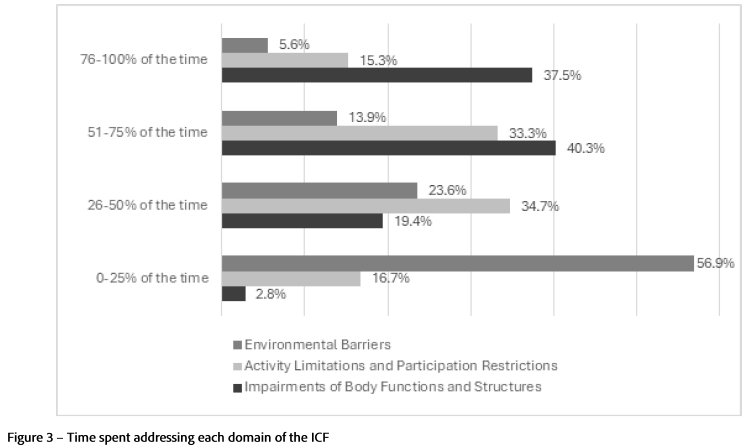
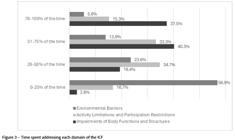
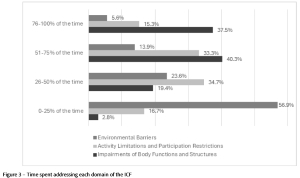
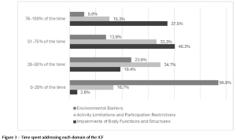
Figure 3 (below) depicts that 19.4% (n=14) of respondents spend more than half their time addressing environmental barriers, while 48.6% (n=35) of respondents spend more than half their time addressing activity limitations and participation restriction. 77.8% (n=56) respondents spend more than half their time addressing aspects of body function and structure.
Use of Occupation-Based Treatment Approaches
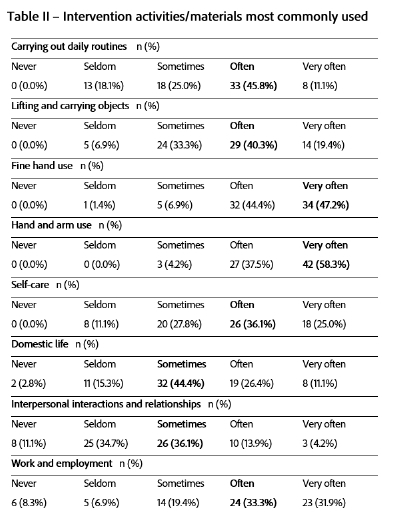
Table II (page 6) depicts the frequency with which respondents used various intervention activities or materials. Of the respondents, 96.1% (n=66) use activities for fine motor hand use often or very often and 95.8% of respondents (n=69) use activities for arm and hand use often or very often. In contrast, 18.1% (n=13) of respondents use activities of interpersonal interactions and relationships often or very often and 37.5% of respondents (n=27) said they use activities of domestic life often or very often.
Respondents were asked to list up to six occupation-based interventions that they commonly use. Text mining was used as an approach to data management by working through the responses manually, removing those that were not occupation-based.
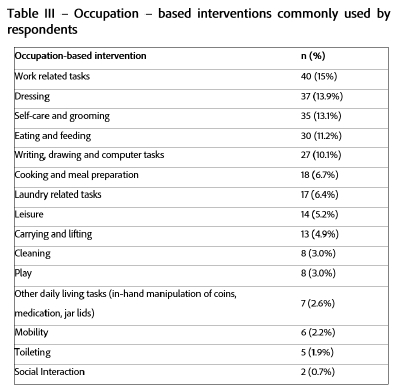
The results from this question are presented in Table III (below). Responses were grouped according to 15 categories and the number of responses per category was calculated. A broad range of occupation-based activities were reported. The most frequently used occupation was work-related tasks, 15.0% (n=40), followed by dressing tasks, 13.9% (n=37) and self-care and grooming, 13.1% (n=35). Other occupations listed included domestic life and mobility.
Use of Virtual Reality
Two respondents (3.8%) indicated that they use virtual reality, which is considered an occupation-based approach, in their treatment. They both reported that they are satisfied with the systems that they use.
Use of Outcome Measures
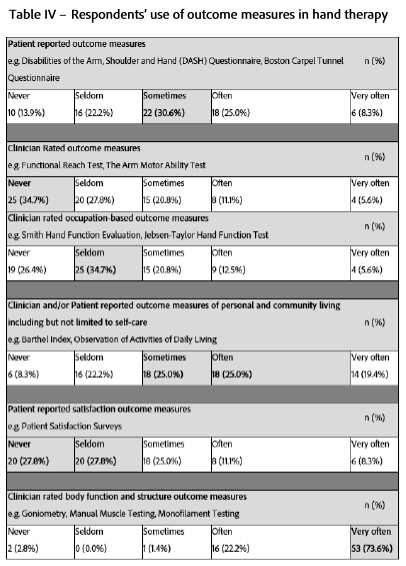
Table IV (below) depicts the frequency of the use of the different types of outcome measures. Clinician-rated body function and structure outcome measures are used most frequently with 95.8% (n=69) of respondents using them often or very often, whilst 33.3% (n=24) of respondents make use of patient reported outcome measures. Additionally, few (18.1%) respondents reported using clinician-rated occupation-based outcome measures often or very often.
DISCUSSION
This study aimed to describe South African occupational therapists' perceptions and use of occupation-based approaches in the field of hand therapy for treatment and outcome measurement. While other studies have explored barriers towards and perceptions of occupation-based approaches in South African hand therapy, they have not investigated occupational therapists' perception and use of specific occupation-based outcome measures and treatment approaches during the occupational therapy process 3,4,19,20. This study therefor adds to the body of knowledge about OBH in the South African setting
The response rate, age range, years of experience and distribution between public and private sector therapists is aligned with other South African studies 9,25. The response rate and demographic characteristics of respondents in this study are similar to other South African studies in the field of hand therapy 4,20 , making the results of this survey comparable to the results of other local studies in the field of hand therapy.
Most (80.6%) respondents reported that they believe it is "extremely important" to directly address their clients' occupational needs. This reflects a recognition of the importance of occupation-based approaches in hand therapy, a concept that is well-documented in both South African and international literature1,2,5,7,8,11-15. Despite this, most (66%) respondents reported that they spend less than half of their treatment time using occupation-based approaches. Although respondents reported that they value an occupation-based approach, this is not reflected in their practice. Similar findings by Valdes et. al.179,20 support this assertion.
There are various barriers outlined in literature which may explain the discrepancy between occupational therapists' perception and use of occupation-based approaches in hand therapy 4,9,20. Barriers to the implementation of occupation-based hand therapy in the South African context include lack of familiarity with occupation-based instruments, lack of resources for occupation-based practice, limited funding and limited treatment time with patients4,9,20.
Considering the percentage of time spent on each domain of the International Classification of Functioning, Disability and Health (ICF), 77.8% of respondents reported that they address body functions and structures in more than half of their treatment time, while only 48.6% of respondents reported addressing activity and participation restrictions in more than half of their treatment time. It is believed that this number could be higher considering the emphasis that the occupational therapy profession places on the use of occupation in treatment1
It is interesting to note that more than half (56,9%) of respondents reported spending less than 25% of their treatment time addressing environmental barriers affecting their clients. It could be expected that occupational therapists would spend more time addressing environmental barriers, because the occupational therapy profession assumes a holistic approach which includes addressing environmental barriers that affect the client's health and wellbeing1
It was challenging to identify specific occupation-based interventions and outcome measures used by respondents, due to the majority of respondents preferring to adopt a more biomechanically-focused approach in their practice. In the item where respondents were asked to list up to six occupation-based approaches that they use during treatment, responses did not consistently reflect occupation-based approaches and included range of motion, massage, strengthening exercises and other biomechanically focused intervention strategies, which may suggest a lack of understanding of occupation-based hand therapy practice. However, the responses also included a variety of occupations that respondents incorporate in their treatment.
The most common occupations that respondents reported using in treatment are work-related tasks, followed by dressing and self-care/grooming. In the survey done in the USA17
Two respondents reported that they make use of virtual reality as a means for treatment, for graded motor imagery, and the treatment of finger dexterity and left-right discrimination. Literature on the use of virtual reality in South African occupational therapy is limited, and the researchers could find no evidence on the use of virtual reality as an occupation-based intervention in hand therapy in South Africa. There is an opportunity for this to be explored in future research.
Respondents' use of occupation-based outcome measures was also limited, with 73.6% of the respondents reporting that they use clinician rated outcome measures of body functions and structures "very often". Ratings on the use of various types of occupation-based outcome measures were varied, but only a few respondents reported that they use any occupation-based outcome measures "very often". A previous South African study9
Although South African occupational therapists believe that occupation-based approaches are important, the use of an occupation-based approach in treatment and outcome measurement remain limited in the field of hand therapy. The importance and benefits of using an occupation-based approach are clear. Therefore, South African occupational therapists should be encouraged to utilise more occupation-based interventions and outcome measures in their practice. Targeted action is needed in this regard; undergraduate and post graduate offerings should include this as a routine part of curricula. In addition, national bodies such as OTASA and SASHT could support, prioritise and drive education towards more occupation-based approaches during occupational therapy intervention. There are opportunities for future research to be conducted on ways to address the barriers to the use of occupation-based approaches, and to increase evidence for the effectiveness of occupation-based outcome measures and treatment approaches.
Strengths and limitations
During the pilot study, the survey was distributed to three occupational therapists actively practicing in three different hand therapy settings. Through this, feedback was obtained from three different viewpoints and incorporated to ensure the survey's validity, relevance and appropriateness for the South African context.
Although a thorough pilot study was conducted, limitations were present in the study. Respondents working in the public health care sector were requested to select their level of care. However, respondents had the opportunity to select more than one option of the three options listed. As a result, it was not possible to accurately report on this.
Moreover, the item where respondents were requested to list at least six occupation-based interventions commonly used may have been slightly ambiguous, which led to some respondents listing interventions that were not occupation-based. This limitation could be addressed in the future by giving the respondents occupation-based options to select instead of listing.
CONCLUSION AND RECOMMENDATIONS
Although the majority of respondents in this study regarded the use of occupation-based approaches as extremely important, few were using them routinely in their practice. Furthermore, few respondents reported spending most of their time treating limitations within in the activity and participation domain of the ICF. Similarly, the majority of the respondents used clinician-rated outcome measures for body functions and structures often or very often, whilst less than half used occupation-based outcome measures often or very often. The results also indicate that not all respondents had a clear understanding of what occupation-based approaches entail.
This has broad implications for occupational therapists working in hand therapy, because occupation-based approaches are a core feature of occupational therapy. The results also imply that the occupational therapists in South Africa do not spend enough time using the approach with the best outcomes in terms of improvement and patient satisfaction, which is occupation-based approaches. To address this, a greater emphasis should be placed on the use and importance of occupation-based approaches in undergraduate and post-graduate hand therapy courses. More opportunities centred around occupation-based practice could be given in the form of undergraduate and post graduate curricula and Continuing Professional Development (CPD) courses. Barriers could be explored through an action research approach to investigate how occupation-based approaches can be implemented and how therapists can be supported to implement such. Further research should be conducted on the effectiveness of occupation-based approaches as demonstrating its effectiveness will motivate more occupational therapists to apply the approaches.
Competing interests
There are no competing interests.
Author contributions
Susan de Klerk conceptualised the study and oversaw the development of the study protocol. Zoe Brummer, Graeme Cherry, Mischa Daniel, Aniqa Omar and Nicole Wood collected the data. All listed authors were involved in the data analysis and held regular meetings to review the direction of the manuscript, revise the manuscript, revised the final documents based on feedback from the reviewers and the editor and lastly approved the final revised manuscript.
REFERENCES
Acknowledgements
Funding was received from Stellenbosch University Undergraduate Research Fund. There are no conflicts of interest in this research study.
LITERATURE REVIEW
- 1. Amini D. Renaissance occupational therapy and occupation-based hand therapy. OT PRACTICE. 2004;9(3):11-15.
-
2. Hand Therapy Certification Commission. Definition of Hand Therapy and Scope of Practice of Certified Hand Therapists. 2020 [accessed 2024 Nov 20]. https://www.htcc.org/about-htcc/definition-of-hand-therapy-and-scope-of-practice#headingOne
» https://www.htcc.org/about-htcc/definition-of-hand-therapy-and-scope-of-practice#headingOne -
3. South African Society of Hand Therapists. South African Society of Hand Therapists. 2025 [accessed 2025 Jan 28]. https://www.sasht.org.za/
» https://www.sasht.org.za/ -
4. de Klerk S et al. Occupation-based hand therapy in South Africa: challenges and opportunities. South African Journal of Occupational Therapy. 2016 [accessed 2017 Nov 14];46(3):10-15. http://ref.scielo.org/6y5cgg. https://doi.org/10.17159/2310-3833/2016/v46n3a3
» http://ref.scielo.org/6y5cgg -
5. Jack J, Estes RI. Documenting progress: Hand therapy treatment shift from biomechanical to occupational adaptation. American Journal of Occupational Therapy. 2010;64(1):82-87. https://doi.org/10.5014/ajot.64.1.82
» https://doi.org/10.5014/ajot.64.1.82 -
6. Colaianni D, Provident I. The benefits of and challenges to the use of occupation in hand therapy. Occupational Therapy in Health Care. 2010;24(2):130-146. https://doi.org/10.3109/07380570903349378
» https://doi.org/10.3109/07380570903349378 -
7. Fitzpatrick N, Presnell S. Can occupational therapists be hand therapists? The British Journal of Occupational Therapy. 2004;67(11):508-510. https://doi.org/10.1177/030802260406701107
» https://doi.org/10.1177/030802260406701107 -
8. Nijland E. Occupation-based hand therapy in a baker with monomelic amyotrophy (distal segmental spinal muscular atrophy or Hirayama disease), https://doi.org/10.1177/1758998319861402.2019 [accessed 2024 Nov 20]: 24(3):97-102. https://doi.org/10.1177/1758998319861402
» https://doi.org/10.1177/1758998319861402.2019 -
9. de Klerk S, Buchanan H, Pretorius B. Occupational therapy hand assessment practices: Cause for concern? South African Journal of Occupational Therapy. 2015;45(2):43-50. http://dx.doi.org/10.17159/2310-3833/2015/V45N2A7
» http://dx.doi.org/10.17159/2310-3833/2015/V45N2A7 -
10. Coovadia H et al. The health and health system of South Africa: historical roots of current public health challenges. The Lancet. 2009;374(9692):817-834. https://doi.org/10.1016/S0140-6736(09)60951-X
» https://doi.org/10.1016/S0140-6736(09)60951-X -
11. Colaianni D, Provident I, Dibartola L, Wheeler S. A phenomenology of occupation-based hand therapy. Australian Occupational Therapy Journal. 2015 [accessed 2021 Jun 1];62(3):177-186. https://doi.org/10.1111/1440-1630.12192
» https://doi.org/10.1111/1440-1630.12192 -
12. Chan J, Spencer J. Adaptation to Hand Injury: An Evolving Experience. The American Journal of Occupational Therapy. 2004 [accessed 2024 Nov 20];58(2):128-139. /ajot/article/58/2/128/4800/Adaptation-to-Hand-Injury-An-Evolving-Experience. https://doi.org/10.5014/ajot.58.2.128
» https://doi.org/10.5014/ajot.58.2.128 -
13. Visser E, de Klerk S, Jacobs-Nzuzi Khuabi LA, Joubert M. Occupation-based intervention in therapy for upper limb musculoskeletal conditions: A systematic review. Hand Therapy. 2021 [accessed 2022 Nov 23];26(4):146-158. https://doi.org/10.1177/17589983211054643
» https://doi.org/10.1177/17589983211054643 -
14. van Stormbroek K. "The hand belongs to someone": a therapist perspective on patient compliance. South African Journal of Occupational Therapy. 2021;50(3). https://doi.org/10.17159/2310-3833/2020/vol50no3a4
» https://doi.org/10.17159/2310-3833/2020/vol50no3a4 -
15. Daud AZC et al. Integration of Occupation Based Intervention in Hand Injury Rehabilitation: A Randomized Controlled Trial. Journal of Hand Therapy. 2015;29(1). https://doi.org/10.1016/j.jht.2015.09.004
» https://doi.org/10.1016/j.jht.2015.09.004 -
16. World Health Organisation. International Classification of Functioning Disability and Health: ICR 2001. https://www.who.int/standards/classifications/international-classification-of-functioning-disability-and-health
» https://www.who.int/standards/classifications/international-classification-of-functioning-disability-and-health -
17. Valdes K, Naughton N, Téllez RC, Szekeres M. The use of occupation-based interventions and assessments in hand therapy: A cross-sectional survey. Journal of Hand Therapy. 2023;36(1):214-220. https://doi.org/10.1016/j.jht.2021.10.008
» https://doi.org/10.1016/j.jht.2021.10.008 -
18. Kaskutas V, Powell R. The impact of flexor tendon rehabilitation restrictions on individuals' independence with daily activities: Implications for hand therapists. Journal of Hand Therapy. 2013 [accessed 2022 Nov 23];26:22-29. https://doi.org/10.1016/j.jht.2012.08.004
» https://doi.org/10.1016/j.jht.2012.08.004 -
19. Grice KO. The use of occupation-based assessments and intervention in the hand therapy setting-A survey. Journal of Hand Therapy. 2015;28(3):300-306. https://doi.org/10.1016/j.jht.2015.01.005
» https://doi.org/10.1016/j.jht.2015.01.005 -
20. Vorster I, Buchanan H. Occupation-based practice in hand therapy -perspectives from a South African occupational therapy survey. Hand Therapy. 2024;29(3):102-111. https://doi.org/10.1177/17589983241239272
» https://doi.org/10.1177/17589983241239272 -
21. Eysenbach G. Improving the quality of web surveys: The Checklist for Reporting Results of Internet E-Surveys (CHERRIES). Journal of Medical Internet Research. 2004;6(3). https://doi.org/10.2196/jmir.6.3.e34
» https://doi.org/10.2196/jmir.6.3.e34 - 22. Oppenheim AN. Questionnaire design, interviewing and attitude measurement. Continuum; 2000.
-
23. Word Counter - The Best Word Count Tool. Internet, [accessed 2024 Nov 20]. https://wordcounttools.com/
» https://wordcounttools.com -
24. Rao V, Chaudhuri JD, Palayanthan N, Rao BV. Using Text Analytics of AJOT Article Titles to Reveal Trends in Occupational Therapy Research. IOSR Journal of Dental and Medical Sciences (IOSR-JDMS) e-ISSN. 2018 [accessed 2021 Jul 23];17(1):76-81. www.iosrjournals.org. https://doi.org/10.9790/0853-1707017681
» www.iosrjournals.org. https://doi.org/10.9790/0853-1707017681 -
25. Naudé AB, de Klerk S. Introducing early active mobilisation following flexor tendon repair in the context of care in a developing country: A randomised feasibility study. South African Journal of Occupational Therapy. 2019 [accessed 2021 Apr 12];49(2):48-56. https://doi.org/10.17159/2310-3833/2019/vol49n2a8
» https://doi.org/10.17159/2310-3833/2019/vol49n2a8
Reviewed: 15 December 2024
Revised: 18 March 2025
Accepted: 20 March 2025
EDITOR
Blanche Pretorious
https://orcid.org/0000-0002-3543-0743
DATA AVAILABLITY
The data supporting the results of this study are available from the corresponding author upon reasonable request. Due to ethical and privacy considerations, access to the data may require approval from the relevant institutional review board.
FUNDING
Funding was received from Stellenbosch University Undergraduate Research Fund
SUPPLEMENTARY DATA
The supplementary data is available in pdf: [Supplementary data 1] [Supplementary data 2]